

Selecting the Best Proton Therapy Centres and Specialists in India for Nigerian Patients
Two centres can both genuinely offer "proton therapy" while using meaningfully different generations of the same underlying technology.
Once a patient and family have confirmed, through this series' main Proton Therapy guide, that a specific diagnosis genuinely falls into the evidence-supported category for this treatment, a second, equally important question follows: which centre, and which specific team, should actually deliver it. Proton therapy is not a single, uniform technology; the specific beam delivery system, the strength of the independent second-opinion process, and the physics team behind treatment planning all vary meaningfully between centres, and understanding these differences shapes this decision as much as the diagnosis itself. This guide focuses specifically on that second decision, choosing between centres once candidacy is genuinely established, rather than repeating the broader candidacy question already covered elsewhere in this series. The two guides are meant to be read in sequence, not as substitutes for one another.
Should you even be reading this guide? If proton therapy has genuinely been discussed and confirmed as appropriate for a specific diagnosis, this guide will help you evaluate the specific centre and team. If candidacy has not yet been assessed, this series' main Proton Therapy guide is the appropriate starting point.
Healing Journeys of Nigerian Patients









Key Takeaways
- The guide's central message is that proton therapy is not delivered using one identical technology at every centre. Patients should confirm the specific beam delivery system before choosing a facility.
- The page 2 comparison distinguishes older passive scattering from current pencil-beam scanning. Pencil-beam scanning delivers the dose point by point and generally provides sharper conformity around complex tumour shapes.
- The guide does not state that passive scattering is automatically inadequate. Instead, it recommends knowing exactly which technology will be used so that treatment precision can be discussed realistically.
- An independent second opinion is presented as a genuine checkpoint before travel, treatment and major costs are committed. It should ideally come from a radiation oncologist unaffiliated with the treating centre.
- The page 3 pathway shows: proton referral → independent radiation-oncology review → candidacy confirmation → treatment plan and centre selection.
- The guide highlights the medical physicist as an essential member of the proton therapy team. The physicist calculates and verifies the exact proton dose distribution for the patient's anatomy.
- The page 4 chart gives 54% weight to the centre's specific beam technology and physics team and 46% to the oncologist's independent candidacy assessment once proton therapy has been considered.
- Nigerian patients should ask about the centre's specific proton technology, dedicated physics team, tumour-specific outcome data and how long the facility has been operating.
- The guide notes that there is no operational proton therapy facility currently anywhere in Sub-Saharan Africa, making independent review and careful remote centre evaluation particularly important for Nigerian patients.
- Four warning signs include discouraging an independent second opinion, inability to identify the beam technology, no dedicated medical physics team and pressure to commit quickly.
Quick Facts
- Treatment
- Proton Therapy / Proton Beam Therapy
- Country
- India
- Patients
- Patients from Nigeria
- Key Specialist
- Radiation Oncologist / Proton Therapy Specialist
- Main Technologies
- Passive Scattering and Pencil-Beam Scanning
- Current Technology
- Pencil-Beam Scanning
- Main Benefit
- Sharper Dose Conformity Around Complex Tumour Shapes
- Primary Check
- Independent Proton Therapy Candidacy Review
- Second Opinion
- Unaffiliated Radiation Oncologist
- Physics Check
- Dedicated Medical Physics Team
- Evaluation Weighting
- 54% Centre Technology & Physics; 46% Independent Candidacy Assessment
- Centre Check
- Confirm Specific Beam Delivery Technology
- Outcome Check
- Ask for Tumour-Specific Centre Outcome Data
- Experience Check
- Confirm How Long the Proton Facility Has Operated
- Nigeria-Specific Point
- No Operational Proton Therapy Facility Currently in Sub-Saharan Africa
- Important Warning
- Pressure to Commit Before Independent Review
- Pre-Travel
- Confirmed Candidacy, Imaging and Pathology Review
- Follow-Up
- Nigerian Oncologist and Case-Appropriate Imaging
- Author
- Dr. Dheeraj Bojwani
- Experience
- 24+ Years
In Brief
For Nigerian patients considering proton therapy in India, the guide recommends confirming genuine candidacy through an independent radiation-oncology second opinion before committing to travel or treatment. Once candidacy is established, patients should compare centres based on the specific beam technology, particularly whether pencil-beam scanning is available, the depth of the medical physics team and tumour-specific experience and outcomes. The guide also recommends arranging coordinated follow-up with a Nigerian oncologist before returning home.
START HERE
"Proton therapy" covers more than one generation of machine
Understanding this distinction is worth doing before evaluating any specific centre on reputation or cost alone.
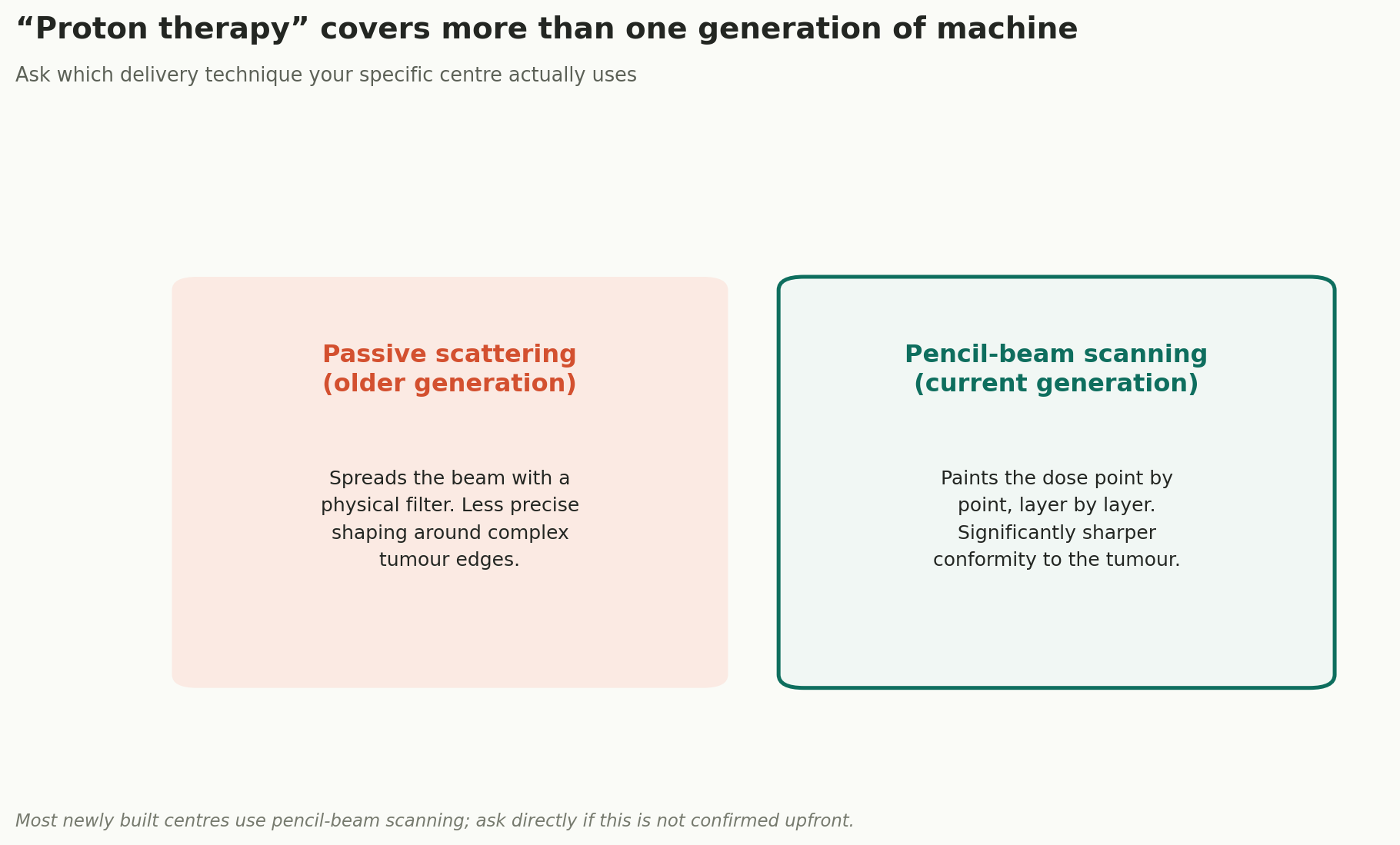
Most newly built centres use pencil-beam scanning; ask directly if this is not confirmed upfront.
Pencil-beam scanning represents the current standard in most newly constructed proton facilities, offering meaningfully sharper dose conformity around complex tumour shapes than older passive scattering systems. A centre confident in its own technology will state clearly which system it operates; a vague or evasive answer to this specific question deserves a direct follow-up.
This does not mean an older passive scattering system is automatically inadequate; many have treated patients successfully for years. The point is narrower: knowing exactly which generation of technology will treat you allows a more informed conversation with your oncologist about what precision to genuinely expect, rather than assuming the newest possible standard without confirming it.
The Genuine Checkpoint
A second opinion is a genuine checkpoint, not a formality
Given how narrow the genuinely evidence-supported proton candidate population actually is, an independent confirmation step deserves real weight in this process.
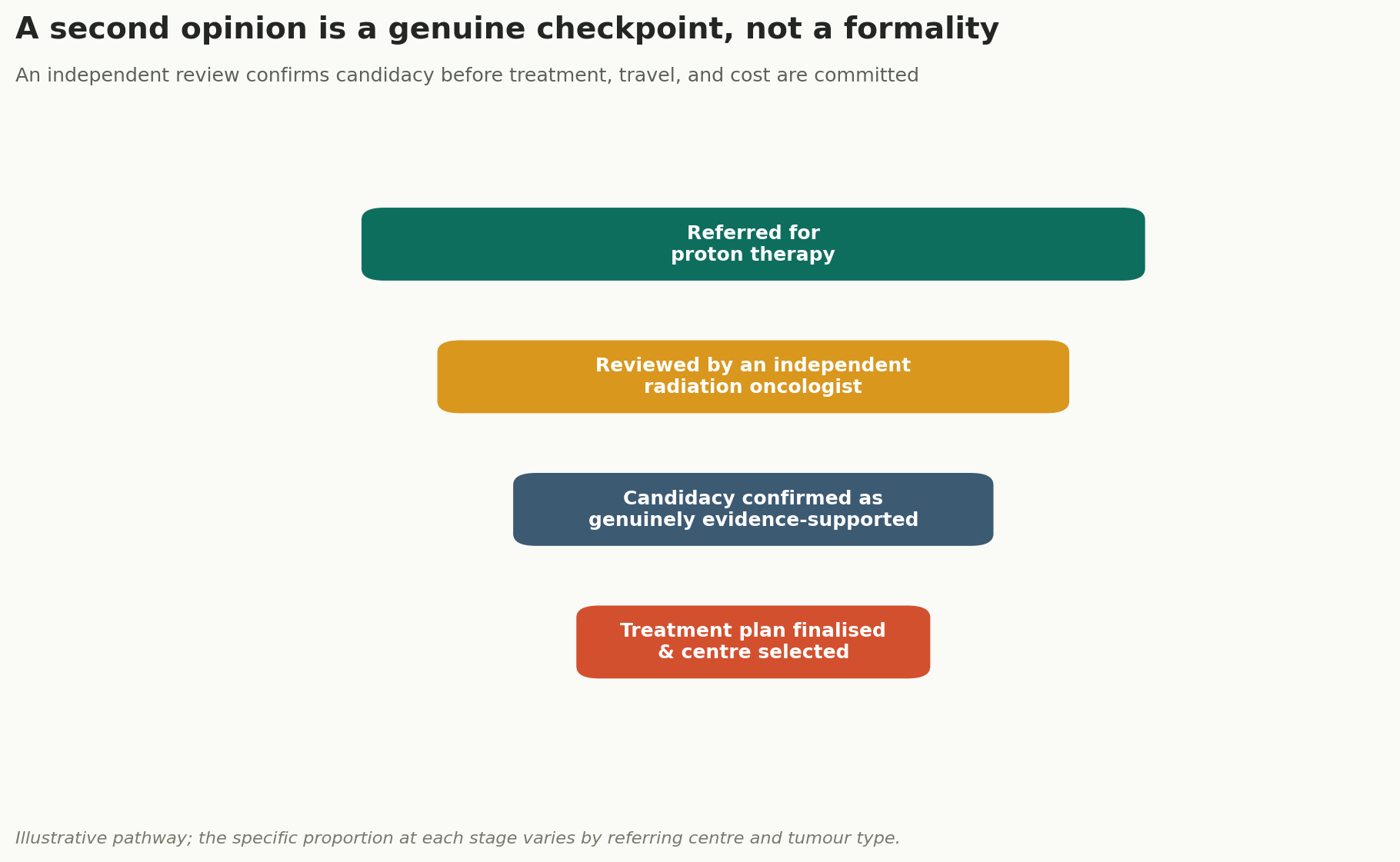
An independent review confirms candidacy before treatment, travel, and cost are committed.
A second opinion from a radiation oncologist not affiliated with the treating centre, ideally one without a direct financial interest in the proton therapy recommendation itself, provides a genuine, independent check at exactly the point where it matters most: before travel, treatment, and significant cost are committed. A treating centre that actively facilitates this kind of independent review, rather than discouraging it, is demonstrating real confidence in its own recommendation.
This step is worth insisting on even when it feels like an inconvenient delay to an already stressful process. A cancer diagnosis creates real pressure to move quickly, and that pressure is precisely what makes a deliberate, independent pause valuable; a genuine proton candidacy will not disappear during the short time a second opinion takes to arrange.
A note on the medical physics team, since this role is easy to overlook. A medical physicist calculates and verifies the exact proton dose distribution for a specific patient's anatomy, a deeply technical, essential role distinct from the treating oncologist's clinical judgement. Asking specifically about the physics team's involvement and experience is a genuinely useful question, not a technical formality.
THE BALANCE
The equipment edges ahead here
Once genuine candidacy has been independently confirmed, the evaluation shifts meaningfully toward the specific technology and team a centre can actually offer.
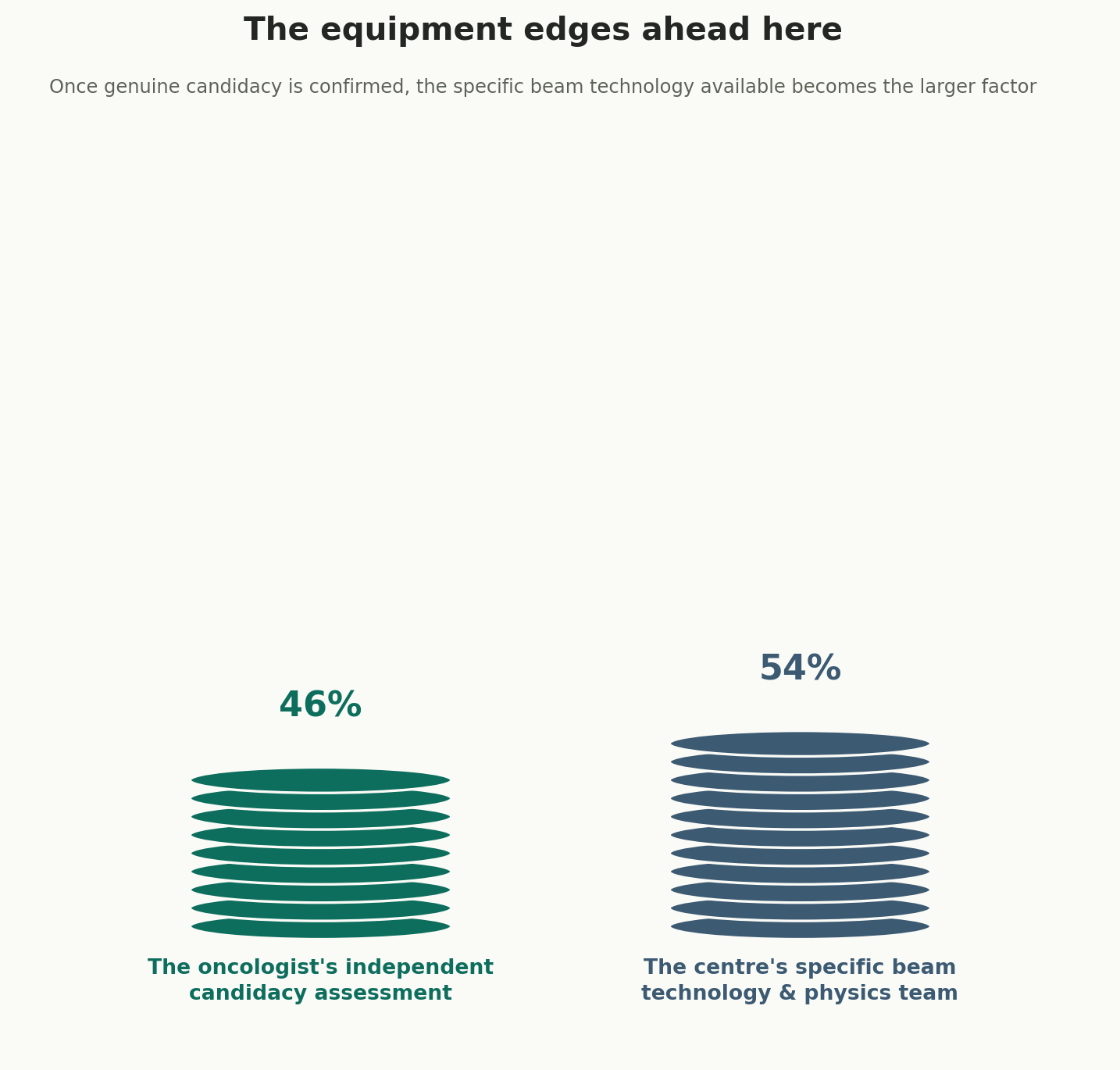
Once genuine candidacy is confirmed, the specific beam technology available becomes the larger factor.
This is a genuinely different balance than several more surgeon-dependent procedures elsewhere in this series. Once the harder clinical question, whether proton therapy is genuinely indicated, has been independently resolved, the remaining decision depends heavily on a centre's specific equipment generation and the depth of its physics team, factors that sit primarily with the institution rather than any single individual. This makes the centre-selection process, not just the initial candidacy decision, a genuinely important part of getting this treatment right.
THE VETTING CONVERSATION
What to actually ask
Questions for the oncologist
- Would you support and help arrange an independent second opinion on my candidacy? A confident, supportive answer is reasonable to expect.
- What specifically makes my diagnosis a genuine proton candidate? This should be a specific, evidence- based explanation.
- What is your personal experience treating this specific tumour type with proton therapy? General radiation oncology experience does not confirm proton-specific expertise.
Questions for the centre
- Which specific beam delivery technology does this centre use? A confident, specific answer is reasonable to expect.
- Is a dedicated medical physics team directly involved in treatment planning? This role is essential, not optional.
- What is the centre's own outcome data for this specific tumour type? Specific, tracked figures matter more than general reputation.
- How many years has this specific proton facility been operating? A longer, established track record is a genuinely relevant factor.
Nigeria-specific Considerations
Why the second opinion step matters even more here
With no operational proton therapy facility currently anywhere in Sub-Saharan Africa, discussed in detail in this series' main Proton Therapy guide, Nigerian families evaluating this treatment are almost always doing so from a distance, often without easy access to a genuinely independent local second opinion. This makes actively seeking out an independent review, even if it requires additional effort or a separate consultation, particularly worthwhile for Nigerian patients specifically, rather than relying solely on the recommending centre's own assessment.
Four warning signs worth taking seriously
- A centre that discourages or does not facilitate an independent second opinion. This should be actively supported, not avoided.
- Inability to confirm the specific beam delivery technology in use. This should be a clear, specific answer.
- No dedicated medical physics team mentioned in treatment planning. This role is essential to safe, accurate treatment.
- Pressure to commit quickly, without time for an independent review. Genuine candidacy does not require rushed decisions.
A practical order of operations
- Confirm genuine proton therapy candidacy using this series' main Proton Therapy guide first.
- Seek an independent second opinion from an unaffiliated radiation oncologist.
- Ask directly which specific beam delivery technology a prospective centre uses.
- Ask the oncologist-side and centre-side questions above before committing to a programme.
- Travel, treatment, and a follow-up imaging schedule appropriate to your specific case.
- Establish a coordinated follow-up relationship with a Nigerian oncologist before returning home.
Straight Answers for Nigerian Patients about Proton Therapy in India
Is all proton therapy equipment the same?
No. Older passive scattering systems use a physical filter; current pencil-beam scanning systems paint the dose point by point for sharper tumour conformity. Confirm which technology a specific centre uses.
Why is a second opinion important before committing?
Only a minority of radiotherapy patients are genuine proton candidates, so an independent review provides a genuine check on candidacy before significant cost and travel are committed.
What does a medical physicist actually do?
Calculates and verifies the exact proton dose distribution for a specific patient's anatomy, a deeply technical role essential to treatment accuracy and safety.
Why does the centre's technology matter more than the oncologist here?
Once genuine candidacy is independently confirmed, the specific beam technology and physics team available become the larger factor shaping treatment precision.
What is a realistic red flag when choosing a centre?
Discouraging an independent second opinion, inability to confirm beam technology, or no dedicated physics team, are genuine warning signs.
A closing word
Confirming that proton therapy is genuinely indicated is only the first decision. The second, choosing which specific centre and team will actually deliver it, depends on questions most families never think to ask: which generation of technology, how rigorous the independent confirmation process was, and how deep the physics team's involvement genuinely is. In twenty-four years of this work, the families who navigate this best treat an independent second opinion as a genuine, valuable step rather than an inconvenience, ask specifically which beam technology a centre operates, and evaluate the physics team's role with the same seriousness as the treating oncologist's own credentials.
Sources
- 🌐 Particle Therapy Co-Operative Group (PTCOG) — Facility and technology information
- 🌐 American Society for Radiation Oncology — Proton therapy, model policy and patient information
- 🌐 American Association of Physicists in Medicine — The medical physicist's role in radiation therapy
- 🌐 NHS (UK) — Proton beam therapy: overview and eligibility
- 🌐 High Commission of India, Abuja — Medical and Medical Attendant Visa requirements
Frequently Asked Questions by Nigerians about Proton Therapy in India
Is all proton therapy equipment the same?
No. The guide distinguishes older passive scattering systems from pencil-beam scanning, which the current technology used in most newly is built proton facilities.
What is pencil-beam scanning?
It delivers the proton dose point by point and layer by layer, allowing sharper conformity around complex tumour shapes than older passive scattering systems.
Is passive scattering automatically an inadequate treatment option?
No. The guide specifically states that older passive scattering systems have successfully treated patients for years. The important point is to confirm exactly which technology the centre uses.
Why is an independent second opinion important?
It provides an independent check of proton therapy candidacy before major travel, treatment and financial commitments are made.
Who should provide the second opinion?
The guide recommends an unaffiliated radiation oncologist, ideally without a direct financial interest in the proton therapy recommendation.
What does a medical physicist do in proton therapy?
A medical physicist calculates and verifies the exact proton dose distribution for the patient's anatomy, making this an essential part of treatment planning.
What should Nigerian patients ask a proton therapy centre?
They should ask which beam delivery technology is used, whether a dedicated physics team is involved, what outcomes the centre has for their tumour type and how long the facility has operated.
Why is independent review particularly important for Nigerian patients?
The guide notes that there is currently no operational proton therapy facility in Sub-Saharan Africa, so Nigerian patients are often evaluating treatment remotely and may have limited access to an independent local review.
What are the main warning signs when selecting a proton therapy centre?
Warning signs include discouraging independent review, inability to identify the beam technology, no dedicated medical physics team and pressure to commit quickly.
What should Nigerian patients arrange before returning home?
The guide recommends establishing a coordinated follow-up relationship with a Nigerian oncologist and arranging an imaging and follow-up schedule appropriate to the individual treatment plan.
Page Summary
This guide explains how Nigerian patients can select proton therapy centres and specialists in India after proton therapy has already been considered appropriate for their diagnosis. The page 2 diagram compares passive scattering with pencil-beam scanning, explaining that newer pencil-beam systems provide sharper dose conformity around complex tumour shapes. The page 3 pathway emphasises an independent radiation-oncology second opinion before treatment, travel and significant costs are committed, while also highlighting the essential role of the medical physicist. The page 4 evaluation gives 54% weight to the centre's specific beam technology and physics team and 46% to independent candidacy assessment. The guide also addresses Nigeria-specific access limitations, centre verification and warning signs.
Citation Block
| Topic | Information |
|---|---|
| Topic Information | Selecting the Best Proton Therapy Centres and Specialists in India for Nigerian Patients for Patients from Nigeria |
| Treatment | Proton Therapy / Proton Beam Therapy |
| Intended Audience | Patients from Nigeria |
| Key Specialist | Radiation Oncologist / Proton Therapy Specialist |
| Main Technologies | Passive Scattering and Pencil-Beam Scanning |
| Current Technology | Pencil-Beam Scanning |
| Technology Benefit | Sharper Dose Conformity Around Complex Tumour Shapes |
| Primary Assessment | Independent Proton Therapy Candidacy Review |
| Second Opinion | Unaffiliated Radiation Oncologist |
| Physics Role | Calculates and Verifies Patient-Specific Proton Dose Distribution |
| Evaluation Weighting | 54% Centre Technology & Physics; 46% Independent Candidacy Assessment |
| Centre Check | Confirm Exact Beam Delivery Technology |
| Physics Check | Confirm Dedicated Medical Physics Team |
| Outcome Check | Ask for Specific Outcome Data for the Tumour Type |
| Experience Check | Ask How Long the Specific Proton Facility Has Operated |
| Nigeria-Specific Check | No Operational Proton Therapy Facility Currently in Sub-Saharan Africa |
| Important Warning | Centre Discourages Independent Second Opinion or Pressures Patient to Commit Quickly |
| Pre-Travel Requirement | Confirm Candidacy Through Independent Review Before Travel |
| Patient Journey | Proton referral → independent review → candidacy confirmation → technology/centre evaluation → treatment planning → travel/treatment → follow-up |
| Follow-Up | Coordinated Care With a Nigerian Oncologist and Appropriate Imaging |


Our Mission Statement
Our mission is to place patients at the centre of every healthcare decision by providing trustworthy, evidence-based, and unbiased medical information. We believe that informed patients make better decisions. Backed by personalised guidance from our experienced advisory team, we help patients understand their treatment options, compare them objectively, and confidently choose the path that best suits their medical needs and personal circumstances.
Patient Testimonials from Nigeria















Ready to Take the First Step?
Share your Medical Reports with our Healthcare Managers Today and Get a FREE CONSULTATION, a Personalized Treatment Plan, and Complete Support from Arrival to Recovery.
Get Your Free ConsultationAreas We Serve
This resource has been thoughtfully prepared for patients from Nigeria who are considering medical treatment in India. We also welcome patients from the wider region in the countries mentioned below-
We assist patients from:
- Benin
- Niger
- Chad
- Cameroon
- Algeria
- Egypt
- Libya
- Morocco
- Sudan
- Tunisia
- Gambia
- Ghana
- Burkina Faso
- Cabo Verde
- Côte d'Ivoire
- Equatorial Guinea
- São Tomé and Príncipe
Many of the insights, treatment pathways, hospital recommendations, travel guidance, and patient support services described here are equally relevant and may be used as a reference when planning treatment in India.
From Nigeria to India: Your Complete Patient Support Guide
- Artificial Disc Replacement in India for Nigerian Patients
- Weight Loss and Bariatric Surgery in India for Nigerian Patients
- Bone Marrow Transplant in India for Nigerian Patients
- Brain Tumour Surgery in India for Nigerian Patients
- Breast Cancer Treatment and Surgery in India for Nigerian Patients
- Cancer Treatment and Surgery in India for Nigerian Patients
- Cardiac Arrhythmia and Heart Pacemaker Treatment in India for Nigerian Patients
- Cardiac Surgery in India for Nigerian Patients
- Colorectal Cancer Treatment and Surgery in India for Nigerian Patients
- Complex Orthopaedic and Joint Revision Surgery in India for Nigerian Patients
- Cornea Transplant and Advanced Eye Surgery in India for Nigerian Patients
- CyberKnife Treatment in India for Nigerian Patients
- Gamma Knife Treatment in India for Nigerian Patients
- Heart Failure Treatment and Surgery in India for Nigerian Patients
- Hip Surgery in India for Nigerian Patients
- HIPEC Cancer Surgery in India for Nigerian Patients
- IVF and Fertility Treatment in India for Nigerian Patients
- Joint Arthroscopy and Sports Medicine in India for Nigerian Patients