

Selecting the Best Plastic and Reconstructive Surgeons in India for Nigerian Patients
For most reconstructive cases, the honest answer to "how many operations will this take" is more than one, and knowing that upfront changes the whole conversation.
Reconstructive surgery restores form or function lost to injury, disease, or a congenital condition, work genuinely different from elective cosmetic enhancement of healthy anatomy. What many patients are not told clearly upfront is that much reconstructive work is deliberately planned across multiple stages, sometimes spanning a year or more, rather than completed in a single operation. Understanding this from the outset shapes realistic expectations about timeline, cost, and what a genuinely complete outcome actually requires. This guide covers the wide range of conditions this specialty addresses, from post-cancer reconstruction and traumatic injury repair to congenital anomaly correction, focusing on the two factors that most shape a genuinely successful outcome: honest, complete staging from the outset, and continuity of care across the full journey.
Should you even be reading this guide? If reconstructive surgery has genuinely been discussed following injury, disease treatment, or a congenital diagnosis, this guide will help you evaluate the surgeon and treatment plan. A full assessment of what specific reconstruction is needed remains the appropriate starting point if this has not yet happened.
Healing Journeys of Nigerian Patients









Key Takeaways
- The guide's central message is that reconstructive surgery is often a planned series of operations rather than a single procedure. Understanding the complete journey upfront helps families plan realistically.
- The page 2 timeline illustrates a typical staged pattern: initial reconstruction, tissue expansion or refinement, followed by later revision and fine-tuning. The exact timing varies according to the type and extent of reconstruction.
- The guide clearly distinguishes reconstructive surgery from cosmetic surgery. Reconstruction restores form or function lost because of injury, disease or a congenital condition, while cosmetic surgery focuses on elective enhancement of healthy anatomy.
- Many reconstructive journeys may span six months to more than a year, because tissues need time to heal or expand before another stage can safely proceed.
- The guide stresses that a surgeon should provide a complete staged plan from the first consultation, rather than explaining only the next operation.
- The page 3 budgeting section warns that a quoted price for “the surgery” may cover only the first stage. Nigerian patients should request a complete estimate covering all planned stages.
- The page 4 evaluation gives 57% weight to the surgeon's staging plan and technique and 43% to the hospital's continuity of care across stages.
- For Nigerian patients, staged reconstruction may require multiple trips to India, making travel, accommodation, recovery time and follow-up planning important from the beginning.
- Patients should ask whether the same surgical team can remain involved across stages, as continuity can help maintain a coherent treatment plan.
- Four warning signs include no full staged plan, a single operation presented as the complete solution when more stages are likely, no complete cost estimate and no clear continuity-of-care plan.
Quick Facts
- Treatment
- Plastic and Reconstructive Surgery
- Country
- India
- Patients
- Patients from Nigeria
- Key Specialist
- Plastic and Reconstructive Surgeon
- Main Purpose
- Restore Form or Function Lost to Injury, Disease or Congenital Conditions
- Treatment Pattern
- Often Multi-Stage
- Typical Stages
- Initial Reconstruction → Tissue Expansion/Refinement → Revision and Fine-Tuning
- Overall Timeline
- Often 6 Months to More Than 1 Year
- Evaluation Weighting
- 57% Surgeon; 43% Hospital
- Surgeon Check
- Complete Staged Plan and Relevant Reconstruction Experience
- Hospital Check
- Continuity of Care Across Stages
- Cost Check
- Full Estimate Covering Every Planned Stage
- Travel Check
- Plan for Multiple Trips Where Required
- Follow-Up
- Nigerian Physician Between International Visits
- Important Warning
- Do Not Treat the First Operation as the Entire Treatment Plan
- Pre-Travel
- Complete Assessment of the Reconstruction Required
- Visa
- Indian Medical Visa and Medical Attendant Visa
- Author
- Dr. Dheeraj Bojwani
- Experience
- 24+ Years
In Brief
For Nigerian patients considering reconstructive surgery in India, the guide recommends looking beyond the first operation and asking for a complete staged treatment plan from beginning to end. Patients should understand how many stages may be required, the expected interval between procedures, the full estimated cost and how care will continue between international visits. The surgeon's ability to plan the complete reconstruction is given greater weight than hospital continuity, while Nigerian patients are also advised to establish a local physician relationship for care between stages.
START HERE
Reconstruction is usually a series, not a single operation
Understanding this upfront changes how a family should think about both the timeline and the full cost of treatment.
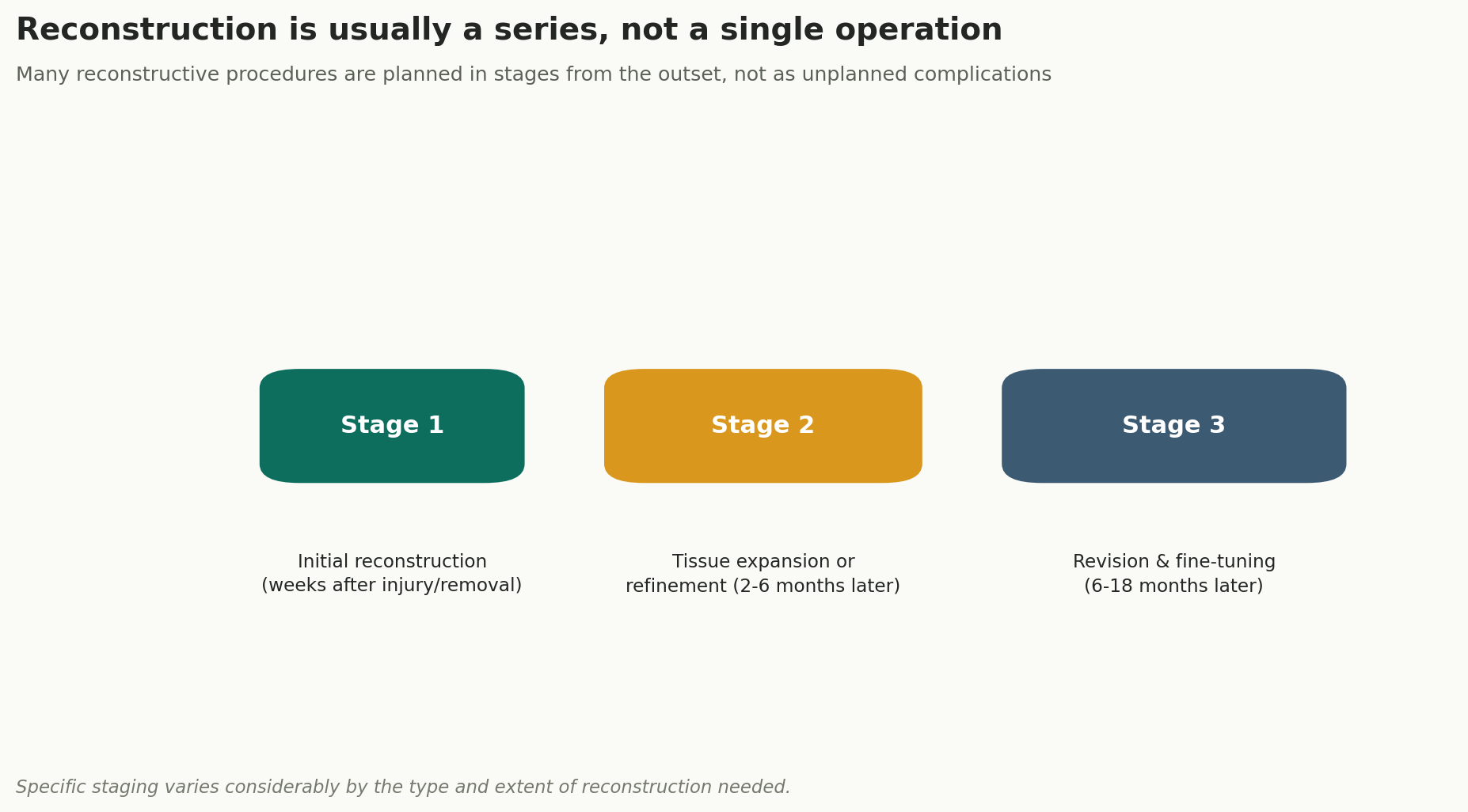
Specific staging varies considerably by the type and extent of reconstruction needed.
This staged approach is a deliberate surgical strategy, not evidence that an earlier operation went wrong. Tissue often needs time to heal, or to be gradually expanded, before a subsequent stage can safely proceed. A surgeon who presents a realistic, full staged plan from the very first consultation, rather than describing only the next immediate operation, is offering genuinely complete information.
Patients and families understandably want to know when the process will feel finished, and a surgeon who can articulate a clear endpoint, even while acknowledging some flexibility along the way, is providing a genuinely useful framework for a journey that can otherwise feel open-ended and difficult to plan around.
A Distinction Worth Understanding
Both fall under "plastic surgery," but the goals genuinely differ
This distinction shapes what a realistic outcome, and a realistic timeline, actually looks like for your specific situation.
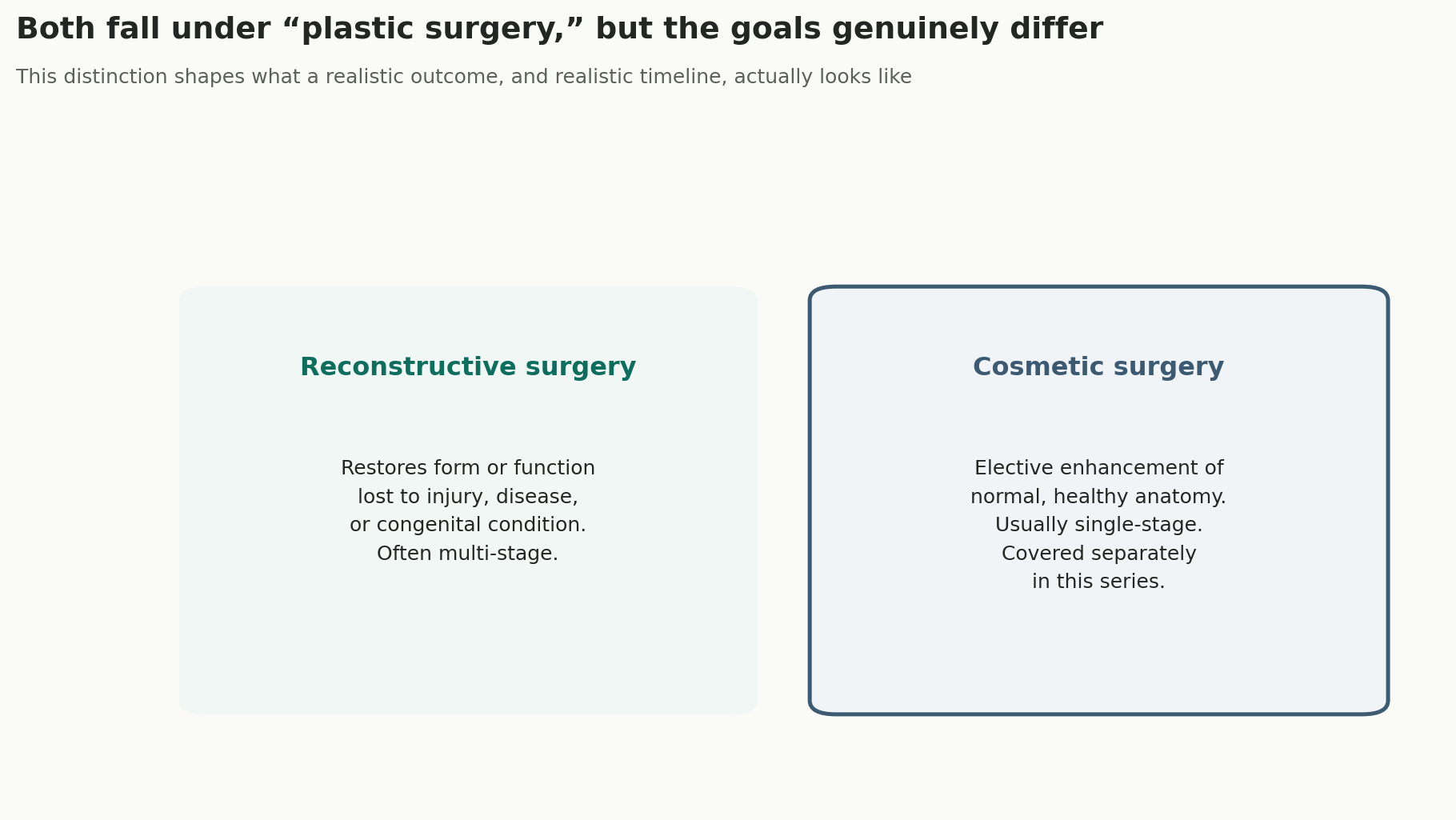
This distinction shapes what a realistic outcome, and realistic timeline, actually looks like.
A qualified reconstructive surgeon has typically completed specific training beyond general cosmetic practice, with genuine experience managing the complex, staged planning this work requires. This series' dedicated Cosmetic and Aesthetic Surgery guide covers the separate considerations relevant to purely elective procedures.
It is worth noting that some reconstructive journeys genuinely conclude with a final stage that has a cosmetic, refinement-focused element, fine-tuning symmetry or appearance once function has been restored. This is a normal, appropriate part of comprehensive reconstructive care, not a departure from its core purpose, and should be discussed as part of the overall staged plan.
A note on budgeting realistically for a multi-stage journey. A quoted price for "the surgery" sometimes reflects only the first stage of a longer plan. Ask directly for a full cost estimate covering every planned stage, not just the initial procedure, to avoid an incomplete picture of the true financial commitment.
THE BALANCE
A staged journey needs a surgeon who plans it fully
Given how much a multi-stage outcome depends on coherent planning from the very first operation, this evaluation weights toward the surgeon.
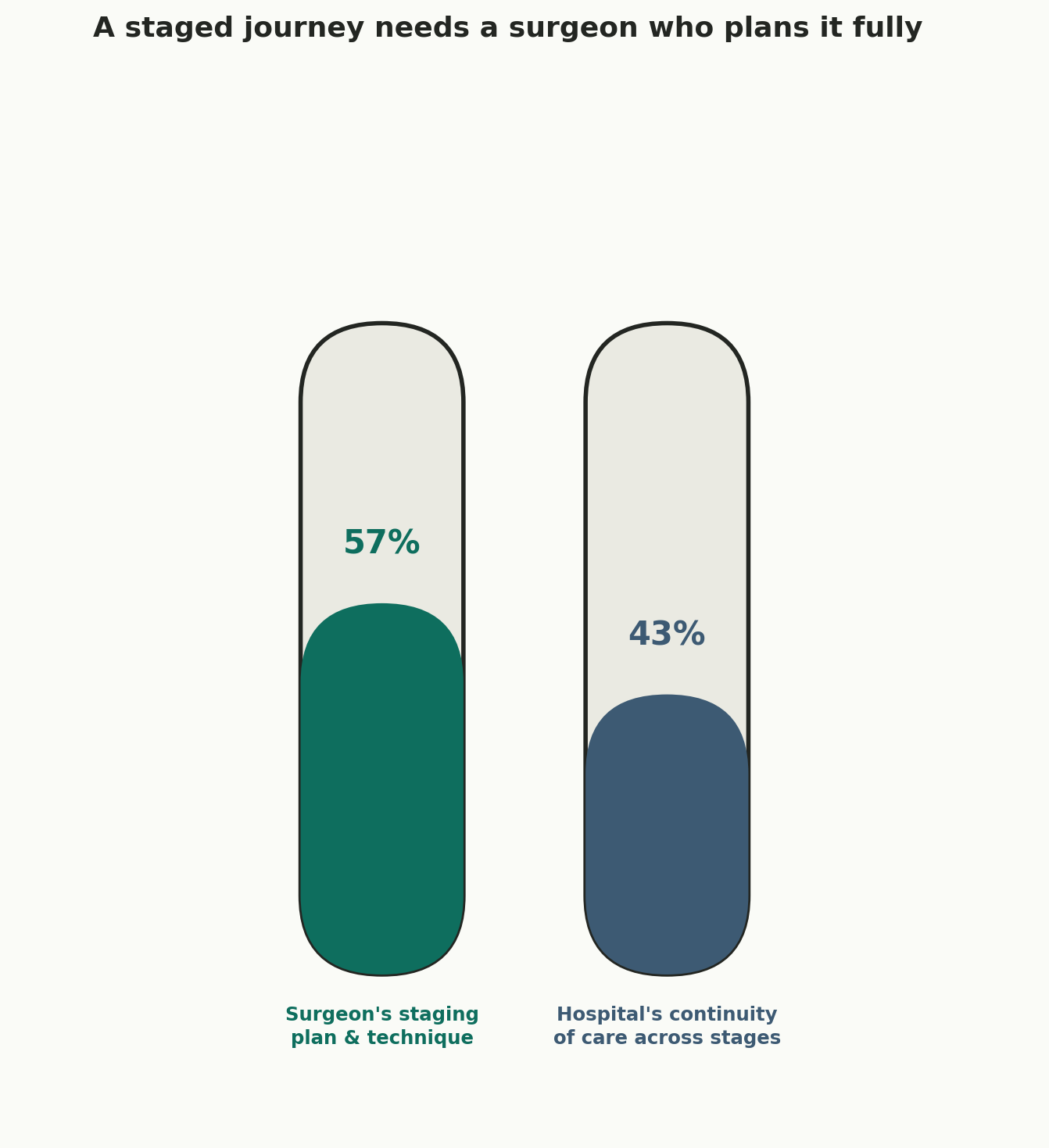
Coherent multi-stage planning depends primarily on the treating surgeon's overall approach.
The hospital's ability to provide continuity of care across multiple stages, ideally with the same surgical team throughout, remains a genuinely important factor. But the overall staging strategy, and how well each operation is designed to build toward the final outcome, is primarily the treating surgeon's responsibility. This weighting reflects how much a genuinely successful multi-stage outcome depends on one consistent, well- considered plan carried through from beginning to end.
THE VETTING CONVERSATION
What to actually ask
Questions for the surgeon
- What is the full staged plan, from start to finish, for my specific case? This should be a complete, realistic picture, not just the next step.
- What is your specific training and experience with this type of reconstruction? A confident, specific answer suggests genuine expertise.
- What is the realistic timeline between each stage? This should be a clear, specific estimate.
- What happens if a stage does not go as planned? This should be a clear, honest explanation.
Questions for the hospital
- Will the same surgical team be involved across every stage? Continuity genuinely matters for a coherent outcome.
- What is the full cost estimate covering every planned stage? This should be complete, not just the first procedure.
- What support exists between stages, during the healing or expansion period? This should be a clear, structured plan.
- What is the hospital's own outcome data for this specific type of reconstruction? Specific, tracked figures matter more than general reputation.
Nigeria-specific Considerations
Why planning multiple trips matters from the outset
For Nigerian patients travelling internationally for staged reconstruction, understanding the full multi-trip nature of treatment from the beginning is essential practical planning, not a detail to discover partway through. Budgeting realistically for multiple journeys, and confirming a genuine, coordinated plan for how each stage will be scheduled, protects against the disruption of an incomplete understanding of what the full journey actually requires.
Four warning signs worth taking seriously
- No full staged plan presented from the first consultation. This should be a complete picture, not revealed stage by stage.
- A single operation presented as a complete solution when more is likely needed. This should be addressed honestly upfront.
- No complete cost estimate covering every planned stage. This should be transparent from the outset.
- No clear plan for continuity of care across multiple stages. This should be a coordinated, consistent approach.
A practical order of operations
- Get a full assessment of what specific reconstruction is genuinely needed.
- Ask for the complete staged plan, from start to finish, not just the first operation.
- Ask the surgeon-side and hospital-side questions above before committing to treatment.
- Get a full, itemised cost estimate covering every planned stage.
- Plan realistically for multiple trips, with time between stages for healing.
- Establish a Nigerian physician relationship for care between international visits.
Straight Answers for Nigerian Patients about Plastic and Reconstructive Surgery in India
Is reconstructive surgery the same as cosmetic surgery?
No. Reconstructive surgery restores form or function lost to injury, disease, or a congenital condition, often in multiple stages. Cosmetic surgery is elective enhancement, usually single-stage.
Why does reconstruction often need multiple operations?
Many procedures are deliberately planned in stages, allowing tissue to heal or expand between operations, rather than attempting everything at once.
How long does a full reconstructive journey take?
This varies considerably, but many staged reconstructions span six months to over a year from the initial procedure to final revision.
Why does the surgeon matter more than the hospital here?
A multi-stage reconstruction requires a coherent plan designed from the outset, with each stage building on the last, primarily the surgeon's responsibility.
What is a realistic red flag when choosing a provider?
No full staged plan presented upfront, a single operation framed as complete when more is likely needed, or no full cost estimate, are genuine warning signs.
A closing word
Reconstructive surgery asks a family to commit not to a single procedure, but to a journey, often spanning many months and multiple operations. A surgeon who presents this journey fully and honestly from the very first consultation, rather than revealing it stage by stage, is offering the kind of complete, respectful information this decision genuinely deserves. In twenty-four years of this work, the patients who navigate this best ask for the complete staged plan at the outset, budget realistically for the full journey rather than just the first operation, and choose continuity of surgical team across every stage where genuinely possible.
Sources
- 🌐 American Society of Plastic Surgeons — Reconstructive surgery, patient information
- 🌐 British Association of Plastic, Reconstructive and Aesthetic Surgeons — Understanding staged reconstruction
- 🌐 American Board of Plastic Surgery — Verifying reconstructive surgery credentials
- 🌐 NHS (UK) — Reconstructive surgery: overview – nhs.uk
- 🌐 High Commission of India, Abuja — Medical and Medical Attendant Visa requirements
Frequently Asked Questions by Nigerians about Plastic and Reconstructive Surgery in India
Is reconstructive surgery usually completed in one operation?
Not always. The guide explains that many reconstructive procedures are deliberately planned in stages, allowing tissues to heal or expand before the next procedure.
Why can reconstructive surgery require multiple operations?
Staging may allow tissue healing, gradual expansion or later refinement, making it a planned part of treatment rather than evidence that an earlier operation failed.
How long can a complete reconstructive journey take?
The guide states that many staged reconstructions may take six months to more than a year, although the actual timeline depends on the patient's condition and reconstruction required.
Is reconstructive surgery the same as cosmetic surgery?
No. Reconstructive surgery aims to restore form or function lost through injury, disease or congenital conditions, while cosmetic surgery is elective enhancement of normal anatomy.
What should Nigerian patients ask the reconstructive surgeon first?
They should request a complete staged plan from start to finish, including the expected number of stages, timing between procedures and what the final treatment goal is.
Should the full treatment cost be discussed before travelling to India?
Yes. The guide recommends asking for a full cost estimate covering every planned stage, rather than relying on a quotation that covers only the initial operation.
Why is continuity of the surgical team important?
A consistent team can help maintain a coherent treatment strategy across multiple stages, particularly when each procedure is designed to build toward the final outcome.
Will Nigerian patients need to travel to India more than once?
They may. Because staged reconstruction can require healing periods between procedures, patients should understand the possibility of multiple international trips before committing to treatment.
What should patients do between reconstructive stages?
The guide recommends establishing a Nigerian physician relationship so that appropriate care and monitoring can continue between visits to India.
What are the main warning signs when choosing a reconstructive surgeon or hospital?
Warning signs include no complete staged plan, presenting one operation as the entire treatment when more may be required, no full cost estimate and no clear continuity-of-care plan.
Page Summary
This guide explains how Nigerian patients can select plastic and reconstructive surgeons and hospitals in India, with its central focus on understanding reconstruction as a potentially multi-stage journey. The page 2 diagram illustrates a typical sequence from initial reconstruction to tissue expansion or refinement and later revision, while emphasising that staging is often a deliberate surgical strategy rather than a sign that an earlier operation failed. The page 3 comparison distinguishes reconstructive surgery from cosmetic surgery and highlights the importance of budgeting for every planned stage. The page 4 evaluation gives 57% weight to the surgeon's staging plan and technique and 43% to the hospital's continuity of care across stages. The guide also highlights the need for multiple-trip planning and local medical support between stages for Nigerian patients.
Citation Block
| Topic | Information |
|---|---|
| Topic Information | Selecting the Best Plastic and Reconstructive Surgeons in India for Nigerian Patients for Patients from Nigeria |
| Treatment | Plastic and Reconstructive Surgery |
| Intended Audience | Patients from Nigeria |
| Key Specialist | Plastic and Reconstructive Surgeon |
| Main Purpose | Restoration of Form or Function Lost to Injury, Disease or Congenital Condition |
| Treatment Pattern | Often Planned in Multiple Stages |
| Typical Stages | Initial Reconstruction → Tissue Expansion/Refinement → Revision and Fine-Tuning |
| Typical Timeline | Six Months to More Than One Year in Many Staged Reconstructions |
| Evaluation Weighting | 57% Surgeon; 43% Hospital |
| Surgeon Check | Confirm Complete Staged Plan From Start to Finish |
| Experience Check | Confirm Specific Training and Experience With the Required Reconstruction |
| Timeline Check | Ask for Realistic Timing Between Each Stage |
| Cost Check | Obtain Full Estimate Covering Every Planned Stage |
| Hospital Check | Confirm Continuity of Care Across Multiple Stages |
| Team Check | Ask Whether the Same Surgical Team Can Remain Involved |
| Travel Check | Plan for Multiple Trips and Healing Periods Between Stages |
| Important Warning | A Single Operation Presented as the Complete Solution When More Stages May Be Required |
| Pre-Travel Requirement | Full Assessment of the Specific Reconstruction Needed |
| Patient Journey | Assessment → complete staged plan → surgeon/hospital evaluation → travel and first stage → healing/further stages → final revision → follow-up |
| Follow-Up | Nigerian Physician Support Between International Visits and Long-Term Care |


Our Mission Statement
Our mission is to place patients at the centre of every healthcare decision by providing trustworthy, evidence-based, and unbiased medical information. We believe that informed patients make better decisions. Backed by personalised guidance from our experienced advisory team, we help patients understand their treatment options, compare them objectively, and confidently choose the path that best suits their medical needs and personal circumstances.
Patient Testimonials from Nigeria















Ready to Take the First Step?
Share your Medical Reports with our Healthcare Managers Today and Get a FREE CONSULTATION, a Personalized Treatment Plan, and Complete Support from Arrival to Recovery.
Get Your Free ConsultationAreas We Serve
This resource has been thoughtfully prepared for patients from Nigeria who are considering medical treatment in India. We also welcome patients from the wider region in the countries mentioned below-
We assist patients from:
- Benin
- Niger
- Chad
- Cameroon
- Algeria
- Egypt
- Libya
- Morocco
- Sudan
- Tunisia
- Gambia
- Ghana
- Burkina Faso
- Cabo Verde
- Côte d'Ivoire
- Equatorial Guinea
- São Tomé and Príncipe
Many of the insights, treatment pathways, hospital recommendations, travel guidance, and patient support services described here are equally relevant and may be used as a reference when planning treatment in India.
From Nigeria to India: Your Complete Patient Support Guide
- Artificial Disc Replacement in India for Nigerian Patients
- Weight Loss and Bariatric Surgery in India for Nigerian Patients
- Bone Marrow Transplant in India for Nigerian Patients
- Brain Tumour Surgery in India for Nigerian Patients
- Breast Cancer Treatment and Surgery in India for Nigerian Patients
- Cancer Treatment and Surgery in India for Nigerian Patients
- Cardiac Arrhythmia and Heart Pacemaker Treatment in India for Nigerian Patients
- Cardiac Surgery in India for Nigerian Patients
- Colorectal Cancer Treatment and Surgery in India for Nigerian Patients
- Complex Orthopaedic and Joint Revision Surgery in India for Nigerian Patients
- Cornea Transplant and Advanced Eye Surgery in India for Nigerian Patients
- CyberKnife Treatment in India for Nigerian Patients
- Gamma Knife Treatment in India for Nigerian Patients
- Heart Failure Treatment and Surgery in India for Nigerian Patients
- Hip Surgery in India for Nigerian Patients
- HIPEC Cancer Surgery in India for Nigerian Patients
- IVF and Fertility Treatment in India for Nigerian Patients
- Joint Arthroscopy and Sports Medicine in India for Nigerian Patients