

Selecting the Best Parkinson's DBS Surgeons and Hospitals in India for Nigerian Patients
Most people picture DBS as brain surgery performed while fully awake. That is still true for many patients, but it is no longer the only genuine option.
Deep brain stimulation for Parkinson's disease has traditionally been performed with the patient awake, off medication, responding to questions while surgeons use electrode recordings to precisely locate the target. A newer approach, performed entirely under general anaesthesia using MRI-based targeting, has emerged as a genuine, evidence-based alternative. This is an active area of ongoing clinical research, not a settled question, and understanding both approaches honestly matters more than assuming one is simply the modern replacement for the other. This guide sets out that specific, current tradeoff, why candidacy screening matters more than the technique choice itself, and the practical planning DBS requires well beyond the day of surgery.
Should you even be reading this guide? If DBS has genuinely been discussed and confirmed as appropriate following thorough candidacy screening, this guide will help you evaluate the treatment team and hospital. If that screening has not yet happened, it remains the essential first step.
Healing Journeys of Nigerian Patients









Key Takeaways
- The guide's central message is that careful DBS candidacy screening matters more than simply choosing between awake and asleep surgery. DBS is not appropriate for every patient with Parkinson's disease.
- Awake DBS uses local anaesthesia, physiological/electrode recordings and patient responses during surgery, while asleep DBS uses general anaesthesia and MRI-based targeting.
- The page 2 comparison explains that neither approach is universally superior. The appropriate choice depends on the patient's tolerance, clinical situation and the centre's specific experience.
- Meta-analyses published in 2024 and 2025 found no significant difference in core motor outcomes between awake and asleep DBS.
- The page 3 chart shows an advantage for awake DBS on the specific measure of reduction in treatment-related side effects off medication: 78.4% for awake DBS versus 59.7% for asleep DBS in the cited analysis.
- The same analysis indicates that asleep DBS may have a lower overall complication rate, making the choice a genuine clinical trade-off rather than a simple “old versus new” decision.
- The page 4 evaluation gives 62% weight to the neurology/neurosurgery team's candidacy screening and targeting and 38% to the hospital's imaging and intraoperative monitoring capability.
- Nigerian patients should ensure that a dedicated movement disorders neurologist is involved, alongside the neurosurgeon, because medication response, symptom pattern and cognitive status are central to candidacy.
- DBS requires ongoing device programming and adjustment over months and years. The guide therefore recommends establishing a realistic programming and follow-up plan in Nigeria before travelling.
- Four warning signs include inadequate candidacy screening, no clear reasoning for awake versus asleep DBS, no dedicated movement disorders neurologist and no plan for ongoing device programming after returning to Nigeria.
Quick Facts
- Treatment
- Deep Brain Stimulation (DBS) for Parkinson’s Disease
- Country
- India
- Patients
- Patients from Nigeria
- Key Specialists
- Movement Disorders Neurologist and Neurosurgeon
- Main Treatment Options
- Awake DBS and Asleep DBS
- Awake DBS
- Local Anaesthesia With Physiological Target Confirmation
- Asleep DBS
- General Anaesthesia With MRI-Based Targeting
- Core Motor Outcomes
- No Significant Difference in Cited 2024–2025 Meta-Analyses
- Side-Effect Measure
- 78.4% Awake DBS vs 59.7% Asleep DBS in the Cited Analysis
- Evaluation Weighting
- 62% Treatment Team; 38% Hospital
- Primary Assessment
- Thorough DBS Candidacy Screening
- Candidacy Factors
- Symptom Pattern, Medication Responsiveness and Cognitive Status
- Team Check
- Dedicated Movement Disorders Neurologist
- Technique Check
- Confirm Why Awake or Asleep DBS Is Recommended
- Hospital Check
- MRI and Intraoperative Monitoring Capability
- Programming Check
- Establish Long-Term Device Programming Plan
- Nigeria Check
- Coordinate Follow-Up Before Travel
- Important Warning
- No Documented Candidacy Screening or Programming Plan
- Pre-Travel Records
- Parkinson’s Diagnosis, Medication History, Imaging and Relevant Neurological Records
- Visa
- Indian Medical Visa and Medical Attendant Visa
- Follow-Up
- Ongoing DBS Programming and Movement-Disorder Care in Nigeria
- Author
- Dr. Dheeraj Bojwani
- Experience
- 24+ Years
In Brief
For Nigerian patients considering DBS for Parkinson’s disease in India, the guide recommends focusing first on whether the patient is genuinely an appropriate DBS candidate, followed by an individualised discussion about awake versus asleep surgery. Patients should ensure that a movement disorders neurologist and neurosurgeon are both involved, ask about the team's specific experience with the proposed technique, and verify the hospital's MRI and intraoperative monitoring capabilities. Because DBS programming continues long after surgery, a realistic plan for ongoing adjustment and follow-up in Nigeria should be established before travel.
START HERE
Both approaches are genuine, current options
Understanding this distinction is worth doing before assuming either approach is automatically the right one.
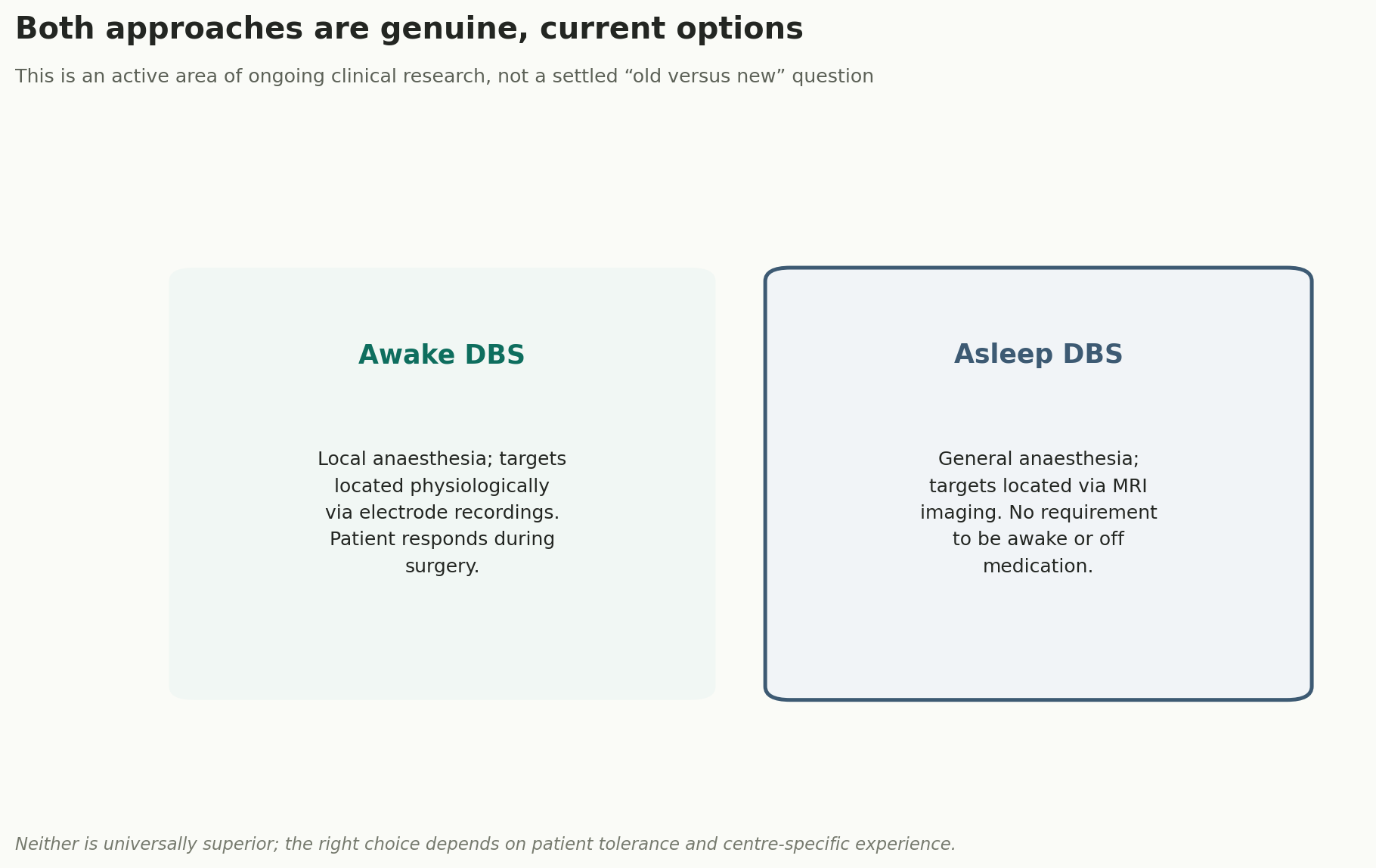
Neither is universally superior; the right choice depends on patient tolerance and centre-specific experience.
Multiple comprehensive meta-analyses published in 2024 and 2025 found no significant difference in core motor outcomes between the two techniques. This is a genuinely reassuring, well-established finding: choosing asleep DBS because being awake during brain surgery feels intolerable is not a compromise on the core benefit most patients are seeking.
This equivalence in core outcomes is a genuinely important, relatively recent development in the field. For years, awake DBS with physiological confirmation was widely treated as the unquestioned reference standard, and patients who could not tolerate the awake experience had few well-supported alternatives. The current evidence base gives those patients a genuine, equally effective option.
The Honest Tradeoff
Awake DBS shows a real edge on one specific measure
Genuine equivalence in core outcomes does not mean the two approaches are identical in every respect.
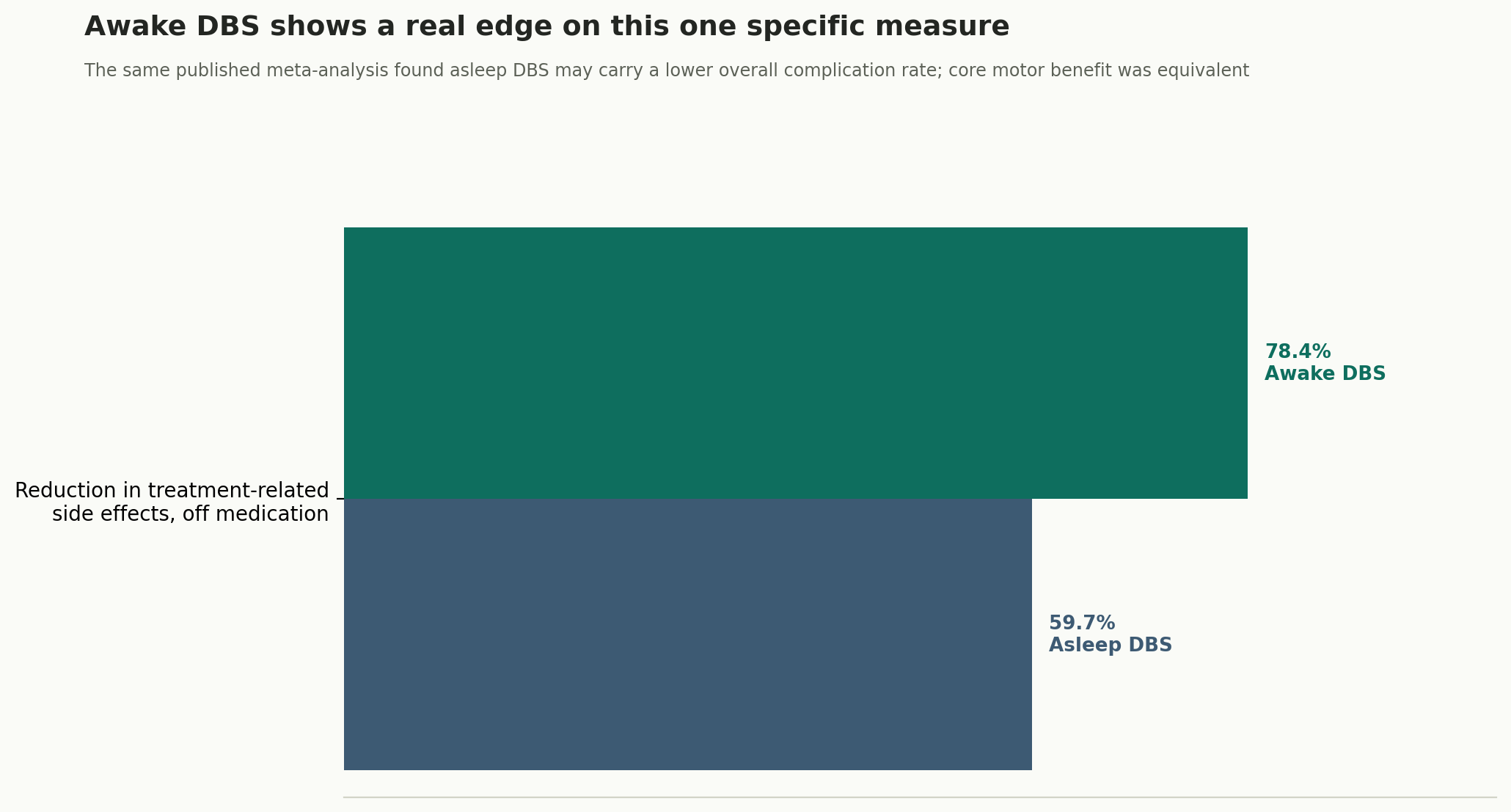
The same published meta-analysis found asleep DBS may carry a lower overall complication rate; core motor benefit was equivalent.
This is a genuine, specific tradeoff worth discussing directly with your treatment team: awake DBS's real-time physiological feedback may better reduce certain treatment-related side effects, while asleep DBS's more controlled surgical environment may carry a lower overall complication rate in some published research. Neither factor should be assumed to dominate for every patient; the right choice depends on your own priorities and tolerance.
A treatment team genuinely engaging with this nuance, rather than presenting one technique as simply correct, is demonstrating exactly the kind of evidence-based, individualised thinking this decision deserves. This is not a topic with a single right answer; it is a conversation worth having thoroughly before surgery, not a box to check quickly on the way to the operating theatre.
A note on why candidacy screening matters more than either technique. DBS is not appropriate for every Parkinson's patient. Careful, thorough screening, assessing symptom pattern, medication responsiveness, and cognitive status, is widely regarded as the single most important factor in DBS success, more consequential than the choice between awake and asleep technique.
THE BALANCE
Getting the candidate right matters most
Given how much DBS success depends on accurate candidacy screening and precise targeting, this evaluation weights meaningfully toward the treatment team.
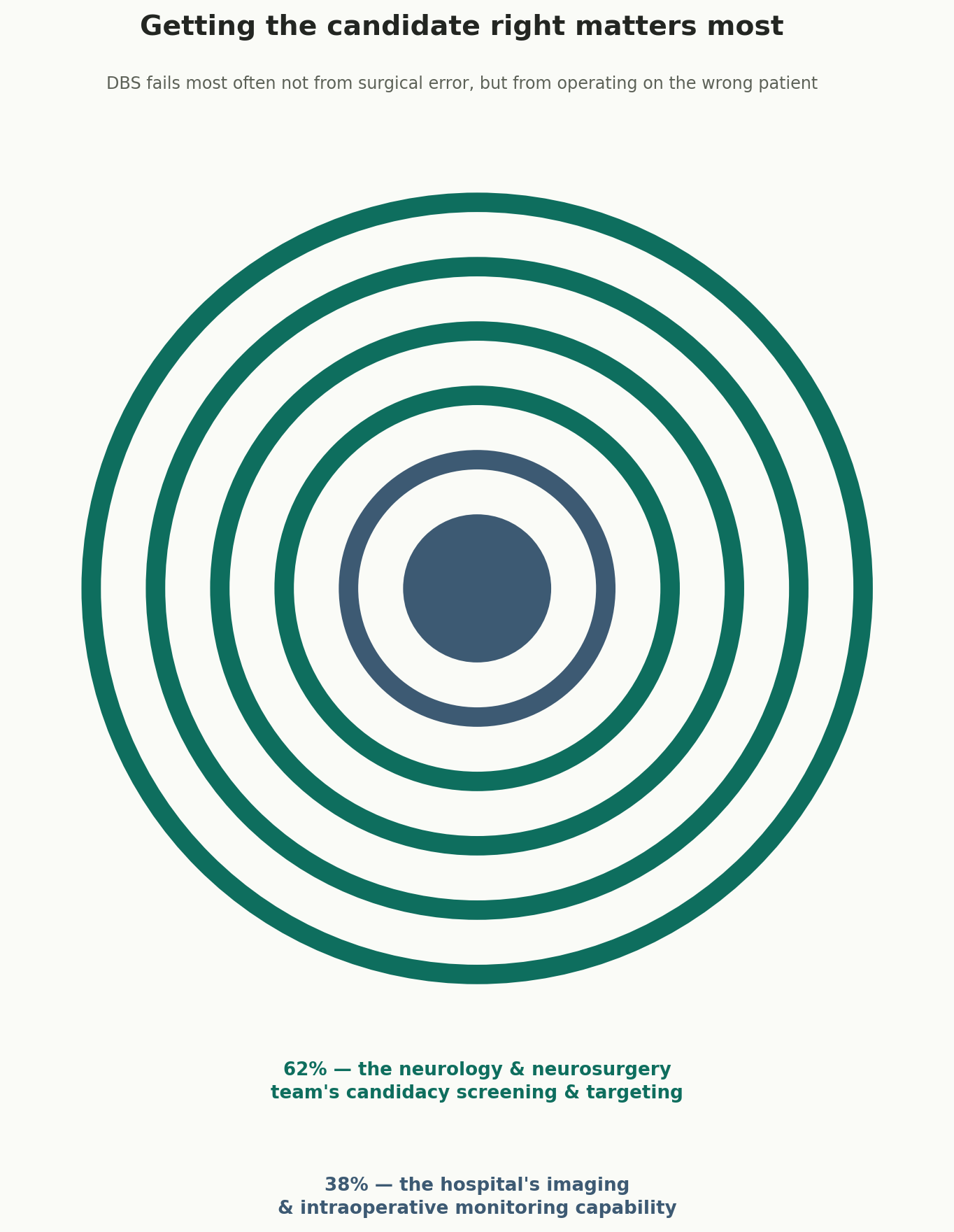
DBS fails most often not from surgical error, but from operating on the wrong patient.
The hospital's imaging and intraoperative monitoring capability remain genuinely important, particularly for asleep DBS, which depends heavily on precise MRI-based targeting infrastructure. But the clinical judgement involved in screening candidates and confirming the target during surgery, whichever technique is used, sits primarily with the treatment team, giving them the larger relative share of this evaluation. This weighting reflects a pattern seen elsewhere in this series for procedures where careful upfront clinical judgement shapes outcomes more decisively than the operation itself.
THE VETTING CONVERSATION
What to actually ask
Questions for the treatment team
- What specific screening process confirmed I am a genuine DBS candidate? This should be a thorough, documented process, not a brief assessment.
- Do you recommend awake or asleep technique for my case, and why? A thoughtful answer engages with your specific situation and preferences.
- Is a dedicated movement disorders neurologist involved in my care, not just a neurosurgeon? Both specialties should be genuinely involved.
- What is your team's specific experience with the technique being proposed? A confident, specific answer suggests genuine, tracked experience.
Questions for the hospital
- What imaging and intraoperative monitoring capability supports this procedure? This should be a specific, verifiable answer.
- What is the hospital's own outcome data for DBS specifically? Specific, tracked figures matter more than general reputation.
- What is the plan for programming and adjusting the device after surgery? This is an ongoing, essential part of DBS care.
- What is the plan for long-term follow-up once I return to Nigeria? This should be coordinated before you travel.
NIGERIA-SPECIFIC CONSIDERATIONS
Why device programming needs a real plan
DBS is not a single event; the implanted device requires ongoing programming and adjustment over months and years to optimise symptom control, a process that continues well beyond the initial surgery and travel. With DBS programming expertise remaining genuinely limited within Nigeria, establishing a clear, realistic plan for how this ongoing adjustment will happen, whether through periodic travel back to the treating centre, remote programming support, or training a Nigerian specialist, is a genuinely important part of this decision, not a detail to resolve after surgery.
Four warning signs worth taking seriously
- No thorough, documented candidacy screening process. This should be a genuine, multi-step assessment, not a brief consultation.
- No clear reasoning for recommending awake versus asleep technique. This should reflect your specific case and preferences.
- No dedicated movement disorders neurologist involved in care. This specialty role is essential alongside the neurosurgeon.
- No clear plan for ongoing device programming after you return home. This should be resolved before you travel.
A practical order of operations
- Complete thorough candidacy screening with a movement disorders neurologist first.
- Discuss awake versus asleep technique honestly, understanding the real tradeoffs for your case.
- Ask the team-side and hospital-side questions above before committing to a programme.
- Confirm a realistic plan for ongoing device programming before you travel.
- Travel, surgery, and initial device activation and programming.
- Establish a coordinated long-term relationship for ongoing adjustment and follow-up.
Straight Answers for Nigerian Patients about Parkinson's Treatment and DBS Surgery in India
Is awake DBS better than asleep DBS?
Neither is universally superior. Meta-analyses found no significant difference in core motor outcomes; awake DBS showed a real edge in reducing certain side effects, while asleep DBS may carry a lower overall complication rate.
Why would someone choose asleep DBS?
It removes the requirement to be awake and off medication during a multi-hour procedure, a genuine consideration for patients unable to tolerate the traditional awake approach.
What matters most for DBS success?
Careful candidacy screening. DBS is not appropriate for every Parkinson's patient, and selecting genuinely suitable candidates matters more than which specific technique is used.
Why is this weighted toward the treatment team?
DBS outcomes depend heavily on accurate candidacy screening and precise targeting, both clinical judgement calls, giving the team a larger relative share than the hospital's equipment alone.
What is a realistic red flag when choosing a provider?
No thorough candidacy screening, no clear reasoning for the recommended technique, or no plan for ongoing device programming, are genuine warning signs.
A closing word
The awake-versus-asleep question, while genuinely interesting and worth discussing, is not the decision that determines whether DBS succeeds. That decision was made earlier, in the thoroughness of the screening process that confirmed you are a genuine candidate in the first place, and it continues afterward, in the ongoing programming that shapes how well the device actually controls your symptoms. In twenty-four years of this work, the families who navigate this best insist on thorough, documented candidacy screening, discuss the awake-versus-asleep choice as a genuine, individualised decision, and arrange a realistic long-term plan for device programming before ever booking travel. The surgery is a single day. The programming that follows shapes years.
Sources
- 🌐 Asleep versus awake deep brain stimulation in the treatment of Parkinson disease: a systematic review and meta-analysis
- 🌐 Awake versus asleep deep brain stimulation for Parkinson's disease: a comprehensive systematic review and meta-analysis
- 🌐 Awake versus asleep deep brain stimulation for Parkinson's disease: a critical comparison and meta-analysis. PubMed
- 🌐 Parkinson's Foundation — Deep brain stimulation, patient information
- 🌐 High Commission of India, Abuja — Medical and Medical Attendant Visa requirements
Frequently Asked Questions by Nigerians about Parkinson's Treatment and DBS Surgery in India
Is DBS suitable for every patient with Parkinson’s disease?
No. The guide emphasises that careful candidacy screening is the most important step, including assessment of symptom pattern, medication responsiveness and cognitive status.
What is the difference between awake and asleep DBS?
Awake DBS is performed with local anaesthesia and physiological/electrode recordings while the patient responds during surgery. Asleep DBS uses general anaesthesia with MRI-based targeting.
Is awake DBS better than asleep DBS?
Not universally. The guide states that 2024–2025 meta-analyses found no significant difference in core motor outcomes, although the techniques differ in other measures.
Why might a patient choose asleep DBS?
It allows the patient to remain under general anaesthesia rather than being awake and off medication during the procedure, which can be important for patients who find the traditional approach difficult to tolerate.
Does awake DBS have any specific advantage?
The cited analysis showed a higher percentage for reduction in treatment-related side effects off medication: 78.4% for awake DBS versus 59.7% for asleep DBS. The guide presents this as one specific advantage, not proof that awake DBS is better overall.
Why is a movement disorders neurologist important?
DBS candidacy depends on more than surgical anatomy. A movement disorders neurologist evaluates symptom pattern, medication response and cognitive status and should be genuinely involved alongside the neurosurgeon.
What should Nigerian patients ask before choosing awake or asleep DBS?
They should ask why the recommended technique suits their specific condition, what experience the team has with that approach and how the hospital's imaging and monitoring systems support the procedure.
Why is DBS programming important after surgery?
The implanted device requires ongoing programming and adjustment over months and years to optimise symptom control. Surgery is therefore only one part of the treatment journey.
How should Nigerian patients plan DBS follow-up after returning home?
The guide recommends arranging a realistic plan before travelling, which may involve periodic travel to the treating centre, remote programming support or training and coordination with a Nigerian specialist.
What are the main warning signs when choosing a DBS programme?
Warning signs include no thorough candidacy screening, no clear reasoning for awake versus asleep DBS, no dedicated movement disorders neurologist and no plan for ongoing device programming after returning to Nigeria.
Page Summary
This guide explains how Nigerian patients can select Parkinson’s DBS surgeons and hospitals in India, with its central focus on careful candidacy screening and the individualised choice between awake and asleep DBS. The page 2 comparison shows that awake DBS uses physiological feedback while the patient is awake, whereas asleep DBS uses general anaesthesia and MRI-based targeting, with neither approach universally superior. The page 3 chart reports 78.4% versus 59.7% for awake and asleep DBS respectively on the cited reduction-in-treatment-related-side-effects measure, while also noting that asleep DBS may have a lower overall complication rate. The page 4 evaluation gives 62% weight to the neurology/neurosurgery team's candidacy screening and targeting and 38% to hospital imaging and intraoperative monitoring. The guide also emphasises movement-disorders expertise and a long-term programming plan after returning to Nigeria.
Citation Block
| Topic | Information |
|---|---|
| Topic Information | Selecting the Best Parkinson’s DBS Surgeons and Hospitals in India for Patients from Nigeria |
| Treatment | Deep Brain Stimulation (DBS) |
| Intended Audience | Patients from Nigeria |
| Key Specialists | Movement Disorders Neurologist and Neurosurgeon |
| Main Treatment Options | Awake DBS and Asleep DBS |
| Awake DBS | Local Anaesthesia With Physiological / Electrode-Based Target Confirmation |
| Asleep DBS | General Anaesthesia With MRI-Based Targeting |
| Core Motor Outcomes | No Significant Difference in Cited 2024–2025 Meta-Analyses |
| Side-Effect Measure | 78.4% Awake DBS vs 59.7% Asleep DBS in the Cited Analysis |
| Technique Trade-Off | Awake DBS Shows an Advantage on the Cited Side-Effect Measure; Asleep DBS May Have a Lower Overall Complication Rate |
| Evaluation Weighting | 62% Treatment Team; 38% Hospital |
| Primary Assessment | Thorough DBS Candidacy Screening |
| Candidacy Factors | Symptom Pattern, Medication Responsiveness and Cognitive Status |
| Team Check | Confirm Dedicated Movement Disorders Neurologist Involvement |
| Technique Check | Ask Why Awake or Asleep DBS Is Recommended for the Specific Patient |
| Experience Check | Confirm Team Experience With the Proposed DBS Technique |
| Hospital Check | Verify MRI-Based Targeting and Intraoperative Monitoring Capability |
| Programming Check | Confirm a Long-Term Device Programming and Adjustment Plan |
| Nigeria-Specific Check | Establish Follow-Up With a Nigerian Specialist Before Travel |
| Important Warning | No Thorough Candidacy Screening, Technique Rationale or Long-Term Programming Plan |
| Pre-Travel Requirement | Complete DBS Screening and Confirm Appropriate Candidacy |
| Patient Journey | DBS screening → awake/asleep discussion → team and hospital evaluation → travel/surgery → initial programming → long-term follow-up and adjustment |
| Follow-Up | Ongoing DBS Programming and Coordinated Movement-Disorder Care in Nigeria |


Our Mission Statement
Our mission is to place patients at the centre of every healthcare decision by providing trustworthy, evidence-based, and unbiased medical information. We believe that informed patients make better decisions. Backed by personalised guidance from our experienced advisory team, we help patients understand their treatment options, compare them objectively, and confidently choose the path that best suits their medical needs and personal circumstances.
Patient Testimonials from Nigeria















Ready to Take the First Step?
Share your Medical Reports with our Healthcare Managers Today and Get a FREE CONSULTATION, a Personalized Treatment Plan, and Complete Support from Arrival to Recovery.
Get Your Free ConsultationAreas We Serve
This resource has been thoughtfully prepared for patients from Nigeria who are considering medical treatment in India. We also welcome patients from the wider region in the countries mentioned below-
We assist patients from:
- Benin
- Niger
- Chad
- Cameroon
- Algeria
- Egypt
- Libya
- Morocco
- Sudan
- Tunisia
- Gambia
- Ghana
- Burkina Faso
- Cabo Verde
- Côte d'Ivoire
- Equatorial Guinea
- São Tomé and Príncipe
Many of the insights, treatment pathways, hospital recommendations, travel guidance, and patient support services described here are equally relevant and may be used as a reference when planning treatment in India.
From Nigeria to India: Your Complete Patient Support Guide
- Artificial Disc Replacement in India for Nigerian Patients
- Weight Loss and Bariatric Surgery in India for Nigerian Patients
- Bone Marrow Transplant in India for Nigerian Patients
- Brain Tumour Surgery in India for Nigerian Patients
- Breast Cancer Treatment and Surgery in India for Nigerian Patients
- Cancer Treatment and Surgery in India for Nigerian Patients
- Cardiac Arrhythmia and Heart Pacemaker Treatment in India for Nigerian Patients
- Cardiac Surgery in India for Nigerian Patients
- Colorectal Cancer Treatment and Surgery in India for Nigerian Patients
- Complex Orthopaedic and Joint Revision Surgery in India for Nigerian Patients
- Cornea Transplant and Advanced Eye Surgery in India for Nigerian Patients
- CyberKnife Treatment in India for Nigerian Patients
- Gamma Knife Treatment in India for Nigerian Patients
- Heart Failure Treatment and Surgery in India for Nigerian Patients
- Hip Surgery in India for Nigerian Patients
- HIPEC Cancer Surgery in India for Nigerian Patients
- IVF and Fertility Treatment in India for Nigerian Patients
- Joint Arthroscopy and Sports Medicine in India for Nigerian Patients