

Selecting the Best Paediatric Orthopaedic Surgeons and Hospitals in India for Nigerian Patients
A child's skeleton is not a small version of an adult's. It is still growing, and that single fact changes almost everything about how this decision should be made.
Every long bone in a child's body has a growth plate, an area of active growth near each end, that closes only once skeletal maturity is reached. This is the single fact that separates paediatric orthopaedic surgery from its adult equivalent most sharply. A technique that would be entirely appropriate in an adult can, near a child's growth plate, cause growth arrest or a deformity that only becomes visible years later, as the rest of the limb continues to grow around a portion that has stopped. Choosing a surgeon and hospital for a child means choosing people who understand they are operating on a target that is still, quite literally, moving. This guide sits alongside this series' other paediatric guides in recognising that children are not simply small adults, but the specific reason differs here: where paediatric heart surgery is shaped by urgency and paediatric neurosurgery by lifelong monitoring, paediatric orthopaedic surgery is shaped by the growth that continues for years after any operation is complete.
Should you even be reading this guide? If a paediatric orthopaedic condition has been diagnosed and surgery has genuinely been recommended, this guide will help you evaluate the surgical team and hospital, and confirm whether surgery is actually the right first step. If a condition has only just been noticed, ask first whether it is a normal developmental variant that may resolve without any treatment at all.
Healing Journeys of Nigerian Patients
Key Takeaways
- Paediatric orthopaedic surgery is fundamentally different from adult orthopaedics because a child's skeleton is still growing. Every long bone contains growth plates near its ends, and these remain active until skeletal maturity.
- This means a surgical technique that would be entirely appropriate in an adult can cause a very different long-term result in a child if it damages or interferes with a growth plate.
- The guide explains that a technical mistake involving a growth plate may not become obvious during the operation. It may only appear months or years later as the rest of the limb continues to grow, potentially producing growth arrest or deformity.
- This is one of the main reasons paediatric orthopaedics is treated as a distinct subspecialty rather than simply an extension of general adult orthopaedic practice.
- A highly experienced adult orthopaedic surgeon may still lack the specific judgement required to operate safely around active growth plates.
- Families should therefore verify the surgeon's specific paediatric orthopaedic training and experience, rather than assuming that general orthopaedic credentials are sufficient.
- Before surgery is discussed, the guide recommends asking another fundamental question: does the condition actually require treatment at all?
- Some childhood limb alignments and musculoskeletal findings are normal developmental variants and may resolve naturally as the child grows.
- More complex deformities or conditions requiring highly specialised surgery may still justify evaluation at a deeper paediatric orthopaedic programme abroad.
- The four major warning signs are: surgery recommended for a condition that often resolves naturally, no mention of Ponseti casting for clubfoot, no discussion of remaining growth or growth plates, and vague answers about paediatric-specific orthopaedic training.
Quick Facts
- Topic
- Selecting Paediatric Orthopaedic Surgeons and Hospitals
- Country
- India
- Intended Audience
- Nigerian Children, Parents and Families
- Primary Specialty
- Paediatric Orthopaedic Surgery
- Main Biological Difference From Adult Orthopaedics
- Ongoing Skeletal Growth
- Major Surgical Risk
- Growth Plate Damage
- Key Clubfoot Treatment
- Ponseti Method
- Major Clubfoot Surgery Usually First-Line?
- No
- Major Timing Principle
- Operate at the Right Stage of Growth
- Hospital Role
- Paediatric Imaging, Bone Age Assessment, Casting and Follow-Up
- Important Imaging Tool
- Bone Age Assessment
- Main Decision Principle
- Treat the Growing Skeleton, Not Just the Current X-Ray
- Author/Advisor
- Dr. Dheeraj Bojwani
- Experience
- 24 Years
In Brief
Selecting a paediatric orthopaedic surgeon in India requires Nigerian families to focus on one issue that does not exist in adult orthopaedics: the child's skeleton is still growing. Growth plate damage or poor timing can create a deformity that may only become visible years after surgery. The guide therefore gives the individual surgeon slightly greater weight than the hospital, particularly for growth plate preservation and timing decisions. It also stresses that not every childhood deformity requires surgery. Clubfoot, for example, is now commonly treated through the Ponseti method using serial casting and bracing rather than major surgery. Nigerian families should therefore verify paediatric-specific surgical training, growth planning, non-surgical alternatives and long-term follow-up before committing to an operation.
START HERE
A target that is still moving
Understanding what the growth plate actually is, and why it matters so much, changes what a family should be evaluating in any surgeon's experience.
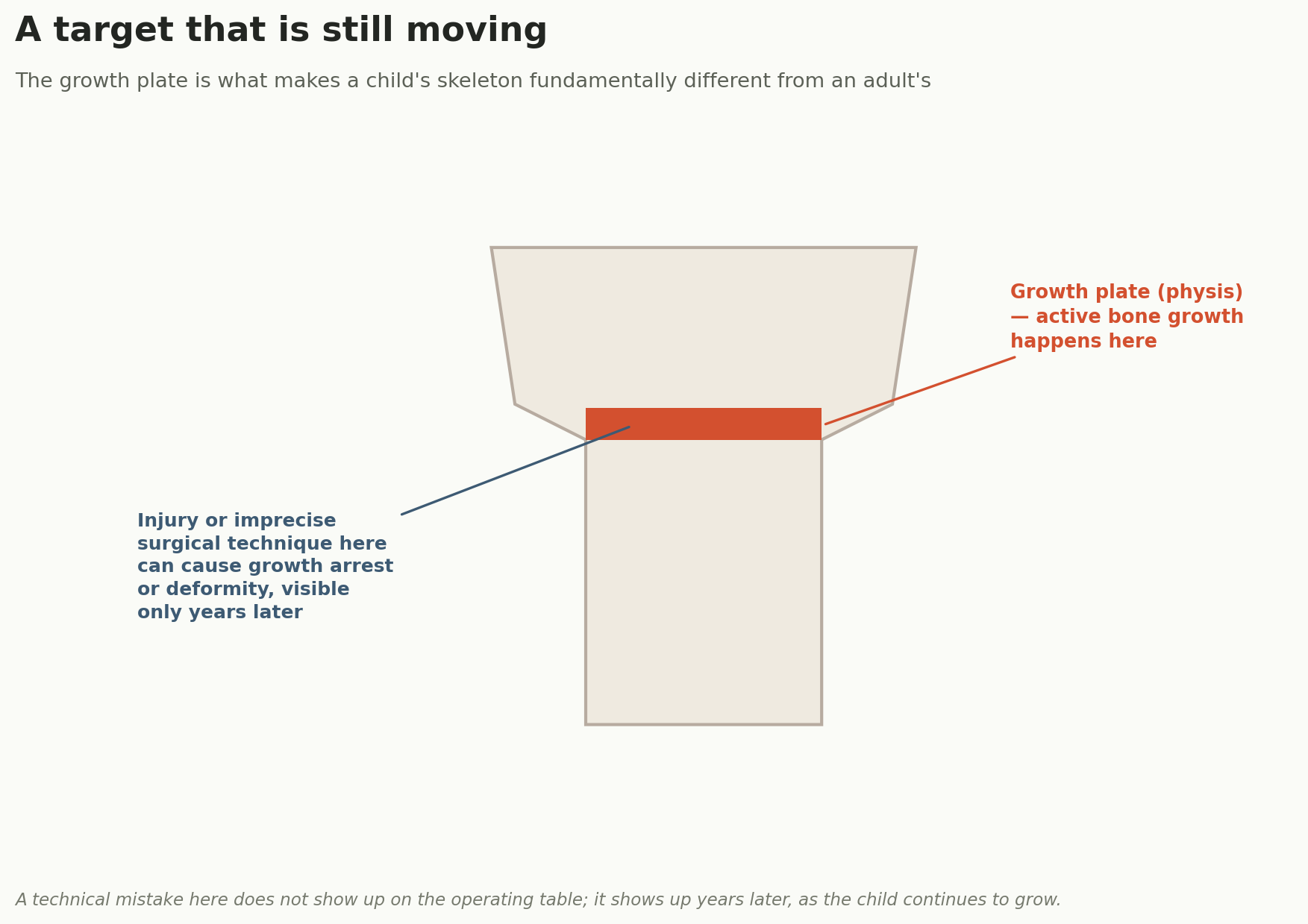
A technical mistake here does not show up on the operating table; it shows up years later, as the child continues to grow.
This is precisely why paediatric orthopaedic surgery is treated as its own distinct subspecialty, requiring specific training beyond general orthopaedic practice. A surgeon whose primary experience is with adult patients, however skilled, may not have the specific, hands-on judgement that growth plate preservation genuinely demands. General orthopaedic competence, built primarily on adult cases, does not automatically transfer to a skeleton still actively growing, and a family should confirm this specific expertise directly rather than assume it.
BEFORE SURGERY IS EVEN DISCUSSED
A question worth asking every time
Not every childhood orthopaedic finding needs treatment, and knowing the difference protects a child from unnecessary risk.
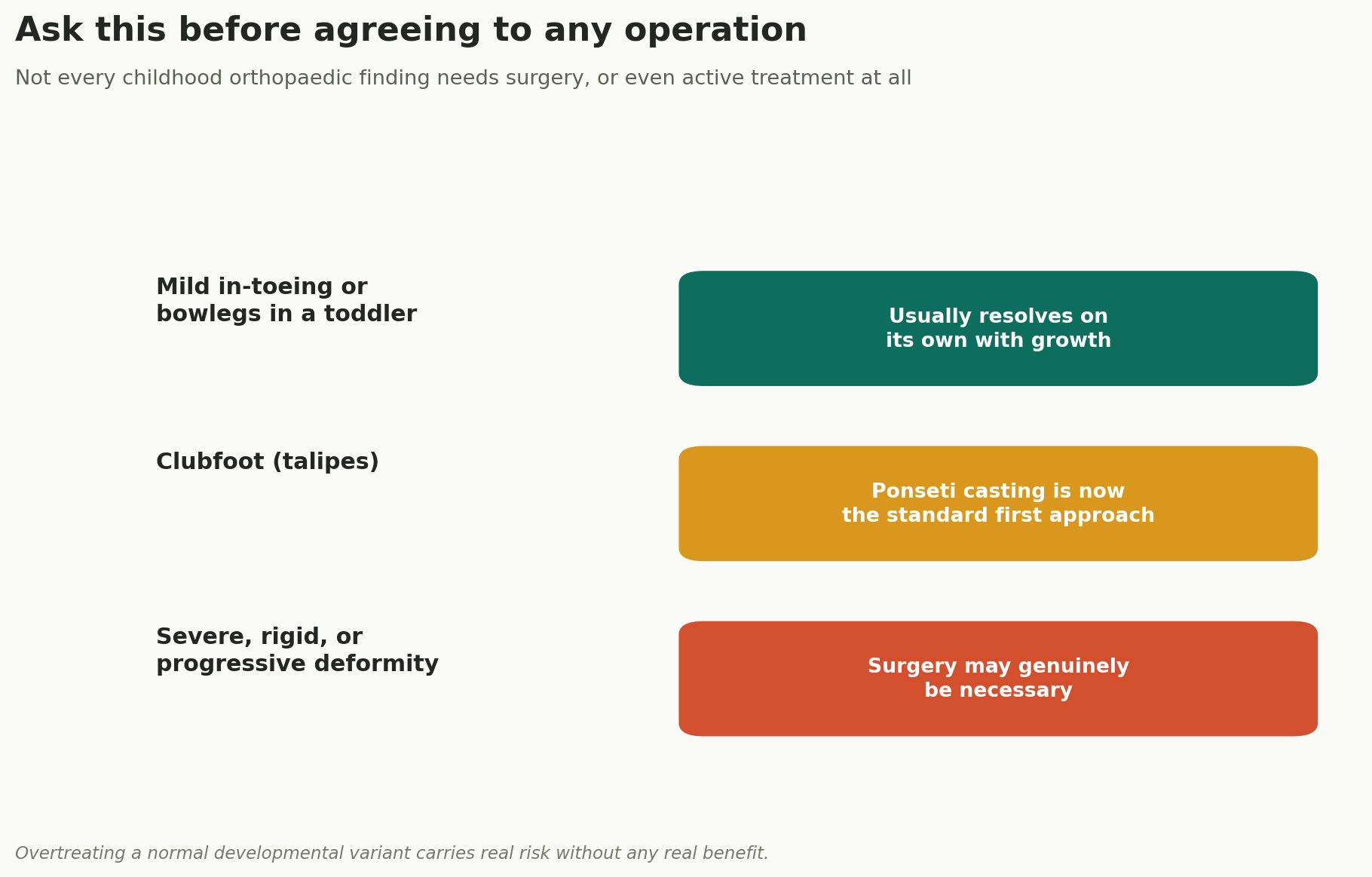
Overtreating a normal developmental variant carries real risk without any real benefit.
Clubfoot is a genuinely useful example of how far this field has moved. The Ponseti method, a careful sequence of gentle castings followed by a bracing period, now corrects most cases without major surgery, a significant shift from older approaches that relied more heavily on surgical release. A programme still defaulting to surgery as the first response to clubfoot, without offering Ponseti casting, is not reflecting current, evidence-based practice. This shift matters for how a family should approach any similarly rigid- sounding diagnosis: assume nothing about whether surgery is the necessary path until a specific, current explanation has been given.
A note on why timing relative to growth matters as much as technique. For many paediatric orthopaedic conditions, operating too early or too late, relative to how much growth remains, can produce a worse outcome than operating at the right moment. A thoughtful surgeon will discuss not just what needs to happen, but when, in the context of a specific child's remaining growth.
THE BALANCE
The surgeon's judgement tips the balance
Given how directly growth plate preservation depends on the individual surgeon's specific technique and timing decisions, this procedure weights slightly more heavily toward the surgeon than several others in this series.
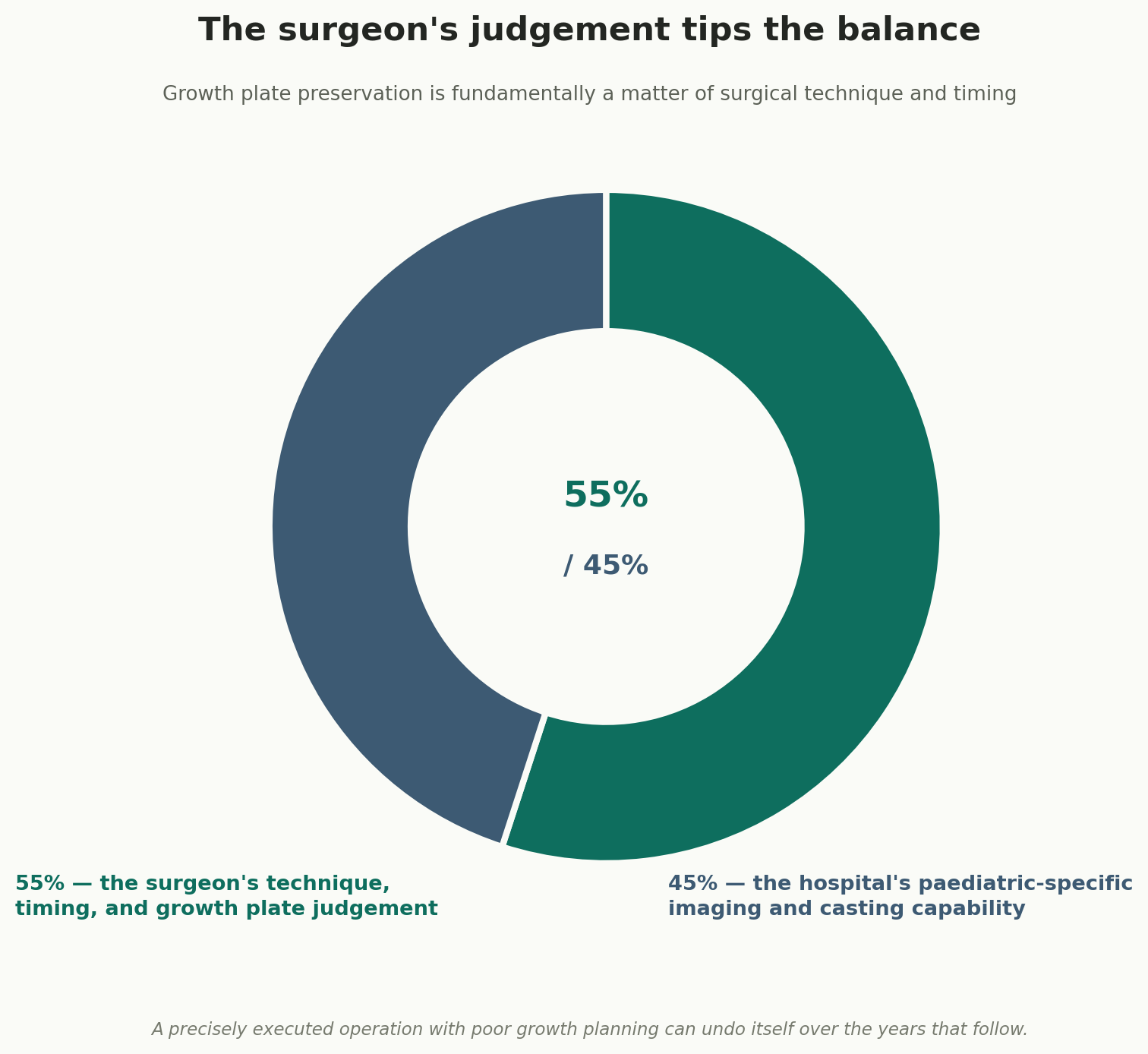
A precisely executed operation with poor growth planning can undo itself over the years that follow.
This does not diminish the hospital's role. Paediatric-specific imaging, including bone age assessment, and genuine casting expertise for non-surgical approaches like Ponseti treatment, remain real, important considerations. It reflects that the central technical judgement, how to treat this specific child's growing skeleton without compromising its future growth, sits primarily with the individual surgeon's training and experience. This is a genuinely different balance than paediatric heart surgery or hydrocephalus care elsewhere in this series, where the surrounding hospital system carries the larger share; here, the individual surgeon's specific expertise is what a family should scrutinise most closely.
THE VETTING CONVERSATION What to actually ask
Questions for the surgeon
- What is your specific paediatric orthopaedic training, beyond general orthopaedic practice? This is a genuinely distinct subspecialty worth confirming directly.
- Is surgery actually necessary here, or could this resolve with growth or non-surgical treatment? A thoughtful answer engages honestly with this question rather than defaulting to surgery.
- How does the growth plate factor into your surgical plan for this specific case? A precise, confident answer suggests genuine, specific expertise.
- How much remaining growth does this child have, and how does that affect timing? This should be a specific, individualised answer.
Questions for the hospital
- Is Ponseti casting available for clubfoot, as a genuine first-line option? This should be offered proactively, not only if requested.
- What paediatric-specific imaging, including bone age assessment, is available? This supports accurate timing decisions.
- What does long-term follow-up look like as the child continues to grow? This should be planned, not left to chance.
- What is the hospital's own outcome data for this specific condition in children? Specific, tracked figures matter more than general reputation.
Nigeria-specific Considerations
A genuine domestic success worth knowing about
Unlike several other guides in this series, this is a story with real, documented domestic progress. The Ponseti method has been successfully scaled across a number of Nigerian and wider African clubfoot treatment programmes in recent years, supported by dedicated non-profit partnerships, making non-surgical correction a genuinely accessible first-line option for many Nigerian families without requiring international travel for this specific condition.
This does not mean every paediatric orthopaedic need is well served domestically; more complex deformities and conditions requiring specialised surgical expertise may still genuinely benefit from evaluation at a programme with deeper, more specific experience. But for clubfoot specifically, a family's first question should reasonably be about accessing established Ponseti programmes close to home before considering travel abroad. This is a genuine, welcome exception to the pattern this series has documented across many other conditions, and it deserves to be recognised as such rather than overlooked in favour of a more familiar international-travel narrative.
Four warning signs worth taking seriously
- Surgery recommended for a condition that commonly resolves on its own. This should prompt a direct, specific question about why.
- No mention of Ponseti casting for clubfoot. This should be offered as the standard first approach.
- No discussion of remaining growth or growth plate considerations. This should be central to any paediatric surgical plan.
- Vague answers about specific paediatric orthopaedic training. This is a genuinely distinct subspecialty worth confirming.
A practical order of operations
- Get a confirmed diagnosis and ask directly whether the condition is likely to resolve without treatment.
- For clubfoot, explore established Ponseti programmes, including domestic options, before considering surgery.
- Ask the surgeon-side and hospital-side questions above, particularly around growth plate judgement and training.
- Confirm how remaining growth factors into the timing and specific plan for the procedure.
- Travel if indicated, surgery, and a recovery period appropriate to the specific procedure.
- Establish a long-term follow-up plan with a Nigerian paediatric specialist to monitor growth as the child continues to develop.
A closing word
Paediatric orthopaedic surgery asks something specific of the people involved: the humility to recognise that a growing skeleton is not simply a smaller version of an adult one, and the discipline to avoid treating a condition that would resolve on its own. The best programmes hold both truths at once, moving decisively when surgery is genuinely needed and holding back when it is not. In twenty-four years of this work, the families who navigate this best ask directly whether a condition needs treatment at all, seek Ponseti casting before surgery for clubfoot, and choose a surgeon with genuine, specific paediatric training who can speak confidently about growth plates and remaining growth. A child's bones will keep growing for years after any operation. Choosing people who plan for that is what this decision is really about, and it is a decision worth making with patience, even when the finding itself looks concerning at first glance.
Sources
- 🌐 Pediatric Orthopaedic Society of North America — Growth plate injuries, patient information
- 🌐 Ponseti International Association — The Ponseti method, patient and provider resources
- 🌐 American Academy of Orthopaedic Surgeons — Growth plate fractures, patient information
- 🌐 NHS (UK) — Clubfoot: overview and treatment – nhs.uk
- 🌐 High Commission of India, Abuja — Medical and Medical Attendant Visa requirements
Frequently Asked Questions by Nigerians about Paediatric Orthopaedic Surgery in India
Why is paediatric orthopaedic surgery different from adult orthopaedics?
Children have active growth plates and continue to grow after surgery. A technique that is appropriate in an adult may interfere with a child's future limb growth if it affects the growth plate.
What is a growth plate?
It is an area of developing tissue near the end of a child's long bones where growth occurs. Damage to it can cause growth arrest or deformity as the child gets older.
Does every childhood leg or bone deformity require treatment?
No. Some findings are normal developmental variants that improve naturally. The guide recommends confirming whether intervention is genuinely necessary before discussing surgery.
Does clubfoot always require surgery?
No. The Ponseti method uses serial casting followed by bracing and now corrects most clubfoot cases without major surgery.
Is Ponseti treatment available in Nigeria?
Yes. The guide notes that Ponseti programmes have been successfully established across Nigeria and the wider African region, making local non-surgical care realistic for many families.
Why does surgical timing matter in children?
Operating too early may interfere with growth, while waiting too long may allow a deformity to worsen. The correct timing depends on the child's diagnosis and remaining growth.
What should parents ask the paediatric orthopaedic surgeon?
Ask about paediatric-specific training, whether surgery is necessary, how the growth plate affects the plan and how much growth the child has remaining.
What should parents ask the hospital?
Ask whether Ponseti casting is available, whether paediatric imaging and bone-age assessment are provided, how long-term growth is monitored and whether condition-specific outcomes are tracked.
Should Nigerian families automatically travel to India for clubfoot treatment?
No. Straightforward clubfoot can often be managed successfully through established Nigerian Ponseti programmes. International evaluation may be more relevant for complex deformities requiring specialised surgery.
What are the biggest warning signs when choosing a paediatric orthopaedic programme?
Major warnings include surgery for a condition likely to resolve naturally, no Ponseti option for clubfoot, no discussion of growth plates or remaining growth and vague answers about specific paediatric orthopaedic training.
What is a growth plate, and why does it matter so much?
It is the area of a child's bone where active growth happens. Injury or imprecise technique near it can cause growth arrest or deformity visible only years later, making its preservation central to paediatric orthopaedic surgery.
Does clubfoot always need surgery?
No. The Ponseti method, gentle casting followed by bracing, is now the standard first approach and avoids major surgery in most cases. Surgical release is reserved for cases that do not respond adequately.
Do all childhood leg or foot differences need treatment?
No. Many common findings, such as mild in-toeing or bowlegs in toddlers, are normal developmental variants that resolve on their own with growth.
Why does the surgeon matter slightly more than the hospital here?
Growth plate preservation is fundamentally a matter of surgical technique, timing, and judgement specific to a still- growing skeleton, though hospital-side paediatric imaging and casting capability remains genuinely important.
What is a realistic red flag when choosing a programme?
Surgery recommended for a condition that commonly resolves on its own, no mention of Ponseti casting, or no discussion of remaining growth, are genuine warning signs.
Page Summary
This guide explains how Nigerian families should choose a paediatric orthopaedic surgeon and hospital in India, beginning with the fact that changes the whole field: a child's bones are still growing. Growth plates stay active until skeletal maturity, and damaging them can produce a deformity that only appears years after an apparently successful operation, which is why adult orthopaedic experience alone is not enough. Not every deformity needs surgery either. Some childhood alignments correct themselves, and clubfoot is the clearest example, where Ponseti casting and bracing replace extensive surgery and established programmes already run in Nigeria and across the region. When surgery is needed, timing depends on how much growth remains, so the surgeon carries slightly more weight than the hospital. Ask exactly how the child's remaining growth changes both the technique and the timing.
Citation Block
| Topic | Information |
|---|---|
| Topic Information | Details |
| Topic | Selecting the Best Paediatric Orthopaedic Surgeons and Hospitals in India for Nigerian Patients |
| Procedure | Paediatric Orthopaedic Treatment and Surgery |
| Country | India |
| Intended Audience | Nigerian Children and Families |
| Primary Specialty | Paediatric Orthopaedics |
| Key Biological Factor | Ongoing Skeletal Growth |
| Critical Structure | Growth Plate |
| Major Long-Term Risk | Growth Arrest or Future Deformity |
| First Treatment Question | Whether Surgery Is Actually Necessary |
| Key Non-Surgical Treatment | Ponseti Casting for Clubfoot |
| Main Decision Principle | Plan Treatment Around the Child's Future Growth |

Our Mission Statement
Our mission is to place patients at the centre of every healthcare decision by providing trustworthy, evidence-based, and unbiased medical information. We believe that informed patients make better decisions. Backed by personalised guidance from our experienced advisory team, we help patients understand their treatment options, compare them objectively, and confidently choose the path that best suits their medical needs and personal circumstances.
Patient Testimonials from Nigeria
Ready to Take the First Step?
Share your Medical Reports with our Healthcare Managers Today and Get a FREE CONSULTATION, a Personalized Treatment Plan, and Complete Support from Arrival to Recovery.
Get Your Free ConsultationAreas We Serve
This resource has been thoughtfully prepared for patients from Nigeria who are considering medical treatment in India. We also welcome patients from the wider region in the countries mentioned below-
We assist patients from:
- Benin
- Niger
- Chad
- Cameroon
- Algeria
- Egypt
- Libya
- Morocco
- Sudan
- Tunisia
- Burkina Faso
- Cabo Verde
- Côte d'Ivoire
- Gambia
- Ghana
- Equatorial Guinea
- São Tomé and Príncipe
Many of the insights, treatment pathways, hospital recommendations, travel guidance, and patient support services described here are equally relevant and may be used as a reference when planning treatment in India.
From Nigeria to India: Your Complete Patient Support Guide
- Artificial Disc Replacement in India for Nigerian Patients
- Weight Loss and Bariatric Surgery in India for Nigerian Patients
- Bone Marrow Transplant in India for Nigerian Patients
- Brain Tumour Surgery in India for Nigerian Patients
- Breast Cancer Treatment and Surgery in India for Nigerian Patients
- Cancer Treatment and Surgery in India for Nigerian Patients
- Cardiac Arrhythmia and Heart Pacemaker Treatment in India for Nigerian Patients
- Cardiac Surgery in India for Nigerian Patients
- Colorectal Cancer Treatment and Surgery in India for Nigerian Patients
- Complex Orthopaedic and Joint Revision Surgery in India for Nigerian Patients
- Cornea Transplant and Advanced Eye Surgery in India for Nigerian Patients
- CyberKnife Treatment in India for Nigerian Patients
- Gamma Knife Treatment in India for Nigerian Patients
- Heart Failure Treatment and Surgery in India for Nigerian Patients
- Hip Surgery in India for Nigerian Patients
- HIPEC Cancer Surgery in India for Nigerian Patients
- IVF and Fertility Treatment in India for Nigerian Patients
- Joint Arthroscopy and Sports Medicine in India for Nigerian Patients