

Selecting the Best Oral and Maxillofacial Surgeons and Hospitals in India for Nigerian Patients
The letters after an OMFS surgeon's name reveal more than a title. They reveal which of two genuinely different training pathways they completed.
Oral and maxillofacial surgery sits at a genuine intersection of dentistry and medicine, and the training pathway to becoming an OMFS surgeon reflects that overlap. Some surgeons complete a dental degree followed by OMFS specialisation. Others complete a longer, dual-degree pathway combining dental and medical training. This is not a minor technicality; it is an actively debated question within the specialty itself, with published surveys showing genuine division among practising OMFS residents in India on whether the dual pathway is truly necessary. This guide sets out that specific distinction, why it matters more for some procedures than others, and why this evaluation carries a meaningfully different balance between surgeon and hospital than several other guides in this series.
Should you even be reading this guide? If oral or maxillofacial surgery has genuinely been recommended for your specific condition, this guide will help you evaluate the surgeon and hospital. This series' main Oral and Maxillofacial Surgery guide covers the broader range of conditions this specialty treats.
Healing Journeys of Nigerian Patients









Key Takeaways
- The guide's central message is that not every OMFS surgeon has the same underlying training pathway. Some complete dental training followed by OMFS specialisation, while others complete a dual dental and medical degree.
- The guide does not consider either pathway universally superior. Instead, the important question is whether the surgeon's training and experience match the complexity of the patient's specific procedure.
- A published survey of 150 OMFS residents across India found genuine disagreement about whether a medical degree is necessary, with more than half also reporting inadequate medical knowledge during their own training.
- The distinction matters less for routine wisdom tooth removal, dentoalveolar surgery and standard implants, but becomes more relevant for complex trauma, orthognathic surgery and head and neck cancer reconstruction.
- The page 3 complexity chart places head and neck cancer with free-flap reconstruction at the highest complexity, followed by major multiple-fracture trauma and complex jaw surgery.
- For complex OMFS procedures, the guide gives 57% weight to the surgeon's specific training matched to the procedure and 43% to the hospital's anaesthesia, ICU and multidisciplinary support.
- Complex reconstruction may require access to plastic surgeons, oncologists, anaesthesia specialists, ICU services and other relevant specialists, making hospital infrastructure an important part of treatment selection.
- Nigerian patients should ask the surgeon what training pathway they completed, why that background suits the proposed procedure and how much specific experience they have with cases of similar complexity.
- The guide recommends asking the hospital about anaesthesia and ICU support, availability of a genuine multidisciplinary team, procedure-specific outcome data and follow-up arrangements after returning to Nigeria.
- Four warning signs include complex reconstruction without relevant training, reluctance to discuss the surgeon's training pathway, no multidisciplinary team for major cases and vague answers about anaesthesia or ICU support.
Quick Facts
- Treatment
- Oral and Maxillofacial Surgery
- Country
- India
- Patients
- Patients from Nigeria
- Key Specialist
- Oral and Maxillofacial Surgeon
- Training Pathways
- Dental Degree + OMFS Specialisation or Dual Dental + Medical Degree
- Main Procedures
- Dentoalveolar Surgery, Trauma, Orthognathic Surgery and Cancer Reconstruction
- Highest Complexity
- Head and Neck Cancer With Free-Flap Reconstruction
- Training Relevance
- Increases With Procedure Complexity
- Surgeon Evaluation
- 57% Weight
- Hospital Evaluation
- 43% Weight
- Surgeon Check
- Specific Training and Procedure Experience
- Complex Case Check
- Confirm Relevant Multidisciplinary Team
- Hospital Check
- Anaesthesia and ICU Support
- Specialist Support
- Plastic Surgeons, Oncologists and Other Relevant Specialists Where Required
- Outcome Check
- Ask for Procedure-Specific Outcome Data
- Important Warning
- Complex Procedure Without Relevant Training Background
- Pre-Travel Records
- Confirmed Diagnosis and Relevant Imaging/Medical Records
- Visa
- Indian Medical Visa and Medical Attendant Visa
- Follow-Up
- Coordinated Care With a Nigerian Specialist
- Author
- Dr. Dheeraj Bojwani
- Experience
- 24+ Years
In Brief
For Nigerian patients considering oral and maxillofacial surgery in India, the guide recommends matching the surgeon's specific training and experience to the complexity of the procedure, rather than assuming every OMFS qualification represents the same pathway. Routine dental and minor procedures may require less emphasis on this distinction, while major trauma, complex jaw surgery and head and neck cancer reconstruction require broader surgical and medical support. Patients should therefore verify the surgeon's background, relevant case experience, multidisciplinary team, anaesthesia and ICU facilities, and establish coordinated follow-up in Nigeria before travelling.
START HERE
Not every OMFS surgeon has the same underlying training
Understanding this distinction is worth doing before assuming every OMFS surgeon is trained identically.
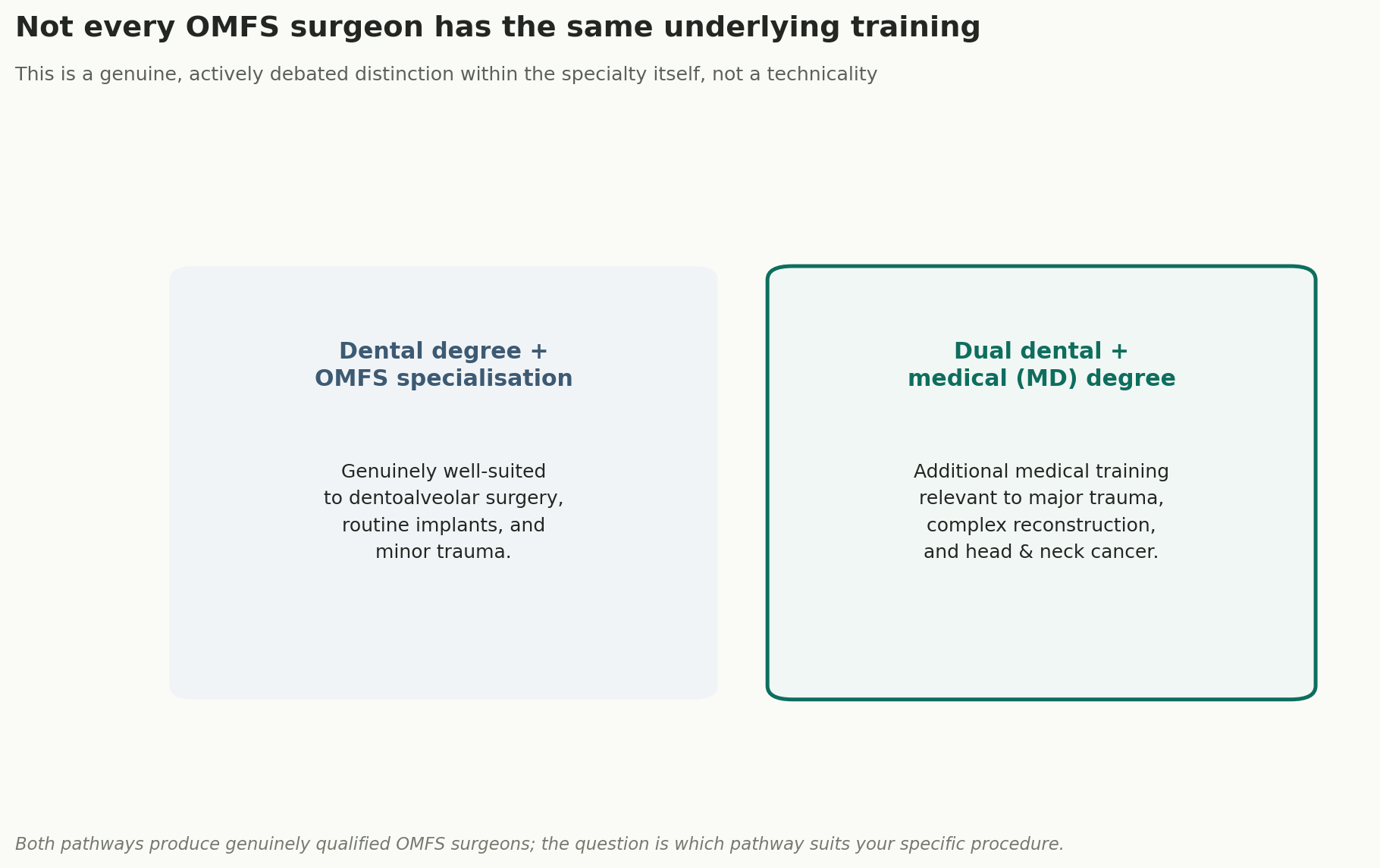
A published survey of 150 OMFS residents across India found genuine, split opinion on this exact question: the majority felt a medical degree was not strictly necessary for their training, while a substantial minority felt it was essential, and more than half felt they had not received adequate medical knowledge during their own training. This is not a settled question the specialty has already resolved; it remains an active, honest conversation worth having directly with a prospective surgeon.
This division of opinion among the profession's own trainees is itself informative. It suggests the right answer genuinely depends on the specific procedure and context, rather than one training pathway being universally correct, which is precisely why this guide encourages matching the surgeon's background to your particular case rather than treating either pathway as automatically superior.
Matching Training to the Procedure
The dual-degree question matters more as complexity rises
This distinction is not equally relevant to every OMFS procedure; it becomes genuinely more important as case complexity increases.
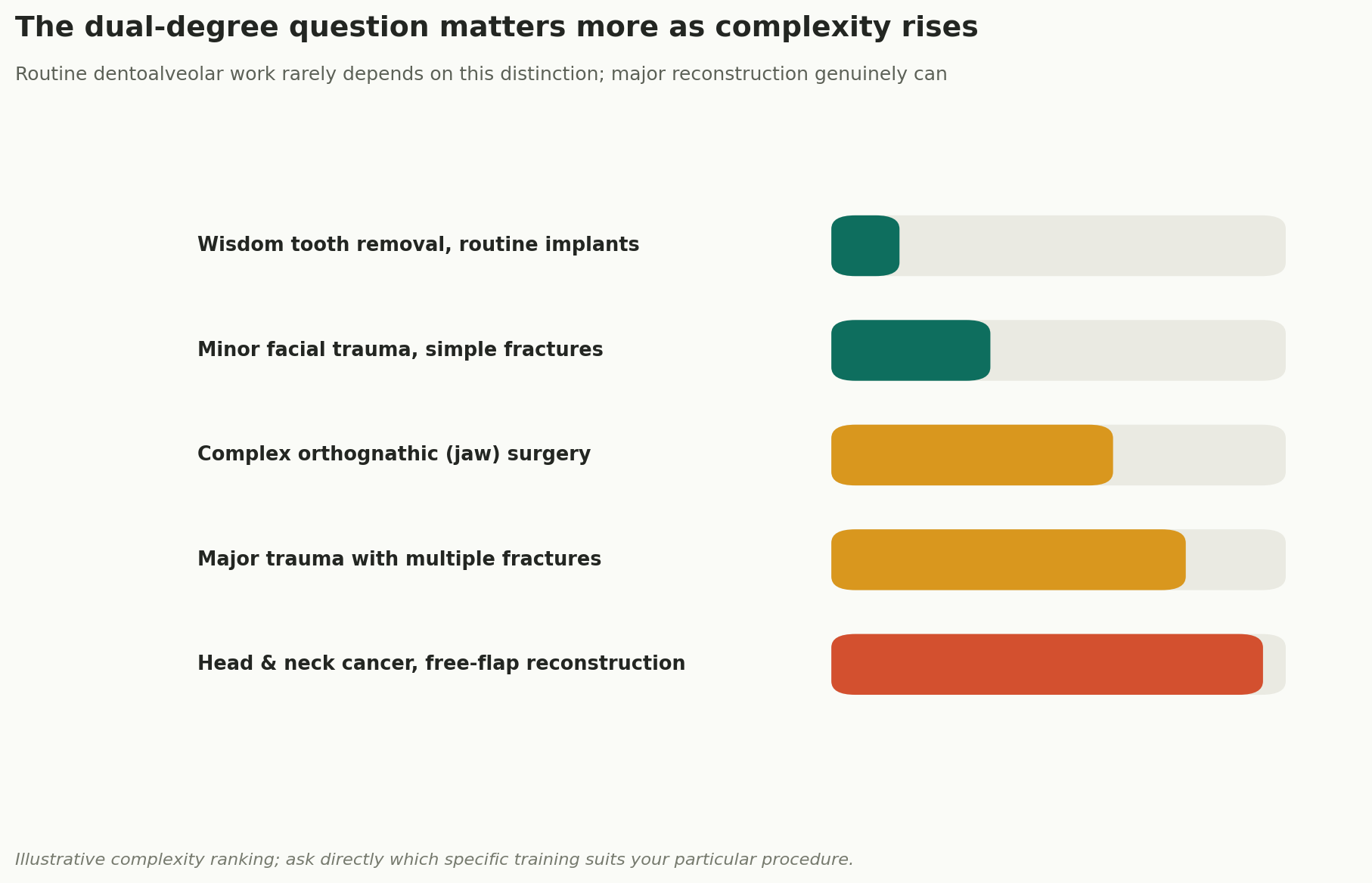
Illustrative complexity ranking; ask directly which specific training suits your particular procedure.
For routine dentoalveolar surgery, wisdom tooth extraction, and standard implant placement, this distinction rarely changes the practical outcome. For major trauma involving multiple fractures, complex jaw realignment, or reconstruction following head and neck cancer surgery, broader medical training becomes considerably more directly relevant, and asking specifically about a surgeon's background for these more complex cases is a genuinely worthwhile question.
A useful mental model is to think of this as a spectrum rather than a strict cutoff. A routine wisdom tooth extraction sits comfortably within either training pathway's genuine competence. A patient requiring free-flap reconstruction after extensive cancer surgery is dealing with a case where broader medical and surgical training, alongside genuine experience with this specific level of complexity, becomes a meaningfully more important factor in the decision.
A note on why this question is worth asking directly, without awkwardness. This is a genuine, professionally acknowledged debate within OMFS itself, not an obscure technicality invented for this guide. A confident, experienced surgeon will discuss their own training background openly, and will explain clearly why their specific background suits the procedure being proposed for your case.
THE BALANCE
Match the training to the complexity of the case
Given how much complex OMFS procedures depend on surrounding medical infrastructure, this evaluation weights notably toward the hospital compared to more isolated surgical procedures elsewhere in this series.
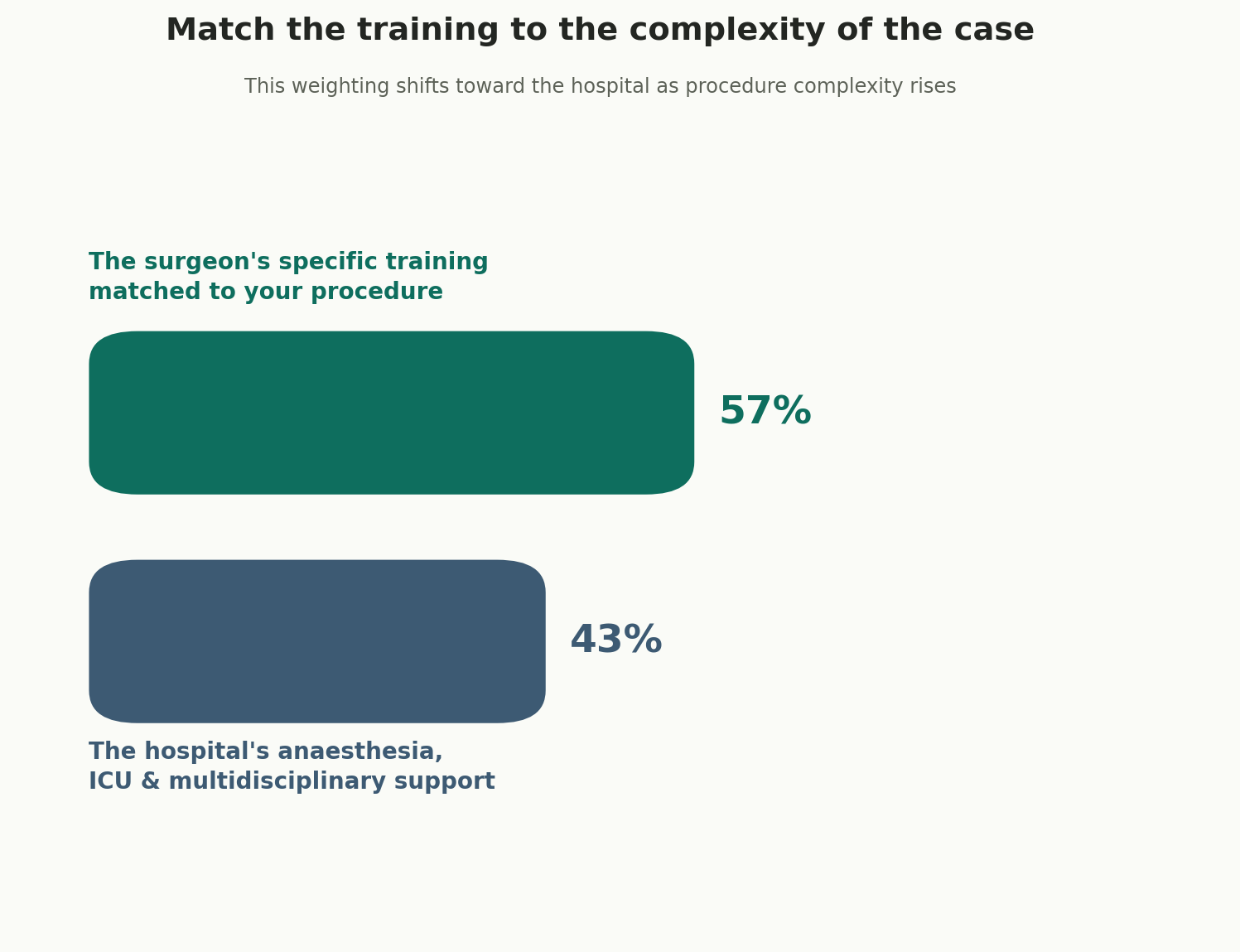
This weighting shifts toward the hospital as procedure complexity rises.
For a complex trauma or reconstructive case specifically, the surrounding hospital infrastructure, anaesthesia support, ICU capability, and access to other relevant specialists including plastic surgeons and oncologists, genuinely shapes outcomes alongside the operating surgeon's own training. This is a meaningfully more balanced weighting than several more surgeon-dominated procedures elsewhere in this series, reflecting how genuinely team-dependent complex OMFS reconstruction actually is.
THE VETTING CONVERSATION
What to actually ask
Questions for the surgeon
- What is your specific training background, dental-only specialisation or dual degree? A confident, direct answer is reasonable to expect.
- Why does your specific training suit my particular procedure? This should be a thoughtful, case-specific explanation.
- What is your specific experience with procedures of this complexity? Ask specifically, not just general OMFS case volume.
- Who else will be involved in my care if this is a complex case? Major reconstruction often genuinely requires a team.
Questions for the hospital
- What anaesthesia and ICU support is available for complex OMFS cases? This should be a specific, verifiable answer.
- Is a genuinely multidisciplinary team available for major reconstruction? This should include relevant specialists beyond OMFS alone.
- What is the hospital's own outcome data for procedures of this complexity? Specific, tracked figures matter more than general reputation.
- What is the plan for follow-up once I return to Nigeria? This should be coordinated before you travel.
Nigeria-specific Considerations
Why asking about training background matters here
Given the genuinely wide range of conditions OMFS covers, from routine dental procedures through complex facial trauma and cancer reconstruction, discussed in detail in this series' main Oral and Maxillofacial Surgery guide, Nigerian patients evaluating providers abroad benefit specifically from understanding this training distinction, since it directly shapes which surgeon is genuinely best suited to a specific, complex case rather than assuming any OMFS credential is interchangeable.
Four warning signs worth taking seriously
- A complex reconstructive procedure recommended without a clearly relevant training background. Ask directly about this fit.
- No willingness to discuss training pathway openly. This is a genuine, professionally acknowledged topic, not an awkward question.
- No clear multidisciplinary team for major trauma or cancer reconstruction. This should be a coordinated, visible team.
- Vague answers about anaesthesia and ICU support for complex cases. This should be specific and verifiable.
A practical order of operations
- Get a confirmed diagnosis and understand the genuine complexity of your specific case.
- Ask directly about the surgeon's specific training background and why it suits your procedure.
- For complex cases, confirm a genuinely multidisciplinary team is involved.
- Ask the surgeon-side and hospital-side questions above before committing to treatment.
- Travel, surgery, and a recovery period appropriate to the specific procedure performed.
- Establish a coordinated follow-up relationship with a Nigerian specialist.
Straight Answers for Nigerian Patients about Oral and Maxillofacial Surgery in India
Do all OMFS surgeons have the same training?
No. Some hold a dental degree with OMFS specialisation, others a dual dental and medical degree, a genuine, actively debated distinction within the specialty itself.
Does this matter for every procedure?
No. It matters far less for routine dentoalveolar work and considerably more for complex trauma, orthognathic surgery, and cancer reconstruction.
Is a dental-only OMFS surgeon less qualified?
Why does this weight toward the hospital as complexity rises?
Complex procedures depend heavily on anaesthesia support, ICU capability, and a genuinely multidisciplinary team, not the surgeon's training alone.
What is a realistic red flag when choosing a provider?
A complex procedure recommended without a clearly relevant training background, or no multidisciplinary team for major cases, are genuine warning signs.
A closing word
OMFS sits genuinely between two professions, and its own practitioners have not fully settled the question of which training pathway best prepares a surgeon for every situation. Rather than treating every OMFS credential as interchangeable, a patient facing a complex procedure benefits from understanding this real distinction and asking about it directly. In twenty-four years of this work, the patients who navigate this best ask openly about a surgeon's specific training background, confirm a genuinely multidisciplinary team for complex cases, and match the complexity of their own procedure honestly against the surgeon's demonstrated, relevant experience.
Sources
- 🌐 Requirement of dual degree for Oral and Maxillofacial Surgery training: perception among Indian OMFS residents
- 🌐 American Association of Oral and Maxillofacial Surgeons — Selecting a training programme
- 🌐 American Board of Oral and Maxillofacial Surgery — Verifying surgeon certification
- 🌐 NHS (UK) — Oral and maxillofacial surgery: overview
- 🌐 High Commission of India, Abuja — Medical and Medical Attendant Visa requirements
Frequently Asked Questions by Nigerians about Oral and Maxillofacial Surgery in India
Do all OMFS surgeons have the same training?
No. The guide identifies two main pathways: a dental degree followed by OMFS specialisation and a dual dental-and-medical degree pathway.
Is a dual dental and medical degree automatically better?
No. The guide states that both pathways produce genuinely qualified OMFS surgeons. The more useful question is whether the surgeon's training matches the complexity of the specific procedure.
Does the training distinction matter for wisdom tooth removal?
Usually less so. The guide places routine wisdom tooth extraction, dentoalveolar surgery and standard implants at the lower end of the complexity spectrum.
When does the surgeon's broader medical training become more relevant?
It becomes more important for major facial trauma, complex jaw realignment and reconstruction following head and neck cancer surgery.
What is considered a highly complex OMFS procedure?
The guide's page 3 chart places head and neck cancer surgery requiring free-flap reconstruction at the highest end of its illustrative complexity ranking.
How should Nigerian patients evaluate an OMFS surgeon?
They should ask about the surgeon's specific training pathway, why it suits their procedure and specific experience with cases of similar complexity, rather than relying only on overall OMFS case volume.
Why is the hospital particularly important for complex OMFS surgery?
Complex reconstruction may require advanced anaesthesia, ICU support and access to plastic surgeons, oncologists and other specialists, making the procedure highly team-dependent.
What should Nigerian patients ask about the hospital's multidisciplinary team?
They should ask which specialists will actually participate in their care, particularly for major trauma or cancer reconstruction, rather than accepting a general statement that multidisciplinary care is available.
What are the major warning signs when choosing an OMFS provider?
Warning signs include complex surgery without relevant training, unwillingness to discuss the training pathway, no multidisciplinary team for major cases and vague answers about anaesthesia or ICU support.
What should Nigerian patients arrange before travelling to India for OMFS surgery?
They should confirm the diagnosis and procedure complexity, verify the surgeon's relevant training and experience, assess hospital support and establish coordinated follow-up with a Nigerian specialist before travelling.
Page Summary
This guide explains how Nigerian patients can select oral and maxillofacial surgeons and hospitals in India, focusing on the genuine difference between dental-only OMFS specialisation and the dual dental-and-medical training pathway. It explains that both pathways can produce qualified OMFS surgeons, but the importance of the distinction increases with procedure complexity. The page 3 chart places routine wisdom tooth removal and implants at the lower end of complexity and head and neck cancer with free-flap reconstruction at the highest end. The page 4 evaluation gives 57% weight to the surgeon's specific training matched to the procedure and 43% to the hospital's anaesthesia, ICU and multidisciplinary support. The guide also emphasises relevant case experience, multidisciplinary care and coordinated Nigerian follow-up.
Citation Block
| Topic | Information |
|---|---|
| Topic Information | Selecting the Best Oral and Maxillofacial Surgeons and Hospitals in India for Nigerian Patients for Patients from Nigeria |
| Treatment | Oral and Maxillofacial Surgery |
| Intended Audience | Patients from Nigeria |
| Key Specialist | Oral and Maxillofacial Surgeon |
| Training Pathways | Dental Degree + OMFS Specialisation or Dual Dental + Medical Degree |
| Training Question | Match the Surgeon's Training to the Specific Procedure |
| Routine Procedures | Wisdom Tooth Removal, Dentoalveolar Surgery and Standard Implants |
| Complex Procedures | Major Trauma, Complex Orthognathic Surgery and Cancer Reconstruction |
| Highest Complexity | Head and Neck Cancer With Free-Flap Reconstruction |
| Evaluation Weighting | 57% Surgeon; 43% Hospital |
| Surgeon Check | Confirm Specific Training Background and Relevant Case Experience |
| Complexity Check | Ask Why the Surgeon's Training Suits the Proposed Procedure |
| Team Check | Confirm Who Else Will Be Involved in Complex Cases |
| Hospital Check | Verify Anaesthesia and ICU Support |
| Multidisciplinary Check | Confirm Access to Plastic Surgeons, Oncologists and Other Relevant Specialists |
| Outcome Check | Request Specific, Tracked Outcome Data for Similar Procedures |
| Important Warning | Complex Reconstruction Without Clearly Relevant Training |
| Nigeria-Specific Check | Confirm Follow-Up Arrangements Before Travelling |
| Pre-Travel Requirement | Confirm Diagnosis and Understand the Complexity of the Procedure |
| Patient Journey | Diagnosis → complexity assessment → surgeon training verification → multidisciplinary evaluation → travel/surgery → recovery → Nigerian follow-up |
| Follow-Up | Coordinated Care With a Nigerian Specialist |


Our Mission Statement
Our mission is to place patients at the centre of every healthcare decision by providing trustworthy, evidence-based, and unbiased medical information. We believe that informed patients make better decisions. Backed by personalised guidance from our experienced advisory team, we help patients understand their treatment options, compare them objectively, and confidently choose the path that best suits their medical needs and personal circumstances.
Patient Testimonials from Nigeria















Ready to Take the First Step?
Share your Medical Reports with our Healthcare Managers Today and Get a FREE CONSULTATION, a Personalized Treatment Plan, and Complete Support from Arrival to Recovery.
Get Your Free ConsultationAreas We Serve
This resource has been thoughtfully prepared for patients from Nigeria who are considering medical treatment in India. We also welcome patients from the wider region in the countries mentioned below-
We assist patients from:
- Benin
- Niger
- Chad
- Cameroon
- Algeria
- Egypt
- Libya
- Morocco
- Sudan
- Tunisia
- Gambia
- Ghana
- Burkina Faso
- Cabo Verde
- Côte d'Ivoire
- Equatorial Guinea
- São Tomé and Príncipe
Many of the insights, treatment pathways, hospital recommendations, travel guidance, and patient support services described here are equally relevant and may be used as a reference when planning treatment in India.
From Nigeria to India: Your Complete Patient Support Guide
- Artificial Disc Replacement in India for Nigerian Patients
- Weight Loss and Bariatric Surgery in India for Nigerian Patients
- Bone Marrow Transplant in India for Nigerian Patients
- Brain Tumour Surgery in India for Nigerian Patients
- Breast Cancer Treatment and Surgery in India for Nigerian Patients
- Cancer Treatment and Surgery in India for Nigerian Patients
- Cardiac Arrhythmia and Heart Pacemaker Treatment in India for Nigerian Patients
- Cardiac Surgery in India for Nigerian Patients
- Colorectal Cancer Treatment and Surgery in India for Nigerian Patients
- Complex Orthopaedic and Joint Revision Surgery in India for Nigerian Patients
- Cornea Transplant and Advanced Eye Surgery in India for Nigerian Patients
- CyberKnife Treatment in India for Nigerian Patients
- Gamma Knife Treatment in India for Nigerian Patients
- Heart Failure Treatment and Surgery in India for Nigerian Patients
- Hip Surgery in India for Nigerian Patients
- HIPEC Cancer Surgery in India for Nigerian Patients
- IVF and Fertility Treatment in India for Nigerian Patients
- Joint Arthroscopy and Sports Medicine in India for Nigerian Patients