

Selecting the Best Liver Transplant Surgeons and Hospitals in India for Nigerian Patients
The liver is the one organ that grows itself back. Do not let that remarkable fact talk you out of asking hard questions about donor safety.
Among every organ used in living donor transplantation, the liver is unique: both the donor's remaining portion and the recipient's transplanted portion regenerate toward near-full original volume within weeks. This genuinely remarkable biological fact is often, understandably, the detail families remember most clearly from an initial consultation. It should not be the only one. Published transplant literature places living liver donation at meaningfully higher donor risk than living kidney donation, and a family that lets the regeneration story stand in for a full understanding of that risk is not as informed as they deserve to be. This guide sits alongside this series' kidney transplant guide in one important respect, both involve a healthy donor accepting real risk on behalf of someone they love, and diverges from it in another: the specific biology, the specific risk profile, and the specific technical demands on the surgeon are genuinely different for a liver.
| Should you even be reading this guide? | If liver failure or a liver tumour has been diagnosed and transplant |
| has genuinely been discussed as an option, ideally with a potential living donor identified, this guide will help you evaluate the surgical teams and hospital programme involved. If donor identification has not yet begun, that conversation, and independent donor evaluation, is the appropriate starting point. |
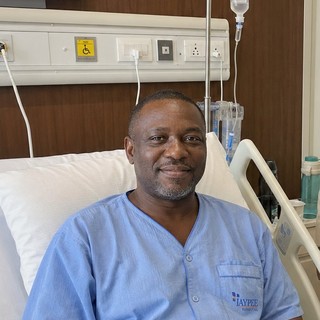
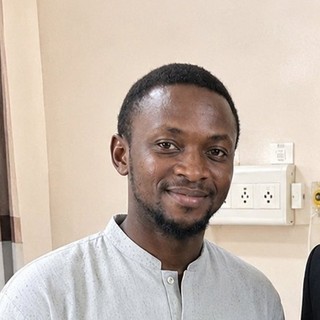
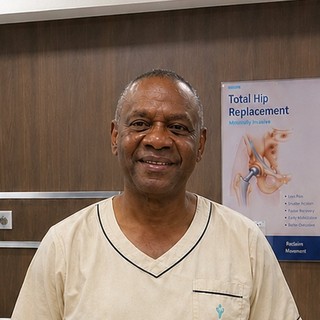
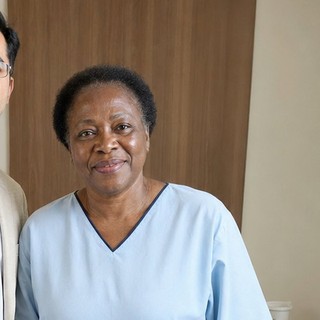
Healing Journeys of Nigerian Patients


Key Takeaways
- Living donor liver transplantation has a unique biological advantage: both the donor's remaining liver and the recipient's transplanted portion regenerate toward near-full original volume within weeks. However, the guide repeatedly warns that regeneration should never be used to minimise the real risks carried by a healthy donor.
- Living liver donation carries a meaningfully higher donor risk than living kidney donation. The guide cites published donor mortality ranges of approximately 0.1–0.5% for living liver donation, compared with roughly 0.03% for living kidney donation.
- The donor should undergo a separate and independent evaluation, rather than being treated simply as part of the recipient's treatment pathway.
- If the graft is too small, the recipient can develop small-for-size syndrome, in which the transplanted liver struggles to meet the body's metabolic demand.
- At the same time, taking a larger graft to benefit the recipient leaves the donor with a smaller liver remnant. Graft-size planning is therefore a genuine two-patient calculation, balancing recipient requirements against donor safety.
- Compared with kidney transplantation, liver transplant places slightly greater relative weight on the individual surgeon.
- Patients should ask for the programme's own donor complication and mortality data, not only recipient survival figures.
- The hospital should provide its own graft-survival and patient-survival data at one year and beyond. Broad statements such as “high success rate” are less useful than specific, tracked outcomes.
- For Nigerian families, the guide links much of the country's transplant need to chronic viral hepatitis, which can progress over years to cirrhosis or liver cancer.
- The four major warning signs identified are: donor risk minimised through the regeneration story, no specific graft-size discussion, vague donor or recipient outcome data, and a donor evaluation that feels rushed or pressured.
Quick Facts
- Topic
- Selecting Liver Transplant Surgeons and Hospitals
- Country
- India
- Intended Audience
- Nigerian Patients and Families
- Primary Specialty
- Liver Transplantation and Hepatobiliary Surgery
- Primary Procedure
- Living Donor Liver Transplant
- Unique Biological Feature
- Liver Regeneration
- Living Liver Donor Mortality Range Mentioned
- Approximately 0.1–0.5%
- Donor Evaluation
- Must Be Independent
- Major Technical Planning Issue
- Graft Size
- Major Graft-Size Complication
- Small-for-Size Syndrome
- Surgeon vs Hospital Weighting
- Slightly More Weight to Surgeon
- Main Decision Principle
- Protect the Donor as Seriously as the Recipient While Choosing a Technically Experienced Transplant Programme
- Author/Advisor
- Dr. Dheeraj Bojwani
- Experience
- 24 Years
In Brief
Selecting a liver transplant programme in India requires Nigerian families to evaluate both surgical precision and the hospital's transplant infrastructure. Living donor liver transplantation is unique because both the donor's remaining liver and the recipient's graft regenerate toward near-full volume over approximately 8–12 weeks, but this does not eliminate donor risk. Published literature cited in the guide places living liver-donor mortality at roughly 0.1–0.5%, higher than for living kidney donation. Graft-size planning is also critical because a graft that is too small can lead to small-for-size syndrome, while taking too much liver increases risk to the donor. For this reason, the guide gives the individual surgeon slightly more weight than the hospital, while still requiring strong ICU, hepatology, vascular and biliary complication management.
START HERE
The organ that grows itself back
Understanding how liver regeneration actually works is worth a moment, since it shapes the entire donor conversation.
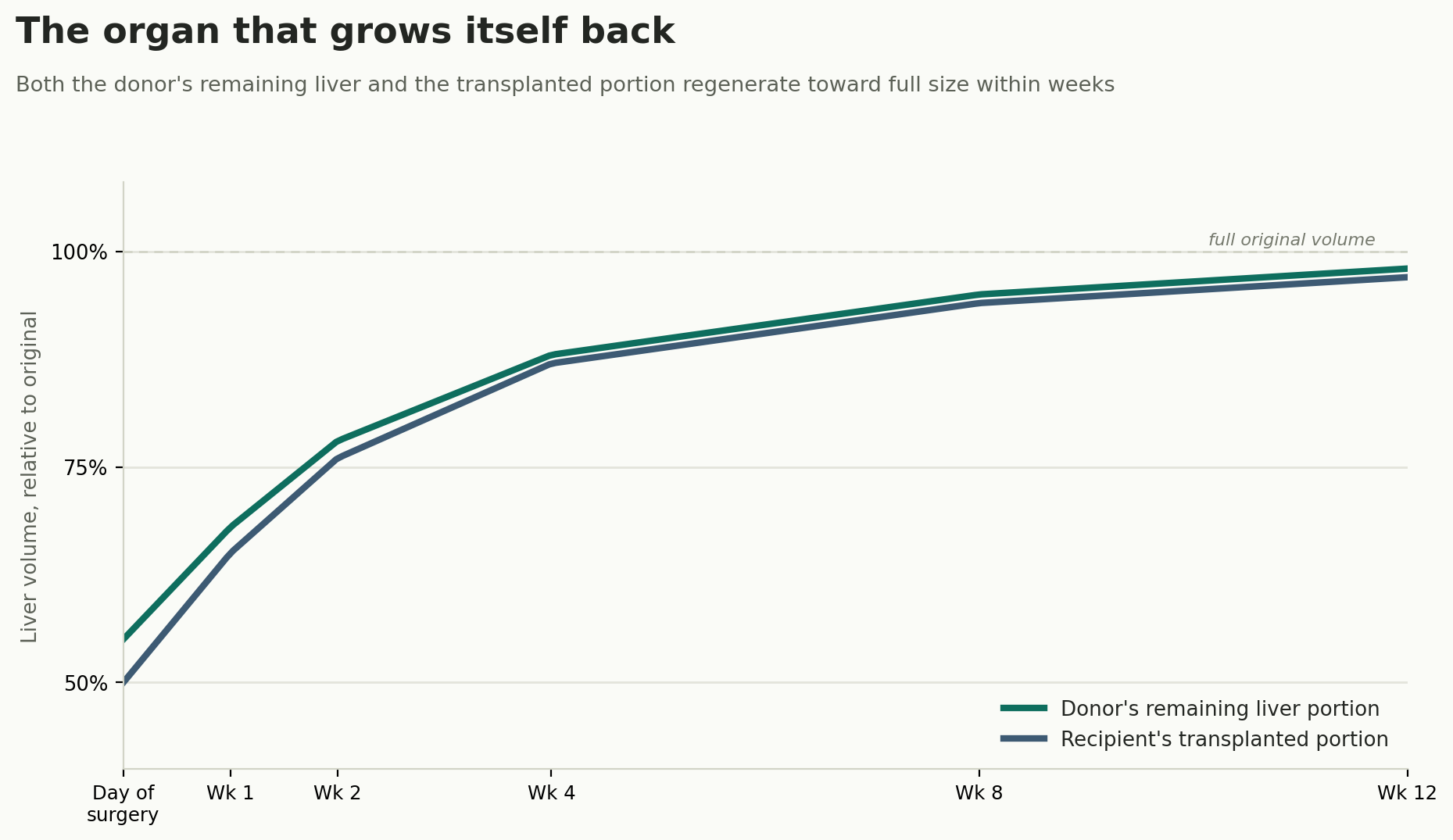
Both the donor's remaining liver and the transplanted portion regenerate toward full size within weeks.
This is genuinely one of the most remarkable facts in transplant medicine, and it is real, not marketing language. It is also, precisely because it sounds so reassuring, a detail that can be used to soften a conversation that deserves to stay clear-eyed. A donor's liver growing back does not mean the surgery itself, or the recovery period before regeneration completes, carries no risk. The weeks between surgery and full regeneration are precisely when a donor is at their most vulnerable, and this is the window a thorough evaluation and recovery plan needs to protect.
THE HONEST NUMBER
Regeneration does not mean the surgery is risk-free
This is worth stating plainly, since it is genuinely easy for a hopeful family to gloss over in the excitement of finding a willing donor.
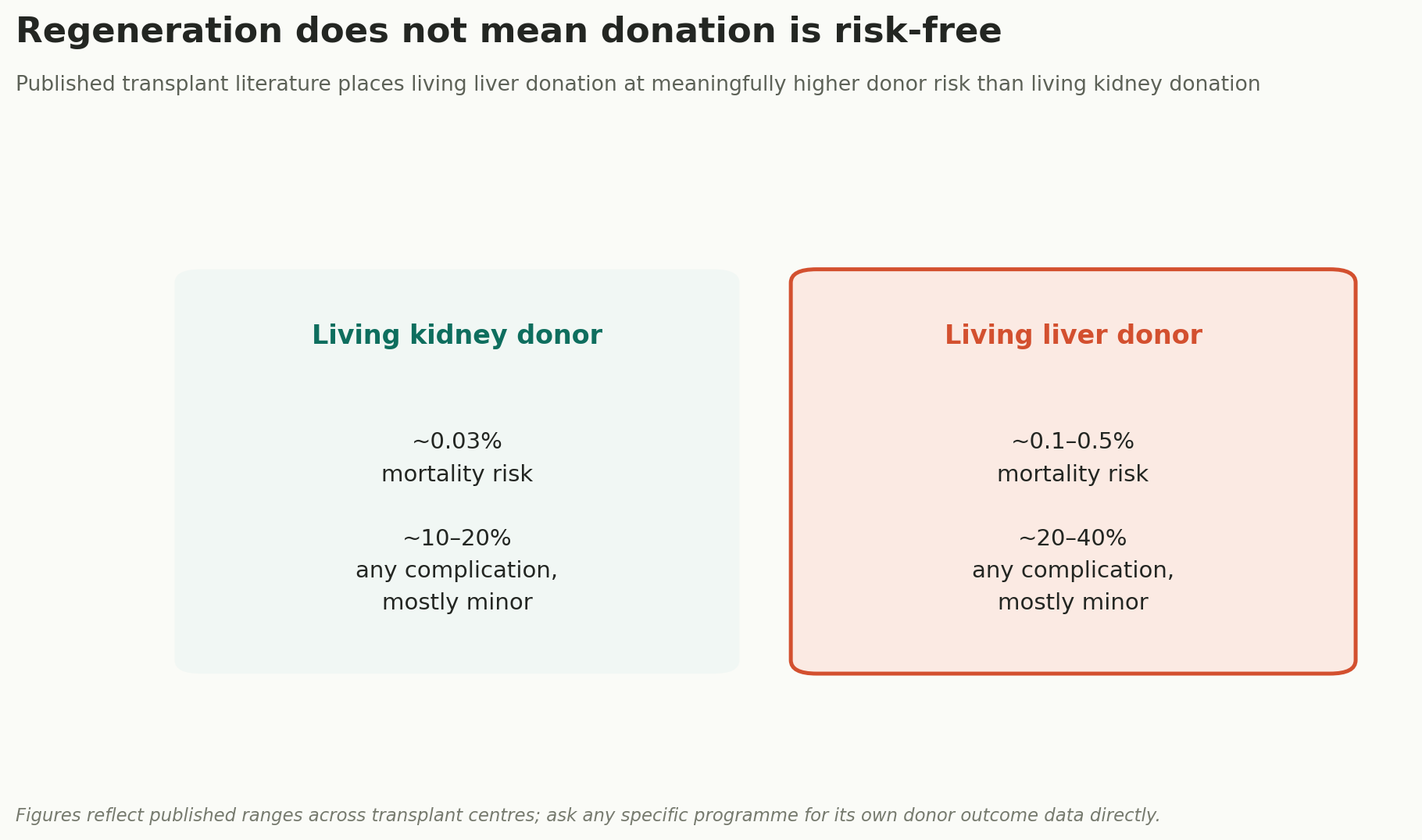
Figures reflect published ranges across transplant centres; ask any specific programme for its own donor outcome data directly.
None of this means living liver donation is unreasonably dangerous; the overwhelming majority of donors recover fully and go on to live entirely normal lives, and the operation has been performed safely at real scale for decades. It means the decision deserves the same honest weighing any major surgery deserves, and a programme that leans heavily on the regeneration story while glossing over these numbers is not giving a donor the full picture they are entitled to before consenting. A donor who understands the real numbers and still chooses to proceed is making a genuinely informed decision; a donor reassured mainly by the regeneration story is not.
| A note on graft size, a technical concern specific to this procedure. | The transplanted liver portion must |
| be large enough, relative to the recipient's body size, to meet their metabolic needs. Too small a graft can lead to small-for-size syndrome, a serious complication where the liver struggles to keep up with demand while it regenerates. Careful pre-operative planning, matching graft size to recipient body size, is essential, and is a genuine marker of surgical planning quality worth asking about directly. This planning also has to weigh the donor's own safety: taking a larger portion to better suit the recipient leaves the donor with a smaller remaining liver of their own, meaning graft size is genuinely a decision made in the interest of two people at once, not one. |
THE BALANCE
Slightly closer to even than kidney transplant
Partitioning a liver for donation, and reconstructing the complex network of blood vessels and bile ducts in the recipient, is technically more demanding than a standard kidney transplant, and this shows up in how the surgeon-hospital balance shifts for this specific procedure.
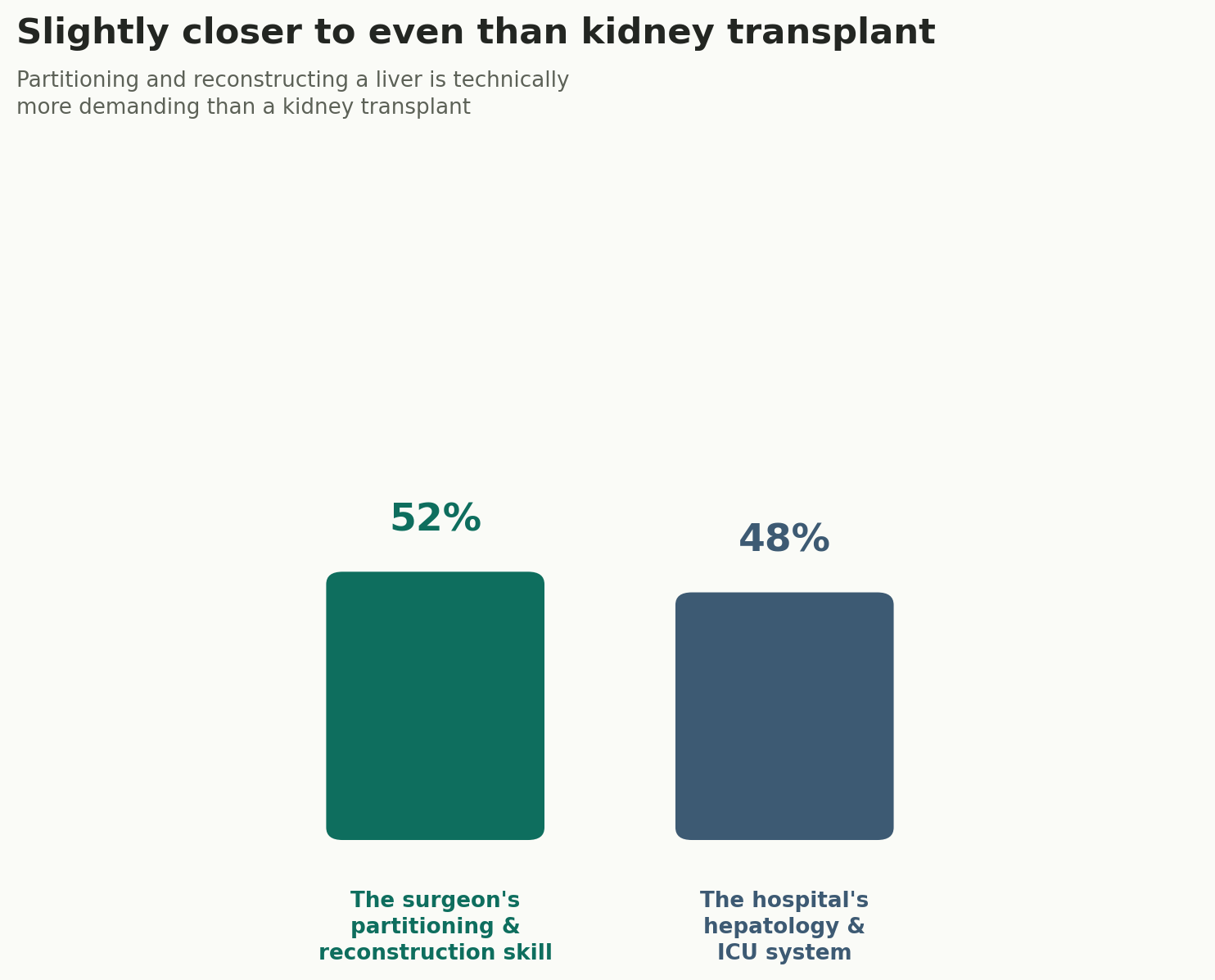
Partitioning and reconstructing a liver is technically more demanding than a kidney transplant.
This is a more even split than kidney transplant, where the hospital's long-term programme infrastructure carries the larger share. For liver transplant, the technical execution during surgery itself, avoiding vascular or biliary complications that can be difficult to fully correct afterward, genuinely tips the balance slightly toward the individual surgeon, even though the hospital's hepatology and ICU capacity remains essential for both donor and recipient recovery. A biliary leak or a vascular complication caught and corrected within hours of surgery often has a very different outcome than one discovered days later, which is precisely why both the surgeon's initial technique and the hospital's early monitoring systems matter so much together.
THE VETTING CONVERSATION What to actually ask
Questions about the donor
- What is your programme's own donor complication and mortality data, specifically? A precise, comfortable answer suggests real, tracked experience.
- How is graft size determined and matched to my specific case? This should be a specific, imaging-based answer, not a general estimate.
- Is the donor evaluated independently, separate from the recipient's care team? This protects against pressure influencing a medical judgement.
- What does donor recovery actually look like, week by week, before regeneration completes? A thorough answer discusses the real recovery period honestly.
Questions about the hospital
- What is the hospital's own graft and patient survival data, at one year and beyond? Specific, tracked figures matter more than general reputation.
- What ICU and hepatology support exists for managing early post-transplant complications? This is where many serious issues are actually caught and managed.
- What is the immunosuppression protocol, and the long-term monitoring plan? This affects the recipient's life for years after returning home.
- What happens if small-for-size syndrome or a vascular complication occurs? A programme with real experience can describe this clearly.
NIGERIA-SPECIFIC CONSIDERATIONS
Why this decision often starts years earlier
Much of the liver disease that eventually leads to transplant need in Nigeria traces back to chronic viral hepatitis, a burden this series has documented as among the highest in the world, layered onto the country's own limited domestic transplant capacity. This means the honest, informed donor conversation described in this guide often arrives at a moment already shaped by years of prior disease progression, making it even more important to get right rather than rush through under pressure. A family that has already spent years managing a loved one's declining liver health can understandably feel enormous urgency once a donor is identified; that urgency is exactly why a deliberate, unhurried evaluation process matters most, not least.
For families identifying a willing donor within Nigeria, the same standard applies regardless of where surgery ultimately takes place: independent donor evaluation, honest risk discussion, and careful graft size planning are not steps to shortcut because a country's healthcare system is unfamiliar, but a baseline every family deserves to insist on everywhere.
Four warning signs worth taking seriously
- Donor risk minimised by leaning heavily on the regeneration story. Regeneration is real, but it does not eliminate real surgical risk.
- No specific discussion of graft size planning for your particular case. This is a genuine, case-specific technical question, not a formality.
- Vague answers about the programme's own donor and recipient outcome data. A confident, experienced programme tracks and shares this.
- A donor evaluation that feels rushed or pressured by family circumstances. This deserves independence and enough time to be genuine.
A practical order of operations
- Identify a potential living donor and begin independent, unhurried donor evaluation.
- Ask directly about the programme's specific donor complication and mortality data.
- Confirm graft size planning is being done specifically for your case, based on imaging.
- Ask the surgeon-side and hospital-side questions above before committing to a programme.
- Travel, surgery for both donor and recipient, and a supervised recovery period through the regeneration window.
- Establish a lifelong monitoring relationship with a Nigerian hepatologist before returning home.
A closing word
The liver's ability to regenerate is one of the more hopeful facts in all of transplant medicine, and it deserves to be shared honestly with every family considering this path. What it should never do is replace a clear, unhurried conversation about the real risk a healthy donor is choosing to accept, or the technical precision graft size planning and surgical reconstruction genuinely require. In twenty-four years of this work, the families who navigate this best hold both truths at once: that this is a remarkable, often life-saving procedure, and that the person donating deserves the same rigorous, honest evaluation as the person receiving. A liver grows back over weeks. The trust built through an honest donor conversation is what makes those weeks worth the risk, and it is a trust worth insisting on from the very first consultation, not assuming will simply be there when it matters most.
Sources
- 🌐 American Liver Foundation — Living donor liver transplant, patient information
- 🌐 American Society of Transplant Surgeons — Living donor risk and outcomes, published guidance
- 🌐 NHS (UK) — Liver transplant: overview – nhs.uk
- 🌐 Liver Transplantation. StatPearls, NCBI Bookshelf, 2026
- 🌐 High Commission of India, Abuja — Medical and Medical Attendant Visa requirements
Frequently Asked Questions by Nigerians about Liver Transplant in India
Does the liver really grow back after living donation?
Yes. Both the donor's remaining liver and the recipient's transplanted portion regenerate toward near-full original volume within approximately eight to twelve weeks, a genuinely unique property among transplantable organs.
Does liver regeneration mean living donation is low risk?
No. Regeneration is real, but the surgery still carries genuine risk. The guide cites living liver donor mortality of roughly 0.1–0.5%, higher than the approximate 0.03% cited for living kidney donation.
Why must the liver donor be evaluated independently?
Because the donor is a healthy person accepting major surgery for someone else. Independent assessment helps protect the donor from medical risk and from family pressure influencing the decision.
What is small-for-size syndrome?
It occurs when the transplanted liver portion is too small relative to the recipient's body size, leading to graft dysfunction. Careful pre-operative graft size planning is essential to avoiding it.
Why is graft-size planning so important?
The surgeon must balance two competing needs: provide enough liver to the recipient while leaving enough behind for the donor to recover safely. This requires patient-specific imaging and calculation.
Why does the surgeon matter slightly more than the hospital in liver transplantation?
Liver partitioning and reconstruction of multiple blood vessels and bile ducts are technically demanding. Errors can lead to serious biliary or vascular complications, so individual surgical experience carries unusual weight.
What should Nigerian families ask the transplant hospital?
Ask for one-year and longer graft and patient survival, ICU and hepatology support, the immunosuppression plan and how the centre handles small-for-size syndrome, biliary leaks and vascular complications.
What should families ask specifically about the donor?
Ask for the programme's donor complication and mortality data, how graft size is calculated, whether donor evaluation is independent and what recovery looks like during the regeneration period.
What are the major warning signs when choosing a liver transplant programme?
Warning signs include minimising donor risk because “the liver grows back,” failing to discuss graft size, giving vague outcome data or rushing the donor evaluation because the recipient's condition is urgent.
What follow-up is needed after returning to Nigeria?
The recipient requires lifelong immunosuppression, liver-function monitoring and ongoing specialist review. The guide recommends establishing a relationship with a Nigerian hepatologist before returning home rather than arranging follow-up afterward.
Is living liver donation as safe as living kidney donation?
No. Published literature places liver donation at meaningfully higher donor risk, with mortality risk around 0.1 to 0.5 percent compared to roughly 0.03 percent for kidney donors, and a higher rate of mostly minor complications.
Why does the surgeon matter slightly more than the hospital here?
Partitioning a liver and reconstructing the complex vessel and bile duct connections is technically more demanding than a kidney transplant, giving the surgeon's skill slightly more weight, though hospital infrastructure still matters substantially.
What is a realistic red flag when choosing a programme?
Downplaying donor risk by emphasising regeneration alone, no discussion of graft size planning, or an inability to describe outcome data, are all genuine warning signs.
Page Summary
This guide explains how Nigerian families should evaluate liver transplant surgeons and hospitals in India, beginning with a fact that reassures too easily: the liver regenerates, in both the donor and the recipient, over roughly 8–12 weeks. That does not make living donation risk-free — donor mortality runs at about 0.1–0.5%, against roughly 0.03% for a kidney — so the donor needs an independent evaluation rather than a place inside the recipient's treatment plan. Graft size is the second technical question: large enough for the recipient, small enough to leave the donor safe. Because dividing the liver and reconstructing vessels and bile ducts is demanding, the surgeon carries slightly more weight here than in kidney transplantation — but only alongside a hospital that can catch a complication early.
Citation Block
| Topic | Information |
|---|---|
| Topic Information | Details |
| Topic | Selecting the Best Liver Transplant Surgeons and Hospitals in India for Nigerian Patients |
| Procedure | Living Donor Liver Transplant |
| Country | India |
| Intended Audience | Nigerian Patients and Families |
| Primary Specialty | Liver Transplant and Hepatobiliary Surgery |
| Unique Biological Feature | Donor and Recipient Liver Regeneration |
| Approximate Regeneration Window | 8–12 Weeks |
| Living Liver Donor Mortality Range Mentioned | Approximately 0.1–0.5% |
| Key Donor Requirement | Independent Medical Evaluation |
| Major Technical Requirement | Patient-Specific Graft-Size Planning |
| Main Decision Principle | Balance Donor Safety, Graft Size, Surgical Skill and Hospital Systems |


Our Mission Statement
Our mission is to place patients at the centre of every healthcare decision by providing trustworthy, evidence-based, and unbiased medical information. We believe that informed patients make better decisions. Backed by personalised guidance from our experienced advisory team, we help patients understand their treatment options, compare them objectively, and confidently choose the path that best suits their medical needs and personal circumstances.
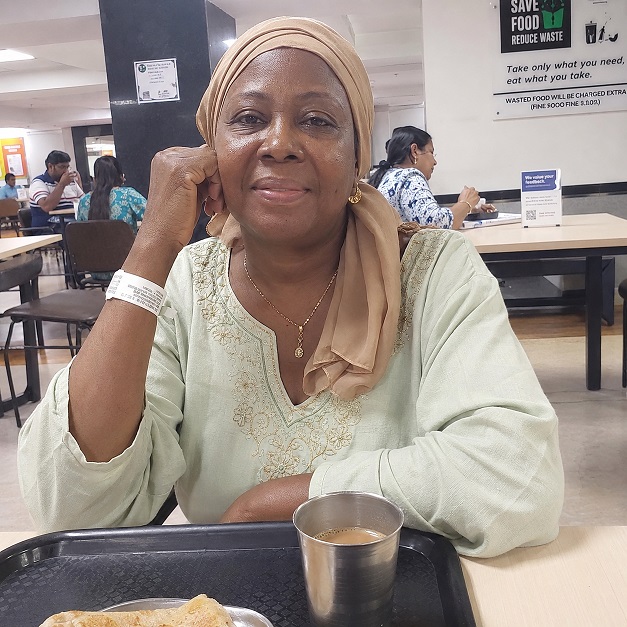
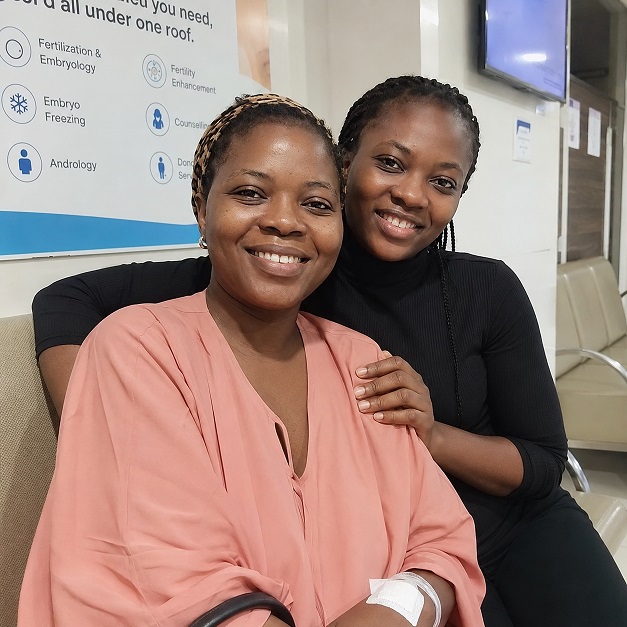
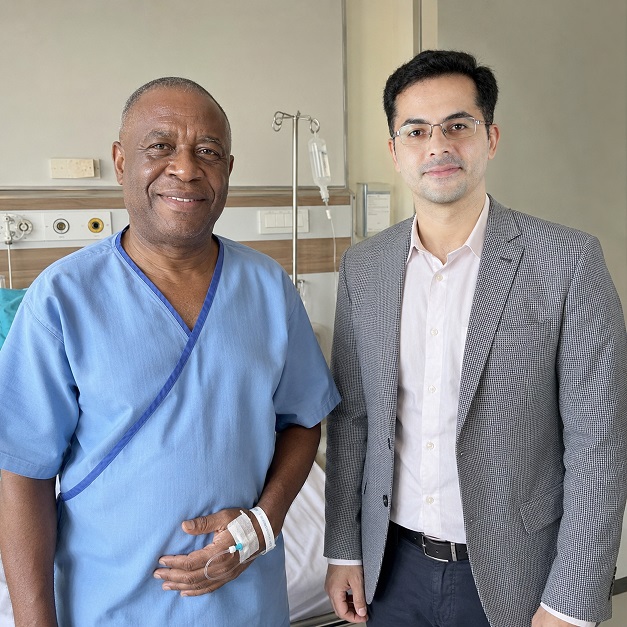
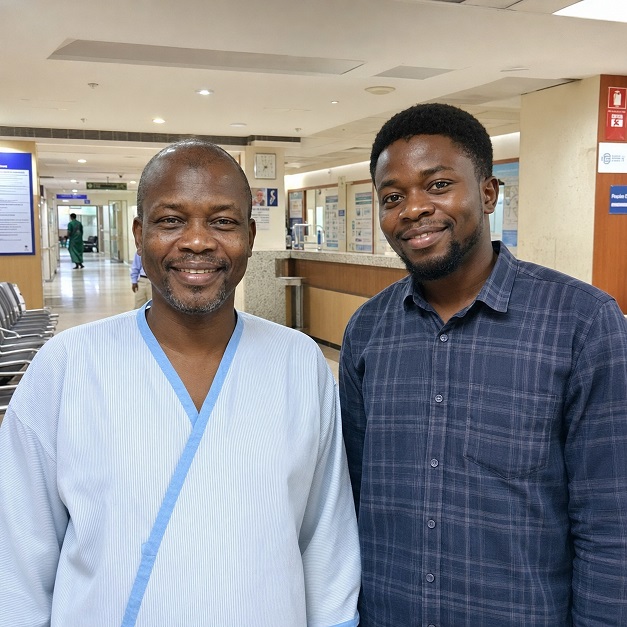
Patient Testimonials from Nigeria
Ready to Take the First Step?
Share your Medical Reports with our Healthcare Managers Today and Get a FREE CONSULTATION, a Personalized Treatment Plan, and Complete Support from Arrival to Recovery.
Get Your Free ConsultationAreas We Serve
This resource has been thoughtfully prepared for patients from Nigeria who are considering medical treatment in India. We also welcome patients from the wider region in the countries mentioned below-
We assist patients from:
- Benin
- Niger
- Chad
- Cameroon
- Algeria
- Egypt
- Libya
- Morocco
- Sudan
- Tunisia
- Burkina Faso
- Cabo Verde
- Côte d'Ivoire
- Gambia
- Ghana
- Equatorial Guinea
- São Tomé and Príncipe
Many of the insights, treatment pathways, hospital recommendations, travel guidance, and patient support services described here are equally relevant and may be used as a reference when planning treatment in India.
From Nigeria to India: Your Complete Patient Support Guide
- Artificial Disc Replacement in India for Nigerian Patients
- Weight Loss and Bariatric Surgery in India for Nigerian Patients
- Bone Marrow Transplant in India for Nigerian Patients
- Brain Tumour Surgery in India for Nigerian Patients
- Breast Cancer Treatment and Surgery in India for Nigerian Patients
- Cancer Treatment and Surgery in India for Nigerian Patients
- Cardiac Arrhythmia and Heart Pacemaker Treatment in India for Nigerian Patients
- Cardiac Surgery in India for Nigerian Patients
- Colorectal Cancer Treatment and Surgery in India for Nigerian Patients
- Complex Orthopaedic and Joint Revision Surgery in India for Nigerian Patients
- Cornea Transplant and Advanced Eye Surgery in India for Nigerian Patients
- CyberKnife Treatment in India for Nigerian Patients
- Gamma Knife Treatment in India for Nigerian Patients
- Heart Failure Treatment and Surgery in India for Nigerian Patients
- Hip Surgery in India for Nigerian Patients
- HIPEC Cancer Surgery in India for Nigerian Patients
- IVF and Fertility Treatment in India for Nigerian Patients
- Joint Arthroscopy and Sports Medicine in India for Nigerian Patients