

Selecting the Best Kidney Transplant Surgeons and Hospitals in India for Nigerian Patients
Most surgical decisions in this series involve one patient. This one involves two, and a genuinely good programme never lets you forget it.
A living donor kidney transplant is not one operation performed on one unwell person. It is two operations, performed on two people, one of whom is entirely healthy and undergoing major surgery purely to help someone they love. This simple fact should reshape how a family evaluates any programme: the questions worth asking are not only about the recipient's outcome, but equally about how seriously a programme takes the healthy person choosing to accept real, lifelong risk on someone else's behalf. Most of the guides in this series ask a family to evaluate a surgeon and hospital on behalf of one person. This one asks a family to evaluate a programme on behalf of two people simultaneously, whose interests, while aligned in wanting a good outcome, are not identical. The recipient wants a working kidney. The donor deserves a programme equally invested in their own long-term health, not merely their usefulness as a source of one.
Should you even be reading this guide? If kidney failure has been diagnosed and transplant has genuinely been discussed as an option, ideally with a potential living donor identified, this guide will help you evaluate the surgical teams and hospital programme involved. If donor identification has not yet begun, that conversation, and independent donor evaluation, is the appropriate starting point.
Healing Journeys of Nigerian Patients






Key Takeaways
- Kidney transplantation is not simply an operation. For Nigerian patients considering treatment in India, the quality of the entire transplant programme matters because successful long-term outcomes depend on donor assessment, surgery, immunosuppression, infection prevention, rejection monitoring and lifelong follow-up.
- The document places particular emphasis on living donor kidney transplantation. A suitable living donor must undergo a detailed medical assessment to protect both the recipient and the donor.
- A transplant should not proceed merely because a willing relative is available. The hospital should be able to explain clearly why that person is medically suitable to donate.
- The document also highlights the importance of compatibility testing. Matching and immunological assessment influence rejection risk and the treatment strategy required after transplantation.
- The transplant surgeon is responsible for technically demanding aspects of donor nephrectomy and recipient transplantation, but the hospital transplant programme carries greater overall weight because care continues long after the operation.
- Hospital outcomes should not be presented only as a broad “success rate.” Patients should ask what the figure actually represents—for example, immediate surgical success, graft survival or patient survival—and over what period it is measured.
- A reputable programme should not promise that rejection will never occur. Instead, it should explain how rejection is monitored, how early signs are detected and what treatment is available if it develops.
- Patients should ask which immunosuppressive medicines will be prescribed, whether they are readily available in Nigeria and what alternatives exist if a particular drug becomes unavailable or unaffordable.
- International kidney transplantation cannot be treated like an ordinary elective surgery booking. The donor-recipient relationship and documentation must satisfy applicable legal and hospital requirements before transplantation can proceed.
- The recommended sequence is to confirm transplant eligibility, identify and medically evaluate the donor, complete compatibility testing, understand legal requirements, compare surgeon and programme outcomes, and establish Nigerian nephrology follow-up before travelling.
Quick Facts
- Topic
- Selecting Kidney Transplant Surgeons and Hospitals
- Country
- India
- Intended Audience
- Nigerian Patients and Families
- Primary Specialty
- Kidney / Renal Transplantation
- Primary Procedure
- Living Donor Kidney Transplant
- Primary Donor Pathway
- Living Donor
- Donor and Recipient Assessment
- Separate
- Compatibility Testing
- Required
- Surgeon vs Hospital Weighting
- Hospital Transplant Programme Carries Greater Overall Weight
- Major Long-Term Risk
- Rejection
- Legal Donor Verification
- Mandatory
- Main Decision Principle
- Choose a Complete Transplant Programme, Not Simply a Surgeon
- Author/Advisor
- Dr. Dheeraj Bojwani
- Experience
- 24 Years
In Brief
Choosing a kidney transplant programme in India requires Nigerian patients to evaluate much more than the operating surgeon. Living donor transplantation begins with independent medical assessment of both recipient and donor, followed by compatibility testing and legally required donor verification. The transplant surgeon's experience matters, but the hospital programme carries greater overall weight because long-term success depends on nephrology care, rejection monitoring, immunosuppressive management, infection prevention and graft surveillance. Patients should ask for clearly defined graft and patient survival outcomes rather than a vague “success rate,” confirm that lifelong medicines will remain accessible in Nigeria and establish post-transplant nephrology follow-up before travelling.
START HERE
The donor is a patient too
It is easy, understandably, for a family's attention to focus entirely on the person who is unwell. A genuinely responsible transplant programme insists on giving the donor equally serious, independent attention.
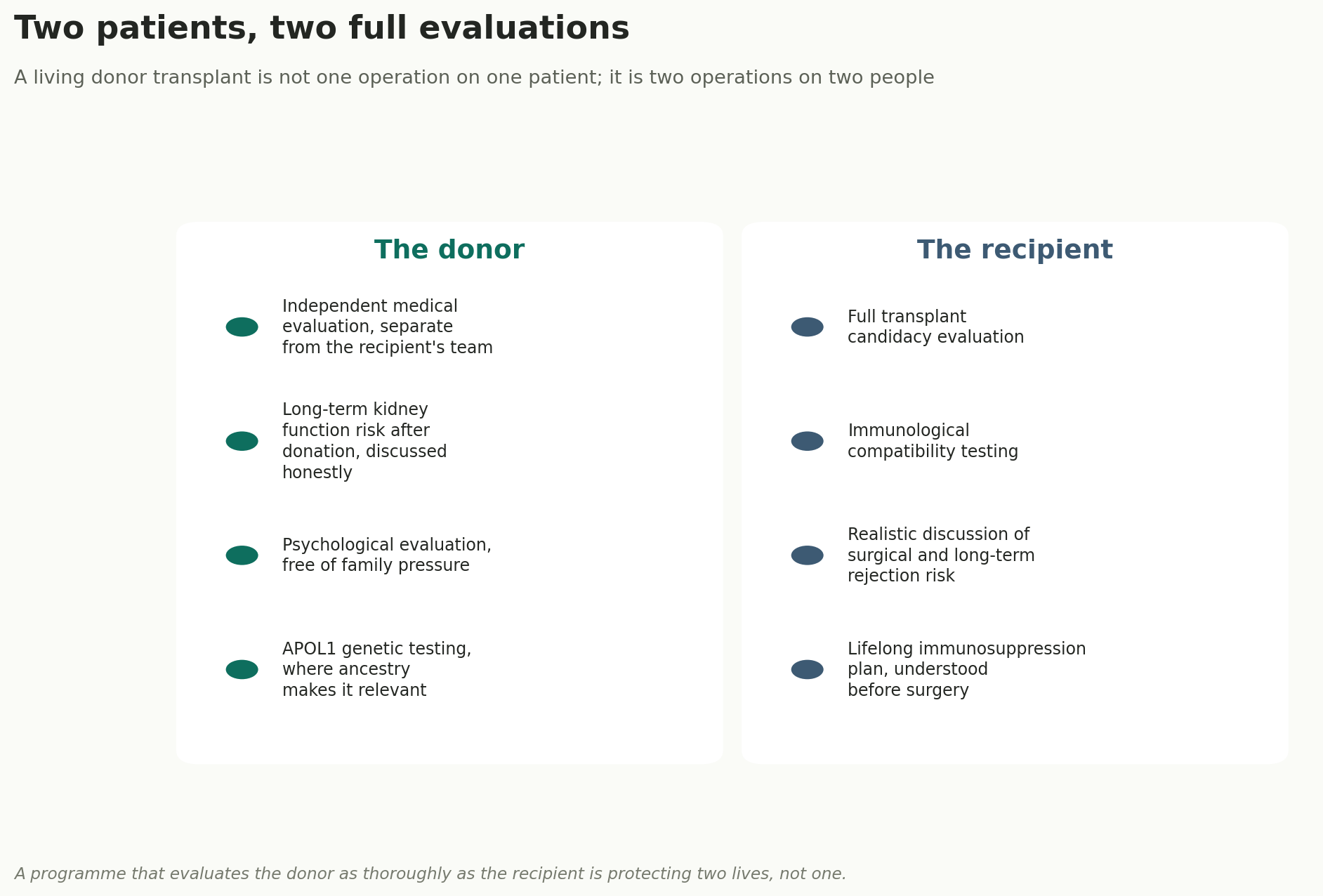
A programme that evaluates the donor as thoroughly as the recipient is protecting two lives, not one.
The donor's evaluation should happen independently of the recipient's team and, ideally, free of the emotional pressure that often surrounds a family member's willingness to donate. A responsible programme will sometimes determine that a willing donor is not, in fact, a suitable one, and a family should want a programme confident enough to say so honestly rather than one that treats every willing relative as automatically eligible. This can be a genuinely difficult moment for a family already under strain, and a good programme handles it with clarity and compassion, not evasiveness.
A MODERN CONSIDERATION
The genetic question that did not used to exist
Donor evaluation has traditionally focused on blood type and tissue compatibility. In recent years, a further, genuinely important question has emerged specifically relevant to donors of West African ancestry.
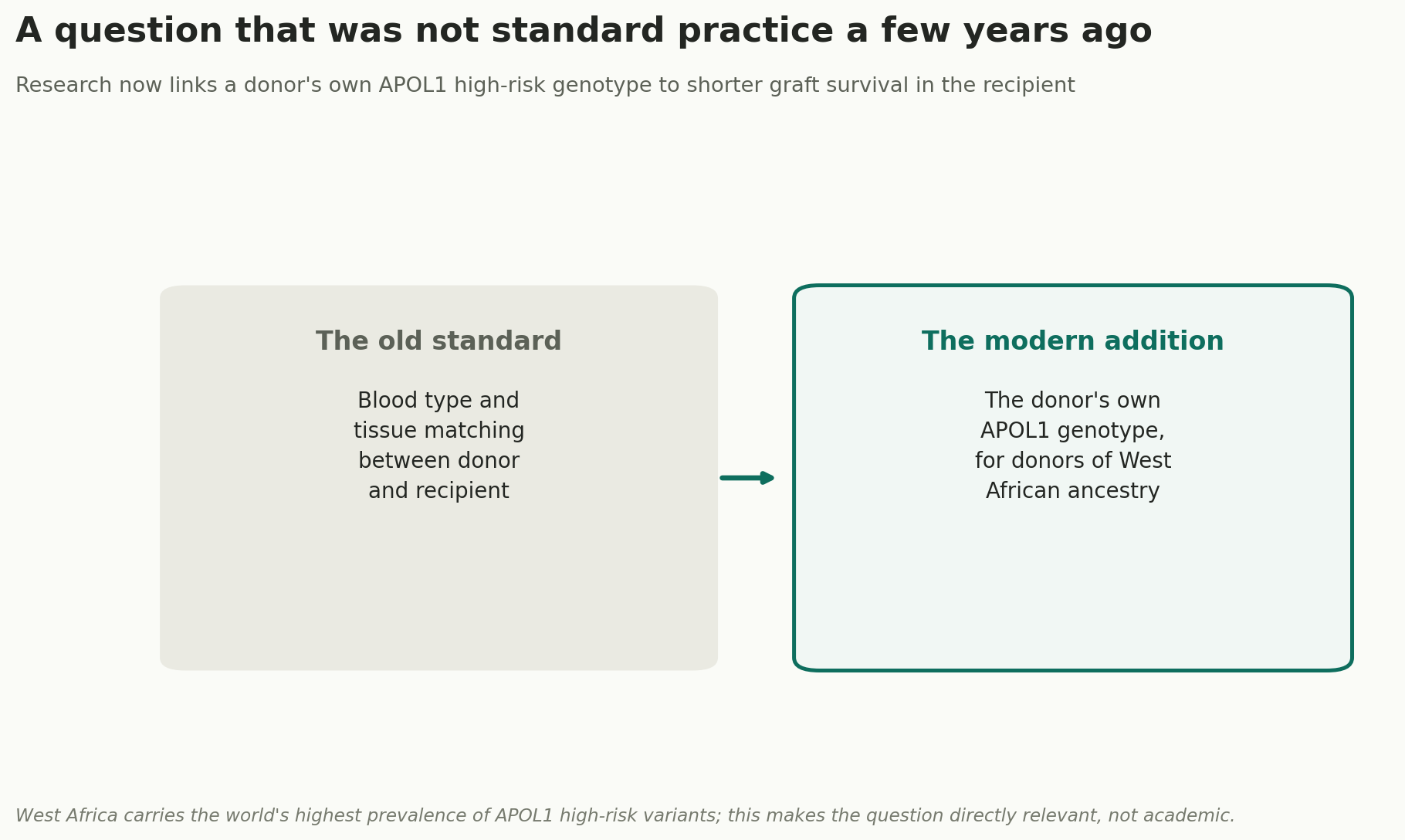
West Africa carries the world's highest prevalence of APOL1 high-risk variants; this makes the question directly relevant, not academic.
Research has found that a living donor's own high-risk APOL1 genotype can be linked to shorter graft survival in the recipient, a finding with genuine, direct relevance given that West Africa, and Nigeria specifically, carries the world's highest documented prevalence of these gene variants. This is not a reason to avoid a family donor; it is a reason to ask, directly and specifically, whether this testing is offered as part of a thorough donor evaluation. A programme unfamiliar with this question, despite treating patients of West African ancestry regularly, may not be as current in its practice as its general reputation suggests.
This question also matters for the donor's own future, not only the recipient's graft. A donor found to carry high-risk APOL1 variants may themselves face an elevated lifetime kidney disease risk, information genuinely worth having before donation, for the donor's own long-term health planning, independent of what it means for graft survival in the recipient.
A note on why this matters beyond any single family. Nigeria's own chronic kidney disease burden is shaped significantly by this same genetic factor, layered onto the country's well-documented rates of hypertension and diabetes. Understanding that a family's own donor evaluation touches the same underlying biology as the recipient's original diagnosis is a useful, if sobering, piece of context for the conversation as a whole.
THE BALANCE
The programme outlasts the procedure
Kidney transplant surgery itself is a well-established, technically standardised procedure performed at real volume in many centres. What varies more meaningfully between programmes is what happens for years afterward.
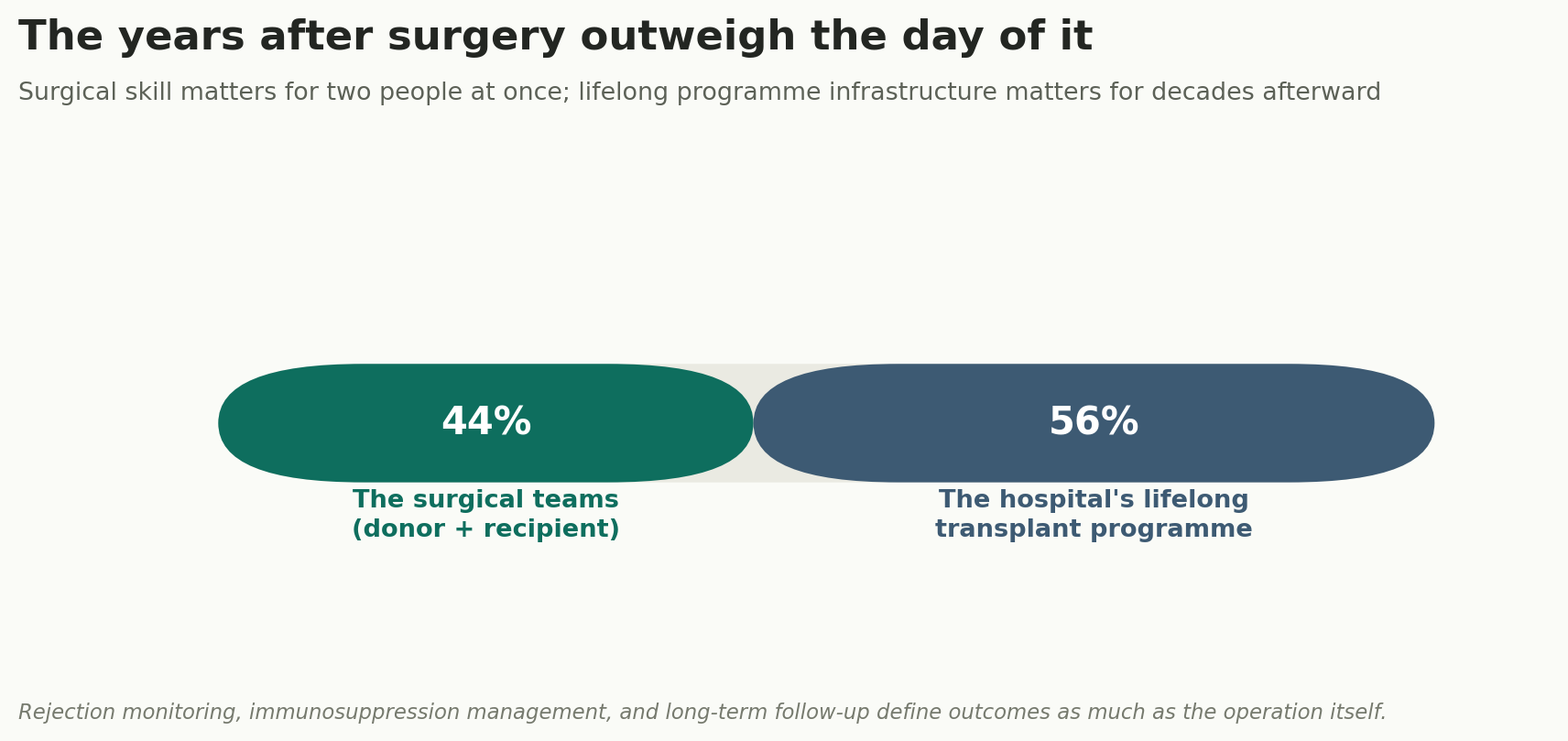
Rejection monitoring, immunosuppression management, and long-term follow-up define outcomes as much as the operation itself.
A kidney transplant recipient requires immunosuppressive medication and monitoring bloodwork for the rest of their life, and the quality of a programme's long-term infrastructure, its transplant immunology laboratory, its rejection surveillance protocols, its coordination with patients returning home to a different country, shapes outcomes over years in a way no single day of surgery can. This is why the hospital's programme, not just the individual surgeon's technique, deserves the larger share of a family's evaluation.
This is a genuinely different weighting than several other guides in this series, where a single surgeon's technical execution during the operation itself carries the larger share. Kidney transplant sits closer to bone marrow transplant in this respect: the procedure is comparatively standardised, and the real differentiator between good and mediocre programmes lies almost entirely in what happens over the following years.
THE VETTING CONVERSATION What to actually ask
Questions about the donor evaluation
- Is the donor evaluated by a team entirely separate from the recipient's care team? This independence protects against pressure influencing a medical judgement.
- Is APOL1 testing offered or discussed for donors of West African ancestry? A specific, direct answer suggests genuinely current practice.
- What long-term kidney function outcomes does this programme discuss with donors? This should be a real, honest conversation, not a brief formality.
- Is the donor's psychological readiness assessed independently, without family present? This protects against a donor who feels obligated rather than genuinely willing.
Questions about the hospital programme
- What is the transplant programme's own graft survival data, at one year and beyond? Specific, tracked figures matter more than general reputation.
- What is the immunosuppression protocol, and what does long-term medication cost look like? This affects a recipient's life for years after returning home.
- What rejection monitoring schedule is recommended, and how will it be coordinated once home? This should be planned before travel, not figured out afterward.
- What happens, practically, if donor evaluation rules out the first-choice donor? A programme with real experience can describe this clearly.
NIGERIA-SPECIFIC CONSIDERATIONS
Why this evaluation matters especially here
Living donor kidney transplant is performed in Nigeria, but capacity remains genuinely limited relative to the country's documented chronic kidney disease burden, itself shaped significantly by the region's high APOL1 variant prevalence layered onto widespread hypertension and diabetes. For families identifying a willing donor within Nigeria before travelling abroad, the donor evaluation questions in this guide apply with equal force domestically; a thorough, independent donor evaluation is not something to seek only once abroad, but a standard worth insisting on at every stage of this process, wherever the surgery itself ultimately takes place.
Long-term dialysis, for patients who are transplant candidates, is generally the less favourable path both clinically and financially compared to transplant, a pattern confirmed in Nigeria-specific health economic research as much as in international literature. This makes early, honest donor evaluation not merely a procedural step but a genuinely time-sensitive decision worth pursuing as soon as a diagnosis makes transplant a realistic option.
Four warning signs worth taking seriously
- A donor evaluation that feels rushed or happens with family members present throughout. Independence and privacy protect the donor's genuine, uncoerced decision.
- No mention of APOL1 testing for a donor of West African ancestry. This should be raised proactively by a genuinely current programme.
- Vague answers about the programme's own graft survival outcomes. Specific, tracked data reflects real accountability.
- No clear plan for lifelong immunosuppression monitoring once the recipient returns home. This is where much of the long-term outcome is actually determined.
A practical order of operations
- Identify a potential living donor and begin independent donor evaluation early.
- Ask explicitly whether APOL1 testing is offered as part of that evaluation.
- Confirm the recipient's full transplant candidacy evaluation and compatibility testing.
- Ask the programme-side questions above, particularly around graft survival data and long-term follow-up planning.
- Travel, surgery for both donor and recipient, and a supervised recovery period for each.
- Establish a lifelong monitoring relationship with a Nigerian nephrologist before returning home, not after.
A closing word
Living donor kidney transplant asks something of a family that few other medical decisions do: it asks one healthy person to accept real, permanent risk so that someone they love can live. A programme worthy of that gift treats the donor's evaluation with the same seriousness as the recipient's, asks the modern genetic questions that current evidence supports, and builds a relationship designed to last decades, not just a single successful operation. In twenty-four years of this work, the families who navigate this best insist on independent, unhurried donor evaluation, ask directly about APOL1 testing where it applies, and choose a programme based on its long-term track record, not just its surgical reputation on the day of the operation. Two people walk into that operating theatre. A good programme never forgets that both of them deserve to walk out well.
Sources
- 🌐 Gbadegesin RA, Adu D, Ojo A, et al. — APOL1 Bi- and Monoallelic Variants and Chronic Kidney Disease in West Africans
- 🌐 APOL1 kidney disease: conclusions from a KDIGO Controversies Conference. Kidney International, 2025
- 🌐 National Kidney Foundation — Living donation, patient and donor resources
- 🌐 NHS (UK) — Kidney transplant: overview – nhs.uk
- 🌐 High Commission of India, Abuja — Medical and Medical Attendant Visa requirements
Frequently Asked Questions by Nigerians about Kidney Transplant in India
What should Nigerian patients evaluate first before choosing a kidney transplant hospital in India?
First confirm that the patient is medically suitable for transplantation and that a potential living donor has been independently evaluated. Hospital comparison should follow—not precede—these basic assessments.
Why must the living kidney donor undergo a separate medical evaluation?
Because donation must be safe for the donor as well as beneficial to the recipient. Kidney function, general health and other risk factors need independent assessment before donation is approved.
Is the transplant surgeon more important than the hospital?
Both matter, but the guide gives greater overall weight to the hospital transplant programme. Kidney transplantation requires nephrology, laboratory support, infection control, immunosuppression management and long-term rejection monitoring.
What should patients ask the kidney transplant surgeon?
Ask about personal kidney-transplant volume, experience with living donor transplantation, donor-nephrectomy approach and outcomes for recipients with comparable medical profiles.
What does a kidney transplant “success rate” actually mean?
It may refer to immediate surgical success, graft survival or patient survival. Patients should ask exactly what outcome is being measured and over what period rather than relying on a single percentage.
Can kidney transplant rejection occur after successful surgery?
Yes. Rejection remains possible after transplantation. A strong programme should explain how it monitors kidney function, identifies rejection early and treats it when necessary.
Will Nigerian patients need medicines after kidney transplantation?
Yes. Immunosuppressive medication is generally required lifelong to reduce rejection risk. Patients should confirm that prescribed medicines and suitable alternatives will remain accessible after returning to Nigeria.
Why is the legal donor approval process important?
Living organ donation is strictly regulated. The donor-recipient relationship and supporting documentation must meet applicable requirements. Any offer to bypass this process should be treated as a serious warning sign.
Does kidney transplantation eliminate the need for medical care?
No. It can eliminate dependence on regular dialysis when successful, but patients require lifelong medicines, kidney-function monitoring and nephrology follow-up.
What are the biggest warning signs when choosing a kidney transplant programme?
Guaranteed success, inadequate donor assessment, vague legal procedures, no meaningful discussion of rejection, unclear long-term medication planning and no Nigerian follow-up strategy are major warning signs.
Why is a living donor evaluated separately from the recipient?
A living donor undergoes real surgery and takes on real, lifelong risk. A genuinely ethical programme evaluates the donor's medical and psychological fitness independently, free of family pressure, rather than treating it as a formality.
What is APOL1, and why should a donor be tested for it?
APOL1 carries variants strongly linked to kidney disease risk in people of recent African ancestry. Research links a donor's own high-risk genotype to shorter graft survival in the recipient, making this genuinely relevant for donors of West African ancestry.
Why does the hospital carry more weight than the surgeon?
The transplant is a well-established, standardised operation, but the recipient needs lifelong immunosuppression, rejection monitoring, and coordinated follow-up. This decades-long relationship depends more on programme infrastructure than a single day of surgery.
Is kidney transplant available in Nigeria?
Yes, but capacity remains limited relative to the country's documented chronic kidney disease burden, shaped significantly by high regional APOL1 variant prevalence.
What is a realistic red flag when choosing a programme?
A rushed or pressured donor evaluation, no discussion of APOL1 testing for West African ancestry, or no clear lifelong follow-up plan, are all genuine warning signs.
Page Summary
This guide explains how Nigerian patients should choose a kidney transplant surgeon and hospital in India, and its central message is that the operation is one stage of a lifelong pathway. There are two patients from the start — the recipient and the living donor — each needing an independent assessment, and a willing relative is not automatically a safe one. The hospital programme therefore outweighs any single surgeon, because nephrology, laboratories, infection control and immunosuppression management all continue long after surgery. Ask what a quoted success rate actually measures and over what period, how rejection is monitored, and whether the prescribed medicines are available in Nigeria. Legal donor approval cannot be bypassed; any suggestion that it can is a warning sign.
Citation Block
| Topic | Information |
|---|---|
| Topic Information | Details |
| Topic | Selecting the Best Kidney Transplant Surgeons and Hospitals in India for Nigerian Patients |
| Procedure | Living Donor Kidney Transplant |
| Country | India |
| Intended Audience | Nigerian Patients |
| Primary Specialty | Renal Transplantation |
| Primary Condition | End-Stage Kidney Disease |
| Donor Pathway | Living Donor |
| Donor Assessment | Independent Medical Evaluation Required |
| Recipient Assessment | Transplant Eligibility Evaluation Required |
| Compatibility | Immunological and Blood-Group Assessment |
| Main Decision Principle | Choose the Programme, Not Only the Surgeon |


Our Mission Statement
Our mission is to place patients at the centre of every healthcare decision by providing trustworthy, evidence-based, and unbiased medical information. We believe that informed patients make better decisions. Backed by personalised guidance from our experienced advisory team, we help patients understand their treatment options, compare them objectively, and confidently choose the path that best suits their medical needs and personal circumstances.
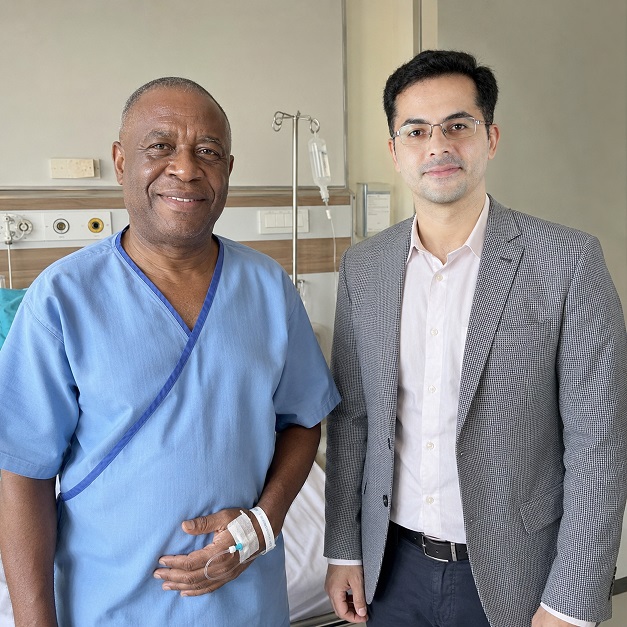
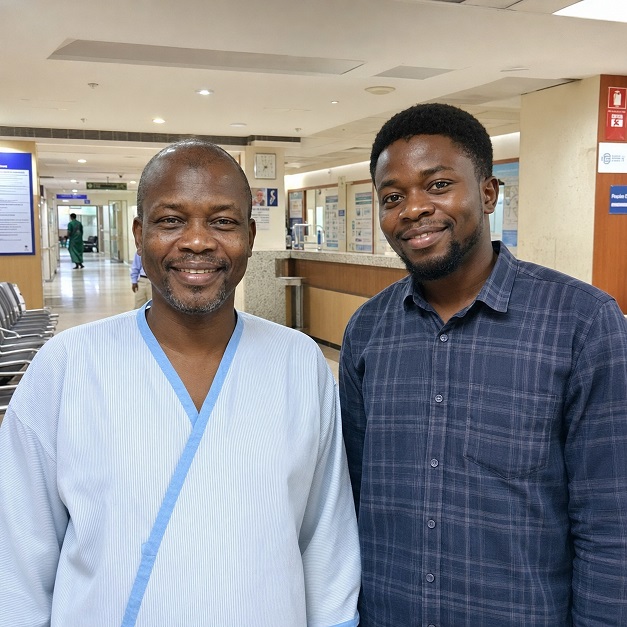
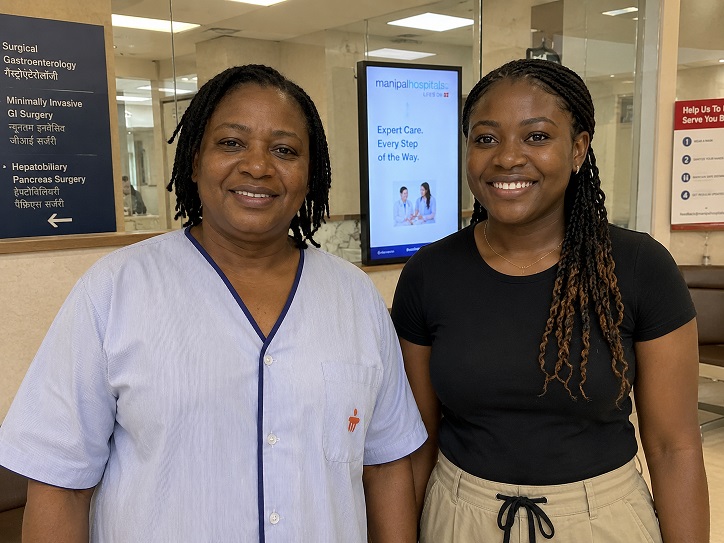
Patient Testimonials from Nigeria
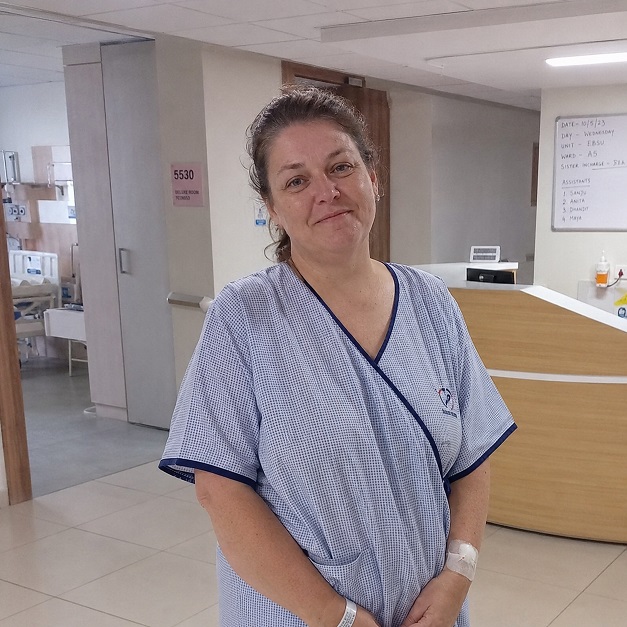
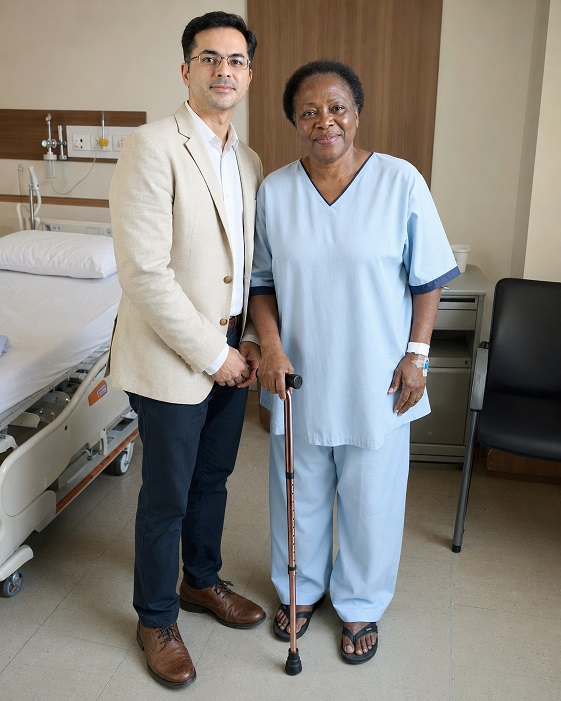
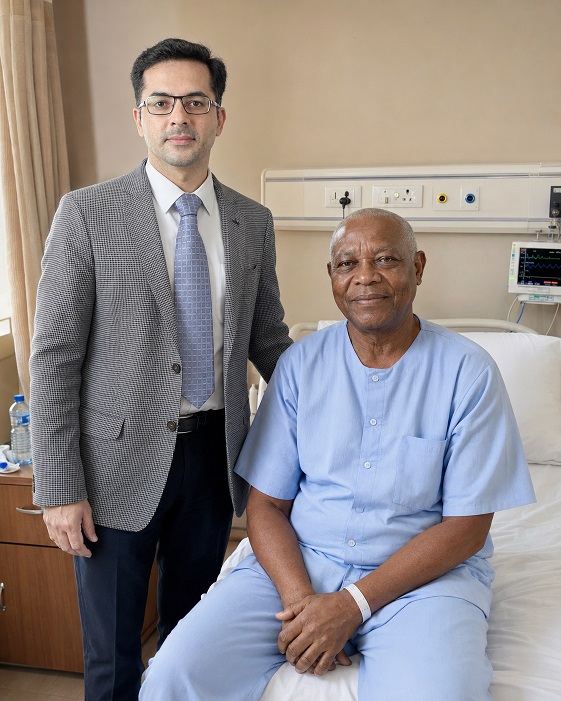
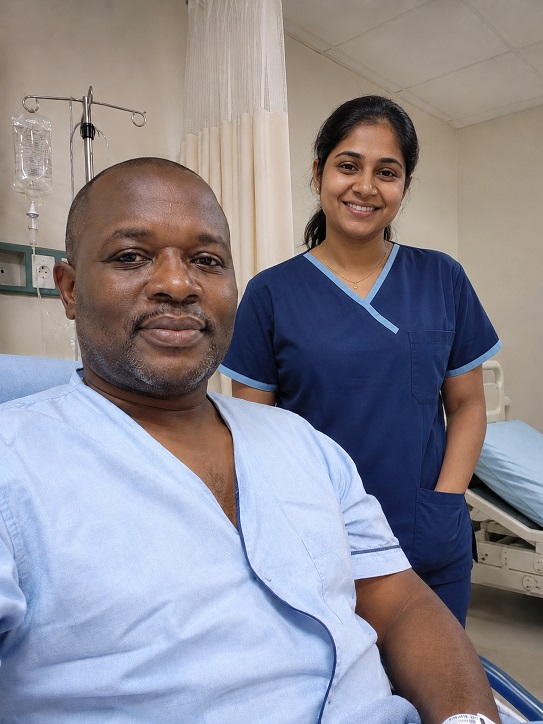


Ready to Take the First Step?
Share your Medical Reports with our Healthcare Managers Today and Get a FREE CONSULTATION, a Personalized Treatment Plan, and Complete Support from Arrival to Recovery.
Get Your Free ConsultationAreas We Serve
This resource has been thoughtfully prepared for patients from Nigeria who are considering medical treatment in India. We also welcome patients from the wider region in the countries mentioned below-
We assist patients from:
- Benin
- Niger
- Chad
- Cameroon
- Algeria
- Egypt
- Libya
- Morocco
- Sudan
- Tunisia
- Burkina Faso
- Cabo Verde
- Côte d'Ivoire
- Gambia
- Ghana
- Equatorial Guinea
- São Tomé and Príncipe
Many of the insights, treatment pathways, hospital recommendations, travel guidance, and patient support services described here are equally relevant and may be used as a reference when planning treatment in India.
From Nigeria to India: Your Complete Patient Support Guide
- Artificial Disc Replacement in India for Nigerian Patients
- Weight Loss and Bariatric Surgery in India for Nigerian Patients
- Bone Marrow Transplant in India for Nigerian Patients
- Brain Tumour Surgery in India for Nigerian Patients
- Breast Cancer Treatment and Surgery in India for Nigerian Patients
- Cancer Treatment and Surgery in India for Nigerian Patients
- Cardiac Arrhythmia and Heart Pacemaker Treatment in India for Nigerian Patients
- Cardiac Surgery in India for Nigerian Patients
- Colorectal Cancer Treatment and Surgery in India for Nigerian Patients
- Complex Orthopaedic and Joint Revision Surgery in India for Nigerian Patients
- Cornea Transplant and Advanced Eye Surgery in India for Nigerian Patients
- CyberKnife Treatment in India for Nigerian Patients
- Gamma Knife Treatment in India for Nigerian Patients
- Heart Failure Treatment and Surgery in India for Nigerian Patients
- Hip Surgery in India for Nigerian Patients
- HIPEC Cancer Surgery in India for Nigerian Patients
- IVF and Fertility Treatment in India for Nigerian Patients
- Joint Arthroscopy and Sports Medicine in India for Nigerian Patients