

Selecting the Best Joint Arthroscopy and Sports Medicine Specialists in India for Nigerian Patients
"Six months, you're cleared" is the sentence most athletes expect to hear. Published research suggests it may be the single most dangerous sentence in sports medicine.
For ACL reconstruction and comparable sports medicine surgeries, most patients focus entirely on the operation itself, the graft, the technique, the surgeon's reputation. What deserves equal, if not greater, attention is how the decision to return to sport is actually made afterward. Published research has found that returning based primarily on elapsed time since surgery, rather than genuine functional readiness, is associated with substantially higher re-injury risk, a finding that should reshape how any programme is evaluated. This guide sets out that specific, well-documented risk, the genuine, evidence-based alternative to time- based clearance, and why this evaluation weighs the rehabilitation programme even more heavily than the surgeon's own technique.
Should you even be reading this guide? If arthroscopic surgery or ligament reconstruction has genuinely been recommended for your specific injury, this guide will help you evaluate the surgeon and, just as importantly, the rehabilitation programme. This series' main Joint Arthroscopy guide covers the broader treatment landscape.
Healing Journeys of Nigerian Patients









Key Takeaways
- The guide's central message is that successful ACL reconstruction depends not only on the operation but also on how return to sport is assessed afterward.
- A published cohort study cited on page 2 found a fivefold increase in re-injury among athletes returning within six months.
- The guide explains that returning before nine months, particularly before six months, is associated with substantially higher re-injury risk. Some cited research reports up to a sevenfold increase for young athletes.
- The page 3 comparison distinguishes time-based clearance from criteria-based clearance. Objective strength testing, functional hop tests and validated outcome scores should determine readiness rather than simply counting months.
- One published study cited in the guide found that structured decision rules reduced re-injury risk by 84%.
- The guide notes that graft choice remains important. Autograft and allograft each have different trade-offs, but the guide places greater emphasis on criteria-based return-to-sport decisions for long-term outcomes.
- The page 4 evaluation gives 55% weight to the rehabilitation programme's criteria-based rehabilitation and return-to-sport testing and 45% to the surgeon's graft choice and reconstruction technique.
- Nigerian patients should ask exactly which strength, hop and functional benchmarks must be achieved before clearance, rather than accepting a fixed return date.
- The guide recommends arranging continuing criteria-based physiotherapy with a Nigerian provider before travelling, so the rehabilitation approach does not change to arbitrary time-based clearance after returning home.
- Four warning signs include return-to-sport clearance based mainly on elapsed time, no specific strength or functional testing, pressure to return quickly and no rehabilitation coordination plan in Nigeria.
Quick Facts
- Treatment
- Joint Arthroscopy and Sports Medicine Surgery
- Country
- India
- Patients
- Patients from Nigeria
- Key Specialist
- Sports Medicine / Arthroscopy Specialist
- Main Procedure
- ACL Reconstruction
- Early Return Risk
- 5× Higher Re-Injury Risk When Returning Within 6 Months
- Young Athlete Risk
- Some Research Reports Up to 7× Higher Risk With Early Return
- Preferred Clearance
- Criteria-Based Rather Than Time-Based
- Key Tests
- Quadriceps Strength, Functional Hop Tests and Validated Scores
- Structured Decision Finding
- 84% Reduction in Re-Injury Risk in the Cited Study
- Evaluation Weighting
- 55% Rehabilitation; 45% Surgeon
- Surgeon Check
- Graft Choice, Reconstruction Technique and Specific Re-Rupture Rate
- Rehabilitation Check
- Objective Testing Before Return to Sport
- Timeline Check
- Avoid a Fixed Clearance Date Without Testing
- Nigeria-Specific Check
- Continue Criteria-Based Physiotherapy in Nigeria
- Important Warning
- Do Not Clear Return to Sport Based Only on Elapsed Time
- Pre-Travel
- Confirm Diagnosis, Graft Plan and Rehabilitation Strategy
- Follow-Up
- Nigerian Physiotherapist and Sports Medicine Specialist
- Author
- Dr. Dheeraj Bojwani
- Experience
- 24+ Years
In Brief
For Nigerian patients considering ACL reconstruction or sports medicine surgery in India, the guide recommends evaluating the rehabilitation programme as carefully as the surgeon and surgical technique. Patients should confirm that return-to-sport decisions are based on objective strength, hop and functional testing rather than a fixed calendar date. They should also ask about graft choice and the surgeon's specific re-rupture rate, while arranging continuing criteria-based physiotherapy with a Nigerian provider before travelling.
START HERE
Rushing back costs far more than the time it saves
Understanding this specific, quantified risk is the necessary first step before evaluating any programme's return-to-sport approach.
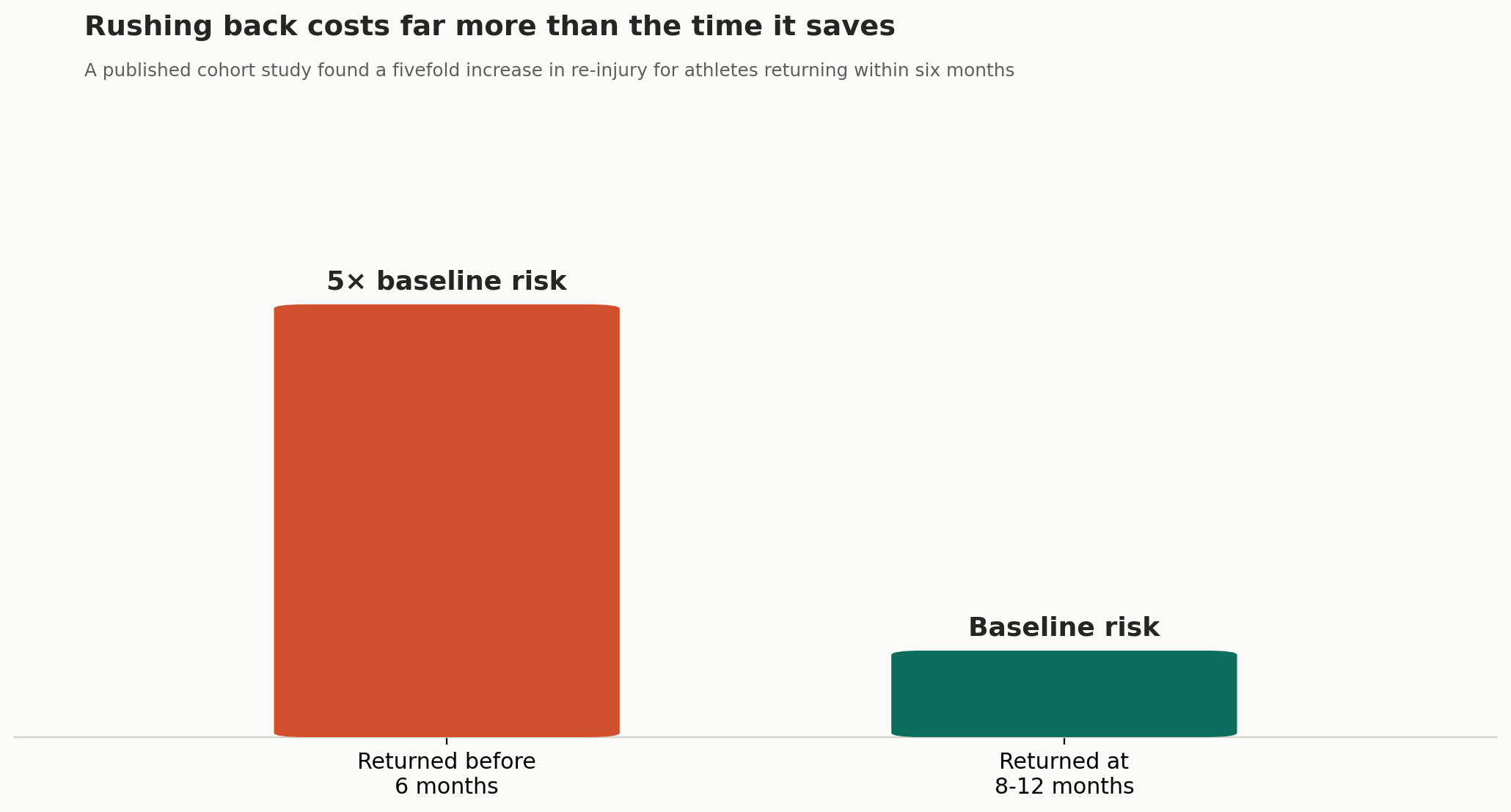
A published cohort study found a fivefold increase in re-injury for athletes returning within six months.
This is not an isolated finding. Multiple published studies converge on a consistent pattern: returning before nine months, and particularly before six months, carries meaningfully elevated re-injury risk, with some research citing up to a sevenfold increase for young athletes specifically. A programme that clears return to sport primarily by counting calendar months is working against this well-established evidence, whether it intends to or not.
This pattern is worth understanding as something rooted in real physiology, not an arbitrary statistical finding. Ligament graft tissue continues remodelling and strengthening for many months after surgery, and neuromuscular control, the body's ability to protect the joint during sudden, high-demand movements, typically takes even longer to fully recover. A fixed calendar date cannot account for how this recovery actually proceeds in any individual patient.
THE GENUINE ALTERNATIVE
"Healed" and "tested ready" are not the same thing
Sports medicine has moved decisively toward a different, evidence-based approach worth understanding directly.
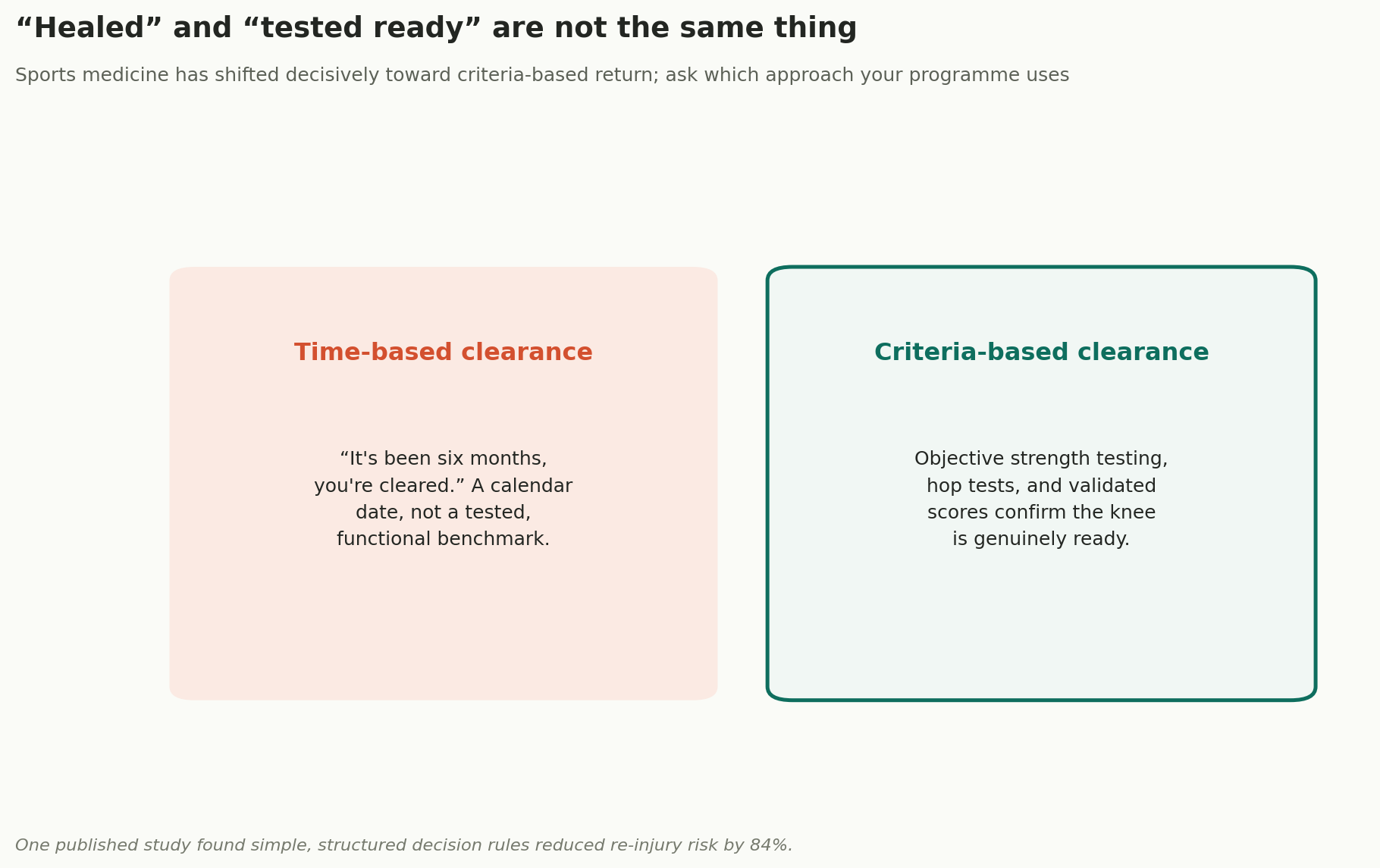
One published study found simple, structured decision rules reduced re-injury risk by 84 percent.
Criteria-based clearance uses specific, objective measures, quadriceps strength testing, functional hop tests, and validated outcome scores, to confirm a knee has genuinely recovered function, rather than assuming recovery based on time alone. A programme using this approach can point to specific numbers and tests behind a return-to-sport decision, not simply a date on a calendar.
A note on graft choice, since it remains a genuinely relevant, separate decision. Autograft, using a patient's own tissue, and allograft, using donor tissue, each carry real tradeoffs in re-rupture risk and donor- site recovery. This choice matters, but published evidence suggests it matters less for long-term outcomes than whether return-to-sport clearance is genuinely criteria-based rather than time-based.
THE BALANCE
The rehab programme decides more than the operation
Given how directly return-to-sport decision-making shapes re-injury risk, this evaluation weights toward the rehabilitation programme.
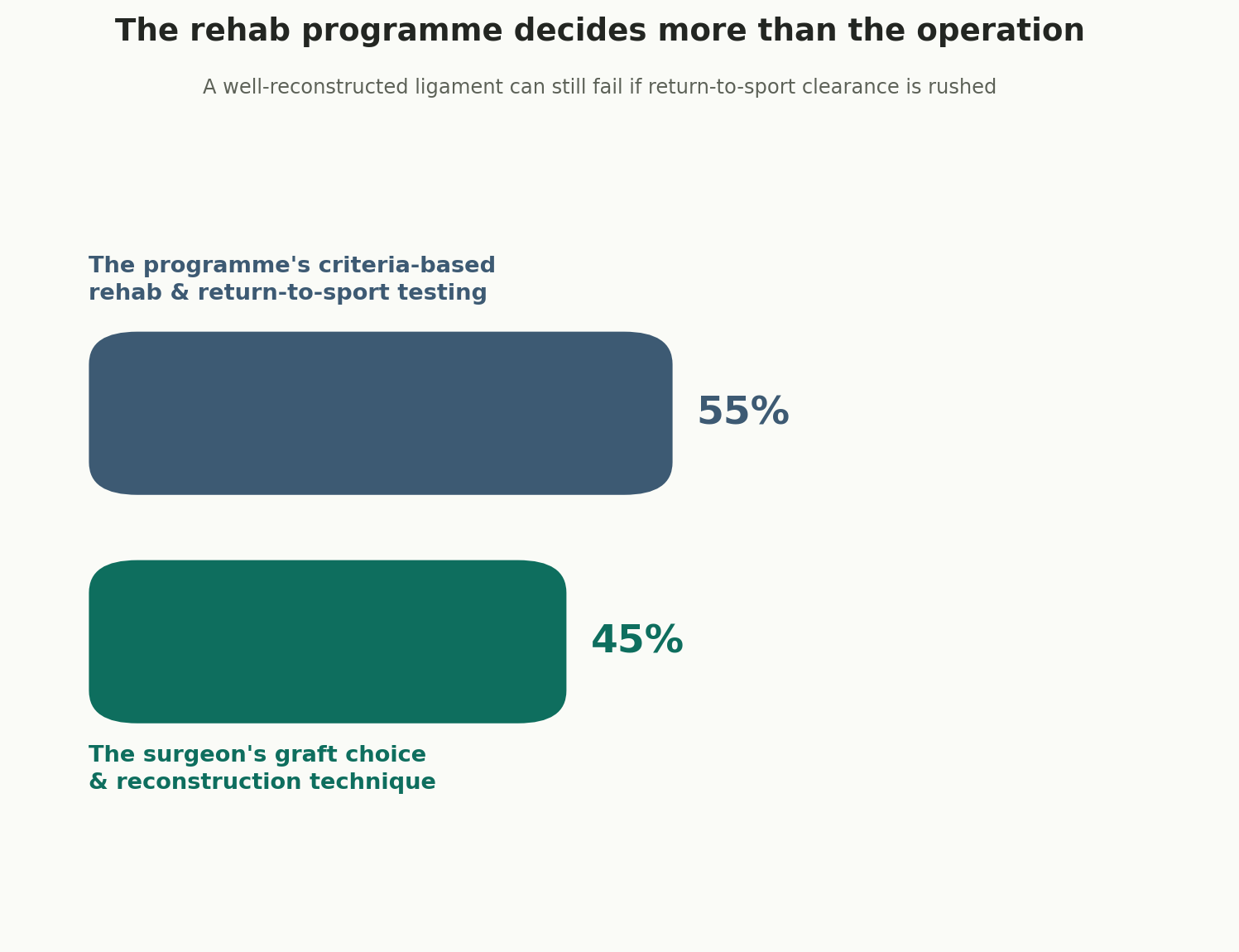
A well-reconstructed ligament can still fail if return-to-sport clearance is rushed.
The surgeon's technical skill in reconstruction remains genuinely important, and a poorly performed procedure cannot be fixed by excellent rehabilitation alone. But published evidence consistently shows that how the return-to-sport decision is made afterward shapes re-injury risk as much as, or more than, the surgery itself, which is why the rehabilitation programme carries the larger relative share of this evaluation. This is a genuinely different balance than most other procedures covered in this series, reflecting how much long-term success here depends on structured decisions made months after the operating theatre has closed.
THE VETTING CONVERSATION
What to actually ask
Questions for the surgeon
- What graft type do you recommend for my specific situation, and why? A thoughtful answer engages with your age and activity level.
- What is your specific re-rupture rate for this procedure? A confident, specific answer suggests genuine, tracked experience.
- Do you personally clear return to sport, or is this a rehabilitation team decision? This should be a clear, coordinated process.
- What is your general timeline expectation, and how flexible is it based on testing? This should not be a fixed, rigid date.
Questions for the rehabilitation programme
- Do you use objective strength and hop testing before clearing return to sport? This should be a clear, confident yes.
- What specific scores or benchmarks determine readiness? Ask for the actual criteria used, not a general description.
- What happens if I am not ready at the typical timeline? A genuine criteria-based programme extends rehab rather than rushing clearance.
- Can this testing and follow-up continue with a Nigerian physiotherapist? This should be coordinated before you travel.
Nigeria-specific Considerations
Why coordinating ongoing rehab matters most here
Given how much return-to-sport success depends on the months of rehabilitation following surgery, discussed in detail in this series' main Joint Arthroscopy guide, arranging continuing, criteria-based physiotherapy with a Nigerian provider before travelling is a genuinely important, practical part of this decision. A technically excellent reconstruction, followed by rehabilitation that reverts to arbitrary time-based clearance once you return home, undermines exactly the evidence-based approach this guide describes.
Four warning signs worth taking seriously
- Return to sport cleared primarily based on elapsed time, without objective testing. This should be criteria-based, not calendar-based.
- No specific strength or functional testing before clearance. This should be a genuine, standard part of the process.
- Pressure to return quickly regardless of testing outcomes. Genuine readiness cannot be rushed by request.
- No coordination plan for continuing rehabilitation once you return home. This should be arranged before you travel.
A practical order of operations
- Get a confirmed diagnosis and discuss graft choice honestly for your specific case.
- Ask directly whether return-to-sport clearance is criteria-based, not time-based.
- Ask the surgeon-side and rehabilitation-side questions above before committing to treatment.
- Arrange continuing physiotherapy with a Nigerian provider before you travel.
- Complete surgery and the full, appropriately-paced rehabilitation programme.
- Return to sport only once genuine, tested criteria have been met.
Straight Answers for Nigerian Patients about Joint Arthroscopy and Sports Medicine in India
Is it safe to return to sport six months after ACL reconstruction?
Published research found returning within six months carries roughly five times the re-injury risk compared to returning at eight to twelve months. Time alone is not a reliable indicator of readiness.
What is criteria-based return to sport?
Using objective strength testing, hop tests, and validated scores to confirm genuine readiness, rather than clearing an athlete based simply on elapsed time since surgery.
Do structured decision rules actually reduce injury risk?
Yes. The Delaware-Oslo ACL cohort study found structured decision rules reduced re-injury risk by 84 percent compared to less structured approaches.
Why does the rehab programme matter more than the surgeon?
Re-injury risk is shaped substantially by how return-to-sport decisions are made afterward, giving the rehabilitation programme's approach a larger relative share of long-term success.
What is a realistic red flag when choosing a provider?
Return to sport cleared primarily by elapsed time, without objective testing, is a genuine warning sign.
A closing word
A calendar date feels reassuring, precise, and easy to plan around, which is exactly why time-based clearance remains common despite genuinely strong evidence against it. A knee that has healed structurally is not automatically a knee ready to withstand the specific demands of competitive sport again. In twenty-four years of this work, the athletes and families who navigate this best ask specifically whether return-to-sport decisions are criteria-based, request the actual testing benchmarks used, and resist the understandable urge to rush back on a fixed timeline. The surgery restores the ligament. The testing confirms whether it, and the athlete, are genuinely ready to trust it again.
Sources
- 🌐 Return to Sport, Re-injury and Performance After ACL Reconstruction. PMC, 2024
- 🌐 Return to Play After ACL Reconstruction: Integrating Key Metrics. American Orthopaedic Society for Sports Medicine, 2026
- 🌐 ACL Rehabilitation: Re-injury and Return to Sport Tests. Physiopedia
- 🌐 From Injury to Return to Play: Criterion-Based Rehabilitation After ACL Reconstruction. SportRxiv, 2026
- 🌐 High Commission of India, Abuja — Medical and Medical Attendant Visa requirements
Frequently Asked Questions by Nigerians about Joint Arthroscopy and Sports Medicine in India
Is it safe to return to sport six months after ACL reconstruction?
The guide cites research showing that returning within six months carries roughly five times the re-injury risk compared with returning at eight to twelve months. Time alone should not determine readiness.
Why is returning before nine months considered risky?
The guide states that multiple studies show meaningfully elevated re-injury risk when athletes return before nine months, particularly when return is based only on elapsed time.
What is criteria-based return to sport?
It means using objective strength testing, functional hop tests and validated outcome scores to establish whether the knee has genuinely recovered enough for sporting demands.
Can structured rehabilitation reduce re-injury risk?
Yes. The guide cites a study in which structured decision rules reduced re-injury risk by 84% compared with less structured approaches.
What should Nigerian patients ask the surgeon about graft choice?
They should ask which graft is recommended for their specific age, activity level and circumstances, and why, as autograft and allograft have different trade-offs.
Should return-to-sport clearance be given by the surgeon alone?
The guide recommends a clear, coordinated process involving the rehabilitation team, with objective testing supporting the final decision.
What tests should be completed before return to sport?
The guide specifically identifies quadriceps strength testing, functional hop tests and validated outcome scores as important criteria.
What happens if a patient is not ready at the expected timeline?
A genuine criteria-based programme should extend rehabilitation rather than rush clearance simply because a typical number of months has passed.
Why should Nigerian patients arrange physiotherapy before travelling to India?
Because rehabilitation continues for months after surgery. The guide recommends ensuring that criteria-based testing and physiotherapy can continue with a Nigerian provider after returning home.
What are the main warning signs when choosing a sports medicine programme?
Warning signs include time-based return clearance without objective testing, no specific strength or functional testing, pressure to return quickly and no plan for continued rehabilitation in Nigeria.
Page Summary
This guide explains how Nigerian patients can select joint arthroscopy and sports medicine specialists in India, with particular emphasis on ACL reconstruction and the rehabilitation process after surgery. The page 2 chart shows a fivefold increase in re-injury risk for athletes returning within six months, while the guide also cites research showing increased risk with return before nine months. The page 3 comparison explains why criteria-based clearance using strength testing, hop tests and validated scores is preferable to a fixed calendar date, with one cited study reporting an 84% reduction in re-injury risk through structured decision rules. The page 4 evaluation gives 55% weight to the rehabilitation programme and 45% to the surgeon's graft choice and reconstruction technique. The guide also stresses continued criteria-based physiotherapy with a Nigerian provider after returning home.
Citation Block
| Topic | Information |
|---|---|
| Topic Information | Selecting the Best Joint Arthroscopy and Sports Medicine Specialists in India for Nigerian Patients for Patients from Nigeria |
| Treatment | Joint Arthroscopy and Sports Medicine Surgery |
| Intended Audience | Patients from Nigeria |
| Key Specialist | Sports Medicine / Arthroscopy Specialist |
| Main Procedure | ACL Reconstruction |
| Early Return Finding | 5× Higher Re-Injury Risk When Returning Within 6 Months |
| Young Athlete Finding | Some Research Cites Up to 7× Higher Re-Injury Risk With Early Return |
| Preferred Clearance | Criteria-Based Rather Than Time-Based |
| Key Testing | Quadriceps Strength, Functional Hop Tests and Validated Outcome Scores |
| Structured Decision Finding | 84% Reduction in Re-Injury Risk in the Cited Study |
| Evaluation Weighting | 55% Rehabilitation; 45% Surgeon |
| Surgeon Check | Graft Choice and Reconstruction Technique |
| Outcome Check | Ask for the Surgeon's Specific Re-Rupture Rate |
| Rehabilitation Check | Confirm Objective Strength and Functional Testing Before Clearance |
| Timeline Check | Ask How Testing Changes the Expected Return Timeline |
| Nigeria-Specific Check | Arrange Continuing Criteria-Based Physiotherapy Before Travel |
| Important Warning | Return to Sport Cleared Primarily by Elapsed Time |
| Pre-Travel Requirement | Confirm Diagnosis, Graft Strategy and Rehabilitation Plan |
| Patient Journey | Diagnosis → graft discussion → surgeon/rehab evaluation → surgery → structured rehabilitation → objective testing → return to sport |
| Follow-Up | Coordinated Sports Medicine and Physiotherapy Care in Nigeria |


Our Mission Statement
Our mission is to place patients at the centre of every healthcare decision by providing trustworthy, evidence-based, and unbiased medical information. We believe that informed patients make better decisions. Backed by personalised guidance from our experienced advisory team, we help patients understand their treatment options, compare them objectively, and confidently choose the path that best suits their medical needs and personal circumstances.
Patient Testimonials from Nigeria















Ready to Take the First Step?
Share your Medical Reports with our Healthcare Managers Today and Get a FREE CONSULTATION, a Personalized Treatment Plan, and Complete Support from Arrival to Recovery.
Get Your Free ConsultationAreas We Serve
This resource has been thoughtfully prepared for patients from Nigeria who are considering medical treatment in India. We also welcome patients from the wider region in the countries mentioned below-
We assist patients from:
- Benin
- Niger
- Chad
- Cameroon
- Algeria
- Egypt
- Libya
- Morocco
- Sudan
- Tunisia
- Gambia
- Ghana
- Burkina Faso
- Cabo Verde
- Côte d'Ivoire
- Equatorial Guinea
- São Tomé and Príncipe
Many of the insights, treatment pathways, hospital recommendations, travel guidance, and patient support services described here are equally relevant and may be used as a reference when planning treatment in India.
From Nigeria to India: Your Complete Patient Support Guide
- Artificial Disc Replacement in India for Nigerian Patients
- Weight Loss and Bariatric Surgery in India for Nigerian Patients
- Bone Marrow Transplant in India for Nigerian Patients
- Brain Tumour Surgery in India for Nigerian Patients
- Breast Cancer Treatment and Surgery in India for Nigerian Patients
- Cancer Treatment and Surgery in India for Nigerian Patients
- Cardiac Arrhythmia and Heart Pacemaker Treatment in India for Nigerian Patients
- Cardiac Surgery in India for Nigerian Patients
- Colorectal Cancer Treatment and Surgery in India for Nigerian Patients
- Complex Orthopaedic and Joint Revision Surgery in India for Nigerian Patients
- Cornea Transplant and Advanced Eye Surgery in India for Nigerian Patients
- CyberKnife Treatment in India for Nigerian Patients
- Gamma Knife Treatment in India for Nigerian Patients
- Heart Failure Treatment and Surgery in India for Nigerian Patients
- Hip Surgery in India for Nigerian Patients
- HIPEC Cancer Surgery in India for Nigerian Patients
- IVF and Fertility Treatment in India for Nigerian Patients
- Joint Arthroscopy and Sports Medicine in India for Nigerian Patients