

Selecting the Best IVF and Infertility Doctors and Clinics in India for Nigerian Patients
Two clinics can both advertise "65% success" and mean genuinely different things. Learning to read that one number correctly changes this entire decision.
IVF success rates are one of the most commonly compared, and most commonly misunderstood, numbers in reproductive medicine. The same underlying outcomes can be described very differently depending on which stage of treatment is used as the denominator, cycles started, egg retrievals, embryo transfers, or which outcome is counted as "success," a positive pregnancy test, a clinical pregnancy, or an actual live birth. A clinic quoting a rate based on embryo transfers, rather than cycles started, will look meaningfully more successful than an identical clinic reporting from the true starting point, without either number being technically false. This is a genuinely different kind of evaluation from most others in this series, since the central risk here is not a surgical complication but a statistic, presented honestly or otherwise. Learning to read that statistic correctly is, in a real sense, the core skill this guide is trying to build.
Should you even be reading this guide? If infertility has been diagnosed and IVF genuinely discussed as a treatment option, this guide will help you evaluate the specific physician and clinic involved, including how to read their reported outcomes correctly. If initial fertility evaluation has not yet happened, that is the appropriate starting point.
Healing Journeys of Nigerian Patients









Key Takeaways
- IVF success rates are among the most frequently compared—and most frequently misunderstood—numbers in reproductive medicine. Two clinics can both advertise a “65% success rate” while measuring completely different stages of treatment.
- For this reason, the guide's most important question is: success rate out of what, and measured at which stage?
- The most meaningful number for many patients is the live birth rate per cycle started, because it measures the full journey from the beginning rather than selecting a later, more favourable point in the treatment funnel.
- Age-stratified data matters because no fertility clinic can override the biological effect of maternal age and diminished ovarian reserve.
- Multiple pregnancy carries increased risk of preterm birth, low birth weight, pre-eclampsia and other maternal and neonatal complications.
- Modern best practice increasingly favours single embryo transfer for suitable patients, supported where appropriate by embryo assessment and genetic testing, rather than routinely transferring multiple embryos merely to increase headline pregnancy rates.
- The guide gives the embryology laboratory greater relative weight than the physician alone.
- The Nigeria-specific section makes an important distinction: IVF is genuinely available in Nigeria. The main barrier is cost relative to household income rather than complete absence of technical capability.
- The guide specifically warns against assuming that one IVF cycle will necessarily result in a live birth. Many couples require more than one attempt, making multi-cycle budgeting important.
- The four major warning signs are: an unqualified headline success rate, routine multiple embryo transfer without individualised counselling, no age-stratified outcomes and uniformly optimistic predictions regardless of the patient's fertility profile.
Quick Facts
- Topic
- Selecting IVF Doctors and Clinics
- Country
- India
- Intended Audience
- Nigerian Couples and Patients
- Primary Specialty
- Reproductive Medicine and Fertility Treatment
- Primary Treatment
- IVF
- Main Evaluation Risk
- Misleading or Poorly Defined Success Rates
- Best Success Measure to Request
- Live Birth Rate Per Cycle Started
- Main Biological Limitation
- Maternal Age and Ovarian Reserve
- Major Embryo-Transfer Issue
- Single vs Multiple Embryo Transfer
- Modern Best Practice
- Increasing Preference for Single Embryo Transfer in Suitable Patients
- Physician vs Laboratory Weighting
- Laboratory Carries Greater Relative Weight
- Main Decision Principle
- Ask What the Success Rate Actually Measures Before Comparing Clinics
- Author/Advisor
- Dr. Dheeraj Bojwani
- Experience
- 24 Years
In Brief
Choosing an IVF clinic in India requires more than comparing headline pregnancy rates. The same clinic can report very different “success rates” depending on whether it counts cycles started, embryo transfers, positive pregnancy tests or live births. The guide identifies live birth rate per cycle started, broken down by age, as one of the most meaningful figures for patients to request. It also places major weight on the embryology laboratory because embryo culture, handling, freezing and thawing occur largely outside the consultation room and strongly influence outcomes. Nigerian couples should compare clinics on transparent age-specific outcomes, laboratory accreditation, single-embryo-transfer practice, realistic multi-cycle planning and individualised expectations rather than assuming that either domestic or international treatment is automatically superior.
START HERE
The same clinic, four different "success rates"
Understanding this funnel, and where a quoted rate actually sits within it, is the necessary first step before comparing any two clinics.
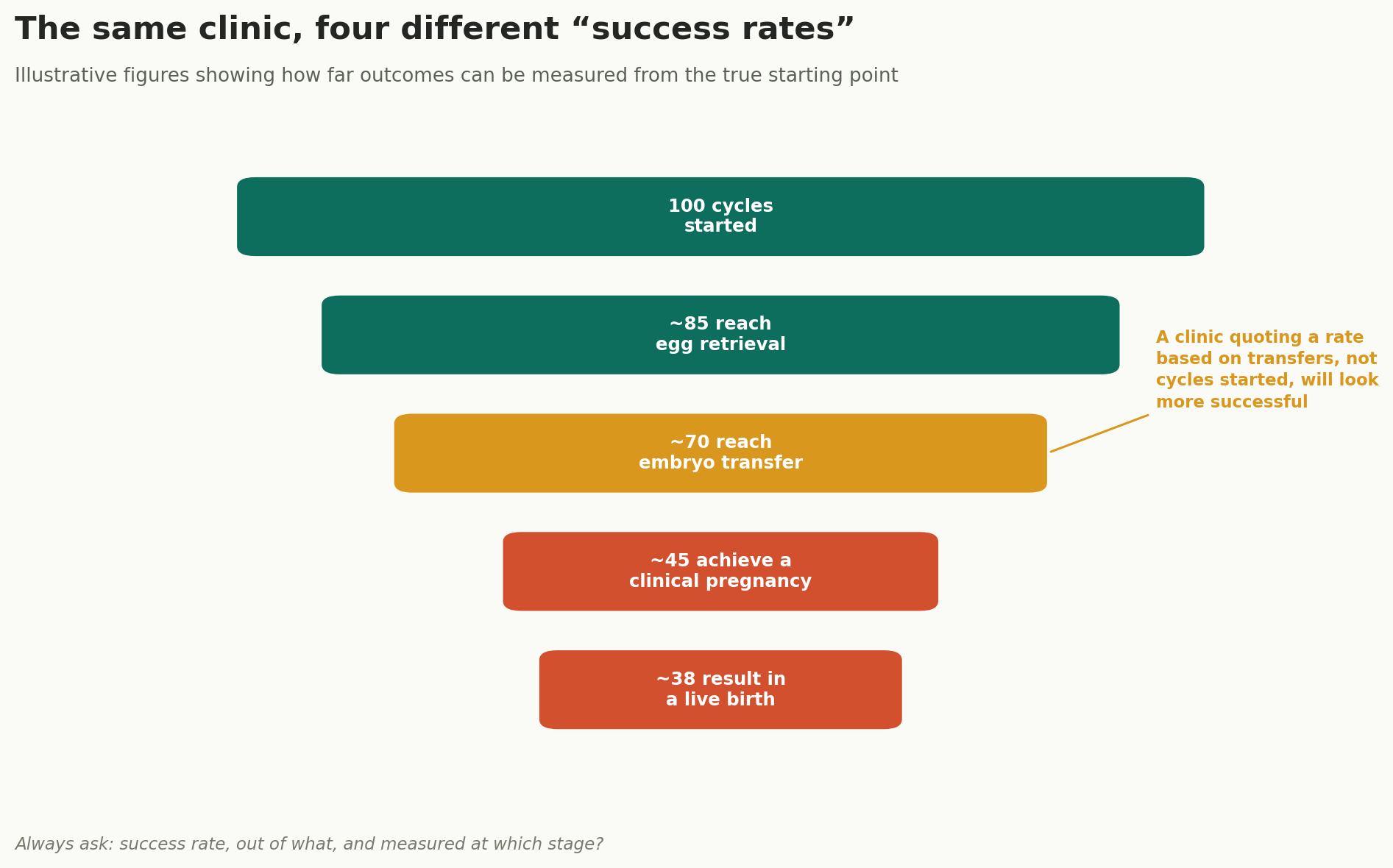
Always ask: success rate, out of what, and measured at which stage?
The most meaningful number for a patient's actual decision is typically the live birth rate per cycle started, since it reflects the full journey from the beginning, not a favourable midpoint. A clinic confident in its own outcomes should be able, and willing, to provide this specific figure without hesitation, ideally broken down by age group rather than as a single blended average. A clinic that answers this question immediately, with a specific number, is behaving very differently from one that redirects to a general, reassuring impression instead.
THE REAL TRADEOFF
A higher rate is not automatically a better outcome
One specific practice can meaningfully inflate a clinic's apparent success rate while introducing real risk that patients deserve to understand clearly.
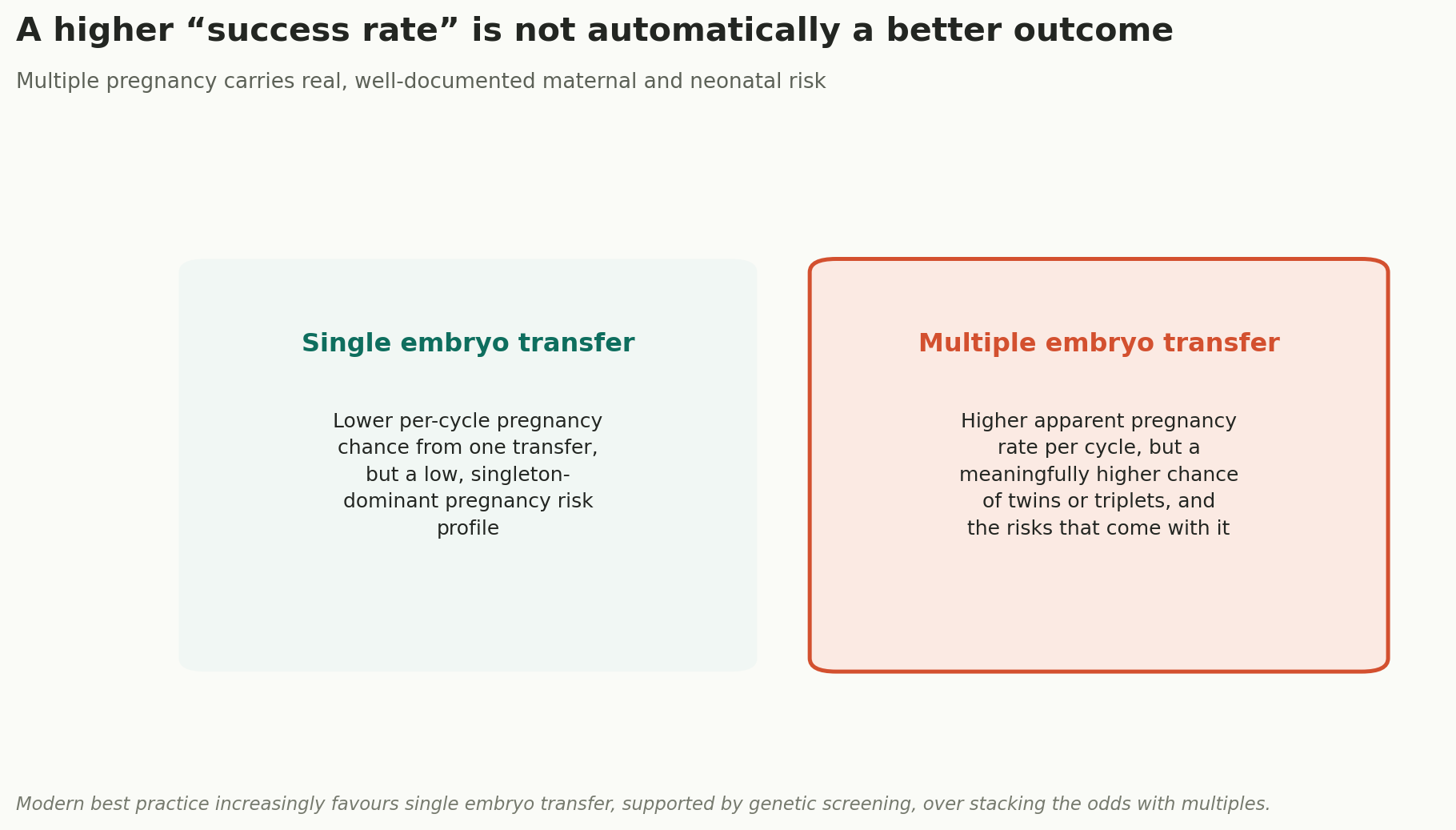
Modern best practice increasingly favours single embryo transfer, supported by genetic screening, over stacking the odds with multiples.
Multiple pregnancy carries genuinely elevated risk of preterm birth, low birth weight, pre-eclampsia, and other complications for both mother and babies. A clinic that defaults to transferring multiple embryos to boost its reported pregnancy rate, without a clear, individualised discussion of this tradeoff, is prioritising an appealing statistic over a patient's actual safety. This is precisely the kind of tradeoff a headline success rate alone can never reveal, since a statistic showing more pregnancies says nothing about how those pregnancies actually went.
A note on age and ovarian reserve, since biology sets the real boundaries. No clinic, however skilled, can overcome the fundamental biological reality that success rates decline with maternal age and diminished ovarian reserve. A programme that promises high success rates regardless of a patient's specific age and fertility profile, rather than setting realistic, individualised expectations, is not being honest about what the numbers actually show.
THE BALANCE
The lab is where the real work happens
Much of what determines whether an embryo develops successfully happens in a laboratory most patients never see, not in the consultation room.
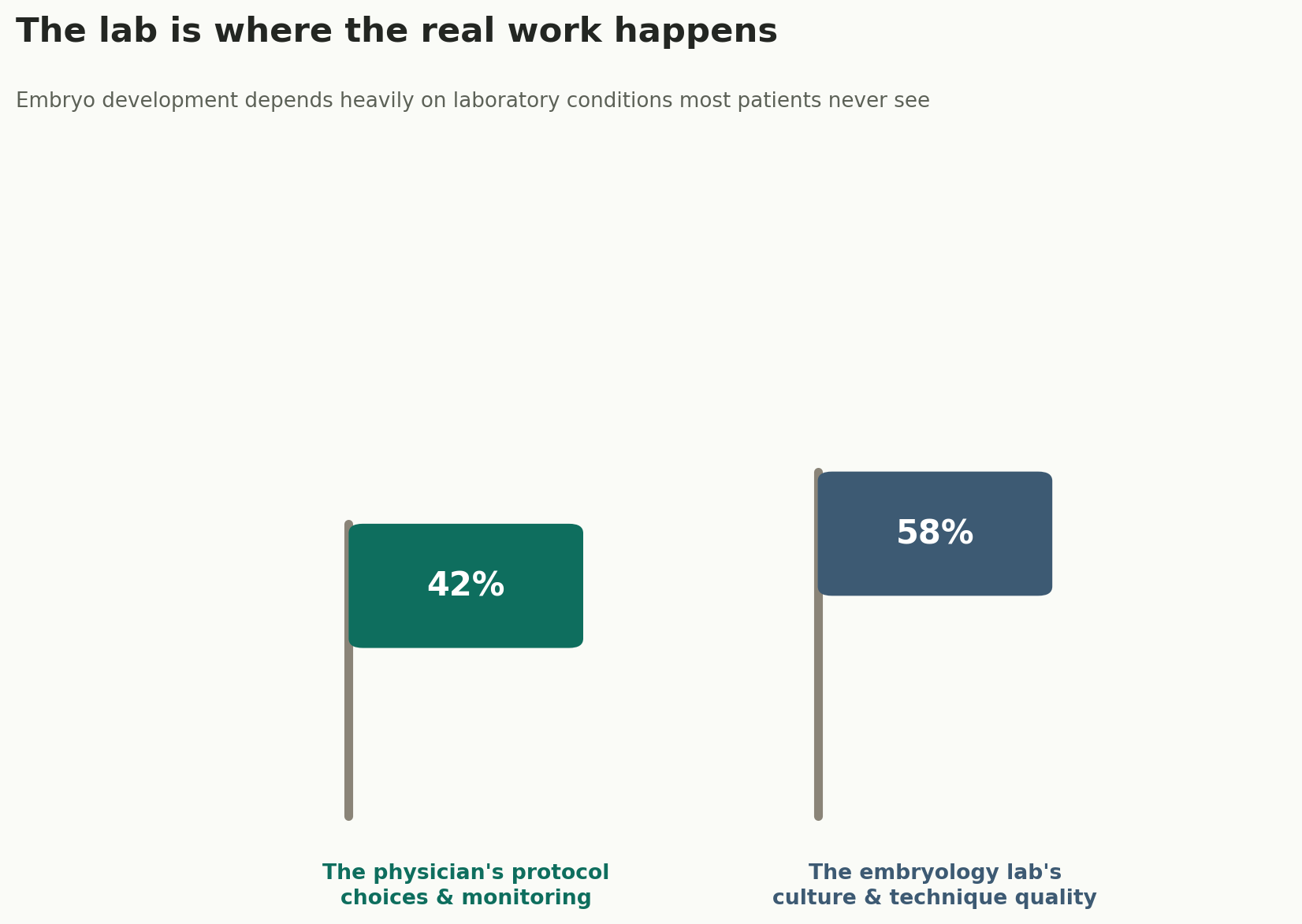
Embryo development depends heavily on laboratory conditions most patients never see.
The treating physician's protocol selection and monitoring genuinely matter, particularly for tailoring stimulation to an individual patient's response. But the embryology laboratory's culture conditions, handling technique, and freezing and thawing precision shape embryo quality and viability in ways that are largely invisible to a patient, yet substantially determine the outcome, giving the laboratory the larger relative share of this evaluation. This is a genuinely different balance than the more surgeon-weighted procedures elsewhere in this series, and it reflects a real, structural feature of how this particular treatment actually works.
THE VETTING CONVERSATION What to actually ask
Questions for the physician
- What is your live birth rate per cycle started, for someone my age? A specific, age-stratified answer suggests genuine, transparent reporting.
- What is your standard recommendation on single versus multiple embryo transfer? A thoughtful answer discusses individualised risk, not a fixed default.
- What is your realistic assessment for my specific fertility profile? This should be honest and individualised, not uniformly optimistic.
- How many cycles might realistically be needed, and what does that mean for cost? A precise, honest answer helps genuine planning.
Questions for the clinic and laboratory
- Is the embryology laboratory independently accredited, and by whom? This is a specific, verifiable fact worth confirming directly.
- What genetic testing options are available for embryo selection? This can support single embryo transfer decisions confidently.
- How is your published success rate defined, specifically? Ask directly whether it is per cycle, per transfer, or a live birth rate.
- What happens to unused embryos, and what are the storage and disposition options? This should be discussed clearly before treatment begins.
NIGERIA-SPECIFIC CONSIDERATIONS
Cost, more than access, is the real barrier
IVF is genuinely available within Nigeria, with real, established domestic programmes achieving documented outcomes. The more significant barrier for most Nigerian families is cost relative to income, rather than a lack of technical capability, and this reality should shape realistic planning as much as the choice of clinic itself. Given that most patients need more than one cycle to achieve a live birth, budgeting honestly for a realistic number of attempts, rather than assuming a single cycle will succeed, is a genuinely important part of this decision.
This also means that comparing domestic and international options honestly, on cost, laboratory quality, and realistic success rates specifically for a patient's own age and fertility profile, rather than assuming international treatment is automatically superior, is a worthwhile and genuinely open comparison for many Nigerian families. The same success-rate literacy this guide describes applies with equal force to a domestic clinic's claims as to an international one; the underlying statistical habits this guide warns about are not specific to any one country.
Four warning signs worth taking seriously
- A single, unqualified success rate quoted without explaining how it is measured. This should be specific and transparent.
- A default toward multiple embryo transfer without a clear, individualised risk discussion. This should be a genuine, informed choice, not a default.
- No age-stratified outcome data available. A blended average across all ages can be genuinely misleading.
- Uniformly optimistic predictions regardless of age or fertility profile. Honest, individualised expectation- setting is a marker of genuine quality.
A practical order of operations
- Complete a thorough fertility evaluation for both partners before choosing a clinic.
- Ask directly for a live birth rate per cycle started, broken down by age.
- Discuss single versus multiple embryo transfer honestly, understanding the real tradeoffs.
- Ask the physician-side and clinic-side questions above before committing to treatment.
- Budget realistically for more than one cycle, given typical per-cycle success rates.
- Coordinate with a Nigerian obstetrician for pregnancy care once a pregnancy is achieved.
A closing word
IVF success rates are genuinely useful information, but only when read correctly. A single headline number, without knowing what it is measured against, tells a family far less than it appears to. Learning to ask the right follow-up question, out of what, and at which stage, turns a marketing figure into something a family can actually use to make an informed decision. In twenty-four years of this work, the patients who navigate this best ask for a live birth rate per cycle, broken down honestly by age, discuss single versus multiple embryo transfer as a genuine choice rather than a default, and evaluate the embryology laboratory as seriously as the physician's own reputation. The number on a clinic's website is a starting point for a conversation, not the answer to it, and a family that treats it that way is protecting itself against a genuinely common, well-documented source of misplaced hope.
Sources
- 🌐 American Society for Reproductive Medicine — Understanding IVF success rates, patient information
- 🌐 Society for Assisted Reproductive Technology — National outcome reporting standards
- 🌐 Practice Committee Guidance on Elective Single Embryo Transfer. Fertility and Sterility
- 🌐 NHS (UK) — IVF: overview and success rates – nhs.uk
- 🌐 High Commission of India, Abuja — Medical and Medical Attendant Visa requirements
Frequently Asked Questions by Nigerians about IVF and Fertility Treatment in India
Why do IVF clinics report such different success rates?
Because success can be measured at different points—per cycle started, per egg retrieval, per embryo transfer, by pregnancy test, clinical pregnancy or live birth. A transfer-based figure usually looks higher than a cycle-started figure.
What is the most useful IVF success rate to ask for?
The guide recommends asking for the live birth rate per cycle started, ideally broken down by maternal age. This provides a more complete picture than a headline pregnancy rate.
Is a higher IVF pregnancy rate always better?
No. A clinic can raise its pregnancy rate by transferring multiple embryos, but this increases the risk of twins or triplets and associated complications such as prematurity and pre-eclampsia.
Why does the embryology laboratory matter so much?
Embryo development depends heavily on culture conditions, laboratory handling and freezing/thawing technique. Much of the outcome is therefore influenced by work patients never directly see.
What should Nigerian patients ask an IVF doctor?
Ask for the live birth rate for your age group, the recommended embryo-transfer strategy, your realistic individual prognosis and how many cycles may realistically be required.
What should patients ask the IVF clinic and laboratory?
Ask about laboratory accreditation, genetic-testing options, how published success rates are calculated and what happens to unused embryos, including storage and future disposition.
Is multiple embryo transfer always better than single embryo transfer?
No. Modern best practice increasingly favours single embryo transfer in suitable patients because it reduces multiple-pregnancy risk while still aiming for a healthy live birth.
Is IVF available in Nigeria?
Yes. The guide states that Nigeria has established IVF programmes with documented outcomes. The principal barrier for many families is cost rather than lack of treatment availability.
Should Nigerian couples automatically choose India over a Nigerian IVF clinic?
No. Domestic and international clinics should be compared on laboratory quality, transparent age-specific live birth rates, treatment strategy and realistic multi-cycle costs rather than assuming one country is automatically better.
What are the main warning signs when choosing an IVF clinic?
Warning signs include a single unexplained success rate, routine multiple embryo transfer without counselling, no age-specific outcome data, inability to describe laboratory accreditation and unrealistic optimism regardless of age or fertility profile.
Why do different clinics report such different success rates?
Rates can be measured at different stages, per cycle, per transfer, or as a live birth rate, and clinics are not always consistent about which figure they highlight. A rate based on transfers will look higher than one based on cycles started.
Is a higher pregnancy rate always better?
Not necessarily. Transferring multiple embryos can raise the apparent rate but meaningfully increases the chance of twins or triplets, which carries real maternal and neonatal risk.
Why does the embryology laboratory matter as much as the physician?
Embryo development depends heavily on laboratory culture conditions and technical handling most patients never see directly, a genuine, major determinant of outcomes.
What should I ask about a clinic's success rate specifically?
Ask whether it is based on cycles started or transfers, whether it reflects a live birth rate, and whether it is broken down by age group rather than a single average.
What is a realistic red flag when choosing a clinic?
An unqualified success rate without explanation, a default toward multiple embryo transfer, or an inability to describe laboratory accreditation, are genuine warning signs.
Page Summary
This guide explains how Nigerian couples should evaluate IVF doctors and clinics in India, starting with the number every clinic advertises. The same outcomes can produce very different percentages depending on what is counted — cycles started, egg retrievals, embryo transfers, positive tests or live births — so ask for the live birth rate per cycle started, broken down by age. A higher pregnancy rate is not automatically better: transferring several embryos lifts the figure and the risk of twins with it. The embryology laboratory deserves as much scrutiny as the doctor, because embryo culture, freezing and thawing all happen there. IVF already exists in Nigeria, so compare domestic and Indian clinics on the same terms, and budget for more than one cycle.
Citation Block
| Topic | Information |
|---|---|
| Topic Information | Details |
| Topic | Selecting the Best IVF and Infertility Doctors and Clinics in India for Nigerian Patients |
| Treatment | IVF and Assisted Reproductive Treatment |
| Country | India |
| Intended Audience | Nigerian Couples and Patients |
| Primary Specialty | Reproductive Medicine |
| Primary Outcome Measure | Live Birth Rate Per Cycle Started |
| Outcome Reporting Requirement | Age-Stratified Data |
| Main Statistical Risk | Success Rates Based on Different Denominators |
| Embryo Transfer Strategy | Single vs Multiple Embryo Transfer |
| Modern Practice Direction | Single Embryo Transfer for Appropriate Patients |
| Main Decision Principle | Understand How Success Is Measured Before Comparing Clinics |


Our Mission Statement
Our mission is to place patients at the centre of every healthcare decision by providing trustworthy, evidence-based, and unbiased medical information. We believe that informed patients make better decisions. Backed by personalised guidance from our experienced advisory team, we help patients understand their treatment options, compare them objectively, and confidently choose the path that best suits their medical needs and personal circumstances.
Patient Testimonials from Nigeria














Ready to Take the First Step?
Share your Medical Reports with our Healthcare Managers Today and Get a FREE CONSULTATION, a Personalized Treatment Plan, and Complete Support from Arrival to Recovery.
Get Your Free ConsultationAreas We Serve
This resource has been thoughtfully prepared for patients from Nigeria who are considering medical treatment in India. We also welcome patients from the wider region in the countries mentioned below-
We assist patients from:
- Benin
- Niger
- Chad
- Cameroon
- Algeria
- Egypt
- Libya
- Morocco
- Sudan
- Tunisia
- Burkina Faso
- Cabo Verde
- Côte d'Ivoire
- Gambia
- Ghana
- Equatorial Guinea
- São Tomé and Príncipe
Many of the insights, treatment pathways, hospital recommendations, travel guidance, and patient support services described here are equally relevant and may be used as a reference when planning treatment in India.
From Nigeria to India: Your Complete Patient Support Guide
- Artificial Disc Replacement in India for Nigerian Patients
- Weight Loss and Bariatric Surgery in India for Nigerian Patients
- Bone Marrow Transplant in India for Nigerian Patients
- Brain Tumour Surgery in India for Nigerian Patients
- Breast Cancer Treatment and Surgery in India for Nigerian Patients
- Cancer Treatment and Surgery in India for Nigerian Patients
- Cardiac Arrhythmia and Heart Pacemaker Treatment in India for Nigerian Patients
- Cardiac Surgery in India for Nigerian Patients
- Colorectal Cancer Treatment and Surgery in India for Nigerian Patients
- Complex Orthopaedic and Joint Revision Surgery in India for Nigerian Patients
- Cornea Transplant and Advanced Eye Surgery in India for Nigerian Patients
- CyberKnife Treatment in India for Nigerian Patients
- Gamma Knife Treatment in India for Nigerian Patients
- Heart Failure Treatment and Surgery in India for Nigerian Patients
- Hip Surgery in India for Nigerian Patients
- HIPEC Cancer Surgery in India for Nigerian Patients
- IVF and Fertility Treatment in India for Nigerian Patients
- Joint Arthroscopy and Sports Medicine in India for Nigerian Patients