

Selecting the Best HIPEC Cancer Surgeons and Hospitals in India for Nigerian Patients
Before asking who should perform this surgery, a more fundamental question deserves an honest answer: should this specific surgery be performed at all, for this specific cancer.
HIPEC, hyperthermic intraperitoneal chemotherapy, combines cytoreductive surgery, physically removing visible tumour from the abdominal cavity, with heated chemotherapy circulated through that cavity afterward. A landmark 2021 trial, PRODIGE 7, found something worth sitting with: for colorectal-origin peritoneal disease specifically, the heated chemotherapy component added no measurable survival benefit over the surgery alone. For appendiceal cancer and peritoneal mesothelioma, by contrast, the evidence for real benefit remains strong. This single fact should shape the very first conversation with any programme, well before questions about a specific surgeon's technique. This guide, unusually among this series, spends real time on whether the procedure itself is the right choice before moving to who should perform it. That order is deliberate: choosing an excellent surgeon for the wrong procedure is still, in a real and important sense, the wrong outcome for a patient.
Should you even be reading this guide? If a peritoneal cancer diagnosis has been made and HIPEC has genuinely been discussed as an option, this guide will help you evaluate whether it is appropriate for your specific cancer origin, and who should perform it if so. If diagnosis and staging are not yet complete, that is the necessary first step.
Healing Journeys of Nigerian Patients









Key Takeaways
- The guide's central message is that the first question should be whether HIPEC is appropriate for the patient's specific cancer, before choosing a surgeon or hospital.
- The page 2 chart shows strong evidence for appendiceal cancer/pseudomyxoma peritonei and peritoneal mesothelioma, growing evidence in selected ovarian and gastric cancers, and uncertain added benefit for colorectal peritoneal disease.
- The PRODIGE 7 trial found no additional survival benefit from the heated chemotherapy component for colorectal-origin peritoneal disease specifically, although cytoreductive surgery itself may still benefit selected patients.
- The Peritoneal Cancer Index (PCI) is a key assessment before surgery. It measures tumour spread across 13 abdominal regions, with each region scored from 0 to 3.
- A high PCI score across multiple regions may indicate that complete or near-complete tumour removal is unrealistic, making HIPEC inappropriate in some patients.
- The guide highlights the importance of the CC score after surgery. CC-0 or CC-1 indicates little or no visible residual disease and is associated with better outcomes than higher scores.
- The page 4 evaluation gives 57% weight to the surgeon and 43% to the hospital system, including ICU, perfusion-team and blood-bank capacity.
- Nigerian patients should ask about the surgeon's personal CC-0/CC-1 rate and annual HIPEC case volume, rather than relying only on general oncology or surgical experience.
- The guide notes that there is no published evidence of an established HIPEC programme in Nigeria, while a 2025 survey in a better-resourced part of Africa found only around one-quarter of institutions offering HIPEC.
- The guide identifies four major warning signs: HIPEC recommended without discussing cancer-specific evidence, no PCI assessment, unavailable cytoreduction results and no dedicated perfusion team or adequate ICU capacity.
Quick Facts
- Treatment
- Cytoreductive Surgery With HIPEC
- Country
- India
- Patients
- Patients from Nigeria
- Key Specialist
- HIPEC / Surgical Oncologist
- Main Assessment
- Cancer Origin and Peritoneal Cancer Index
- PCI
- Tumour Spread Scored Across 13 Abdominal Regions
- PCI Scoring
- 0–3 Per Region
- Strongest Evidence
- Appendiceal Cancer / Pseudomyxoma Peritonei and Peritoneal Mesothelioma
- Selected Cases
- Ovarian and Gastric Cancer
- Colorectal Disease
- Added HIPEC Survival Benefit Uncertain
- Key Trial
- PRODIGE 7
- Cytoreduction Goal
- Complete or Near-Complete Visible Tumour Removal
- Outcome Measure
- CC-0 / CC-1 Completeness of Cytoreduction
- Surgeon Evaluation
- 57% Weight
- Hospital Evaluation
- 43% Weight
- Important Check
- Ask for Personal CC-0/CC-1 Rate
- Hospital Check
- Dedicated Perfusion Team, ICU and Blood-Bank Capacity
- Nigeria Availability
- No Published Evidence of an Established HIPEC Programme
- Recovery
- Typically 2–3 Weeks in Hospital
- Pre-Travel Records
- Pathology, Imaging and Cancer-Staging Records
- Follow-Up
- Nigerian Oncologist and Coordinated Long-Term Cancer Care
- Author
- Dr. Dheeraj Bojwani
- Experience
- 24+ Years
In Brief
For Nigerian patients considering HIPEC in India, the guide recommends first confirming whether the evidence supports HIPEC for the specific cancer origin and whether the patient's PCI suggests that meaningful cytoreduction is achievable. Patients should ask about the surgeon's personal CC-0/CC-1 rate and annual HIPEC experience, while also verifying the hospital's dedicated perfusion team, ICU capacity and blood-bank support. Since HIPEC requires a demanding recovery, the guide also recommends arranging coordinated follow-up with a Nigerian oncologist and transferring complete pathology, treatment and cytoreduction records after returning home.
START HERE
The question before the surgeon question
Not every cancer that has spread to the peritoneum, the lining of the abdominal cavity, benefits equally from the heated chemotherapy component of this procedure. The strength of evidence varies meaningfully by where the original cancer came from.
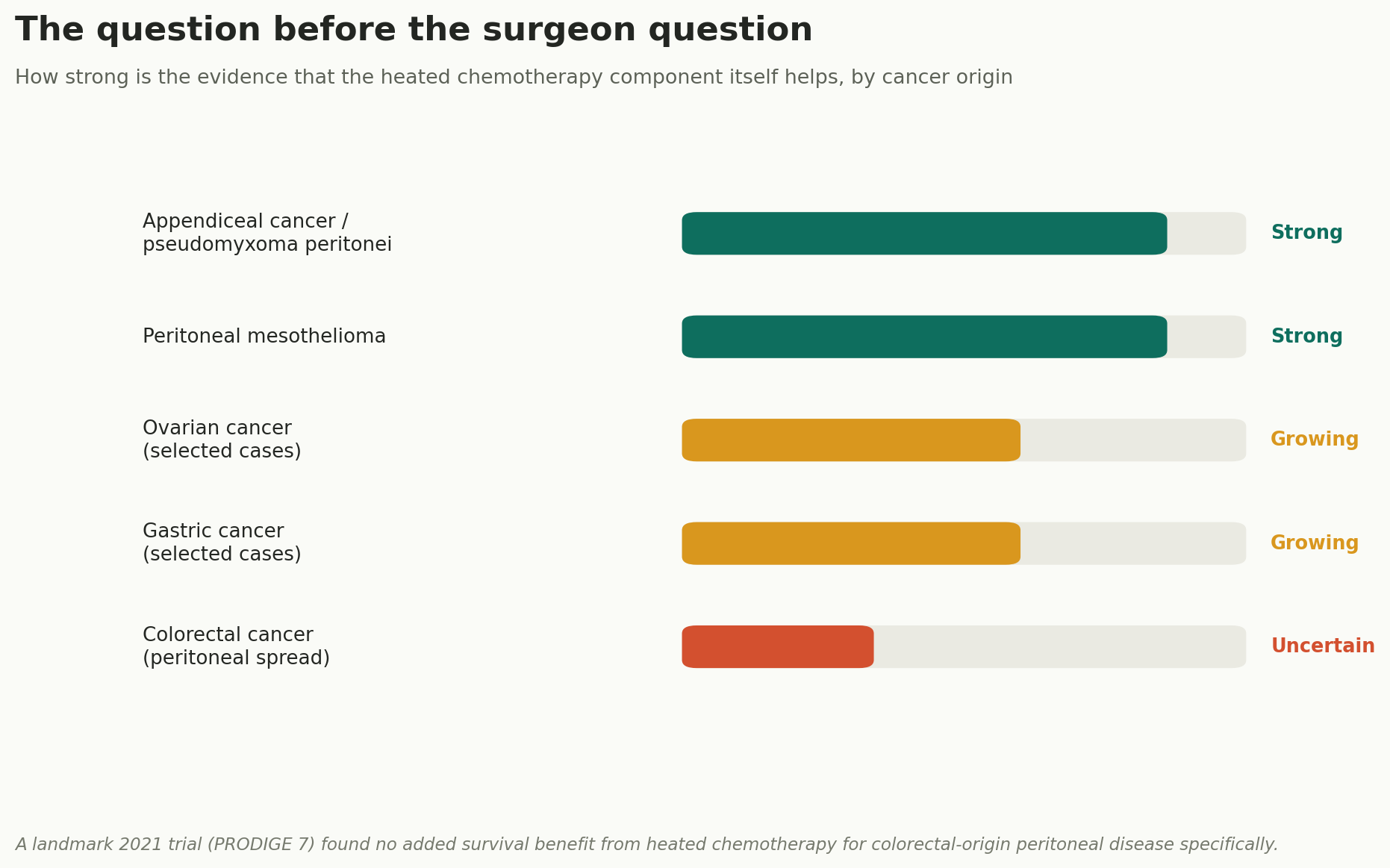
A landmark 2021 trial (PRODIGE 7) found no added survival benefit from heated chemotherapy for colorectal-origin peritoneal disease specifically.
This does not mean HIPEC is never appropriate for colorectal-origin disease; cytoreductive surgery itself can still offer real benefit, and individual cases vary. It means the specific claim, that the heated chemotherapy adds survival benefit, deserves a direct, honest conversation grounded in your specific cancer's origin, not a general assumption that the full procedure automatically helps because it sounds comprehensive. A programme genuinely committed to evidence-based care will have this conversation readily; one more focused on procedure volume may be less inclined to raise it unprompted.
The Technical Assessment
The score that decides whether surgery can even work
Even where HIPEC is genuinely indicated, whether a specific patient is a good candidate depends on how extensively the disease has spread within the abdominal cavity, measured through the peritoneal cancer index.
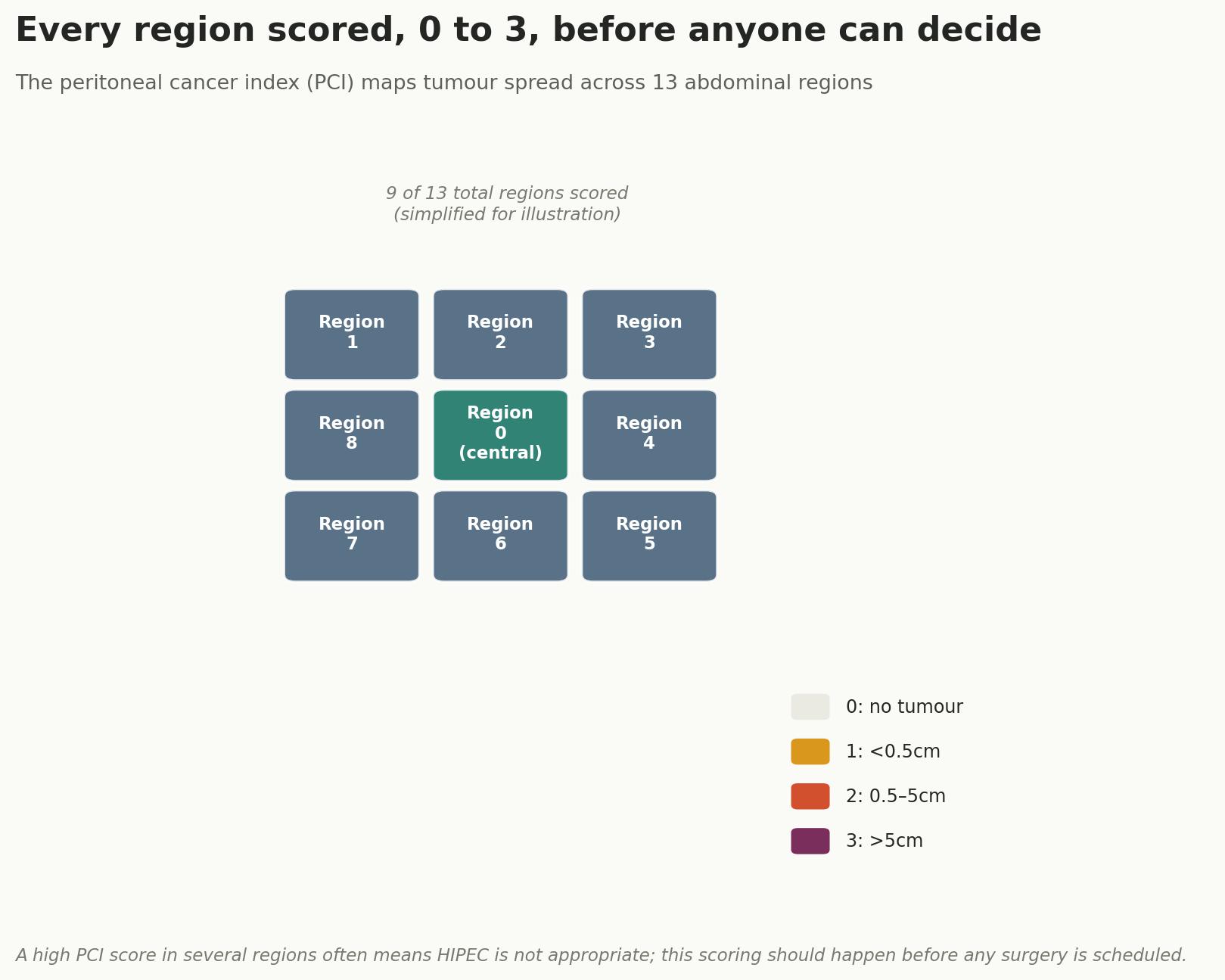
A high PCI score in several regions often means HIPEC is not appropriate; this scoring should happen before any surgery is scheduled.
The goal of cytoreductive surgery is complete or near-complete removal of visible tumour, and a high PCI score spread across many regions often signals that this goal is not realistically achievable, in which case proceeding with surgery may add risk without meaningful benefit. This assessment, ideally through imaging and sometimes diagnostic laparoscopy, should happen before a surgery date is ever discussed. A programme willing to walk a family through this score honestly, including scenarios where surgery may not be advisable, is demonstrating exactly the kind of judgement this procedure demands.
A note on what "successful" cytoreduction actually means. Surgeons record a completeness of cytoreduction, or CC, score after the operation, describing how much visible tumour remained. A CC-0 or CC- 1 score, indicating little to no visible residual disease, is associated with meaningfully better outcomes than a higher score. Ask for this score directly after surgery, the same way a colorectal cancer patient would ask about mesorectal fascia status. This single number, more than any description of how the surgery "went," is the closest thing to objective evidence of what was actually achieved.
THE BALANCE
The surgeon's judgement sits at the centre
Cytoreductive surgery for HIPEC can run many hours, with the surgeon making continuous, real-time decisions about what tissue can safely and completely be removed. This individual judgement carries unusual weight in this specific procedure.
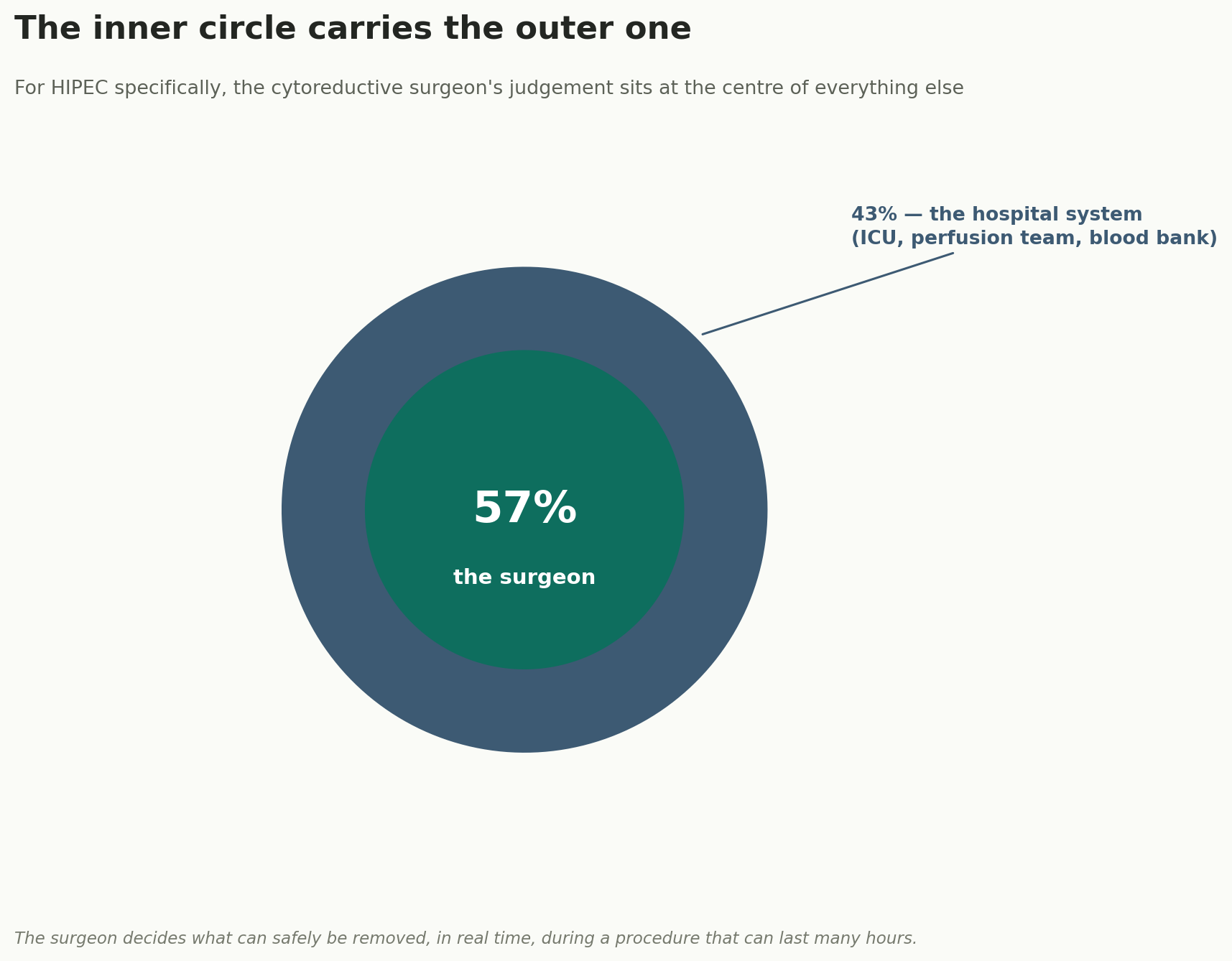
The surgeon decides what can safely be removed, in real time, during a procedure that can last many hours.
The hospital system surrounding that judgement remains genuinely essential: a dedicated perfusion team to deliver and monitor the heated chemotherapy safely, ICU capacity for a demanding recovery, and a blood bank equipped for a long, complex operation. But without the central surgical judgement being sound, none of that surrounding infrastructure can compensate. This is a genuinely different balance than pancreatic cancer surgery, where system-level complication management edges out the individual surgeon; HIPEC sits closer to colorectal cancer surgery in this respect, where the surgeon's own technical execution carries the larger share.
THE VETTING CONVERSATION
What to actually ask
Questions for the surgeon
- What is the strength of evidence for HIPEC specifically, given my cancer's origin? A thoughtful, honest answer engages directly with this, rather than a blanket recommendation.
- What is my peritoneal cancer index score, and what does it suggest about achievable cytoreduction? This should be a specific number, not a general impression.
- What is your personal rate of CC-0/CC-1 completeness of cytoreduction? A confident, specific answer suggests real, tracked experience.
- What is your annual case volume for this specific procedure? HIPEC is technically demanding and volume-sensitive, similar to other complex oncological surgery.
Questions for the hospital
- Is there a dedicated perfusion team experienced specifically with HIPEC delivery? This is specialised equipment and expertise, not standard operating theatre capability.
- What is the ICU and high-dependency capacity for this recovery? This is among the more physiologically demanding recoveries in oncological surgery.
- What is the hospital's own complication and mortality rate for this specific procedure? A programme that tracks and discusses this candidly is demonstrating real accountability.
- What is the plan for systemic therapy after surgery, if indicated? This should be part of a coordinated, multidisciplinary plan.
NIGERIA-SPECIFIC CONSIDERATIONS
A gap documented across the wider region
There is no published evidence of an established HIPEC programme operating in Nigeria. This pattern extends beyond Nigeria specifically: a 2025 survey across a comparatively better-resourced part of Africa found that while most surveyed institutions offered cytoreductive surgery and systemic chemotherapy individually, only around a quarter offered HIPEC itself, reflecting the specialised perfusion equipment, trained team, and intensive post-operative infrastructure this specific procedure requires beyond standard oncological surgery capacity. This is a genuinely useful data point in itself: it confirms the gap here is not unique to Nigeria but reflects how specialised this particular combination of surgery and technology remains across much of the continent.
For a Nigerian patient specifically, this means the more relevant local question is not simply "where is HIPEC available" but "has a proper cancer-origin-specific and PCI-based evaluation happened at all," since this assessment can, and should, begin with imaging and specialist consultation domestically before any decision about travelling for the procedure itself. A Nigerian oncologist can meaningfully contribute to this early evaluation even without direct HIPEC experience, since staging, imaging review, and an honest discussion of cancer origin do not require the specialised surgical infrastructure the procedure itself needs.
Four warning signs worth taking seriously
- HIPEC recommended without discussing the evidence strength for your specific cancer origin. This conversation should happen honestly, upfront.
- No clear peritoneal cancer index assessment before a surgery date is proposed. This score should genuinely inform whether surgery proceeds.
- Vague or unavailable completeness of cytoreduction rates. A genuinely experienced programme tracks and can share this.
- No dedicated perfusion team or unclear post-operative ICU capacity. This specialised infrastructure should be confirmed directly, not assumed.
A practical order of operations
- Get a confirmed diagnosis and identify the primary cancer origin before any HIPEC discussion.
- Ask directly about evidence strength for your specific cancer origin, using this guide as a reference.
- Complete a peritoneal cancer index assessment, through imaging or diagnostic laparoscopy, before scheduling surgery.
- Ask the surgeon-side and hospital-side questions above, particularly around CC-score tracking and perfusion team experience.
- Travel, surgery, and an extended, closely monitored recovery, typically two to three weeks in hospital.
- Hand full pathology, CC-score, and treatment documentation to a Nigerian oncologist for coordinated follow-up.
Straight Answers for Nigerian Patients about HIPEC Cancer Surgery in India
Does the heated chemotherapy always add a survival benefit?
No. PRODIGE 7 found no added survival benefit for colorectal-origin peritoneal disease specifically, though the surgery itself still showed benefit. Evidence remains strong for appendiceal cancer and peritoneal mesothelioma.
What is the peritoneal cancer index, and why does it matter?
It scores tumour spread across 13 abdominal regions from 0 to 3 each. A high score across multiple regions often means complete cytoreduction is not achievable, and HIPEC would not be appropriate.
Is HIPEC available in Nigeria?
There is no published evidence of an established programme. Even in better-resourced parts of Africa, a 2025 survey found only around a quarter of institutions offered HIPEC despite most offering the individual component treatments.
Why does the surgeon matter so much here?
Cytoreductive surgery requires real-time judgement about what tumour can safely and completely be removed, often over many hours. This individual judgement is central to whether the procedure succeeds.
What is a realistic red flag when choosing a programme?
HIPEC recommended without a clear PCI assessment, an inability to state completeness of cytoreduction rates, or no discussion of evidence strength for your cancer origin, are genuine warning signs.
A closing word
HIPEC is a genuine example of a procedure where more is not automatically better. The strongest evidence exists for specific cancer origins, the technical assessment before surgery matters as much as the operation itself, and a programme's honesty about all of this says more about its quality than any facility tour or marketing material. In twenty-four years of this work, the families who navigate this best ask directly whether the evidence supports HIPEC for their specific cancer, insist on a proper peritoneal cancer index assessment before committing to surgery, and confirm both the surgeon's individual track record and the hospital's specialised perfusion and ICU capacity. The question of whether to operate deserves as much rigour as the question of who should, and a family that asks both well is protecting itself against the single greatest risk in this specific decision: a technically excellent operation that should not have been performed at all.
Sources
- 🌐 Quenet F, et al. — Cytoreductive surgery with or without hyperthermic intraperitoneal chemotherapy for colorectal peritoneal metastases (PRODIGE 7)
- 🌐 Peritoneal Surface Oncology Group International — HIPEC and cytoreductive surgery, patient and provider resources
- 🌐 Survey of cytoreductive surgery and HIPEC availability across North African oncology institutions, 2025
- 🌐 American Society of Peritoneal Surface Malignancies — Patient information
- 🌐 High Commission of India, Abuja — Medical and Medical Attendant Visa requirements
Frequently Asked Questions by Nigerians about HIPEC Cancer Surgery in India
Should every Nigerian patient with peritoneal cancer receive HIPEC?
No. The guide stresses that HIPEC is not equally beneficial for every cancer origin and that suitability should be established before selecting a surgeon or hospital.
Which cancers have the strongest evidence for HIPEC?
The guide identifies appendiceal cancer/pseudomyxoma peritonei and peritoneal mesothelioma as having strong evidence for benefit from the heated chemotherapy component.
Does HIPEC provide a survival benefit for colorectal peritoneal cancer?
The PRODIGE 7 trial found no additional survival benefit from the heated chemotherapy component for colorectal-origin peritoneal disease specifically. Cytoreductive surgery itself may still benefit selected patients.
What is the Peritoneal Cancer Index?
PCI measures the extent of tumour spread across 13 abdominal regions, with each region scored from 0 to 3. It helps determine whether meaningful cytoreduction is realistically achievable.
Why is the PCI important before travelling to India?
A high PCI across multiple regions may indicate that complete tumour removal is unlikely, meaning the risks of surgery may outweigh the expected benefit. The guide recommends assessment before scheduling surgery.
What does a CC-0 or CC-1 score mean after HIPEC surgery?
It indicates that little or no visible tumour remains after cytoreduction. The guide identifies CC-0/CC-1 as an important objective measure of surgical completeness.
How should Nigerian patients evaluate a HIPEC surgeon?
They should ask for the surgeon's personal CC-0/CC-1 rate, annual HIPEC case volume and experience with the patient's specific cancer origin, rather than relying only on general surgical experience.
What should Nigerian patients check about the hospital?
They should confirm a dedicated HIPEC perfusion team, appropriate ICU or high-dependency capacity and a blood bank capable of supporting a long, complex operation.
Is HIPEC available in Nigeria?
The guide states that there is no published evidence of an established HIPEC programme in Nigeria. It also cites a 2025 African survey in which only around one-quarter of surveyed institutions offered HIPEC.
How should Nigerian patients plan follow-up after HIPEC in India?
The guide recommends returning home with complete pathology, CC-score and treatment documentation and establishing coordinated follow-up with a Nigerian oncologist. Recovery typically involves an extended hospital stay of around 2–3 weeks.
Page Summary
This guide explains how Nigerian patients can evaluate HIPEC surgeons and hospitals in India, with its central focus on determining whether HIPEC is appropriate before selecting a treatment programme. The page 2 chart shows that evidence is strongest for appendiceal cancer/pseudomyxoma peritonei and peritoneal mesothelioma, while the benefit of the heated chemotherapy component remains uncertain for colorectal-origin peritoneal disease following the PRODIGE 7 findings. The page 3 PCI diagram explains how tumour spread is scored across 13 abdominal regions and why a high score may make complete cytoreduction unrealistic. The page 4 evaluation gives 57% weight to the surgeon and 43% to hospital infrastructure, while the guide also emphasises CC-0/CC-1 outcomes, specialised perfusion support, ICU capacity, Nigeria's limited HIPEC availability and coordinated follow-up.
Citation Block
| Topic | Information |
|---|---|
| Topic Information | Selecting the Best HIPEC Cancer Surgeons and Hospitals in India for Nigerian Patients for Patients from Nigeria |
| Treatment | Cytoreductive Surgery With HIPEC |
| Intended Audience | Patients from Nigeria |
| Key Specialist | HIPEC / Surgical Oncologist |
| Primary Assessment | Cancer Origin and Peritoneal Cancer Index |
| PCI Assessment | Tumour Spread Across 13 Abdominal Regions, Scored 0–3 Each |
| Strong Evidence | Appendiceal Cancer / Pseudomyxoma Peritonei and Peritoneal Mesothelioma |
| Selected Cases | Ovarian and Gastric Cancer |
| Colorectal Cancer | Added Survival Benefit From Heated Chemotherapy Uncertain |
| Key Evidence | PRODIGE 7 Trial |
| Surgical Goal | Complete or Near-Complete Visible Tumour Removal |
| Outcome Measure | CC-0 / CC-1 Completeness of Cytoreduction |
| Evaluation Weighting | 57% Surgeon; 43% Hospital System |
| Surgeon Check | Confirm Personal CC-0/CC-1 Rate and Annual HIPEC Volume |
| Hospital Check | Confirm Dedicated HIPEC Perfusion Team |
| Infrastructure Check | ICU / High-Dependency Capacity and Adequate Blood Bank |
| Systemic Therapy Check | Confirm Post-Surgery Systemic Treatment Plan Where Indicated |
| Important Warning | Do Not Proceed Without Cancer-Origin-Specific Evidence Discussion |
| Pre-Travel Requirement | Confirm Diagnosis, Cancer Origin and PCI Assessment |
| Nigeria-Specific Check | No Published Evidence of an Established HIPEC Programme in Nigeria |
| Patient Journey | Diagnosis → cancer-origin assessment → PCI → surgeon/hospital evaluation → travel/surgery → extended recovery → Nigerian oncology follow-up |
| Follow-Up | Transfer Pathology, CC-Score and Treatment Records to Nigerian Oncologist |


Our Mission Statement
Our mission is to place patients at the centre of every healthcare decision by providing trustworthy, evidence-based, and unbiased medical information. We believe that informed patients make better decisions. Backed by personalised guidance from our experienced advisory team, we help patients understand their treatment options, compare them objectively, and confidently choose the path that best suits their medical needs and personal circumstances.
Patient Testimonials from Nigeria















Ready to Take the First Step?
Share your Medical Reports with our Healthcare Managers Today and Get a FREE CONSULTATION, a Personalized Treatment Plan, and Complete Support from Arrival to Recovery.
Get Your Free ConsultationAreas We Serve
This resource has been thoughtfully prepared for patients from Nigeria who are considering medical treatment in India. We also welcome patients from the wider region in the countries mentioned below-
We assist patients from:
- Benin
- Niger
- Chad
- Cameroon
- Algeria
- Egypt
- Libya
- Morocco
- Sudan
- Tunisia
- Gambia
- Ghana
- Burkina Faso
- Cabo Verde
- Côte d'Ivoire
- Equatorial Guinea
- São Tomé and Príncipe
Many of the insights, treatment pathways, hospital recommendations, travel guidance, and patient support services described here are equally relevant and may be used as a reference when planning treatment in India.
From Nigeria to India: Your Complete Patient Support Guide
- Artificial Disc Replacement in India for Nigerian Patients
- Weight Loss and Bariatric Surgery in India for Nigerian Patients
- Bone Marrow Transplant in India for Nigerian Patients
- Brain Tumour Surgery in India for Nigerian Patients
- Breast Cancer Treatment and Surgery in India for Nigerian Patients
- Cancer Treatment and Surgery in India for Nigerian Patients
- Cardiac Arrhythmia and Heart Pacemaker Treatment in India for Nigerian Patients
- Cardiac Surgery in India for Nigerian Patients
- Colorectal Cancer Treatment and Surgery in India for Nigerian Patients
- Complex Orthopaedic and Joint Revision Surgery in India for Nigerian Patients
- Cornea Transplant and Advanced Eye Surgery in India for Nigerian Patients
- CyberKnife Treatment in India for Nigerian Patients
- Gamma Knife Treatment in India for Nigerian Patients
- Heart Failure Treatment and Surgery in India for Nigerian Patients
- Hip Surgery in India for Nigerian Patients
- HIPEC Cancer Surgery in India for Nigerian Patients
- IVF and Fertility Treatment in India for Nigerian Patients
- Joint Arthroscopy and Sports Medicine in India for Nigerian Patients