

Selecting the Best Heart Valve Replacement Surgeons and Hospitals in India for Nigerian Patients
The name of this guide is slightly misleading. The best possible outcome for many patients is a valve they never actually have to replace.
When a diseased heart valve is diagnosed, most patients assume the question is simply which replacement valve to choose. There is often a genuinely better question to ask first: can this valve be repaired instead. Repair, where feasible, avoids both major long-term commitments replacement requires, lifelong anticoagulation for a mechanical valve, or a degeneration timeline that may mean reoperation for a bioprosthetic one. Whether repair is genuinely possible depends on the specific valve and pathology involved, and on a surgeon's specific, dedicated skill in this more technically demanding procedure, a skill that varies meaningfully between surgeons who otherwise share similar general cardiac surgery experience. This guide is organised around that central question, since it reshapes almost everything else about how a family should evaluate a surgeon and hospital for this specific procedure. A programme that raises repair as a genuine possibility, before any replacement conversation begins, is signalling something meaningfully different from one that moves straight to discussing valve brands and types.
Should you even be reading this guide? If valve disease has been diagnosed and surgery genuinely discussed, this guide will help you evaluate whether repair is a realistic option, and how to choose the surgical team and hospital if replacement is ultimately necessary. If diagnosis or a full cardiology work-up has not yet happened, that is the appropriate starting point.
Healing Journeys of Nigerian Patients









Key Takeaways
- The guide's central message is that valve replacement should not automatically be the first option. The most important question is whether the patient's own valve can be repaired.
- The page 2 chart shows that mitral and tricuspid regurgitation are often more repairable, while severely calcified aortic stenosis usually requires replacement. Repair feasibility depends on the patient's specific anatomy and pathology.
- The guide explains that regurgitation generally provides more repair opportunities than stenosis, because stenotic valves may have extensive calcification and scarring.
- When replacement is necessary, the guide compares mechanical and bioprosthetic valves. Mechanical valves can last decades but require lifelong anticoagulation and regular INR monitoring.
- Bioprosthetic valves generally avoid lifelong anticoagulation but can degenerate faster in younger patients, potentially creating a need for another procedure after approximately 10–15 years in some younger populations.
- The guide gives special attention to women planning future pregnancy, because mechanical-valve anticoagulation creates important pregnancy-related considerations.
- Nigerian surgical data show a strong preference for mechanical valves, which the guide relates partly to the younger, rheumatic-disease-dominant patient population in Nigeria.
- The page 4 evaluation gives 54% weight to the surgeon's repair judgement and technical skill and 46% to the hospital's perfusion team and anticoagulation-care capacity.
- The guide stresses that general cardiac surgery volume is not enough. Patients should ask for the surgeon's personal repair rate for their specific valve and pathology, particularly when rheumatic disease is involved.
- Four major warning signs are identified: replacement recommended without discussing repair, inability to provide a specific repair rate, a rushed mechanical-versus-bioprosthetic discussion and no coordinated anticoagulation-monitoring plan after returning to Nigeria.
Quick Facts
- Treatment
- Heart Valve Repair / Replacement
- Country
- India
- Patients
- Patients from Nigeria
- Key Specialist
- Cardiac Surgeon / Heart Valve Specialist
- Main Conditions
- Mitral, Tricuspid and Aortic Valve Disease
- Primary Assessment
- Detailed Valve Imaging and Full Cardiology Work-Up
- First Question
- Is Valve Repair Feasible?
- More Often Repairable
- Mitral and Tricuspid Regurgitation
- Usually Replacement
- Severely Calcified Aortic Stenosis
- Mechanical Valve
- Long-Term Durability With Lifelong Anticoagulation
- Bioprosthetic Valve
- No Lifelong Anticoagulation but Faster Degeneration in Younger Patients
- Surgeon Evaluation
- 54% Weight
- Hospital Evaluation
- 46% Weight
- Important Check
- Ask for Personal Repair Rate for the Specific Valve
- Rheumatic Disease Check
- Confirm Experience With Rheumatic Valve Pathology
- Anticoagulation Check
- Confirm Long-Term INR Monitoring Plan
- Pre-Travel Records
- Valve Imaging and Complete Cardiology Records
- Visa
- Indian Medical Visa and Medical Attendant Visa
- Follow-Up
- Nigerian Cardiologist and Long-Term Valve Monitoring
- Author
- Dr. Dheeraj Bojwani
- Experience
- 24+ Years
In Brief
For Nigerian patients considering heart valve surgery in India, the guide recommends asking whether the valve can be repaired before discussing replacement, because successful repair may avoid the lifelong commitments associated with either mechanical or bioprosthetic valves. If replacement is necessary, patients should have an individualised discussion about mechanical versus bioprosthetic options based on age, lifestyle, anticoagulation access and circumstances such as future pregnancy. They should also verify the surgeon's specific repair experience, the hospital's perfusion and anticoagulation support, and establish long-term follow-up with a Nigerian cardiologist before returning home.
START HERE
The valve you get to keep
Understanding where a specific diagnosis sits on this spectrum is the necessary first step before any surgeon or hospital conversation begins.
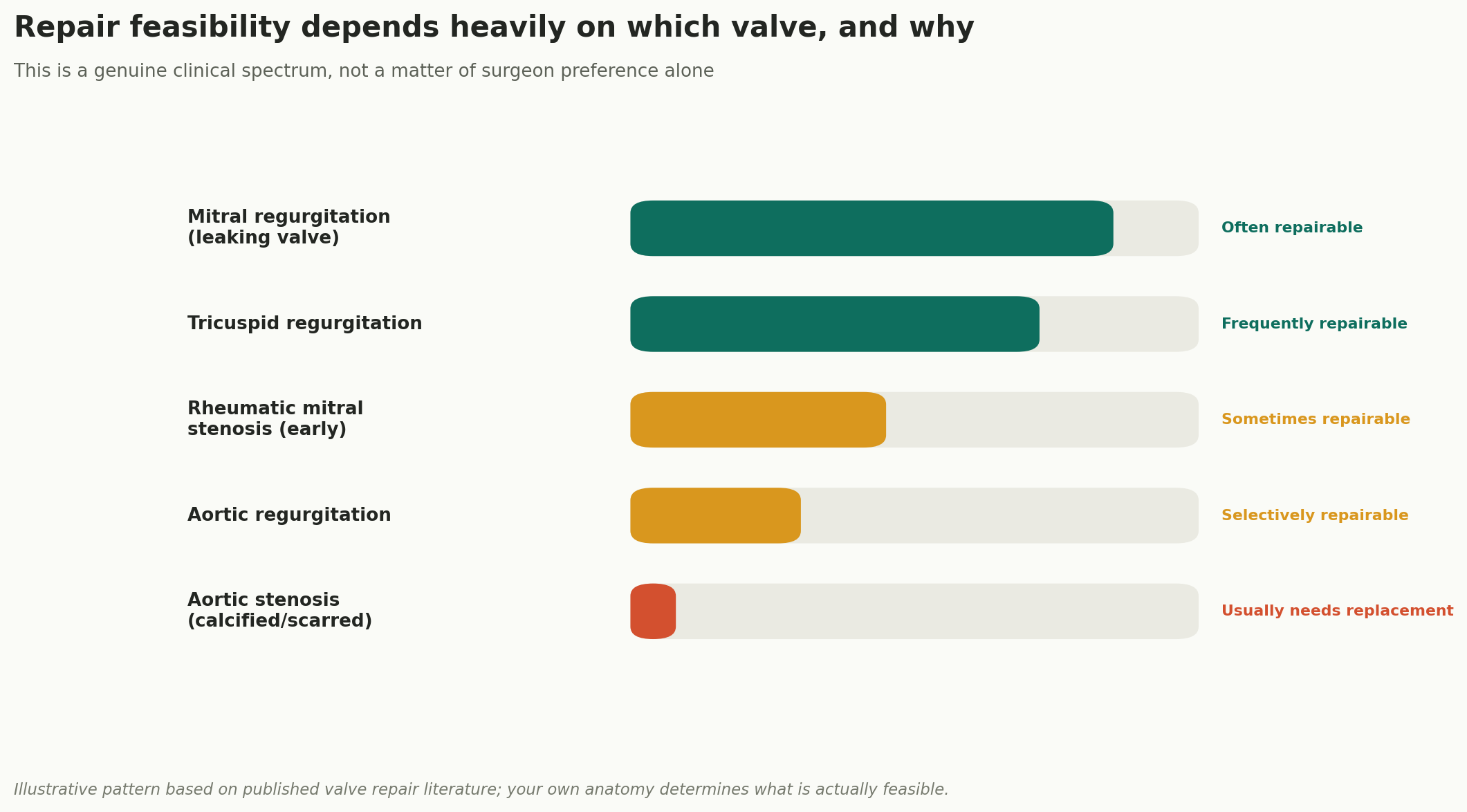
Illustrative pattern based on published valve repair literature; your own anatomy determines what is actually feasible.
This is not a matter of surgeon preference or a hospital's marketing language; it reflects genuine anatomical and pathological reality. A leaking mitral valve, for instance, is frequently repairable because the surgeon is reshaping existing, still-functional tissue. A severely calcified, scarred aortic valve, by contrast, often no longer has enough healthy tissue left to repair meaningfully. Asking directly where your specific diagnosis falls on this spectrum, before any conversation about replacement valve type, is the single most useful question in this guide.
Even within a single valve, the specific type of dysfunction matters enormously. Regurgitation, a valve that leaks, generally offers more repair opportunity than stenosis, a valve that has become too narrow or stiff to open properly, since stenotic valves are often affected by the kind of calcification and scarring that leaves little healthy tissue to work with. A surgeon who explains this distinction clearly, in relation to your specific imaging, is demonstrating exactly the kind of case-specific thinking this decision deserves.
IF REPLACEMENT IS NECESSARY
A choice that deserves the full conversation
When repair has genuinely been ruled out, the mechanical-versus-bioprosthetic decision becomes the central question, and it deserves real time, not a rushed recommendation.
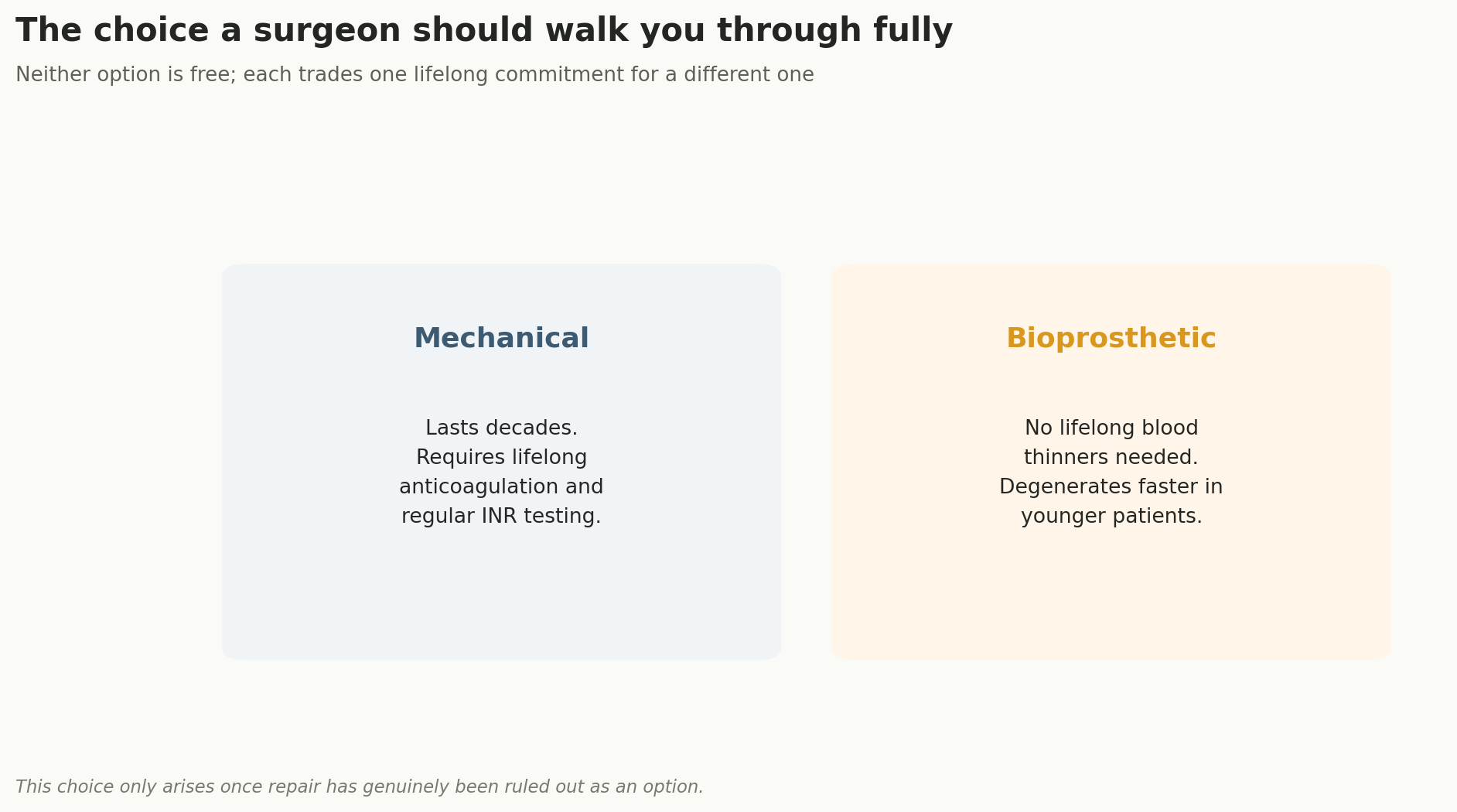
This choice only arises once repair has genuinely been ruled out as an option.
Published Nigerian surgical data shows a strong preference for mechanical valves, largely because the young, rheumatic-disease-dominant patient population common in Nigeria makes bioprosthetic degeneration, and a likely second surgery within 10 to 15 years, a genuinely serious consideration. This is not a universal rule; it reflects a population-level pattern worth discussing specifically in relation to your own age, lifestyle, and realistic access to anticoagulation monitoring.
A woman planning future pregnancy deserves particular attention in this conversation, since mechanical valve anticoagulation carries real, documented risk during pregnancy, making bioprosthetic valves a genuinely relevant consideration despite their shorter expected lifespan in younger patients. This is precisely the kind of individual circumstance a thorough surgeon should ask about directly, rather than defaulting to whichever valve type their programme uses most often.
A note on why repair-specific experience is worth asking about directly. A surgeon can have extensive general cardiac surgery volume while rarely attempting valve repair specifically, since repair is technically more demanding and some surgeons default to replacement even in genuinely repairable cases. Asking for a surgeon's personal repair rate, for your specific valve and pathology, is a more useful question than asking about overall surgical volume alone.
THE BALANCE
The surgeon's judgement tips the balance
Given how directly the repair-or-replace decision, and the technical execution of a repair, depends on the individual surgeon, this procedure weights meaningfully toward the surgeon.
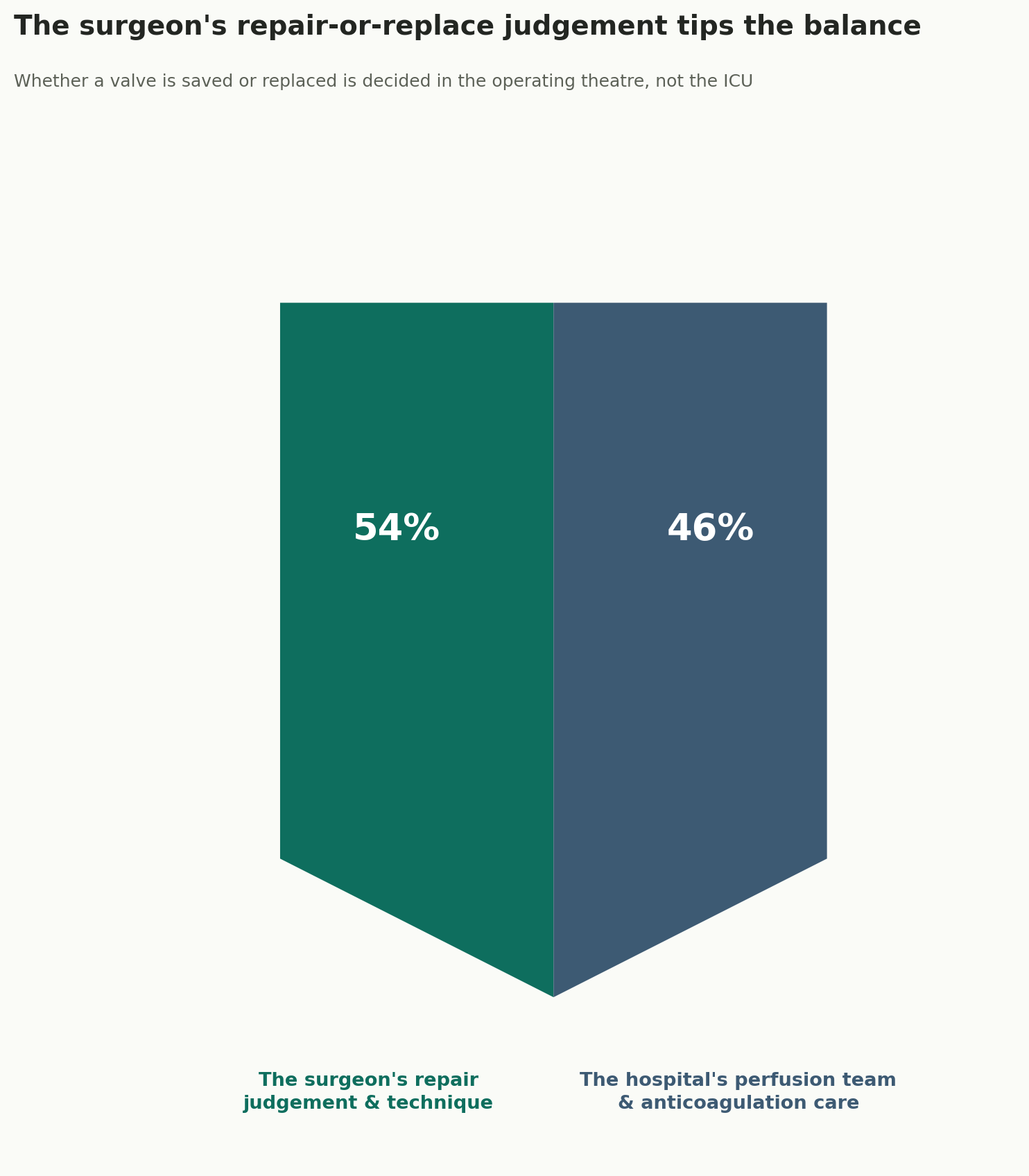
Whether a valve is saved or replaced is decided in the operating theatre, not the ICU.
This does not diminish the hospital's role. The perfusion team, managing the heart-lung bypass machine during surgery, and the hospital's capacity to coordinate long-term anticoagulation monitoring for mechanical valve recipients, both matter genuinely. But the central, defining decision, made in real time as the surgeon examines the valve directly, and the specific skill required to execute a repair rather than default to replacement, sits primarily with the individual surgeon's training and judgement.
This weighting is worth comparing against other cardiac procedures in this series. Paediatric heart surgery leans more heavily toward the hospital, given how much a fragile infant's outcome depends on the surrounding team. Adult valve surgery leans back toward the surgeon specifically because the repair-versus- replace decision is such a defining, individually-determined moment within the operation itself.
THE VETTING CONVERSATION
What to actually ask
Questions for the surgeon
- Is repair genuinely feasible for my specific valve and pathology? A thoughtful answer engages with your particular anatomy, not a general policy.
- What is your personal repair rate for this specific valve? A specific, confident answer suggests real, dedicated experience beyond general volume.
- If replacement is needed, walk me through mechanical versus bioprosthetic for my situation. This should be a genuine, individualised conversation.
- What happens if the valve turns out to be repairable once you are actually operating? A clear, honest answer suggests real intraoperative flexibility, not a fixed plan.
Questions for the hospital
- What is the perfusion team's specific experience with valve surgery? This is a distinct, specialised skill worth confirming directly.
- What is the plan for anticoagulation monitoring if a mechanical valve is placed? This should be a coordinated plan, not left for the patient to arrange alone.
- What is the hospital's own repair rate, not just replacement outcomes? A programme confident in its repair capability will track and share this.
- What is the plan for long-term follow-up once I return to Nigeria? This should be established before travel, not after.
Nigeria-specific Considerations
Why this conversation matters even more here
Nigerian valve disease is overwhelmingly rheumatic in origin, striking a younger population than the degenerative valve disease more common in high-income countries. This makes the repair question genuinely urgent to raise: a young patient facing a lifetime with a replaced valve, mechanical or bioprosthetic, is looking at decades of consequences from this single decision, far more than an older patient with degenerative disease might face. Asking specifically about repair feasibility is not a theoretical exercise for this population; it is often the single decision most likely to shape quality of life for the following fifty years.
This also means the surgeon's specific experience with rheumatic valve disease, distinct from the degenerative disease more heavily represented in Western surgical training, is worth confirming directly. Rheumatic valve tissue often presents differently than degenerative disease, and genuine, dedicated experience with this specific pathology, not just general valve surgery volume, shapes both repair feasibility and outcomes meaningfully.
Four warning signs worth taking seriously
- Replacement recommended without a specific discussion of repair feasibility. This should be raised proactively, not only if asked.
- A surgeon unable to state their personal repair rate for your specific valve. Vague reassurance is not the same as tracked experience.
- A rushed mechanical-versus-bioprosthetic conversation. This decision deserves real time and honest, individualised discussion.
- No coordinated plan for anticoagulation monitoring after a mechanical valve. This should be arranged before you return home, not left to chance.
A practical order of operations
- Get a confirmed diagnosis and full cardiology work-up, including detailed valve imaging.
- Ask directly whether repair is feasible for your specific valve and pathology.
- If replacement is genuinely necessary, work through the mechanical-versus-bioprosthetic decision fully.
- Ask the surgeon-side and hospital-side questions above before committing to a programme.
- Travel, surgery, and a supervised recovery period appropriate to the procedure performed.
- Establish a coordinated monitoring relationship with a Nigerian cardiologist before returning home.
Straight Answers for Nigerian Patients about Heart Valve Replacement Surgery in India
Is valve repair always better than replacement?
When genuinely feasible, repair is generally preferred, avoiding both the anticoagulation burden of a mechanical valve and the degeneration timeline of a bioprosthetic one. Feasibility depends heavily on the specific valve and pathology.
Why should I ask about a surgeon's specific repair experience?
Repair is technically more demanding than replacement and requires dedicated experience beyond general surgical volume. A low personal repair rate is a genuine signal worth asking about directly.
If replacement is needed, how should I think about mechanical versus bioprosthetic?
Neither is free of long-term commitment. Mechanical valves last decades but need lifelong blood thinners. Bioprosthetic valves need none but degenerate faster in younger patients.
Why does the surgeon matter more than the hospital here?
Whether a valve is repaired or replaced is decided in real time by the surgeon in the operating theatre, a judgement and skill that sits primarily with the individual, though hospital infrastructure remains genuinely important.
What is a realistic red flag when choosing a programme?
Replacement recommended without discussing repair, an inability to state a personal repair rate, or a rushed valve-type conversation, are genuine warning signs.
A closing word
Heart valve surgery is often framed as a choice between two replacement options, when the more important question frequently comes earlier: whether replacement is even necessary at all. A surgeon confident and skilled enough to repair a valve, rather than default to replacement, is offering something genuinely valuable, a native valve, and years without the lifelong commitments either replacement option requires. In twenty-four years of this work, the patients who navigate this best ask directly about repair feasibility before any replacement conversation begins, request a surgeon's specific repair experience rather than general volume, and, where replacement is genuinely necessary, insist on a full, unhurried conversation about which valve type actually fits their life. The valve itself may be addressed in a matter of hours. What that decision means for the decades that follow is what this guide is really about.
Sources
- 🌐 Surgical Treatment of Valvular Heart Disease in Nigeria: A 6-Year Experience. Published Nigerian cardiac surgery series
- 🌐 American College of Cardiology / American Heart Association — Valvular heart disease guidelines, valve repair versus replacement
- 🌐 Zilla P, Human P, Pennel T. Mechanical valve replacement for patients with rheumatic heart disease
- 🌐 American Heart Association — Heart valve surgery, patient information
- 🌐 High Commission of India, Abuja — Medical and Medical Attendant Visa requirements
Frequently Asked Questions by Nigerians about Heart Valve Replacement Surgery in India
Should Nigerian patients ask about valve repair before replacement?
Yes. The guide considers this the most important initial question, because a successful repair can preserve the patient's own valve and avoid some long-term replacement-related commitments.
Which heart valves are more likely to be repairable?
The guide shows that mitral and tricuspid regurgitation are often repairable, while repair becomes less likely with severely calcified aortic stenosis.
Is valve repair always possible for mitral or tricuspid disease?
No. Repair depends on the specific anatomy, pathology and condition of the valve tissue. The patient's imaging must be assessed individually.
What is the difference between mechanical and bioprosthetic valves?
Mechanical valves can last decades but require lifelong anticoagulation and INR monitoring. Bioprosthetic valves generally avoid lifelong blood thinners but can degenerate faster, particularly in younger patients.
Why is valve choice especially important for younger Nigerian patients?
The guide notes that Nigeria has a younger, rheumatic-disease-dominant valve population, making the long-term consequences of valve replacement particularly important.
Which valve may be relevant for a woman planning future pregnancy?
The guide states that a bioprosthetic valve may be an important consideration, because anticoagulation associated with mechanical valves carries documented pregnancy-related risks.
Why should Nigerian patients ask for the surgeon's personal repair rate?
Repair is technically more demanding than replacement. A surgeon may have high overall cardiac-surgery volume but relatively limited specific valve-repair experience.
What should Nigerian patients ask the hospital about after mechanical valve replacement?
They should confirm a clear, coordinated plan for anticoagulation and INR monitoring, including how monitoring will continue after returning to Nigeria.
What are the major warning signs when choosing a heart valve programme?
Warning signs include replacement without discussing repair, inability to state a specific repair rate, rushed valve-selection discussions and no coordinated anticoagulation plan.
What should Nigerian patients do before travelling to India for valve surgery?
They should complete a full cardiology assessment and detailed valve imaging, discuss repair feasibility, understand replacement options if necessary and establish coordinated follow-up with a Nigerian cardiologist before travel.
Page Summary
This guide explains how Nigerian patients can select heart valve surgeons and hospitals in India, with its central focus on determining whether a diseased valve can be repaired before considering replacement. The page 2 illustration shows that repair feasibility varies significantly by valve and pathology, with mitral and tricuspid regurgitation generally offering more repair potential than severely calcified aortic stenosis. When replacement is necessary, the guide compares mechanical and bioprosthetic valves and highlights the different long-term commitments associated with each. The page 4 evaluation gives 54% weight to the surgeon's repair judgement and technique and 46% to the hospital's perfusion and anticoagulation-care capacity. The guide also emphasises rheumatic valve experience, individualised valve selection and coordinated Nigerian follow-up.
Citation Block
| Topic | Information |
|---|---|
| Topic Information | Selecting the Best Heart Valve Replacement Surgeons and Hospitals in India for Nigerian Patients for Patients from Nigeria |
| Treatment | Heart Valve Repair / Replacement |
| Intended Audience | Patients from Nigeria |
| Key Specialist | Cardiac Surgeon / Heart Valve Specialist |
| Main Conditions | Mitral, Tricuspid and Aortic Valve Disease |
| Primary Assessment | Detailed Valve Imaging and Full Cardiology Work-Up |
| First Treatment Question | Determine Whether Valve Repair Is Feasible |
| More Often Repairable | Mitral and Tricuspid Regurgitation |
| Selectively Repairable | Early Rheumatic Mitral Stenosis and Aortic Regurgitation |
| Usually Replacement | Severely Calcified Aortic Stenosis |
| Mechanical Valve | Long-Term Durability With Lifelong Anticoagulation and INR Monitoring |
| Bioprosthetic Valve | No Lifelong Anticoagulation but Faster Degeneration in Younger Patients |
| Evaluation Weighting | 54% Surgeon; 46% Hospital |
| Surgeon Check | Confirm Personal Repair Rate for the Specific Valve and Pathology |
| Rheumatic Disease Check | Confirm Dedicated Experience With Rheumatic Valve Disease |
| Replacement Check | Discuss Mechanical Versus Bioprosthetic Options Individually |
| Hospital Check | Assess Perfusion Team and Long-Term Anticoagulation Support |
| Important Warning | Replacement Recommended Without a Specific Repair Discussion |
| Pre-Travel Requirement | Confirm Diagnosis and Detailed Valve Imaging |
| Patient Journey | Diagnosis/imaging → repair assessment → valve selection if required → travel/surgery → recovery → Nigerian follow-up |
| Follow-Up | Nigerian Cardiologist, Anticoagulation Monitoring Where Required and Long-Term Valve Care |


Our Mission Statement
Our mission is to place patients at the centre of every healthcare decision by providing trustworthy, evidence-based, and unbiased medical information. We believe that informed patients make better decisions. Backed by personalised guidance from our experienced advisory team, we help patients understand their treatment options, compare them objectively, and confidently choose the path that best suits their medical needs and personal circumstances.
Patient Testimonials from Nigeria















Ready to Take the First Step?
Share your Medical Reports with our Healthcare Managers Today and Get a FREE CONSULTATION, a Personalized Treatment Plan, and Complete Support from Arrival to Recovery.
Get Your Free ConsultationAreas We Serve
This resource has been thoughtfully prepared for patients from Nigeria who are considering medical treatment in India. We also welcome patients from the wider region in the countries mentioned below-
We assist patients from:
- Benin
- Niger
- Chad
- Cameroon
- Algeria
- Egypt
- Libya
- Morocco
- Sudan
- Tunisia
- Gambia
- Ghana
- Burkina Faso
- Cabo Verde
- Côte d'Ivoire
- Equatorial Guinea
- São Tomé and Príncipe
Many of the insights, treatment pathways, hospital recommendations, travel guidance, and patient support services described here are equally relevant and may be used as a reference when planning treatment in India.
From Nigeria to India: Your Complete Patient Support Guide
- Artificial Disc Replacement in India for Nigerian Patients
- Weight Loss and Bariatric Surgery in India for Nigerian Patients
- Bone Marrow Transplant in India for Nigerian Patients
- Brain Tumour Surgery in India for Nigerian Patients
- Breast Cancer Treatment and Surgery in India for Nigerian Patients
- Cancer Treatment and Surgery in India for Nigerian Patients
- Cardiac Arrhythmia and Heart Pacemaker Treatment in India for Nigerian Patients
- Cardiac Surgery in India for Nigerian Patients
- Colorectal Cancer Treatment and Surgery in India for Nigerian Patients
- Complex Orthopaedic and Joint Revision Surgery in India for Nigerian Patients
- Cornea Transplant and Advanced Eye Surgery in India for Nigerian Patients
- CyberKnife Treatment in India for Nigerian Patients
- Gamma Knife Treatment in India for Nigerian Patients
- Heart Failure Treatment and Surgery in India for Nigerian Patients
- Hip Surgery in India for Nigerian Patients
- HIPEC Cancer Surgery in India for Nigerian Patients
- IVF and Fertility Treatment in India for Nigerian Patients
- Joint Arthroscopy and Sports Medicine in India for Nigerian Patients