

Selecting the Best Heart Failure Specialists and Hospitals in India for Nigerian Patients
For advanced heart failure specifically, the most important part of "the surgery" happens in the years of outpatient visits that follow it.
Heart failure spans a genuinely wide range of severity, from earlier-stage disease well managed by a single cardiologist and medication, through advanced disease requiring devices such as a left ventricular assist device, or LVAD, and consideration of transplantation. For this more advanced end of the spectrum specifically, published research points to a finding many patients do not expect: long-term survival depends substantially on the structure and depth of ongoing, coordinated care after the initial procedure, not on the procedure alone. This guide sets out that specific finding, what genuine multidisciplinary team depth actually looks like, and why this evaluation weighs the surrounding programme more heavily than the treating surgeon, a genuinely different balance than several other procedures in this series.
Should you even be reading this guide? If advanced heart failure treatment, including device therapy, has genuinely been discussed as appropriate for your specific condition, this guide will help you evaluate the specialist team and hospital. This series' main Heart Failure guide covers the broader diagnostic and treatment landscape.
Healing Journeys of Nigerian Patients









Key Takeaways
- The guide's central message is that advanced heart failure care requires a multidisciplinary programme, not just an individual cardiologist. This becomes particularly important when device therapy such as an LVAD is being considered.
- The page 2 comparison identifies a genuine advanced programme as one involving heart-failure cardiologists, nurse coordinators, pharmacists, nutritionists, social workers and device specialists.
- The guide stresses that long-term outcomes depend substantially on the structured outpatient programme after the procedure, rather than on the implant operation alone.
- The page 3 chart reports survival of 97.9% at year 1, 92.8% at year 2, 83.7% at year 4 and 51.1% at year 8 under a well-structured LVAD outpatient programme.
- An LVAD is not presented as a cure. It is a serious therapy that may extend survival and improve quality of life for appropriately selected patients with advanced heart failure.
- The LVAD driveline exits through the skin and requires careful daily management to reduce infection risk, making hands-on training before discharge essential.
- The page 4 evaluation gives 58% weight to the programme's multidisciplinary depth and long-term care structure and 42% to the surgeon's specific implant or procedural technique.
- Nigerian patients should confirm a structured outpatient follow-up plan, device monitoring arrangements and an emergency response plan before travelling for advanced heart failure treatment.
- The guide recommends identifying the Nigerian specialist who will coordinate ongoing care before travel, particularly because advanced heart failure infrastructure and device therapy remain limited within Nigeria.
- Four major warning signs are identified: no genuine multidisciplinary team, no structured outpatient follow-up plan, inadequate device-care training and no coordinated Nigerian follow-up plan.
Quick Facts
- Treatment
- Advanced Heart Failure Care / LVAD Therapy
- Country
- India
- Patients
- Patients from Nigeria
- Key Specialist
- Heart Failure Cardiologist / Advanced Heart Failure Team
- Main Advanced Therapy
- Left Ventricular Assist Device (LVAD)
- Team Structure
- Cardiologists, Nurse Coordinators, Pharmacists, Nutritionists, Social Workers and Device Specialists
- Primary Assessment
- Full Heart Failure Assessment and Staging
- Programme Evaluation
- 58% Multidisciplinary Programme; 42% Surgeon / Procedural Technique
- Year 1 Survival
- 97.9% in the Cited Well-Structured LVAD Programme
- Year 8 Survival
- 51.1% in the Cited Well-Structured LVAD Programme
- Important Care Requirement
- Lifelong Driveline and Device Management
- Training Check
- Hands-On Device and Driveline Care Before Discharge
- Follow-Up Check
- Structured Outpatient Monitoring Plan
- Emergency Check
- Clear Device-Related Emergency Plan After Returning to Nigeria
- Nigeria Check
- Establish a Nigerian Specialist Before Travel
- Important Warning
- No Multidisciplinary Team or Structured Follow-Up
- Pre-Travel Records
- Full Heart Failure Assessment and Relevant Medical Records
- Visa
- Indian Medical Visa and Medical Attendant Visa
- Follow-Up
- Coordinated Long-Term Heart Failure Care in Nigeria
- Author
- Dr. Dheeraj Bojwani
- Experience
- 24+ Years
In Brief
For Nigerian patients considering advanced heart failure treatment in India, the guide recommends evaluating the entire multidisciplinary programme rather than choosing a hospital or cardiologist on reputation alone. Patients should ask who will be involved beyond the treating cardiologist, what structured outpatient follow-up will continue after an LVAD or other advanced therapy, how device monitoring and emergencies will be handled after returning to Nigeria, and what training will be provided for driveline care. A Nigerian specialist should be identified for coordinated long-term care before travel.
START HERE
"Advanced heart failure care" means a team, not a doctor
Understanding this distinction is worth doing before evaluating any specific provider by cardiologist reputation alone.
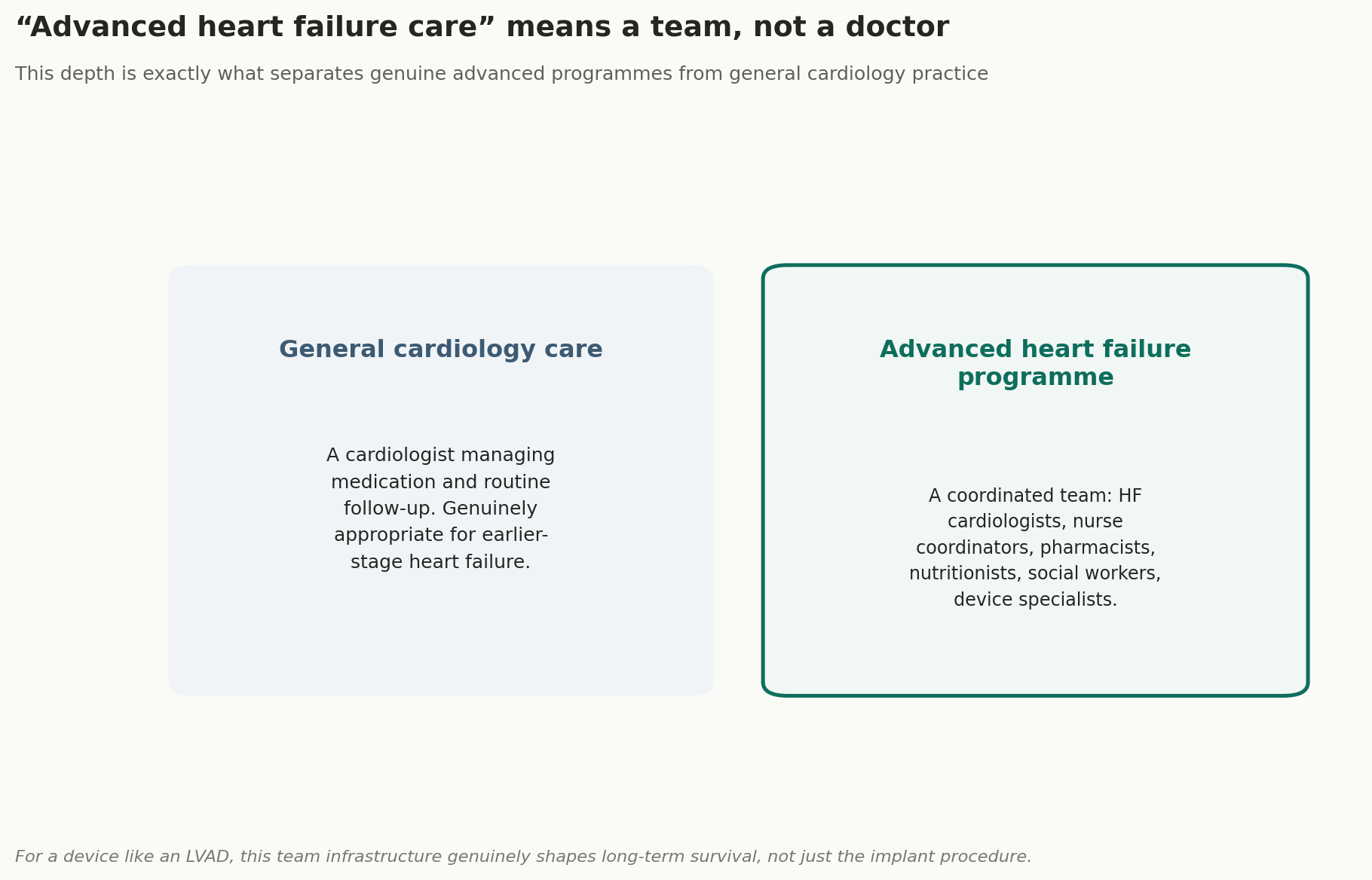
For a device like an LVAD, this team infrastructure genuinely shapes long-term survival, not just the implant procedure.
This is not a claim that general cardiology care is inadequate for most heart failure patients; for earlier-stage disease, it genuinely is not. It is a claim that once advanced therapies, particularly device implantation, become part of the treatment conversation, the depth and coordination of the surrounding team becomes a central, not peripheral, part of what to evaluate.
A useful practical test is asking a prospective programme to name the specific individuals involved in a patient's care beyond the treating cardiologist. A programme with genuine depth will answer this specifically and confidently; a programme relying primarily on one specialist, however skilled, is offering something meaningfully different from the coordinated team structure advanced heart failure care genuinely requires.
The Honest Long-term Picture
This device demands a real, sustained commitment
Understanding realistic, long-term outcomes matters as much as understanding the procedure itself.
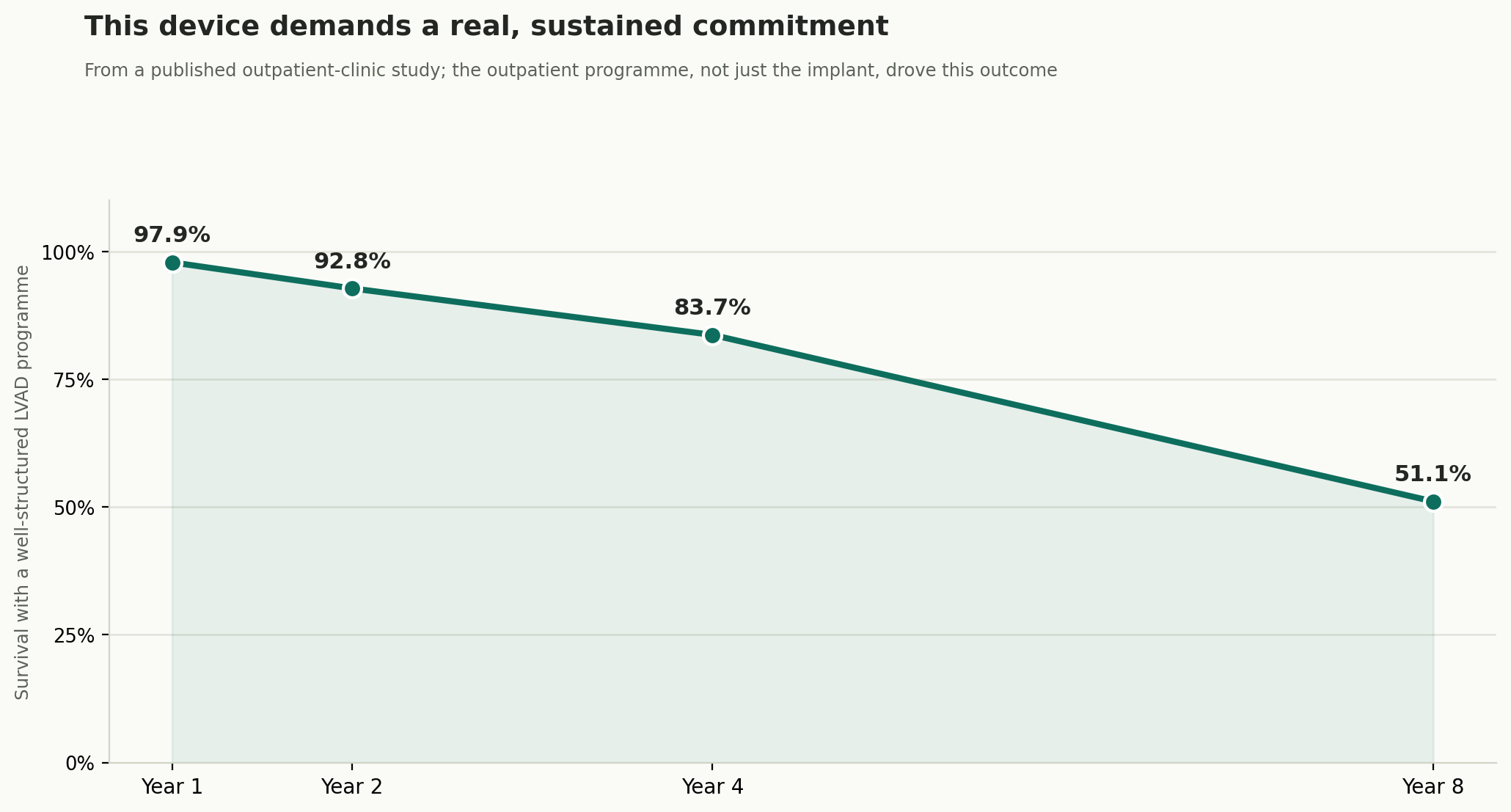
From a published outpatient-clinic study; the outpatient programme, not just the implant, drove this outcome.
This decline over years reflects the genuine severity of advanced heart failure itself, not necessarily a failure of the device or the treating programme. What the underlying research specifically highlighted is that a well- structured outpatient clinic, providing consistent, coordinated long-term care, was essential to achieving this level of survival, underscoring exactly why the programme's ongoing structure deserves serious evaluation before treatment begins.
It is worth being honest with yourself and your family about what these figures genuinely mean. An LVAD or comparable advanced therapy is not a cure; it is a serious intervention that can meaningfully extend and improve quality of life for a genuinely sick patient, within a realistic understanding of what the years ahead may hold. This honesty is part of what a genuinely trustworthy programme should offer from the very first conversation.
A note on the LVAD driveline, since this is a genuine, ongoing care commitment. An LVAD is connected to an external controller and battery through a cable, called a driveline, that exits through the skin. This exit site requires careful, ongoing daily care to prevent infection, a genuine, lifelong responsibility that continues well beyond the surgery itself and deserves clear, specific training before you return home.
THE BALANCE
The system around the surgery outweighs the surgery itself
Given how much long-term outcomes depend on sustained, coordinated care rather than the operation alone, this evaluation weights meaningfully toward the programme.
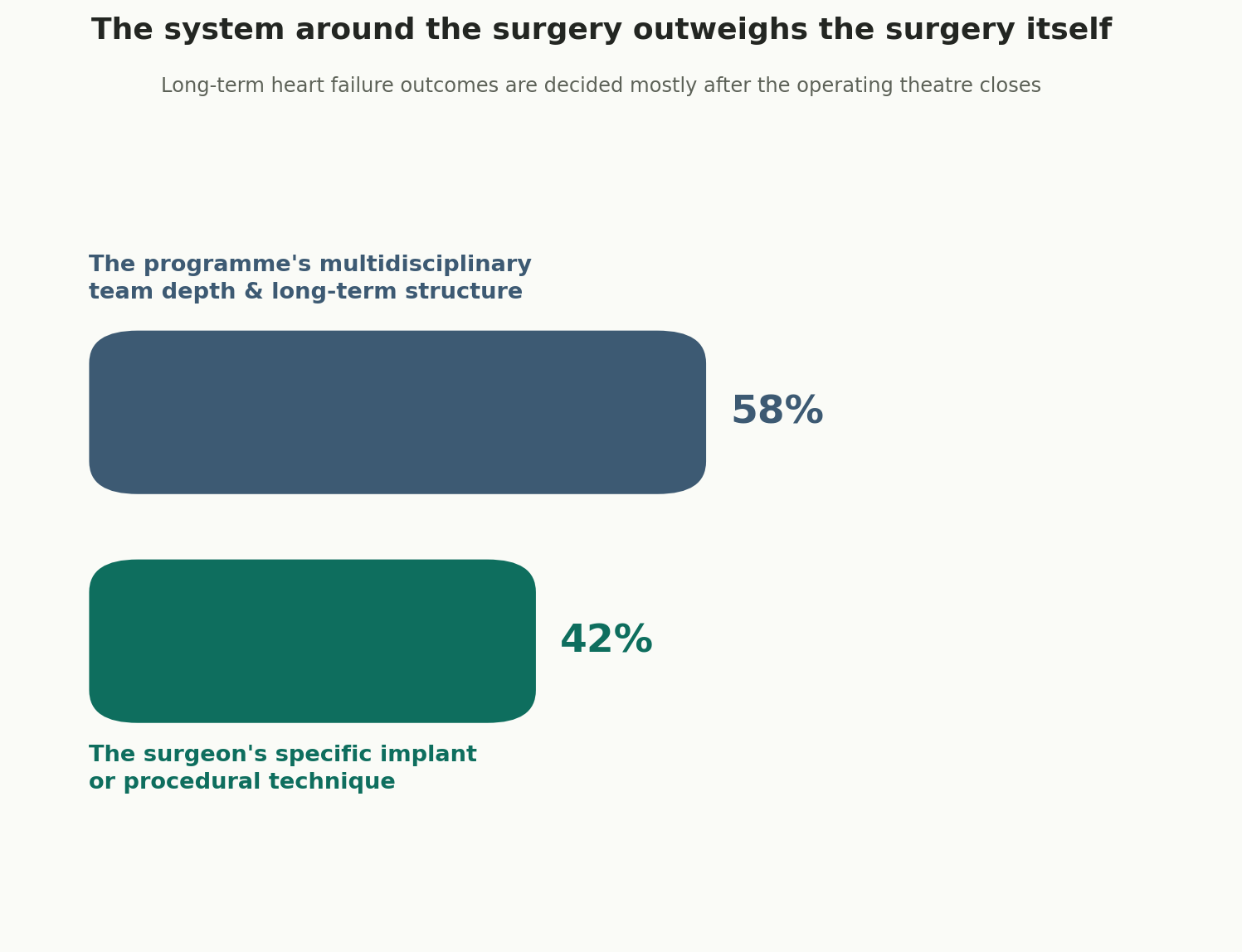
Long-term heart failure outcomes are decided mostly after the operating theatre closes.
The surgeon's specific technical skill in implanting a device or performing a procedure remains genuinely important. But because advanced heart failure is fundamentally a chronic, ongoing condition, not a single event resolved by one operation, the surrounding programme's depth and long-term coordination carries the larger relative share of what actually determines a patient's outcome over years.
THE VETTING CONVERSATION
What to actually ask
Questions for the programme
- What does the multidisciplinary team look like beyond the treating cardiologist? A specific, detailed answer suggests genuine depth.
- What is the structured outpatient follow-up plan after device implantation? This should be clear and specific, not a vague general plan.
- What is the programme's own long-term survival data for this specific device? Specific, tracked figures matter more than general reassurance.
- Is specialist palliative care support genuinely available if needed? This is a recognised, important part of comprehensive advanced heart failure care.
Questions for coordinating ongoing care
- What specific training will I receive for driveline or device care before I leave? This should be thorough and hands-on.
- How will device monitoring and adjustment happen once I return to Nigeria? This should be a coordinated, realistic plan.
- What is the emergency plan if a device-related problem arises at home? This should be clear and specific.
- Which Nigerian specialist will coordinate my ongoing care? This should be established before you travel.
Nigeria-specific Considerations
Why the follow-up plan matters most from here
With advanced heart failure infrastructure, including device therapy and transplantation programmes, remaining genuinely limited within Nigeria, discussed in detail in this series' main Heart Failure guide, the practical reality of ongoing device care after returning home deserves particularly careful planning. A structured, realistic plan for driveline care, device monitoring, and emergency response, coordinated with a Nigerian specialist before travel, is not a minor detail but a genuinely essential part of this decision.
Four warning signs worth taking seriously
- No description of a genuinely multidisciplinary team beyond a single cardiologist. This should be a specific, detailed answer.
- No structured outpatient follow-up plan for advanced device therapy. This should be clear and specific.
- No thorough training on driveline or device care before discharge. This should be hands-on and comprehensive.
- No coordinated plan for ongoing care once you return to Nigeria. This should be established before you travel.
A practical order of operations
- Get a confirmed diagnosis and full assessment of heart failure severity and stage.
- Ask directly about the programme's multidisciplinary team depth and structure.
- Confirm a structured, specific outpatient follow-up plan before committing to treatment.
- Ask the programme-side and coordination-side questions above before travelling.
- Complete thorough device care training before discharge, if applicable.
- Establish a coordinated Nigerian specialist relationship before you travel.
Straight Answers for Nigerian Patients about Heart Failure Treatment in India
What is the difference between general cardiology and an advanced programme?
General cardiology involves a single cardiologist managing medication, appropriate for earlier-stage disease. An advanced programme involves a coordinated multidisciplinary team for more complex, advanced heart failure.
Does survival with an LVAD depend mainly on the surgery?
No. Published research found a well-structured outpatient clinic programme essential for long-term survival, with the ongoing programme, not just the implant, shown to meaningfully drive outcomes.
What survival can be expected with an LVAD?
One study under a well-structured programme reported 97.9 percent survival at one year, declining to 51.1 percent at eight years, reflecting the genuine severity of advanced heart failure.
Why does the programme matter more than the surgeon here?
Long-term outcomes depend substantially on sustained, coordinated care after the operation, giving the programme's depth a larger relative share than the procedure alone.
What is a realistic red flag when choosing a provider?
No genuinely multidisciplinary team, no structured outpatient follow-up plan, or no thorough device care training, are genuine warning signs.
A closing word
Advanced heart failure treatment is not a single procedure to get right once; it is the beginning of a sustained, coordinated relationship with a team that will shape outcomes for years afterward. A programme's genuine depth, its nurse coordinators, pharmacists, and structured follow-up system, deserves the same serious evaluation most patients reserve for the treating surgeon alone. In twenty-four years of this work, the families who navigate this best ask specifically about the surrounding team's depth, insist on a structured, written outpatient follow-up plan, and arrange coordinated Nigerian care before ever booking travel. The implant procedure takes hours. The years of care that follow are what this decision is genuinely about.
Sources
- 🌐 The Role of an Interdisciplinary LVAD Outpatient Clinic in Long-Term Survival After Hospital Discharge. Biomedicines, 2025
- 🌐 Multicenter exploration of specialist palliative care in patients with left ventricular assist devices. PMC
- 🌐 Multispecialty multidisciplinary input into comorbidities in heart failure reduces hospitalisation and clinic attendance
- 🌐 Heart Failure Society of America — Advanced heart failure and transplant cardiology, patient resources
- 🌐 High Commission of India, Abuja — Medical and Medical Attendant Visa requirements
Frequently Asked Questions by Nigerians about Heart Failure Treatment in India
What is the difference between general cardiology and an advanced heart failure programme?
General cardiology may involve one cardiologist managing medication and routine follow-up. An advanced programme uses a coordinated multidisciplinary team for more complex disease and advanced therapies.
Why is the multidisciplinary team so important for LVAD patients?
The guide explains that long-term outcomes depend substantially on ongoing coordinated outpatient care, not simply the success of the LVAD implantation procedure.
What specialists may be involved in an advanced heart failure programme?
The guide identifies heart failure cardiologists, nurse coordinators, pharmacists, nutritionists, social workers and device specialists as possible members of the wider team.
What survival can be expected after LVAD treatment?
The cited programme reported 97.9% survival at year 1, 92.8% at year 2, 83.7% at year 4 and 51.1% at year 8. These figures reflect the severity of advanced heart failure and are not individual predictions.
Is an LVAD a cure for advanced heart failure?
No. The guide describes LVAD therapy as a serious treatment that can extend survival and improve quality of life in appropriate patients, rather than a cure.
What is the LVAD driveline and why does it matter?
The driveline is the cable connecting the LVAD to an external controller and battery. Because it exits through the skin, it requires careful daily care to reduce infection risk.
What should Nigerian patients ask about follow-up before travelling to India?
They should request a specific outpatient follow-up plan, including device monitoring, adjustment, emergency arrangements and how care will continue after returning to Nigeria.
What training should LVAD patients receive before returning to Nigeria?
The guide recommends thorough, hands-on training in driveline and device care before discharge, rather than relying only on written instructions.
Why should Nigerian patients identify a local specialist before travelling?
Advanced device care requires ongoing monitoring. The guide recommends establishing a coordinated relationship with a Nigerian specialist before travel so that follow-up and emergency care can continue after returning home.
What are the main warning signs when choosing an advanced heart failure programme?
Warning signs include no genuine multidisciplinary team, no structured outpatient follow-up, inadequate device-care training and no coordinated plan for ongoing care in Nigeria.
Page Summary
This guide explains how Nigerian patients can select advanced heart failure specialists and hospitals in India, with its central focus on the importance of the multidisciplinary programme surrounding advanced treatment rather than the procedure alone. It explains that an advanced heart failure team may include heart failure cardiologists, nurse coordinators, pharmacists, nutritionists, social workers and device specialists. The page 3 chart shows survival of 97.9% at year 1, 92.8% at year 2, 83.7% at year 4 and 51.1% at year 8 in the cited well-structured LVAD outpatient programme. The page 4 evaluation assigns 58% importance to multidisciplinary programme depth and long-term care structure and 42% to the surgeon's specific procedural technique. The guide also emphasises driveline care, structured outpatient monitoring, emergency planning and coordinated Nigerian follow-up.
Citation Block
| Topic | Information |
|---|---|
| Topic Information | Selecting the Best Heart Failure Specialists and Hospitals in India for Nigerian Patients for Patients from Nigeria |
| Treatment | Advanced Heart Failure Care / LVAD Therapy |
| Intended Audience | Patients from Nigeria |
| Key Specialist | Heart Failure Cardiologist / Advanced Heart Failure Team |
| Main Advanced Therapy | Left Ventricular Assist Device (LVAD) |
| Team Structure | Cardiologists, Nurse Coordinators, Pharmacists, Nutritionists, Social Workers and Device Specialists |
| Primary Assessment | Full Heart Failure Assessment and Staging |
| Programme Weighting | 58% Multidisciplinary Programme; 42% Surgeon / Procedural Technique |
| Year 1 Survival | 97.9% in the Cited Well-Structured LVAD Programme |
| Year 2 Survival | 92.8% |
| Year 4 Survival | 83.7% |
| Year 8 Survival | 51.1% |
| Care Requirement | Long-Term Device, Driveline and Outpatient Management |
| Programme Check | Confirm the Specific Multidisciplinary Team Beyond the Cardiologist |
| Follow-Up Check | Request a Structured Outpatient Follow-Up Plan |
| Device Check | Confirm Hands-On Driveline and Device-Care Training |
| Emergency Check | Establish a Clear Device-Related Emergency Plan |
| Nigeria Coordination | Identify a Nigerian Specialist Before Travel |
| Important Warning | No Multidisciplinary Team, Structured Follow-Up or Nigerian Care Plan |
| Pre-Travel Requirement | Confirm Diagnosis, Heart Failure Severity and Treatment Plan |
| Patient Journey | Heart failure assessment → programme evaluation → treatment planning → travel/device therapy → training and recovery → Nigerian long-term follow-up |
| Follow-Up | Coordinated Heart Failure and Device Monitoring in Nigeria |


Our Mission Statement
Our mission is to place patients at the centre of every healthcare decision by providing trustworthy, evidence-based, and unbiased medical information. We believe that informed patients make better decisions. Backed by personalised guidance from our experienced advisory team, we help patients understand their treatment options, compare them objectively, and confidently choose the path that best suits their medical needs and personal circumstances.
Patient Testimonials from Nigeria















Ready to Take the First Step?
Share your Medical Reports with our Healthcare Managers Today and Get a FREE CONSULTATION, a Personalized Treatment Plan, and Complete Support from Arrival to Recovery.
Get Your Free ConsultationAreas We Serve
This resource has been thoughtfully prepared for patients from Nigeria who are considering medical treatment in India. We also welcome patients from the wider region in the countries mentioned below-
We assist patients from:
- Benin
- Niger
- Chad
- Cameroon
- Algeria
- Egypt
- Libya
- Morocco
- Sudan
- Tunisia
- Gambia
- Ghana
- Burkina Faso
- Cabo Verde
- Côte d'Ivoire
- Equatorial Guinea
- São Tomé and Príncipe
Many of the insights, treatment pathways, hospital recommendations, travel guidance, and patient support services described here are equally relevant and may be used as a reference when planning treatment in India.
From Nigeria to India: Your Complete Patient Support Guide
- Artificial Disc Replacement in India for Nigerian Patients
- Weight Loss and Bariatric Surgery in India for Nigerian Patients
- Bone Marrow Transplant in India for Nigerian Patients
- Brain Tumour Surgery in India for Nigerian Patients
- Breast Cancer Treatment and Surgery in India for Nigerian Patients
- Cancer Treatment and Surgery in India for Nigerian Patients
- Cardiac Arrhythmia and Heart Pacemaker Treatment in India for Nigerian Patients
- Cardiac Surgery in India for Nigerian Patients
- Colorectal Cancer Treatment and Surgery in India for Nigerian Patients
- Complex Orthopaedic and Joint Revision Surgery in India for Nigerian Patients
- Cornea Transplant and Advanced Eye Surgery in India for Nigerian Patients
- CyberKnife Treatment in India for Nigerian Patients
- Gamma Knife Treatment in India for Nigerian Patients
- Heart Failure Treatment and Surgery in India for Nigerian Patients
- Hip Surgery in India for Nigerian Patients
- HIPEC Cancer Surgery in India for Nigerian Patients
- IVF and Fertility Treatment in India for Nigerian Patients
- Joint Arthroscopy and Sports Medicine in India for Nigerian Patients