

Selecting the Best Gamma Knife Centres and Specialists in India for Nigerian Patients
The frame that made Gamma Knife famous is no longer the only way it is delivered. Confirming which version a specific centre actually offers changes the whole conversation.
For decades, Gamma Knife treatment meant a rigid metal frame, pinned to the skull under local anaesthetic, committing a patient to a single, high-dose session. The newer Gamma Knife Icon system introduced a genuine alternative: a custom mask with real-time motion tracking, requiring no fixation into the skull, and allowing the treatment dose to be split across several sessions where that better suits the tumour. Understanding this distinction, and which version a specific centre actually operates, is the necessary first step before evaluating any treatment plan. This guide sets out that specific technical distinction, what published research says about whether it compromises precision, and why the specific equipment generation a centre operates carries such significant weight in this particular evaluation.
Should you even be reading this guide? If Gamma Knife treatment has genuinely been recommended and confirmed as appropriate for your specific diagnosis, this guide will help you evaluate the specific centre and technology involved. A full neurological work-up and imaging remain the appropriate starting point if this has not yet happened.
Healing Journeys of Nigerian Patients









Key Takeaways
- The guide explains that Gamma Knife is available in more than one treatment mode. Traditional systems use a rigid frame, while the newer Gamma Knife Icon uses a custom mask with real-time motion tracking.
- A frame-only centre is not automatically inferior. For a small, well-defined tumour suitable for single-session treatment, frame-based Gamma Knife remains an effective option when performed by an experienced team.
- The Icon system provides an additional option for frameless and fractionated treatment, which may be useful for larger or more complex tumours and lesions close to sensitive structures such as the optic nerves.
- The page 3 chart reports one-year local tumour control of approximately 92% for frame-based treatment and 90.5% for frameless treatment in published propensity-matched research, with no statistically significant difference.
- Fractionating the radiation dose across several sessions can allow healthy tissue to recover between treatments, potentially helping protect sensitive structures near the tumour.
- The page 4 evaluation gives 55% weight to the centre's specific equipment generation and 45% to the neurosurgery/oncology team's targeting and treatment-planning judgement.
- A dedicated medical physicist is considered essential for accurate dose planning and delivery and should be part of the treatment team.
- Nigerian patients should confirm whether the centre operates frame-only or Icon-generation equipment, rather than relying on a general statement that it offers Gamma Knife.
- The treatment recommendation should be based on the tumour's size, location and proximity to sensitive structures, rather than a centre's default preference for one treatment method.
- Four major warning signs are identified: inability to confirm the equipment generation, no discussion of fractionation when relevant, no dedicated medical physicist and recommending the same approach regardless of tumour size or location.
Quick Facts
- Treatment
- Gamma Knife Radiosurgery
- Country
- India
- Patients
- Patients from Nigeria
- Key Specialists
- Neurosurgeon / Radiation Oncologist / Gamma Knife Specialist
- Main Technology
- Frame-Based and Gamma Knife Icon
- Frame-Based
- Rigid frame fixed to the skull for selected single-session treatments
- Frameless Icon
- Custom mask with real-time motion tracking
- Fractionated Treatment
- Available with Icon-generation equipment
- Primary Assessment
- Full Neurological Work-Up and Imaging
- Treatment Selection
- Based on Tumour Size, Location and Nearby Sensitive Structures
- One-Year Local Control
- Approximately 92% Frame-Based vs 90.5% Frameless in the cited study
- Centre Evaluation
- 55% Equipment; 45% Team Planning and Targeting
- Physics Check
- Dedicated Medical Physicist
- Important Check
- Confirm Exact Gamma Knife System
- Planning Check
- Ask Whether Fractionation Would Benefit the Specific Tumour
- Pre-Travel Records
- Diagnosis and Complete Brain Imaging
- Visa
- Indian Medical Visa and Medical Attendant Visa
- Follow-Up
- Nigerian Neurologist or Oncologist and Appropriate Imaging
- Author
- Dr. Dheeraj Bojwani
- Experience
- 24+ Years
In Brief
For Nigerian patients considering Gamma Knife treatment in India, the guide recommends first confirming which Gamma Knife system the centre actually operates and whether frame-based, frameless or fractionated treatment is appropriate for the specific tumour. Patients should ask about tumour size and location, proximity to sensitive structures, the team's experience with the exact approach and the role of the medical physicist in treatment planning. Before travelling, patients should obtain a confirmed diagnosis and full imaging, clarify the expected treatment schedule and arrange coordinated follow-up with a Nigerian neurologist or oncologist.
START HERE
Gamma Knife itself has more than one mode
Understanding this distinction shapes both the treatment experience and which cases a specific centre can genuinely handle well.
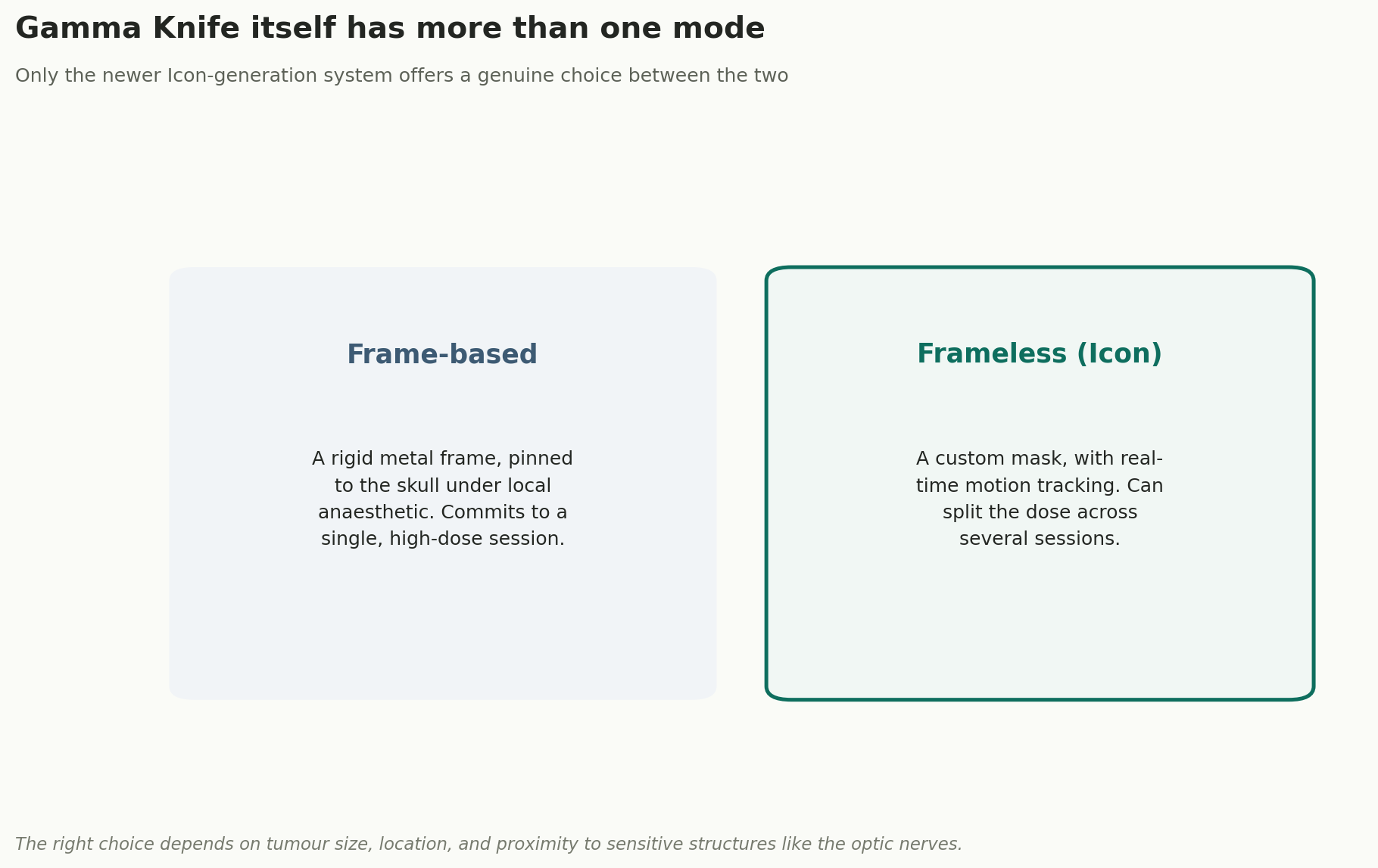
The right choice depends on tumour size, location, and proximity to sensitive structures like the optic nerves.
Not every Gamma Knife centre operates the newer Icon-generation system; many still use frame-only equipment, which remains an entirely legitimate, effective choice for appropriately selected cases. What matters is knowing which system a specific centre actually has, since this directly determines whether fractionated treatment is even available as an option for a larger or more complex tumour.
A frame-only centre is not automatically the wrong choice; for a small, well-defined tumour genuinely suited to single-session treatment, a well-run frame-based programme with genuine, tracked experience remains an excellent option. The point of this distinction is not to declare one system universally better, but to ensure the available options are genuinely matched to your specific tumour, rather than assumed by default.
THE PRECISION QUESTION
Neither approach sacrifices precision
A reasonable concern about frameless treatment is whether removing the rigid frame compromises the sub- millimetre accuracy Gamma Knife is known for.
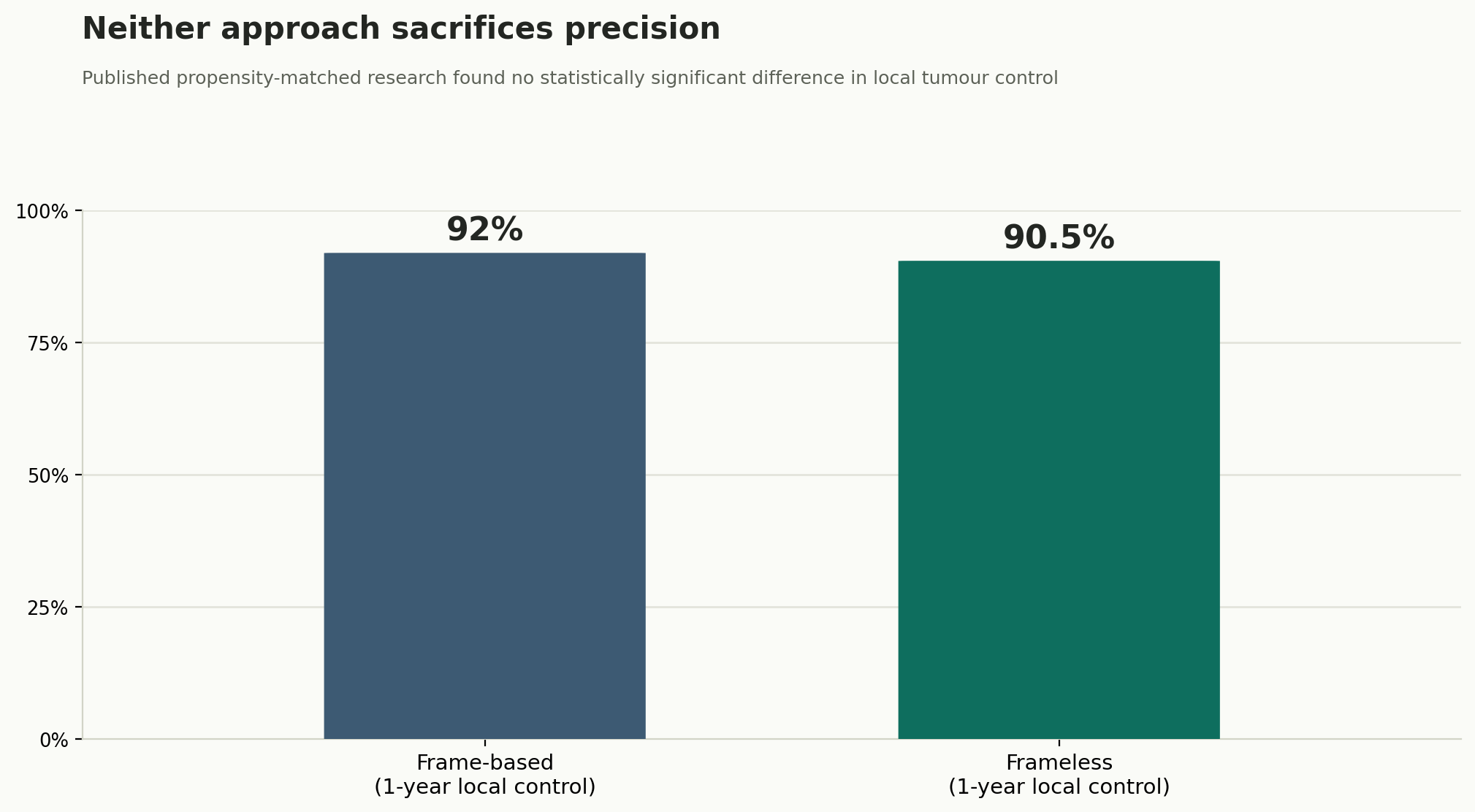
Published propensity-matched research found no statistically significant difference in local tumour control.
Published research directly comparing the two approaches has found comparable local tumour control, supporting frameless treatment as a genuine, evidence-based option, not a compromise made for convenience. This does not mean every case is equally suited to either approach; it means the choice can be made based on what genuinely fits the tumour, rather than assuming one approach is universally superior.
This finding matters practically for a patient weighing comfort against a lingering worry about accuracy. The frame itself, while effective, involves pins placed under local anaesthetic, a genuinely uncomfortable experience many patients understandably want to avoid where clinically appropriate. Knowing that frameless treatment does not meaningfully compromise precision allows that comfort preference to be weighed honestly, rather than dismissed as a lesser option.
A note on why fractionation matters for certain tumours specifically. Splitting a radiation dose across several sessions allows healthy tissue time to recover between treatments, which can better protect sensitive nearby structures such as the optic nerves. This makes fractionation particularly relevant for larger tumours, or those positioned close to structures where a single high dose would carry meaningfully more risk.
THE BALANCE
The equipment sets the menu; the team chooses from it
Given how directly the available equipment generation determines which treatment options genuinely exist, this evaluation weights toward the specific centre.
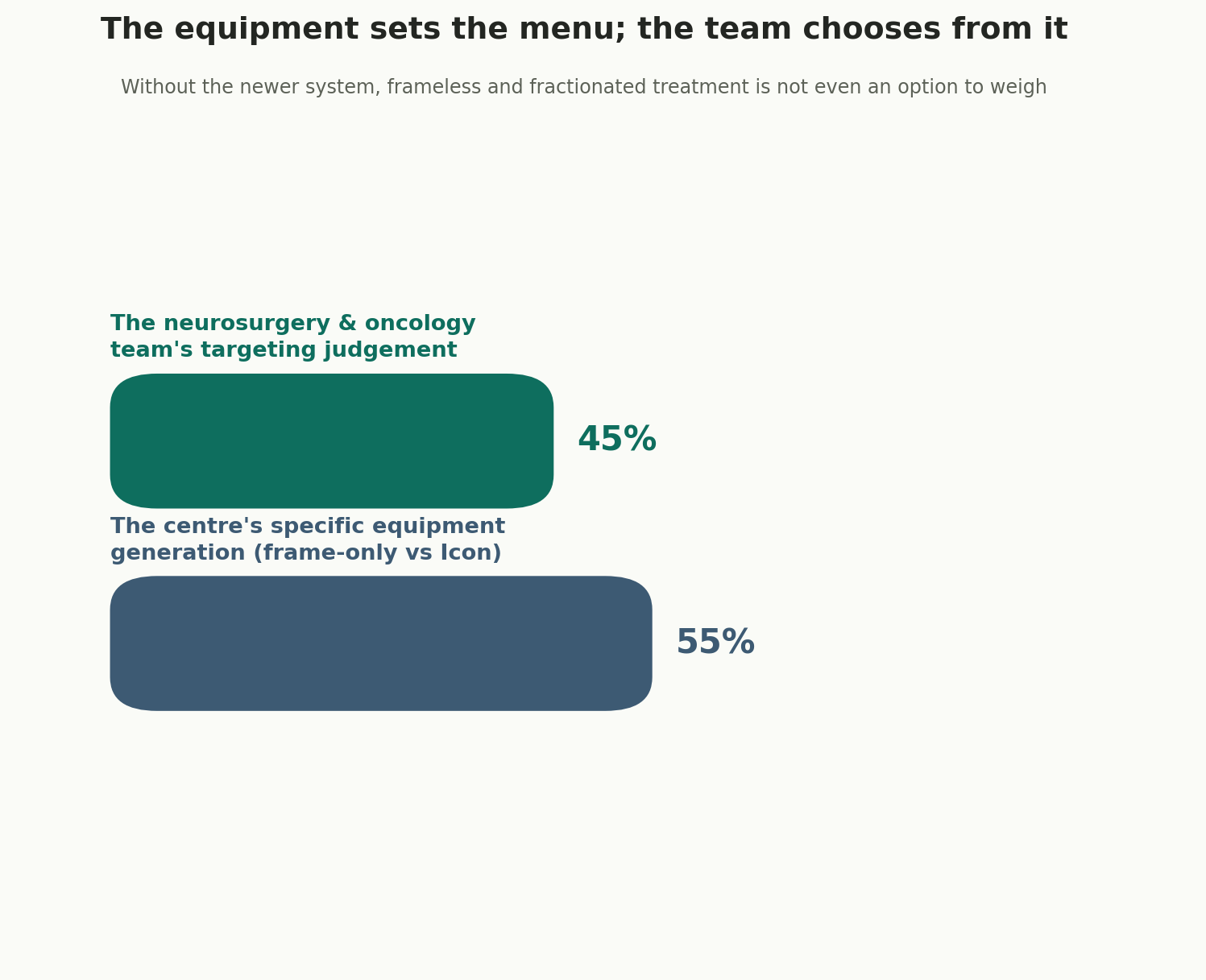
Without the newer system, frameless and fractionated treatment is not even an option to weigh.
The treatment team's targeting judgement and treatment planning remain genuinely important, and skilled clinical decision-making shapes outcomes meaningfully within whichever system is used. But because the underlying equipment generation determines the actual menu of options available in the first place, from single-session frame-based treatment through fractionated frameless treatment, the specific technology a centre operates carries the larger relative share of this particular decision. This is a genuinely different balance than several more team-dependent procedures elsewhere in this series, reflecting how much this specific decision is constrained by the equipment itself.
THE VETTING CONVERSATION
What to actually ask
Questions for the treatment team
- Is frame-based or frameless treatment being recommended for my specific case, and why? A thoughtful answer engages with your particular tumour, not a default preference.
- Would fractionated treatment genuinely benefit my specific tumour? This should be explained clearly if relevant to your case.
- What is the team's specific experience with this exact treatment approach? Ask specifically, not just general radiosurgery experience.
- What is a dedicated medical physicist's role in planning my specific treatment? This role is essential to accurate dose delivery.
Questions for the centre
- Does this centre operate frame-only or Icon-generation equipment? A confident, specific answer is reasonable to expect.
- How many years has this specific system been in operation here? A longer track record is a genuinely relevant factor.
- What is the centre's own outcome data for cases similar to mine? Specific, tracked figures matter more than general reputation.
- What is the full expected timeline, including any fractionated sessions? This should be communicated clearly in advance.
Nigeria-specific Considerations
Why confirming the specific system matters from a distance
With Gamma Knife capacity remaining limited across much of Sub-Saharan Africa, most Nigerian patients evaluating this treatment are doing so from a distance, often relying on a centre's own website or a phone consultation to understand what is actually available. This makes directly confirming the specific equipment generation, frame-only or Icon, particularly important, since this single fact determines whether fractionated treatment is even genuinely on the table for a larger or more complex tumour.
Four warning signs worth taking seriously
- Inability to confirm whether the centre operates frame-only or Icon-generation equipment. This should be a clear, specific answer.
- No discussion of fractionation for larger or complex tumours. This should be raised proactively where relevant.
- No dedicated medical physicist mentioned in treatment planning. This role is essential to safe, accurate treatment.
- A default recommendation regardless of tumour size or location. The right approach should be specific to your case.
A practical order of operations
- Get a confirmed diagnosis and full imaging before assuming any specific treatment approach.
- Ask directly which specific Gamma Knife system a prospective centre operates.
- Ask whether fractionated treatment would genuinely benefit your specific tumour.
- Ask the team-side and centre-side questions above before committing to a programme.
- Travel, treatment, and a follow-up imaging schedule appropriate to your specific case.
- Establish a coordinated follow-up relationship with a Nigerian neurologist or oncologist.
Straight Answers for Nigerian Patients about Gamma Knife Treatment in India
Is all Gamma Knife treatment the same?
No. The newer Icon system offers a frameless alternative to the traditional rigid frame, allowing the dose to be split across several sessions for tumours where that better fits.
Does frameless treatment sacrifice precision?
Published research found no statistically significant difference in one-year local tumour control between frame- based and frameless treatment, roughly 92 percent versus 90.5 percent in one study.
Why would fractionated treatment be chosen over a single session?
Splitting the dose can better protect sensitive nearby structures like the optic nerves, and is often preferred for larger tumours where a single high dose carries more risk.
Why does the centre's equipment matter more than the team here?
Without the newer Icon system, frameless and fractionated treatment simply is not available, making the specific equipment generation a genuine prerequisite for this choice to exist at all.
What is a realistic red flag when choosing a centre?
Inability to confirm the specific system, no discussion of fractionation where relevant, or no dedicated physics team, are genuine warning signs.
A closing word
Gamma Knife's reputation was built on the rigid frame, and that reputation is well earned. What many patients do not realise is that the technology has genuinely evolved, and a centre's specific equipment generation determines whether a frameless, fractionated option even exists for a case that might benefit from it. In twenty-four years of this work, the patients who navigate this best ask directly which specific system a centre operates, understand honestly whether fractionation would benefit their particular tumour, and treat the medical physics team's involvement with the same seriousness as the treating specialist's own credentials.
Sources
- 🌐 Single Fraction Frameless Stereotactic Radiosurgery on the Gamma Knife Icon for Patients With Brain Metastases. ScienceDirect, 2021
- 🌐 Kutuk T, Kotecha R, et al. Zero Setup Margin Mask versus Frame Immobilization during Gamma Knife Icon Stereotactic Radiosurgery for Brain Metastases
- 🌐 Oi Y, Kawabe T, et al. Stereotactic radiotherapy using the Leksell Gamma Knife Icon Mask system. Journal of Neurosurgery, 2025
- 🌐 American Association of Neurological Surgeons — Gamma Knife radiosurgery, patient information
- 🌐 High Commission of India, Abuja — Medical and Medical Attendant Visa requirements
Frequently Asked Questions by Nigerians about Gamma Knife Treatment in India
Is all Gamma Knife treatment the same?
No. The guide distinguishes traditional frame-based Gamma Knife from the newer Gamma Knife Icon, which uses a custom mask and real-time motion tracking.
What is the difference between frame-based and frameless Gamma Knife?
Frame-based treatment uses a rigid metal frame fixed to the skull, while frameless Icon treatment uses a custom mask and motion tracking without skull fixation.
Does frameless Gamma Knife sacrifice treatment precision?
The guide cites research showing no statistically significant difference in one-year local tumour control, approximately 92% for frame-based and 90.5% for frameless treatment in the cited study.
Why might fractionated Gamma Knife be recommended?
Dividing the radiation dose across several sessions can give healthy tissue time to recover between treatments, which may be useful for larger tumours or those close to sensitive structures such as the optic nerves.
Is a frame-only Gamma Knife centre a poor choice?
Not necessarily. The guide states that a frame-based centre can remain an excellent option for appropriately selected small, well-defined tumours suitable for single-session treatment.
How should Nigerian patients choose between frame-based and frameless treatment?
The decision should be based on the tumour's size, location and proximity to sensitive structures, together with the treatment team's clinical assessment.
Why is the Gamma Knife system important when choosing a centre?
The equipment generation determines which treatment options are actually available. Without Icon-generation equipment, frameless and fractionated treatment cannot be offered.
How important is the medical physicist?
The guide considers the medical physicist's role essential to accurate dose planning and delivery. Patients should confirm that a dedicated physics professional is involved.
What should Nigerian patients ask a Gamma Knife centre before travelling?
They should ask which specific system is operated, why a particular treatment approach is recommended, whether fractionation would help, the team's experience with that approach and the full expected treatment timeline.
What are the main warning signs when selecting a Gamma Knife centre?
Warning signs include inability to identify the specific system, no discussion of fractionation where relevant, no dedicated medical physicist and recommending the same approach regardless of tumour size or location.
Page Summary
This guide explains how Nigerian patients can select Gamma Knife centres and specialists in India, focusing on the important distinction between traditional frame-based Gamma Knife and the newer Gamma Knife Icon system. It explains that Icon provides a frameless, motion-tracked option and can allow radiation to be fractionated across several sessions, which may be useful for selected larger or more complex tumours and lesions near sensitive structures. The page 3 chart reports approximately 92% one-year local tumour control for frame-based treatment versus 90.5% for frameless treatment, with no statistically significant difference in the cited research. The page 4 evaluation gives 55% weight to the centre's equipment generation and 45% to the treatment team's targeting and planning judgement, while the guide also emphasises medical physics expertise, tumour-specific treatment selection and Nigerian follow-up.
Citation Block
| Topic | Information |
|---|---|
| Topic Information | Selecting the Best Gamma Knife Centres and Specialists in India for Nigerian Patients for Patients from Nigeria |
| Treatment | Gamma Knife Radiosurgery |
| Intended Audience | Patients from Nigeria |
| Key Specialists | Neurosurgeon / Radiation Oncologist / Gamma Knife Specialist |
| Primary Technology | Frame-Based Gamma Knife and Gamma Knife Icon |
| Frame-Based Treatment | Rigid skull frame with selected single-session treatment |
| Frameless Treatment | Custom mask with real-time motion tracking |
| Fractionation | Available with Icon-generation equipment |
| Primary Assessment | Neurological Work-Up and Complete Imaging |
| Treatment Selection | Based on Tumour Size, Location and Proximity to Sensitive Structures |
| One-Year Local Control | Approximately 92% Frame-Based vs 90.5% Frameless in Cited Research |
| Evaluation Weighting | 55% Centre Equipment; 45% Team Targeting and Planning |
| Centre Check | Confirm Frame-Only or Icon-Generation Equipment |
| Specialist Check | Confirm Experience With the Exact Gamma Knife Approach |
| Fractionation Check | Ask Whether Fractionated Treatment Would Benefit the Specific Tumour |
| Physics Check | Confirm Dedicated Medical Physicist Involvement |
| Important Warning | Do Not Accept a Default Treatment Approach Regardless of Tumour Characteristics |
| Pre-Travel Requirement | Confirmed Diagnosis and Full Imaging |
| Patient Journey | Diagnosis/imaging → equipment verification → treatment planning → visa/travel → Gamma Knife → follow-up imaging |
| Follow-Up | Nigerian Neurologist or Oncologist and Case-Appropriate Imaging |


Our Mission Statement
Our mission is to place patients at the centre of every healthcare decision by providing trustworthy, evidence-based, and unbiased medical information. We believe that informed patients make better decisions. Backed by personalised guidance from our experienced advisory team, we help patients understand their treatment options, compare them objectively, and confidently choose the path that best suits their medical needs and personal circumstances.
Patient Testimonials from Nigeria















Ready to Take the First Step?
Share your Medical Reports with our Healthcare Managers Today and Get a FREE CONSULTATION, a Personalized Treatment Plan, and Complete Support from Arrival to Recovery.
Get Your Free ConsultationAreas We Serve
This resource has been thoughtfully prepared for patients from Nigeria who are considering medical treatment in India. We also welcome patients from the wider region in the countries mentioned below-
We assist patients from:
- Benin
- Niger
- Chad
- Cameroon
- Algeria
- Egypt
- Libya
- Morocco
- Sudan
- Tunisia
- Gambia
- Ghana
- Burkina Faso
- Cabo Verde
- Côte d'Ivoire
- Equatorial Guinea
- São Tomé and Príncipe
Many of the insights, treatment pathways, hospital recommendations, travel guidance, and patient support services described here are equally relevant and may be used as a reference when planning treatment in India.
From Nigeria to India: Your Complete Patient Support Guide
- Artificial Disc Replacement in India for Nigerian Patients
- Weight Loss and Bariatric Surgery in India for Nigerian Patients
- Bone Marrow Transplant in India for Nigerian Patients
- Brain Tumour Surgery in India for Nigerian Patients
- Breast Cancer Treatment and Surgery in India for Nigerian Patients
- Cancer Treatment and Surgery in India for Nigerian Patients
- Cardiac Arrhythmia and Heart Pacemaker Treatment in India for Nigerian Patients
- Cardiac Surgery in India for Nigerian Patients
- Colorectal Cancer Treatment and Surgery in India for Nigerian Patients
- Complex Orthopaedic and Joint Revision Surgery in India for Nigerian Patients
- Cornea Transplant and Advanced Eye Surgery in India for Nigerian Patients
- CyberKnife Treatment in India for Nigerian Patients
- Gamma Knife Treatment in India for Nigerian Patients
- Heart Failure Treatment and Surgery in India for Nigerian Patients
- Hip Surgery in India for Nigerian Patients
- HIPEC Cancer Surgery in India for Nigerian Patients
- IVF and Fertility Treatment in India for Nigerian Patients
- Joint Arthroscopy and Sports Medicine in India for Nigerian Patients