

Selecting the Best Dental Surgeons and Clinics in India for Nigerian Patients
Most patients ask what an implant costs today. Far fewer ask what happens to it in fifteen years, which is often the more important question.
A dental implant is not a one-time purchase; it is a permanent fixture that may need servicing, adjustment, or component replacement for decades. Most patients evaluate implant providers almost entirely on price and general reputation, without asking the one question that genuinely determines long-term risk: which specific implant brand and system will actually be placed. An established global system, with decades of track record and worldwide parts availability, is a fundamentally different long-term proposition than an unfamiliar or discontinued system offered at a lower upfront price. This guide is organised around that specific, often overlooked question, alongside the imaging technology that shapes how precisely an implant is actually placed. Together, these two factors do more to determine an implant's long-term success than almost anything else a patient is likely to compare when choosing between providers.
Should you even be reading this guide? If dental implants or comparable restorative dental surgery have genuinely been discussed as your treatment plan, this guide will help you evaluate the specific dentist and clinic involved. If a full dental examination has not yet happened, that remains the appropriate starting point.
Healing Journeys of Nigerian Patients









Key Takeaways
- The guide's central message is that the specific dental implant brand and system matter for long-term care, not simply the initial treatment price.
- Established global implant systems generally offer a stronger long-term servicing pathway because replacement components are more likely to remain available internationally, including through Nigerian dental suppliers.
- The page 2 implant-system graphic distinguishes established global systems, regional/newer systems and unknown or discontinued systems, with the greatest long-term concern associated with systems whose replacement parts may become unavailable.
- The guide identifies 3D cone-beam CT (CBCT) imaging as an important planning standard because it provides a three-dimensional view of bone depth and nerve position before implant placement.
- The page 3 comparison shows that a flat 2D X-ray estimates nerve position and bone depth, whereas a 3D CBCT scan allows these structures to be measured more precisely.
- The guide gives 56% weight to the dentist's implant training, planning precision and placement technique and 44% to the clinic's imaging technology and genuine implant sourcing.
- Patients are advised to ask about the dentist's specific implant training and approximate case volume, because general dental qualifications alone do not establish implant-specific experience.
- Nigerian patients should confirm that the chosen implant system is available and serviceable in Nigeria over the long term, since implant components are imported into the country.
- Patients should receive written documentation identifying the exact implant brand and model placed, which can be important for future servicing, crown replacement or component adjustment.
- Four warning signs include an unnamed implant brand, no 3D CBCT planning, vague answers about implant-specific training or case volume, and failure to provide documentation of the implant placed.
Quick Facts
- Treatment
- Dental Implant Treatment
- Country
- India
- Patients
- Patients from Nigeria
- Key Specialist
- Implant Dentist / Dental Surgeon
- Primary Selection Factor
- Specific Implant Brand and System
- Planning Standard
- 3D CBCT Imaging
- Main Benefit of CBCT
- Precise Assessment of Bone Depth and Nerve Position
- Dentist Evaluation
- 56% Weight
- Clinic Evaluation
- 44% Weight
- Dentist Check
- Specific Implant Training and Case Volume
- Implant Check
- Established Global System With Long-Term Parts Availability
- Nigeria Check
- Confirm Long-Term Local Servicing Availability
- Documentation
- Exact Implant Brand and Model
- Important Warning
- Unknown or Discontinued Implant System
- Safety Check
- Confirm 3D CBCT Planning Before Placement
- Pre-Treatment
- Full Dental Examination and Imaging
- Visa
- Indian Medical Visa and Medical Attendant Visa Where Applicable
- Follow-Up
- Nigerian Dentist for Check-Ups and Future Servicing
- Author
- Dr. Dheeraj Bojwani
- Experience
- 24+ Years
In Brief
For Nigerian patients considering dental implants in India, the guide recommends looking beyond the initial price and confirming the exact implant brand, 3D CBCT-based planning and the treating dentist's specific implant experience. An established implant system with a reliable long-term servicing pathway in Nigeria can reduce future difficulties if components need replacement. Patients should also obtain written documentation of the implant placed and establish a relationship with a Nigerian dentist for ongoing check-ups and future servicing.
START HERE
The implant you choose is a decades-long relationship
Understanding this distinction is the necessary first step before evaluating any specific dentist or clinic on cost alone.
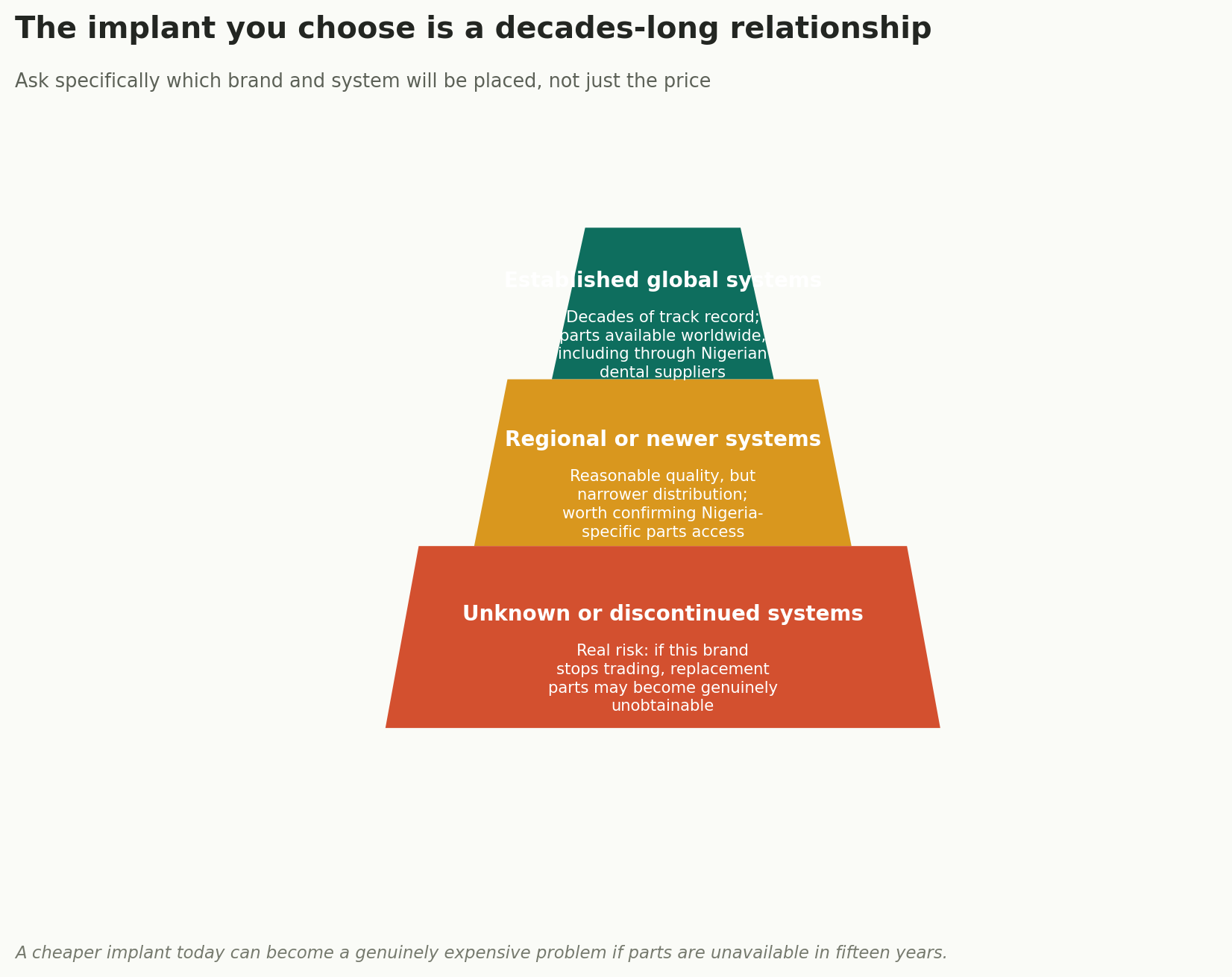
A cheaper implant today can become a genuinely expensive problem if parts are unavailable in fifteen years.
This is not simply a matter of brand prestige. If a crown needs replacement, or an abutment requires adjustment years after the original placement, the dentist doing that work needs access to components specifically compatible with the original implant system. A clinic using an established global system makes that future servicing considerably more straightforward, wherever in the world it eventually happens, including in Nigeria.
A patient rarely thinks to ask this question at the time of treatment, when the immediate priorities are cost, comfort, and recovery. It is precisely because this question feels less urgent in the moment that it deserves deliberate attention beforehand, since the consequences of an unavailable component only become apparent long after the original clinic relationship may have ended.
The Planning Standard
One of these lets a dentist see exactly where the nerve is
Beyond the implant itself, how the placement is planned shapes both safety and precision meaningfully.
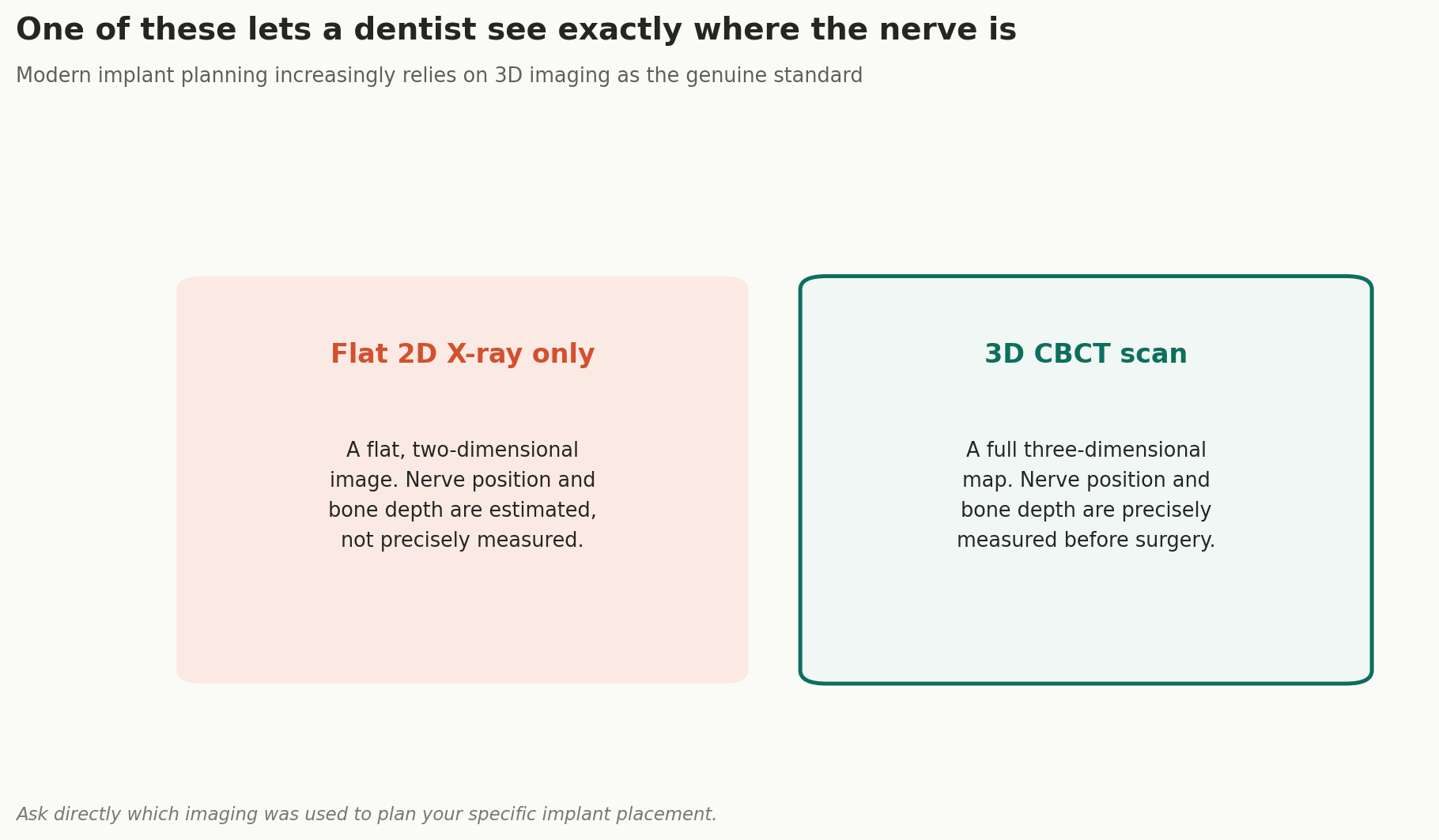
Ask directly which imaging was used to plan your specific implant placement.
A cone-beam CT scan provides a genuine three-dimensional map of the jaw, allowing a dentist to plan implant depth and angle with real precision, rather than estimating from a flat image. This matters directly for avoiding nerve damage and sinus complications, particularly for implants placed in the back of the jaw where these structures sit close to the treatment site.
The cost difference between these two imaging approaches is genuinely modest relative to the overall cost of implant treatment, which makes a clinic's choice to skip 3D imaging a meaningful signal about its general approach to precision and patient safety, not simply a cost-saving measure passed on to the patient.
A note on who is actually placing the implant, since qualifications vary considerably. Some general dentists have genuine, dedicated implant training and substantial case experience; others have considerably less. Asking directly about specific implant training, separate from general dental qualifications, and requesting an approximate case volume, is a reasonable, informative question that any confident, experienced provider will answer directly.
THE BALANCE
The hands matter slightly more than the clinic
Given how directly precise placement depends on the individual dentist's specific training and technique, this evaluation weights slightly toward the practitioner.
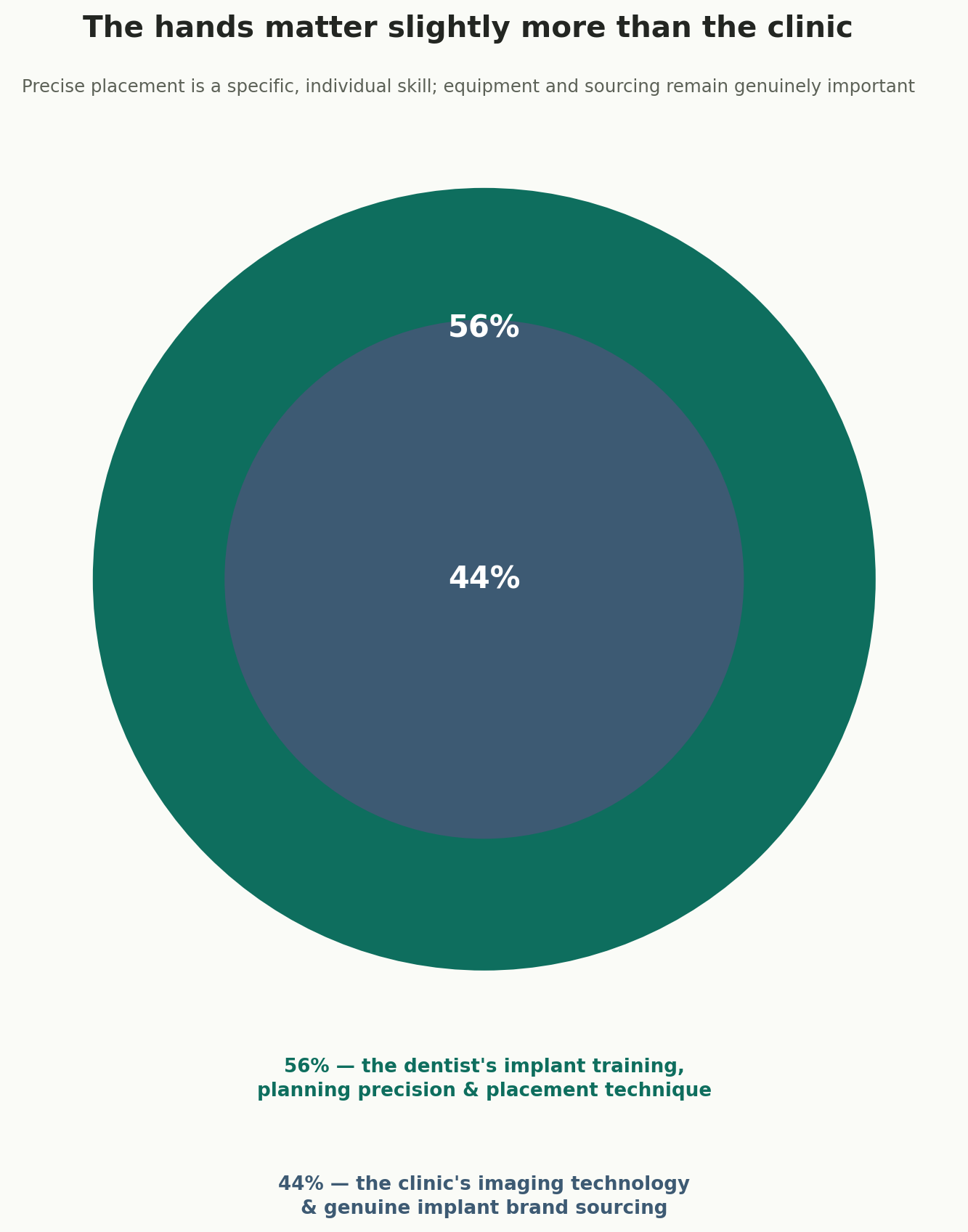
Precise placement is a specific, individual skill; equipment and sourcing remain genuinely important.
The clinic's role remains genuinely significant: without 3D imaging capability and a reliable relationship with an established implant manufacturer, even a skilled dentist cannot deliver the same standard of care. But the actual precision of placement, positioning the implant to avoid nerve damage and achieve proper bone integration, is a specific, individual skill that sits primarily with the treating dentist. This is a genuinely different balance than several more equipment-dependent guides elsewhere in this series, reflecting how much this specific procedure still depends on an individual practitioner's hands and training.
THE VETTING CONVERSATION
What to actually ask
Questions for the dentist
- What specific implant brand and system will be used? A confident, specific answer, by name, is reasonable to expect.
- What is your specific implant training, separate from general dental qualifications? This is a distinct, worthwhile question.
- Will 3D CBCT imaging be used to plan this specific placement? This should be the standard for implant planning.
- What is your approximate case volume with this specific implant system? A specific, comfortable answer suggests genuine, tracked experience.
Questions for the clinic
- Is 3D imaging equipment available on-site? This should be a direct, verifiable answer.
- Is the implant system genuinely available and serviceable in Nigeria, long-term? This protects against future servicing difficulty.
- What is the clinic's own complication rate for implant placement? Specific, tracked figures matter more than general reassurance.
- What documentation will I receive confirming the exact implant brand and model placed? This should be provided as standard practice.
Nigeria-specific Considerations
Why the brand question matters even more from here
Dental implant components are entirely imported into Nigeria, a reality this series' main Dental Surgery guide covers in detail. This makes the specific implant brand question genuinely more consequential for Nigerian patients than for patients in countries with broader, more established domestic implant distribution networks. An established global system, already stocked and serviceable through existing Nigerian dental supply channels, offers a meaningfully more reliable long-term servicing pathway than an obscure system that may never reach the Nigerian market at all.
Four warning signs worth taking seriously
- Reluctance or inability to name the specific implant brand and system. This should be a confident, specific answer.
- No use of 3D CBCT imaging for implant planning. This should be the genuine standard, not an optional upgrade.
- Vague answers about specific implant training and case volume. General dental experience does not confirm implant-specific skill.
- No documentation provided confirming the exact implant placed. This should be standard practice, not something you must request.
A practical order of operations
- Get a full dental examination and 3D imaging before assuming any specific treatment plan.
- Ask directly which implant brand and system will be used, and confirm this in writing.
- Confirm the treating dentist's specific implant training and approximate case volume.
- Ask the dentist-side and clinic-side questions above before committing to treatment.
- Request full documentation of the exact implant placed, for future reference.
- Establish a relationship with a Nigerian dentist for ongoing check-ups and future servicing.
Straight Answers for Nigerian Patients about Dental Surgery in India
Does the specific implant brand matter?
Yes, considerably, for the long term. Established global systems have decades of track record and worldwide parts availability; unknown systems carry real risk if the manufacturer stops trading.
Why does 3D imaging matter for implant planning?
A CBCT scan precisely maps nerve position and bone depth, allowing far more accurate placement than a flat 2D X-ray, which only estimates these measurements.
Is any general dentist qualified to place implants?
Training varies considerably. Some have genuine, dedicated implant training; others have minimal additional education. Asking directly about specific training is a reasonable question.
Why does the dentist matter more than the clinic here?
Precise placement, avoiding nerve damage and achieving proper integration, is a specific, individual skill, though the clinic's imaging and sourcing remain genuinely important.
What is a realistic red flag when choosing a provider?
Inability to name the specific implant brand, no 3D imaging used, or vague answers about specific implant training, are genuine warning signs.
A closing word
An implant placed today is a decision that follows a patient for decades, and the price quoted at the outset rarely reflects the full, long-term picture. A cheaper implant from an obscure or discontinued system may cost considerably more, in both money and disruption, if a component fails years later and cannot be sourced. In twenty-four years of this work, the patients who navigate this best ask for the specific implant brand by name, confirm 3D imaging is genuinely used for planning, and choose a system with a real, verifiable long- term servicing pathway in Nigeria. The placement itself takes an afternoon. The decades that follow are what this choice is actually about.
Sources
- 🌐 American Academy of Implant Dentistry — Choosing an implant provider, patient information
- 🌐 American Dental Association — Dental implants, patient information
- 🌐 International Team for Implantology — CBCT imaging guidance for implant planning
- 🌐 Nigerian Dental Association — Practitioner and specialty verification
- 🌐 High Commission of India, Abuja — Medical and Medical Attendant Visa requirements
Frequently Asked Questions by Nigerians about Dental Surgery in India
Does the dental implant brand really matter?
Yes. The guide explains that an established global system can make future component replacement and servicing easier, including after the patient returns to Nigeria.
Why is implant brand availability particularly important for Nigerian patients?
The guide notes that dental implant components are imported into Nigeria. A system with established local supply channels may therefore provide a more reliable long-term servicing pathway.
Why is 3D CBCT important before dental implant placement?
CBCT creates a three-dimensional map of the jaw, allowing the dentist to assess bone depth and nerve position more precisely than a flat 2D X-ray.
Is a 2D dental X-ray enough for implant planning?
The guide presents 3D CBCT as the planning standard for implant placement and identifies the absence of 3D imaging as a warning sign.
What should Nigerian patients ask about the dentist's experience?
They should ask about specific implant training and approximate case volume with the proposed implant system, rather than relying only on general dental qualifications.
Should patients ask which exact implant will be placed?
Yes. The guide recommends obtaining the specific implant brand and system by name and confirming it in writing before treatment.
What documentation should patients receive after implant placement?
Patients should receive documentation confirming the exact implant brand and model placed, so that future dentists can identify compatible components if servicing is required.
How should Nigerian patients evaluate the clinic?
They should confirm 3D imaging capability, reliable sourcing of established implant systems and the clinic's own complication information.
What are the main warning signs when choosing a dental implant provider?
Warning signs include inability to name the implant brand, no 3D CBCT planning, vague answers about implant-specific training and failure to document the implant placed.
What should Nigerian patients arrange after returning from India?
They should establish an ongoing relationship with a Nigerian dentist for routine check-ups and future implant servicing, while keeping the implant documentation for reference.
Page Summary
This guide explains how Nigerian patients can select dental implant surgeons and clinics in India, focusing on two factors that can significantly influence long-term implant care: the specific implant system used and the precision of treatment planning. It recommends established implant systems with reliable future parts availability, particularly because implant components are imported into Nigeria, and highlights 3D CBCT imaging for accurate assessment of bone depth and nerve position. The page 4 evaluation gives 56% weight to the dentist's implant training, planning precision and placement technique and 44% to the clinic's imaging technology and implant sourcing. The guide also covers dentist-specific training, case volume, documentation, Nigerian servicing and warning signs when selecting a provider.
Citation Block
| Topic | Information |
|---|---|
| Topic Information | Selecting the Best Dental Surgeons and Clinics in India for Nigerian Patients for Patients from Nigeria |
| Treatment | Dental Implant Treatment |
| Intended Audience | Patients from Nigeria |
| Key Specialist | Implant Dentist / Dental Surgeon |
| Primary Selection Factor | Specific Implant Brand and System |
| Planning Standard | 3D CBCT Imaging |
| CBCT Benefit | Precise Assessment of Bone Depth and Nerve Position |
| Evaluation Weighting | 56% Dentist; 44% Clinic |
| Dentist Check | Confirm Specific Implant Training and Case Volume |
| Implant Check | Confirm Exact Brand and System Before Treatment |
| Nigeria Servicing Check | Verify Long-Term Availability of Compatible Components in Nigeria |
| Clinic Check | Confirm On-Site 3D Imaging Capability |
| Documentation Check | Obtain Exact Implant Brand and Model in Writing |
| Safety Check | Confirm CBCT-Based Planning for the Specific Placement |
| Important Warning | Unknown, Unavailable or Discontinued Implant System |
| Pre-Travel Requirement | Complete Dental Examination and Treatment Planning |
| Patient Journey | Dental examination → CBCT planning → implant/system verification → dentist/clinic evaluation → treatment → documentation → Nigerian follow-up |
| Follow-Up | Ongoing Check-Ups and Future Servicing With a Nigerian Dentist |


Our Mission Statement
Our mission is to place patients at the centre of every healthcare decision by providing trustworthy, evidence-based, and unbiased medical information. We believe that informed patients make better decisions. Backed by personalised guidance from our experienced advisory team, we help patients understand their treatment options, compare them objectively, and confidently choose the path that best suits their medical needs and personal circumstances.
Patient Testimonials from Nigeria















Ready to Take the First Step?
Share your Medical Reports with our Healthcare Managers Today and Get a FREE CONSULTATION, a Personalized Treatment Plan, and Complete Support from Arrival to Recovery.
Get Your Free ConsultationAreas We Serve
This resource has been thoughtfully prepared for patients from Nigeria who are considering medical treatment in India. We also welcome patients from the wider region in the countries mentioned below-
We assist patients from:
- Benin
- Niger
- Chad
- Cameroon
- Algeria
- Egypt
- Libya
- Morocco
- Sudan
- Tunisia
- Gambia
- Ghana
- Burkina Faso
- Cabo Verde
- Côte d'Ivoire
- Equatorial Guinea
- São Tomé and Príncipe
Many of the insights, treatment pathways, hospital recommendations, travel guidance, and patient support services described here are equally relevant and may be used as a reference when planning treatment in India.
From Nigeria to India: Your Complete Patient Support Guide
- Artificial Disc Replacement in India for Nigerian Patients
- Weight Loss and Bariatric Surgery in India for Nigerian Patients
- Bone Marrow Transplant in India for Nigerian Patients
- Brain Tumour Surgery in India for Nigerian Patients
- Breast Cancer Treatment and Surgery in India for Nigerian Patients
- Cancer Treatment and Surgery in India for Nigerian Patients
- Cardiac Arrhythmia and Heart Pacemaker Treatment in India for Nigerian Patients
- Cardiac Surgery in India for Nigerian Patients
- Colorectal Cancer Treatment and Surgery in India for Nigerian Patients
- Complex Orthopaedic and Joint Revision Surgery in India for Nigerian Patients
- Cornea Transplant and Advanced Eye Surgery in India for Nigerian Patients
- CyberKnife Treatment in India for Nigerian Patients
- Gamma Knife Treatment in India for Nigerian Patients
- Heart Failure Treatment and Surgery in India for Nigerian Patients
- Hip Surgery in India for Nigerian Patients
- HIPEC Cancer Surgery in India for Nigerian Patients
- IVF and Fertility Treatment in India for Nigerian Patients
- Joint Arthroscopy and Sports Medicine in India for Nigerian Patients