

Selecting the Best Dental Implants and Smile Makeover Specialists in India for Nigerian Patients
A "smile makeover" sounds like one seamless transformation. It is actually a combination of separate procedures, some undoable, some permanent, and knowing which is which changes everything.
The phrase "smile makeover" describes a goal, not a single procedure. In practice, it is a combination of techniques, whitening, orthodontics, bonding, veneers, crowns, sometimes implants, chosen and sequenced for a specific patient's needs. What most patients are never told clearly is that these techniques sit on a genuinely wide spectrum of commitment, from fully reversible to permanently altering natural tooth structure. Understanding this spectrum, and the specific process a provider uses before any irreversible step, matters more than the general promise of a beautiful new smile. This guide sets out that spectrum clearly, the specific, now-standard workflow that protects patients from unnecessary permanent tooth reduction, and why the dentist's own design judgement carries slightly more weight in this evaluation than the laboratory work that follows it.
Should you even be reading this guide? If a smile makeover or comprehensive cosmetic dental plan has genuinely been discussed for your specific case, this guide will help you evaluate the specific dentist and process involved. This series' main Dental Surgery guide covers the broader treatment and cost landscape.
Healing Journeys of Nigerian Patients









Key Takeaways
- The guide's central message is that a smile makeover is not one procedure. It may combine whitening, aligners, bonding, veneers, crowns and sometimes dental implants.
- The page 2 spectrum shows that whitening and clear aligners are fully reversible, bonding can be redone, minimal-prep veneers require little tooth reduction, while traditional veneers and crowns involve permanent tooth alteration.
- Nigerian patients should know which parts of their proposed treatment are reversible and which are permanent before agreeing to a combined treatment package.
- The page 3 workflow recommends digital smile design → physical mock-up → patient approval → irreversible treatment. The mock-up allows the patient to see and feel the proposed smile before tooth reduction.
- A 2025 systematic review cited in the guide found that digital smile design meaningfully improves outcomes and patient satisfaction.
- The guide highlights mock-up-guided preparation as a way to preserve maximum healthy tooth structure while achieving the approved aesthetic design.
- The specific ceramic material is presented as less important than the dentist's design judgement and disciplined mock-up-first process. Lithium disilicate and feldspathic porcelain can both provide good results in skilled hands.
- The page 4 evaluation gives 58% weight to the dentist's cosmetic design skill and mock-up-first process and 42% to the ceramist and laboratory's fabrication precision.
- For Nigerian patients, approving the design remotely before travelling can help ensure that the proposed result matches expectations before any irreversible treatment is performed in India.
- Four warning signs include no digital or physical mock-up, no distinction between reversible and permanent procedures, pressure toward aggressive tooth reduction and inability to show the treating dentist's own cosmetic work.
Quick Facts
- Treatment
- Dental Implants and Smile Makeover
- Country
- India
- Patients
- Patients from Nigeria
- Key Specialist
- Cosmetic Dentist / Implant Dentist
- Main Procedures
- Whitening, Aligners, Bonding, Veneers, Crowns and Dental Implants
- Fully Reversible
- Whitening and Clear Aligners
- Partly Reversible
- Composite Bonding
- Minimal-Prep
- Little to No Tooth Reduction
- Permanent
- Traditional Veneers and Crowns
- Primary Process
- Digital Smile Design → Physical Mock-Up → Patient Approval → Treatment
- Key Principle
- Preserve Healthy Tooth Structure
- 2025 Finding
- Digital Smile Design Improved Outcomes and Patient Satisfaction
- Evaluation Weighting
- 58% Dentist; 42% Laboratory
- Dentist Check
- Cosmetic Design Skill and Mock-Up-First Process
- Tooth Reduction Check
- Ask Exactly How Much Reduction Is Required
- Laboratory Check
- Fabrication Precision and Ceramic Expertise
- Nigeria-Specific Check
- Approve the Design Before Travelling
- Important Warning
- Do Not Begin Irreversible Treatment Without a Mock-Up
- Pre-Travel
- Full Dental Examination and Agreed Treatment Design
- Follow-Up
- Nigerian Dentist for Ongoing Care
- Author
- Dr. Dheeraj Bojwani
- Experience
- 24+ Years
In Brief
For Nigerian patients considering dental implants or a smile makeover in India, the guide recommends first understanding which procedures are reversible and which permanently alter natural teeth. Patients should expect a digital smile design followed by a physical mock-up and should approve the proposed result before any irreversible tooth reduction. The guide gives slightly greater weight to the dentist's design judgement and mock-up-first process than to laboratory fabrication, while also recommending that Nigerian patients establish a local dentist relationship for ongoing care after treatment.
START HERE
"Smile makeover" covers a wide range of commitment levels
Understanding exactly where each planned procedure sits on this spectrum is the necessary first step before evaluating any specific provider.
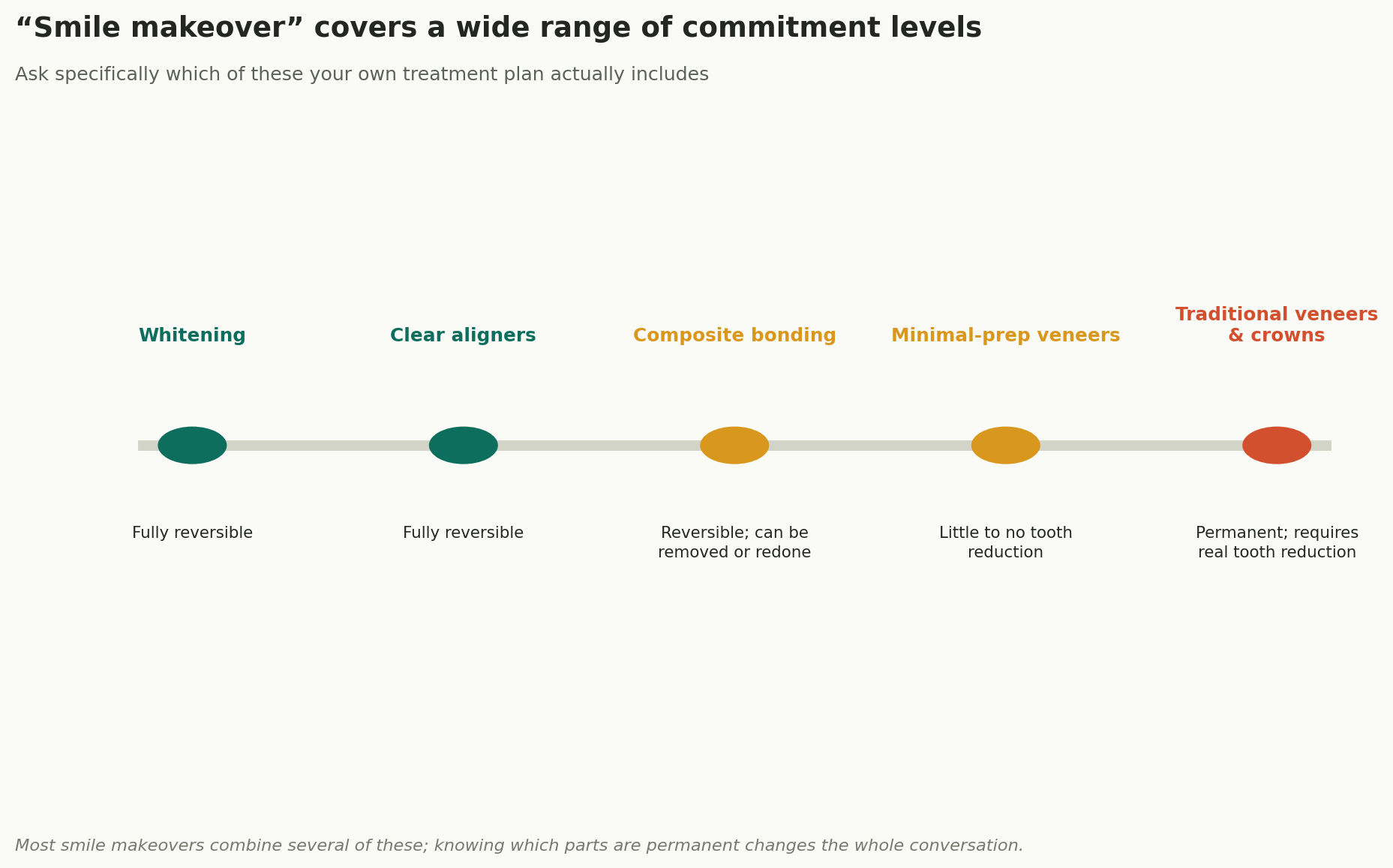
Most smile makeovers combine several of these; knowing which parts are permanent changes the whole conversation.
A genuinely thorough provider will walk through your specific treatment plan and identify, procedure by procedure, which parts are fully reversible and which involve permanent tooth alteration. A plan presented only as a single combined package, without this distinction made clear, leaves a patient less informed than they deserve to be about a genuinely permanent decision.
This distinction also shapes how much deliberation a specific decision deserves. Choosing a whitening shade or trying a set of clear aligners is a low-stakes decision that can be revisited freely. Choosing whether to reduce healthy enamel for a full set of traditional veneers is a decision that will affect those specific teeth for the rest of a patient's life, and deserves proportionally more time, second opinions, and genuine certainty before proceeding.
The Genuine Standard of Care
Test the smile before your teeth are permanently committed to it
Modern cosmetic dentistry has a specific, well-established process for protecting patients from unnecessary, irreversible tooth reduction.
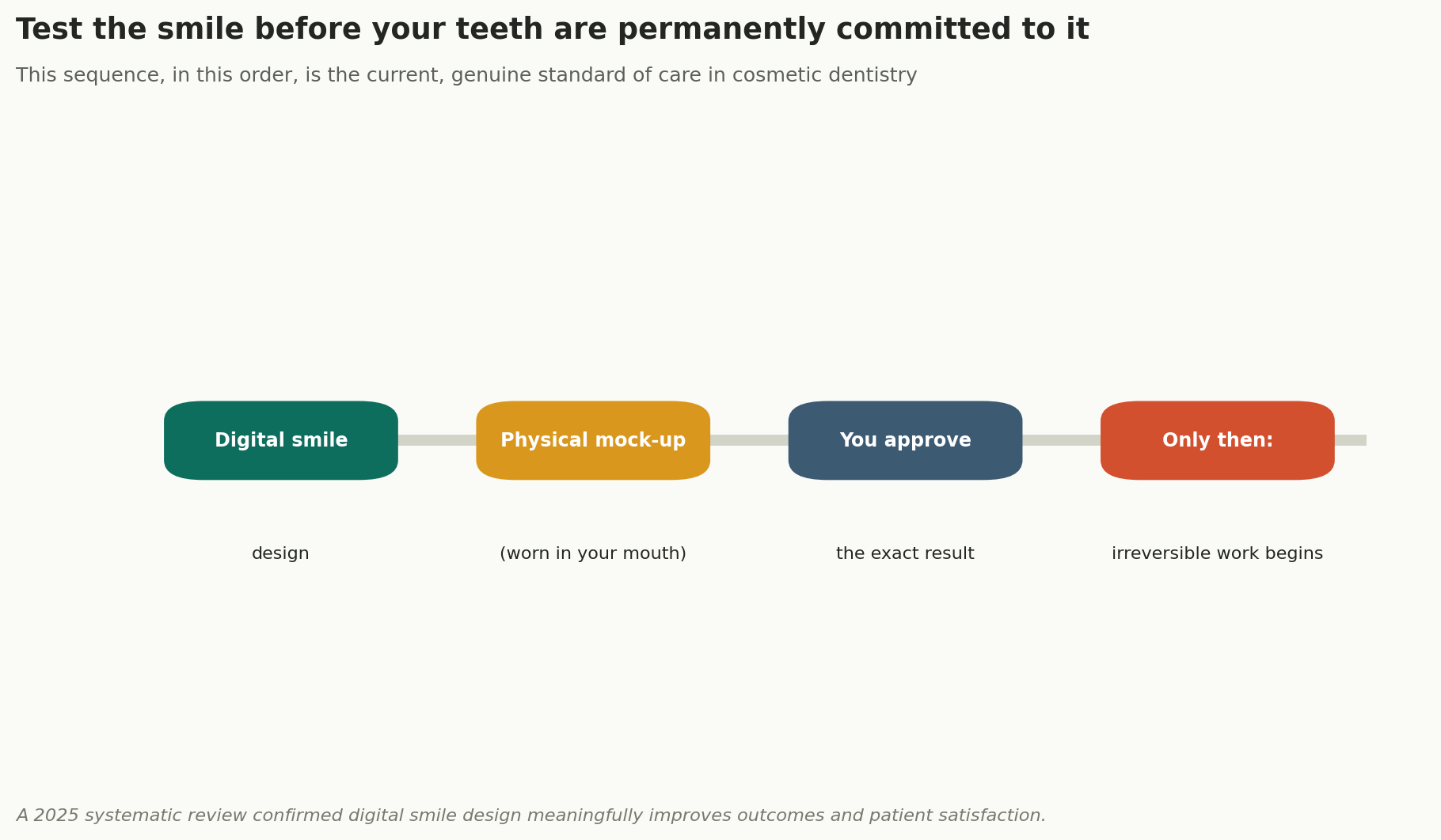
A 2025 systematic review confirmed digital smile design meaningfully improves outcomes and patient satisfaction.
The physical mock-up step matters as much as the digital preview, since it lets a patient see and feel the proposed shapes while speaking and smiling, in their own mouth, before any enamel is touched. This mock- up also allows a skilled dentist to plan minimally invasive tooth reduction specifically guided by the approved design, rather than defaulting to aggressive, one-size-fits-all preparation.
Published clinical guidance on this exact technique, sometimes called mock-up-guided preparation, describes it as a method that preserves maximum healthy tooth structure while still achieving the desired aesthetic outcome, in contrast to older approaches that reduced teeth uniformly regardless of how much reduction the final design genuinely required. This is a meaningful, evidence-based advance worth expecting from any provider claiming genuine cosmetic dentistry expertise.
A note on why this matters more than which specific ceramic material is used. Modern ceramics, whether lithium disilicate or feldspathic porcelain, all offer genuinely excellent aesthetic and durability outcomes in skilled hands. The mock-up-first process, and the discipline to preserve natural tooth structure wherever possible, is a more meaningful marker of a provider's genuine quality than any single material brand name.
THE BALANCE
The design decisions matter slightly more than the lab work
Given how much the final result depends on getting the design right before fabrication even begins, this evaluation weights slightly toward the treating dentist.
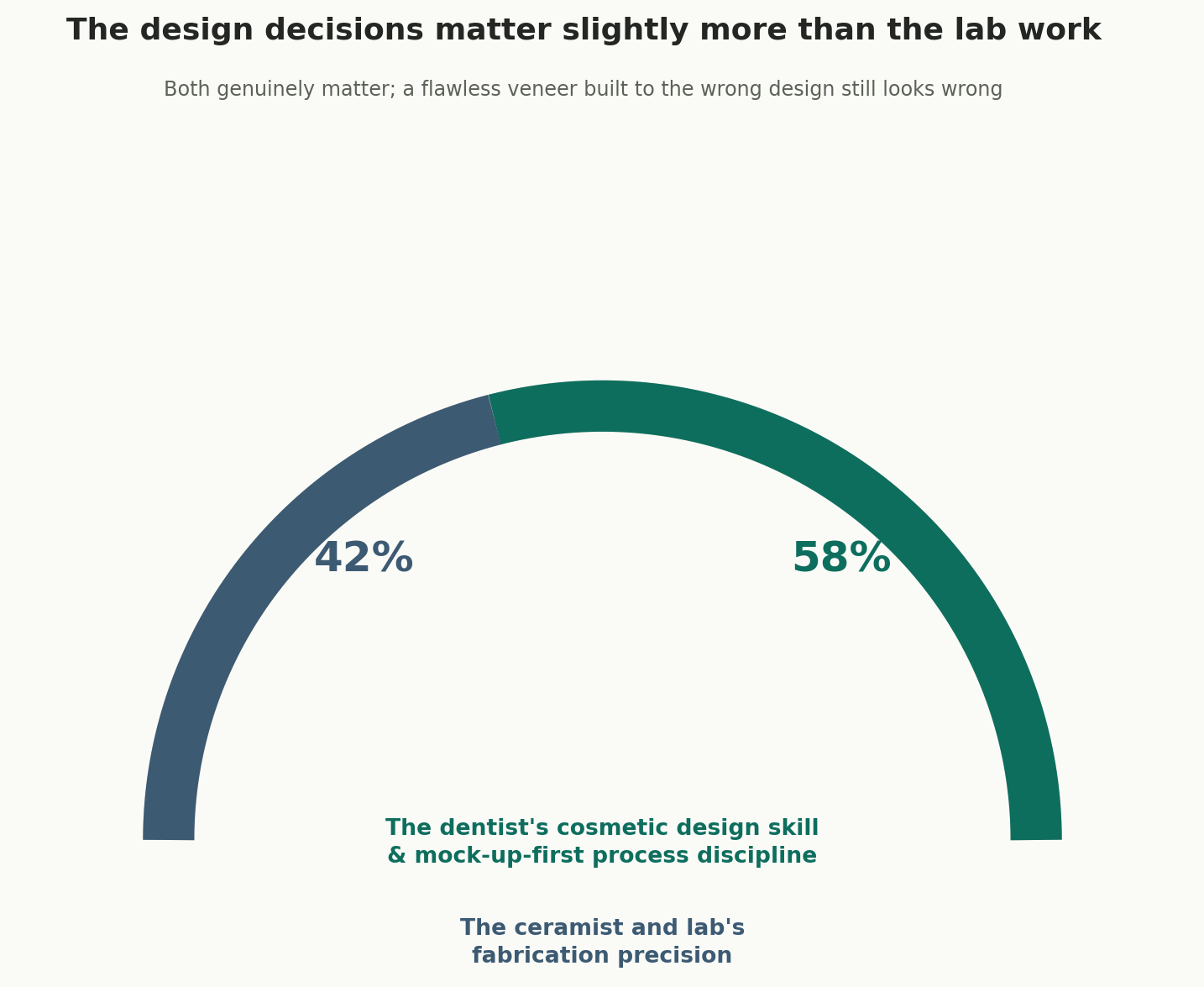
Both genuinely matter; a flawless veneer built to the wrong design still looks wrong.
The ceramist and laboratory's fabrication precision remains genuinely important; even a perfect design can be undermined by imprecise milling or an inexperienced technician. But the dentist's own design judgement, and their discipline in following the mock-up-first process rather than skipping ahead, shapes the foundation everything else is built on, giving them the slightly larger relative share of this evaluation.
THE VETTING CONVERSATION
What to actually ask
Questions for the dentist
- Which specific procedures in my plan are reversible, and which are permanent? This should be a clear, itemised answer.
- Will I see a digital design and a physical mock-up before any tooth reduction? This should be a confident, standard yes.
- How much tooth reduction does my specific plan actually require? Ask for a specific answer, not a general reassurance.
- What is your specific training and experience in cosmetic smile design? This is a distinct skill from general dentistry.
Questions for the clinic
- Is there an in-house or closely coordinated ceramic laboratory? This affects both quality and turnaround time.
- What specific ceramic material will be used, and why? A specific, confident answer is reasonable to expect.
- Can I see genuine before-and-after examples of this specific dentist's work? Ask specifically, not a general clinic gallery.
- What is the plan if I am not satisfied with the mock-up? This should be a clear, flexible, iterative process.
Nigeria-specific Considerations
Why the mock-up step matters even more from a distance
Given that smile makeover treatment often involves multiple visits and, for implant components specifically, genuine import dependency discussed in detail in this series' main Dental Surgery guide, confirming a genuine mock-up-first process before travelling is particularly valuable for Nigerian patients. Approving a design remotely, before committing to travel and treatment, helps ensure the final result matches real expectations before any irreversible step is taken far from home.
Four warning signs worth taking seriously
- No digital design or physical mock-up offered before treatment begins. This should be a standard, expected step.
- No clear distinction made between reversible and permanent procedures in your plan. This should be explained clearly.
- Pressure toward aggressive tooth reduction without discussing minimally invasive alternatives. Ask directly about this.
- Inability to show genuine examples of the treating dentist's own cosmetic work. This should be specific, not generic.
A practical order of operations
- Get a full dental examination and discuss your specific aesthetic goals honestly.
- Ask which procedures in your plan are reversible and which are permanent.
- Insist on a digital design and physical mock-up before any irreversible work.
- Ask the dentist-side and clinic-side questions above before committing to treatment.
- Approve the final design specifically before any tooth reduction begins.
- Establish a relationship with a Nigerian dentist for ongoing care afterward.
Straight Answers for Nigerian Patients about Dental Implants and Smile Makeover in India
Are all smile makeover procedures permanent?
No. Whitening and aligners are fully reversible. Bonding can be redone. Minimal-prep veneers require little tooth reduction. Traditional veneers and crowns are permanent.
What is digital smile design?
Software-based previewing of a planned smile transformation before treatment begins, shown by a 2025 review to meaningfully improve outcomes and satisfaction.
What is a physical mock-up?
A temporary version of the planned result placed directly in your mouth, letting you see and feel the outcome before any permanent tooth reduction.
Why does the dentist's design skill matter more than the lab?
A technically flawless restoration built to an incorrect design still looks wrong, giving the dentist's design judgement the slightly larger relative share.
What is a realistic red flag when choosing a provider?
Proceeding directly to irreversible reduction without a mock-up, or being unable to clearly distinguish reversible from permanent procedures, are genuine warning signs.
A closing word
A beautiful new smile is a genuinely worthwhile goal, and the process of getting there deserves the same careful, informed decision-making as any other permanent change to the body. Knowing which specific steps can be undone, and which cannot, is not a technicality; it is the single most important piece of information in this entire decision. In twenty-four years of this work, the patients who navigate this best insist on a genuine digital design and physical mock-up before anything irreversible happens, ask specifically which parts of their plan are permanent, and treat that mock-up approval as the real decision point, not a formality on the way to a result they have already committed to.
Sources
- 🌐 Digital Smile Design with AI-Assisted Workflow for Minimally Invasive Veneer Rehabilitation. MDPI, 2026
- 🌐 Digital smile design-driven minimally invasive lithium disilicate laminate veneers. Frontiers in Dental Medicine, 2026
- 🌐 What Is a Digital Smile Preview and Why Does It Matter Before Veneers? Patient information resource, 2026
- 🌐 American Academy of Cosmetic Dentistry — Choosing a cosmetic dentist, patient resources
- 🌐 High Commission of India, Abuja — Medical and Medical Attendant Visa requirements
Frequently Asked Questions by Nigerians about Dental Implants and Smile Makeover in India
Is every smile makeover procedure permanent?
No. The guide states that whitening and clear aligners are fully reversible, bonding can be redone, while traditional veneers and crowns permanently alter natural tooth structure.
What should Nigerian patients ask before agreeing to a smile makeover?
They should ask which procedures are reversible, which are permanent and exactly how much natural tooth reduction their specific plan requires.
What is digital smile design?
It is a software-based preview of the proposed smile transformation before treatment. The guide cites a 2025 systematic review reporting meaningful improvements in outcomes and patient satisfaction.
What is a physical mock-up?
It is a temporary version of the planned smile placed directly in the patient's mouth, allowing them to see and feel the proposed result before permanent tooth reduction.
Should a physical mock-up be completed before veneers or crowns?
The guide recommends a digital design followed by a physical mock-up and patient approval before any irreversible work begins.
Why is the mock-up-first process important?
It helps the dentist plan minimal tooth reduction based on the approved design, rather than reducing teeth uniformly or more aggressively than necessary.
Does the ceramic material determine the quality of the smile makeover?
Not by itself. The guide explains that modern ceramics such as lithium disilicate and feldspathic porcelain can both provide excellent results in skilled hands. Design quality and tooth preservation are more meaningful indicators.
What should Nigerian patients ask the dentist?
They should ask about reversible versus permanent procedures, digital and physical mock-ups, required tooth reduction and the dentist's specific training and experience in cosmetic smile design.
What should Nigerian patients ask the dental clinic?
They should ask whether there is an in-house or closely coordinated ceramic laboratory, which material will be used and why, and whether they can see genuine before-and-after examples of the treating dentist's own work.
What are the main warning signs when choosing a smile makeover provider?
Warning signs include no digital or physical mock-up, no clear distinction between permanent and reversible procedures, pressure toward aggressive tooth reduction and inability to show genuine work by the treating dentist.
Page Summary
This guide explains how Nigerian patients can select dental implant and smile makeover specialists in India, focusing on the difference between reversible and permanent procedures and the importance of approving the proposed smile before irreversible treatment begins. The page 2 spectrum places whitening and clear aligners at the fully reversible end, while traditional veneers and crowns involve permanent tooth alteration. The page 3 workflow shows digital smile design → physical mock-up → patient approval → irreversible work, with a 2025 systematic review cited for improved outcomes and satisfaction. The page 4 evaluation gives 58% weight to the dentist's cosmetic design skill and mock-up-first process and 42% to laboratory fabrication precision. The guide also stresses tooth preservation, remote design approval and continuing dental care in Nigeria.
Citation Block
| Topic | Information |
|---|---|
| Topic Information | Selecting the Best Dental Implant and Smile Makeover Specialists in India for Patients from Nigeria |
| Treatment | Dental Implants and Smile Makeover |
| Intended Audience | Patients from Nigeria |
| Key Specialist | Cosmetic Dentist / Implant Dentist |
| Main Procedures | Whitening, Aligners, Bonding, Veneers, Crowns and Dental Implants |
| Reversible Procedures | Whitening and Clear Aligners |
| Bonding | Reversible; Can Be Removed or Redone |
| Minimal-Prep Veneers | Little to No Tooth Reduction |
| Permanent Procedures | Traditional Veneers and Crowns |
| Primary Process | Digital Smile Design → Physical Mock-Up → Patient Approval → Irreversible Work |
| Evidence Point | 2025 Systematic Review Found Digital Smile Design Improved Outcomes and Satisfaction |
| Evaluation Weighting | 58% Dentist; 42% Laboratory |
| Dentist Check | Cosmetic Design Skill and Mock-Up-First Process |
| Tooth Preservation Check | Ask How Much Tooth Reduction the Specific Plan Requires |
| Laboratory Check | Fabrication Precision and Ceramic Expertise |
| Design Check | Approve the Exact Smile Design Before Irreversible Treatment |
| Nigeria-Specific Check | Establish a Nigerian Dentist for Continuing Care |
| Important Warning | No Digital or Physical Mock-Up Before Tooth Reduction |
| Pre-Travel Requirement | Full Dental Examination and Agreed Treatment Design |
| Patient Journey | Dental assessment → reversible/permanent treatment review → digital design → physical mock-up → approval → treatment → Nigerian follow-up |
| Follow-Up | Ongoing Dental Care With a Nigerian Provider |


Our Mission Statement
Our mission is to place patients at the centre of every healthcare decision by providing trustworthy, evidence-based, and unbiased medical information. We believe that informed patients make better decisions. Backed by personalised guidance from our experienced advisory team, we help patients understand their treatment options, compare them objectively, and confidently choose the path that best suits their medical needs and personal circumstances.
Patient Testimonials from Nigeria















Ready to Take the First Step?
Share your Medical Reports with our Healthcare Managers Today and Get a FREE CONSULTATION, a Personalized Treatment Plan, and Complete Support from Arrival to Recovery.
Get Your Free ConsultationAreas We Serve
This resource has been thoughtfully prepared for patients from Nigeria who are considering medical treatment in India. We also welcome patients from the wider region in the countries mentioned below-
We assist patients from:
- Benin
- Niger
- Chad
- Cameroon
- Algeria
- Egypt
- Libya
- Morocco
- Sudan
- Tunisia
- Gambia
- Ghana
- Burkina Faso
- Cabo Verde
- Côte d'Ivoire
- Equatorial Guinea
- São Tomé and Príncipe
Many of the insights, treatment pathways, hospital recommendations, travel guidance, and patient support services described here are equally relevant and may be used as a reference when planning treatment in India.
From Nigeria to India: Your Complete Patient Support Guide
- Artificial Disc Replacement in India for Nigerian Patients
- Weight Loss and Bariatric Surgery in India for Nigerian Patients
- Bone Marrow Transplant in India for Nigerian Patients
- Brain Tumour Surgery in India for Nigerian Patients
- Breast Cancer Treatment and Surgery in India for Nigerian Patients
- Cancer Treatment and Surgery in India for Nigerian Patients
- Cardiac Arrhythmia and Heart Pacemaker Treatment in India for Nigerian Patients
- Cardiac Surgery in India for Nigerian Patients
- Colorectal Cancer Treatment and Surgery in India for Nigerian Patients
- Complex Orthopaedic and Joint Revision Surgery in India for Nigerian Patients
- Cornea Transplant and Advanced Eye Surgery in India for Nigerian Patients
- CyberKnife Treatment in India for Nigerian Patients
- Gamma Knife Treatment in India for Nigerian Patients
- Heart Failure Treatment and Surgery in India for Nigerian Patients
- Hip Surgery in India for Nigerian Patients
- HIPEC Cancer Surgery in India for Nigerian Patients
- IVF and Fertility Treatment in India for Nigerian Patients
- Joint Arthroscopy and Sports Medicine in India for Nigerian Patients