

Selecting the Best CyberKnife Centres and Specialists in India for Nigerian Patients
CyberKnife is a brand name, not a generic term. Confirming exactly what a centre means when it advertises "advanced radiosurgery" is the first, most practical question worth asking.
"Advanced radiosurgery" and "stereotactic treatment" are marketing phrases that can describe several genuinely different technologies, Gamma Knife, CyberKnife, and various linac-based systems among them. Each has different capabilities, different tracking methods, and suits different tumour types. CyberKnife specifically, a robotic, frameless system with real-time image tracking, is often the right choice for tumours outside the brain, and for tumours that move as a patient breathes, but confirming that a centre is genuinely using this specific system, not a similarly- marketed alternative, is where an informed decision actually begins. This guide is built around that single, practical distinction, since it shapes almost every other question worth asking. A family that confirms the specific technology first is in a genuinely stronger position to evaluate everything that follows, from the treatment timeline to the team involved.
Should you even be reading this guide? If a tumour has been diagnosed and stereotactic radiosurgery genuinely discussed as a treatment option, this guide will help you confirm the specific technology involved and evaluate the treating team. If a full diagnostic work-up has not yet happened, that remains the appropriate starting point.
Healing Journeys of Nigerian Patients









Key Takeaways
- The guide's central message is that “advanced radiosurgery” is not a specific technology. Nigerian patients should confirm that the centre actually uses CyberKnife rather than another stereotactic radiation system.
- The page 2 comparison shows that CyberKnife is frameless, uses real-time image tracking and can treat tumours throughout the body, while Gamma Knife is primarily for brain lesions and uses a fixed head frame.
- CyberKnife may be particularly useful for tumours outside the brain and tumours that move with breathing, because its tracking system can account for tumour motion during treatment.
- For lung, liver and pancreatic tumours, fiducial markers may be required to help track tumour movement. The guide states that marker placement and settling can add approximately one week before treatment begins.
- Not every tumour is suitable for CyberKnife. The guide stresses that treatment generally works best for a limited number of well-defined, relatively small tumours, rather than widespread or diffuse disease.
- The page 4 evaluation gives 52% weight to the centre's physics team and genuine equipment verification and 48% to the oncologist's contouring and treatment-planning precision.
- A dedicated medical physicist is an essential part of CyberKnife treatment planning, including calculating and verifying the radiation dose distribution.
- Nigerian patients should ask the centre to confirm the specific CyberKnife system by name and manufacturer, preferably in writing before travelling.
- The guide identifies four warning signs: vague answers about the actual system, no discussion of fiducial markers where relevant, no dedicated medical physicist and recommending CyberKnife regardless of tumour size or number.
- Because dedicated CyberKnife capacity remains limited in Nigeria and the wider region, international treatment may be required. Patients should therefore arrange full imaging, technology verification, treatment planning and Nigerian oncology follow-up before travel.
Quick Facts
- Treatment
- CyberKnife Radiosurgery
- Country
- India
- Patients
- Patients from Nigeria
- Key Specialist
- Radiation Oncologist / CyberKnife Specialist
- Main Technology
- Robotic, Frameless Radiosurgery With Real-Time Image Tracking
- Common Applications
- Brain, Spine, Lung, Liver and Prostate Tumours
- Primary Assessment
- Full Imaging and Tumour Size, Number and Location Review
- Important Preparation
- Fiducial Markers Where Required
- Additional Timeline
- Approximately 1 Week for Marker Placement and Settling Where Applicable
- Treatment Pattern
- Usually 1–5 Sessions
- Centre Weight
- 52% Equipment Verification and Physics Team
- Oncologist Weight
- 48% Contouring and Treatment Planning
- Important Check
- Confirm the Exact System and Manufacturer
- Physics Check
- Confirm Dedicated Medical Physicist Involvement
- Suitability Check
- Confirm Tumour Size, Number and Location
- Pre-Travel Records
- Complete Imaging and Diagnostic Records
- Visa
- Indian Medical Visa and Medical Attendant Visa
- Travel Check
- Include Any Fiducial Marker Preparation in the Travel Timeline
- Follow-Up
- Nigerian Oncologist and Follow-Up Imaging
- Author
- Dr. Dheeraj Bojwani
- Experience
- 24+ Years
In Brief
For Nigerian patients considering CyberKnife treatment in India, the guide recommends first confirming the exact radiosurgery system being offered and whether the patient's tumour is genuinely suitable for CyberKnife. Patients should ask whether fiducial markers are required, understand that this preparation can add about a week for certain moving tumours, and verify the involvement of a dedicated medical physicist. Before travelling, the centre should provide a specific treatment plan, confirm the equipment and expected timeline, and the patient should arrange coordinated follow-up with a Nigerian oncologist.
START HERE
"Advanced radiosurgery" is not one single technology
Before evaluating any specific centre, understanding what these different systems actually are, and are not, changes the entire conversation.
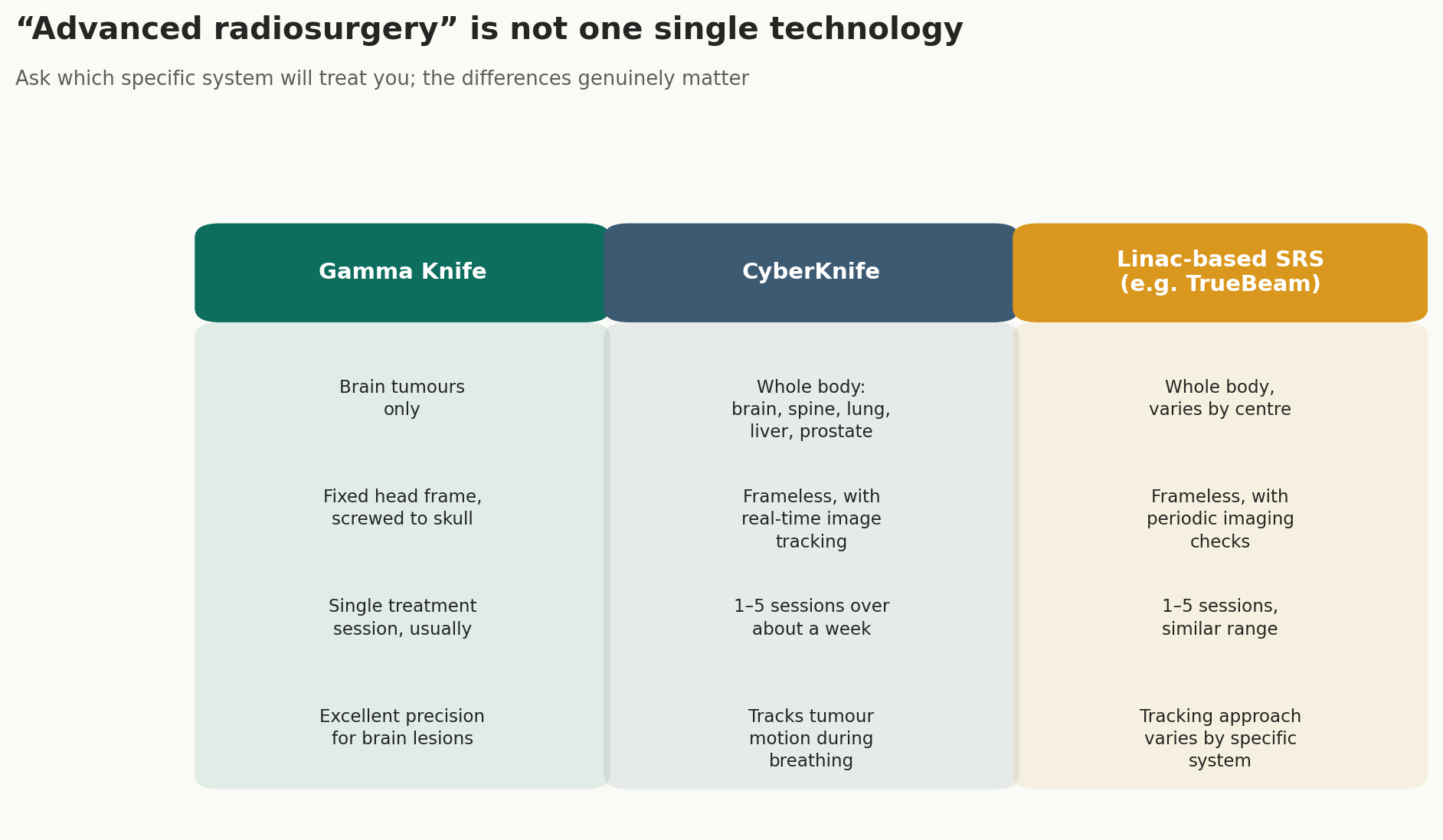
Ask which specific system will treat you; the differences genuinely matter.
A centre confident in its technology will state clearly, and specifically, which system it uses, without hesitation. A centre that responds to a direct question about CyberKnife specifically with a general answer about "advanced radiosurgery" or "the latest technology" deserves a more precise follow-up question before proceeding. This is not a matter of one system being universally superior to another; each genuinely suits different clinical situations, and the right question is whether the specific system available matches your specific diagnosis.
The Practical Step Most Patients Aren't Told
For a moving tumour, treatment starts a week earlier than you'd think
CyberKnife's real advantage over many other systems is its ability to track a tumour's motion in real time, but for certain tumour sites, this tracking depends on a preparatory step many patients only learn about once they arrive.
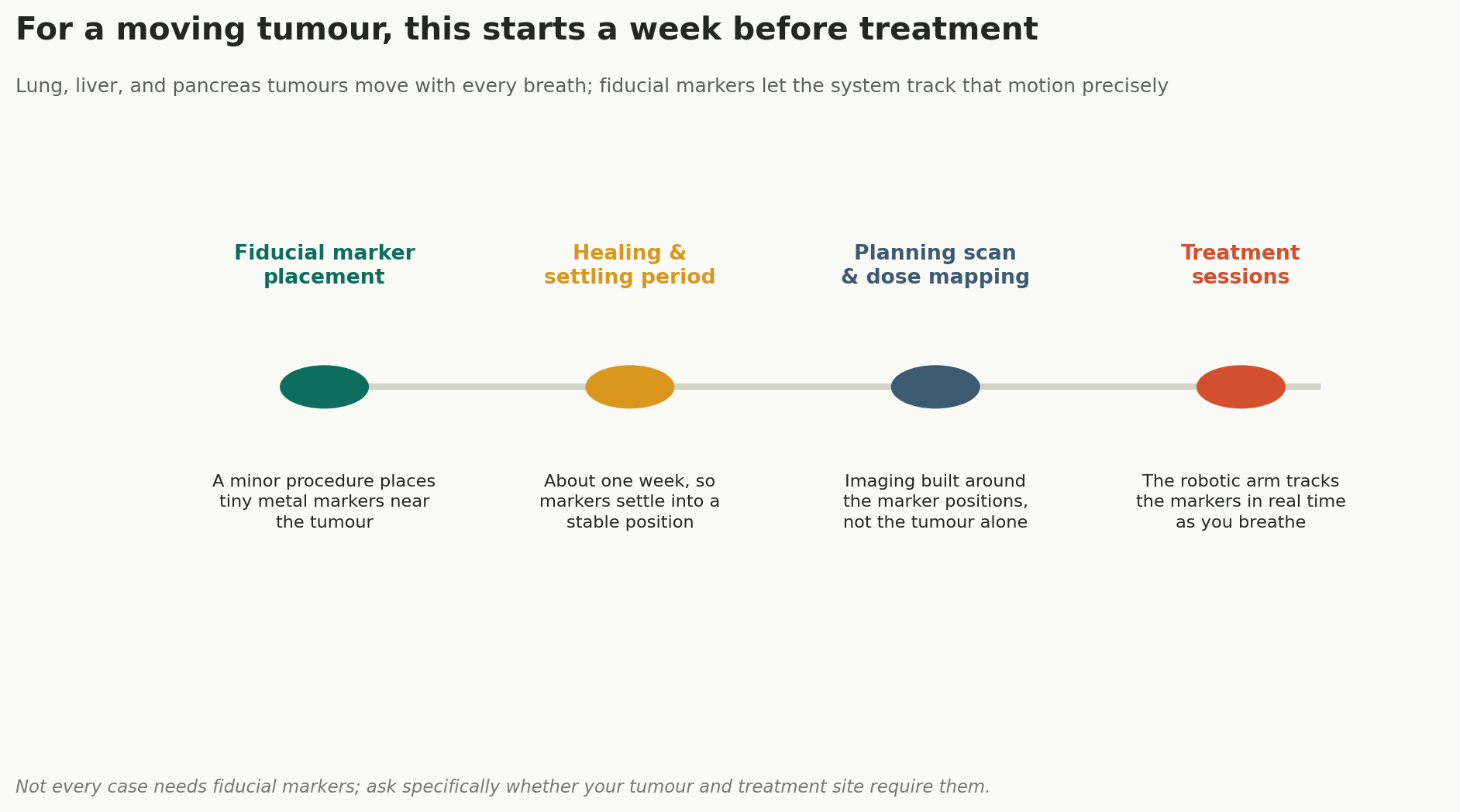
Not every case needs fiducial markers; ask specifically whether your tumour and treatment site require them.
Lung, liver, and pancreas tumours move with every breath, and CyberKnife's tracking system often relies on tiny metal fiducial markers, placed near the tumour through a minor separate procedure, to follow that motion precisely. This adds roughly a week to the overall timeline before treatment itself can begin, a detail worth building into travel planning from the outset rather than discovering upon arrival.
This is a genuinely practical, logistical point as much as a clinical one. A family budgeting for a short, single trip abroad may be caught off guard by an unplanned extra week of accommodation and living costs if this step was not clearly explained beforehand. Asking about fiducial markers early, well before booking flights, protects against exactly this kind of avoidable disruption.
A note on tumour size and number, since CyberKnife is not suited to every case. This treatment works best for a limited number of well-defined, relatively small tumours, not widespread or diffuse disease. A programme should explain clearly whether your specific case, in terms of tumour size, number, and location, is genuinely well suited to this approach, rather than assuming any tumour qualifies.
THE BALANCE
A team decision, slightly tipped toward the centre
Given how much treatment accuracy depends on genuine, well-maintained equipment and a dedicated physics team, alongside the treating oncologist's own planning precision, this evaluation weights close to evenly, with a slight lean toward the centre.
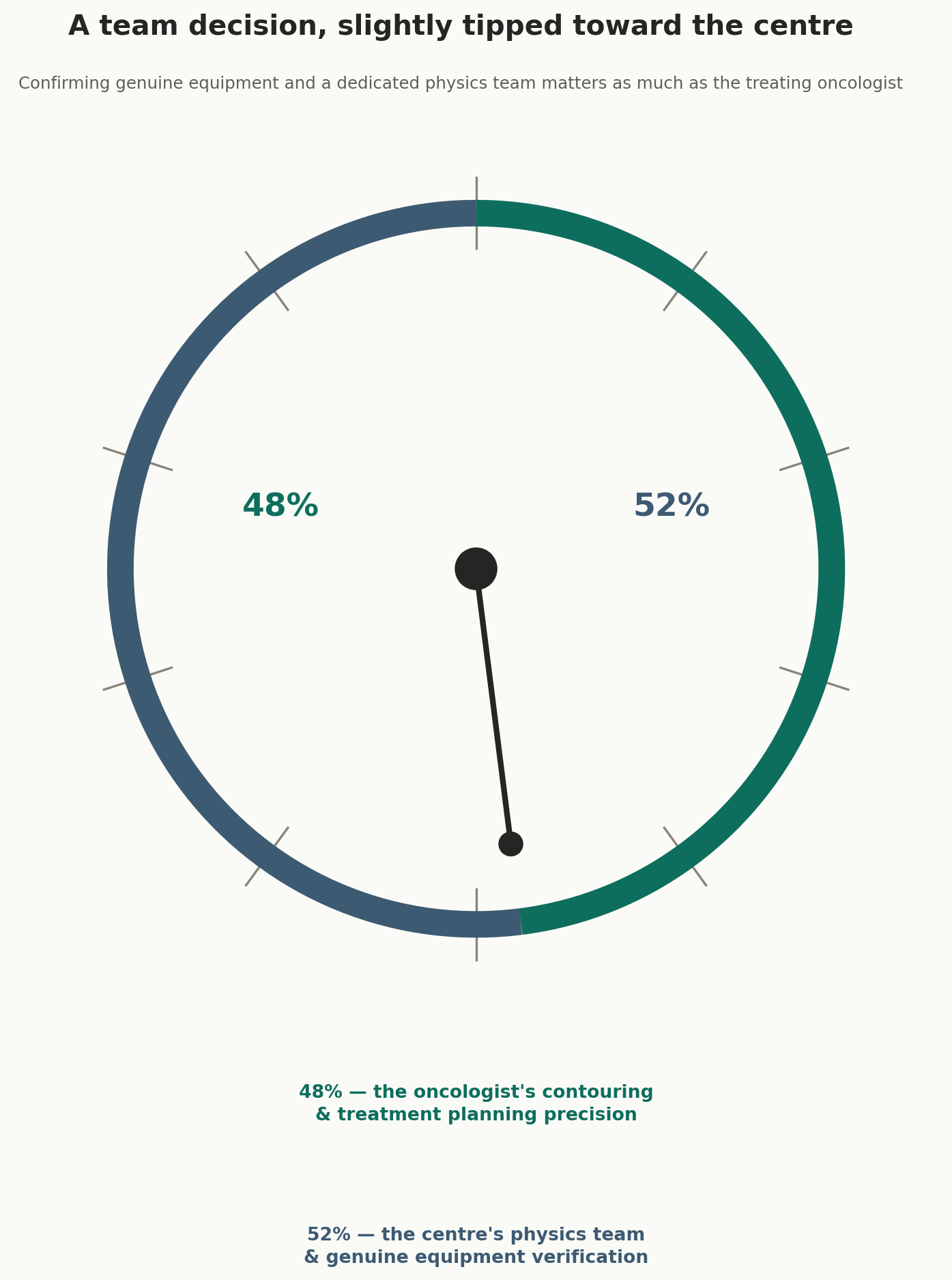
Confirming genuine equipment and a dedicated physics team matters as much as the treating oncologist.
The treating radiation oncologist's precision in contouring the tumour and surrounding structures remains genuinely important. But because CyberKnife treatment planning is such a deeply technical, physics- dependent process, involving a dedicated medical physicist calculating and verifying the exact dose distribution, the centre's team and its genuine equipment carry a slightly larger relative share of this specific decision. This is a genuinely close balance, reflecting how collaborative this specific treatment actually is between clinical judgement and technical execution.
THE VETTING CONVERSATION
What to actually ask
Questions for the oncologist
- Which specific system, by name, will be used for my treatment? A confident, specific answer is reasonable to expect.
- Is my specific tumour genuinely well suited to this treatment, given its size and number? This should be a case-specific, honest assessment.
- Will fiducial markers be needed for my tumour site, and what does that process involve? This should be explained clearly before travel.
- What is your personal experience treating this specific tumour type with this system? General radiosurgery volume does not confirm site-specific expertise.
Questions for the centre
- Is a dedicated medical physicist directly involved in treatment planning? This is a distinct, essential role, not an optional extra.
- How is the equipment's accuracy verified and maintained? A confident, specific answer suggests genuine, rigorous practice.
- What is the centre's own outcome data for this specific tumour type? Specific, tracked figures matter more than general reputation.
- What is the full expected timeline, including any fiducial marker placement? This should be planned and communicated clearly in advance.
Nigeria-specific Considerations
Why verification matters even more from a distance
Dedicated CyberKnife and comparable advanced radiosurgery capacity remains genuinely limited within Nigeria and much of the wider region, making international travel the realistic route to this specific technology for most patients. Evaluating a centre from a distance, often based on a website or a phone consultation, makes the specific verification questions in this guide more important, not less; a centre's polished marketing materials do not, by themselves, confirm which actual system a patient will be treated with.
A useful practical habit is requesting written confirmation of the specific system, by name and manufacturer, before travel, rather than relying on a verbal assurance during an initial consultation call. A centre genuinely willing to put this in writing, alongside a specific treatment plan for your diagnosis, is demonstrating exactly the kind of transparency this guide encourages families to expect.
Four warning signs worth taking seriously
- Vague answers about which specific radiosurgery system is used. This should be a clear, confident, specific answer.
- No discussion of fiducial markers for a tumour site where they would genuinely be needed. This should be raised proactively.
- No dedicated medical physicist mentioned as part of the treatment planning process. This role is essential, not optional.
- A recommendation for this treatment regardless of tumour size or number. This approach is not suited to every case.
A practical order of operations
- Get a confirmed diagnosis and full imaging to assess tumour size, number, and location.
- Ask directly which specific radiosurgery system a centre actually uses.
- Confirm whether fiducial markers will be needed, and build that time into your travel plan.
- Ask the oncologist-side and centre-side questions above before committing to a programme.
- Travel, treatment, and a follow-up imaging schedule appropriate to your specific case.
- Establish a coordinated follow-up relationship with a Nigerian oncologist before returning home.
Straight Answers for Nigerian Patients about CyberKnife Treatment in India
Is CyberKnife the same as Gamma Knife?
No. Gamma Knife treats brain tumours only, using a fixed frame, usually in one session. CyberKnife treats tumours throughout the body, frameless, with real-time tracking, usually over several sessions.
Why does a centre need to confirm its specific system?
Terms like radiosurgery cover several genuinely different technologies with different capabilities and suitability, so confirming the specific system is a meaningful, not cosmetic, question.
What is a fiducial marker?
A tiny metal marker placed near a tumour to track its position during treatment, typically needed for tumours that move with breathing, adding roughly a week before treatment can begin.
Why does the centre carry slightly more weight than the oncologist?
Confirming genuine equipment and a dedicated physics team supporting treatment planning matters as much as the treating oncologist's own precision.
What is a realistic red flag when choosing a programme?
Vague answers about the specific system used, no discussion of fiducial markers where needed, or no dedicated medical physicist involved, are genuine warning signs.
A closing word
The words "advanced" and "radiosurgery" tell a patient very little on their own. What actually matters is a specific, verifiable answer: which system, operated by which team, treating which specific tumour, with what preparation beforehand. A centre confident in its own technology and process will answer every one of these questions directly and specifically. In twenty-four years of this work, the patients who navigate this best ask for the specific system by name, confirm whether fiducial markers apply to their case before booking travel, and treat a dedicated medical physicist's involvement as a genuine marker of quality, not a technical footnote. The treatment sessions themselves may be brief. Getting the technology, the team, and the timeline right beforehand is what this decision actually depends on, and asking these specific, direct questions is what actually protects a family from an unwelcome surprise partway through the process.
Sources
- 🌐 American Society for Radiation Oncology — Stereotactic radiosurgery and stereotactic body radiotherapy, model policy
- 🌐 Radiosurgery Society — Patient information on stereotactic treatment technologies
- 🌐 National Cancer Institute — Stereotactic radiosurgery, patient information
- 🌐 NHS (UK) — Stereotactic radiotherapy and radiosurgery: overview
- 🌐 High Commission of India, Abuja — Medical and Medical Attendant Visa requirements
Frequently Asked Questions by Nigerians about CyberKnife Treatment in India
Is CyberKnife the same as Gamma Knife?
No. The guide explains that Gamma Knife is primarily for brain tumours and uses a fixed head frame, while CyberKnife is frameless, uses real-time tracking and can treat tumours throughout the body.
Why should Nigerian patients confirm the exact radiosurgery system?
“Advanced radiosurgery” can describe several technologies with different capabilities. The guide recommends confirming CyberKnife specifically by name and manufacturer before travelling.
Which tumours may be suitable for CyberKnife?
The guide discusses treatment across sites including the brain, spine, lung, liver and prostate, with suitability depending on tumour size, number, location and other clinical factors.
Are fiducial markers required for every CyberKnife patient?
No. The guide states that not every case requires fiducial markers. They may be used for tumours that move with breathing, particularly in the lung, liver and pancreas.
How much additional time can fiducial markers add?
For cases requiring them, the guide indicates that marker placement and settling can add approximately one week before CyberKnife treatment begins.
Is CyberKnife suitable for widespread cancer?
The guide states that CyberKnife generally works best for a limited number of well-defined, relatively small tumours, rather than widespread or diffuse disease.
How important is the medical physicist in CyberKnife treatment?
Very important. The guide identifies a dedicated medical physicist as an essential part of treatment planning, including calculating and verifying the radiation dose distribution.
What should Nigerian patients ask the CyberKnife centre before travelling?
They should ask which specific system will be used, whether fiducial markers are needed, who the medical physicist is, how equipment accuracy is verified and what the complete treatment timeline will be.
What are the major warning signs when choosing a CyberKnife programme?
Warning signs include vague technology descriptions, no discussion of fiducial markers where relevant, no dedicated medical physicist and recommending CyberKnife regardless of tumour size or number.
What should Nigerian patients arrange before returning home after CyberKnife?
They should establish a coordinated follow-up relationship with a Nigerian oncologist and obtain an appropriate follow-up imaging schedule based on their diagnosis and treatment plan.
Page Summary
This guide explains how Nigerian patients can select CyberKnife centres and specialists in India, with its central focus on confirming the specific technology rather than relying on broad terms such as “advanced radiosurgery.” It distinguishes CyberKnife from Gamma Knife and linac-based systems, explains its real-time tumour tracking capability and highlights the possible need for fiducial markers for moving tumours such as those in the lung, liver and pancreas. The page 4 assessment gives 52% weight to genuine equipment verification and the dedicated physics team and 48% to the oncologist's treatment-planning precision. The guide also covers tumour suitability, travel planning, warning signs, technology verification and coordinated follow-up with a Nigerian oncologist.
Citation Block
| Topic | Information |
|---|---|
| Topic Information | Selecting the Best CyberKnife Centres and Specialists in India for Nigerian Patients for Patients from Nigeria |
| Treatment | CyberKnife Radiosurgery |
| Intended Audience | Patients from Nigeria |
| Key Specialist | Radiation Oncologist / CyberKnife Specialist |
| Primary Technology | Robotic, Frameless System With Real-Time Image Tracking |
| Common Treatment Sites | Brain, Spine, Lung, Liver and Prostate |
| Primary Assessment | Imaging and Tumour Size, Number and Location |
| Important Preparation | Fiducial Markers for Selected Moving Tumours |
| Additional Timeline | Approximately One Week Where Fiducial Markers Are Required |
| Treatment Sessions | Usually 1–5 Sessions |
| Evaluation Weighting | 52% Centre Equipment and Physics Team; 48% Oncologist Planning |
| Centre Check | Confirm Specific CyberKnife System and Manufacturer |
| Physics Check | Confirm Dedicated Medical Physicist Involvement |
| Specialist Check | Ask About Experience With the Specific Tumour Type |
| Suitability Check | Confirm Tumour Size, Number and Location |
| Important Warning | Do Not Accept “Advanced Radiosurgery” Without Identifying the Actual System |
| Travel Check | Include Fiducial Marker Preparation in the Overall Timeline Where Applicable |
| Follow-Up | Nigerian Oncologist and Case-Appropriate Follow-Up Imaging |


Our Mission Statement
Our mission is to place patients at the centre of every healthcare decision by providing trustworthy, evidence-based, and unbiased medical information. We believe that informed patients make better decisions. Backed by personalised guidance from our experienced advisory team, we help patients understand their treatment options, compare them objectively, and confidently choose the path that best suits their medical needs and personal circumstances.
Patient Testimonials from Nigeria















Ready to Take the First Step?
Share your Medical Reports with our Healthcare Managers Today and Get a FREE CONSULTATION, a Personalized Treatment Plan, and Complete Support from Arrival to Recovery.
Get Your Free ConsultationAreas We Serve
This resource has been thoughtfully prepared for patients from Nigeria who are considering medical treatment in India. We also welcome patients from the wider region in the countries mentioned below-
We assist patients from:
- Benin
- Niger
- Chad
- Cameroon
- Algeria
- Egypt
- Libya
- Morocco
- Sudan
- Tunisia
- Gambia
- Ghana
- Burkina Faso
- Cabo Verde
- Côte d'Ivoire
- Equatorial Guinea
- São Tomé and Príncipe
Many of the insights, treatment pathways, hospital recommendations, travel guidance, and patient support services described here are equally relevant and may be used as a reference when planning treatment in India.
From Nigeria to India: Your Complete Patient Support Guide
- Artificial Disc Replacement in India for Nigerian Patients
- Weight Loss and Bariatric Surgery in India for Nigerian Patients
- Bone Marrow Transplant in India for Nigerian Patients
- Brain Tumour Surgery in India for Nigerian Patients
- Breast Cancer Treatment and Surgery in India for Nigerian Patients
- Cancer Treatment and Surgery in India for Nigerian Patients
- Cardiac Arrhythmia and Heart Pacemaker Treatment in India for Nigerian Patients
- Cardiac Surgery in India for Nigerian Patients
- Colorectal Cancer Treatment and Surgery in India for Nigerian Patients
- Complex Orthopaedic and Joint Revision Surgery in India for Nigerian Patients
- Cornea Transplant and Advanced Eye Surgery in India for Nigerian Patients
- CyberKnife Treatment in India for Nigerian Patients
- Gamma Knife Treatment in India for Nigerian Patients
- Heart Failure Treatment and Surgery in India for Nigerian Patients
- Hip Surgery in India for Nigerian Patients
- HIPEC Cancer Surgery in India for Nigerian Patients
- IVF and Fertility Treatment in India for Nigerian Patients
- Joint Arthroscopy and Sports Medicine in India for Nigerian Patients