

Selecting the Best Cosmetic and Aesthetic Surgeons and Hospitals in India for Nigerian Patients
Two very different titles get used almost interchangeably in this field. Only one of them is something you can actually verify.
"Plastic surgeon" and "cosmetic surgeon" sound like two ways of describing the same profession. They are not. Plastic surgeon generally refers to a physician who has completed a recognised surgical residency and a dedicated plastic surgery fellowship, followed by formal board certification, a path that takes roughly ten to fourteen years and can be independently verified through a certifying body's own public records. Cosmetic surgeon, in many jurisdictions, is not a protected title at all, and can be adopted by any licensed physician regardless of the specific surgical training they have actually completed. Understanding this distinction, and knowing how to verify it, is the single most protective thing a patient can do before choosing anyone to perform an elective surgical procedure. This guide is deliberately built around that single distinction, rather than repeating the broader regulatory landscape covered in this series' main Cosmetic and Aesthetic Surgery guide. The question here is narrower and more practical: once you are actually evaluating a specific individual to perform your procedure, what is the one piece of information most worth verifying, and how do you actually go about verifying it.
Should you even be reading this guide? If you have already decided a specific cosmetic or aesthetic procedure is right for you, this guide will help you verify that the provider performing it has genuine, checkable surgical credentials. It does not exist to question that decision, only to protect it.
Healing Journeys of Nigerian Patients









Key Takeaways
- The guide's central message is that “plastic surgeon” and “cosmetic surgeon” should not automatically be treated as interchangeable titles. Patients should verify the surgeon's actual training and certification.
- A formally trained plastic surgeon generally follows a recognised surgical residency, dedicated plastic surgery training and board certification. The guide describes this pathway as taking approximately 10–14 years and being independently verifiable.
- The page 2 diagram shows the difference clearly: the formal pathway progresses through medical school → general surgery residency → plastic surgery fellowship → board certification, while “cosmetic surgeon” may not be a protected title in many jurisdictions.
- Before-and-after photographs should be examined carefully. The page 3 comparison identifies consistent lighting and angles, healing timelines, confirmation that the patients are genuinely the surgeon's own and multiple examples as useful evidence.
- The guide warns that even genuine before-and-after photographs represent individual outcomes rather than guarantees because anatomy, healing and patient expectations differ.
- A surgeon's willingness to discuss their own revision surgery rate is presented as an important transparency and quality signal.
- The page 4 evaluation gives 60% weight to the surgeon's specific surgical credentials and 40% to the facility's accreditation and safety systems, showing that the individual surgeon carries greater weight in this assessment.
- Nigerian patients should independently verify the surgeon's certification through the named certifying body's own public register, rather than relying only on information displayed by a clinic.
- Facility checks should include accreditation, a qualified named anaesthetist, written emergency protocols including ICU access, and documented outcome and complication data.
- The guide identifies four major warning signs: unverified qualifications, unconfirmed before-and-after photographs, reluctance to name the certifying or accrediting body, and unwillingness to discuss revision or complication rates honestly.
Quick Facts
- Treatment
- Cosmetic and Aesthetic Surgery
- Country
- India
- Patients
- Patients from Nigeria
- Key Specialist
- Board-Certified Plastic Surgeon / Qualified Aesthetic Surgeon
- Primary Selection Factor
- Specific, Verifiable Surgical Credentials
- Formal Training Pathway
- Medical School → General Surgery Residency → Plastic Surgery Fellowship → Board Certification
- Training Duration
- Approximately 10–14 Years
- Evaluation Weight
- 60% Surgeon Credentials; 40% Facility Accreditation and Safety
- Photo Check
- Confirm Authenticity, Consistent Lighting and Healing Timeline
- Outcome Check
- Ask About Revision and Complication Rates
- Facility Check
- Verify Accreditation and Emergency Protocols
- Anaesthesia Check
- Confirm a Qualified, Named Anaesthetist
- Pre-Travel Check
- Verify Credentials Directly Through the Certifying Body
- Important Warning
- Do Not Rely on the General Title “Cosmetic Surgeon”
- Nigeria Consideration
- Independent Credential Verification Is Especially Important
- Visa
- Indian Medical Visa and Medical Attendant Visa Where Applicable
- Follow-Up
- Confirm Post-Procedure Care and Emergency Contact Arrangements
- Author
- Dr. Dheeraj Bojwani
- Experience
- 24+ Years
In Brief
For Nigerian patients considering cosmetic or aesthetic surgery in India, the guide recommends making specific, independently verifiable surgical credentials the first priority rather than choosing a provider based on a general title, clinic presentation or price. Patients should verify board certification directly, examine before-and-after photographs for authenticity and healing timelines, ask about the surgeon's revision rate, and independently confirm facility accreditation, anaesthesia arrangements and emergency protocols. The guide stresses that these checks are equally important whether treatment is being considered in Nigeria or India.
START HERE
Two paths, two very different titles
Understanding what actually separates these two titles is the necessary first step before evaluating any specific provider.
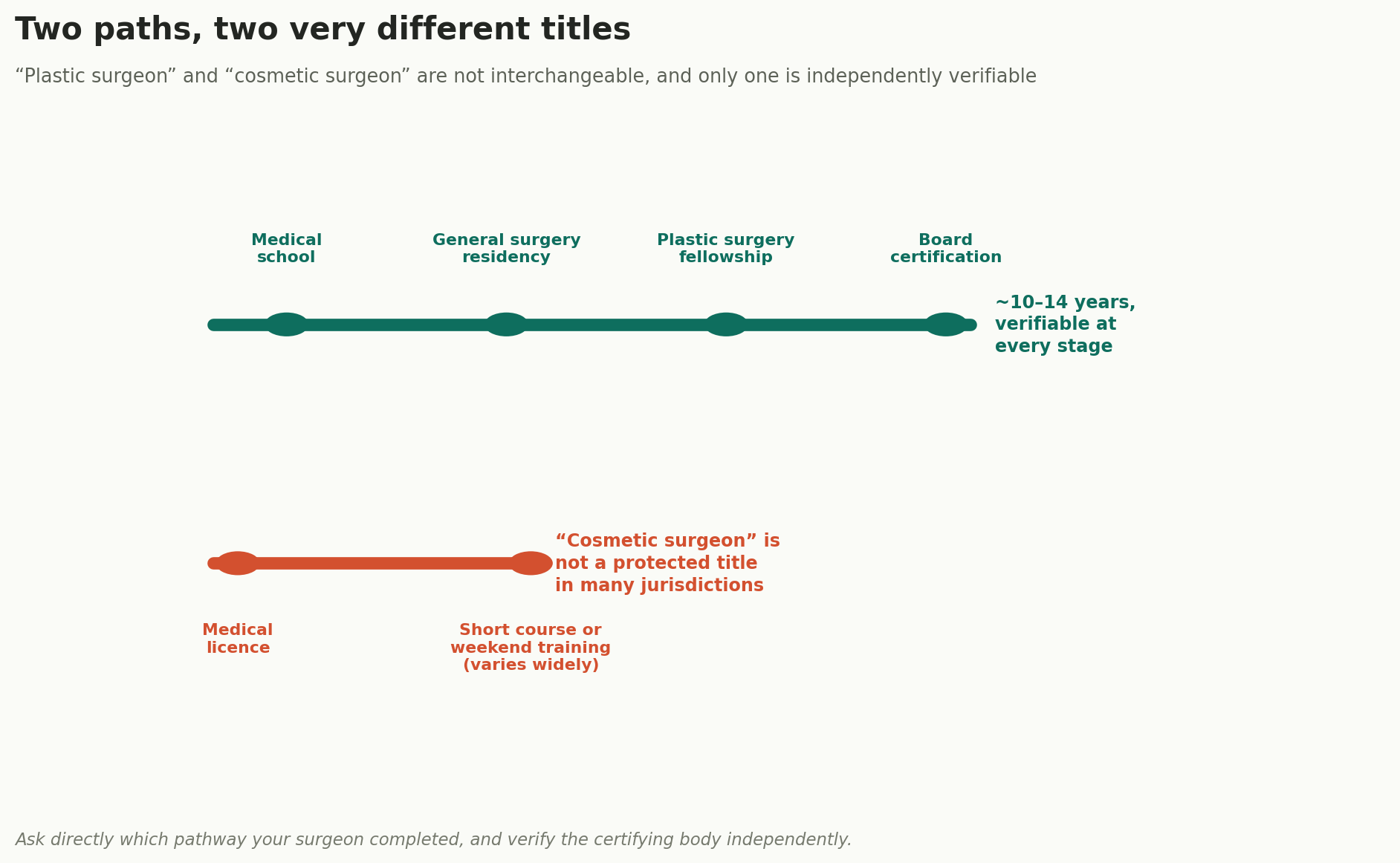
Ask directly which pathway your surgeon completed, and verify the certifying body independently.
This is not a claim that every physician using the title cosmetic surgeon is unqualified; some genuinely have extensive relevant training. It is a claim that the title itself tells you nothing verifiable on its own, and that a specific, named board certification, checked directly against the certifying body's own records, is what actually protects a patient here. A genuinely qualified provider, whichever title they use, will have no difficulty naming their specific certification and pointing you toward the organisation that issued it.
Reading the Evidence Correctly
Before-and-after photos are evidence, not decoration
Photo galleries are one of the most persuasive marketing tools in this field, and also one of the easiest to present in a misleading way, deliberately or otherwise.
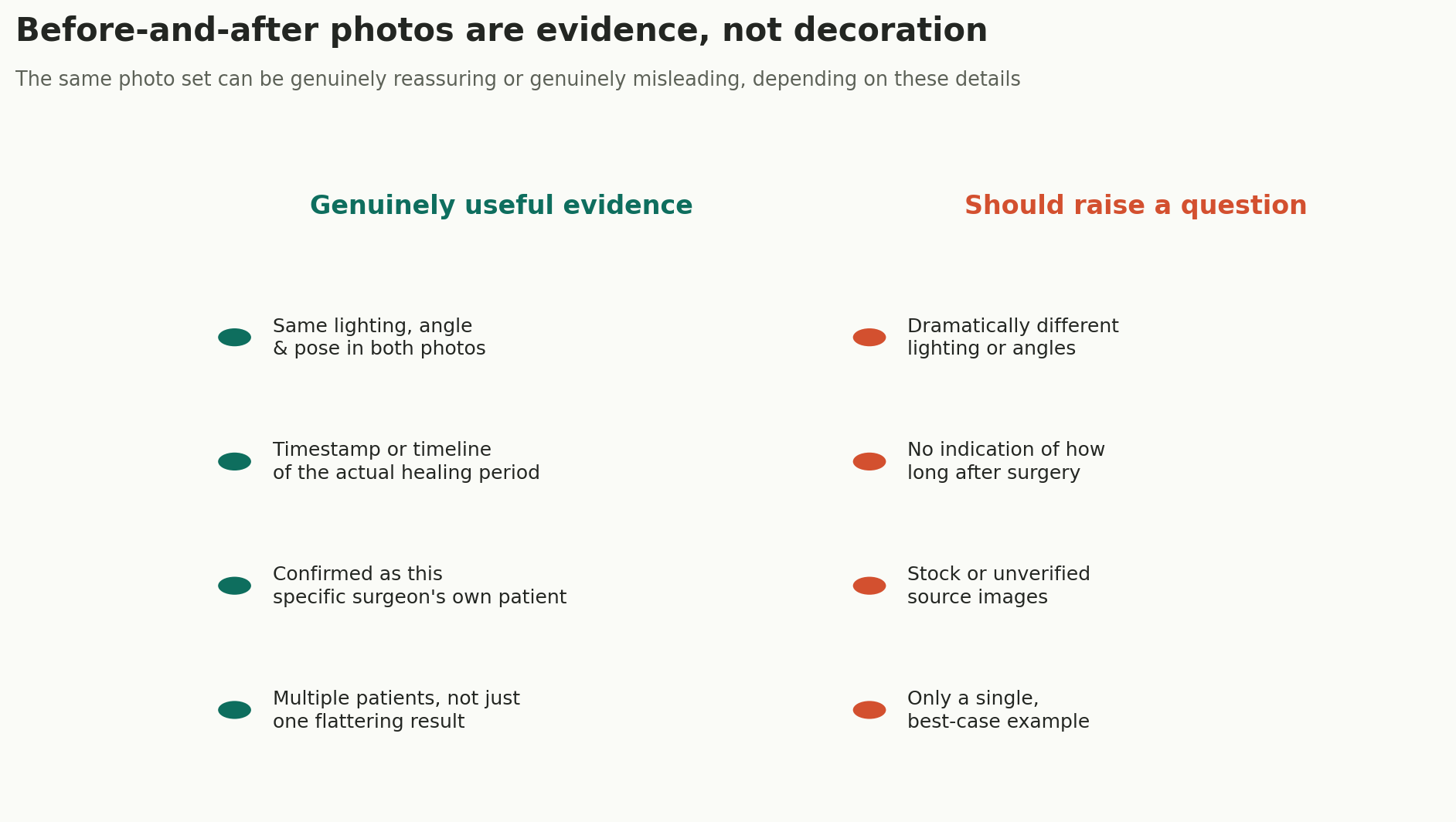
The same photo set can be genuinely reassuring or genuinely misleading, depending on these details.
A confident, experienced surgeon will typically welcome specific questions about their own photo gallery, when the photos were taken, whether lighting and pose were kept consistent, and whether the images genuinely represent their own patients. Hesitation or vagueness in response to these specific questions is itself a meaningful piece of information.
It is worth remembering that even entirely genuine before-and-after photos represent a single outcome, not a guarantee. A patient's own anatomy, healing response, and specific goals mean that another patient's excellent result, however authentic, does not predict your own outcome with certainty. Photos are useful evidence of a surgeon's skill and consistency, not a promise of a specific personal result.
A note on revision surgery rates, since this is a genuinely honest quality signal. Every surgeon, however skilled, has some patients who need a secondary correction. A surgeon willing to discuss their own revision rate honestly, rather than implying a flawless record, is demonstrating exactly the kind of transparency worth valuing in this field.
THE BALANCE
The credential is the decision here
Given how directly a surgeon's specific, verifiable training shapes both technical skill and clinical judgement in this field, this evaluation weights heavily toward the individual practitioner.
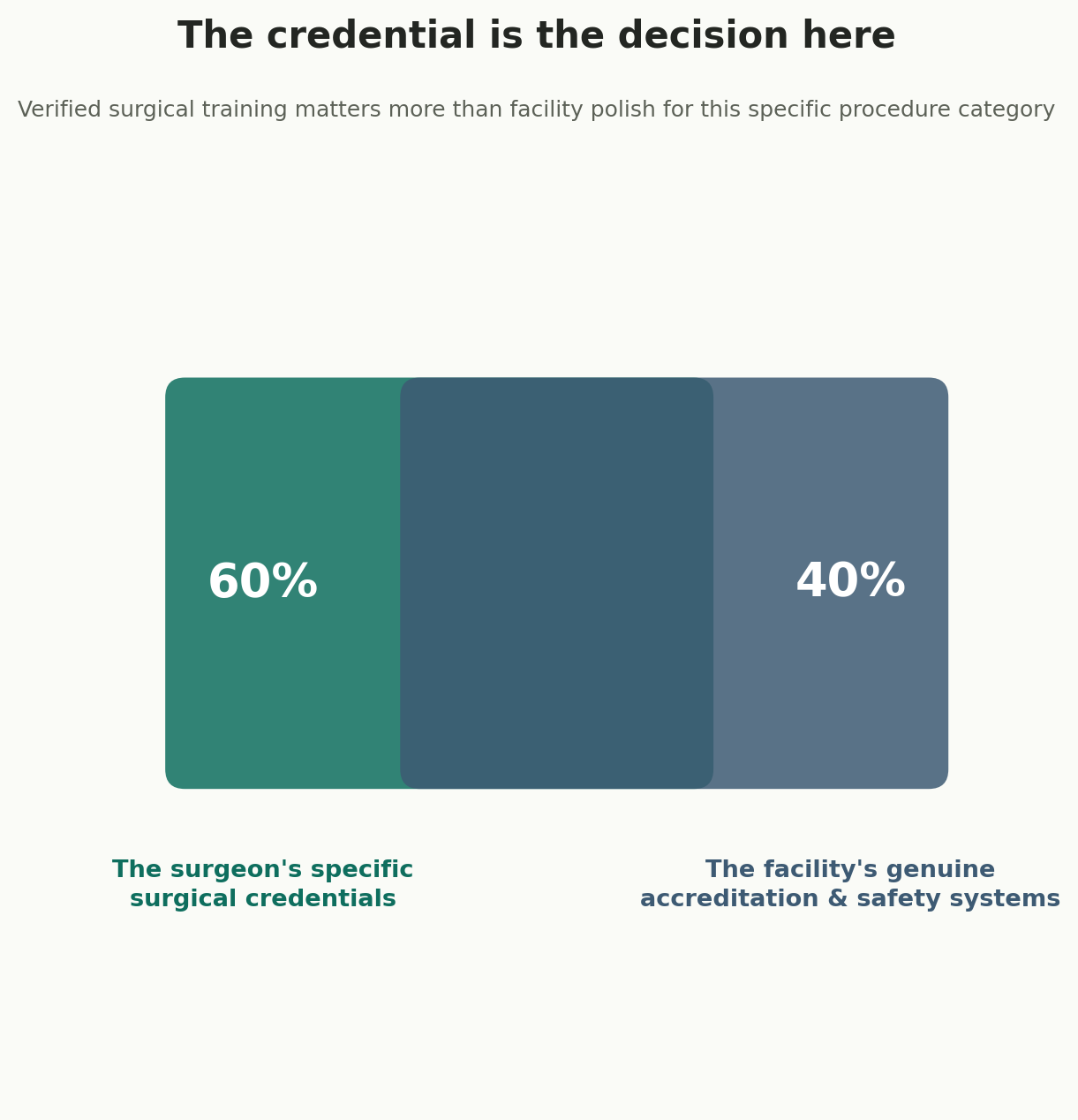
Verified surgical training matters more than facility polish for this specific procedure category.
A well-appointed, accredited facility genuinely matters, and remains an essential part of this evaluation. But it cannot substitute for the specific surgical training, judgement, and technical skill an individual practitioner brings into the operating theatre, which is why the credential itself carries the larger relative share of this particular decision. This is a meaningfully different balance than several more equipment-dependent procedures elsewhere in this series, reflecting how much this specific category of surgery depends on an individual's hands and judgement rather than surrounding technology.
THE VETTING CONVERSATION
What to actually ask
Questions for the surgeon
- What is your specific board certification, and which body issued it? Ask for the exact name, then verify it independently.
- Did you complete a formal plastic surgery residency or fellowship? A specific, confident answer is reasonable to expect.
- Are these before-and-after photos genuinely your own patients? A confident surgeon will answer this directly.
- What is your own revision surgery rate for this specific procedure? Honest transparency here is a genuine marker of quality.
Questions for the facility
- Is the facility itself accredited, and by whom? This should be a specific, verifiable answer.
- Is anaesthesia delivered by a qualified, named anaesthetist? This role should never be filled informally.
- What is the documented emergency protocol, including nearest ICU access? This should exist in writing.
- What is the facility's own outcome and complication data? Specific, tracked figures matter more than general reassurance.
NIGERIA-SPECIFIC CONSIDERATIONS
Why title verification matters even more here
Given the genuine, well-documented regulatory gap in aesthetic medicine oversight within Nigeria, discussed in detail in this series' dedicated Cosmetic and Aesthetic Surgery guide, the burden of verifying a provider's specific credentials currently falls more heavily on the patient than it should. This makes the distinction between a formally trained, board-certified plastic surgeon and a self-styled cosmetic surgeon, and the specific, independent verification steps in this guide, especially important for Nigerian patients evaluating providers both at home and abroad.
This distinction matters equally whether a patient is considering treatment in Lagos, Abuja, or India specifically. A patient travelling internationally may feel additional pressure to trust a provider's claims simply because verifying credentials from a distance feels more difficult; in practice, most legitimate certifying bodies maintain public, searchable registers precisely so that this verification can happen from anywhere, and a genuinely qualified international provider will make this easy, not difficult.
Four warning signs worth taking seriously
- The general title "cosmetic surgeon" used without a specific, named, verifiable board certification. Ask directly and check independently.
- Before-and-after photos that cannot be confirmed as this surgeon's own patients. This should be answered directly, not deflected.
- Reluctance to name a specific certifying body or facility accreditation. Genuine credentials are never something a provider hides.
- No willingness to discuss revision rates or complication data honestly. Transparency here reflects genuine confidence and quality.
A practical order of operations
- Ask for the surgeon's specific board certification and training pathway, by name.
- Verify that certification directly through the certifying body's own public register.
- Ask specific, pointed questions about before-and-after photo authenticity and timeline.
- Confirm the facility's accreditation and emergency protocol independently.
- Ask the surgeon-side and facility-side questions above before booking any procedure.
- Never let a lower price outweigh an unresolved question about genuine qualifications.
Straight Answers for Nigerian Patients about Cosmetic and Aesthetic Surgery in India
Is a cosmetic surgeon the same as a plastic surgeon?
Not necessarily. Plastic surgeon typically requires a recognised residency and fellowship, taking roughly ten to fourteen years and independently verifiable. Cosmetic surgeon is not a protected title in many jurisdictions.
How can I verify board certification independently?
Ask for the specific certifying body by name, then verify directly through that organisation's own public register, not just a clinic's own claims.
What should I look for in before-and-after photos?
Consistent lighting and angle, a clear healing timeline, confirmation the images are this surgeon's own patients, and multiple examples rather than one best-case result.
Why does the surgeon's credential matter more than the facility?
Specific, verifiable surgical training shapes technical skill and clinical judgement directly, something a well- appointed facility alone cannot substitute for.
What is a realistic red flag when choosing a provider?
The general title "cosmetic surgeon" without a specific, verifiable certification, unconfirmed photos, or reluctance to name a certifying body, are genuine warning signs.
A closing word
The single most protective habit in this entire field is refusing to accept a general title as a substitute for a specific, verifiable credential. A genuinely qualified provider will never be offended by direct questions about their training, their certifying body, or their own outcome data; a provider who deflects these same questions is telling a patient something important, whether they mean to or not. In twenty-four years of this work, the patients who navigate this best ask for the specific certification by name, verify it independently rather than trusting a website's claims, and treat every one of the verification steps in this guide as non-negotiable, regardless of how polished a clinic's marketing appears.
Sources
- 🌐 American Board of Plastic Surgery — Verifying a surgeon's certification, public information
Frequently Asked Questions by Nigerians about Cosmetic and Aesthetic Surgery in India
Is a cosmetic surgeon the same as a plastic surgeon?
Not necessarily. The guide explains that plastic surgeon generally refers to a formally trained surgical specialist, while “cosmetic surgeon” is not a protected title in many jurisdictions.
How can Nigerian patients verify a plastic surgeon's qualifications in India?
Patients should ask for the specific board certification and the organisation that issued it, then verify the credential directly through that organisation's public register.
How long does the formal plastic surgery training pathway take?
The guide describes a pathway of approximately 10–14 years, including medical school, general surgery residency, plastic surgery fellowship and board certification.
Can Nigerian patients trust before-and-after photographs on a surgeon's website?
They should verify them rather than accepting them automatically. The guide recommends checking consistent lighting and angles, healing timelines, authenticity and multiple patient examples.
Do genuine before-and-after photos guarantee a similar result?
No. The guide explains that photographs demonstrate individual outcomes and may provide evidence of a surgeon's skill, but they cannot guarantee the same result for another patient's anatomy or healing response.
Why should Nigerian patients ask about a surgeon's revision rate?
A willingness to discuss revision surgery honestly is presented as a useful transparency and quality signal. Every surgeon may have patients who require secondary correction.
How important is the hospital or facility compared with the surgeon?
Both matter, but the guide's page 4 evaluation gives 60% weight to the surgeon's credentials and 40% to facility accreditation and safety systems.
What should Nigerian patients check about the facility?
They should verify facility accreditation, qualified anaesthesia, written emergency protocols including ICU access, and documented outcome and complication data.
What are major warning signs when choosing a cosmetic surgeon?
Warning signs include no specific verifiable certification, unconfirmed photographs, reluctance to identify the certifying body or facility accreditation, and unwillingness to discuss revision or complication rates.
What should Nigerian patients do before booking cosmetic surgery in India?
They should verify the surgeon's credentials independently, assess before-and-after evidence, confirm facility accreditation and emergency arrangements, and resolve any qualification or safety concerns before booking.
Page Summary
This guide explains how Nigerian patients can select cosmetic and aesthetic surgeons and hospitals in India, with its central focus on independently verifying the surgeon's specific surgical credentials. It distinguishes the formal plastic-surgery training pathway from the less-specific “cosmetic surgeon” title and explains how patients can verify board certification through the relevant certifying body's own records. The guide also covers before-and-after photograph verification, revision-rate transparency, facility accreditation, anaesthesia qualifications and emergency protocols. The page 4 evaluation assigns 60% importance to the surgeon's specific credentials and 40% to the facility's accreditation and safety systems, while the Nigeria-specific section emphasises that patients should carry out these checks regardless of whether treatment is being considered in Nigeria or India.
Citation Block
| Topic | Information |
|---|---|
| Topic Information | Selecting the Best Cosmetic and Aesthetic Surgeons and Hospitals in India for Nigerian Patients for Patients from Nigeria |
| Treatment | Cosmetic and Aesthetic Surgery |
| Intended Audience | Patients from Nigeria |
| Key Specialist | Board-Certified Plastic Surgeon / Qualified Aesthetic Surgeon |
| Primary Selection Factor | Specific, Verifiable Surgical Credentials |
| Formal Training Pathway | Medical School → General Surgery Residency → Plastic Surgery Fellowship → Board Certification |
| Training Duration | Approximately 10–14 Years |
| Evaluation Weighting | 60% Surgeon Credentials; 40% Facility Accreditation and Safety Systems |
| Credential Check | Verify Certification Directly Through the Certifying Body's Public Register |
| Training Check | Confirm Formal Plastic Surgery Residency or Fellowship |
| Photo Check | Verify Own Patients, Consistent Lighting/Angles and Healing Timeline |
| Outcome Check | Ask About Surgeon-Specific Revision and Complication Rates |
| Facility Check | Confirm Accreditation and Documented Safety Systems |
| Anaesthesia Check | Confirm a Qualified, Named Anaesthetist |
| Emergency Check | Ask for Written Emergency Protocol and Nearest ICU Access |
| Important Warning | Do Not Accept “Cosmetic Surgeon” as a Substitute for Verifiable Credentials |
| Nigeria-Specific Check | Independently Verify Credentials Even When Evaluating Providers Abroad |
| Pre-Travel Requirement | Complete Surgeon and Facility Verification Before Booking |
| Patient Journey | Identify surgeon → verify credentials → review evidence → verify facility → ask safety questions → proceed only after unresolved concerns are addressed |
| Follow-Up | Confirm Post-Procedure Care and Emergency Arrangements |


Our Mission Statement
Our mission is to place patients at the centre of every healthcare decision by providing trustworthy, evidence-based, and unbiased medical information. We believe that informed patients make better decisions. Backed by personalised guidance from our experienced advisory team, we help patients understand their treatment options, compare them objectively, and confidently choose the path that best suits their medical needs and personal circumstances.
Patient Testimonials from Nigeria















Ready to Take the First Step?
Share your Medical Reports with our Healthcare Managers Today and Get a FREE CONSULTATION, a Personalized Treatment Plan, and Complete Support from Arrival to Recovery.
Get Your Free ConsultationAreas We Serve
This resource has been thoughtfully prepared for patients from Nigeria who are considering medical treatment in India. We also welcome patients from the wider region in the countries mentioned below-
We assist patients from:
- Benin
- Niger
- Chad
- Cameroon
- Algeria
- Egypt
- Libya
- Morocco
- Sudan
- Tunisia
- Gambia
- Ghana
- Burkina Faso
- Cabo Verde
- Côte d'Ivoire
- Equatorial Guinea
- São Tomé and Príncipe
Many of the insights, treatment pathways, hospital recommendations, travel guidance, and patient support services described here are equally relevant and may be used as a reference when planning treatment in India.
From Nigeria to India: Your Complete Patient Support Guide
- Artificial Disc Replacement in India for Nigerian Patients
- Weight Loss and Bariatric Surgery in India for Nigerian Patients
- Bone Marrow Transplant in India for Nigerian Patients
- Brain Tumour Surgery in India for Nigerian Patients
- Breast Cancer Treatment and Surgery in India for Nigerian Patients
- Cancer Treatment and Surgery in India for Nigerian Patients
- Cardiac Arrhythmia and Heart Pacemaker Treatment in India for Nigerian Patients
- Cardiac Surgery in India for Nigerian Patients
- Colorectal Cancer Treatment and Surgery in India for Nigerian Patients
- Complex Orthopaedic and Joint Revision Surgery in India for Nigerian Patients
- Cornea Transplant and Advanced Eye Surgery in India for Nigerian Patients
- CyberKnife Treatment in India for Nigerian Patients
- Gamma Knife Treatment in India for Nigerian Patients
- Heart Failure Treatment and Surgery in India for Nigerian Patients
- Hip Surgery in India for Nigerian Patients
- HIPEC Cancer Surgery in India for Nigerian Patients
- IVF and Fertility Treatment in India for Nigerian Patients
- Joint Arthroscopy and Sports Medicine in India for Nigerian Patients