

Selecting the Best Complex Orthopaedic and Joint Revision Surgeons in India for Nigerian Patients
Revision surgery is not a bigger version of the first operation. Published data shows it has its own, genuinely different volume threshold for safety.
When a joint replacement fails, whether from infection, loosening, or instability, the surgery to fix it is fundamentally more technically demanding than the original procedure. Revision surgery involves removing existing implants, addressing bone loss, and managing scar tissue, all in an anatomy already altered by prior surgery. Recent, large-scale registry research has found this genuine added complexity translates into a real, quantifiable volume-outcome relationship, both at the level of the individual surgeon and the hospital itself, distinct from what applies to first-time joint replacement. This guide sets out these two specific, independent volume findings, why the choice between one-stage and two-stage revision for infection deserves genuinely individualised discussion, and why this particular evaluation weighs surgeon and hospital experience almost equally, a distinctive pattern within this series.
Should you even be reading this guide? If revision surgery has genuinely been recommended for a failed or failing joint replacement, this guide will help you evaluate the specific surgeon and hospital. This series' main Complex Orthopaedic and Joint Revision Surgery guide covers the broader diagnostic landscape.
Healing Journeys of Nigerian Patients









Key Takeaways
- The guide's central message is that revision joint surgery is substantially different from first-time joint replacement because existing implants may need removal, bone loss may be present and scarred tissue can make surgery more difficult.
- UK National Joint Registry data cited in the guide found that surgeons performing 9 or more revisions annually had significantly lower re-revision risk.
- Hospital volume matters independently. The page 3 chart shows that hospitals performing 12 or fewer revisions per year had 2.53 times the odds of re-revision compared with higher-volume hospitals.
- The guide explains that high general orthopaedic volume does not automatically mean high revision-specific experience. Patients should ask separately about the surgeon's and hospital's annual revision numbers.
- For infected joint replacements, one-stage and two-stage revision are both possible approaches, but neither is universally better. One-stage revision is appropriate only for carefully selected patients.
- Revision surgery may reveal unexpected bone loss, making access to specialised revision implants and a prepared surgical team important.
- The page 4 evaluation gives 52% weight to the surgeon's specific annual revision volume and 48% to the hospital's annual revision volume.
- Nigerian patients should ask for the surgeon's personal re-revision rate, the hospital's own revision outcomes and the availability of specialised revision implants.
- Patients should also establish a coordinated follow-up relationship with a Nigerian orthopaedic surgeon before returning home, particularly after complex revision surgery.
- Four warning signs include no specific annual revision volume, a fixed one-stage/two-stage approach without case discussion, no clear bone-loss contingency plan and no coordinated Nigerian follow-up plan.
Quick Facts
- Treatment
- Complex Orthopaedic and Joint Revision Surgery
- Country
- India
- Patients
- Patients from Nigeria
- Key Specialist
- Orthopaedic Joint Revision Surgeon
- Main Procedures
- Knee and Hip Revision Surgery
- Primary Issue
- Failed or Failing Joint Replacement
- Surgeon Threshold
- 9+ Revision Cases Annually
- Hospital Finding
- 2.53× Higher Re-Revision Odds in Hospitals Performing ≤12 Revisions/Year
- Evaluation Weighting
- 52% Surgeon; 48% Hospital
- Infection Strategy
- Individualised One-Stage or Two-Stage Revision
- Bone-Loss Check
- Confirm Availability of Specialised Revision Implants
- Surgeon Check
- Annual Revision Volume and Specific Re-Revision Rate
- Hospital Check
- Annual Revision Volume and Outcome Data
- Follow-Up
- Nigerian Orthopaedic Surgeon
- Important Warning
- Do Not Rely on General Orthopaedic Volume Alone
- Pre-Travel
- Confirm Why the Original Joint Replacement Failed
- Visa
- Indian Medical Visa and Medical Attendant Visa
- Author
- Dr. Dheeraj Bojwani
- Experience
- 24+ Years
In Brief
For Nigerian patients considering complex joint revision surgery in India, the guide recommends evaluating revision-specific experience at both surgeon and hospital level, rather than relying on general orthopaedic reputation. Patients should ask for actual annual revision volumes, discuss whether one-stage or two-stage revision is appropriate if infection is present, and confirm how unexpected bone loss will be managed. Before travelling, they should also establish a coordinated follow-up plan with a Nigerian orthopaedic surgeon.
START HERE
There is a real, published volume threshold
Understanding this specific, quantified relationship is worth doing before evaluating any surgeon's general orthopaedic reputation.
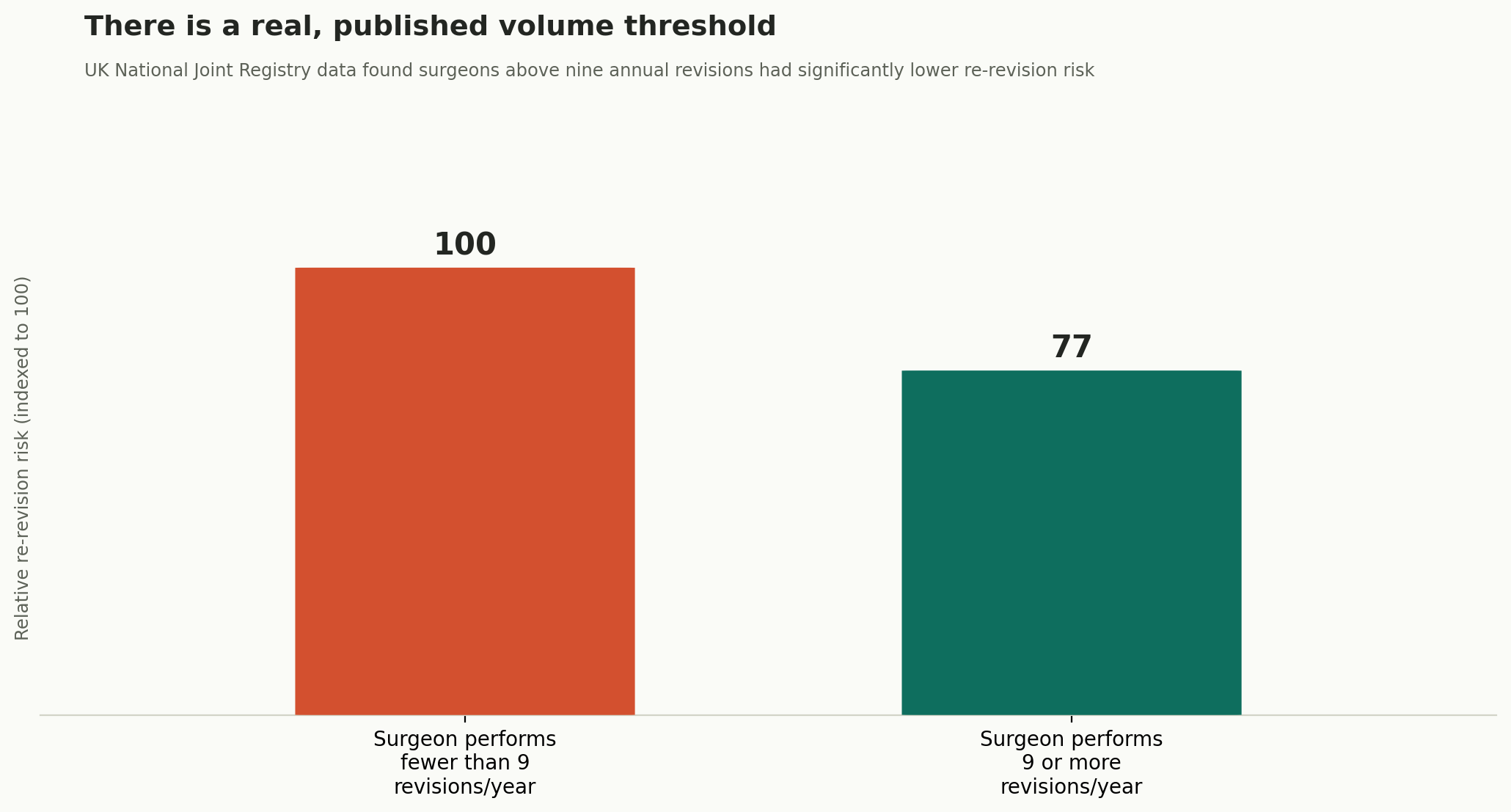
UK National Joint Registry data found surgeons above nine annual revisions had significantly lower re-revision risk.
This is a specific, actionable number, not a vague general impression. A surgeon's overall orthopaedic reputation, or even general joint replacement volume, does not automatically confirm this specific, technique- relevant threshold has been met. Asking directly for a surgeon's annual revision case volume, specifically, is a genuinely useful, evidence-supported question.
It is worth being clear about why this threshold exists physiologically, not just statistically. Revision surgery demands specific technical skills that differ meaningfully from primary joint replacement: extracting well-fixed implants without further damaging bone, managing unpredictable bone loss discovered only once surgery begins, and controlling infection risk in tissue already compromised by prior surgery. These are skills built specifically through repetition of this exact procedure, not transferred automatically from high general surgical volume.
A Second, Independent Factor
The hospital's own case volume matters independently
This is not simply the same finding restated at a different level; published research found both factors mattered separately.
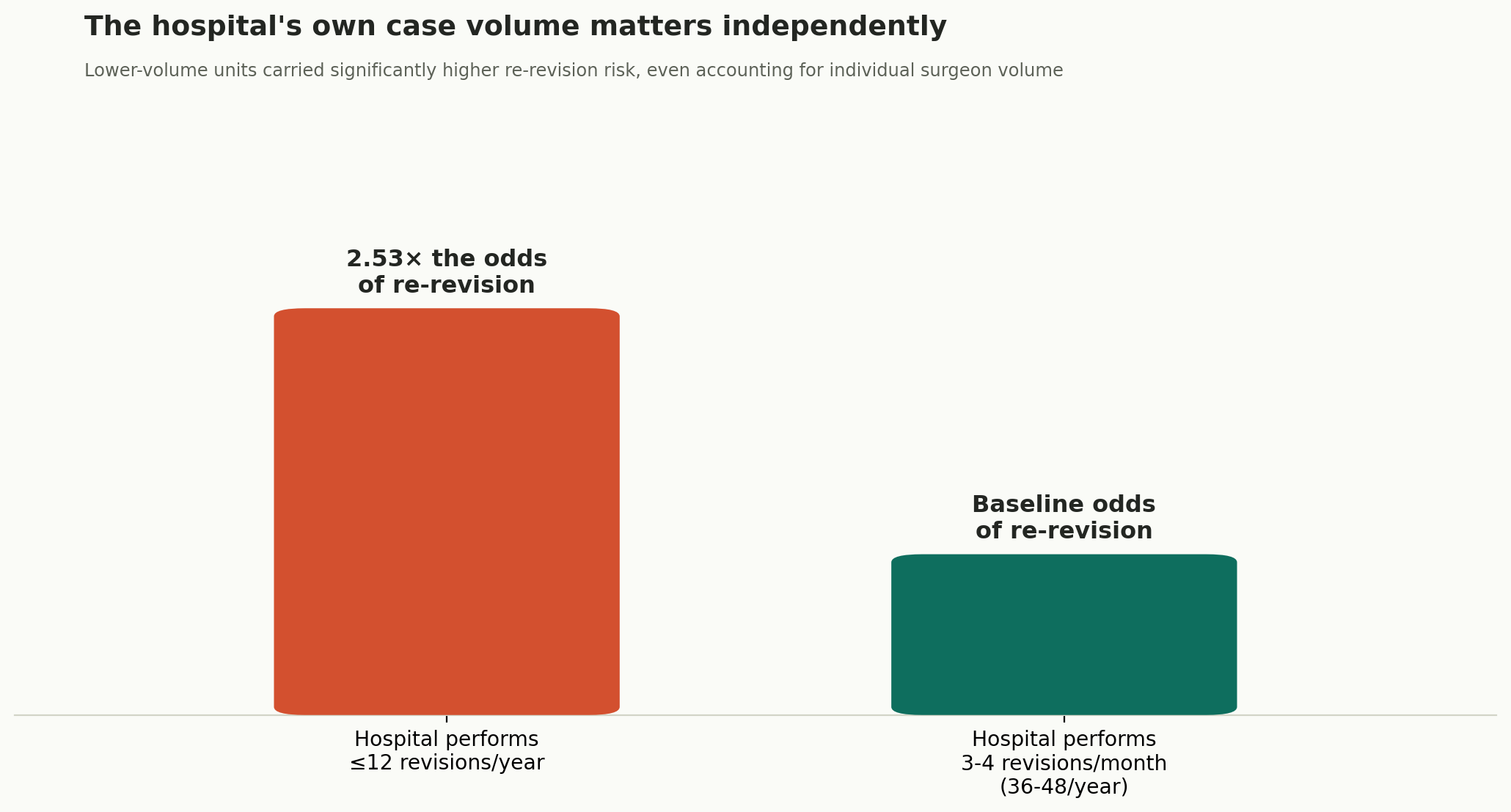
Lower-volume units carried significantly higher re-revision risk, even accounting for individual surgeon volume.
This finding points to something beyond any single surgeon's skill: the surrounding infrastructure, the anaesthesia team's experience with complex cases, the availability of specialised implants for bone loss, and the broader surgical team's collective experience with revision-specific challenges. A hospital's overall case volume for this specific category of surgery is a genuinely separate, worthwhile question from any individual surgeon's own numbers.
A note on one-stage versus two-stage revision for infection, since this is a genuine, case-specific
choice. For an infected joint replacement, revision can be performed in one operation or staged across two, with a period of infection treatment between them. Published research has found outcomes vary by approach, but also that one-stage revision is only appropriate for carefully selected patients, making this a decision that deserves specific, individualised discussion rather than a fixed default.
THE BALANCE
Two independent volume effects, almost equally important
Given how clearly published research found both surgeon and hospital volume to matter independently, this evaluation weights close to evenly between the two.
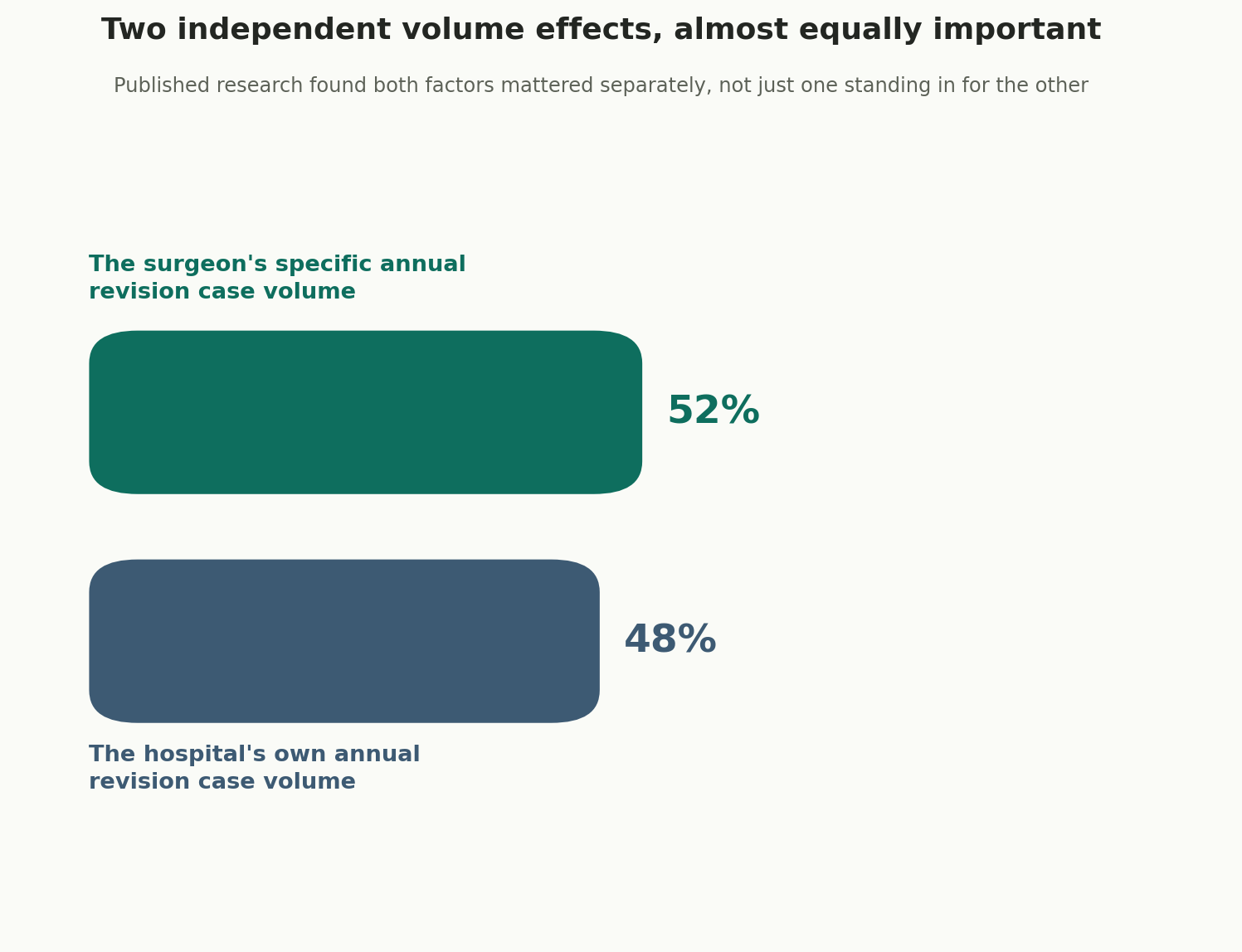
Published research found both factors mattered separately, not just one standing in for the other.
This is a genuinely distinctive pattern in this series: rather than one factor clearly dominating, the underlying research itself demonstrates that surgeon-specific and hospital-specific volume operate as separate, independently meaningful signals. A patient evaluating a prospective provider benefits from asking about both specifically, rather than assuming a high-volume hospital automatically means a high-volume surgeon, or vice versa.
This is precisely why both questions belong in the same conversation rather than treating either one as sufficient on its own. A skilled, high-volume surgeon operating within a lower-volume hospital unit, or a high- volume hospital where any individual surgeon's own revision experience is genuinely limited, are both genuinely worth understanding before committing to either.
THE VETTING CONVERSATION
What to actually ask
Questions for the surgeon
- How many revision cases, specifically, do you personally perform each year? A confident, specific number is reasonable to expect.
- If infection is involved, do you recommend one-stage or two-stage revision, and why? This should be a case-specific, individualised answer.
- What is your personal re-revision rate for this specific procedure? A specific, tracked answer suggests genuine expertise.
- What is your plan for managing bone loss if it is found during surgery? This should reflect real, prepared contingency planning.
Questions for the hospital
- How many revision joint procedures does this hospital perform annually? This should be a specific, verifiable answer.
- Is specialised revision-specific implant inventory available on-site? This matters directly for managing bone loss during surgery.
- What is the hospital's own re-revision and infection control outcome data? Specific, tracked figures matter more than general reputation.
- What is the plan for follow-up once I return to Nigeria? This should be coordinated before you travel.
Nigeria-specific Considerations
Why asking about both numbers matters here
Given the genuine technical complexity of revision joint surgery, discussed in detail in this series' main Complex Orthopaedic and Joint Revision Surgery guide, Nigerian patients evaluating international programmes benefit specifically from asking both the surgeon-level and hospital-level volume questions this guide describes, rather than assuming a hospital's general international reputation automatically confirms genuine, specific revision-surgery experience at both levels.
Four warning signs worth taking seriously
- Inability to state a specific annual revision case volume, surgeon or hospital. This should be a confident, specific number.
- A fixed staging approach recommended without discussing your specific case. One-stage versus two- stage should be individualised.
- No clear plan for managing potential bone loss discovered during surgery. This should reflect genuine preparation.
- No coordinated follow-up plan once you return to Nigeria. This should be established before you travel.
A practical order of operations
- Get a confirmed diagnosis and full assessment of why the original joint replacement failed.
- Ask directly for the surgeon's specific annual revision case volume.
- Ask directly for the hospital's own specific annual revision case volume.
- Ask the surgeon-side and hospital-side questions above before committing to treatment.
- Travel, surgery, and a recovery period appropriate to the specific procedure performed.
- Establish a coordinated follow-up relationship with a Nigerian orthopaedic surgeon.
Straight Answers for Nigerian Patients about Complex Orthopaedic and Joint Revision Surgery in India
Does surgeon volume genuinely affect revision outcomes?
Yes. UK registry research found surgeons performing nine or more revisions annually had significantly lower re- revision risk than those performing fewer.
Does the hospital's volume matter separately?
Yes. Hospitals performing 12 or fewer revisions annually had over twice the odds of re-revision compared to higher-volume centres, independent of surgeon volume.
Is one-stage or two-stage revision better for infection?
Neither is universally superior. Outcomes vary by approach, and one-stage revision is only suitable for carefully selected patients, making this a genuinely case-specific decision.
Why is this weighted almost evenly between surgeon and hospital?
Published research found both factors independently predicted outcomes, rather than one simply reflecting the other, so both deserve close to equal weight.
What is a realistic red flag when choosing a provider?
Inability to state specific annual revision volume, or a fixed staging approach without case-specific discussion, are genuine warning signs.
A closing word
Revision joint surgery deserves to be evaluated on its own terms, not as a simple continuation of general orthopaedic reputation. The published evidence is specific and genuinely actionable: ask for real numbers, from both the surgeon and the hospital, rather than relying on general impressions of expertise. In twenty-four years of this work, the patients who navigate this best ask for both specific volume figures directly, discuss staging decisions as genuinely individualised rather than routine, and confirm real preparation for the anatomical complexity revision surgery specifically involves. The first joint replacement is rarely simple to repeat successfully; asking the right, specific questions is what protects against needing to repeat it again.
Sources
- 🌐 Higher surgeon volume reduces early failure in first time revision of non-infected total knee arthroplasty
- 🌐 Higher hospital volume reduces early failure rates in single-stage revision TKR for infection. PMC, 2025
- 🌐 Satisfactory and Similar Outcomes After Knee Arthroplasty Revisions in One or Two Stages for Infection. ScienceDirect, 2025
- 🌐 Mid-term to long-term outcome and risk factors for failure of two-stage revision for periprosthetic hip joint infection
- 🌐 High Commission of India, Abuja — Medical and Medical Attendant Visa requirements
Frequently Asked Questions by Nigerians about Complex Orthopaedic and Joint Revision Surgery in India
Why is revision joint surgery different from the first joint replacement?
Revision surgery may involve removing existing implants, managing bone loss and working through scarred tissue, making it technically more demanding than primary replacement.
How many revision procedures should a surgeon perform annually?
The guide cites UK National Joint Registry research showing that surgeons performing 9 or more revisions annually had significantly lower re-revision risk.
Does the hospital's revision volume also matter?
Yes. The guide reports that hospitals performing 12 or fewer revisions annually had 2.53 times the odds of re-revision compared with higher-volume centres.
Should Nigerian patients ask about both surgeon and hospital volume?
Yes. The guide stresses that surgeon-specific and hospital-specific revision volumes are independent factors, so one should not be used as a substitute for the other.
What if the joint replacement is infected?
The surgeon may consider one-stage or two-stage revision, depending on the individual infection and clinical circumstances. The guide does not recommend one approach as a universal default.
Is one-stage revision always better because it requires fewer operations?
No. The guide states that one-stage revision is appropriate only for carefully selected patients. The decision should be based on the specific case.
Why is bone-loss planning important in revision surgery?
Bone loss may become apparent during surgery. The hospital should therefore have appropriate revision implants and a prepared strategy for managing bone deficiency.
What should Nigerian patients ask the surgeon before travelling?
They should ask for the surgeon's annual revision volume, specific re-revision rate, recommended revision strategy and plan for managing possible bone loss.
What should Nigerian patients ask the hospital?
They should confirm the hospital's annual revision volume, outcome data, availability of specialised revision implants and follow-up arrangements after returning to Nigeria.
What are the main warning signs when choosing a revision centre?
Warning signs include inability to provide specific revision volumes, a fixed staging approach without individual assessment, no clear bone-loss plan and no coordinated follow-up after returning to Nigeria.
Page Summary
This guide explains how Nigerian patients can select complex orthopaedic and joint revision surgeons and hospitals in India, focusing on the separate importance of surgeon and hospital revision volume. The page 2 chart shows that surgeons performing 9 or more revisions annually had lower re-revision risk, while the page 3 chart shows 2.53 times higher odds of re-revision in hospitals performing 12 or fewer revisions annually. The guide also explains that infected joint replacements may require either one-stage or two-stage revision depending on the individual case, and that unexpected bone loss requires appropriate planning and specialised implants. The page 4 evaluation gives 52% weight to surgeon-specific revision volume and 48% to hospital revision volume. Nigerian patients are also advised to arrange coordinated orthopaedic follow-up before returning home.
Citation Block
| Topic | Information |
|---|---|
| Topic Information | Selecting the Best Complex Orthopaedic and Joint Revision Surgeons in India for Nigerian Patients for Patients from Nigeria |
| Treatment | Complex Orthopaedic and Joint Revision Surgery |
| Intended Audience | Patients from Nigeria |
| Key Specialist | Orthopaedic Joint Revision Surgeon |
| Main Procedures | Knee and Hip Revision Surgery |
| Primary Issue | Failed or Failing Joint Replacement |
| Surgeon Volume Threshold | 9 or More Revision Cases Annually |
| Hospital Volume Finding | 2.53× Higher Re-Revision Odds in Hospitals Performing ≤12 Revisions/Year |
| Evaluation Weighting | 52% Surgeon; 48% Hospital |
| Surgeon Check | Confirm Specific Annual Revision Case Volume |
| Outcome Check | Ask for the Surgeon's Specific Re-Revision Rate |
| Hospital Check | Confirm Annual Revision Case Volume and Outcome Data |
| Infection Check | Discuss One-Stage Versus Two-Stage Revision for the Individual Case |
| Bone-Loss Check | Confirm a Clear Plan for Unexpected Bone Loss |
| Implant Check | Verify Availability of Specialised Revision-Specific Implants |
| Important Warning | Do Not Rely on General Orthopaedic Reputation or Volume Alone |
| Nigeria-Specific Check | Establish Follow-Up With a Nigerian Orthopaedic Surgeon |
| Pre-Travel Requirement | Confirm the Cause of the Original Joint Replacement Failure |
| Patient Journey | Failure assessment → surgeon volume check → hospital volume check → revision strategy → travel/surgery → recovery → Nigerian follow-up |
| Follow-Up | Coordinated Orthopaedic Care After Returning to Nigeria |


Our Mission Statement
Our mission is to place patients at the centre of every healthcare decision by providing trustworthy, evidence-based, and unbiased medical information. We believe that informed patients make better decisions. Backed by personalised guidance from our experienced advisory team, we help patients understand their treatment options, compare them objectively, and confidently choose the path that best suits their medical needs and personal circumstances.
Patient Testimonials from Nigeria















Ready to Take the First Step?
Share your Medical Reports with our Healthcare Managers Today and Get a FREE CONSULTATION, a Personalized Treatment Plan, and Complete Support from Arrival to Recovery.
Get Your Free ConsultationAreas We Serve
This resource has been thoughtfully prepared for patients from Nigeria who are considering medical treatment in India. We also welcome patients from the wider region in the countries mentioned below-
We assist patients from:
- Benin
- Niger
- Chad
- Cameroon
- Algeria
- Egypt
- Libya
- Morocco
- Sudan
- Tunisia
- Gambia
- Ghana
- Burkina Faso
- Cabo Verde
- Côte d'Ivoire
- Equatorial Guinea
- São Tomé and Príncipe
Many of the insights, treatment pathways, hospital recommendations, travel guidance, and patient support services described here are equally relevant and may be used as a reference when planning treatment in India.
From Nigeria to India: Your Complete Patient Support Guide
- Artificial Disc Replacement in India for Nigerian Patients
- Weight Loss and Bariatric Surgery in India for Nigerian Patients
- Bone Marrow Transplant in India for Nigerian Patients
- Brain Tumour Surgery in India for Nigerian Patients
- Breast Cancer Treatment and Surgery in India for Nigerian Patients
- Cancer Treatment and Surgery in India for Nigerian Patients
- Cardiac Arrhythmia and Heart Pacemaker Treatment in India for Nigerian Patients
- Cardiac Surgery in India for Nigerian Patients
- Colorectal Cancer Treatment and Surgery in India for Nigerian Patients
- Complex Orthopaedic and Joint Revision Surgery in India for Nigerian Patients
- Cornea Transplant and Advanced Eye Surgery in India for Nigerian Patients
- CyberKnife Treatment in India for Nigerian Patients
- Gamma Knife Treatment in India for Nigerian Patients
- Heart Failure Treatment and Surgery in India for Nigerian Patients
- Hip Surgery in India for Nigerian Patients
- HIPEC Cancer Surgery in India for Nigerian Patients
- IVF and Fertility Treatment in India for Nigerian Patients
- Joint Arthroscopy and Sports Medicine in India for Nigerian Patients