

Radiotherapy and Modern Cancer Treatment in India for Nigerian Patients
For the treatment plan that calls for radiotherapy, and the two questions that decide everything else: is the machine actually working today, and is it the modern kind or the decades-old kind?
A review published in October 2025 called radiotherapy access in Nigeria exactly what its authors believed it to be: a silent emergency. Of eight government-funded radiotherapy centres nationally, only two consistently had a functional linear accelerator on any given day. Most of the country's radiotherapy is still delivered using outdated two-dimensional techniques, without the CT or MRI-guided planning that modern cancer treatment now considers standard almost everywhere else. Patients wait weeks or months for a machine, sometimes with their disease progressing during the wait. This guide sets out what modern radiotherapy actually costs in India once travel is counted, what genuinely separates older techniques from current ones, why treatment unfolds over weeks rather than a single visit, and what Nigeria's own radiotherapy infrastructure can and cannot offer today.
| 2 of 8 | 1968 | Mostly 2D | 70–85% |
|---|---|---|---|
| GOVERNMENT RADIOTHERAPY CENTRES IN NIGERIA CONSISTENTLY HAVE A WORKING MACHINE | YEAR NIGERIA'S FIRST SUPERVOLTAGE RADIOTHERAPY MACHINE WAS INSTALLED, AT LUTH | TECHNIQUE STILL USED AT MOST NIGERIAN CENTRES, WITHOUT CT/MRI PLANNING | TYPICAL SAVING ON AN EQUIVALENT INDIA PATHWAY VS. THE US |
Healing Journeys of Nigerian Patients


Key Takeaways
- The guide describes two separate radiotherapy problems in Nigeria: whether a functioning machine is available at all, and whether the available treatment uses modern image-guided planning rather than older technology.
- A review published in October 2025 found that of eight government-funded radiotherapy centres in Nigeria, only two consistently had a functioning linear accelerator on a given day.
- The document says most Nigerian centres still rely predominantly on older two-dimensional radiotherapy techniques, often without the CT- or MRI-based planning used routinely in modern radiation oncology.
- Nigeria's first supervoltage radiotherapy machine was installed at Lagos University Teaching Hospital in 1968, yet more than half a century later the document describes machine breakdowns, power problems, maintenance limitations and workforce shortages as continuing barriers.
- The workforce problem extends beyond radiation oncologists. The guide states that Nigeria has no clinical residency programme for medical physicists, whose role includes calculating and verifying radiation dose plans.
- The clinical consequence is especially important for potentially curable cancers such as breast, cervical and head-and-neck cancers, where waiting weeks or months for a working machine can allow disease to progress.
- The document distinguishes older radiotherapy from modern techniques by precision. IMRT divides radiation into multiple beam segments of different intensity so that dose can be shaped closely around an irregular tumour while reducing exposure to nearby structures.
Quick Facts
- Treatment
- Radiotherapy and Modern Cancer Treatment
- Country
- India
- Intended Audience
- Nigerian Cancer Patients and Families
- Primary Specialty
- Radiation Oncology
- Nigeria Government Radiotherapy Centres Mentioned
- 8
- Centres Consistently With Functional Linear Accelerator
- 2
- Nigeria First Supervoltage Radiotherapy Machine
- 1968
- First Centre Mentioned
- Lagos University Teaching Hospital
- Predominant Technique in Nigeria Mentioned
- Mostly 2D Radiotherapy
- Major Planning Gap
- Limited CT / MRI-Based Radiotherapy Planning
- Other Infrastructure Problems
- Machine Breakdowns, Power Supply and Maintenance
- Medical Physicist Residency Programme in Nigeria
- None Mentioned
- Author
- Dr. Dheeraj Bojwani
- Experience
- 24 Years
In Brief
Modern radiotherapy in India for Nigerian patients differs from older radiation treatment mainly in precision, image guidance and reliability of treatment delivery. The guide reports that only two of Nigeria's eight government-funded radiotherapy centres consistently had a functioning linear accelerator in a 2025 review, while much domestic treatment still relied on older two-dimensional planning. Indian treatment options described in the guide include IMRT at US$4,000–7,000, VMAT at US$4,500–7,500, IGRT-guided treatment at US$5,000–8,500 and HDR brachytherapy at US$3,000–5,500. A complete IMRT medical-travel pathway is estimated at approximately US$11,500–17,500. Completing the entire planned course without unnecessary interruption is a central part of treatment effectiveness.
01 · THE REAL PROBLEM
Two separate crises wearing the same name
“Radiotherapy is unavailable” and “radiotherapy is available but decades behind current standards” are two different problems, and Nigeria is living through both at once. The 2025 review found that beyond machine breakdowns, erratic power supply, and inadequate maintenance affecting even the working units, most Nigerian centres still rely on two-dimensional planning techniques that shape the radiation beam far more crudely than intensity-modulated approaches now standard internationally, and lack the CT or MRI simulators needed to plan treatment with modern precision.
The workforce gap compounds the equipment gap. Nigeria has no clinical residency programme for medical physicists, the specialists who calculate and verify radiation dose plans, and offers limited continuing education for those already working in the field, alongside an insufficient number of radiation oncologists for the country's growing cancer burden. First efforts to build radiotherapy capacity in Nigeria date back to 1968, when Lagos University Teaching Hospital acquired the country's first supervoltage machine — more than half a century of infrastructure-building that has still not closed the gap between what patients need and what the system can consistently deliver.
The clinical consequence is specific and serious: patients needing radiotherapy for curable cancers, including breast, cervical, and head and neck cancer, face waits measured in weeks or months for access to a working machine, during which disease that was treatable at diagnosis can progress to a stage where it no longer is.
02 · Old Technique VS. Modern Technique
Why the type of machine matters as much as whether one is working
Even where a Nigerian centre has a functioning machine, the technique used matters enormously for both effectiveness and side effects. Older two-dimensional and basic three-dimensional conformal radiotherapy shape the beam relatively simply, delivering a broader, less precisely sculpted dose. Intensity-modulated radiotherapy, IMRT, divides the beam into many smaller segments of varying intensity, allowing the dose to be shaped tightly around an irregular tumour while sparing nearby healthy structures such as the spinal cord, salivary glands, or bowel. Volumetric modulated arc therapy, VMAT, achieves a similar result faster, delivering the dose as the machine's gantry rotates continuously around the patient rather than from fixed positions.
Image-guided radiotherapy, IGRT, adds daily imaging immediately before treatment to confirm the tumour's exact position, correcting for the small movements that happen naturally between planning and each individual session, particularly important for tumours near the lung, prostate, or bowel that shift with breathing or organ filling. None of these techniques are exotic elsewhere; they are the routine standard of care in well- resourced radiotherapy departments internationally, including at Indian centres serving international patients.
The practical difference for a patient is real: better tumour control with fewer side effects, and for some cancers, a shorter overall course than older techniques would require to achieve the same result.
03 · THE TREATMENT MAP
Which technique, and what it costs
Radiotherapy is quoted as a full course, not a single session, and the technique used is usually the biggest driver of cost within a similar number of fractions.
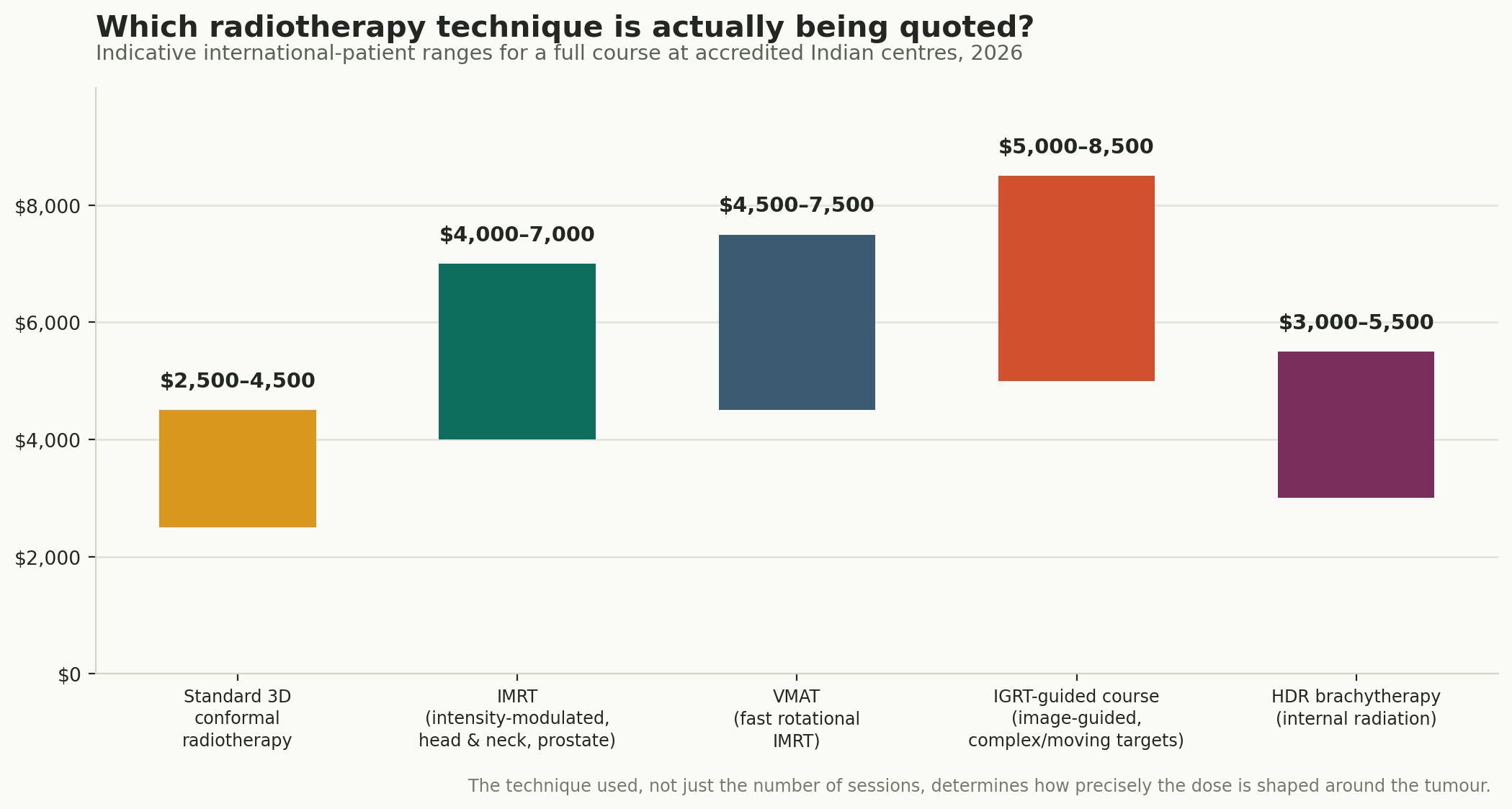
Figure 1. The technique used, not just the number of sessions, determines how precisely the dose is shaped around the tumour and how much surrounding healthy tissue is spared.
| Technique | Typically suits | Indicative cost | Typical duration |
|---|---|---|---|
| Standard 3D conformal radiotherapy | Simpler, well-defined tumours where basic shaping is adequate | $2,500–4,500 | 4–6 weeks |
| IMRT | Head and neck, prostate, and other tumours near sensitive structures | $4,000–7,000 | 5–7 weeks |
| VMAT | Similar precision to IMRT, delivered faster per session | $4,500–7,500 | 5–7 weeks |
| IGRT-guided course | Tumours that move with breathing or organ filling, needing daily image confirmation | $5,000–8,500 | 5–7 weeks |
| HDR brachytherapy | Cervical, prostate, and some breast cancers, as sole treatment or a boost | $3,000–5,500 | 2–4 short visits |
Table 1. Indicative international-patient pricing for a full course at accredited Indian radiotherapy centres, mid-2026. Figures are planning ranges, not offers, and vary by cancer type, number of fractions, and hospital tier.
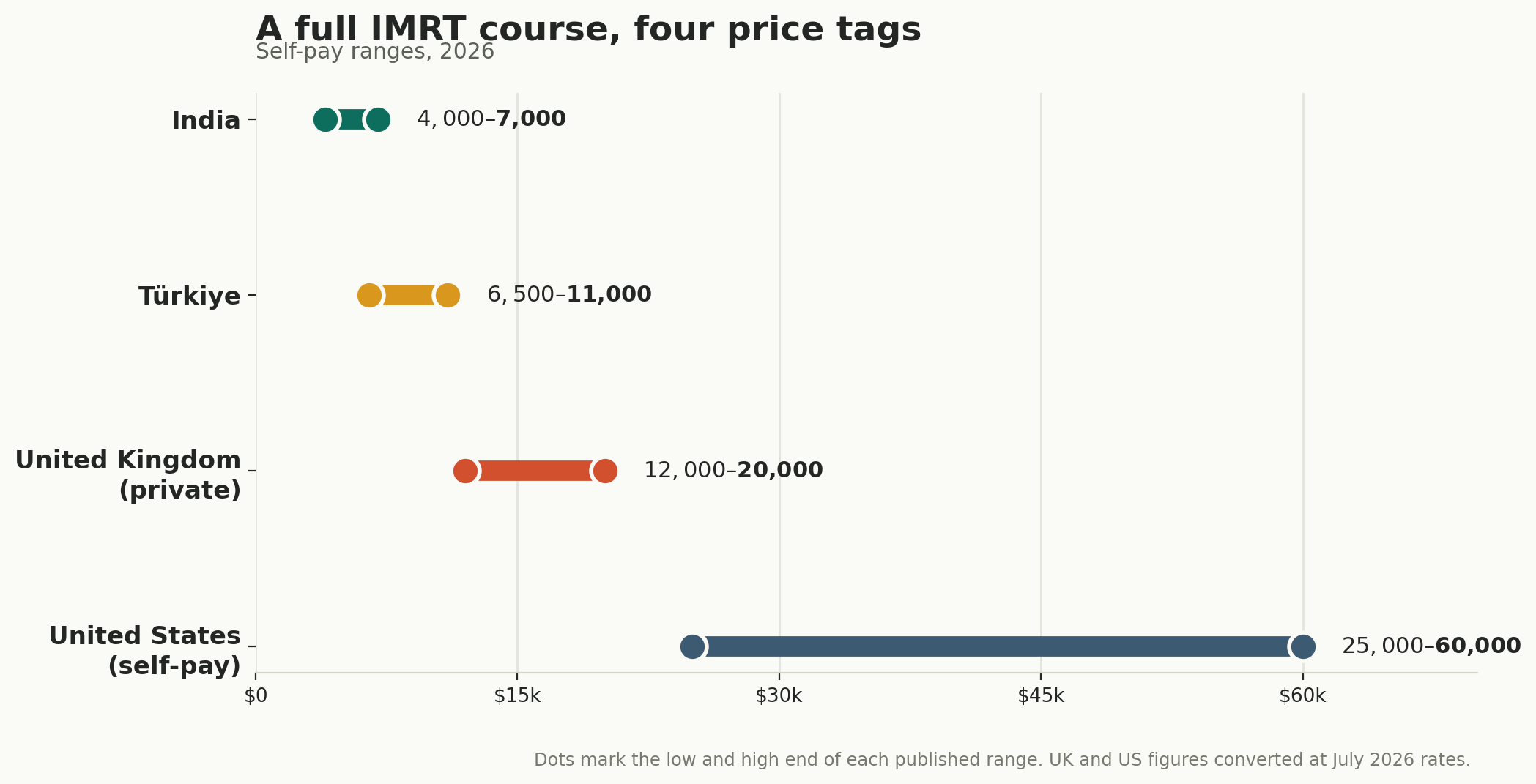
Figure 2. A full IMRT course, priced across four common destinations for Nigerian medical travellers.
What a proper written quote must itemise
- The exact technique planned — 3D conformal, IMRT, VMAT, or IGRT — not just “radiotherapy”
- The number of fractions and total dose planned, and why that specific course was chosen
- Whether CT or MRI simulation is included in the planning process
- Whether daily image guidance is used, and at what additional cost if not included
- Follow-up imaging included to confirm treatment response over the following months
04 · the Full Budget
What the whole journey costs, beyond the treatment fee
The treatment fee is the number families anchor on, and the least complete one. A representative pathway — a full IMRT course, one patient and one attendant, roughly six to eight weeks in India — adds up like this:
- Treatment package (planning, simulation, all fractions): $5,000–8,000
- Return flights, two travellers (Lagos/Abuja – Delhi/Mumbai/Chennai): $2,200–3,000
- Pre-treatment workup (staging imaging, biopsy review, bloodwork): $500–900
- Accommodation, six to eight weeks, two people : $2,600–4,200
- Medical and attendant visas (two applications): $400–500
- Contingency for additional fractions or an extended planning process: 15–20% All-in, most families should plan for US$11,500–17,500 for a full IMRT course — roughly ₦15.9–24.2 million at the official mid-July 2026 rate of about ₦1,380 to the dollar, somewhat higher at parallel-market rates near ₦1,410. Brachytherapy-only pathways are typically shorter and less expensive, given the smaller number of visits involved.
05 · Getting There
Visa, travel, and why the schedule is the real commitment
India issues a Medical Visa (M) to the patient and a Medical Attendant Visa (MX) to up to two close relatives, and given the length of a typical radiotherapy course, extended visa validity should be requested from the outset. Applications go through the High Commission in Abuja or the Consulate General in Lagos by prior appointment. The hospital's invitation letter, three months of certified bank statements, and passports valid well beyond six months move the process fastest.
Lagos and Abuja both reach Delhi, Mumbai and Chennai with a single stop, usually via Addis Ababa, Doha,
Dubai, Nairobi or Istanbul, a total journey of 13 to 18 hours.
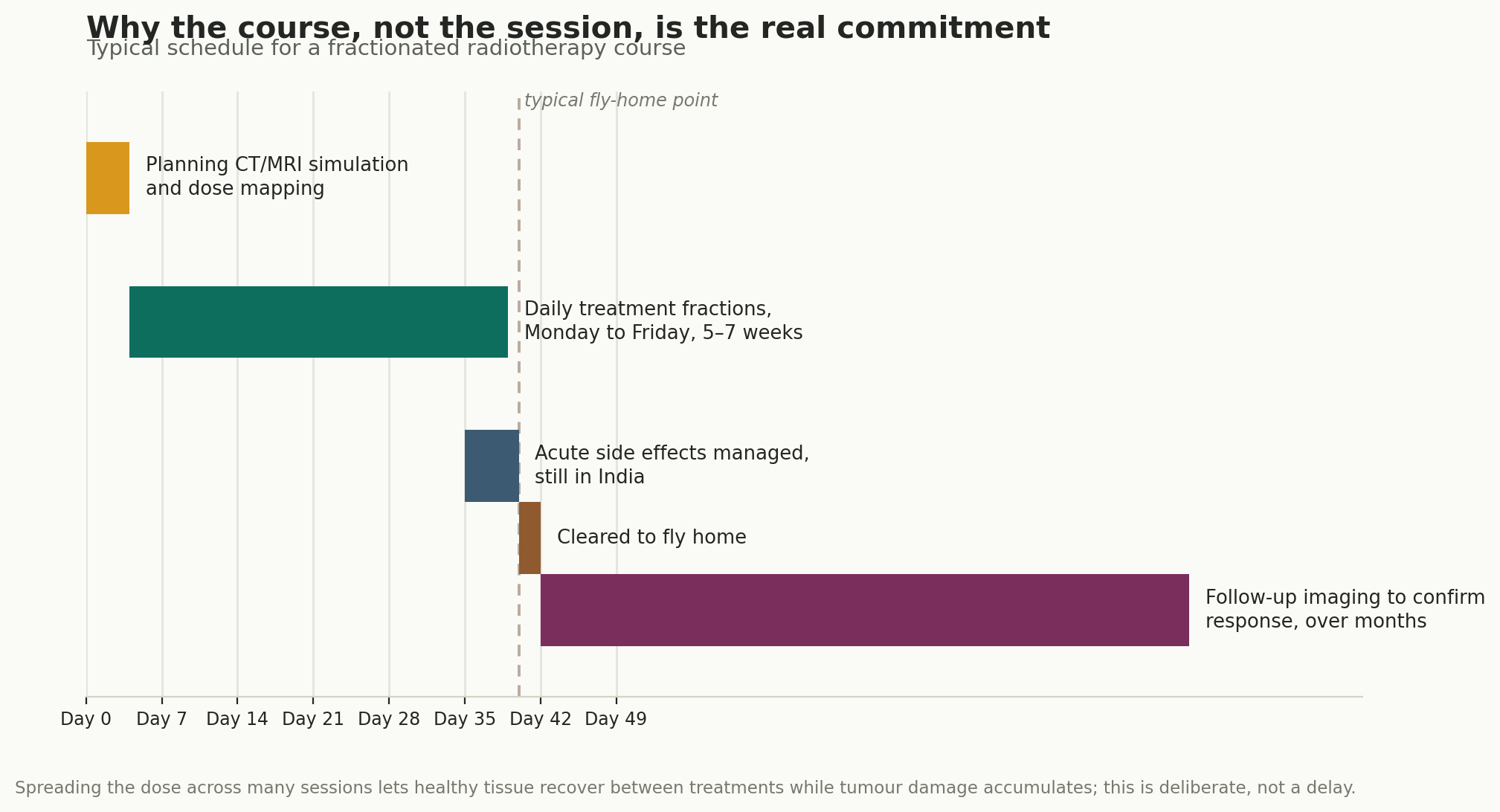
Figure 3. Spreading treatment across many sessions is a deliberate biological strategy, not a scheduling inconvenience: it gives healthy tissue time to recover between doses while cancer cells accumulate lasting damage.
On why missed sessions matter. Radiotherapy's effectiveness depends on completing the full planned course within roughly the intended timeframe; significant gaps or interruptions can measurably reduce how well treatment works. Before committing to a course abroad, confirm realistically that the full schedule, typically five consecutive days a week for five to seven weeks, can actually be sustained without interruption.
What has to travel home with the patient
- Full treatment record, including technique used, total dose, and number of fractions delivered
- Planning and treatment imaging on disc, not just a written summary
- A written plan for managing any ongoing side effects after treatment ends
- A follow-up imaging schedule to confirm treatment response over the following months
- A named clinician contact for teleconsultation if new symptoms arise during follow-up
06 · THE HONEST COMPARISON
What stays in Nigeria, and what travels
Where a Nigerian centre has a genuinely functioning machine with imaging support, and the treatment plan and timeline are clearly explained, treatment at home is entirely reasonable, and there is no need to travel purely to access radiotherapy in general.
What tips the calculation toward travelling is precisely what the 2025 review documented: unreliable machine access, reliance on outdated technique without modern image guidance, and long waits that risk disease progression. For tumours near sensitive structures where IMRT or VMAT genuinely changes the side-effect profile, or for any case where local access is uncertain, travelling for a complete, uninterrupted, modern course is a serious and legitimate option.
Before you commit to radiotherapy abroad
- Ask explicitly which technique is being offered, and whether CT or MRI planning is included.
- Confirm the total number of fractions and realistically plan for the full length of stay this requires.
- Ask whether daily image guidance is included or billed separately.
- For brachytherapy, confirm the number of sessions needed and whether it replaces or supplements external treatment.
- Establish the follow-up imaging schedule and who will interpret results once you are home.
- Verify the invitation letter has reached the mission by email, with both attendants named.
- Pay into the hospital's own institutional account only, never an individual's personal account.
Straight Answers for Nigerian Patients about Radiotherapy and Modern Cancer Treatment in India
Is modern radiotherapy in India cheaper than the UK or US?
Yes, substantially. A full IMRT course is indicatively $4,000 to $7,000 in India, against roughly $12,000 to $20,000 privately in the UK and $25,000 to $60,000 self-pay in the United States.
What is the difference between IMRT, VMAT and older 2D radiotherapy?
Older 2D and 3D conformal techniques shape the beam more simply. IMRT varies the beam's intensity across many segments to sculpt the dose precisely around the tumour. VMAT delivers a similar result faster, using a continuously rotating beam.
Why does radiotherapy take so many sessions?
Fractionating the dose across many sessions, typically 25 to 35 over five to seven weeks, lets healthy tissue recover between treatments while cancer cells accumulate lasting injury. This is a deliberate radiobiological strategy, not a delay.
Do Nigerians need a visa for radiotherapy in India?
Yes. You need an Indian Medical Visa from the High Commission in Abuja, the Consulate in Lagos, or the e- Medical route, plus a Medical Attendant Visa for up to two close relatives, with a hospital invitation letter and financial proof.
Is radiotherapy available in Nigeria at all?
Yes, but access is severely constrained. A 2025 review found that of eight government-funded radiotherapy centres, only two consistently had a functional linear accelerator, with most other centres relying on outdated 2D techniques without CT or MRI-guided planning.
What is brachytherapy?
It places a radioactive source directly inside or next to the tumour, commonly used for cervical, prostate and some breast cancers, delivering a high dose to a small area over a small number of sessions rather than daily external treatment over several weeks.
Is India better than Nigeria for radiotherapy?
For modern, image-guided techniques and reliable machine access specifically, often yes, given how few of Nigeria's radiotherapy centres are consistently functional. Where local access exists and imaging supports precise planning, treatment at home remains reasonable for many cases.
A closing word
Radiotherapy is unusual among cancer treatments in that its success depends as much on consistency, a working machine, a full uninterrupted course, precise daily positioning, as on any single decision made at diagnosis. Nigeria's own radiation oncologists have been honest, publicly, about how far the country's infrastructure currently falls short of that consistency, and that honesty is worth taking seriously as a planning factor, not a discouragement.
In twenty-four years of this work, the patients who do best are the ones who confirm exactly which technique they are being offered, ask directly whether a machine's uptime record supports a reliable schedule, and treat a realistic length-of-stay plan as seriously as the treatment itself. A radiotherapy course interrupted partway through rarely achieves what the same course, completed on schedule, would have delivered.
Sources
- 🌐 American Cancer Society — Radiation therapy for cancer, overview
- 🌐 NHS (UK) — Radiotherapy: overview and what to expect
- 🌐 Adeleke OD et al. — Radiotherapy in Nigeria: a silent emergency in cancer care. Annals of Medicine and Surgery, 2025
- 🌐 A Japanese national survey on IMRT/SBRT utilisation. Journal of Radiation Research, 2025
- 🌐 Volumetric Modulated Arc Therapy: technique overview and clinical applications
- 🌐 High Commission of India, Abuja — Medical and Medical Attendant Visa requirements
Frequently Asked Questions by Nigerians about Radiotherapy and Modern Cancer Treatment in India
Is modern radiotherapy in India cheaper than the UK or US?
Yes. The guide lists a full IMRT course at approximately US$4,000–7,000 in India, compared with US$12,000–20,000 privately in the UK and US$25,000–60,000 self-pay in the United States.
What is the difference between IMRT, VMAT and older 2D radiotherapy?
Older 2D and basic 3D techniques shape radiation more simply. IMRT varies beam intensity to conform closely to the tumour, while VMAT achieves similar dose shaping as the machine rotates around the patient.
What is IGRT and why might Nigerian patients need it?
IGRT uses imaging immediately before treatment to confirm the target position. The guide highlights its value for tumours that move with breathing or organ filling, such as lung, prostate or bowel targets.
Why does radiotherapy take so many sessions?
Radiotherapy is commonly divided into 25–35 fractions over five to seven weeks. This allows healthy tissue to recover between treatments while cancer cells accumulate lasting radiation damage.
What happens if radiotherapy sessions are repeatedly missed?
The document warns that significant interruptions can reduce treatment effectiveness. Patients should therefore make sure they can remain for the full course and that the treating centre has reliable machine availability.
Is radiotherapy available in Nigeria?
Yes, but access is severely constrained. The guide cites a 2025 review in which only two of eight government-funded centres consistently had a functioning linear accelerator, with much treatment still relying on older planning techniques.
What is brachytherapy?
Brachytherapy places a radioactive source directly inside or close to the tumour. The guide describes it for cervical, prostate and some breast cancers, either as the main treatment or as a boost to external radiotherapy.
How much should Nigerian patients budget for a complete IMRT pathway in India?
The guide recommends approximately US$11,500–17,500 overall, covering planning and treatment, investigations, flights, accommodation, visas and contingency for one patient and one attendant.
Do Nigerian patients need a visa for radiotherapy in India?
Yes. The guide specifies an Indian Medical Visa for the patient and a Medical Attendant Visa for up to two close relatives. Because a full course may take six to eight weeks, extended validity should be requested.
Is India always better than Nigeria for radiotherapy?
No. Where a Nigerian centre has a reliably functioning machine, appropriate imaging support and a clear uninterrupted treatment schedule, local treatment may be entirely reasonable. India becomes more relevant when modern image guidance or consistent machine access cannot be assured.
Page Summary
This guide presents Nigeria's radiotherapy challenge as two problems rather than one: limited reliable access to a functioning machine and limited consistent access to the modern techniques now considered routine in well-resourced radiation oncology departments. The 2025 review cited in the document found only two of eight government-funded centres consistently operating a functional linear accelerator. Even where a machine is functioning, treatment is frequently based on older two-dimensional planning rather than CT- or MRI-guided modern techniques.
Citation Block
| Topic | Information |
|---|---|
| Topic Information | Radiotherapy and Modern Cancer Treatment in India for Nigerian Patients |
| Procedure | External Beam Radiotherapy and Brachytherapy |
| Country | India |
| Intended Audience | Nigerian Cancer Patients and Families |
| Conditions Covered | Cancer Requiring Radiation Treatment, Including Breast, Cervical, Head-and-Neck, Prostate and Selected Other Tumours |
| Nigeria Government Centres Mentioned | 8 |
| Consistently Functioning Linear Accelerators | 2 |
| Main Nigeria Technology Issue | Predominantly Older 2D Planning |
| Modern Techniques | IMRT, VMAT and IGRT |
| Internal Radiation Technique | HDR Brachytherapy |
| Typical External Beam Duration | Approximately 4–7 Weeks |
| Typical Fractions | Approximately 25–35 |
| Representative Treatment Package | US$5,000–8,000 for Full IMRT Planning and Treatment |
| Typical Stay in India | Approximately 6–8 Weeks |
| Average Cost / All-In IMRT Budget | US$11,500–17,500 |
| Treatment Schedule | Commonly Five Days per Week |
| Critical Treatment Principle | Avoid Significant Interruptions |
| Nigeria Appropriate Care | Reliable Functioning Machine With Adequate Imaging Support |
| Travel More Relevant For | IMRT/VMAT/IGRT Access and Unreliable Local Treatment Scheduling |
| Medical Visa | Medical Visa (M) |
| Medical Attendant Visa | Medical Attendant Visa (MX), Up to Two Close Relatives |
| Records for Follow-Up | Technique, Total Dose, Fraction Count, Planning Imaging and Follow-Up Schedule |
| Author | Dr. Dheeraj Bojwani |
| Experience | 24 Years |


Our Mission Statement
Our mission is to place patients at the centre of every healthcare decision by providing trustworthy, evidence-based, and unbiased medical information. We believe that informed patients make better decisions. Backed by personalised guidance from our experienced advisory team, we help patients understand their treatment options, compare them objectively, and confidently choose the path that best suits their medical needs and personal circumstances.
Patient Testimonials from Nigeria
Ready to Take the First Step?
Share your Medical Reports with our Healthcare Managers Today and Get a FREE CONSULTATION, a Personalized Treatment Plan, and Complete Support from Arrival to Recovery.
Get Your Free ConsultationAreas We Serve
This resource has been thoughtfully prepared for patients from Nigeria who are considering medical treatment in India. We also welcome patients from the wider region in the countries mentioned below-
We assist patients from:
- Benin
- Niger
- Chad
- Cameroon
- Algeria
- Egypt
- Libya
- Morocco
- Sudan
- Tunisia
- Gambia
- Ghana
- Burkina Faso
- Cabo Verde
- Côte d'Ivoire
- Equatorial Guinea
- São Tomé and Príncipe
Many of the insights, treatment pathways, hospital recommendations, travel guidance, and patient support services described here are equally relevant and may be used as a reference when planning treatment in India.
From Nigeria to India: Your Complete Patient Support Guide
- Artificial Disc Replacement in India for Nigerian Patients
- Weight Loss and Bariatric Surgery in India for Nigerian Patients
- Bone Marrow Transplant in India for Nigerian Patients
- Brain Tumour Surgery in India for Nigerian Patients
- Breast Cancer Treatment and Surgery in India for Nigerian Patients
- Cancer Treatment and Surgery in India for Nigerian Patients
- Cardiac Arrhythmia and Heart Pacemaker Treatment in India for Nigerian Patients
- Cardiac Surgery in India for Nigerian Patients
- Colorectal Cancer Treatment and Surgery in India for Nigerian Patients
- Complex Orthopaedic and Joint Revision Surgery in India for Nigerian Patients
- Cornea Transplant and Advanced Eye Surgery in India for Nigerian Patients
- CyberKnife Treatment in India for Nigerian Patients
- Gamma Knife Treatment in India for Nigerian Patients
- Heart Failure Treatment and Surgery in India for Nigerian Patients
- Hip Surgery in India for Nigerian Patients
- HIPEC Cancer Surgery in India for Nigerian Patients
- IVF and Fertility Treatment in India for Nigerian Patients
- Joint Arthroscopy and Sports Medicine in India for Nigerian Patients