

Proton Therapy in India for Nigerian Patients
The most precise form of radiotherapy that exists — genuinely essential for some patients, and genuinely unnecessary for most who ask about it.
Proton therapy uses a beam of protons rather than conventional X-rays to treat cancer. Protons carry a genuinely useful physical property: they deposit most of their energy at a specific, controllable depth inside the body and then stop, rather than continuing through tissue the way conventional radiation does. This allows a tumour to be targeted with real precision while sparing more of the surrounding healthy tissue. It is also, unavoidably, one of the most expensive and least accessible cancer treatments in the world, and understanding exactly who genuinely benefits from it matters as much as understanding how it works. This guide sets out that distinction plainly: which patients have a genuine, evidence-based reason to seek proton therapy specifically, what it costs and takes to complete a course in India, and why, for the great majority of cancer patients, a well-planned course of modern conventional radiotherapy remains the right, and far more accessible, choice.
| ~10–15% | ~98 | Zero | 7–8 wks |
|---|---|---|---|
| OF RADIOTHERAPY PATIENTS ESTIMATED TO BE GENUINE PROTON CANDIDATES | FUNCTIONAL PROTON FACILITIES WORLDWIDE, HEAVILY CONCENTRATED IN A HANDFUL OF COUNTRIES | CURRENTLY OPERATIONAL PROTON FACILITIES IN SUB-SAHARAN AFRICA | TYPICAL LENGTH OF A FULL PROTON THERAPY COURSE |
Healing Journeys of Nigerian Patients









Key Takeaways
- The guide emphasises that proton therapy is not a universal upgrade over conventional radiotherapy. Published candidacy literature cited in the guide places genuine proton candidates at approximately 10–15% of radiotherapy patients.
- The strongest potential benefit is concentrated among children, tumours close to critical structures such as the brainstem, spinal cord, skull base or eye, and selected re-irradiation cases.
- Proton therapy's main advantage is its ability to deposit most of its energy at a specific controllable depth and then stop, potentially reducing radiation exposure to surrounding healthy tissue.
- The page 4 comparison shows proton therapy performing strongly in precision, paediatric suitability, healthy-tissue sparing and re-irradiation, while conventional radiotherapy has major advantages in cost, availability and broad applicability.
- Indicative Indian costs are US$4,000–US$7,500 for conventional radiotherapy, US$12,000–US$20,000 for a partial proton course and US$28,000–US$45,000 for a full proton course.
- A full proton therapy course generally takes 7–8 weeks. The page 6 timeline illustrates approximately 7 days for consultation/planning, 5 days for immobilisation and dose planning, 35 days of weekday proton sessions and 7 days for recovery and first follow-up scan.
- The guide states that no proton therapy facility is currently operational in Sub-Saharan Africa, making international travel necessary for Nigerian patients whose tumours genuinely meet proton-treatment criteria.
- The guide particularly highlights paediatric cancer, because sparing healthy developing tissue may have greater long-term importance in children.
- Nigerian patients should seek a specific second opinion on proton candidacy, rather than simply asking whether proton therapy is available. Treatment planning should ideally happen before conventional radiotherapy begins when proton therapy may be relevant.
- Because treatment can last nearly two months, patients should plan extended accommodation and follow-up arrangements in India, obtain a complete written cost breakdown and establish a Nigerian oncologist for coordinated care after returning home.
Quick Facts
- Treatment
- Proton Therapy
- Country
- India
- Patients
- Patients from Nigeria
- Key Specialist
- Radiation Oncologist / Proton Therapy Specialist
- Main Advantage
- Precise Radiation Dose Deposition
- Genuine Candidate Group
- Approximately 10–15% of Radiotherapy Patients
- Strongest Indications
- Paediatric, Critical-Structure and Selected Re-Irradiation Cases
- Conventional Radiotherapy
- US$4,000–US$7,500
- Partial Proton Course
- US$12,000–US$20,000
- Full Proton Course
- US$28,000–US$45,000
- Treatment Duration
- Approximately 7–8 Weeks
- Important Check
- Confirm Specific Proton Candidacy
- Second Opinion
- Proton-Specific Radiation Oncology Review
- Pre-Travel Records
- Imaging, Pathology and Previous Treatment Records
- Visa
- Indian Medical Visa and Medical Attendant Visa
- Travel
- Lagos/Abuja to Indian Medical Hubs With One Stop
- Accommodation
- Extended Stay Required for Full Course
- Follow-Up
- Nigerian Oncologist and Post-Treatment Monitoring
- Author
- Dr. Dheeraj Bojwani
- Experience
- 24+ Years
In Brief
For Nigerian patients considering proton therapy in India, the guide recommends first establishing whether the specific tumour, location and clinical circumstances genuinely justify proton therapy, rather than assuming it is automatically better than conventional radiotherapy. Children, tumours near critical structures and selected re-irradiation cases may have stronger reasons to consider it. Patients should obtain a proton-specific second opinion, confirm the complete seven-to-eight-week treatment schedule and written cost, and arrange extended accommodation and follow-up with a Nigerian oncologist before travelling.
01 · THE HONEST STARTING POINT
Not a universal upgrade
The single most important thing to understand about proton therapy is also the one most marketing material glosses over: it is not simply a better version of conventional radiotherapy for every cancer. Published proton therapy candidacy literature places the proportion of radiotherapy patients with a genuine, evidence- supported reason to choose proton over modern conventional techniques at roughly 10 to 15 percent.
For everyone outside that group, choosing proton therapy is not harmful, but it is an expensive, logistically demanding choice that delivers, at best, a marginal theoretical advantage over conventional treatment already well-supported by decades of evidence. A clear, honest understanding of where a specific diagnosis actually falls is the single most valuable piece of information a family can walk away from this guide with.
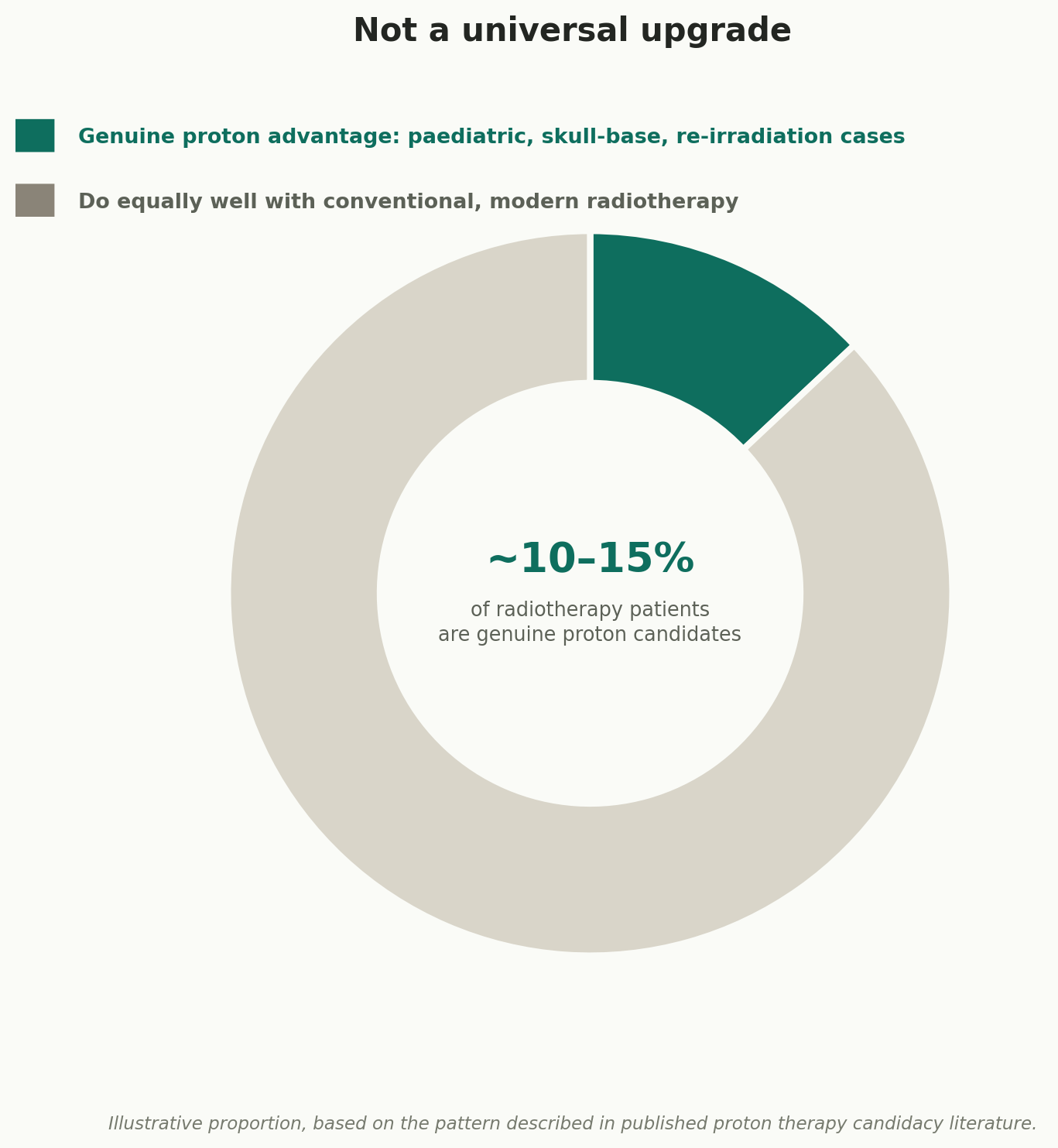
Figure 1. The strongest evidence for proton therapy sits with a specific, minority group of patients, not the general radiotherapy population.
That minority is not arbitrary. It is concentrated among children, whose developing bodies benefit disproportionately from sparing healthy tissue near a tumour; tumours near critical structures such as the brainstem, spinal cord, skull base, or eye, where a small amount of stray radiation can cause serious harm; and patients needing re-irradiation of an area previously treated, where healthy tissue has little further tolerance for radiation exposure. Outside these situations, a well-planned course of modern conventional radiotherapy typically achieves comparable outcomes at a fraction of the cost.
This distinction matters because proton therapy is often marketed, understandably given its genuine technological sophistication, as an unambiguous premium upgrade. A family facing a cancer diagnosis, searching for the very best available option, can be drawn toward the most advanced-sounding treatment without being told clearly that the specific clinical evidence supporting it applies to a fairly narrow set of situations, not to cancer treatment broadly.
02 · PROTON VS CONVENTIONAL
Where each option genuinely wins
Rather than treating this as a simple upgrade decision, it is more accurate, and more useful, to see proton and conventional radiotherapy as two tools suited to different jobs.
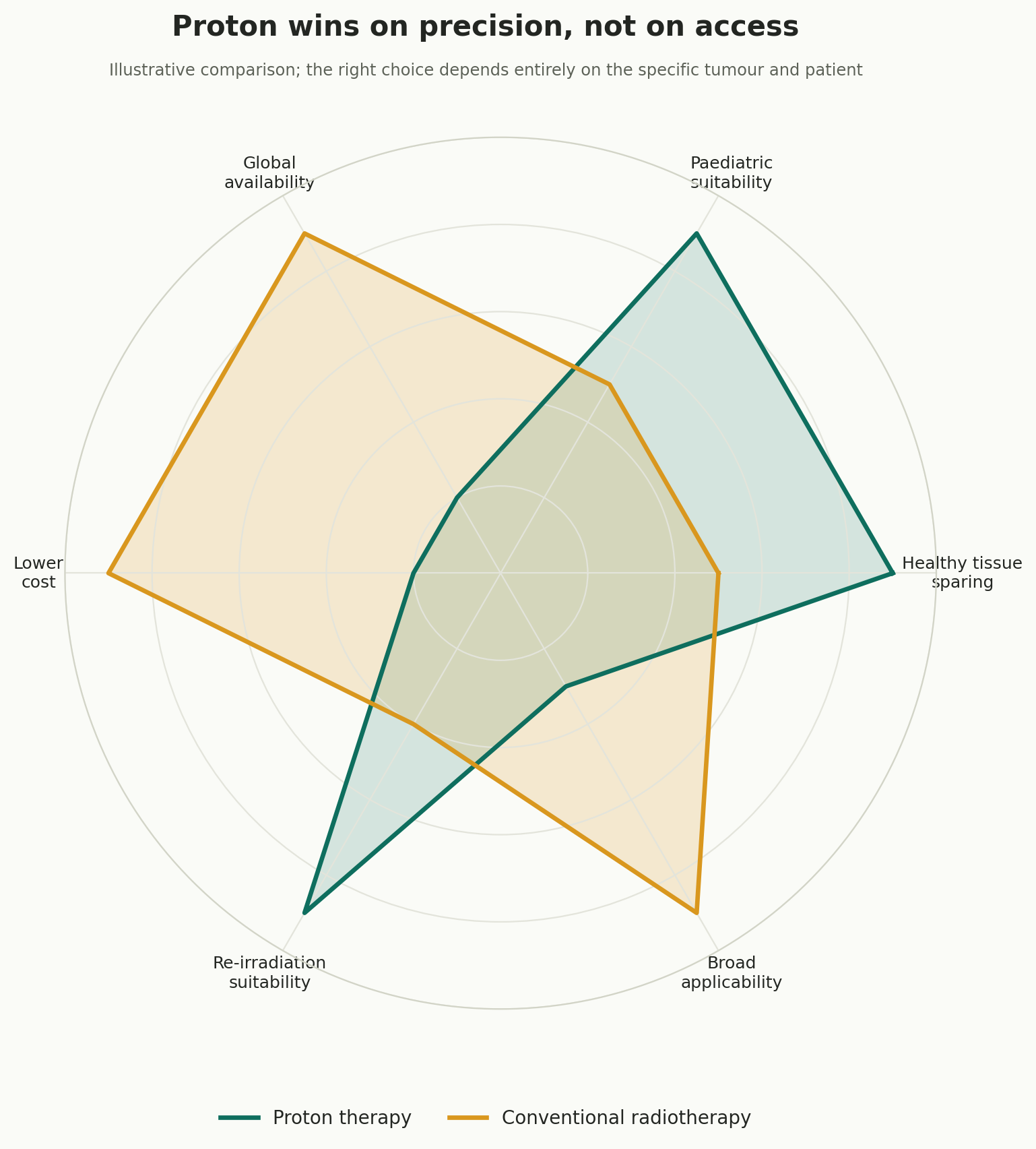
Figure 2. Proton therapy wins decisively on precision and re-irradiation suitability. Conventional radiotherapy wins decisively on availability, cost, and broad applicability.
This is precisely the conversation to have directly with a radiation oncologist: not "should I get proton therapy," but "does my specific tumour, in my specific location, fall into the category where proton's precision genuinely changes the outcome." A programme recommending proton therapy without engaging with this specific question deserves a direct follow-up.
It is also worth understanding that proton therapy is not an all-or-nothing choice in every case. Some treatment plans genuinely combine both approaches, using conventional radiotherapy for the bulk of a course and a proton boost for a smaller portion where precision matters most, offering a middle path between the two extremes shown in this comparison.
03 · COST AND TIMELINE
What it costs, and how long it takes
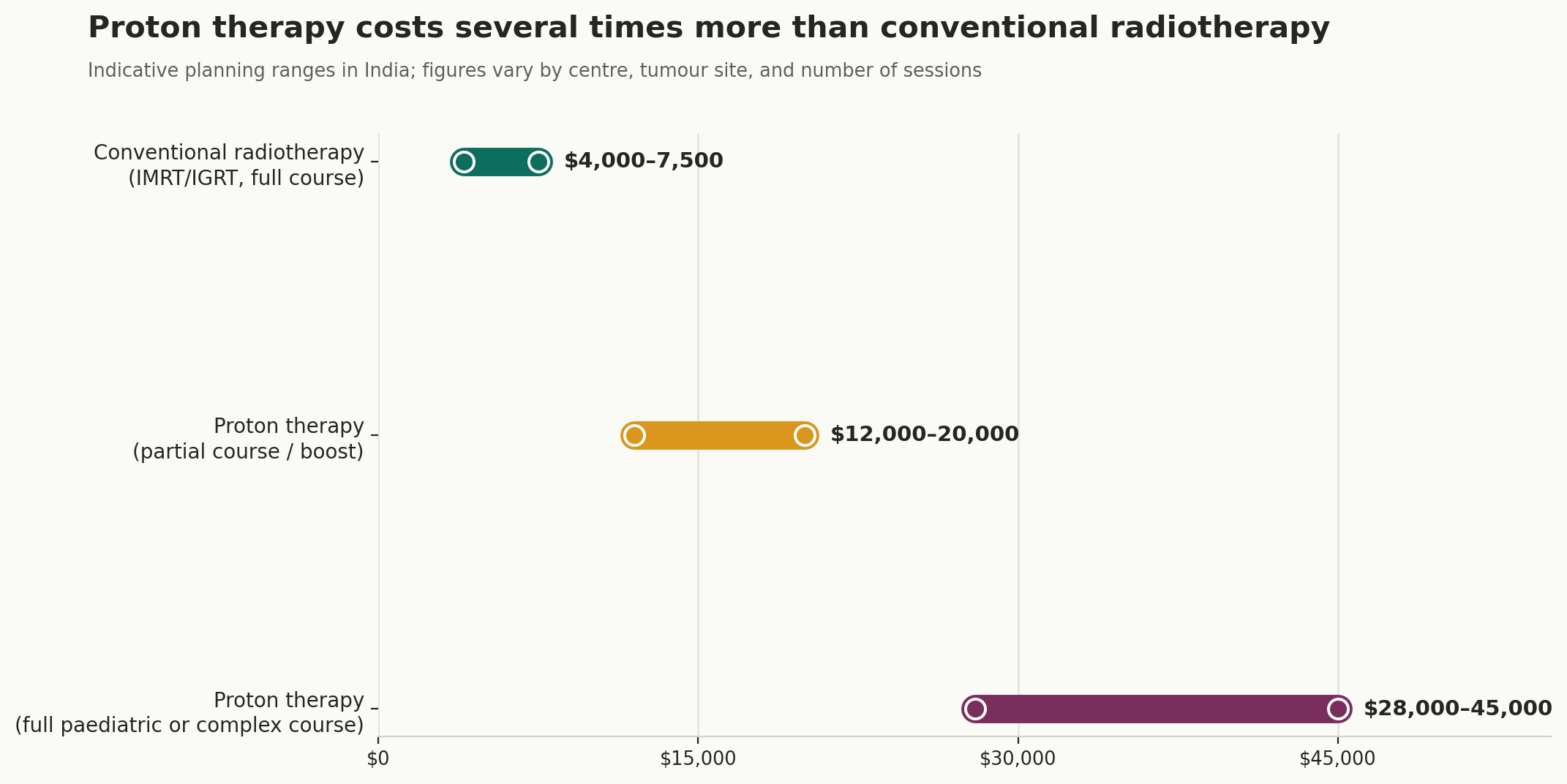
Figure 3. Proton therapy's cost reflects the scale of the facility required to deliver it, several times the price of conventional radiotherapy for a comparable course.
The gap between these figures reflects the underlying facility cost. A proton therapy centre requires a purpose-built particle accelerator and heavily shielded treatment vault, an infrastructure investment on an entirely different scale from a conventional linear accelerator, and that cost is, unavoidably, reflected directly in what patients are charged.
| Treatment | Typically suits | Indicative cost |
|---|---|---|
| Conventional radiotherapy | Most solid tumours, standard evidence base | $4,000–7,500 |
| Proton therapy, partial course | A precision boost added to part of a treatment plan | $12,000–20,000 |
| Proton therapy, full course | Paediatric or complex cases with strong proton indication | $28,000–45,000 |
Table 1. Indicative international-patient pricing at accredited Indian centres, mid-2026. Figures vary by tumour site, number of sessions, and specific centre.
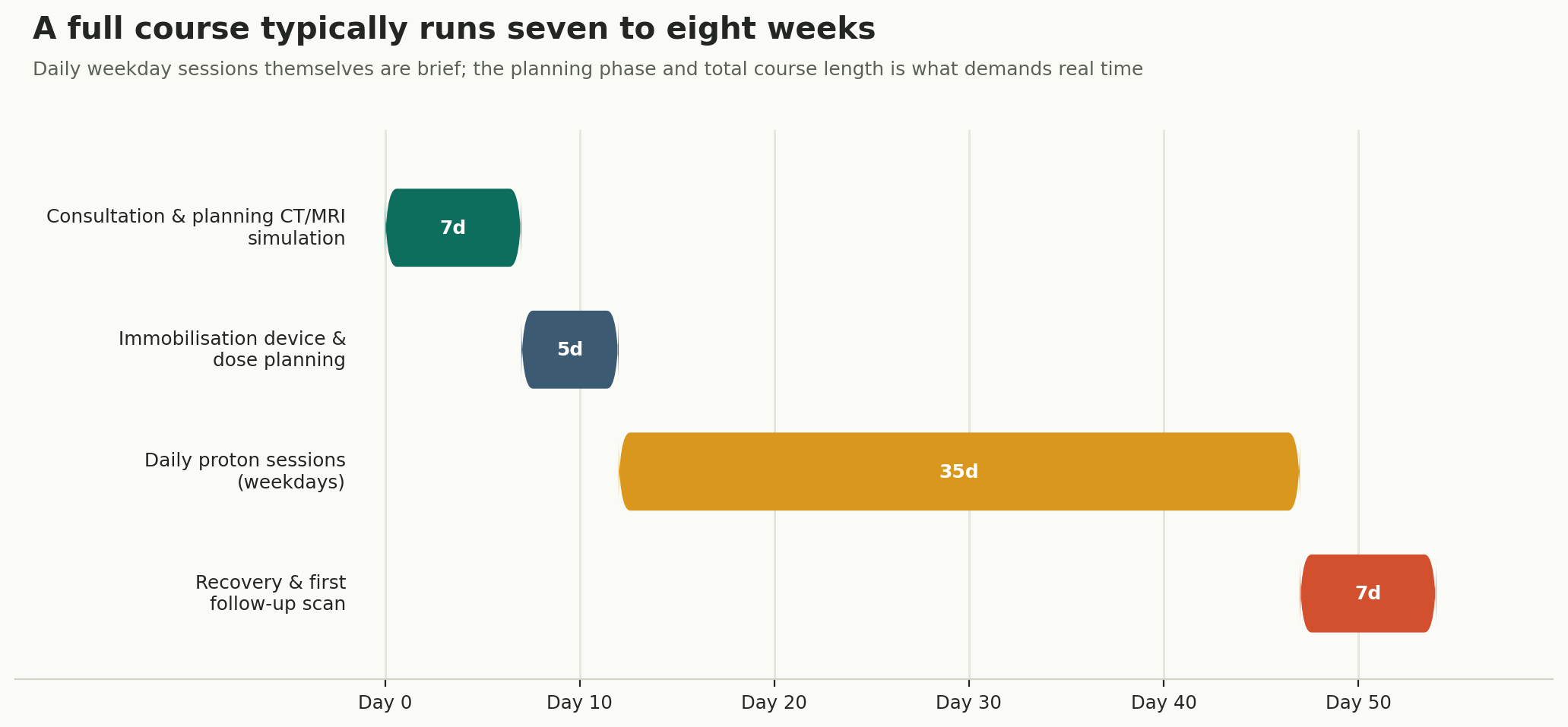
Figure 4. A full course runs seven to eight weeks in total. The planning phase, not the daily sessions themselves, is where much of that time goes.
04 · the Nigeria Context
Why this matters disproportionately for children
No proton therapy facility is currently operational anywhere in Sub-Saharan Africa. A dedicated initiative in South Africa has been publicly described as a future first for the region, but remains in development, not yet treating patients. For Nigerian families facing a paediatric cancer diagnosis where proton therapy is genuinely indicated, this means international travel is not a preference but, at present, the only realistic route to this specific treatment.
This absence of regional capacity stands in contrast to conventional radiotherapy, which, while genuinely under-resourced across much of Nigeria, at least exists in a functioning form domestically. Proton therapy sits at a further, more extreme point on that same spectrum of access, a technology that has not yet reached the region at all, rather than one that exists but remains under-resourced.
This gap carries real weight given how starkly childhood cancer outcomes differ by region: survival rates that approach 80 percent in well-resourced health systems fall dramatically in much of Sub-Saharan Africa, a disparity shaped by many factors beyond radiotherapy access alone, but one where sparing a child's developing healthy tissue, proton therapy's core advantage, matters more than it does for an adult patient of similar disease.
For a family navigating a paediatric diagnosis specifically, this makes the earlier question in this guide, whether the specific tumour genuinely falls into an evidence-supported proton category, worth raising directly and early with the treating paediatric oncologist, rather than discovering the option only after a treatment plan built around conventional radiotherapy is already well underway.
Timing genuinely matters here. Some radiotherapy planning decisions are difficult to reverse once conventional treatment has already begun, making an early, deliberate conversation about proton candidacy, ideally before any radiotherapy starts, meaningfully more useful than raising the same question midway through an established treatment course.
On visa and travel. India issues a Medical Visa (M) to the patient and a Medical Attendant Visa (MX) to accompanying family, through the High Commission in Abuja, the Consulate in Lagos, or the e-Medical route. Lagos and Abuja reach India's major medical hubs with a single stop, a 13 to 18 hour total journey. Given the seven to eight week treatment course, budgeting realistically for extended accommodation is essential, not optional.
Before you commit to a proton therapy plan
- Ask directly whether your specific tumour and location fall into an evidence-supported proton category.
- Request a second opinion specifically on proton candidacy, not just general treatment planning.
- Confirm the full course length and total number of sessions before booking travel.
- Get a complete written cost breakdown, including planning, sessions, and any imaging required.
- Establish a Nigerian oncologist for coordinated follow-up care after treatment concludes.
- Pay into the hospital's own institutional account only, never an individual's personal account.
Straight Answers for Nigerian Patients about Proton Therapy in India
Is proton therapy always better than conventional radiotherapy?
No. Roughly 10 to 15 percent of radiotherapy patients are genuine proton candidates, mainly children, tumours near critical structures, and re-irradiation cases. Most other patients do equally well with modern conventional radiotherapy.
Why does proton therapy spare healthy tissue better?
Protons deposit most of their energy at a specific, controllable depth and then stop, unlike conventional radiation which continues through tissue beyond the tumour.
Is proton therapy available in Africa?
Not yet operationally. A dedicated initiative in South Africa has been announced as a future first for the region but remains in development.
Why is proton therapy so much more expensive?
It requires an enormous, highly specialised particle accelerator and shielded facility, a vastly larger capital investment than conventional radiotherapy equipment.
Do Nigerians need a visa for proton therapy in India?
Yes. You need an Indian Medical Visa from the High Commission in Abuja, the Consulate in Lagos, or the e- Medical route, plus a Medical Attendant Visa for accompanying family.
A closing word
Proton therapy is a genuine medical breakthrough, and its value lies precisely in being used where the evidence supports it, not as a default premium option marketed to every cancer patient who can afford it. The families who navigate this best ask directly whether their specific case falls into that evidence-supported minority, rather than assuming the most expensive, most technologically advanced option is automatically the best one for their situation.
Sources
- 🌐 Particle Therapy Co-Operative Group (PTCOG) — global facility statistics and patient information
- 🌐 American Society for Radiation Oncology — Proton therapy, model policy and patient information
- 🌐 St. Jude Children's Research Hospital — Proton therapy in paediatric oncology, patient information
- 🌐 NHS (UK) — Proton beam therapy: overview and eligibility
- 🌐 High Commission of India, Abuja — Medical and Medical Attendant Visa requirements
Frequently Asked Questions by Nigerians about Proton Therapy in India
Is proton therapy better than conventional radiotherapy for all Nigerian cancer patients?
No. The guide states that only around 10–15% of radiotherapy patients are considered genuine proton candidates. Most patients can receive effective modern conventional radiotherapy.
Which Nigerian patients may benefit most from proton therapy?
The guide highlights children, tumours near critical structures such as the brainstem, spinal cord, skull base or eye, and selected patients requiring re-irradiation.
Why can proton therapy spare healthy tissue better?
Protons deposit most of their energy at a specific controllable depth and then stop, unlike conventional radiation, which continues beyond the tumour.
How much does proton therapy cost in India for Nigerian patients?
The guide gives an indicative range of US$12,000–US$20,000 for a partial course and US$28,000–US$45,000 for a full course. Costs vary by tumour, number of sessions and centre.
How long does a full proton therapy course take?
A full course generally takes approximately 7–8 weeks. The page 6 timeline includes planning, immobilisation, about 35 weekday treatment sessions and initial follow-up.
Is proton therapy available in Nigeria or elsewhere in Sub-Saharan Africa?
The guide states that no proton therapy facility is currently operational in Sub-Saharan Africa. A South African initiative is described as being in development.
Should Nigerian patients get a second opinion before choosing proton therapy?
Yes. The guide specifically recommends a second opinion focused on proton candidacy, rather than only obtaining a general cancer-treatment opinion.
When should proton candidacy be assessed?
Ideally before radiotherapy begins. The guide notes that some radiation-planning decisions become difficult to reverse once conventional treatment has already started.
What should Nigerian patients include in their cost planning?
They should obtain a written breakdown covering treatment planning, proton sessions and required imaging, while separately budgeting for extended accommodation because the full course lasts seven to eight weeks.
What follow-up should Nigerian patients arrange after proton therapy in India?
The guide recommends establishing a Nigerian oncologist for coordinated follow-up care before travelling. Patients should also return with their treatment records and planned follow-up schedule.
Page Summary
This guide explains the key considerations for Nigerian patients exploring proton therapy in India, with its central focus on determining whether proton treatment provides a genuine clinical advantage over modern conventional radiotherapy. It identifies children, tumours near critical structures and selected re-irradiation cases as the groups with stronger evidence for proton therapy, while noting that most radiotherapy patients can achieve comparable outcomes with conventional treatment. Indicative costs range from US$12,000–US$20,000 for a partial proton course to US$28,000–US$45,000 for a full course, with treatment typically lasting 7–8 weeks. The guide also covers Nigeria's lack of operational proton facilities, medical visas, extended accommodation, second opinions, and written cost planning and coordinated follow-up care.
Citation Block
| Topic | Information |
|---|---|
| Topic Information | Proton Therapy in India for Patients from Nigeria |
| Treatment | Proton Therapy / Proton Beam Radiotherapy |
| Intended Audience | Patients from Nigeria |
| Key Specialist | Radiation Oncologist / Proton Therapy Specialist |
| Primary Assessment | Tumour Imaging, Pathology and Radiation Oncology Review |
| Genuine Candidate Estimate | Approximately 10–15% of Radiotherapy Patients |
| Strongest Candidate Groups | Children, Tumours Near Critical Structures and Selected Re-Irradiation Cases |
| Partial Proton Course | US$12,000–US$20,000 |
| Full Proton Course | US$28,000–US$45,000 |
| Treatment Duration | Approximately 7–8 Weeks |
| Main Treatment Advantage | Greater Precision and Healthy-Tissue Sparing |
| Important Specialist Check | Confirm Whether Proton Therapy Changes the Expected Clinical Outcome |
| Second Opinion Check | Request a Proton-Specific Candidacy Review |
| Important Warning | Do Not Choose Proton Therapy Simply Because It Is More Technologically Advanced |
| Planning Check | Confirm Total Sessions and Full Course Timeline |
| Cost Check | Request a Written Breakdown Covering Planning, Treatment and Required Imaging |
| Nigeria Context | No Operational Proton Therapy Facility Currently Reported in Sub-Saharan Africa |
| Pre-Travel Records | Imaging, Pathology and Previous Radiotherapy Records |
| Visa Requirement | Indian Medical Visa and Medical Attendant Visa |
| Patient Journey | Candidacy review → second opinion → planning → visa/travel → proton sessions → recovery/follow-up |
| Follow-Up | Nigerian Oncologist and Coordinated Post-Treatment Monitoring |


Our Mission Statement
Our mission is to place patients at the centre of every healthcare decision by providing trustworthy, evidence-based, and unbiased medical information. We believe that informed patients make better decisions. Backed by personalised guidance from our experienced advisory team, we help patients understand their treatment options, compare them objectively, and confidently choose the path that best suits their medical needs and personal circumstances.
Patient Testimonials from Nigeria















Ready to Take the First Step?
Share your Medical Reports with our Healthcare Managers Today and Get a FREE CONSULTATION, a Personalized Treatment Plan, and Complete Support from Arrival to Recovery.
Get Your Free ConsultationAreas We Serve
This resource has been thoughtfully prepared for patients from Nigeria who are considering medical treatment in India. We also welcome patients from the wider region in the countries mentioned below-
We assist patients from:
- Benin
- Niger
- Chad
- Cameroon
- Algeria
- Egypt
- Libya
- Morocco
- Sudan
- Tunisia
- Gambia
- Ghana
- Burkina Faso
- Cabo Verde
- Côte d'Ivoire
- Equatorial Guinea
- São Tomé and Príncipe
Many of the insights, treatment pathways, hospital recommendations, travel guidance, and patient support services described here are equally relevant and may be used as a reference when planning treatment in India.
From Nigeria to India: Your Complete Patient Support Guide
- Artificial Disc Replacement in India for Nigerian Patients
- Weight Loss and Bariatric Surgery in India for Nigerian Patients
- Bone Marrow Transplant in India for Nigerian Patients
- Brain Tumour Surgery in India for Nigerian Patients
- Breast Cancer Treatment and Surgery in India for Nigerian Patients
- Cancer Treatment and Surgery in India for Nigerian Patients
- Cardiac Arrhythmia and Heart Pacemaker Treatment in India for Nigerian Patients
- Cardiac Surgery in India for Nigerian Patients
- Colorectal Cancer Treatment and Surgery in India for Nigerian Patients
- Complex Orthopaedic and Joint Revision Surgery in India for Nigerian Patients
- Cornea Transplant and Advanced Eye Surgery in India for Nigerian Patients
- CyberKnife Treatment in India for Nigerian Patients
- Gamma Knife Treatment in India for Nigerian Patients
- Heart Failure Treatment and Surgery in India for Nigerian Patients
- Hip Surgery in India for Nigerian Patients
- HIPEC Cancer Surgery in India for Nigerian Patients
- IVF and Fertility Treatment in India for Nigerian Patients
- Joint Arthroscopy and Sports Medicine in India for Nigerian Patients