

Plastic and Reconstructive Surgery in India for Nigerian Patients
For the injury, condition, or congenital difference that reconstructive surgery exists specifically to address — and the real, structured way surgeons decide which technique actually fits.
Plastic and reconstructive surgery restores form and function after trauma, burns, cancer removal, or congenital conditions such as cleft lip and palate. Unlike elective cosmetic surgery, this is a functional, often medically necessary field, guided by a genuine, foundational principle called the reconstructive ladder: choosing the simplest technique that will actually work, before considering something more complex. Understanding this principle helps explain why a treatment plan looks the way it does, and what reasonable questions to ask about the specific technique proposed for you. This guide is written for the genuinely wide range of situations reconstructive surgery addresses: a child born with a cleft lip, an adult recovering from a serious burn, a patient facing tissue loss after cancer surgery, or someone rebuilding function after a traumatic injury. Each of these situations calls for a different point on the same underlying decision framework, and understanding that framework is the most useful thing a patient or family can bring into this process.
| 6 | 1.1 | 25.7% | Up to 1yr |
|---|---|---|---|
| RUNGS ON THE RECONSTRUCTIVE LADDER, FROM SIMPLEST TO MOST COMPLEX | PER 1,000 LIVE BIRTHS GLOBALLY AFFECTED BY CLEFT LIP OR PALATE | OF NIGERIAN CLEFT PATIENTS IN ONE STUDY WERE TREATED AFTER AGE ONE | FOR FULL SCAR MATURATION AND FUNCTIONAL RECOVERY AFTER MAJOR RECONSTRUCTION |
Healing Journeys of Nigerian Patients









Key Takeaways
- The guide explains the reconstructive ladder, a six-level framework progressing from natural wound healing and primary closure through skin grafts, local and regional flaps, to free-flap microsurgery. The key principle is to choose the simplest technique that genuinely achieves the required reconstruction rather than automatically selecting the most complex option.
- The page 3 graphic explains the modern “reconstructive elevator” concept, where a surgeon may appropriately move directly to a more complex technique when the defect requires it. This can avoid an inadequate initial procedure and a second operation, particularly for large or complex defects such as those following cancer surgery.
- The guide gives particular attention to cleft lip and palate, reporting that orofacial clefts affect approximately 1.1 in 1,000 live births globally and that early repair, ideally within the first year, supports better functional and speech outcomes. It also notes that Nigerian research has found a meaningful proportion of children treated later than this ideal window.
- The page 4 cost chart gives indicative Indian prices ranging from $1,200–2,800 for skin grafting and $1,800–3,500 for cleft lip/palate repair to $8,000–16,000 for free-flap microsurgical reconstruction. Burn scar and contracture release is listed at approximately $3,000–7,500, with costs varying according to defect size, location and complexity.
- The page 5 recovery graphic shows that patients may often be medically cleared to fly home within four to six weeks, while scar maturation and functional recovery can continue for up to one year. The guide stresses that early redness, firmness or raised scars do not necessarily indicate treatment failure because scar maturation continues for many months.
- The Nigerian context section notes stronger established cleft-care networks but continuing gaps in burn contracture, chronic wound and complex trauma reconstruction, as well as limited access to speech and language therapy after cleft palate repair. Nigerian patients are therefore advised to establish appropriate local follow-up and, for cleft cases, speech therapy support before returning home.
Quick Facts
- Author
- Dr. Dheeraj Bojwani
- Experience
- 24+ Years
- Treatment
- Plastic & Reconstructive Surgery
- Patients
- Nigerian Patients
- Key Specialist
- Plastic & Reconstructive Surgeon
- Core Principle
- Reconstructive ladder and defect-specific technique selection
- Key Procedures
- Cleft repair, skin grafts, flap reconstruction and free flaps
- Cleft Rate
- Approximately 1.1 per 1,000 live births globally
- Skin Grafting Cost
- Approximately $1,200–2,800
- Cleft Repair Cost
- Approximately $1,800–3,500
- Free Flap Cost
- Approximately $8,000–16,000
- Travel Readiness
- Usually 4–6 weeks after surgery
- Full Recovery
- Scar and functional improvement can continue for up to 1 year
- Pre-Travel Check
- Full assessment and imaging
- Follow-Up
- Nigerian specialist and therapy support where required
- Key Warning
- Do not choose a technique based only on complexity or price
- Decision Principle
- Choose the technique genuinely suited to the specific defect.
In Brief
For Nigerian patients considering reconstructive surgery in India, the guide recommends understanding why a particular technique has been selected, whether simpler or more complex alternatives were considered, the expected recovery timeline, the complete treatment cost and the arrangements for specialist follow-up in Nigeria, rather than judging treatment solely by surgical complexity or price.
01 · the Foundational Concept
The reconstructive ladder: a real, foundational concept
Plastic and reconstructive surgeons are trained around a specific, well-established decision-making framework called the reconstructive ladder. It describes six broad levels of increasing complexity for closing a wound or reconstructing tissue, starting with allowing a wound to heal naturally, through primary stitched closure, skin grafting, local tissue flaps, regional flaps, and, at the most complex level, free flaps using microsurgical techniques to transplant tissue with its own blood supply from elsewhere in the body.
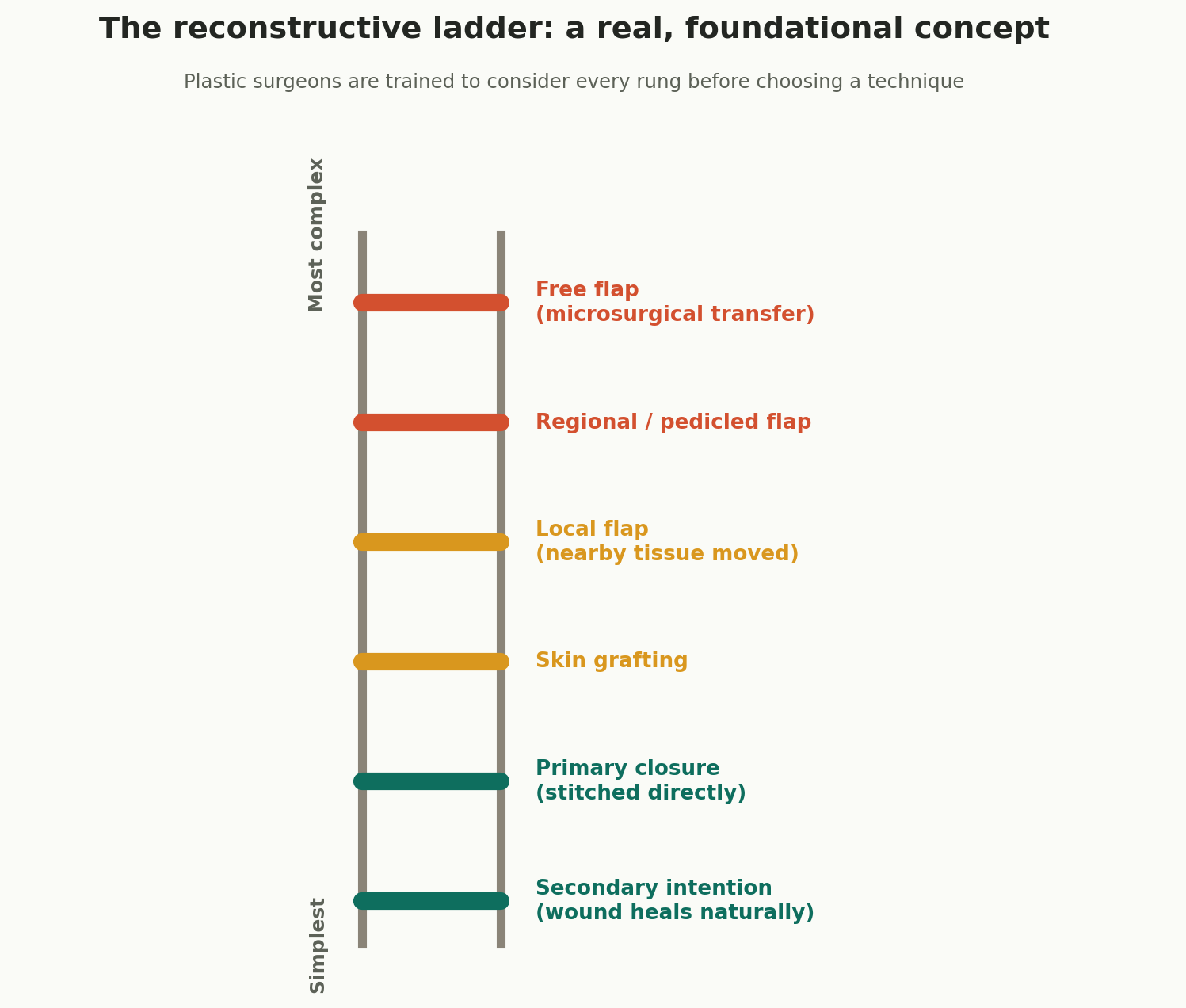
Plastic surgeons are trained to consider every rung before choosing a technique.
This framework exists because more complex techniques, while offering real advantages for larger or more difficult defects, also carry proportionally more risk, cost, and recovery time. A surgeon working through this framework with you, explaining specifically why a given technique was chosen over a simpler or more complex alternative, is demonstrating exactly the kind of considered, principled decision-making this field is built on.
Consider how this plays out practically for two genuinely different injuries. A small, clean wound on the forearm with healthy surrounding tissue might heal perfectly well through simple stitched closure, the second rung of the ladder. A large area of skin lost to a severe burn, by contrast, has no nearby healthy tissue to stitch together and genuinely requires skin grafting, several rungs higher, to close safely. Neither patient is receiving a lesser or greater standard of care; each is receiving the technique genuinely matched to their specific wound.
02 · A Modern Evolution
Complexity buys capability, not automatic superiority
A significant, well-documented evolution in this field, sometimes called the reconstructive elevator, has refined the original ladder concept. Rather than always working sequentially upward from the simplest option, modern practice recognises that sometimes going directly to a more complex, genuinely appropriate technique produces a better outcome than starting at a lower rung and revising later if it proves insufficient.
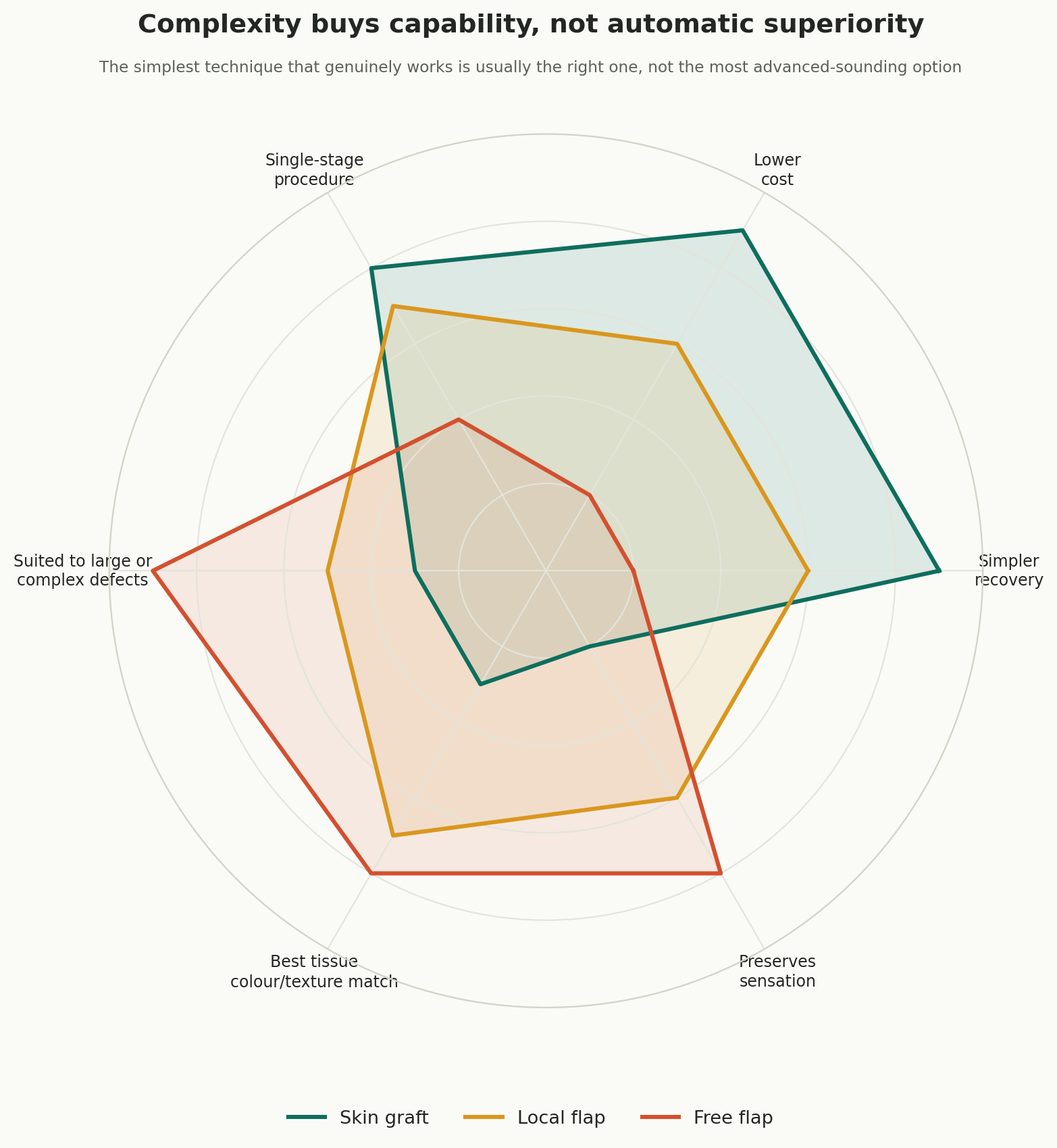
The simplest technique that genuinely works is usually the right one, not the most advanced-sounding option.
This is a genuinely important distinction for patients to understand: neither "always start simple" nor "always choose the most advanced option" is the correct general rule. The right technique is the one genuinely suited to your specific defect, and a thorough surgeon should be able to explain clearly why the proposed approach, whichever rung it sits on, is the right fit for your particular case.
A useful example is reconstruction following cancer resection in the head and neck region. Historically, surgeons might have attempted a simpler local flap first, only to find it inadequate for a large defect and needing to return to surgery with a more complex free flap afterward. The reconstructive elevator approach instead recognises upfront when a defect is genuinely large enough that a free flap is the appropriate first choice, avoiding an unnecessary intermediate procedure and its associated recovery time entirely.
On cleft lip and palate specifically, since this is one of the most common reconstructive needs.
Orofacial clefts affect an estimated 1.1 in 1,000 live births worldwide, and Nigeria, as Africa's most populous country, carries a substantial absolute burden. Early repair, ideally within the first year of life, produces the best functional and speech outcomes, though published Nigerian research has found a meaningful proportion of children are treated later than this ideal window.
03 · What it Costs and How Long it Takes
Cost tracks complexity, closely and predictably
The simplest effective technique is usually the least expensive one too, not just the fastest.
Procedure Typically suits Indicative cost
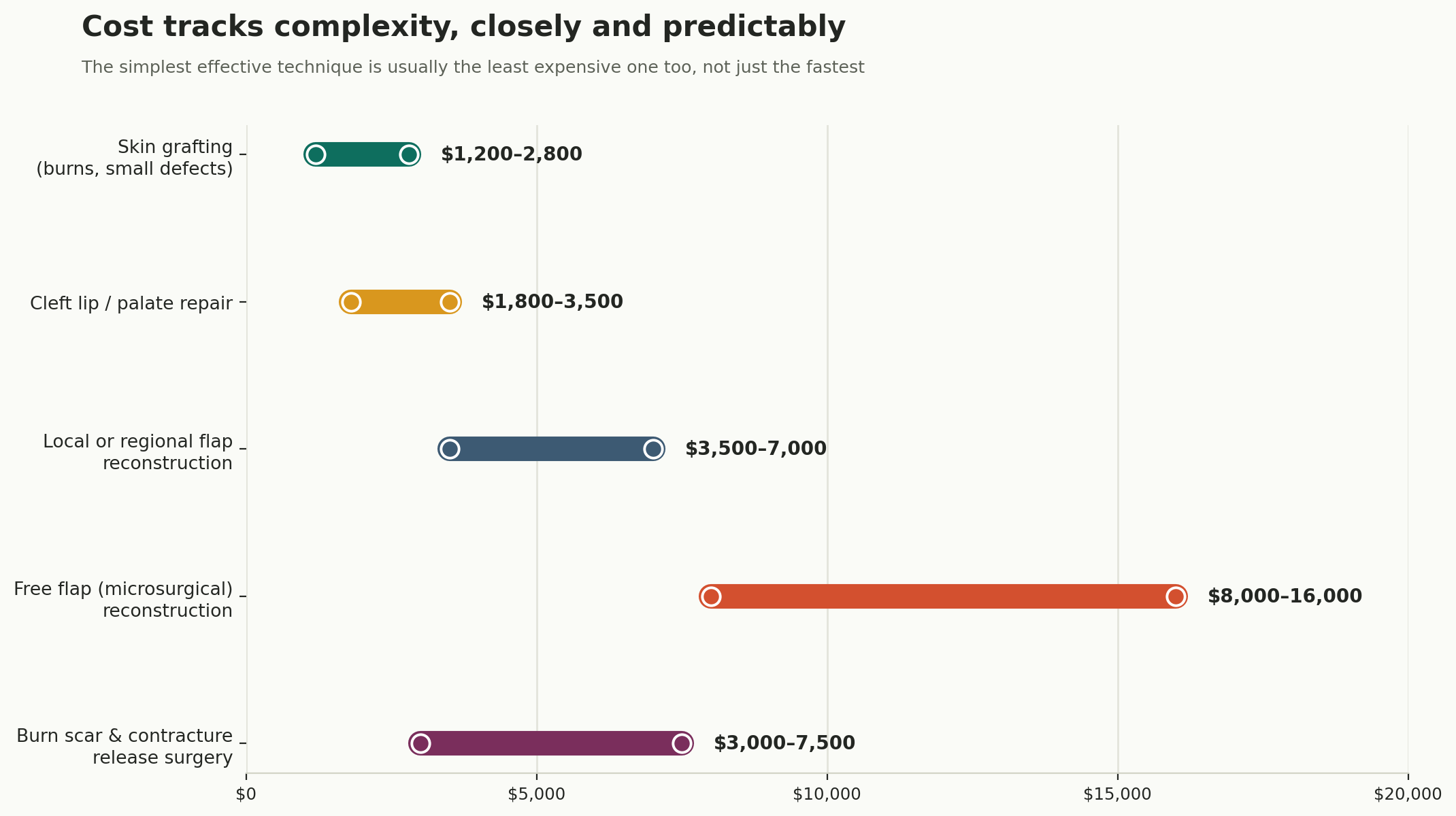
| Skin grafting | Burns, smaller defects with healthy wound beds | $1,200–2,800 |
|---|---|---|
| Cleft lip / palate repair | Congenital orofacial cleft correction | $1,800–3,500 |
| Local or regional flap | Moderate defects needing better tissue match | $3,500–7,000 |
| Procedure | Typically suits | Indicative cost |
| Free flap (microsurgical) | Large or complex defects, cancer reconstruction | $8,000–16,000 |
| Burn scar & contracture release | Restoring movement lost to burn scarring | $3,000–7,500 |
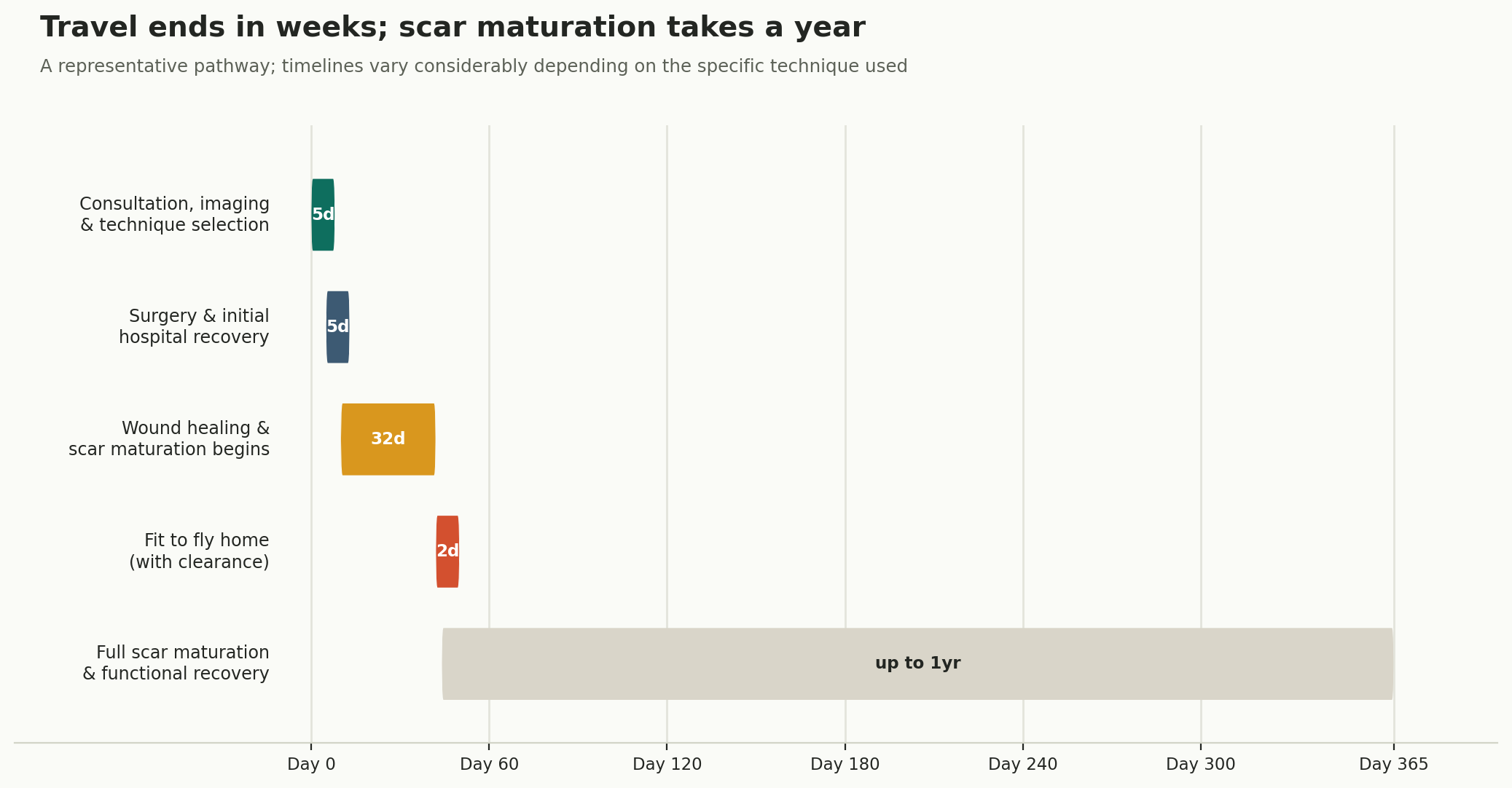
Table 1. Indicative international-patient pricing at accredited Indian centres, mid-2026. Figures vary considerably by defect size, location, and complexity.
A representative pathway; timelines vary considerably depending on the specific technique used.
The distinction between travel readiness and full recovery matters enormously here. Most patients are medically cleared to fly home within four to six weeks of surgery, but scars continue maturing, and function continues improving, for up to a year afterward. Planning realistic expectations around this longer arc, not just the trip itself, protects against disappointment with a result that is, in fact, still actively improving.
This distinction matters for a genuinely practical reason: a scar that looks red, raised, or firm at six weeks is not a failed result, it is simply an early-stage scar still in the middle of a maturation process that takes many months to complete. Patients and families unaware of this normal timeline sometimes worry unnecessarily during this period, when in fact the appearance and texture of most scars continues to improve substantially over the following months without any further intervention needed.
04 · THE NIGERIAN CONTEXT
Genuine progress, alongside genuine gaps
Nigeria has a genuinely active cleft care landscape, anchored by a network of Smile Train-supported partner hospitals across multiple geopolitical zones, alongside local professional bodies including the Nigerian Association of Plastic, Reconstructive and Aesthetic Surgeons. Field outreach programmes, including a documented decade of work by centres in Enugu, Ebonyi, and Benue states, have delivered hundreds of cleft repairs directly to underserved communities. This is real, meaningful, ongoing progress.
Genuine gaps remain alongside this progress. Published clinical accounts specifically note that local and visiting surgical teams are often less well trained in burn contracture and chronic lower-extremity wound reconstruction than in cleft care, and access to speech and language therapy following cleft palate repair, essential for full functional recovery, remains severely limited nationally. A meaningful proportion of children, in one published study over a quarter, are also treated later than the ideal window for the best speech and growth outcomes.
This uneven distribution of expertise, strong in one area, genuinely limited in another, is worth understanding honestly when weighing domestic versus international treatment for a specific condition. Cleft care in particular has benefited from years of sustained, coordinated investment through international partnerships, while other reconstructive needs, burn contracture release and complex trauma reconstruction among them, may currently be better served by centres with deeper, more specifically relevant experience, wherever that experience happens to be located.
05 · GETTING THERE
Visa, travel, and planning around recovery
India issues a Medical Visa (M) to the patient and a Medical Attendant Visa (MX) to accompanying family. Applications go through the High Commission in Abuja or the Consulate General in Lagos by prior appointment, and an e-Medical route turns around in days for straightforward files. The clinic's invitation letter, three months of certified bank statements, and a passport valid six months with two blank pages move the process fastest.
Lagos and Abuja both reach Delhi, Mumbai and Chennai with a single stop, usually via Addis Ababa, Doha, Dubai, Nairobi or Istanbul, a total journey of 13 to 18 hours.
What has to travel home with the patient
- Full operative record, including the specific technique and any graft or flap details
- Clear wound and scar care instructions covering the full recovery period
- A specific follow-up schedule, including any planned revision procedures
- Referral information for continuing therapy, including speech therapy where relevant For cleft palate repair specifically, arranging a Nigerian speech and language therapist, or at minimum a structured home practice plan, before returning is genuinely important given the documented shortage of this specific service nationally. This single piece of planning can meaningfully affect how completely a child's speech development recovers following an otherwise successful surgical repair.
Before you commit to a treatment plan abroad
- Get a full assessment and imaging to understand the genuine scope of your specific defect.
- Ask the surgeon to explain which reconstructive technique is proposed, and why.
- Confirm whether a simpler or more complex alternative was genuinely considered.
- Get the full expected timeline in writing, including both travel readiness and full recovery.
- For cleft care specifically, confirm what speech therapy support will follow surgery.
- Establish a Nigerian specialist for ongoing follow-up before returning home.
Straight Answers for Nigerian Patients about Plastic and Reconstructive Surgery in India
What is the reconstructive ladder?
A foundational framework describing six levels of increasing reconstruction complexity, from natural healing and primary closure through skin grafting, local and regional flaps, to free flap microsurgical transfer.
Does a surgeon always start with the simplest technique?
Not necessarily. Modern practice recognises that going directly to a more complex, genuinely appropriate technique can sometimes produce a better outcome than working up sequentially.
How much does reconstructive surgery cost in India?
Skin grafting is indicatively $1,200 to $2,800. Cleft repair is $1,800 to $3,500. Free flap reconstruction, the most complex option, is $8,000 to $16,000.
How long does recovery take?
Most patients can travel home within four to six weeks, but full scar maturation and functional recovery can continue for up to a year.
Do Nigerians need a visa for this treatment in India?
Yes. You need an Indian Medical Visa from the High Commission in Abuja, the Consulate in Lagos, or the e- Medical route, plus a Medical Attendant Visa for accompanying family.
A closing word
Reconstructive surgery is a field built on genuine, structured decision-making, not a menu of interchangeable procedures. Understanding the reconstructive ladder, and its more recent evolution, gives patients a real framework for understanding why a specific technique has been proposed for their case, and for asking whether that reasoning genuinely holds.
In twenty-four years of this work, the patients who navigate this best ask directly why a specific technique was chosen, understand that full recovery unfolds over months, not weeks, and, for cleft care specifically, plan for the ongoing speech therapy that genuinely completes the picture surgery alone cannot finish. The operation restores structure. What follows determines how fully that structure restores a life.
Sources
- 🌐 Reconstructive Ladder: An Overview. ScienceDirect Topics, referencing established plastic surgery literature
- 🌐 Suh HP. The Evolving Reconstruction Toolbox of the Plastic Surgeon. Archives of Plastic Surgery, 2025
- 🌐 Comprehensive Cleft Care in Nigeria: From Surgical Access to Speech Therapy Gaps. African Cleft-Palate Craniofacial Journal, 2025
- 🌐 Babalola A, et al. Cleft lip and palate in Nigerian children: a scoping review of surgical access and postoperative outcomes
- 🌐 High Commission of India, Abuja — Medical and Medical Attendant Visa requirements
Frequently Asked Questions by Nigerians about Plastic and Reconstructive Surgery in India
What is the reconstructive ladder?
It is a six-level framework ranging from natural wound healing and primary closure through skin grafts, local and regional flaps, to free-flap microsurgical reconstruction.
Does reconstructive surgery always start with the simplest technique?
Not necessarily. Modern practice recognises that a more complex technique may sometimes be the appropriate first choice when the defect is large or complex.
How much does reconstructive surgery cost in India?
Indicative costs range from $1,200–2,800 for skin grafting, $1,800–3,500 for cleft repair and $8,000–16,000 for free-flap reconstruction.
How long before a patient can travel home?
The guide states that most patients can be medically cleared to fly home within approximately four to six weeks, depending on the procedure and recovery.
How long does full recovery take?
Although travel may be possible within weeks, scar maturation and functional recovery can continue for up to one year.
When should cleft lip and palate ideally be repaired?
The guide states that early repair, ideally within the first year of life, is associated with better functional and speech outcomes.
Why is speech therapy important after cleft palate repair?
The guide highlights limited national access to speech and language therapy in Nigeria and recommends arranging appropriate therapy support before returning home.
What should Nigerian patients ask the surgeon?
Ask why the proposed technique is appropriate, whether simpler or more complex alternatives were considered and what the expected recovery timeline is.
What should patients take home after surgery?
Patients should obtain the complete operative record, technique and flap/graft details, wound and scar-care instructions, follow-up schedule and therapy referral information.
What visa is required for reconstructive surgery in India?
The guide states that Nigerian patients require an Indian Medical Visa, while accompanying family members can obtain a Medical Attendant Visa.
Page Summary
This guide helps Nigerian patients understand plastic and reconstructive surgery options in India, focusing on defect-specific technique selection, the reconstructive ladder, cleft repair, burn reconstruction, flap and microsurgical procedures, costs, recovery and Nigerian follow-up. It highlights indicative Indian costs from $1,200–2,800 for skin grafting to $8,000–16,000 for free-flap reconstruction, while explaining that patients may return home within four to six weeks even though scar maturation and functional recovery can continue for up to a year.
Citation Block
| Topic | Information |
|---|---|
| Topic | Plastic & Reconstructive Surgery in India for Nigerian Patients |
| Treatment | Plastic and Reconstructive Surgery |
| Patients | Nigerian Patients |
| Specialist | Plastic & Reconstructive Surgeon |
| Core Framework | Reconstructive ladder |
| Technique Selection | Match the technique to the specific defect |
| Complex Reconstruction | Free-flap microsurgical reconstruction |
| Cleft Finding | ~1.1 per 1,000 live births globally |
| Cleft Timing | Ideally repaired within the first year |
| Skin Grafting Cost | ~$1,200–2,800 |
| Cleft Repair Cost | ~$1,800–3,500 |
| Flap Reconstruction Cost | ~$3,500–7,000 |
| Free Flap Cost | ~$8,000–16,000 |
| Burn Contracture Cost | ~$3,000–7,500 |
| Travel Readiness | Usually 4–6 weeks |
| Full Recovery | Up to 1 year for scar maturation and functional recovery |
| Pre-Travel Assessment | Full clinical assessment and imaging |
| Follow-Up | Nigerian specialist and relevant therapy |
| Cleft Follow-Up | Speech and language therapy should be planned where needed |
| Warning Signs | Unclear technique rationale, unrealistic recovery promises, inadequate follow-up planning |
| Key Decision | Prioritise defect-specific expertise and the technique that genuinely fits the case |


Our Mission Statement
Our mission is to place patients at the centre of every healthcare decision by providing trustworthy, evidence-based, and unbiased medical information. We believe that informed patients make better decisions. Backed by personalised guidance from our experienced advisory team, we help patients understand their treatment options, compare them objectively, and confidently choose the path that best suits their medical needs and personal circumstances.
Patient Testimonials from Nigeria















Ready to Take the First Step?
Share your Medical Reports with our Healthcare Managers Today and Get a FREE CONSULTATION, a Personalized Treatment Plan, and Complete Support from Arrival to Recovery.
Get Your Free ConsultationAreas We Serve
This resource has been thoughtfully prepared for patients from Nigeria who are considering medical treatment in India. We also welcome patients from the wider region in the countries mentioned below-
We assist patients from:
- Benin
- Niger
- Chad
- Cameroon
- Algeria
- Egypt
- Libya
- Morocco
- Sudan
- Tunisia
- Gambia
- Ghana
- Burkina Faso
- Cabo Verde
- Côte d'Ivoire
- Equatorial Guinea
- São Tomé and Príncipe
Many of the insights, treatment pathways, hospital recommendations, travel guidance, and patient support services described here are equally relevant and may be used as a reference when planning treatment in India.
From Nigeria to India: Your Complete Patient Support Guide
- Artificial Disc Replacement in India for Nigerian Patients
- Weight Loss and Bariatric Surgery in India for Nigerian Patients
- Bone Marrow Transplant in India for Nigerian Patients
- Brain Tumour Surgery in India for Nigerian Patients
- Breast Cancer Treatment and Surgery in India for Nigerian Patients
- Cancer Treatment and Surgery in India for Nigerian Patients
- Cardiac Arrhythmia and Heart Pacemaker Treatment in India for Nigerian Patients
- Cardiac Surgery in India for Nigerian Patients
- Colorectal Cancer Treatment and Surgery in India for Nigerian Patients
- Complex Orthopaedic and Joint Revision Surgery in India for Nigerian Patients
- Cornea Transplant and Advanced Eye Surgery in India for Nigerian Patients
- CyberKnife Treatment in India for Nigerian Patients
- Gamma Knife Treatment in India for Nigerian Patients
- Heart Failure Treatment and Surgery in India for Nigerian Patients
- Hip Surgery in India for Nigerian Patients
- HIPEC Cancer Surgery in India for Nigerian Patients
- IVF and Fertility Treatment in India for Nigerian Patients
- Joint Arthroscopy and Sports Medicine in India for Nigerian Patients