

Heart Valve Replacement Surgery in India for Nigerian Patients
For the young Nigerian adult whose childhood sore throat quietly became a damaged heart valve years later — and the two-way choice, mechanical or tissue, that will shape the rest of their life either way.
Heart valve disease in Nigeria does not resemble the disease described in most international treatment guidance. In high-income countries, valve disease is usually degenerative, calcific narrowing of the aortic valve that develops slowly with age. Nigerian hospital data tells a different story almost entirely: valve disease that is overwhelmingly rheumatic in origin, tracing back to an untreated or inadequately treated streptococcal throat infection in childhood, striking patients in their teens, twenties, and thirties, often at the exact point in life when careers, marriage, and children are just beginning. This distinction shapes every decision that follows, from which valve type genuinely suits a young patient's remaining decades of life, to how realistic ongoing anticoagulation monitoring is once travel is over and daily life at home resumes. A treatment plan borrowed wholesale from guidance written for a 70-year-old patient in a well-resourced health system does not automatically transfer to a 24-year-old Nigerian patient managing this decision for the next fifty years. This guide sets out what valve replacement actually involves, the genuinely difficult choice between a mechanical and a tissue valve that most patients are never fully prepared for, what each pathway costs in India once travel is counted, and why this decision deserves more time and more honest conversation than it typically receives.
| 75.4% | 64/87 | ~250,000 | 3.4% |
|---|---|---|---|
| OF DISEASED VALVES REPLACED WITH A MECHANICAL PROSTHESIS IN A NIGERIAN SURGICAL SERIES | RHEUMATIC VALVES IN THAT SERIES WERE MITRAL VALVES, THE MOST COMMONLY AFFECTED | DEATHS WORLDWIDE EACH YEAR LINKED TO RHEUMATIC HEART DISEASE, MOSTLY YOUNGER PEOPLE | IN-HOSPITAL MORTALITY REPORTED IN A PUBLISHED NIGERIAN 6-YEAR VALVE SURGERY SERIES |
Healing Journeys of Nigerian Patients









Key Takeaways
- The guide highlights that rheumatic heart disease is the dominant pattern of valve disease in Nigeria, affecting a much younger population than the degenerative valve disease commonly described in Western treatment guidance.
- A published six-year Nigerian surgical series reviewed 122 diseased valves, of which 87 were rheumatic; 64 involved the mitral valve and 23 the aortic valve.
- The page 3 chart shows that 75.4% of the 122 valves received mechanical prostheses, 23.8% were repaired and 0.8% received bioprostheses, illustrating the strong preference for mechanical valves in that Nigerian series.
- The guide stresses that valve repair should be considered before replacement when the patient's own valve tissue is suitable, because successful repair can avoid both lifelong anticoagulation and prosthetic-valve durability concerns.
- When replacement is required, the central decision is mechanical versus bioprosthetic valve. Mechanical valves offer long durability but require lifelong warfarin and regular INR monitoring, while tissue valves reduce the need for long-term anticoagulation but generally have shorter durability in younger patients.
- The page 4 comparison shows that neither valve type is superior across every factor. The choice depends on age, durability, pregnancy considerations, bleeding risk and access to reliable anticoagulation monitoring.
- Indicative Indian costs range from US$3,500–US$6,000 for balloon valvuloplasty, US$9,000–US$14,000 for single valve repair, US$11,000–US$17,000 for single valve replacement and US$16,000–US$24,000 for double valve replacement.
- A representative single mechanical mitral valve replacement journey is estimated at approximately US$16,500–US$24,500 all-in, including surgery, flights, pre-operative testing, accommodation, visas and contingency.
- The page 8 pathway shows that mechanical-valve patients may require a longer stay, including anticoagulation stabilisation before flying home. Lifelong INR testing and warfarin management must be arranged in Nigeria before travel.
- Nigerian patients should choose a cardiac centre with specific experience in rheumatic valve disease, rather than relying only on general valve-surgery volume. The guide also recommends confirming the full anticoagulation plan and identifying a Nigerian cardiologist for long-term monitoring.
Quick Facts
- Treatment
- Heart Valve Replacement Surgery
- Country
- India
- Patients
- Patients from Nigeria
- Key Specialist
- Cardiac Surgeon / Cardiologist
- Main Condition
- Rheumatic Heart Valve Disease
- Common Valve
- Mitral Valve
- Other Valve
- Aortic Valve
- Treatment Options
- Valve Repair or Replacement
- Replacement Types
- Mechanical or Bioprosthetic
- Single Valve Replacement
- US$11,000–US$17,000
- Double Valve Replacement
- US$16,000–US$24,000
- Single Mechanical Valve Journey
- US$16,500–US$24,500 All-In
- Important Check
- Confirm Whether Valve Repair Is Possible
- Valve Choice
- Individualised Mechanical vs Bioprosthetic Decision
- Pre-Travel Records
- Echocardiogram and Cardiac Reports
- Visa
- Indian Medical Visa and Medical Attendant Visa
- Attendants
- Up to Two Close Relatives
- Recovery
- Hospital Recovery Plus Anticoagulation Stabilisation Where Required
- Follow-Up
- Lifelong Cardiac Monitoring
- Author
- Dr. Dheeraj Bojwani
- Experience
- 24+ Years
In Brief
For Nigerian patients considering heart valve surgery in India, the guide recommends obtaining a complete echocardiographic assessment and confirming whether valve repair is possible before assuming replacement is necessary. If replacement is required, mechanical and bioprosthetic valves should be discussed as an individualised long-term decision, particularly because mechanical valves require lifelong INR monitoring while tissue valves may have limited durability in younger patients. Patients should choose a centre experienced in rheumatic valve disease, obtain a detailed written quotation and establish a Nigerian cardiology follow-up plan before travelling.
01 · the Real Problem
A young person's disease, not an old person's disease
Rheumatic heart disease begins, almost always, with an ordinary childhood illness: a streptococcal throat infection that goes untreated or under-treated. In a small number of children, the body's immune response to that infection mistakenly attacks the heart valves as well, causing scarring that thickens, stiffens, or distorts the valve over years. By the time symptoms, breathlessness, fatigue, swelling, become severe enough to bring a patient to a cardiologist, often in their twenties or thirties, the underlying childhood infection is long forgotten, and the valve damage has become a fully separate, adult surgical problem.
This slow, silent progression is part of why rheumatic heart disease remains such a persistent public health challenge across Nigeria and much of Sub-Saharan Africa: there is often no dramatic single moment that signals danger, only a gradual decline in stamina that a young, otherwise healthy person, and the people around them, can easily attribute to something else entirely for years before a diagnosis is finally made.
A published six-year surgical series from a Nigerian cardiac centre found valvular heart disease there to be mainly rheumatic, affecting mostly younger to middle-aged patients treated surgically with prosthetic valve replacement. Of 122 diseased valves reviewed, 87 were confirmed rheumatic, 64 of the mitral valve and 23 of the aortic valve, reflecting the pattern seen across much of Sub-Saharan Africa. This is fundamentally different from the population most international valve research, and most valve device design, is actually built around.
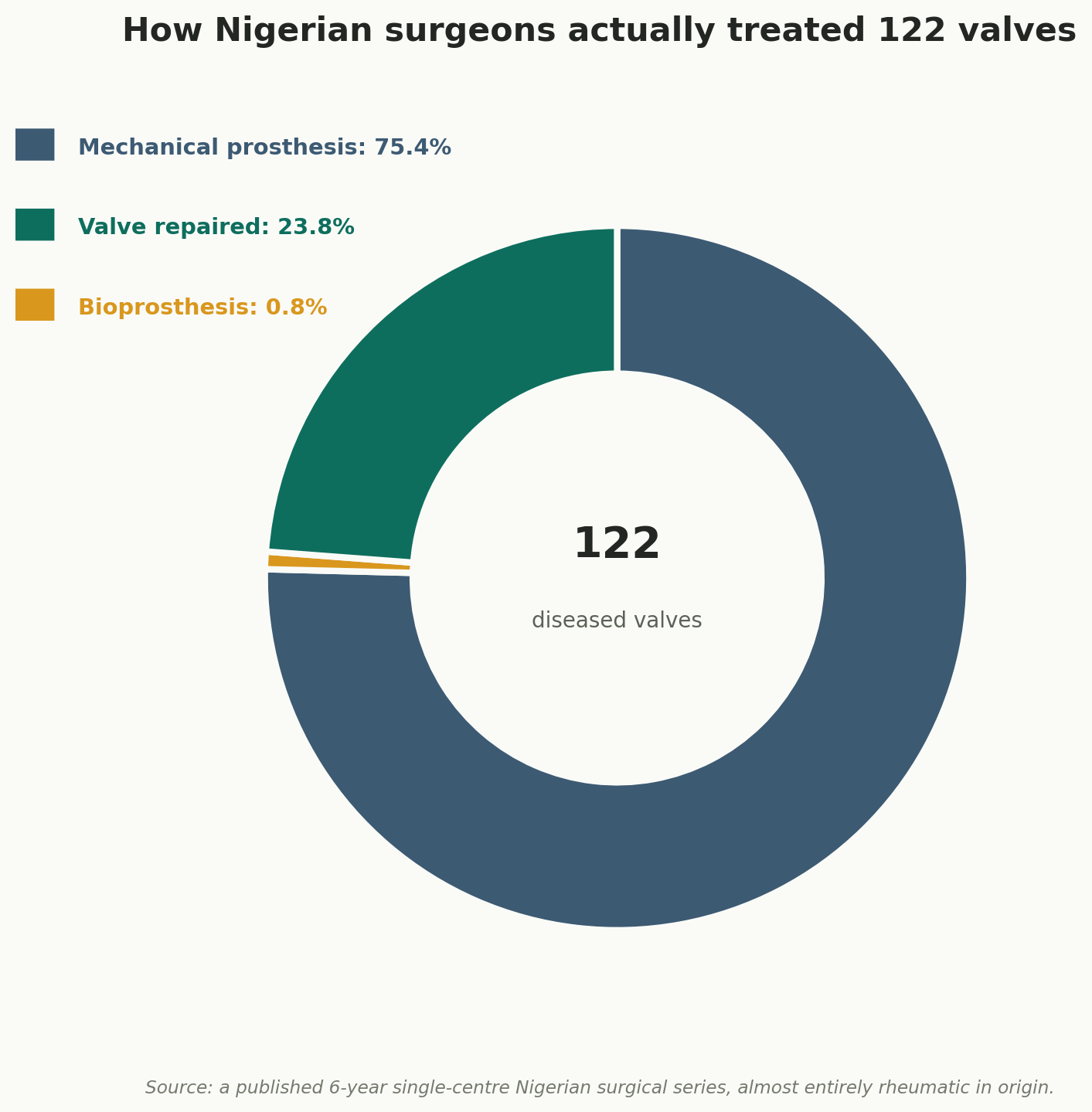
Figure 1. How Nigerian surgeons actually treated 122 diseased valves in this published series, almost entirely rheumatic in origin.
This difference matters practically, not just academically. Much of the global evidence on valve choice, expected valve lifespan, and long-term outcomes comes from studies of much older patients with degenerative disease. A 25-year-old Nigerian patient with rheumatic mitral valve disease is, in a genuine sense, a different clinical population than the 75-year-old patient most valve trials are designed around, and the treatment decision deserves to be made with that difference clearly in mind.
02 · the Central Decision
Mechanical or tissue: a choice with no easy answer
Once replacement, rather than repair, is needed, the single most consequential decision is which type of valve to receive, and this choice is permanent in a way few other medical decisions are.
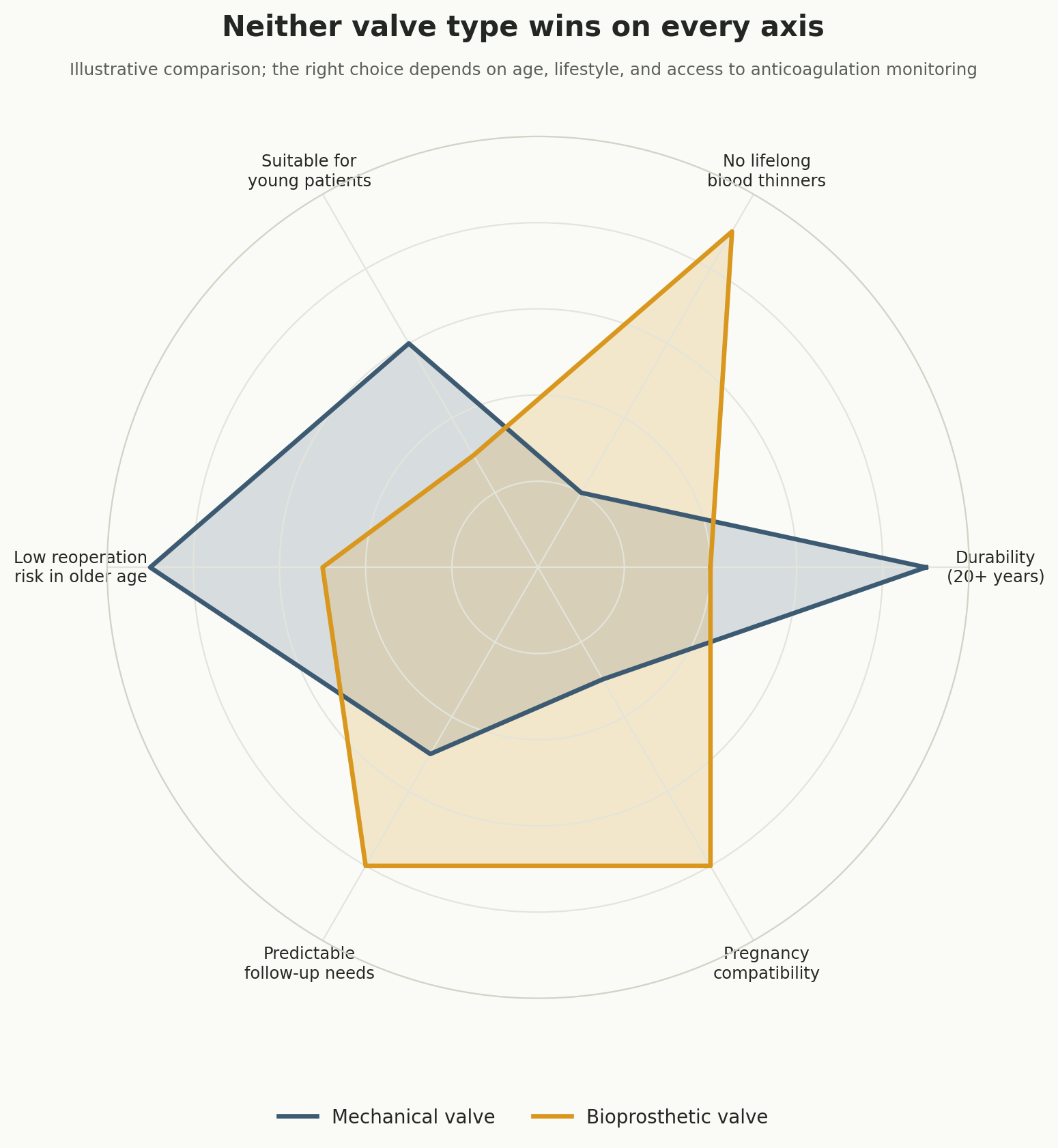
Figure 2. Neither valve type wins across every dimension that matters. The right choice depends on the specific patient, not a universal rule.
Mechanical valves are built to last decades, often the patient's lifetime, without wearing out. Their cost is a lifelong commitment to blood-thinning medication, warfarin in most settings, with international normalised ratio, or INR, blood tests needed regularly to keep the dose in a safe range. Too little anticoagulation risks a blood clot forming on the valve; too much risks dangerous bleeding. Published research specifically examining this issue in African settings has described the reality of INR control in Africa as a genuine, ongoing clinical challenge, given how much reliable anticoagulation monitoring depends on infrastructure that is not evenly available.
Bioprosthetic, or tissue, valves need no blood thinners beyond a short initial period, a genuine advantage for a patient without reliable access to regular INR testing, or for a woman planning future pregnancy, since mechanical valve anticoagulation carries real risk during pregnancy. Their drawback is durability: tissue valves degenerate faster in younger patients than in the older patients they were originally studied in, and a second, higher-risk reoperation years later is a realistic possibility many younger patients are not adequately warned about at the time of the first surgery.
This is precisely why the Nigerian surgical series cited above shows such a strong preference for mechanical valves, 92 of 122 cases, despite the anticoagulation challenge: for a young patient, a valve expected to degenerate within a decade is often judged a worse long-term outcome than committing to lifelong blood- thinning medication, even where INR monitoring access is imperfect. This is a genuine clinical trade-off, not a simple right answer, and it deserves a full, honest conversation with your surgeon before any decision is made.
03 · THE TREATMENT OPTIONS
What actually happens, and what it costs
Not every diseased valve needs replacement. Where the valve's own tissue is healthy enough, repair, reshaping the patient's own valve rather than replacing it, avoids both the anticoagulation question and the durability question entirely, and is genuinely preferable where feasible. Whether repair is realistic depends heavily on how advanced the rheumatic damage already is by the time surgery is considered, which is why earlier diagnosis matters as much as surgical skill.
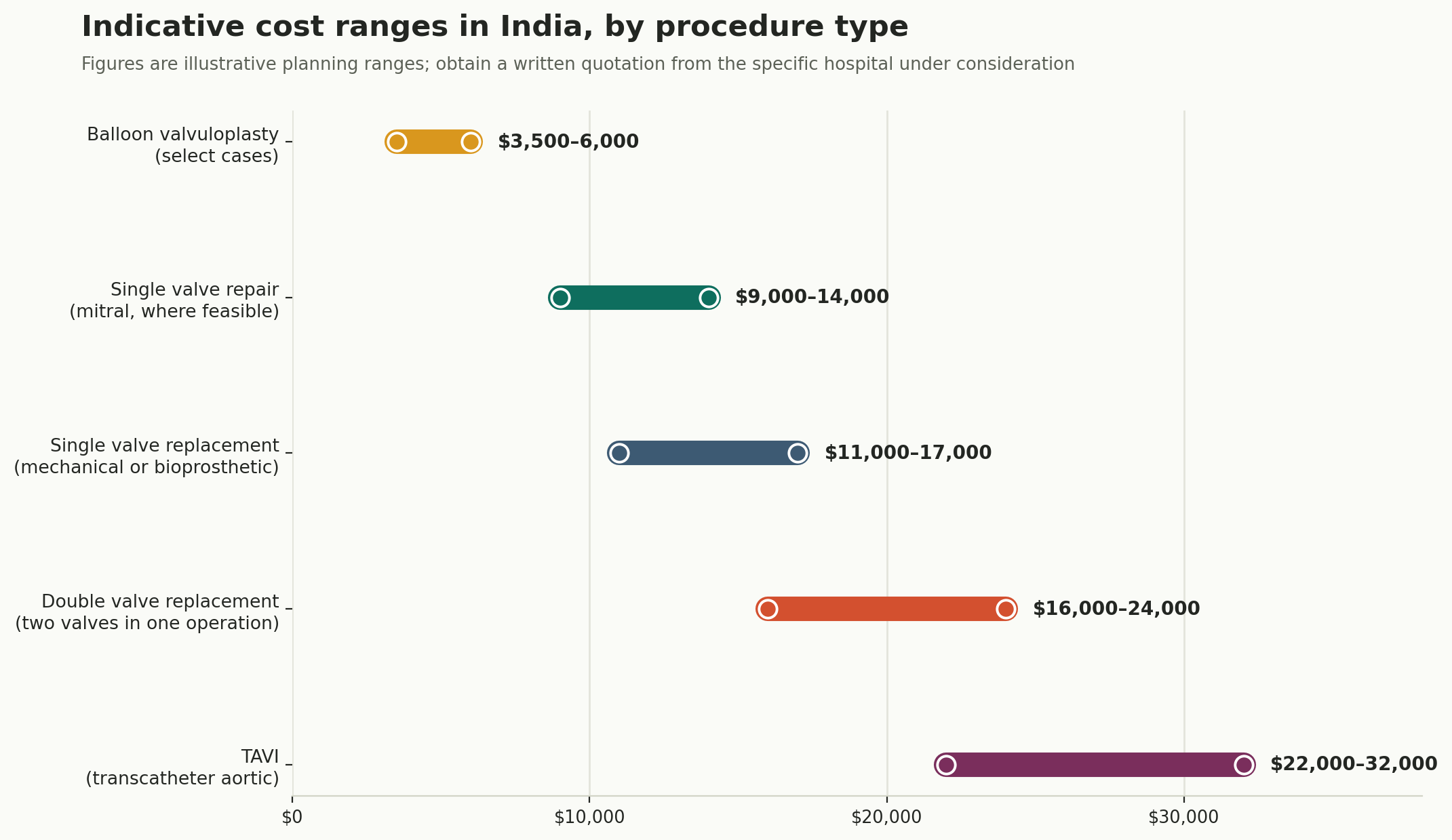
Figure 3. Indicative cost ranges by procedure type. The specific valve, single versus double, and mechanical versus bioprosthetic, all shift the final figure.
| Procedure | Typically suits | Indicative cost | Hospital stay |
|---|---|---|---|
| Balloon valvuloplasty | Select cases of pure mitral stenosis, suitable valve anatomy | $3,500–6,000 | 1–2 nights |
| Single valve repair | Regurgitant valve with healthy enough tissue, usually mitral | $9,000–14,000 | 6–9 nights |
| Single valve replacement | Advanced rheumatic or degenerative disease of one valve | $11,000–17,000 | 7–10 nights |
| Double valve replacement | Combined mitral and aortic disease, common in advanced rheumatic disease | $16,000–24,000 | 8–12 nights |
| TAVI | Selected aortic valve cases, evolving role for younger patients | $22,000–32,000 | 3–5 nights |
Table 1. Indicative international-patient pricing at accredited Indian cardiac centres, mid-2026. Figures are planning ranges, not offers, and vary by hospital tier, valve brand, and case complexity.
What a proper written quote must itemise
- Whether repair or replacement is being recommended, and the specific clinical reasoning
- Valve type, mechanical or bioprosthetic, brand and model, with the reasoning for that recommendation
- Whether one or two valves need treatment, and the surgical plan for each
- The full anticoagulation and monitoring plan if a mechanical valve is chosen
- Written policy on cost if intraoperative findings change the surgical plan
04 · the Full Budget
What the whole journey costs, beyond the procedure fee
The procedure fee is the number families anchor on, and the least complete one. A representative pathway — single mechanical mitral valve replacement, one patient and one attendant, roughly three weeks in India — adds up like this:
- Surgical package (valve, surgery, hospital stay): $11,000–17,000
- Return flights, two travellers (Lagos/Abuja – Delhi/Mumbai/Chennai): $2,200–3,000
- Pre-operative workup (echocardiogram, cardiac catheterisation if needed, blood tests): $500–900
- Accommodation, about three weeks, two people : $1,300–2,000
- Medical and attendant visas (two applications): $400–500
- Contingency for extended recovery or anticoagulation stabilisation: 15–20% All-in, most families should plan for US$16,500–24,500 for single mechanical valve replacement — roughly ₦22.8–33.8 million at the official mid-July 2026 rate of about ₦1,380 to the dollar, somewhat higher at parallel-market rates near ₦1,410. Double valve replacement, and any mechanical valve pathway's ongoing INR testing and warfarin costs after return home, require additional, sustained budgeting well beyond the initial trip.
05 · Getting There
Visa, travel, and a recovery that does not end at discharge
India issues a Medical Visa (M) to the patient and a Medical Attendant Visa (MX) to up to two close relatives. Applications go through the High Commission in Abuja or the Consulate General in Lagos by prior appointment, and an e-Medical route turns around in days for straightforward files. The hospital's invitation letter, three months of certified bank statements, and a passport valid six months with two blank pages move the process fastest.
Lagos and Abuja both reach Delhi, Mumbai and Chennai with a single stop, usually via Addis Ababa, Doha, Dubai, Nairobi or Istanbul, a total journey of 13 to 18 hours.
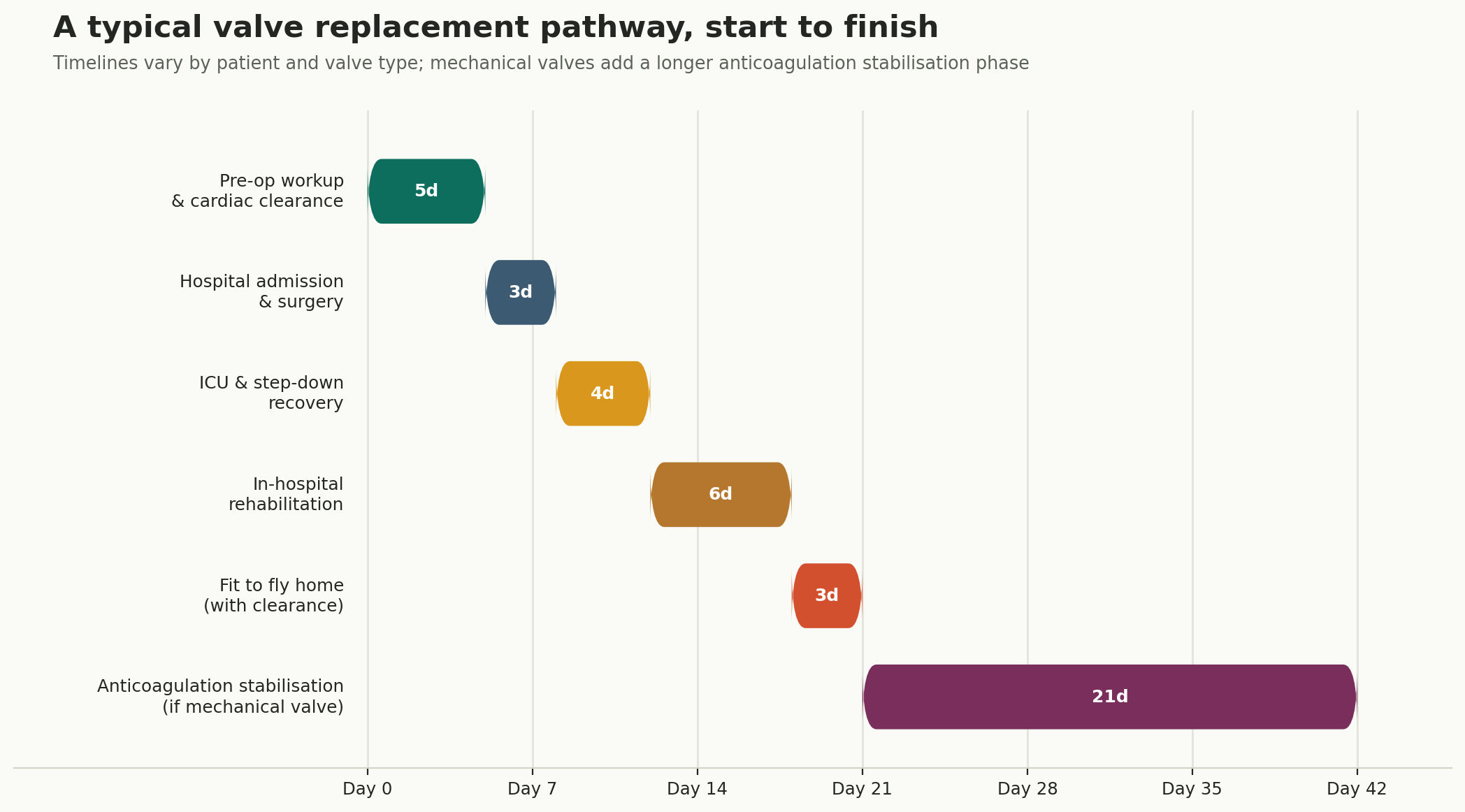
Figure 4. A typical pathway, start to finish. Mechanical valve recipients need a longer in-country stay to confirm stable anticoagulation before flying home.
On what a mechanical valve actually means, day to day, once home. Regular INR blood testing, careful attention to diet and other medications that interact with warfarin, and a clear emergency plan for unexpected bleeding or bruising are lifelong commitments, not a temporary post-operative phase. Establish exactly how and where this testing will happen in Nigeria before you travel, not after.
What has to travel home with the patient
- Full operative record, including exact valve type, brand, and size implanted
- A valve identification card, carried at all times, particularly important for mechanical valves
- A written anticoagulation plan with target INR range, if a mechanical valve was placed
- Clear written instructions on warning signs of valve or anticoagulation-related complications
- A named clinician contact for teleconsultation between visits
06 · the Honest Comparison
What stays in Nigeria, and what genuinely benefits from travel
Diagnosis, initial evaluation, and routine anticoagulation monitoring for patients who already have a mechanical valve belong, wherever possible, with a Nigerian cardiologist close to home, and there is no reason to travel for this ongoing care. Getting early diagnosis right, before rheumatic damage progresses to the point where repair is no longer possible, matters as much as any later surgical decision.
What tips the calculation toward travelling is the surgery itself: case volume, valve technique experience across both repair and replacement, and, where genuinely appropriate, access to newer options like TAVI, where Nigeria's cardiac surgical capacity remains genuinely limited relative to the disease burden this guide has described. For that surgical decision specifically, India's case volume and integrated cardiac programmes offer a real, measurable advantage.
Before you commit to a treatment plan abroad
- Get a confirmed diagnosis and full echocardiographic assessment before assuming replacement is the only option.
- Ask explicitly whether valve repair is realistic for your specific anatomy before replacement is recommended.
- Discuss mechanical versus bioprosthetic valve choice as a genuine, individualised decision, not a default.
- Ask for the centre's case volume specifically for your valve and procedure type.
- Confirm the full anticoagulation plan, and how it will be monitored once you return to Nigeria.
- Establish the full expected length of stay in writing, including anticoagulation stabilisation time if relevant.
- Identify a Nigerian cardiologist for long-term monitoring before you travel, not after.
- Pay into the hospital's own institutional account only, never an individual's personal account.
Straight Answers for Nigerian Patients about Heart Valve Replacement Surgery in India
Is heart valve replacement in India cheaper than the UK or US?
Yes, substantially. A single valve replacement is indicatively $11,000 to $17,000 in India, against roughly $40,000 to $70,000 privately in the UK and $80,000 to $150,000 self-pay in the United States, before complications.
Why is heart valve disease different in Nigeria compared to Western countries?
In Western countries, valve disease is usually degenerative, calcific aortic stenosis in older patients. In Nigeria, valve disease is overwhelmingly rheumatic in origin, following childhood rheumatic fever, and affects a much younger population.
Should I choose a mechanical or a bioprosthetic valve?
There is no universally correct answer. Mechanical valves last decades but require lifelong blood-thinning medication with regular monitoring. Bioprosthetic valves need no blood thinners but typically degenerate faster in younger patients. The right choice depends on age, access to reliable anticoagulation monitoring, and personal circumstances.
What is TAVI, and is it available for rheumatic valve disease?
TAVI delivers a replacement valve through a catheter rather than open surgery. It was originally developed for degenerative aortic stenosis in older patients, and its role in younger, rheumatic valve disease is still evolving.
Do Nigerians need a visa for heart valve surgery in India?
Yes. You need an Indian Medical Visa from the High Commission in Abuja, the Consulate in Lagos, or the e- Medical route, plus a Medical Attendant Visa for up to two close relatives, with a hospital invitation letter and financial proof.
A closing word
Heart valve replacement in Nigeria is, more often than not, a young person's operation, arriving decades earlier than the disease most international guidance is written around. The choice between a mechanical and a tissue valve is not a technical footnote; it is a decision that will shape daily life, family planning, and long- term health for the rest of that patient's life, and it deserves to be made with full, honest information, not rushed through in a single consultation.
In twenty-four years of this work, the families who navigate this best insist on understanding both valve options fully before choosing, ask directly about the surgeon's specific experience with rheumatic, not just degenerative, valve disease, and build a realistic, lifelong plan for whichever valve is chosen, not just a plan for the operation itself. The surgery takes a matter of hours. The valve chosen that day stays with the patient for the rest of their life.
Sources
- 🌐 Surgical Treatment of Valvular Heart Disease in Nigeria: A 6-Year Experience. Published Nigerian cardiac surgery series
- 🌐 Zilla P, Human P, Pennel T. Mechanical valve replacement for patients with rheumatic heart disease
- 🌐 Watkins DA, et al. Global, regional, and national burden of rheumatic heart disease, 1990–2015. New England Journal of Medicine
- 🌐 American Heart Association — Heart valve surgery, patient information
- 🌐 NHS (UK) — Heart valve surgery: overview – nhs.uk
- 🌐 High Commission of India, Abuja — Medical and Medical Attendant Visa requirements
Frequently Asked Questions by Nigerians about Heart Valve Replacement Surgery in India
Why is rheumatic heart disease important for Nigerian patients?
The guide explains that valve disease in Nigeria is predominantly rheumatic in origin and often affects younger patients, particularly those in their teens, twenties and thirties.
Which heart valve is most commonly affected in the Nigerian surgical series?
The published series cited in the guide found 64 of 87 confirmed rheumatic valves were mitral valves, compared with 23 aortic valves.
Does every Nigerian patient with severe valve disease need replacement?
No. The guide recommends asking whether valve repair is technically possible before replacement. Successful repair can avoid some long-term prosthetic-valve issues.
What is the difference between a mechanical and a bioprosthetic valve?
Mechanical valves can last decades or potentially a lifetime, but require lifelong warfarin and INR monitoring. Bioprosthetic valves generally require less long-term anticoagulation but may deteriorate sooner in younger patients.
How much does single heart valve replacement cost in India for Nigerian patients?
The guide gives an indicative range of US$11,000–US$17,000 for single valve replacement at an accredited Indian cardiac centre.
How much does double valve replacement cost in India?
The guide gives an indicative range of US$16,000–US$24,000, depending on the valves involved, hospital and surgical complexity.
What is the approximate all-in cost for a mechanical mitral valve replacement?
A representative journey for one patient and one attendant is estimated at approximately US$16,500–US$24,500, including surgery, travel, investigations, accommodation, visas and contingency.
Why is INR monitoring important after a mechanical valve replacement?
Mechanical valves require lifelong anticoagulation with warfarin. Regular INR testing is necessary to keep anticoagulation within the appropriate range and reduce clotting or bleeding risks.
What should Nigerian patients check before choosing a cardiac centre?
They should ask about the centre's specific experience with rheumatic valve disease and the exact valve procedure required, rather than relying only on its overall cardiac surgery volume.
How should Nigerian patients plan follow-up after valve replacement in India?
Before travelling, patients should identify a Nigerian cardiologist for long-term monitoring, particularly if a mechanical valve is implanted. They should also return with the operative record, valve identification card and written anticoagulation plan.
Page Summary
This guide explains the key considerations for Nigerian patients exploring heart valve replacement surgery in India, with particular emphasis on the prevalence of rheumatic valve disease among younger Nigerian patients. It covers mitral and aortic valve disease, the possibility of valve repair before replacement, and the long-term decision between mechanical and bioprosthetic valves. The guide provides indicative costs for balloon valvuloplasty, valve repair, single and double valve replacement and TAVI, including an estimated US$16,500–US$24,500 all-in journey for a single mechanical mitral valve replacement. It also explains anticoagulation planning, hospital selection, travel and visa requirements, recovery time and the importance of establishing long-term cardiac monitoring in Nigeria.
Citation Block
| Topic | Information |
|---|---|
| Topic Information | Heart Valve Replacement Surgery in India for Patients from Nigeria |
| Treatment | Heart Valve Replacement / Repair |
| Intended Audience | Patients from Nigeria |
| Key Specialist | Cardiac Surgeon / Cardiologist |
| Main Condition | Rheumatic Heart Valve Disease |
| Common Valve | Mitral Valve |
| Other Valve | Aortic Valve |
| Primary Assessment | Echocardiographic and Cardiac Assessment |
| Treatment Options | Valve Repair, Mechanical or Bioprosthetic Replacement |
| Single Valve Replacement Cost | US$11,000–US$17,000 |
| Double Valve Replacement Cost | US$16,000–US$24,000 |
| Single Mechanical Valve Journey | US$16,500–US$24,500 All-In |
| Important Specialist Check | Confirm Experience With Rheumatic Valve Disease |
| Valve Choice Check | Discuss Mechanical vs Bioprosthetic Based on Individual Circumstances |
| Anticoagulation Check | Confirm Lifelong INR and Warfarin Monitoring if Mechanical Valve Is Chosen |
| Important Warning | Replacement Recommended Without First Assessing Whether Repair Is Possible |
| Pre-Travel Records | Echocardiogram and Cardiac Reports |
| Visa Requirement | Indian Medical Visa and Medical Attendant Visa |
| Patient Journey | Cardiac assessment → repair/replacement decision → visa → travel/surgery → recovery → long-term follow-up |
| Follow-Up | Nigerian Cardiologist and Long-Term Monitoring |


Our Mission Statement
Our mission is to place patients at the centre of every healthcare decision by providing trustworthy, evidence-based, and unbiased medical information. We believe that informed patients make better decisions. Backed by personalised guidance from our experienced advisory team, we help patients understand their treatment options, compare them objectively, and confidently choose the path that best suits their medical needs and personal circumstances.
Patient Testimonials from Nigeria















Ready to Take the First Step?
Share your Medical Reports with our Healthcare Managers Today and Get a FREE CONSULTATION, a Personalized Treatment Plan, and Complete Support from Arrival to Recovery.
Get Your Free ConsultationAreas We Serve
This resource has been thoughtfully prepared for patients from Nigeria who are considering medical treatment in India. We also welcome patients from the wider region in the countries mentioned below-
We assist patients from:
- Benin
- Niger
- Chad
- Cameroon
- Algeria
- Egypt
- Libya
- Morocco
- Sudan
- Tunisia
- Gambia
- Ghana
- Burkina Faso
- Cabo Verde
- Côte d'Ivoire
- Equatorial Guinea
- São Tomé and Príncipe
Many of the insights, treatment pathways, hospital recommendations, travel guidance, and patient support services described here are equally relevant and may be used as a reference when planning treatment in India.
From Nigeria to India: Your Complete Patient Support Guide
- Artificial Disc Replacement in India for Nigerian Patients
- Weight Loss and Bariatric Surgery in India for Nigerian Patients
- Bone Marrow Transplant in India for Nigerian Patients
- Brain Tumour Surgery in India for Nigerian Patients
- Breast Cancer Treatment and Surgery in India for Nigerian Patients
- Cancer Treatment and Surgery in India for Nigerian Patients
- Cardiac Arrhythmia and Heart Pacemaker Treatment in India for Nigerian Patients
- Cardiac Surgery in India for Nigerian Patients
- Colorectal Cancer Treatment and Surgery in India for Nigerian Patients
- Complex Orthopaedic and Joint Revision Surgery in India for Nigerian Patients
- Cornea Transplant and Advanced Eye Surgery in India for Nigerian Patients
- CyberKnife Treatment in India for Nigerian Patients
- Gamma Knife Treatment in India for Nigerian Patients
- Heart Failure Treatment and Surgery in India for Nigerian Patients
- Hip Surgery in India for Nigerian Patients
- HIPEC Cancer Surgery in India for Nigerian Patients
- IVF and Fertility Treatment in India for Nigerian Patients
- Joint Arthroscopy and Sports Medicine in India for Nigerian Patients