

Dental Surgery in India for Nigerian Patients
For the missing tooth that has waited years, the crown that needs redoing, or the full smile someone has quietly wanted to fix — and the honest arithmetic of where that treatment should actually happen.
Dental care in Nigeria is not a story of complete absence, the way some of the more specialised medicine covered elsewhere in this series is. It is a story of genuine, measurable growth, real progress in the number of dentists practising nationally, colliding with two stubborn, well- documented problems: dentists are heavily concentrated in a handful of cities, and the components needed for more advanced work, dental implants specifically, are entirely imported, keeping costs meaningfully higher than a straightforward comparison of "dental care exists here" would suggest. This nuance matters for how a family should actually approach this decision. A Lagos resident with a single missing tooth and a well-established local implant dentist faces a genuinely different calculation than a patient in a poorly served northern state needing comprehensive restorative work, and treating both cases as though the same advice applies equally does neither one justice. This guide sets out what dental surgery actually involves, from routine restorative work through full mouth rehabilitation, what treatment costs in India once travel is counted, and why implants specifically almost always require two separate trips rather than one.
| 88.5% | 1:36,425 | 1:254,521 | 1:10,000 |
|---|---|---|---|
| GROWTH IN REGISTERED NIGERIAN DENTISTS BETWEEN 2020 AND 2022 | DENTIST-TO-POPULATION RATIO IN THE SOUTH WEST, THE BEST-SERVED REGION | DENTIST-TO-POPULATION RATIO IN THE NORTH WEST, THE LEAST-SERVED REGION | THE WORLD HEALTH ORGANIZATION'S RECOMMENDED DENTIST-TO-POPULATION RATIO |
Healing Journeys of Nigerian Patients









Key Takeaways
- The guide highlights that Nigeria's registered dentist workforce grew by 88.5% between 2020 and 2022, but access remains highly uneven across regions.
- The South West accounts for 37.8% of registered dentists, while the North East and North West each account for under 5%. The guide cites a dentist-to-population ratio of approximately 1:36,425 in the South West versus 1:254,521 in the North West.
- Routine dental care such as check-ups, fillings, simple extractions, scaling and root canal treatment is generally available in many Nigerian cities and may not justify international travel when good local care is accessible.
- Dental implants are different because implant fixtures, abutments and related components are imported into Nigeria, contributing significantly to treatment costs.
- The guide gives indicative Indian prices of US$900–US$1,600 for a single implant, US$6,000–US$12,000 for full-mouth implants and US$8,000–US$18,000 for full-mouth rehabilitation.
- The page 5 comparison shows that an implant, bridge and denture each have different advantages involving natural appearance, preservation of adjacent teeth, durability, simplicity and upfront cost.
- Most conventional dental implants require two separate trips. The guide's page 7 timeline shows approximately 2 weeks for the initial treatment, around 12 weeks for osseointegration and another 2-week return visit for crown fitting and final assessment.
- A representative single-implant journey across both trips is estimated at US$4,300–US$6,700 all-in, including the implant package, two sets of flights, scans, accommodation, visas and contingency.
- Patients should confirm the implant brand and system, crown and abutment inclusion, possible bone grafting, number of trips and cost policy for additional procedures before booking.
- The guide recommends obtaining both a local Nigerian quote and an Indian quote for exactly the same treatment plan, particularly because the financial advantage of travelling depends on the number of teeth being treated.
Quick Facts
- Treatment
- Dental Surgery
- Country
- India
- Patients
- Patients from Nigeria
- Key Specialist
- Implant Dentist / Prosthodontist
- Main Treatments
- Dental Implants and Full Mouth Rehabilitation
- Other Treatments
- Root Canal, Crowns and Porcelain Veneers
- Primary Assessment
- Dental Examination and Imaging
- Single Implant Cost
- US$900–US$1,600
- Full Mouth Implants
- US$6,000–US$12,000
- Full Mouth Rehabilitation
- US$8,000–US$18,000
- Single Implant Journey
- US$4,300–US$6,700 All-In
- Important Check
- Implant Brand and System
- Treatment Check
- Confirm Crown, Abutment and Bone-Grafting Costs
- Trip Requirement
- Usually Two Trips for Conventional Implants
- Pre-Travel Records
- Dental Examination and Imaging
- Visa
- Indian Medical Visa and Medical Attendant Visa
- Travel Routes
- Lagos/Abuja to Delhi, Mumbai or Chennai via a connecting hub
- Healing Period
- Approximately 12 Weeks for Osseointegration in the Illustrative Pathway
- Follow-Up
- Crown Fitting and Long-Term Dental Care
- Author
- Dr. Dheeraj Bojwani
- Experience
- 24+ Years
In Brief
For Nigerian patients considering dental treatment in India, the guide recommends obtaining a complete dental examination and imaging locally first and determining whether the need is routine or specialised. International treatment becomes more relevant for implants and full-mouth rehabilitation, particularly when several teeth are involved. Patients should confirm the implant brand, what the quotation includes, the number and timing of trips, and the arrangements for complications during healing. For conventional implants, the guide stresses that the gap between placement and crown fitting is biological and usually requires several months for the implant to fuse with the jawbone.
01 · THE REAL PROBLEM
Growing capacity, badly distributed
The number of registered dentists in Nigeria rose from 1,651 in 2020 to 3,112 in 2022, an increase of 88.5 percent in just three years, a genuinely encouraging trend for a profession that has historically struggled with severe undersupply. This growth deserves real recognition rather than being buried under a more familiar, discouraging narrative, particularly given how often discussions of Nigerian healthcare capacity default to a single, uniformly pessimistic story regardless of the specific specialty involved.
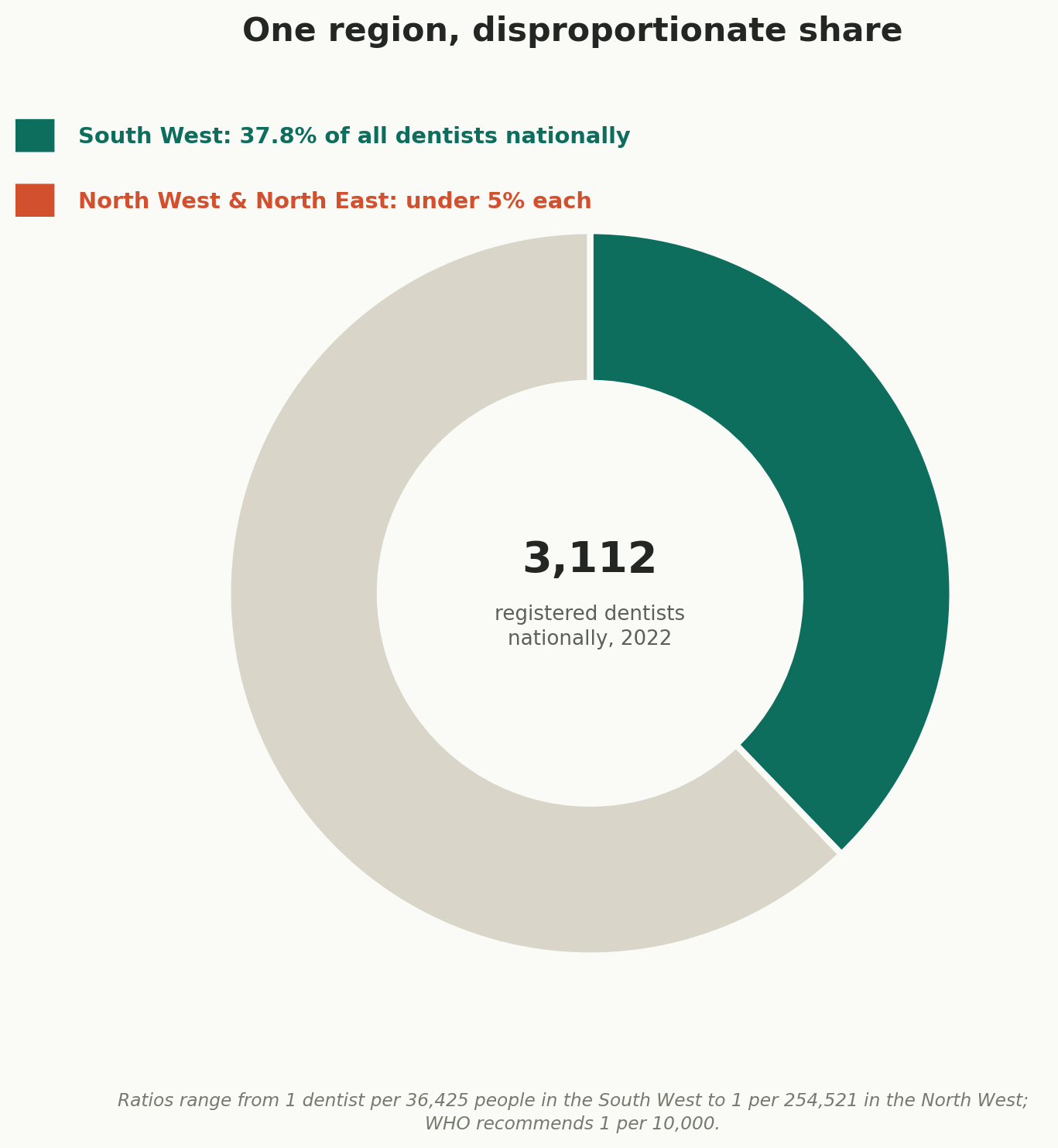
Figure 1. One region holds a disproportionate share of the country's growing dental workforce.
What that national growth figure hides is where those dentists actually practise. The South West alone accounts for 37.8 percent of all registered dentists nationally, while the North East and North West each account for under 5 percent. Translated into access, the South West has roughly one dentist per 36,425 people; the North West has roughly one per 254,521, nearly a sevenfold gap within the same country, and both figures sit far below the World Health Organization's recommended ratio of one dentist per 10,000 people. For a patient in a poorly served region, "dental care exists in Nigeria" and "dental care is genuinely accessible to me" can be two very different statements.
Rural populations, who make up more than half of Nigeria's people, face this gap most acutely, with formal dental clinics concentrated overwhelmingly in urban centres. This pattern is not unique to dentistry within Nigerian healthcare, but it carries a particular weight here because untreated dental disease, unlike some other conditions, tends to worsen slowly and invisibly for years before becoming a genuine emergency, meaning a patient's actual need can grow substantially during exactly the kind of prolonged wait that poor regional access produces.
02 · the Import Problem
Why implants cost more than a filling ever could
Routine dental care, examinations, fillings, extractions, scaling and polishing, is genuinely affordable and widely available across many Nigerian cities, priced in the tens of thousands of naira. Implants sit in an entirely different category, not primarily because of a shortage of skilled dentists, but because every implant fixture, abutment, and related component is manufactured abroad and imported into Nigeria, a cost that lands on the final bill regardless of which specific clinic performs the procedure.
This is a genuinely different kind of barrier than the workforce shortage described above, and it explains why domestic dental implant pricing in Nigeria, commonly cited in a range from roughly ₦250,000 to well over ₦1,500,000 per tooth depending on the clinic and case complexity, can sit surprisingly close to, or even above, indicative pricing for the same procedure in India, once India's own lower labour and facility costs are factored in alongside comparable imported components.
This is precisely why a family evaluating a single implant should genuinely compare a specific, written domestic quote against a specific, written international one, rather than assuming international treatment is automatically cheaper. For routine, non-implant dental work, that assumption rarely holds; for implant and full mouth work specifically, the comparison is often closer than expected, and sometimes favours travelling only once several teeth, not just one, are involved.
03 · THE OPTIONS
What actually happens, and what it costs
Dental treatment spans a genuinely wide range of complexity, from a single filling to a comprehensive rebuild of every tooth in the mouth. Understanding where a specific need sits on that spectrum shapes both the realistic cost and the realistic timeline.
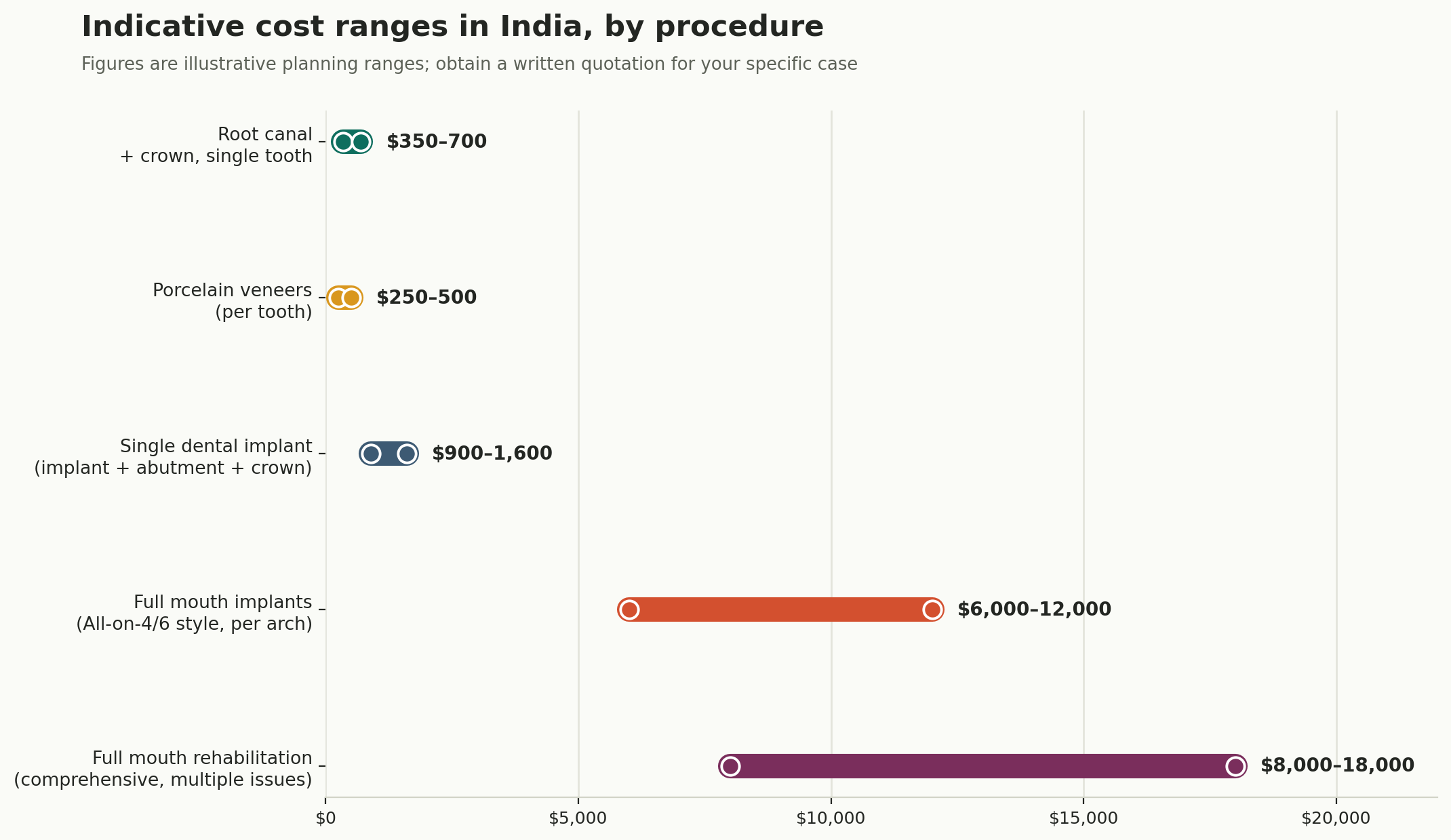
Figure 2. Indicative cost ranges by procedure. Implant-based work carries a materially different cost profile from routine restorative dentistry.
| Procedure | Typically suits | Indicative cost | Trips needed |
|---|---|---|---|
| Root canal + crown | A single damaged or infected tooth, salvageable structure | $350–700 | One |
| Porcelain veneers | Cosmetic correction of tooth shape, colour, or minor spacing | $250–500 / tooth | One or two |
| Single dental implant | One missing tooth, adequate bone density | $900–1,600 | Usually two |
| Full mouth implants | Most or all teeth missing in one arch | $6,000–12,000 | Usually two |
| Full mouth rehabilitation | Multiple, combined issues across the whole mouth | $8,000–18,000 | Often two or more |
Table 1. Indicative international-patient pricing at accredited Indian dental centres, mid-2026. Figures are planning ranges, not offers, and vary by clinic, implant brand, and case complexity.
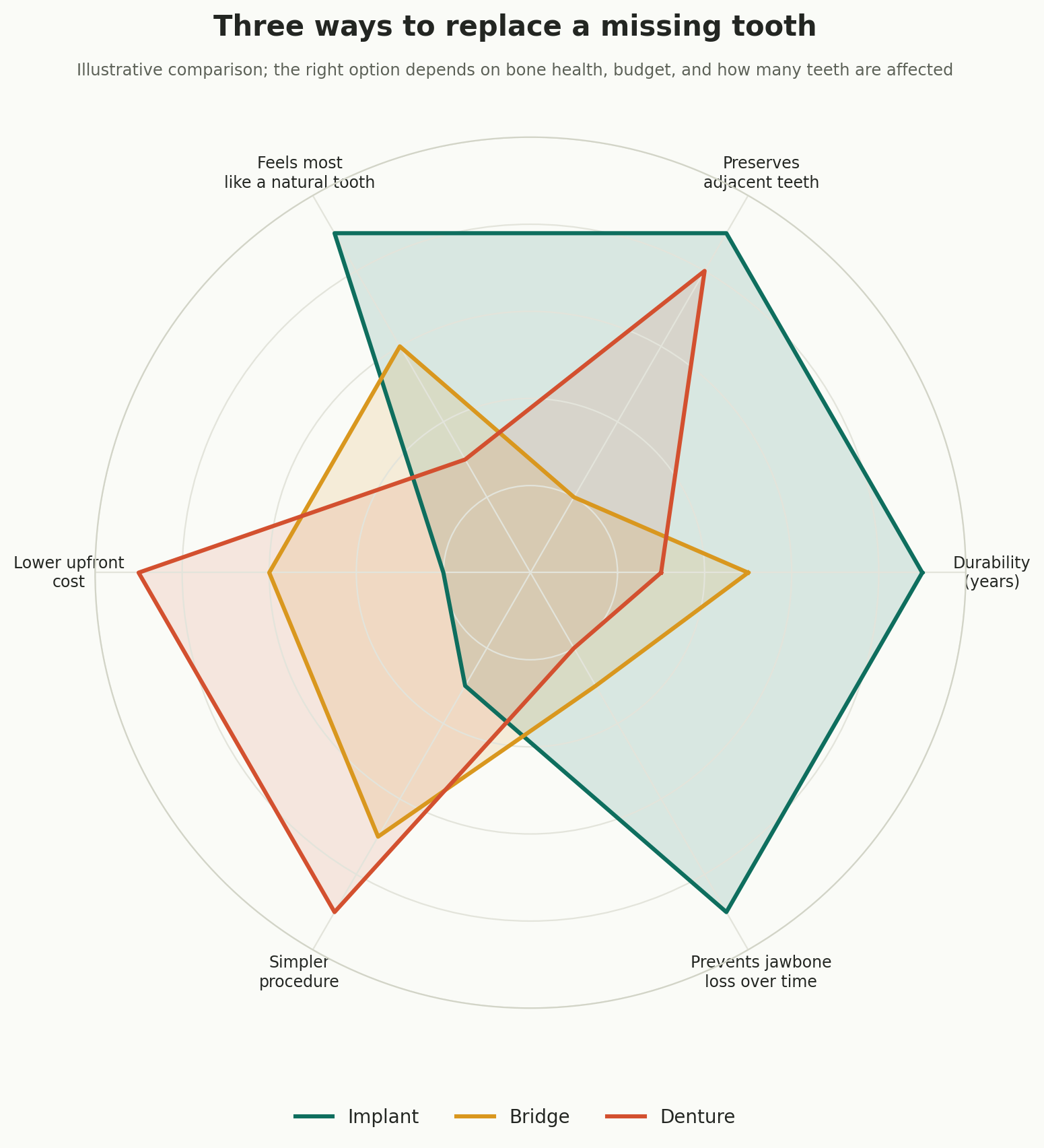
Figure 3. Three genuinely different ways to replace a missing tooth. The right choice depends on bone health, budget, and how many teeth are affected, not a single universal answer.
What a proper written quote must itemise
- Implant brand and system, since long-term component availability varies significantly by manufacturer
- Whether the quoted price includes the crown, abutment, and any necessary bone grafting
- The full number of trips required, and what each trip specifically involves
- Written policy on cost if bone grafting or additional procedures are found necessary once treatment begins
04 · the Full Budget
What the whole journey costs, beyond the procedure fee
The procedure fee is the number patients anchor on, and the least complete one, particularly for implant treatment spanning two separate trips. A representative pathway — a single dental implant, one patient travelling alone, split across two visits — adds up like this:
- Implant package (placement, abutment, crown, across both visits): $900–1,600
- Return flights, two trips (Lagos/Abuja – Delhi/Mumbai/Chennai): $2,400–3,200
- Pre-treatment scans (CT imaging, treatment planning): $150–300
- Accommodation, roughly one week per trip : $500–800
- Medical visa (two applications, one per trip): $300–400
- Contingency for bone grafting or extended healing: 15–20% All-in, most patients should plan for US$4,300–6,700 for a single implant across both required trips — roughly ₦5.9–9.2 million at the official mid-July 2026 rate of about ₦1,380 to the dollar, somewhat higher at parallel-market rates near ₦1,410. Full mouth implant work, treated in fewer combined trips relative to the number of teeth involved, often carries a meaningfully better cost-per-tooth outcome than single-implant pricing might suggest.
This is a genuinely important budgeting distinction for anyone comparing a single missing tooth against a fuller restoration: the fixed costs of travel, two round trips, accommodation across both visits, remain largely the same whether one implant or six are placed, meaning the effective cost per tooth drops substantially for patients with more extensive need. A family assuming multi-tooth treatment is proportionally more expensive than single-tooth treatment is often working from a mistaken assumption.
05 · GETTING THERE
Visa, travel, and the two-trip reality
India issues a Medical Visa (M) to the patient and a Medical Attendant Visa (MX) to accompanying family. Applications go through the High Commission in Abuja or the Consulate General in Lagos by prior appointment, and an e-Medical route turns around in days for straightforward files. The clinic's invitation letter, three months of certified bank statements, and a passport valid six months with two blank pages move the process fastest.
Lagos and Abuja both reach Delhi, Mumbai and Chennai with a single stop, usually via Addis Ababa, Doha, Dubai, Nairobi or Istanbul, a total journey of 13 to 18 hours.
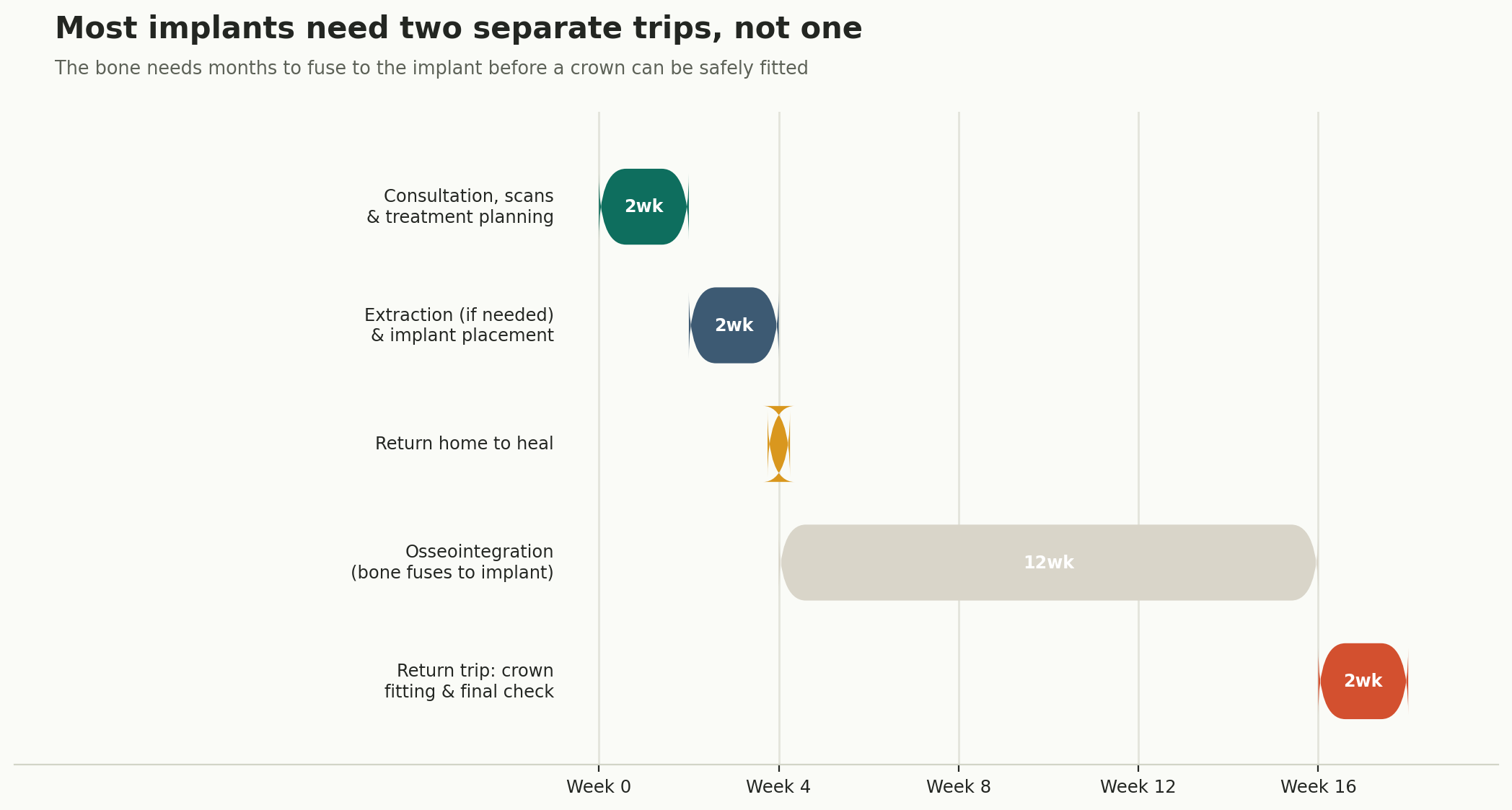
Figure 4. A typical implant pathway, start to finish. The gap between the two trips is biological, not logistical, and cannot be safely shortened.
On why the wait between trips matters. Fitting a crown before the implant has properly fused to the jawbone risks the whole procedure failing. A clinic offering to complete implant placement and final crown fitting within days of each other, for a case that has not been specifically assessed as suitable for an immediate-load protocol, deserves a direct, sceptical question before proceeding.
What has to travel home with the patient
- Full treatment record, including implant brand, size, and placement details
- Post-operative care instructions covering the healing period between trips
- A clear schedule for the return visit, agreed in writing before leaving after the first trip
- Contact details for the treating dentist for questions during the healing period
06 · the Honest Comparison
What stays in Nigeria, and what genuinely benefits from travel
Routine dental care, check-ups, fillings, simple extractions, root canal treatment, belongs with a local Nigerian dentist wherever one is genuinely accessible, and there is little reason to travel for this level of care. Establishing a relationship with a dentist for ongoing, preventive care is worth prioritising regardless of where any specific procedure ultimately happens, since regular check-ups often prevent the kind of advanced disease that eventually requires the more complex, costlier treatment this guide focuses on.
What tips the calculation toward travelling is implant and full mouth rehabilitation work specifically, where the combination of imported component costs and, in many regions, genuinely limited access to implant-trained dentists locally makes a well-planned trip to a high-volume international clinic a realistic, often cost- competitive option, particularly for patients needing several implants at once rather than a single tooth. A patient weighing this decision should request both a domestic and an international quote for the exact same treatment plan before deciding, since the honest comparison genuinely depends on the specific case, not a general rule that applies equally to everyone.
Before you commit to a treatment plan abroad
- Get a full dental examination and imaging locally first, to understand the genuine scope of what is needed.
- Ask explicitly which specific implant brand and system will be used, and confirm this in writing.
- Confirm the full number of trips required, and the expected gap between them, before booking any flights.
- Ask for the clinic's specific case volume for the exact procedure being proposed.
- Request a full written cost breakdown covering both trips, not just the first visit.
- Establish a plan for any complications during the healing period between trips.
- Identify a Nigerian dentist for ongoing check-ups once treatment is complete.
- Pay into the clinic's own institutional account only, never an individual's personal account.
Straight Answers for Nigerian Patients about Dental Surgery in India
Is dental treatment in India cheaper than the UK or US?
Yes, substantially, particularly for implants and full mouth work. A single dental implant is indicatively $900 to $1,600 in India, against roughly $3,000 to $5,000 privately in the UK and $3,000 to $6,000 self-pay in the United States.
Is dental care available in Nigeria at all?
Yes, and the number of registered dentists has grown 88.5 percent between 2020 and 2022. Access is severely uneven, however, with the South West holding a disproportionate share nationally.
Why do implants cost more than basic dental care in Nigeria?
Implant components are not manufactured in Nigeria and must be imported, which drives up cost regardless of which clinic performs the procedure.
Why do implants usually require two separate trips?
The bone needs several months, often around twelve weeks, to fuse to the implant before a crown can be safely fitted. Most patients travel once for placement and again later for the crown.
Do Nigerians need a visa for dental treatment in India?
Yes. You need an Indian Medical Visa from the High Commission in Abuja, the Consulate in Lagos, or the e- Medical route, plus a Medical Attendant Visa for accompanying family.
A closing word
Dental care in Nigeria is a genuine progress story wrapped inside a genuine access problem, more dentists than ever, concentrated in fewer places than the population actually needs, and a cost structure for advanced work shaped as much by global supply chains for implant components as by any local factor. Understanding which of these forces applies to a specific patient's specific need is what separates an informed decision from a guess.
In twenty-four years of this work, the patients who navigate this best get a full local assessment first, understand honestly whether their need is routine or specialised, and plan realistically for the two-trip rhythm that implant treatment genuinely requires rather than being caught off guard by it midway through. A tooth replaced well lasts decades. Planning that replacement properly, from the very first consultation, is what makes that outcome likely, and that planning starts with an honest, specific comparison rather than a general assumption about where dental care is or is not available.
Sources
- 🌐 Unequal access to dental care in Nigeria. Intelpoint, 2026, citing Nigerian dental workforce registry data
- 🌐 Access to Oral Health Care: A Focus on Dental Caries Treatment Provision in Enugu, Nigeria. Published clinical access study
- 🌐 American Dental Association — Dental implants, patient information
- 🌐 NHS (UK) — Dental implants: overview – nhs.uk
- 🌐 High Commission of India, Abuja — Medical and Medical Attendant Visa requirements
Frequently Asked Questions by Nigerians about Dental Surgery in India
Should Nigerian patients travel to India for routine dental treatment?
Not necessarily. The guide states that check-ups, fillings, simple extractions and root canal treatment are generally better handled locally where qualified care is accessible.
Why may Nigerian patients consider India for dental implants?
Implant components are imported into Nigeria, which can increase costs. India may offer a competitive alternative, particularly for multiple implants or full-mouth rehabilitation.
How much does a single dental implant cost in India for Nigerian patients?
The guide gives an indicative treatment cost of US$900–US$1,600 for a single implant, including implant, abutment and crown in the planning range.
How much does full-mouth implant treatment cost in India?
The guide gives an indicative range of US$6,000–US$12,000 for full-mouth implants, while full-mouth rehabilitation involving multiple combined issues is approximately US$8,000–US$18,000.
Why do dental implants usually require two trips to India?
The implant needs time to fuse with the jawbone before the permanent crown is fitted. The guide's page 7 pathway allows approximately 12 weeks for osseointegration between the two visits.
What is the total cost of a single implant journey from Nigeria to India?
The guide estimates approximately US$4,300–US$6,700 all-in across both trips, including treatment, flights, scans, accommodation, visas and contingency.
What should Nigerian patients check about the implant before treatment?
They should confirm the implant brand and system, whether the crown and abutment are included, whether bone grafting may be needed and what happens financially if additional treatment becomes necessary.
Can an implant and final crown always be completed during one short trip?
No. The guide warns that offering placement and final crown fitting within days should be questioned unless the case has specifically been assessed as suitable for an immediate-load protocol.
What should Nigerian patients do before travelling to India?
They should obtain a full dental examination and imaging locally, understand the exact treatment required and compare a domestic quote with an Indian quote for the same treatment plan.
What should patients take home after the first implant trip?
They should receive the complete treatment record, implant brand and size, placement details, post-operative instructions, written schedule for the return visit and the treating dentist's contact details during the healing period.
Page Summary
This guide explains the key considerations for Nigerian patients exploring dental surgery in India, focusing on the uneven distribution of dentists in Nigeria, the imported-component costs associated with dental implants and the difference between routine dental care and specialised implant or full-mouth treatment. It covers root canal treatment, veneers, single implants, full-mouth implants and full-mouth rehabilitation, with indicative Indian costs ranging from US$250–US$18,000 depending on the procedure. The guide places particular emphasis on the two-trip nature of conventional implant treatment, the approximately 12-week healing period shown in the page 7 timeline, complete cost planning, implant-brand verification, bone-grafting contingencies, medical-visa requirements and establishing ongoing dental follow-up in Nigeria.
Citation Block
| Topic | Information |
|---|---|
| Topic Information | Dental Surgery in India for Patients from Nigeria |
| Treatment | Dental Surgery |
| Intended Audience | Patients from Nigeria |
| Key Specialist | Implant Dentist / Prosthodontist |
| Main Treatments | Dental Implants and Full Mouth Rehabilitation |
| Other Treatments | Root Canal, Crowns and Porcelain Veneers |
| Primary Assessment | Dental Examination and Imaging |
| Single Implant Cost | US$900–US$1,600 |
| Full Mouth Implants | US$6,000–US$12,000 |
| Full Mouth Rehabilitation | US$8,000–US$18,000 |
| Single Implant Journey | US$4,300–US$6,700 All-In Across Two Trips |
| Important Specialist Check | Confirm Experience With the Specific Implant Procedure |
| Implant Check | Confirm Brand, System, Crown and Abutment |
| Trip Requirement | Conventional Implant Treatment Usually Requires Two Trips |
| Healing Requirement | Allow Adequate Osseointegration Before Final Crown Fitting |
| Important Warning | Clinic Offers Implant Placement and Final Crown Within Days Without Appropriate Immediate-Load Assessment |
| Cost Check | Request a Written Quote Covering Both Trips |
| Pre-Travel Records | Full Dental Examination and Imaging |
| Travel Routes | Lagos/Abuja to Delhi, Mumbai or Chennai via Connecting Hubs |
| Visa Requirement | Indian Medical Visa and Medical Attendant Visa |
| Patient Journey | Examination/imaging → treatment plan → first trip/implant placement → healing → second trip/crown fitting → follow-up |
| Follow-Up | Ongoing Dental Care in Nigeria and Treating Dentist Contact |


Our Mission Statement
Our mission is to place patients at the centre of every healthcare decision by providing trustworthy, evidence-based, and unbiased medical information. We believe that informed patients make better decisions. Backed by personalised guidance from our experienced advisory team, we help patients understand their treatment options, compare them objectively, and confidently choose the path that best suits their medical needs and personal circumstances.
Patient Testimonials from Nigeria















Ready to Take the First Step?
Share your Medical Reports with our Healthcare Managers Today and Get a FREE CONSULTATION, a Personalized Treatment Plan, and Complete Support from Arrival to Recovery.
Get Your Free ConsultationAreas We Serve
This resource has been thoughtfully prepared for patients from Nigeria who are considering medical treatment in India. We also welcome patients from the wider region in the countries mentioned below-
We assist patients from:
- Benin
- Niger
- Chad
- Cameroon
- Algeria
- Egypt
- Libya
- Morocco
- Sudan
- Tunisia
- Gambia
- Ghana
- Burkina Faso
- Cabo Verde
- Côte d'Ivoire
- Equatorial Guinea
- São Tomé and Príncipe
Many of the insights, treatment pathways, hospital recommendations, travel guidance, and patient support services described here are equally relevant and may be used as a reference when planning treatment in India.
From Nigeria to India: Your Complete Patient Support Guide
- Artificial Disc Replacement in India for Nigerian Patients
- Weight Loss and Bariatric Surgery in India for Nigerian Patients
- Bone Marrow Transplant in India for Nigerian Patients
- Brain Tumour Surgery in India for Nigerian Patients
- Breast Cancer Treatment and Surgery in India for Nigerian Patients
- Cancer Treatment and Surgery in India for Nigerian Patients
- Cardiac Arrhythmia and Heart Pacemaker Treatment in India for Nigerian Patients
- Cardiac Surgery in India for Nigerian Patients
- Colorectal Cancer Treatment and Surgery in India for Nigerian Patients
- Complex Orthopaedic and Joint Revision Surgery in India for Nigerian Patients
- Cornea Transplant and Advanced Eye Surgery in India for Nigerian Patients
- CyberKnife Treatment in India for Nigerian Patients
- Gamma Knife Treatment in India for Nigerian Patients
- Heart Failure Treatment and Surgery in India for Nigerian Patients
- Hip Surgery in India for Nigerian Patients
- HIPEC Cancer Surgery in India for Nigerian Patients
- IVF and Fertility Treatment in India for Nigerian Patients
- Joint Arthroscopy and Sports Medicine in India for Nigerian Patients