

Selecting the Best Scoliosis and Spine Deformity Surgeons and Hospitals in India for Nigerian Patients
Not every curve needs the same surgeon. Knowing which one yours needs is where this decision actually begins.
A mild, stable curve in a teenager and a severe congenital deformity in a five-year-old are, medically speaking, almost different specialties wearing the same name. Both fall under "scoliosis." Both may eventually need surgery. But the surgeon qualified to treat one competently is not automatically qualified to treat the other well, and conflating the two is where many families' evaluation process quietly goes wrong before a single flight is booked. In twenty-four years of guiding Nigerian patients through treatment decisions abroad, this is the pattern that repeats most often with spine deformity specifically: families research the country thoroughly, and the specific surgeon barely at all, when for this procedure the second question matters considerably more than the first. A country's reputation for good healthcare is a reasonable starting filter, but it says almost nothing about whether one particular surgeon, on one particular day, is the right person to correct one particular child's or adult's curve.
Should you even be reading this guide? If scoliosis or spinal deformity has been confirmed by a specialist, and surgical correction, rather than observation or bracing alone, has genuinely been recommended, this guide will help you match the case to the right level of surgical expertise. If you have not yet had a formal diagnosis and curve measurement, start there first with a spine specialist before assessing surgical options abroad.
Healing Journeys of Nigerian Patients
Key Takeaways
- Nigerian patients and families considering scoliosis or spine deformity surgery in India should first establish what level of deformity the patient actually has, because not every curve requires the same type of surgeon. A mild adolescent idiopathic curve and a severe congenital deformity in a young child may both be called scoliosis, but they require very different levels of specialist experience.
- The guide strongly warns against assuming that any surgeon who regularly performs spine surgery is automatically qualified to perform complex deformity correction. Degenerative spine surgery and spinal deformity correction are described as genuinely different skill sets.
- The first major decision is therefore to match the case to the correct surgeon tier before comparing hospitals, prices or general reputation.
- The guide distinguishes several surgeon levels:
- General orthopaedic surgeon — broad orthopaedic practice with occasional spine exposure; not appropriate for deformity correction.
- General spine surgeon — regularly performs spine surgery and may be appropriate for degenerative disc disease or straightforward fusion.
- Deformity-focused spine surgeon — has dedicated training and meaningful annual deformity volume and is more appropriate for moderate or severe scoliosis.
- Paediatric deformity subspecialist — has specific training and experience in growing-child deformity and is particularly relevant for early-onset scoliosis and growth-friendly programmes.
- The guide also distinguishes idiopathic, congenital and neuromuscular scoliosis. Identifying which category the patient falls into helps determine the level of expertise required.
Quick Facts
- Treatment
- Scoliosis and Spine Deformity Surgery
- Country
- India
- Intended Audience
- Nigerian Patients and Families
- Primary Conditions
- Scoliosis and Structural Spine Deformity
- Scoliosis Types Mentioned
- Idiopathic, Congenital and Neuromuscular Scoliosis
- First Decision
- Determine the Complexity/Tier of the Deformity Before Choosing the Surgeon
- Primary Selection Principle
- Match the Case to the Correct Level of Deformity Expertise
- General Orthopaedic Surgeon
- Not Recommended for Deformity Correction
- General Spine Surgeon
- More Appropriate for Degenerative Disc Disease and Straightforward Fusion
- Deformity-Focused Spine Surgeon
- Appropriate for Moderate to Severe Scoliosis and Complex Deformity Cases
- Paediatric Deformity Subspecialist
- Particularly Important for Early-Onset and Growing-Child Deformity
- Main Surgeon Metric
- Annual Case Volume in Scoliosis and Deformity Correction Specifically
- General Spine Volume
- Does Not Automatically Demonstrate Deformity Expertise
In Brief
Nigerian families choosing a scoliosis or spine deformity surgeon in India should first identify the type and complexity of the deformity and match it to the appropriate surgeon tier. A general spine surgeon is not automatically a deformity specialist, and severe congenital, neuromuscular or growing-child scoliosis may require dedicated deformity or paediatric deformity expertise. The guide places greater weight on the individual surgeon than the hospital and recommends verifying deformity-specific annual case volume, comparable pre- and postoperative imaging, complication and revision rates, and realistic correction goals. Hospital requirements include routine intraoperative neuromonitoring, appropriate postoperative intensive or high-dependency care, blood-bank support and a genuine paediatric deformity programme when treating a growing child.
START HERE
Match the case to the tier, before anything else
The single most useful question a family can ask before evaluating any specific surgeon is not "how good are they," but "what level of case is this, and does this surgeon's actual experience sit at that level." Scoliosis and spine deformity span a genuine range of surgical difficulty, and the qualification a case requires rises with that difficulty, not with a surgeon's general seniority or the size of their hospital.
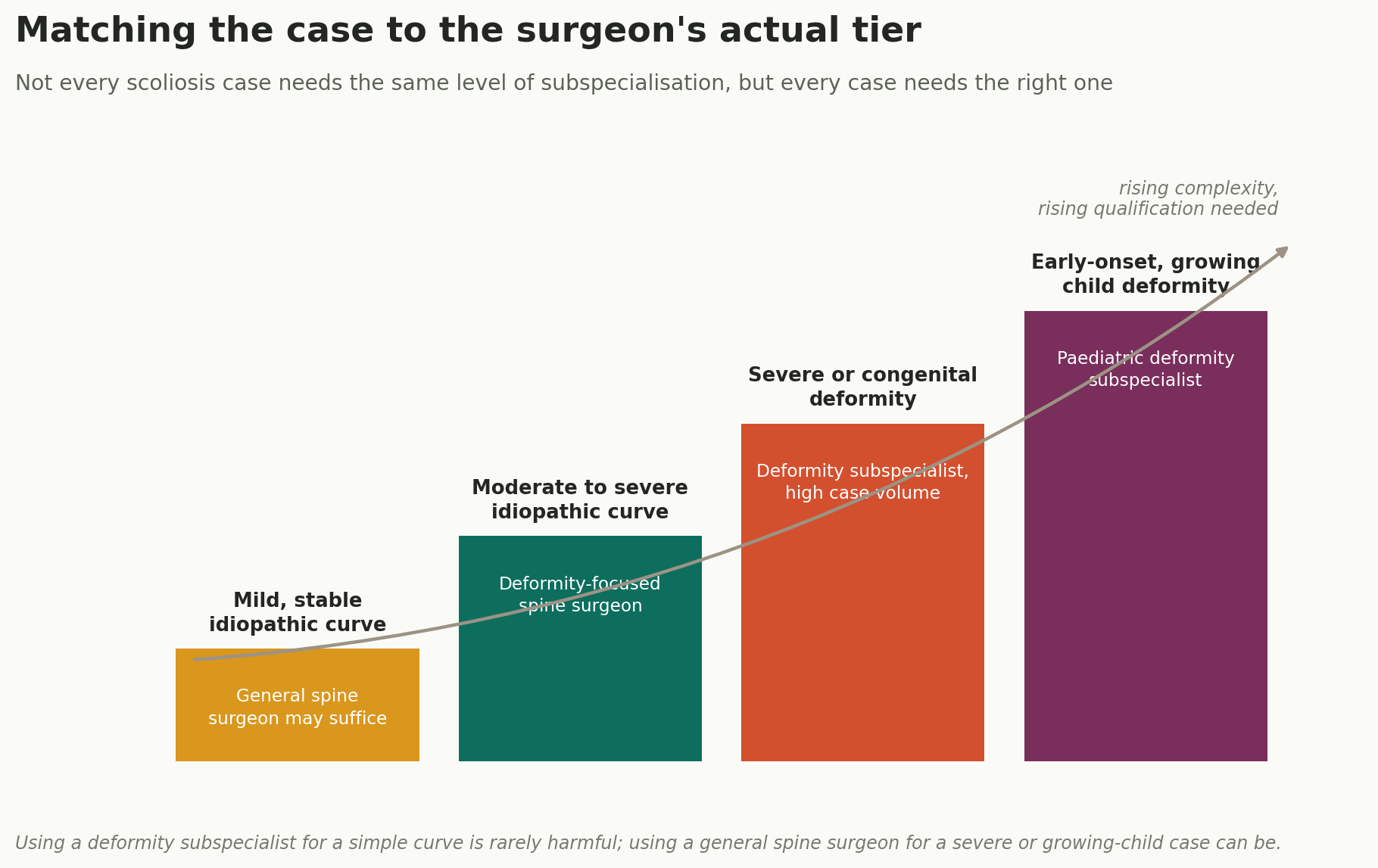
A deformity subspecialist treating a simple curve is rarely a problem; a general spine surgeon treating a severe or growing-child case genuinely can be.
Where families most often go wrong is assuming any surgeon who regularly operates on spines is automatically equipped for deformity correction specifically. Routine degenerative spine surgery, treating disc disease or straightforward single-level fusion, and deformity correction, realigning a structurally curved spine while protecting the spinal cord throughout, draw on genuinely different skill sets, even though both fall under a surgeon's general "spine surgery" title. A surgeon can be genuinely excellent at one and have only limited, occasional exposure to the other, and a general reputation for skilled spine surgery does not, by itself, tell you which is true.
THE FRAMEWORK
Once the tier is right, what actually drives the result
Having identified roughly which tier of surgeon a case needs, the next question is what, within that tier, actually predicts a good outcome. Two things: the specific surgeon operating, and the hospital supporting that surgeon. These do not carry equal weight.
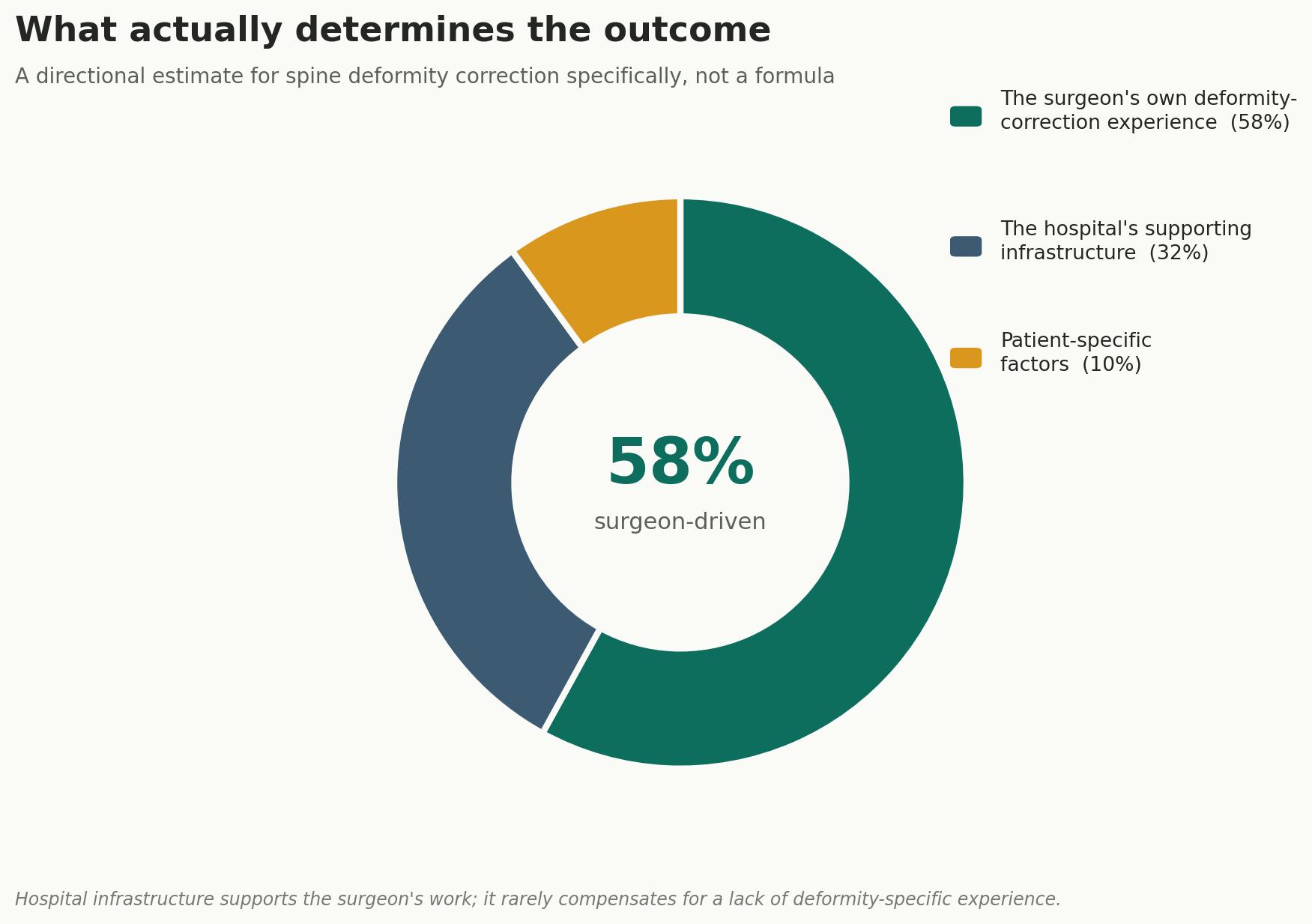
Hospital infrastructure supports the surgeon's work; it rarely compensates for a lack of deformity-specific experience.
This is a directional estimate, not an exact formula, but it reflects a consistent pattern in how deformity correction actually goes wrong when it goes wrong: the failure is far more often a judgement or technical execution issue specific to the operating surgeon than a facilities gap at an otherwise adequate hospital. This is precisely why a family's evaluation time should weight the surgeon question more heavily than the hospital question, even while confirming both. A hospital with excellent general infrastructure but a surgeon operating outside their real depth of experience is a genuinely riskier combination than a slightly less prominent hospital paired with the right surgeon for the case.
A note on terminology, since it shapes how you should read a surgeon's history. "Idiopathic" scoliosis has no single identified cause and is the most common type, particularly in adolescents. "Congenital" deformity stems from a spinal malformation present from birth and is often structurally more complex. "Neuromuscular" scoliosis accompanies an underlying neurological or muscular condition. Ask which category your case falls into, since it directly determines which tier in the staircase above applies.
THE VETTING CONVERSATION
What to actually ask, and who should answer it
Questions for the surgeon
- What is your annual case volume in scoliosis and deformity correction specifically? General spine surgery volume, even a high one, does not translate directly into deformity correction experience.
- Can I see real pre- and post-operative correction imaging from comparable prior cases? Marketing photographs of smiling patients answer a different question entirely.
- What are your complication and revision rates, and how do they compare to published benchmarks? Every surgeon operating at real volume has some; how openly this is discussed tells you a great deal.
- Given my specific imaging, what correction is realistically achievable? A serious answer references your actual curve, not a flat percentage offered before it has been reviewed.
Questions for the hospital
- Is intraoperative neuromonitoring standard for deformity cases, or a costly add-on? For this specific procedure, it should never need to be requested separately.
- What post-operative care is available: a dedicated spine ICU, or general high-dependency capacity? Major deformity correction is physiologically demanding recovery, not routine post-surgical care.
- Is there an in-house, appropriately matched blood bank? Deformity correction can involve significant blood loss, and this should not depend on external sourcing under time pressure.
- If the patient is a growing child, is there a genuine paediatric deformity programme? Growth-friendly treatment is a longitudinal relationship, not a single operation, and needs a programme built for that.
PRIORITISING
If you cannot verify everything, verify these first
A thorough evaluation covers every question above, but few families have unlimited time, and some questions matter more than others when time is genuinely short.
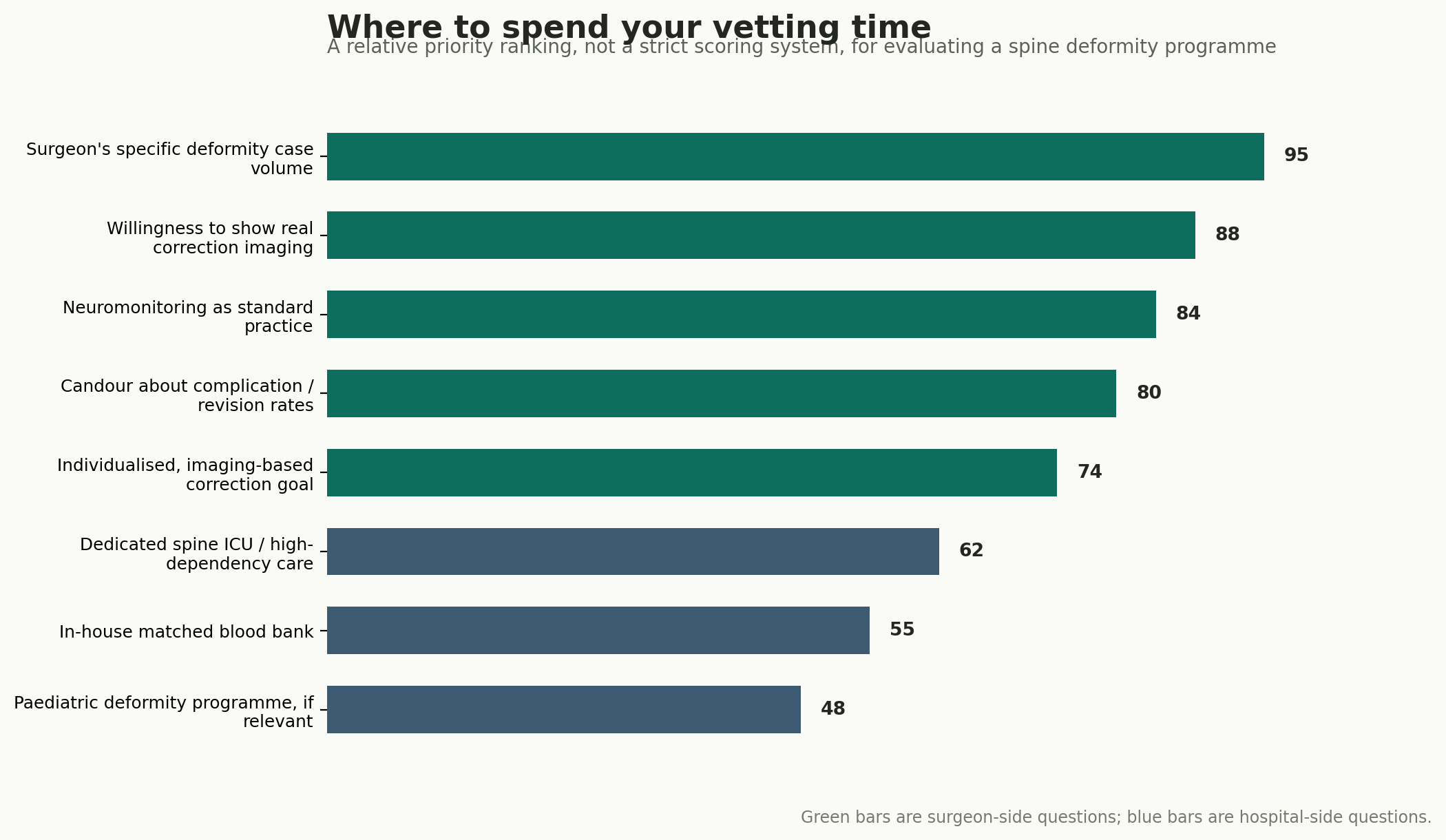
Green bars are surgeon-side questions; blue bars are hospital-side questions. If only four questions are possible before a decision, take the top four.
Notice that the top of this list is entirely surgeon-side. This is consistent with the weighting shown earlier, and it is a useful, practical rule when a consultation call is short and a family needs to prioritise which questions actually get asked. If a programme cannot answer the top four items clearly and specifically, that alone is informative, regardless of how impressive the remaining items on the list might sound.
Reading credentials, and why this matters more without a local benchmark
| Tier | What it typically means | Right for |
|---|---|---|
| General orthopaedic surgeon | Broad orthopaedic training, occasional spine cases | Not deformity correction |
| Spine surgeon, general practice | Regular spine surgery, mixed case types | Degenerative disc, straightforward fusion |
| Spine surgeon, deformity-focused | Dedicated fellowship, meaningful annual deformity volume | Moderate to severe scoliosis, adult and adolescent |
| Paediatric deformity subspecialist | Specific training and volume in growing-child deformity | Early-onset scoliosis, growing rod programmes |
Table 1. A general framework for understanding surgeon qualification tiers relevant to deformity correction; ask directly which tier a proposed surgeon occupies.
Scoliosis and spine deformity surgery is a highly specialised field even in well-resourced health systems, and Nigeria's own domestic capacity for deformity-specific correction remains limited relative to more routine orthopaedic and spine procedures. This means most Nigerian families approaching this decision are, understandably, doing so without an existing local reference point for what a genuinely qualified deformity surgeon looks like, which is precisely why a structured, independent evaluation process matters more here than it might for a more routine procedure with an established local standard to compare against.
Word-of-mouth recommendations from other families are genuinely valuable and worth seeking out, but they usually describe how a family was treated personally, not the specific technical details of the surgery itself, the curve correction actually achieved, complications encountered, or long-term outcomes at follow-up. Combining a trusted personal recommendation with the independent, structured questions in this guide gives a far more complete picture than either approach used alone. A recommendation is a reasonable place to start a search; it should not be the only verification a family performs before committing to major surgery.
Four warning signs worth taking seriously
- A specific correction percentage promised before your imaging has been reviewed. No responsible surgeon can commit to an outcome without first seeing your actual curve.
- Reluctance to discuss complication or revision rates. Every genuinely high-volume deformity surgeon has some; evasiveness here is more concerning than an honest number.
- No mention of neuromonitoring as a standard part of the surgical plan. For deformity correction, this should never need to be specifically requested.
- Pressure to commit quickly, without time for a second opinion. A confident, well-qualified programme does not need to rush this decision.
A practical order of operations
- Send full-length standing spine X-rays for review before any consultation call.
- Confirm which complexity tier the case actually falls into, using the staircase above as a starting reference.
- Ask the surgeon-side questions first; they carry more weight in this specific decision.
- Confirm neuromonitoring and post-operative capacity directly with the hospital.
- Get a written surgical plan, not a verbal estimate, before booking travel.
- After surgery and supervised early recovery, hand the brace and follow-up plan to a Nigerian clinician for ongoing care.
Straight Answers for Nigerian Patients about Scoliosis and Spine Deformity Surgery in India
Does every scoliosis case need a deformity subspecialist?
Not necessarily. A mild, stable idiopathic curve may be appropriately managed by a general spine surgeon, but moderate to severe curves, congenital deformity, and growing-child cases genuinely benefit from a surgeon with specific deformity-correction subspecialty training.
Why does the surgeon matter more than the hospital?
Deformity correction is a technically demanding, highly surgeon-dependent procedure where the margin between a good outcome and a neurological complication is set largely by the individual surgeon's specific experience, not the hospital's general reputation.
What is intraoperative neuromonitoring, and why does it matter?
It continuously tracks spinal cord and nerve function during surgery, alerting the team immediately if curve correction begins to put neurological function at risk. This should be standard, not an optional extra.
Should a growing child be treated differently from an adult?
Yes. A child who has not finished growing may need growth-friendly techniques, such as growing rods, requiring planned repeat procedures over several years, needing a surgeon and programme specifically experienced in paediatric deformity.
What is a realistic red flag when choosing a surgeon?
A promised correction percentage before your imaging is reviewed, avoidance of complication or revision rate questions, or no examples of comparable prior cases are all genuine warning signs.
A closing word
Scoliosis is not one surgical problem; it is a family of related problems ranging from straightforward to genuinely difficult, and the qualification a case needs should be matched to where it actually sits, not assumed from a surgeon's general seniority or a hospital's overall reputation. Getting that match right is the real work of this decision, well before a flight is ever booked. In twenty-four years of this work, the families who get the best results are the ones who identify their case's true complexity tier first, then spend the bulk of their evaluation time on surgeon-specific questions, confirming hospital infrastructure as a genuine but secondary check. The surgery itself may take a matter of hours. Matching the case to the right hands deserves considerably longer than that.
Sources
- 🌐 Scoliosis Research Society — Surgeon and centre resources
- 🌐 American Academy of Orthopaedic Surgeons — Scoliosis in children and adults, patient information
- 🌐 NHS (UK) — Scoliosis: overview and treatment – nhs.uk
- 🌐 High Commission of India, Abuja — Medical and Medical Attendant Visa requirements
Frequently Asked Questions by Nigerians about Scoliosis and Spine Deformity Surgery in India
How should Nigerian families choose a scoliosis surgeon in India?
First identify what type and complexity of deformity the patient has, then choose a surgeon whose actual practice matches that tier. General spine surgery experience alone does not establish expertise in deformity correction.
Is every spine surgeon qualified to perform scoliosis surgery?
No. The guide specifically distinguishes routine degenerative spine surgery from deformity correction. A surgeon may be highly experienced in disc surgery or simple fusion without having sufficient deformity-specific experience.
What is the most important surgeon question for scoliosis surgery?
Ask how many scoliosis and spine deformity corrections the surgeon personally performs each year. The question should be deformity-specific rather than based on total spine-surgery volume.
Should families ask to see previous scoliosis surgery results?
Yes. The guide recommends asking for genuine pre- and postoperative imaging from cases comparable with the patient's own deformity rather than relying only on patient photographs or testimonials.
Why should complication and revision rates be discussed?
Every surgeon performing substantial deformity volume will encounter complications. The guide treats a clear and transparent discussion of personal complication and revision rates as more reassuring than unrealistic claims of perfect outcomes.
Is the surgeon or hospital more important for scoliosis surgery?
The surgeon carries greater weight in this guide because judgement, correction planning and technical execution directly determine much of the outcome. Hospital infrastructure supports this work but cannot compensate for inadequate deformity-specific skill.
Is intraoperative neuromonitoring necessary during scoliosis surgery?
The guide says neuromonitoring should be standard for deformity correction rather than an optional add-on. It is used to monitor spinal-cord and nerve function during major correction.
What hospital facilities should Nigerian families check?
Important facilities include intraoperative neuromonitoring, appropriate spine ICU or high-dependency care and an in-house blood bank. For children, families should also confirm a genuine paediatric deformity programme.
Why does paediatric scoliosis require a special programme?
Growing children may need growth-friendly treatment and long-term staged care rather than one definitive operation. The guide therefore recommends genuine paediatric deformity expertise for early-onset and growing-child cases.
Does this guide provide a scoliosis surgery cost or standard stay in India?
No. This surgeon-and-hospital-selection guide does not provide a specific India surgery-cost range or standard treatment-stay duration, so those figures should not be added to the document summary.
Page Summary
This guide explains that the key to choosing scoliosis and spine deformity treatment in India is matching the patient's curve to the correct level of surgeon expertise. Scoliosis is not one uniform operation: adolescent idiopathic curves, congenital deformity, neuromuscular scoliosis and early-onset growing-child deformity can require very different levels of training and experience.
Citation Block
| Topic | Information |
|---|---|
| Topic Information | Selecting Scoliosis and Spine Deformity Surgeons and Hospitals in India for Nigerian Patients |
| Procedure | Scoliosis and Spine Deformity Surgery |
| Country | India |
| Intended Audience | Nigerian Patients and Families |
| Conditions Covered | Idiopathic, Congenital and Neuromuscular Scoliosis and Other Structural Spine Deformities |
| First Requirement | Formal Diagnosis, Curve Assessment and Complexity Classification |
| Primary Selection Principle | Match the Case to the Correct Surgeon Expertise Tier |
| Surgeon Tiers | General Orthopaedic, General Spine, Deformity-Focused Spine and Paediatric Deformity Subspecialist |
| Primary Surgeon Metric | Annual Scoliosis/Deformity Case Volume |
| Outcome Evidence | Comparable Pre- and Post-Operative Imaging, Complication and Revision Rates |
| Postoperative Requirement | Spine ICU or Appropriate High-Dependency Care |
| Additional Hospital Requirement | In-House Blood Bank |
| Paediatric Requirement | Genuine Paediatric Deformity Programme |
| India Treatment Cost | Specific Cost Range Not Provided in This Guide |
| Typical Stay | Specific Duration Not Provided in This Guide |
| Follow-Up | Long-Term Spine/Deformity Monitoring Where Required |
| Author | Dr. Dheeraj Bojwani |
| Experience | 24 Years |

Our Mission Statement
Our mission is to place patients at the centre of every healthcare decision by providing trustworthy, evidence-based, and unbiased medical information. We believe that informed patients make better decisions. Backed by personalised guidance from our experienced advisory team, we help patients understand their treatment options, compare them objectively, and confidently choose the path that best suits their medical needs and personal circumstances.
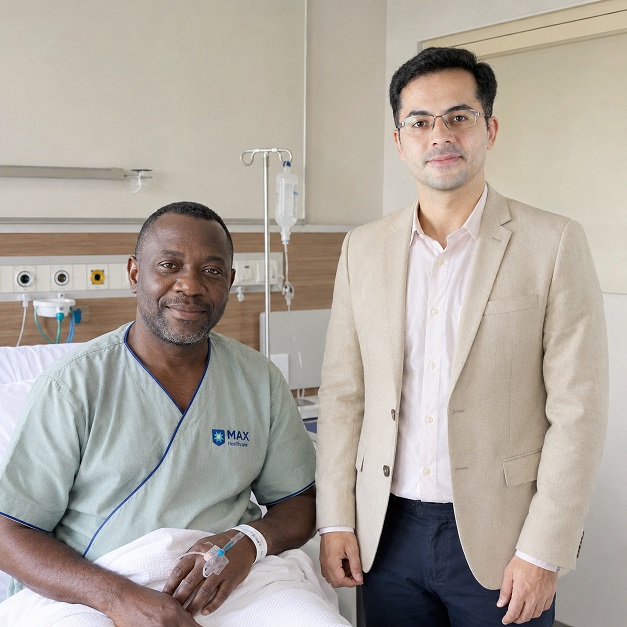
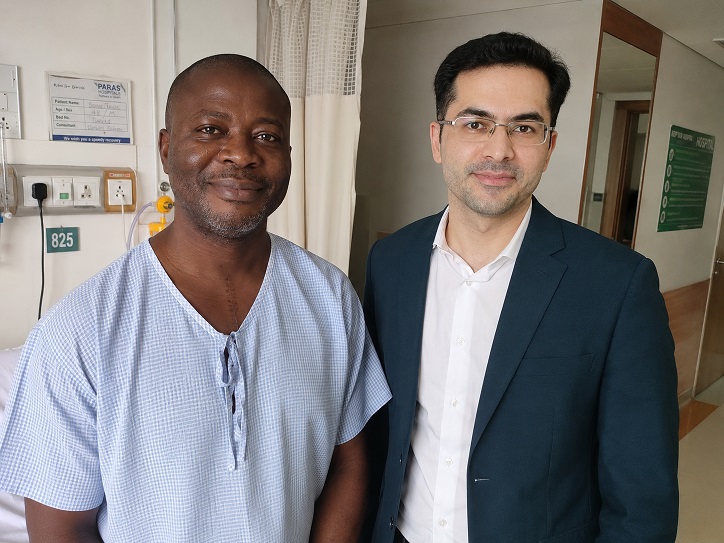
Patient Testimonials from Nigeria
Ready to Take the First Step?
Share your Medical Reports with our Healthcare Managers Today and Get a FREE CONSULTATION, a Personalized Treatment Plan, and Complete Support from Arrival to Recovery.
Get Your Free ConsultationAreas We Serve
This resource has been thoughtfully prepared for patients from Nigeria who are considering medical treatment in India. We also welcome patients from the wider region in the countries mentioned below-
We assist patients from:
- Benin
- Niger
- Chad
- Cameroon
- Algeria
- Egypt
- Libya
- Morocco
- Sudan
- Tunisia
- Gambia
- Ghana
- Burkina Faso
- Cabo Verde
- Côte d'Ivoire
- Equatorial Guinea
- São Tomé and Príncipe
Many of the insights, treatment pathways, hospital recommendations, travel guidance, and patient support services described here are equally relevant and may be used as a reference when planning treatment in India.
From Nigeria to India: Your Complete Patient Support Guide
- Artificial Disc Replacement in India for Nigerian Patients
- Weight Loss and Bariatric Surgery in India for Nigerian Patients
- Bone Marrow Transplant in India for Nigerian Patients
- Brain Tumour Surgery in India for Nigerian Patients
- Breast Cancer Treatment and Surgery in India for Nigerian Patients
- Cancer Treatment and Surgery in India for Nigerian Patients
- Cardiac Arrhythmia and Heart Pacemaker Treatment in India for Nigerian Patients
- Cardiac Surgery in India for Nigerian Patients
- Colorectal Cancer Treatment and Surgery in India for Nigerian Patients
- Complex Orthopaedic and Joint Revision Surgery in India for Nigerian Patients
- Cornea Transplant and Advanced Eye Surgery in India for Nigerian Patients
- CyberKnife Treatment in India for Nigerian Patients
- Gamma Knife Treatment in India for Nigerian Patients
- Heart Failure Treatment and Surgery in India for Nigerian Patients
- Hip Surgery in India for Nigerian Patients
- HIPEC Cancer Surgery in India for Nigerian Patients
- IVF and Fertility Treatment in India for Nigerian Patients
- Joint Arthroscopy and Sports Medicine in India for Nigerian Patients