

Selecting the Best Pancreatic Cancer Surgeons and Hospitals in India for Nigerian Patients
One number predicts this outcome better than almost anything else a hospital can put in a brochure: how many of these it actually does.
At high-volume centres, pancreaticoduodenectomy, the Whipple procedure, carries a perioperative mortality rate consistently below 5 percent. A 2025 published series from a lower-volume centre reported 7.3 percent. Both figures describe the same operation. The difference between them is not the surgery; it is how often the team performing it actually does it, together, as a system. This is one of the most rigorously documented relationships in all of surgery, and it is the single most important fact to understand before evaluating any specific surgeon or hospital for pancreatic cancer treatment. Most of this series has focused on matching a specific type of case to a specific level of expertise. Pancreatic cancer surgery adds a further, sharper dimension to that same logic: even within a single country, even within a single city, the gap between a genuinely high-volume programme and an occasional one can be the difference described above, and no amount of general hospital prestige closes that gap on its own.
Should you even be reading this guide? If pancreatic cancer has been diagnosed and a specialist has indicated surgery may be an option, this guide will help you evaluate who should perform it and where. If resectability has not yet been formally assessed, that assessment itself, ideally by an experienced multidisciplinary team, is the appropriate next step before this guide's questions become relevant.
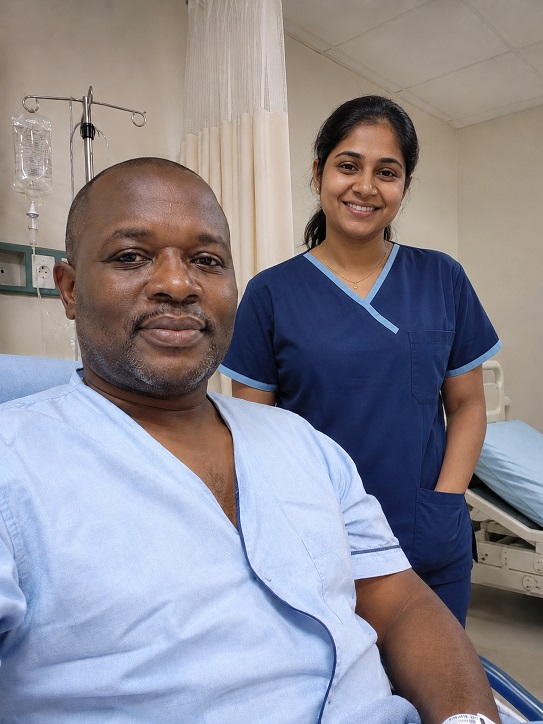
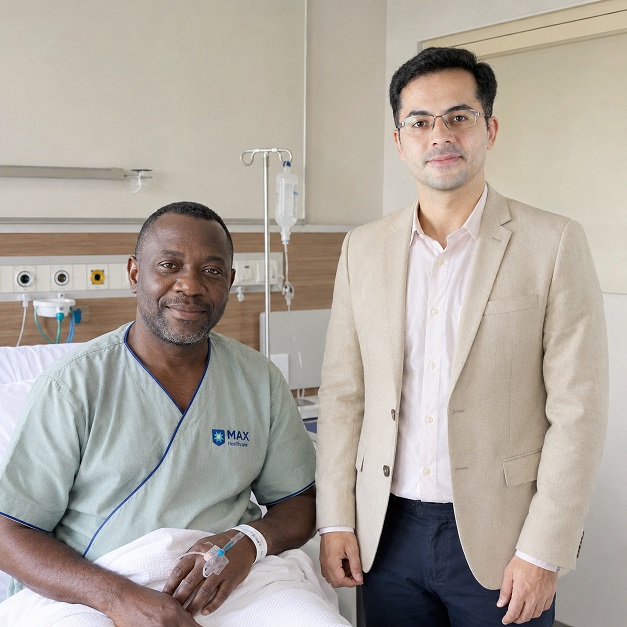
Healing Journeys of Nigerian Patients





Key Takeaways
- Nigerian patients considering pancreatic cancer surgery in India should make annual case volume the first major filter when evaluating a surgeon and hospital. The guide states that pancreaticoduodenectomy, commonly called the Whipple procedure, has one of the clearest volume-outcome relationships in surgery.
- The document contrasts a perioperative mortality rate below 5% at high-volume centres with a published 7.3% rate from a lower-volume centre. The central message is that the difference is not simply the country or hospital brand, but how often the entire pancreatic-surgery team performs and manages this operation together.
- Pancreaticoduodenectomy is described as one of the most technically demanding major operations, involving removal and reconstruction of several connected digestive structures. Even in excellent centres, postoperative complications can occur frequently.
- The guide gives an overall complication range of approximately 30–60% for relatively minor and major issues combined, making complication recognition and management a central part of programme quality.
- Patients should therefore not search for a centre claiming to have no complications. Instead, they should ask how frequently complications such as pancreatic fistula, bleeding, infection or delayed recovery occur and how quickly the team recognises and manages them.
- The document introduces the idea of a “textbook outcome” rather than judging success only by survival. This broader measure considers whether the patient avoids major complications, reoperation, excessive hospital stay and delayed return to cancer treatment.
- The page 2 diagram illustrates that a good pancreatic-surgery outcome includes more than surviving the operation; it encompasses the whole recovery pathway.
Quick Facts
- Treatment
- Pancreatic Cancer Treatment and Surgery
- Country
- India
- Intended Audience
- Nigerian Patients and Families
- Primary Condition
- Pancreatic Cancer
- Major Procedure
- Pancreaticoduodenectomy / Whipple Procedure
- First Selection Question
- How Many Pancreaticoduodenectomies Does This Team Perform Annually?
- Core Quality Principle
- Case Volume Strongly Influences Outcomes
- High-Volume Centre Perioperative Mortality Mentioned
- Consistently Below 5%
- Lower-Volume Published Mortality Mentioned
- 7.3%
- Overall Complication Range Mentioned
- Approximately 30–60%
- Important Interpretation
- Complications Are Common Enough That Management Quality Matters as Much as Avoidance
- Broader Outcome Measure
- Textbook Outcome
- Textbook Outcome Concept
- Evaluates the Entire Recovery Rather Than Mortality Alone
- Resectable Disease at Diagnosis
- Approximately 15–20% of Patients
- First Clinical Requirement
- Formal Resectability Assessment
- Borderline Cases
- Should Be Reviewed by a Multidisciplinary Team
- Preoperative Treatment Question
- Is Neoadjuvant Chemotherapy Appropriate?
- Primary Surgeon Question
- Annual Whipple/Pancreaticoduodenectomy Volume
In Brief
Nigerian patients evaluating pancreatic cancer surgeons and hospitals in India should make programme volume and complication-management capability central to the decision. The guide notes that pancreaticoduodenectomy carries perioperative mortality consistently below 5% at high-volume centres, compared with 7.3% in one lower-volume published series, and explains that the value of a high-volume programme comes from the entire system rather than the operation alone. Pancreatic cancer is weighted approximately 48% toward the surgeon and 52% toward the hospital because postoperative ICU care, interventional radiology, nutrition support and rapid recognition of complications are critical. Patients should ask for annual Whipple volume, textbook outcome rates, tumour-board review and timing of adjuvant chemotherapy.
START HERE
The relationship that should anchor this whole decision
Pancreaticoduodenectomy is among the most technically demanding operations performed in modern surgery, involving the removal and reconstruction of multiple connected organs. Its complication rate, even in excellent hands, can reach 30 to 60 percent for relatively minor issues; what separates outcomes is how reliably a team recognises and manages complications when, not if, they occur. This framing matters: the goal of evaluating a programme is not finding one that claims to avoid complications entirely, which would be an unrealistic promise, but finding one demonstrably skilled at catching and managing them before they become dangerous.
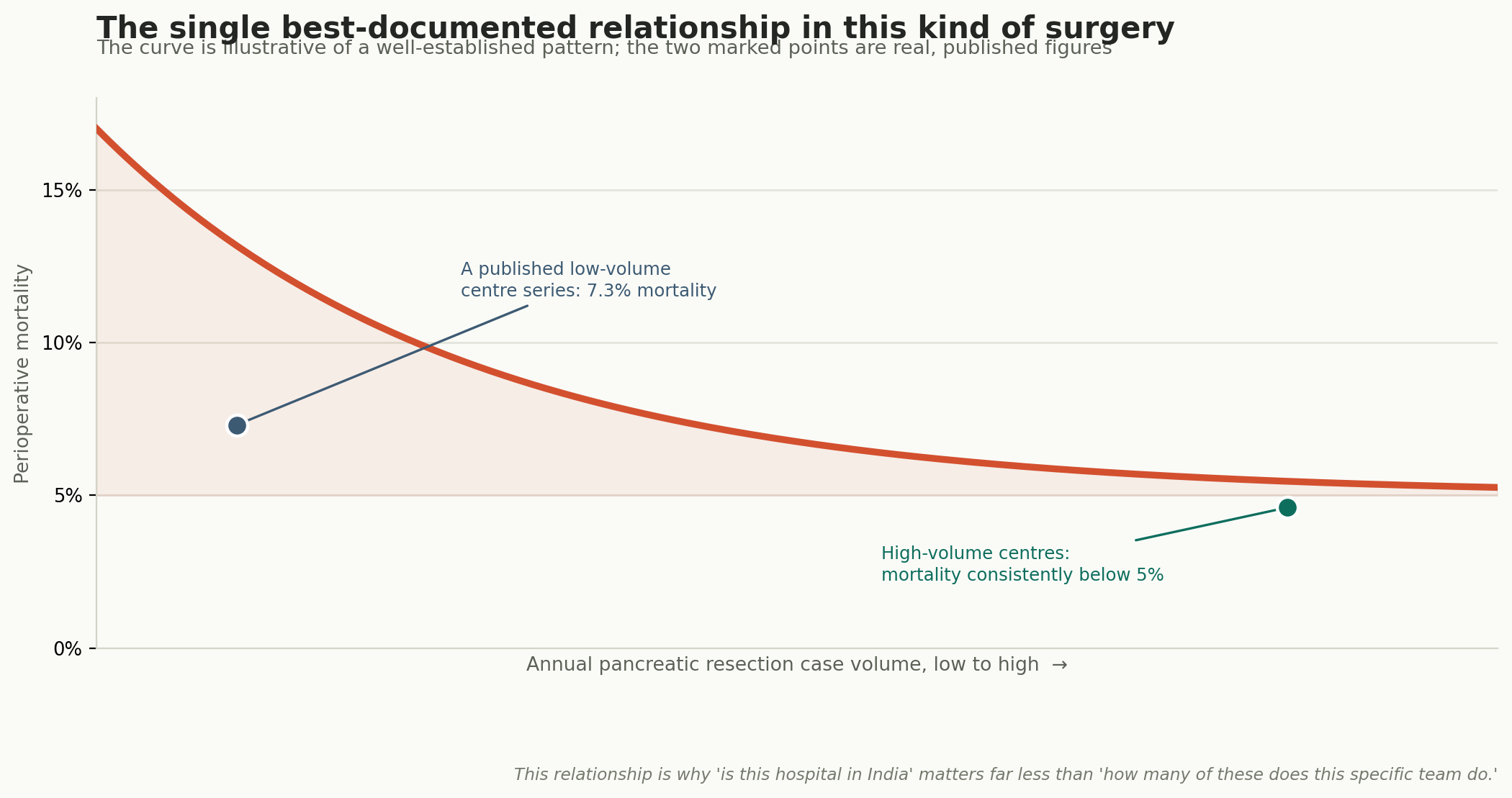
This relationship is why "is this hospital in India" matters far less than "how many of these does this specific team do."
This is precisely why case volume, not national reputation, hospital size, or general prestige, is the first and most important filter to apply. A large, well-known hospital that performs this specific operation only occasionally carries meaningfully different risk than one where it happens weekly, and the two are not distinguishable from a hospital's general marketing material. A specific, direct question about annual volume, asked before anything else, does more to protect a patient than almost any other single piece of due diligence in this guide.
WHAT "GOOD" ACTUALLY MEANS
Success is a composite, not a single statistic
A low headline mortality rate is necessary but not sufficient. Current surgical literature increasingly measures success through a composite standard, sometimes called "textbook outcome," that captures the fuller picture of how a patient's entire journey through this surgery actually went.
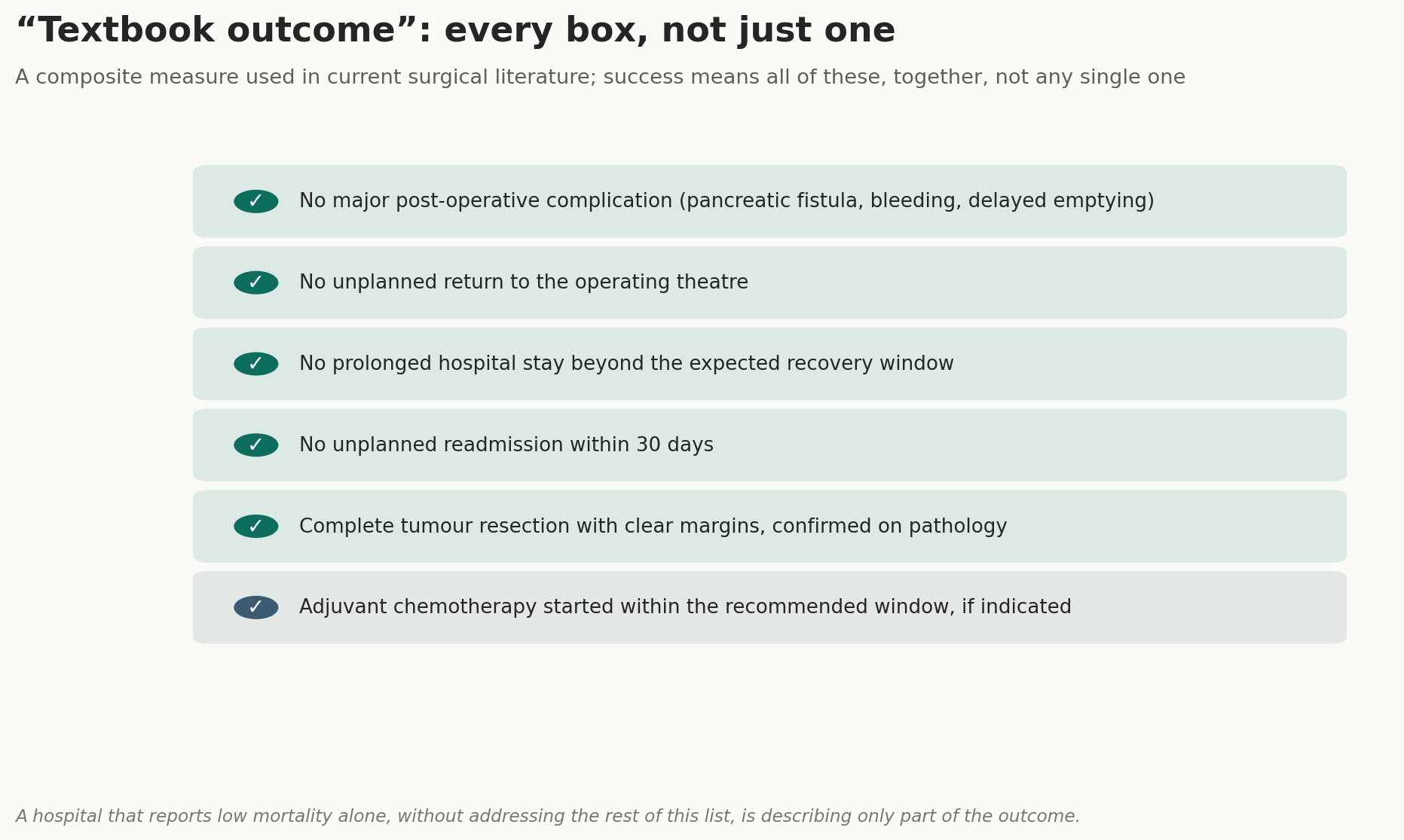
A hospital that reports low mortality alone, without addressing the rest of this list, is describing only part of the outcome.
When asking any programme about their outcomes, ask specifically about this fuller set, not just survival. A team that readily discusses fistula rates, reoperation rates, and how quickly patients typically start any needed chemotherapy afterward is demonstrating exactly the kind of comprehensive tracking that correlates with genuinely good care. A team that can only speak to whether patients survived, without this fuller picture, may simply not be measuring the rest closely enough to answer.
A note on timing, since it shapes everything else. Only around 15 to 20 percent of pancreatic cancer patients present with resectable disease at the time of diagnosis, since the disease often produces few symptoms until it is advanced. An honest, prompt resectability assessment, rather than either an overly optimistic promise or a reflexive refusal to operate, is itself a marker of a genuinely experienced team. Where the case is borderline, this is exactly where a genuinely multidisciplinary team, rather than a single surgeon's individual judgement, tends to make the more reliable call.
THE BALANCE
Here, the system edges out the individual
Across this series, most procedures weight the individual surgeon more heavily than the hospital. Pancreatic cancer surgery is a partial exception, for a specific, well-understood reason, and understanding why is useful even beyond this single decision, since it reflects a broader truth about which kinds of surgery depend most on individual technique versus coordinated systems.
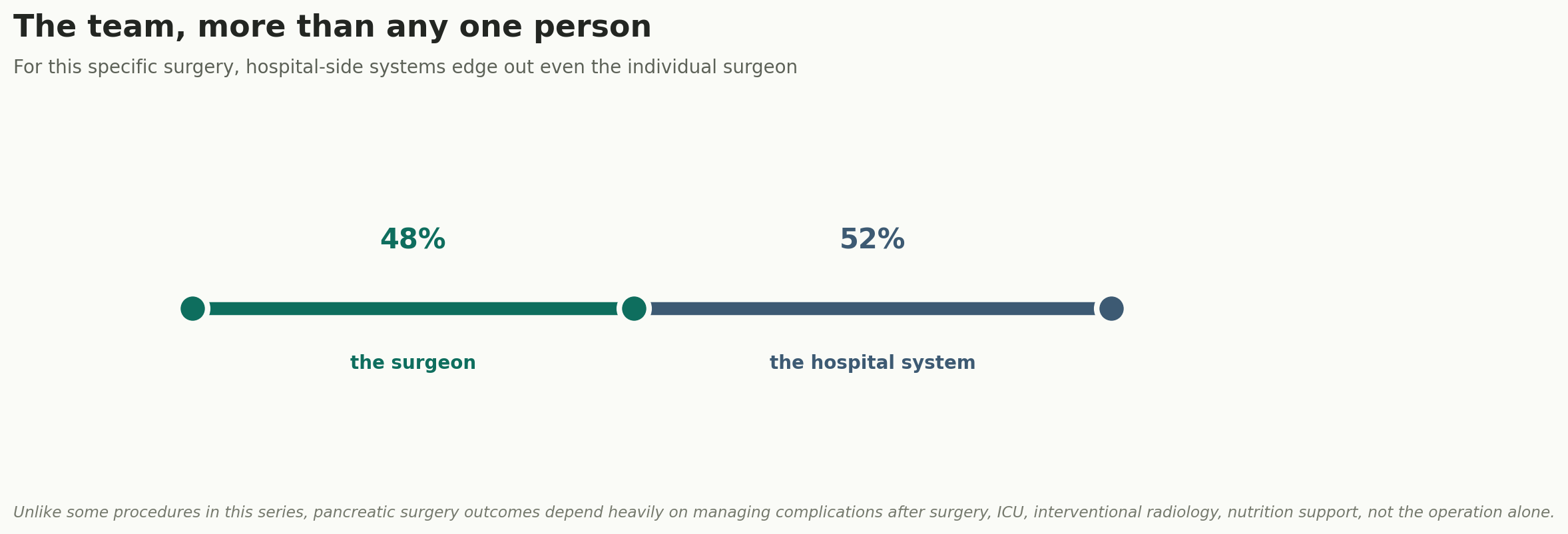
Unlike some procedures in this series, pancreatic surgery outcomes depend heavily on managing complications after surgery, not the operation alone.
Much of what determines survival after this surgery happens in the days and weeks following the operation itself, managing a pancreatic fistula before it becomes dangerous, recognising delayed bleeding early, supporting nutrition through a difficult recovery. These depend on ICU capacity, interventional radiology availability, and a coordinated ward team as much as they depend on the surgeon's hands during the operation. This is why the hospital-side evaluation deserves at least as much scrutiny as the surgeon-side one here, even though the surgeon remains, understandably, where most families instinctively focus their attention first.
THE VETTING CONVERSATION
What to actually ask
Questions for the surgeon and surgical team
- How many pancreaticoduodenectomies does this team perform annually? This single number is the most predictive question you can ask.
- What is your own textbook outcome rate, not just survival? A precise, comfortable answer suggests real, tracked experience.
- Was my case discussed at a multidisciplinary tumour board? Resectability and treatment sequencing decisions benefit from more than one specialist's judgement.
- Is neoadjuvant chemotherapy being considered before surgery, and why or why not? A thoughtful, case- specific answer matters more than a fixed policy either way.
Questions for the hospital
- What is the hospital's dedicated ICU and high-dependency capacity for this recovery? This is where many complications are actually managed.
- Is interventional radiology available on-site for managing bleeding or fluid collections without further open surgery? This capability meaningfully changes how complications are handled.
- What is the plan for nutrition support during a difficult recovery? This affects both comfort and healing capacity.
- How quickly, on average, do patients here start adjuvant chemotherapy if it is needed? Delay here can affect long-term outcomes.
NIGERIA-SPECIFIC CONSIDERATIONS
An honest gap worth naming directly
A 2025 systematic review of pancreatic cancer surgery outcomes across low- and middle-income countries identified published African studies from only one country, Egypt. This does not necessarily mean pancreatic cancer surgery is never performed in Nigeria; it means there is essentially no published outcome data to evaluate domestic case volume or results against, which is itself informative. Given how strongly outcomes for this specific surgery depend on case volume and systematised post-operative care, this absence of published data is a meaningful reason for a Nigerian family to seek treatment at a genuinely high-volume centre, wherever that centre is located, rather than assume any specific claim without independent verification.
This is precisely the kind of situation where the volume question from earlier in this guide becomes not just useful but essential: ask directly, get a specific number, and treat vagueness on this single point as more informative than almost anything else a programme might say. A family navigating this decision without a local reference point is not at a disadvantage if they ask precise, specific questions; they are at a disadvantage only if they rely on general impressions in place of those questions.
Four warning signs worth taking seriously
- A programme that cannot or will not state its own annual case volume. This is the single most important number in this entire evaluation.
- Reluctance to discuss complication or reoperation rates specifically. Every genuinely high-volume centre can speak to this candidly.
- Surgery proposed before a proper multidisciplinary resectability assessment. This decision benefits from more than one specialist's perspective.
- No clear plan for adjuvant treatment discussed before the operation itself. Planning this in advance reflects genuine, coordinated care.
A practical order of operations
- Get full imaging and a formal resectability assessment before contacting any surgical programme.
- Ask directly for the team's annual case volume; treat this as the first filter, not an afterthought.
- Ask about textbook outcome rates, not survival alone.
- Confirm ICU, interventional radiology, and nutrition support capacity at the hospital.
- Travel, surgery, and a closely monitored recovery period, typically two to three weeks in hospital.
- Hand full pathology and treatment documentation to a Nigerian oncologist for coordinated follow-up and any needed adjuvant therapy.
Straight Answers for Nigerian Patients about Pancreatic Cancer Surgery in India
Why does hospital case volume matter so much?
The Whipple procedure is among the most technically demanding operations in surgery, and the relationship between how often a centre performs it and how safely patients survive it is one of the most consistently documented findings in surgical literature. High-volume centres report mortality consistently below 5 percent.
What does "textbook outcome" mean?
A composite measure combining several factors: no major complication, no unplanned return to theatre, no prolonged stay, no unplanned readmission, complete resection with clear margins, and timely adjuvant therapy if needed. Good outcomes mean all of these together.
Is pancreatic cancer always operable?
No. Only around 15 to 20 percent of patients present with resectable disease at diagnosis. An honest, timely resectability assessment by an experienced multidisciplinary team is essential, not a formality.
Why does the hospital matter more than the surgeon here?
Much of what determines survival happens after the operation: managing pancreatic fistula, bleeding, or delayed gastric emptying depends on ICU capacity, interventional radiology, and nutrition support as much as surgical skill during the operation itself.
What is a realistic red flag when choosing a programme?
A programme that cannot state its own annual case volume, avoids discussing complication rates, or proposes surgery before a proper multidisciplinary assessment, are all genuine warning signs.
A closing word
Pancreatic cancer surgery is, more than almost any other procedure in this series, a story about systems rather than individual heroics. The best outcomes come from teams that do this operation often enough to have genuinely internalised how to prevent, recognise, and manage its considerable risks, together, as a coordinated unit, not from any single surgeon's skill in isolation. This is a genuinely different kind of decision than choosing a specialist for a more contained, single-surgeon procedure, and it deserves to be approached that way. In twenty-four years of this work, the families who navigate this best ask the volume question early and directly, evaluate the hospital's complication-management systems as seriously as the surgeon's individual skill, and insist on a proper multidisciplinary assessment before any surgery is scheduled. This is a decision where the honest, sometimes uncomfortable questions are exactly the ones worth asking.
drawn from published surgical literature current as of mid-2026; always verify current case volumes and outcomes directly with any specific surgeon or hospital under consideration.
Sources
- 🌐 The textbook outcome of pancreaticoduodenectomy for adenocarcinoma of the pancreas in a high-volume centre. 2026
- 🌐 Analysis of Short-term Outcomes of Pancreatic Resections from a Low Volume Centre in a Tier II City in India
- 🌐 Morbidity and Mortality Following Surgery for Pancreatic Cancer in Low- and Middle-Income Countries: A Systematic Review and Meta-Analysis
- 🌐 Pancreaticoduodenectomy (Whipple Procedure). StatPearls, NCBI Bookshelf, 2026
- 🌐 High Commission of India, Abuja — Medical and Medical Attendant Visa requirements
Frequently Asked Questions by Nigerians about Pancreatic Cancer Surgery in India
What is the most important question Nigerian patients should ask before Whipple surgery in India?
Ask how many pancreaticoduodenectomies the specific team performs every year. The guide describes annual case volume as the single most predictive question in this decision.
Why does hospital volume matter so much for pancreatic cancer surgery?
Because a large part of the risk comes from postoperative complications rather than the operation alone. High-volume teams become experienced not only in performing the surgery but in recognising and managing fistulas, bleeding and other complications quickly.
What mortality rates does the guide mention for Whipple surgery?
It states that high-volume centres consistently report perioperative mortality below 5%, while one 2025 lower-volume published series reported 7.3%.
What is a textbook outcome after pancreatic cancer surgery?
It is a broader measure of success than simple survival. It considers complications, reoperation, recovery and whether the patient can continue into the next stage of cancer treatment without major delay.
Is the surgeon or hospital more important for pancreatic cancer surgery?
The guide gives the hospital a slight advantage at approximately 52% hospital versus 48% surgeon, because postoperative ICU care, interventional radiology and complication management strongly affect outcomes.
Why is interventional radiology important after Whipple surgery?
It can allow bleeding or fluid collections to be treated through minimally invasive procedures rather than requiring another open operation. The guide treats on-site interventional radiology as an important hospital capability.
Does every pancreatic cancer patient qualify for surgery?
No. The guide states that only around 15–20% of patients present with resectable disease at diagnosis. Formal assessment of resectability is therefore essential before surgery is planned.
Should chemotherapy ever be given before pancreatic cancer surgery?
Yes, particularly in selected borderline cases. The guide recommends asking whether neoadjuvant chemotherapy is appropriate and why the multidisciplinary team has chosen either to use or not use it.
Does this guide give a specific pancreatic cancer surgery cost in India?
No. This surgeon-and-hospital-selection guide does not provide a specific India cost range or standard stay duration, so those details should not be added to the summary.
What are the main warning signs when choosing a pancreatic cancer programme in India?
Major warning signs include vagueness about annual Whipple volume, quoting survival without broader outcome measures, no multidisciplinary resectability review and inadequate ICU or interventional-radiology capability for complication management.
Page Summary
This guide is built around one central fact: pancreatic cancer surgery outcomes are strongly related to how often the treating team performs the operation. The opening comparison shows perioperative mortality below 5% at high-volume centres versus 7.3% in one lower-volume published series.
Citation Block
| Topic | Information |
|---|---|
| Topic Information | Selecting Pancreatic Cancer Surgeons and Hospitals in India for Nigerian Patients |
| Treatment | Pancreatic Cancer Treatment and Surgery |
| Country | India |
| Intended Audience | Nigerian Patients and Families |
| Primary Condition | Pancreatic Cancer |
| Major Procedure | Pancreaticoduodenectomy / Whipple Procedure |
| First Requirement | Formal Resectability Assessment |
| Primary Selection Factor | Annual Pancreaticoduodenectomy Volume |
| High-Volume Mortality Figure | Below 5% |
| Lower-Volume Published Mortality Figure | 7.3% |
| Complication Range Mentioned | Approximately 30–60% |
| Resectable at Diagnosis | Approximately 15–20% |
| Critical Hospital Capabilities | ICU/HDU, Interventional Radiology and Nutrition Support |
| Preoperative Treatment Consideration | Neoadjuvant Chemotherapy |
| Postoperative Treatment | Adjuvant Chemotherapy Where Indicated |
| India Treatment Cost | Specific Cost Range Not Provided in This Guide |
| Typical Stay | Specific Duration Not Provided in This Guide |
| Author | Dr. Dheeraj Bojwani |
| Experience | 24 Years |


Our Mission Statement
Our mission is to place patients at the centre of every healthcare decision by providing trustworthy, evidence-based, and unbiased medical information. We believe that informed patients make better decisions. Backed by personalised guidance from our experienced advisory team, we help patients understand their treatment options, compare them objectively, and confidently choose the path that best suits their medical needs and personal circumstances.
Patient Testimonials from Nigeria
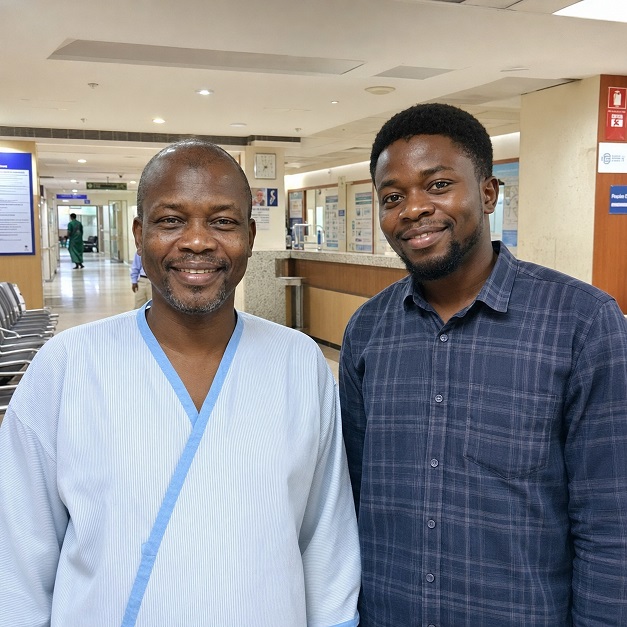
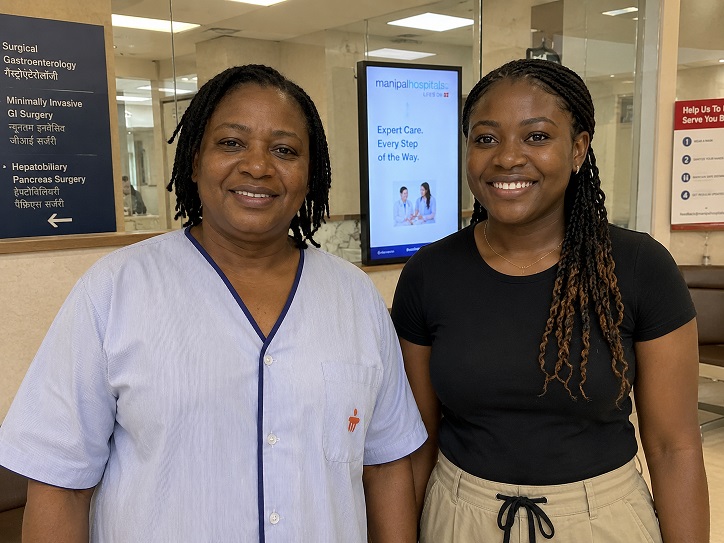
Ready to Take the First Step?
Share your Medical Reports with our Healthcare Managers Today and Get a FREE CONSULTATION, a Personalized Treatment Plan, and Complete Support from Arrival to Recovery.
Get Your Free ConsultationAreas We Serve
This resource has been thoughtfully prepared for patients from Nigeria who are considering medical treatment in India. We also welcome patients from the wider region in the countries mentioned below-
We assist patients from:
- Benin
- Niger
- Chad
- Cameroon
- Algeria
- Egypt
- Libya
- Morocco
- Sudan
- Tunisia
- Gambia
- Ghana
- Burkina Faso
- Cabo Verde
- Côte d'Ivoire
- Equatorial Guinea
- São Tomé and Príncipe
Many of the insights, treatment pathways, hospital recommendations, travel guidance, and patient support services described here are equally relevant and may be used as a reference when planning treatment in India.
From Nigeria to India: Your Complete Patient Support Guide
- Artificial Disc Replacement in India for Nigerian Patients
- Weight Loss and Bariatric Surgery in India for Nigerian Patients
- Bone Marrow Transplant in India for Nigerian Patients
- Brain Tumour Surgery in India for Nigerian Patients
- Breast Cancer Treatment and Surgery in India for Nigerian Patients
- Cancer Treatment and Surgery in India for Nigerian Patients
- Cardiac Arrhythmia and Heart Pacemaker Treatment in India for Nigerian Patients
- Cardiac Surgery in India for Nigerian Patients
- Colorectal Cancer Treatment and Surgery in India for Nigerian Patients
- Complex Orthopaedic and Joint Revision Surgery in India for Nigerian Patients
- Cornea Transplant and Advanced Eye Surgery in India for Nigerian Patients
- CyberKnife Treatment in India for Nigerian Patients
- Gamma Knife Treatment in India for Nigerian Patients
- Heart Failure Treatment and Surgery in India for Nigerian Patients
- Hip Surgery in India for Nigerian Patients
- HIPEC Cancer Surgery in India for Nigerian Patients
- IVF and Fertility Treatment in India for Nigerian Patients
- Joint Arthroscopy and Sports Medicine in India for Nigerian Patients