

Selecting the Best Cancer Treatment Surgeons and Hospitals in India for Nigerian Patients
This is not one decision. It is a series of decisions, made under pressure, that together determine whether a life is saved. Every family deserves to make them well.
In 2022, Nigeria recorded 269,109 new cancer cases. Behind every one of those numbers sat a family, in the space of days, trying to understand a diagnosis, a prognosis, a set of treatment options, and a decision about who should deliver that treatment, all while managing fear, cost, and the practical logistics of a serious illness. This guide exists because that moment, disorienting as it is, is also the moment when the decisions that matter most get made, often quickly, often under enormous emotional weight, and often without the structured framework that would help a family make them well. This is the most comprehensive guide in this series, and deliberately so. Where the other guides in this collection address a single cancer type, spine deformity, neurosurgery, pancreatic cancer, breast cancer, colorectal cancer, HIPEC and peritoneal surgery, this one steps back to address the questions that apply regardless of diagnosis: how to evaluate a surgeon and a hospital together, how to read accreditation claims correctly, how to understand why the right balance between surgeon and hospital shifts by cancer type, and how to build the kind of informed, structured evaluation that a family facing this decision deserves to have.
Should you even be reading this guide? If a cancer diagnosis has been made, or is strongly suspected, and treatment planning, including possibly surgery, is underway or approaching, this guide will help you build a structured evaluation of the surgeons and hospitals under consideration. If your specific cancer type has its own dedicated guide elsewhere in this series, read both; this guide provides the broader framework, and the cancer-specific guide provides the detail relevant to your exact diagnosis.
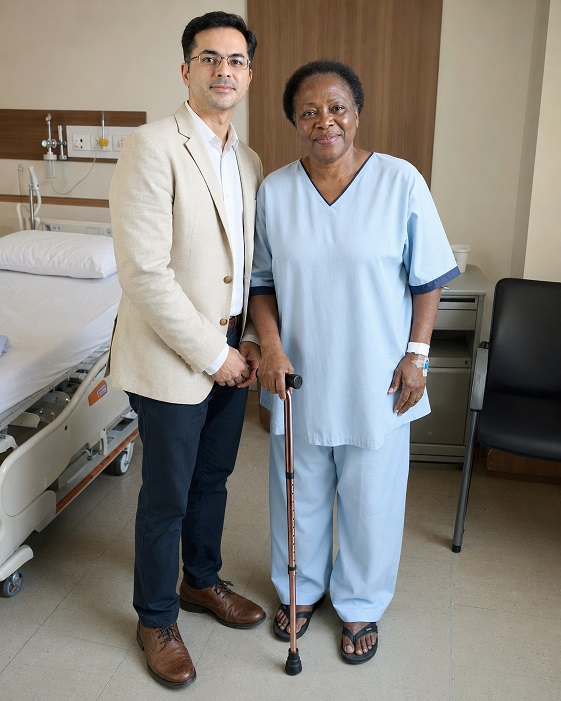
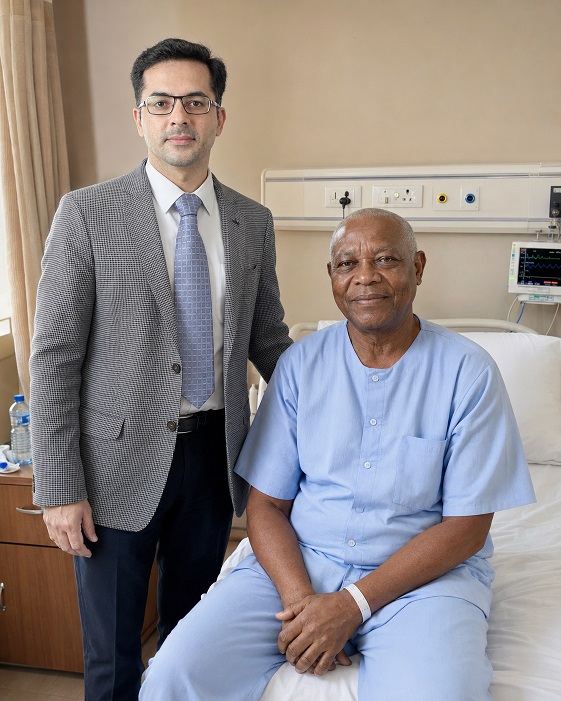
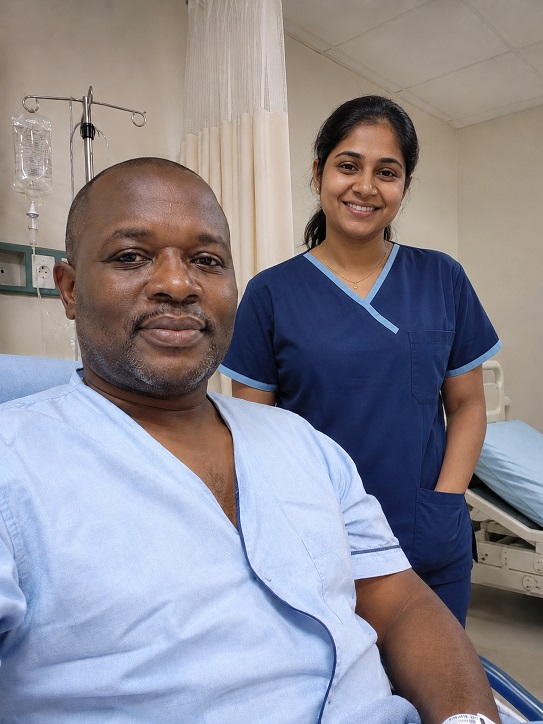
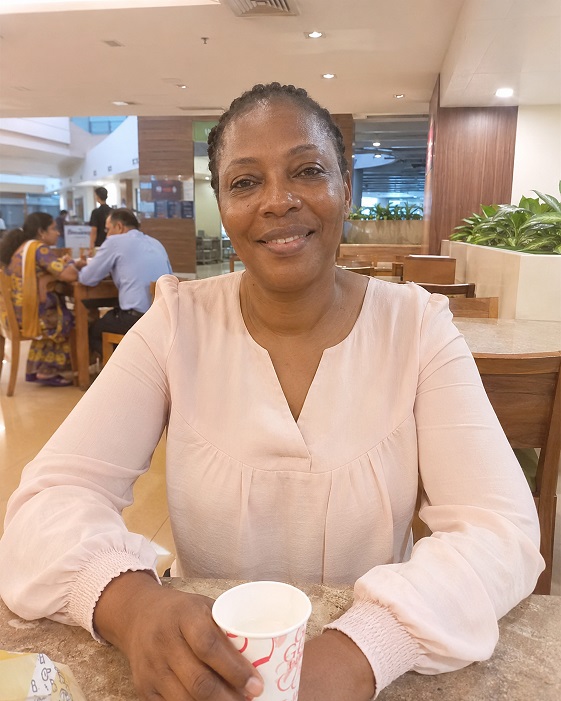
Healing Journeys of Nigerian Patients




Key Takeaways
- Nigerian families evaluating cancer treatment in India should understand that this is not one decision but a series of interlocking decisions involving diagnosis, staging, molecular testing, multidisciplinary planning, surgeon selection, hospital infrastructure and long-term follow-up.
- The guide reports 269,109 new cancer cases in Nigeria in 2022. Its page 2 infographic also gives an age-standardised cancer incidence of 130.6 per 100,000 Nigerian women, an African breast-cancer mortality-to-incidence ratio of 0.510, and notes that roughly 70% of global cancer deaths occur in low- and middle-income countries.
- Before evaluating any surgeon or hospital, the first question should be whether the proposed treatment is genuinely appropriate for the patient's exact cancer type, stage and molecular profile.
- The guide gives four questions that apply across cancer types:
- Is this the right treatment for my exact diagnosis?
- Has my case been reviewed by more than one specialist?
- What does this specific team's track record show?
- What happens if things do not go as planned?
- A genuine multidisciplinary tumour board should include, at minimum, a surgeon, medical oncologist, radiation oncologist, radiologist and pathologist. Their role is to review imaging, pathology and staging together and establish the sequence of treatment.
- The balance between surgeon and hospital is not universal across cancer types. The page 4 chart demonstrates that the weighting shifts according to the disease and procedure.
- The guide's own framework gives approximately:
- Colorectal cancer: Surgeon 54% / Hospital 46%
- HIPEC / Peritoneal: Surgeon 57% / Hospital 43%
- Neurosurgical brain tumour: Surgeon 55% / Hospital 45%
- Pancreatic cancer: Surgeon 48% / Hospital 52%
- Breast cancer: Surgeon 46% / Hospital 54%
Quick Facts
- Treatment
- Cancer Treatment, Cancer Surgery and Multidisciplinary Oncology Care
- Country
- India
- Intended Audience
- Nigerian Patients and Families
- Primary Focus
- Selecting the Right Cancer Treatment Team, Surgeon and Hospital
- Nigeria Cancer Cases Mentioned
- 269,109 New Cases in 2022
- Female Age-Standardised Incidence Mentioned
- 130.6 per 100,000 Nigerian Women
- Africa Breast Cancer Mortality-to-Incidence Ratio Mentioned
- 0.510
- Global Cancer Deaths in Low- and Middle-Income Countries
- Approximately 70%
- First Decision
- Confirm the Exact Diagnosis, Stage and Molecular Profile
- First Universal Question
- Is This the Right Treatment for My Exact Diagnosis?
- Second Universal Question
- Has My Case Been Seen by More Than One Specialist?
- Third Universal Question
- What Does This Specific Team's Track Record Show?
- Fourth Universal Question
- What Happens if Things Do Not Go as Planned?
- Primary Planning Structure
- Multidisciplinary Tumour Board
- Minimum Tumour Board Members Mentioned
- Surgeon, Medical Oncologist, Radiation Oncologist, Radiologist and Pathologist
- Treatment Sequencing
- Surgery, Systemic Therapy and Radiation Should Be Planned Together
- Molecular Testing
- Receptor Status, Genetic Mutation Testing and Molecular Subtyping May Affect Treatment
In Brief
Nigerian patients evaluating cancer surgeons and hospitals in India should begin with a confirmed diagnosis, full staging and relevant molecular or genetic testing before comparing treatment programmes. The guide recommends multidisciplinary tumour-board review involving surgical, medical and radiation oncology together with radiology and pathology, because the correct treatment sequence varies by cancer type and stage. There is no universal answer to whether the surgeon or hospital matters more: the guide's framework ranges from 57% surgeon weighting for HIPEC/peritoneal treatment to 46% surgeon weighting for breast cancer, where hospital-level testing and coordination carry more influence. Accreditation such as NABH or JCI should be used as a baseline filter, while cancer-specific case volumes, complication rates and published outcomes provide stronger evidence of programme quality.
THE SCALE
Why this decision carries the weight it does
It is worth sitting, briefly, with the scale of what this guide addresses before moving into the practical framework that follows.
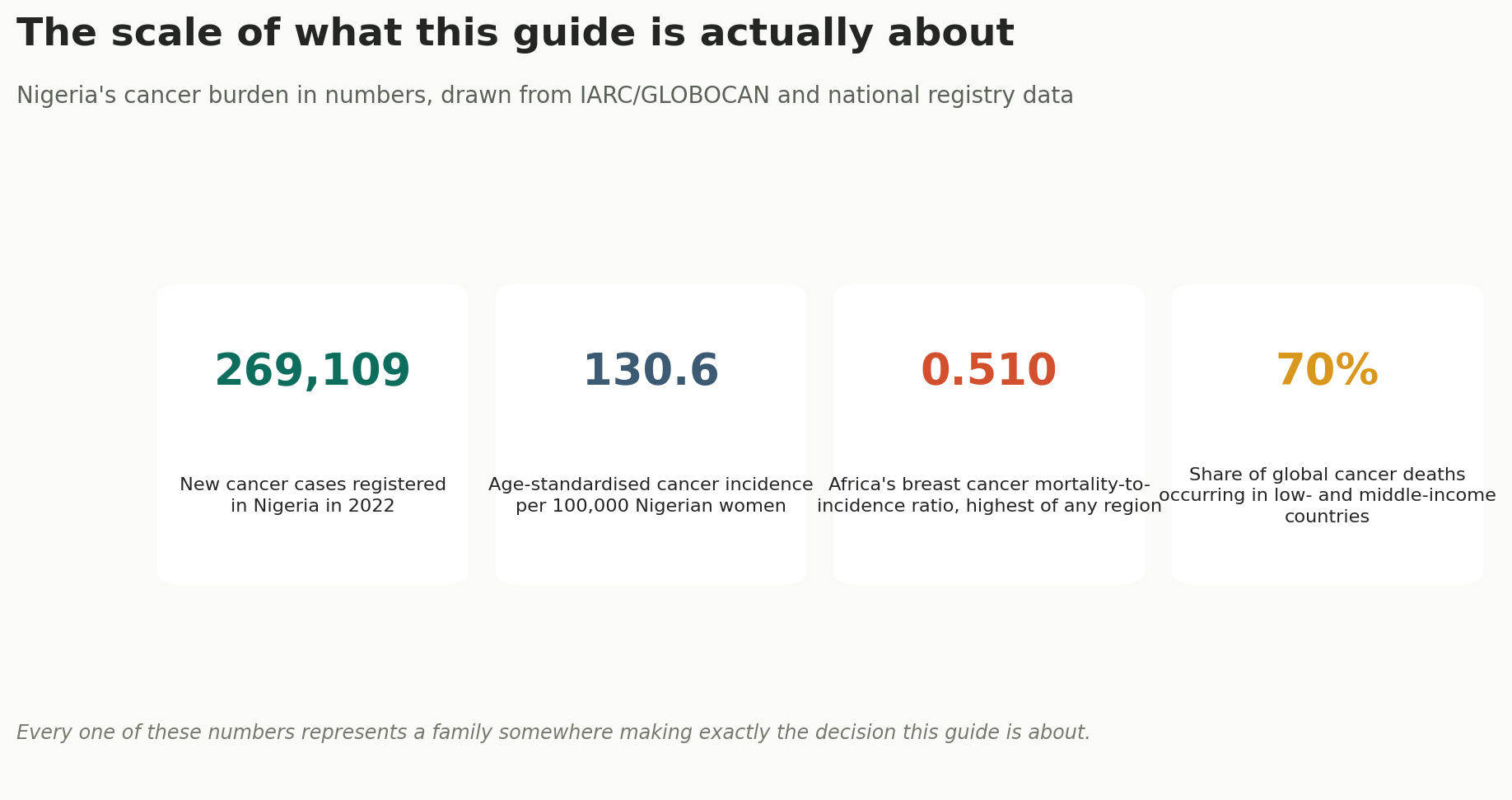
Every one of these numbers represents a family somewhere making exactly the decision this guide is about.
The last of these four figures deserves particular attention: roughly 70 percent of global cancer deaths occur in low- and middle-income countries, not because cancer itself behaves differently there, but because of documented, addressable gaps in early detection, diagnostic access, and treatment quality. Africa's breast cancer mortality-to-incidence ratio, more than double that of North America, tells the same story from a different angle: it is not that African women get a worse disease; it is that the systems around diagnosis and treatment too often fail to catch and treat it as effectively. This is precisely the gap a well-informed, carefully evaluated treatment decision can help close for any individual family, even where it cannot be closed at the level of an entire health system overnight.
This context is not offered to alarm; it is offered because understanding the scale of what is at stake is what justifies the time and rigour this guide asks of anyone using it. A cancer treatment decision is not a single choice made once. It is a series of interlocking choices, diagnosis and staging, molecular and genetic testing where relevant, multidisciplinary planning, surgical technique, hospital infrastructure, and long-term follow- up, each of which shapes the odds of the outcome a family is actually hoping for.
THE FRAMEWORK
Four questions that outlast any single diagnosis
Across every cancer-specific guide in this series, from spine deformity's surgeon-dependent technique to pancreatic cancer's system-dependent recovery, four questions recur, in one form or another, regardless of the specific cancer involved.
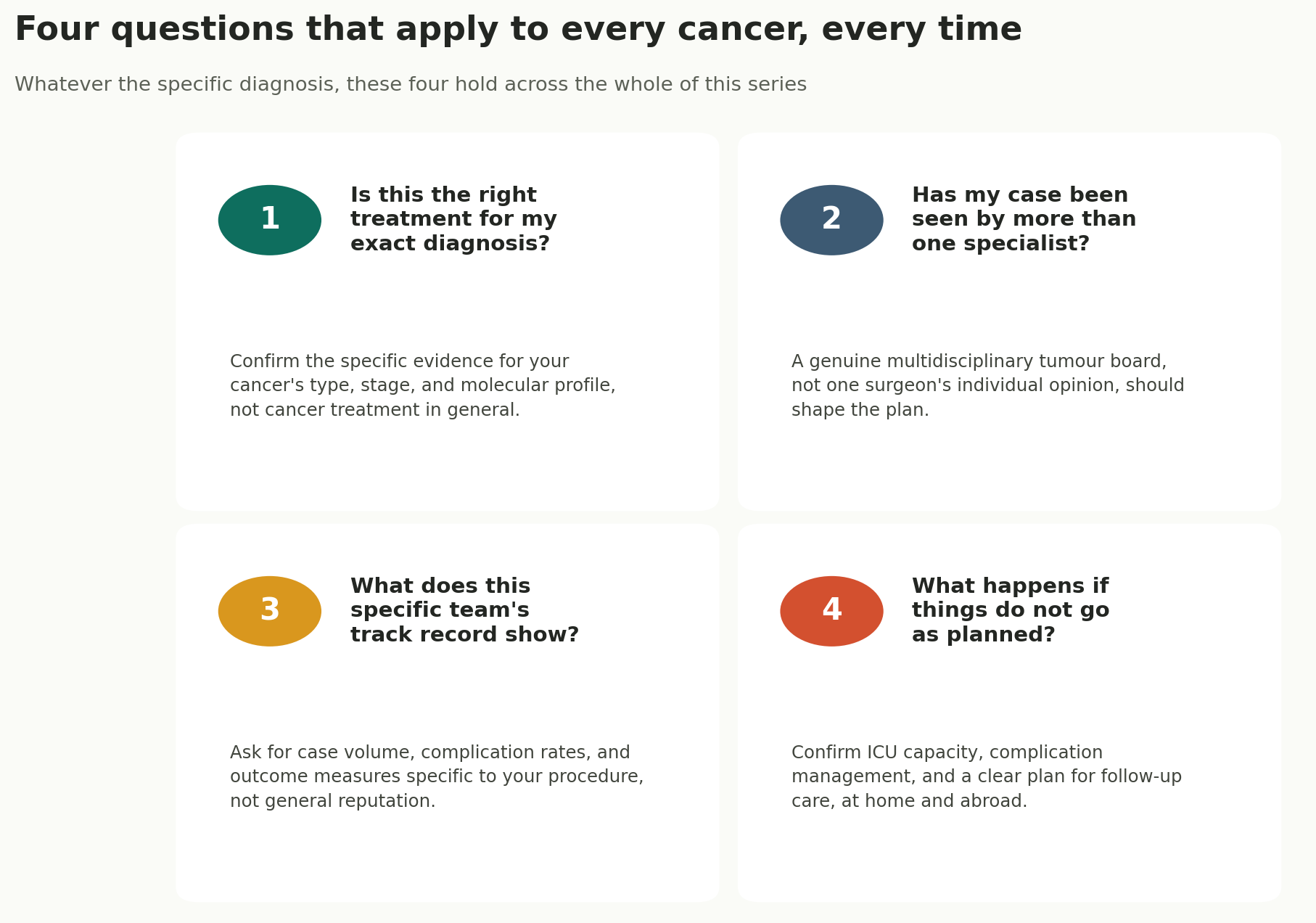
Whatever the specific diagnosis, these four hold across the whole of this series.
The first question, whether a proposed treatment is genuinely right for the exact diagnosis, matters more than it might initially seem. This series has documented real, specific cases where the answer is not simply yes: HIPEC's heated chemotherapy component, for instance, lacks strong evidence of added benefit for colorectal-origin peritoneal disease specifically, even though the broader procedure sounds comprehensive and reassuring. A treatment that is right for one cancer, or one subtype, is not automatically right for another that superficially resembles it.
The second question, multidisciplinary review, is worth explaining plainly for anyone unfamiliar with the concept. A multidisciplinary tumour board brings together a surgeon, a medical oncologist, a radiation oncologist, a radiologist, and a pathologist, at minimum, to review imaging, pathology, and staging together and agree on a coordinated plan. This is meaningfully different from a single surgeon reviewing a case alone and recommending surgery, however skilled that surgeon may be individually. The evidence across oncology broadly favours multidisciplinary planning precisely because different specialists catch different things, and treatment sequencing, whether chemotherapy should precede or follow surgery, for instance, benefits from more than one trained perspective.
The Balance, Honestly
There is no single answer to "surgeon or hospital"
One of the most common questions this series receives, in one form or another, is simple: does the surgeon matter more, or the hospital? The honest answer, developed across this advisory's cancer-specific guides, is that it genuinely depends on the cancer, and pretending otherwise would be a disservice to any family relying on this guidance.
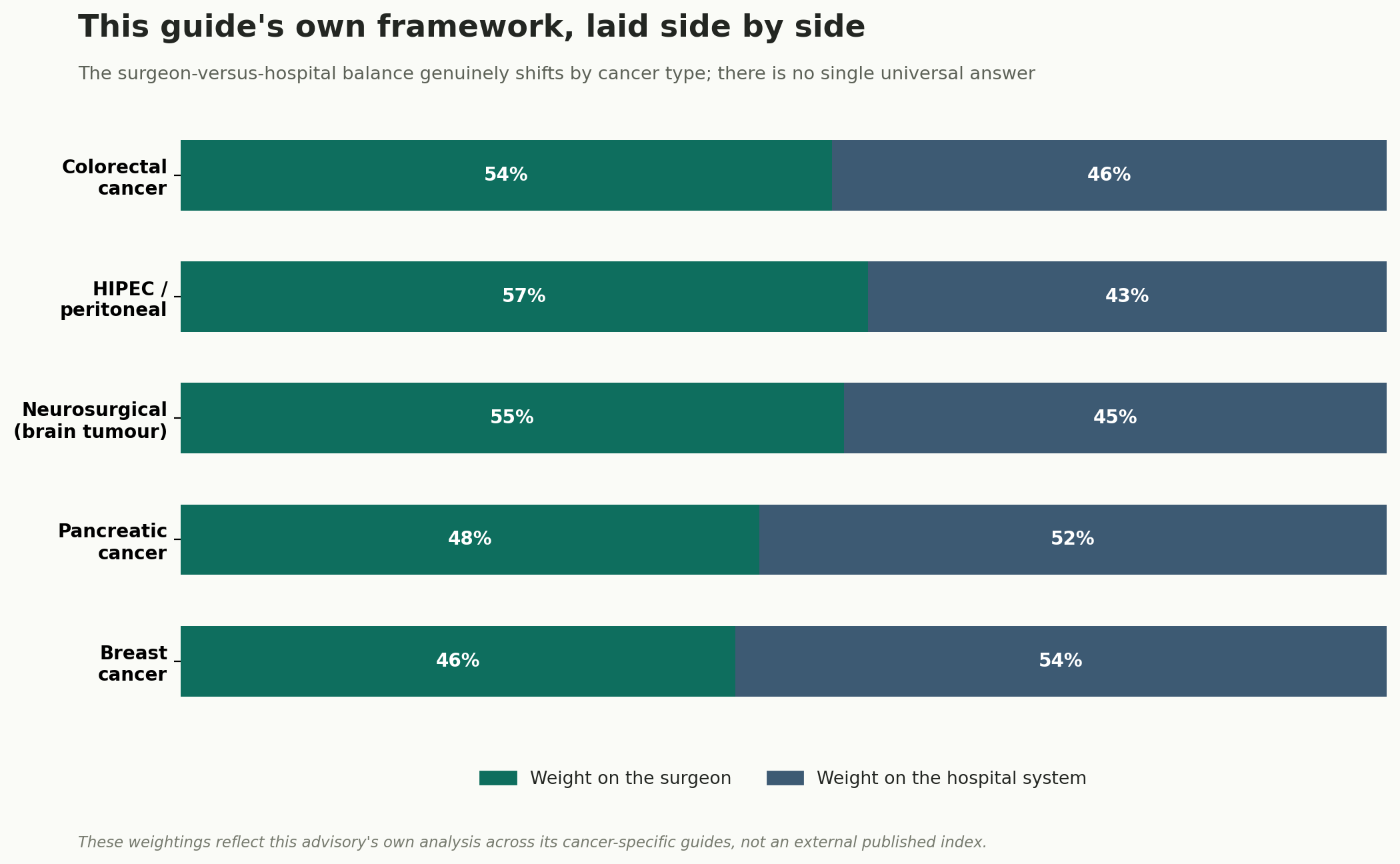
These weightings reflect this advisory's own analysis across its cancer-specific guides, not an external published index.
A pattern is visible in this comparison worth naming explicitly. Procedures where the surgeon's own hands, in real time, determine a specific technical outcome, an intact mesorectal plane in colorectal surgery, a complete cytoreduction in HIPEC, a precisely executed resection near eloquent brain tissue in neurosurgery, weight more heavily toward the individual surgeon. Procedures where survival depends more on coordinated systems working together over an extended period, accurate molecular testing and multidisciplinary sequencing in breast cancer, complication recognition and management across a difficult recovery in pancreatic cancer, weight more heavily toward the hospital as a whole. Understanding which category a specific diagnosis falls into is itself one of the most useful things a family can determine early.
Where a specific diagnosis does not have its own dedicated guide in this series, a reasonable working assumption is a roughly even split, with adjustments toward the surgeon for technically demanding, single- operation procedures, and toward the hospital for cancers requiring extended multidisciplinary coordination, complex recovery management, or both.
A note on genetic and molecular testing, since it now touches nearly every cancer type. Across breast cancer, colorectal cancer, and increasingly others, receptor status, genetic mutation testing, and molecular subtyping shape treatment decisions in ways that were not standard practice a generation ago. Whatever the specific diagnosis, asking whether this testing has been completed, and whether the treatment plan genuinely reflects its results, is a universally relevant question worth raising with any programme, anywhere.
Reading the Claims
What "accredited" actually tells you, and what it doesn't
Nearly every hospital marketing itself to international patients will mention accreditation of some kind. Not all
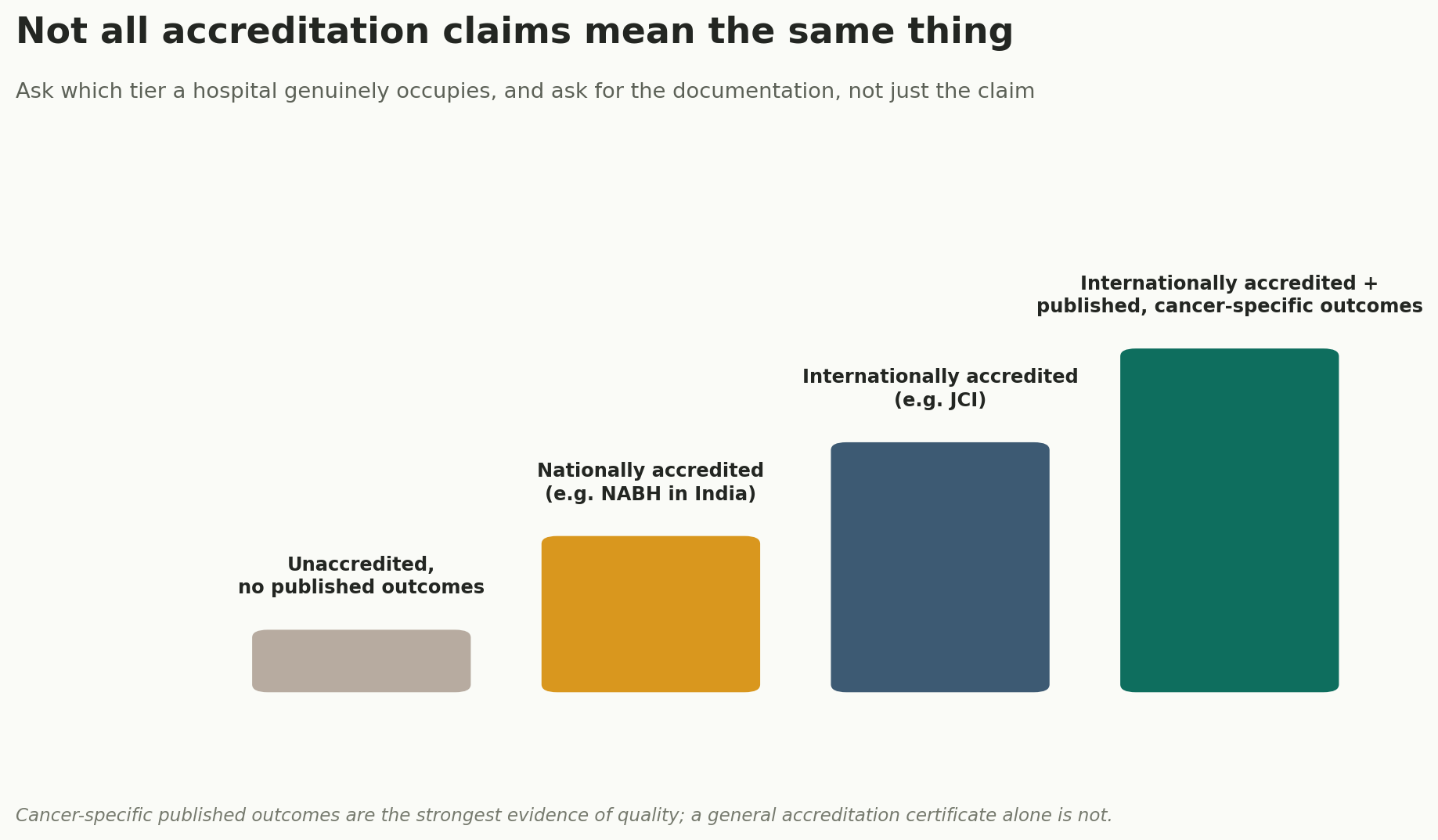
accreditation claims carry equal weight, and understanding the difference is a genuinely practical skill for this decision.
Cancer-specific published outcomes are the strongest evidence of quality; a general accreditation certificate alone is not.
National accreditation bodies, such as India's National Accreditation Board for Hospitals and Healthcare Providers, verify baseline safety and quality standards, and are a genuinely meaningful floor, not a ceiling. International accreditation, such as Joint Commission International, generally reflects a further layer of process and safety standardisation, often specifically relevant to international patients. The strongest tier, though, is neither of these alone: it is a hospital's willingness and ability to share published, cancer-specific outcome data, case volumes, complication rates, and survival figures for the exact procedure being considered, not a general accreditation certificate presented as though it answers every question on its own.
A practical rule follows from this: treat accreditation as a starting filter, not a final answer. A hospital's accreditation status is easy to verify independently and worth checking, but the more informative conversation is the one where a specific programme discusses its own specific outcomes, candidly and in detail, for the specific procedure under consideration.
PUTTING IT TOGETHER
What a complete evaluation actually looks like
Drawing the threads of this series together, a complete evaluation for any cancer treatment decision should cover the following ground, adapted to the specific diagnosis using this series' cancer-specific guides where available.
| Area | What to establish | Primarily whose responsibility |
|---|---|---|
| Diagnosis and staging | Confirmed diagnosis, full staging, molecular or genetic testing where relevant | Diagnostic team |
| Treatment appropriateness | Evidence specifically supports the proposed treatment for this diagnosis and stage | Multidisciplinary board |
| Surgeon-specific track record | Case volume, complication rates, and outcome measures for the exact procedure | Surgeon |
| Hospital infrastructure | ICU capacity, specialised equipment, complication management systems | Hospital |
| Coordinated sequencing | Surgery, systemic therapy, and radiation planned together, in the right order | Multidisciplinary board |
| Follow-up planning | A clear plan for ongoing care at home, with documentation to support it | Home oncologist + treating team |
Table 1. A general evaluation framework, applicable across cancer types, to be read alongside any cancer-specific guide in this series relevant to your diagnosis.
No single conversation will cover all of this ground in one sitting, and that is appropriate; a genuinely thorough evaluation should take place over more than one interaction, with time to reflect and, where helpful, to seek a second opinion between them.
Nigeria-specific Considerations
What this looks like from where you are standing
Nigeria's own National Strategic Cancer Control Plan, covering 2023 to 2027, reflects a genuine, ongoing institutional effort to strengthen cancer diagnosis, treatment, and control domestically, and this progress deserves acknowledgement rather than being overlooked in a guide focused on international treatment. At the same time, the gaps this series has documented across specific cancers, limited HIPEC availability, thin neuronavigation capacity, financial barriers causing many patients to abandon treatment mid-course, remain real and well-documented in the published literature.
The most useful posture for a Nigerian family is neither uncritical confidence in what is available domestically nor a blanket assumption that treatment abroad is automatically superior. It is a specific, case-by-case evaluation: what does my specific diagnosis need, what can be established and pursued domestically right now, and where does a genuine, well-verified gap exist that justifies the real cost and disruption of travelling for treatment. This series exists to make that specific evaluation easier to do well.
Warning signs worth taking seriously, across any cancer type
- A treatment plan proposed before diagnosis and staging are fully complete. This sequence should never be reversed, regardless of the cancer type.
- No mention of multidisciplinary review before a surgical date is set. One specialist's individual opinion is not the same as coordinated planning.
- Reluctance to discuss case volume, complication rates, or outcomes for the exact procedure. Confidence in genuine quality shows up as openness, not evasiveness.
- Accreditation presented as though it alone answers every question. A specific conversation about specific outcomes matters more than a certificate.
- Pressure to commit quickly, without time for a second opinion. A serious, well-run programme does not need to rush this decision.
A practical order of operations, for any cancer diagnosis
- Get a confirmed diagnosis, full staging, and relevant molecular or genetic testing before evaluating treatment options.
- Check whether this series has a dedicated guide for your specific cancer type, and read it alongside this one.
- Confirm multidisciplinary tumour board review has happened, or will happen, before any treatment date is set.
- Evaluate the surgeon and hospital using the weighting appropriate to your specific diagnosis, not a generic assumption.
- Verify accreditation as a starting filter, then ask for specific, cancer-relevant outcome data directly.
- Travel, treatment, and a supervised recovery appropriate to the specific procedure and diagnosis.
- Hand full documentation, pathology, molecular testing results, and treatment records, to a Nigerian oncologist for coordinated, ongoing follow-up.
Straight Answers for Nigerian Patients about Cancer Treatment in India
How big is Nigeria's cancer burden, really?
Nigeria recorded 269,109 new cancer cases in 2022, with age-standardised incidence rates of 66.4 per 100,000 men and 130.6 per 100,000 women, higher than in many developed countries. Breast and prostate cancer are the most prevalent.
Is the surgeon or the hospital more important?
It genuinely depends on the specific cancer. Across this advisory's guides, the balance ranges from around 57 percent surgeon-weighted for HIPEC to 46 percent surgeon-weighted for breast cancer, where hospital-level testing and coordination carry slightly more weight.
What does a multidisciplinary tumour board actually do?
It brings together a surgeon, medical oncologist, radiation oncologist, radiologist, and pathologist to review a case together and agree on a treatment plan, rather than one specialist deciding alone.
Does hospital accreditation guarantee good cancer care?
Not by itself. Accreditation reflects broad quality and safety standards, but published, cancer-specific outcome data for the exact procedure is stronger evidence of quality than a certificate alone.
What is the single most important thing a family can do?
Get a confirmed diagnosis with full staging and relevant molecular testing, then insist on multidisciplinary review before any treatment plan, including surgery, is finalised.
A closing word
A cancer diagnosis arrives without warning and rarely leaves room for a slow, careful decision-making process. Families are asked, in the space of days or weeks, to absorb complex medical information, weigh treatment options, evaluate surgeons and hospitals they have never met, and commit to a course of action with real, permanent consequences, all while managing the fear and grief that any serious diagnosis brings with it. This guide, and this series, exist because that decision deserves better than being made on instinct, reputation, or whichever option happens to present itself first. In twenty-four years of this work, guiding families through exactly this moment, the pattern that separates good outcomes from preventable regret is rarely about finding a single "best" surgeon or "best" hospital in the abstract. It is about asking the right questions, in the right order, with enough rigour to match the seriousness of what is actually at stake, and enough humanity to remember that behind every one of the 269,109 cases this year, and every case in the years before and after it, is a person and a family who deserved exactly that kind of careful attention. This guide is an attempt to help provide it.
Sources
- 🌐 Ogunniyi A, et al. — Current Status of Cancer Diagnosis and Treatment in Nigeria. Health Science Reports, 2025
- 🌐 IARC/GLOBOCAN — Nigeria cancer fact sheet and global cancer statistics 2022
- 🌐 Demographic and Population Determinants, and Consequences of Cancer Incidence and Survival in Nigeria. IntechOpen, 2025
- 🌐 Global burden and projections of breast cancer incidence and mortality to 2050: a comprehensive analysis of GLOBOCAN data
- 🌐 Nigeria National Strategic Cancer Control Plan 2023–2027. Nigeria Institute for Cancer Research and Treatment
- 🌐 High Commission of India, Abuja — Medical and Medical Attendant Visa requirements
Frequently Asked Questions by Nigerians about Cancer Treatment in India
How should Nigerian patients choose a cancer surgeon and hospital in India?
Start with a confirmed diagnosis, complete staging and relevant molecular testing. Then confirm multidisciplinary tumour-board review before comparing the surgeon's procedure-specific track record and the hospital's cancer-specific infrastructure.
Is the surgeon or hospital more important for cancer treatment?
There is no universal answer. The guide's own framework gives more weight to the surgeon in areas such as HIPEC and colorectal surgery, while hospital systems carry more weight in breast and pancreatic cancer.
What is a multidisciplinary tumour board?
It is a team that includes at least a surgeon, medical oncologist, radiation oncologist, radiologist and pathologist who review the case together and agree on the treatment sequence rather than relying on one specialist's opinion.
Why is molecular testing important before cancer treatment?
Receptor status, mutations and molecular subtypes can change which treatment is appropriate. The guide recommends confirming both that testing has been completed and that the treatment plan reflects the results.
Does NABH or JCI accreditation prove that an Indian cancer hospital is the best choice?
No. Accreditation indicates broad safety and quality systems, but the guide treats it as a starting filter. Procedure-specific case volumes, complication rates and cancer-specific published outcomes are stronger evidence.
What should Nigerian patients ask a cancer surgeon about outcomes?
Ask for experience and outcomes specific to the exact procedure and cancer rather than general oncology statistics. Relevant questions include annual case volume, complication rates and measurable procedure-specific outcomes.
What hospital facilities matter when choosing cancer treatment in India?
The answer depends on the cancer, but the guide broadly recommends checking ICU capacity, specialised equipment, complication-management systems, molecular and pathology capabilities and coordination between surgery, systemic therapy and radiation.
Should Nigerian patients automatically travel to India after a cancer diagnosis?
No. The document explicitly recommends a case-by-case evaluation. Some treatment can be established or completed in Nigeria, while travel should be justified by a genuine gap in expertise, technology, treatment coordination or access.
What should Nigerian patients bring home after cancer treatment in India?
They should return with complete pathology, molecular and genetic test results where relevant, operative and treatment documentation and a clear follow-up plan that their Nigerian oncologist can continue.
What are the biggest warning signs when selecting a cancer programme in India?
The guide identifies five major warnings: treatment planned before diagnosis and staging are complete, no multidisciplinary review, reluctance to discuss exact procedure outcomes, accreditation presented as though it proves everything and pressure to commit without time for a second opinion.
Page Summary
This flagship guide provides a broad framework for Nigerian families selecting cancer treatment surgeons and hospitals in India, rather than focusing on one particular cancer. It begins with Nigeria's cancer burden and then reframes cancer care as a sequence of linked decisions rather than a single choice of surgeon or hospital.
Citation Block
| Topic | Information |
|---|---|
| Topic Information | Selecting Cancer Treatment Surgeons and Hospitals in India for Nigerian Patients |
| Treatment | Cancer Treatment, Cancer Surgery and Multidisciplinary Oncology |
| Country | India |
| Intended Audience | Nigerian Patients and Families |
| Cancer Scope | General Framework Across Cancer Types |
| First Requirement | Confirmed Diagnosis, Full Staging and Relevant Molecular/Genetic Testing |
| Primary Planning Method | Multidisciplinary Tumour Board |
| Tumour Board | Surgeon, Medical Oncologist, Radiation Oncologist, Radiologist and Pathologist |
| Surgeon Evaluation | Exact Procedure Case Volume, Complication Rates and Outcome Measures |
| Hospital Evaluation | ICU Capacity, Specialised Equipment and Complication Management |
| Treatment Sequencing | Surgery, Systemic Therapy and Radiation Planned Together |
| Accreditation Mentioned | NABH and JCI |
| Best Quality Evidence | Published Cancer-Specific Outcomes |
| Surgeon/Hospital Weighting | Varies by Cancer Type |
| Nigeria Cancer Burden Mentioned | 269,109 New Cases in 2022 |
| Nigeria-Specific Policy Mentioned | National Strategic Cancer Control Plan 2023–2027 |
| Follow-Up | Coordinated Ongoing Care With Nigerian Oncologist |
| Records for Follow-Up | Pathology, Molecular Testing Results and Complete Treatment Documentation |
| Author | Dr. Dheeraj Bojwani |
| Experience | 24 Years' Experience |


Our Mission Statement
Our mission is to place patients at the centre of every healthcare decision by providing trustworthy, evidence-based, and unbiased medical information. We believe that informed patients make better decisions. Backed by personalised guidance from our experienced advisory team, we help patients understand their treatment options, compare them objectively, and confidently choose the path that best suits their medical needs and personal circumstances.
Patient Testimonials from Nigeria

Ready to Take the First Step?
Share your Medical Reports with our Healthcare Managers Today and Get a FREE CONSULTATION, a Personalized Treatment Plan, and Complete Support from Arrival to Recovery.
Get Your Free ConsultationAreas We Serve
This resource has been thoughtfully prepared for patients from Nigeria who are considering medical treatment in India. We also welcome patients from the wider region in the countries mentioned below-
We assist patients from:
- Benin
- Niger
- Chad
- Cameroon
- Algeria
- Egypt
- Libya
- Morocco
- Sudan
- Tunisia
- Gambia
- Ghana
- Burkina Faso
- Cabo Verde
- Côte d'Ivoire
- Equatorial Guinea
- São Tomé and Príncipe
Many of the insights, treatment pathways, hospital recommendations, travel guidance, and patient support services described here are equally relevant and may be used as a reference when planning treatment in India.
From Nigeria to India: Your Complete Patient Support Guide
- Artificial Disc Replacement in India for Nigerian Patients
- Weight Loss and Bariatric Surgery in India for Nigerian Patients
- Bone Marrow Transplant in India for Nigerian Patients
- Brain Tumour Surgery in India for Nigerian Patients
- Breast Cancer Treatment and Surgery in India for Nigerian Patients
- Cancer Treatment and Surgery in India for Nigerian Patients
- Cardiac Arrhythmia and Heart Pacemaker Treatment in India for Nigerian Patients
- Cardiac Surgery in India for Nigerian Patients
- Colorectal Cancer Treatment and Surgery in India for Nigerian Patients
- Complex Orthopaedic and Joint Revision Surgery in India for Nigerian Patients
- Cornea Transplant and Advanced Eye Surgery in India for Nigerian Patients
- CyberKnife Treatment in India for Nigerian Patients
- Gamma Knife Treatment in India for Nigerian Patients
- Heart Failure Treatment and Surgery in India for Nigerian Patients
- Hip Surgery in India for Nigerian Patients
- HIPEC Cancer Surgery in India for Nigerian Patients
- IVF and Fertility Treatment in India for Nigerian Patients
- Joint Arthroscopy and Sports Medicine in India for Nigerian Patients