

Shoulder Surgery in India for Kenyan Patients
After a fall or a boda boda accident: getting the diagnosis right first, then choosing the shoulder surgeon and hospital in India, and what it all costs.
Kenya's boda boda economy has become one of the country's most visible sources of employment, and also, less visibly, one of its most consistent sources of shoulder injury. With over 1.4 million registered motorcycles and an estimated 1.8 million riders, many operating with minimal training, low helmet use, and little formal licensing, the shoulder trauma that follows a crash, dislocation, rotator cuff tears, clavicle fractures, has become a genuinely common reason Kenyan patients end up needing surgery. Across 24 years of guiding Kenyan patients through treatment in India, shoulder surgery is a category where getting the right, injury-specific technique matters enormously for how completely a patient recovers. This article explains what shoulder surgery involves, why Kenya's boda boda economy makes this a genuinely common and distinct injury pattern, what treatment costs in India compared with Kenya and Western countries, and the practical factors to weigh before deciding where to be treated.
Healing Journeys of Kenyan Patients


Key Takeaways
- The guide highlights a distinct shoulder-trauma pattern in Kenya linked to the country's boda boda economy. Kenya has more than 1.4 million registered motorcycles and an estimated 1.8 million riders, with low helmet use, inadequate training and licensing, passenger overloading and limited enforcement contributing to crash risk. One cited study found that 15.4% of motorcycle-crash patients sustained an upper-extremity joint dislocation.
- Shoulder injuries following motorcycle crashes are often more complex than they initially appear. A patient may have a shoulder dislocation together with a rotator cuff or labral tear, or a clavicle fracture with additional soft-tissue damage. The guide therefore recommends a complete diagnostic workup rather than treating only the most obvious injury.
- Common conditions requiring surgery include rotator cuff tears, recurrent shoulder dislocation, labral tears and clavicle fractures. Arthroscopic surgery is now commonly used because it involves small incisions and may allow less pain, shorter hospitalisation and faster initial recovery. However, large tears, significant bone loss and certain fracture patterns may still require open surgery.
- The guide emphasises that arthroscopic shoulder experience should be specific to the patient's injury, rather than relying on a surgeon's general orthopaedic reputation. Kenyan patients should ask how many procedures matching their exact injury type the surgeon personally performs each year and whether the recommended approach is genuinely arthroscopic or open.
- India has developed substantial arthroscopic shoulder surgery capacity, particularly among orthopaedic surgeons treating sports and trauma-related injuries. Leading centres combine specialist expertise with JCI and NABH accreditation and structured physiotherapy programmes, which are important because successful shoulder recovery depends heavily on rehabilitation after the operation.
- The guide estimates arthroscopic shoulder surgery, including rotator cuff repair, at approximately US$2,500–6,000 in India, compared with US$3,000–8,000 for private treatment in Kenya, US$15,000–25,000 in the UK and US$15,000–40,000 in the US. The page 3 cost chart visually reinforces India's lower estimated treatment range.
- Kenyan patients should also plan for approximately 1–2 weeks in India, including surgery and initial recovery. Before booking, the page 4 “Six Things to Check” graphic recommends verifying hospital accreditation, the surgeon's arthroscopic shoulder volume, the arthroscopic-versus-open assessment, an all-inclusive quotation, visa/travel arrangements and a structured rehabilitation plan in Kenya.
Quick Facts
- Author
- Dr. Dheeraj Bojwani
- Experience
- 24+ Years
- Treatment
- Shoulder Surgery
- Patients
- Kenyan Patients
- First Assessment
- Complete shoulder imaging and injury assessment
- Key Specialist
- Arthroscopic Shoulder / Orthopaedic Surgeon
- Common Injuries
- Rotator cuff tears, dislocations, labral tears and clavicle fractures
- Main Approach
- Arthroscopic surgery where clinically suitable
- Alternative
- Open surgery for selected complex injuries
- Kenya Motorcycle Base
- 1.4+ million registered boda bodas
- Crash Finding
- 15.4% upper-extremity joint dislocation in cited motorcycle-crash study
- Hospital Check
- JCI / NABH accreditation
- Case Volume
- Exact shoulder procedure and injury type
- Cost Check
- Written estimate covering surgery, anaesthesia and physiotherapy
- India Cost
- US$2,500–6,000
- Kenya Cost
- US$3,000–8,000 private
- Medical Records
- Imaging and previous treatment reports
- Visa
- Indian medical e-visa with hospital invitation
- Travel
- Nairobi–Delhi or Mumbai flights
- Stay
- Approximately 1–2 weeks
- Follow-Up
- Structured physiotherapy in Kenya
- Key Warning
- Treating an obvious injury without checking for associated damage
- Decision Principle
- Prioritise complete diagnosis, injury-specific expertise and rehabilitation.
In Brief
For Kenyan patients with shoulder injuries, particularly after a boda boda accident, the priority should be a complete diagnosis before choosing surgery. Patients should verify the surgeon's experience with their exact injury, understand why arthroscopic or open surgery is being recommended, obtain a complete written cost estimate and arrange structured physiotherapy in Kenya before travelling.
What shoulder surgery actually involves
The shoulder is the body's most mobile joint, held together by a complex arrangement of bones, tendons, and ligaments, which also makes it particularly vulnerable to injury from a fall or direct impact. The most common conditions requiring surgery include rotator cuff tears, where one or more of the tendons stabilising the shoulder is torn; shoulder dislocation, where the joint pops out of its socket, sometimes repeatedly if the surrounding tissue is damaged; labral tears, damage to the cartilage ring around the shoulder socket; and clavicle fractures, a break in the collarbone often caused by landing directly on the shoulder.
Most shoulder surgery today is performed arthroscopically, a minimally invasive technique using a small camera and instruments inserted through a few small incisions, rather than a single large open incision. This approach generally means less pain, a shorter hospital stay, often same-day discharge, and faster initial recovery than open surgery. Not every case is suitable for an arthroscopic approach; very large, complex tears, significant bone loss, or certain fracture patterns may still require open surgery, and a good surgeon should explain clearly which approach fits your specific injury rather than defaulting automatically to one technique.
Recovery from shoulder surgery, regardless of technique, depends heavily on structured physiotherapy in the weeks and months afterward. The surgery itself repairs the damaged structure, but regaining full strength and range of motion requires consistent, guided rehabilitation, often over several months, and patients who follow this programme closely generally achieve meaningfully better long-term function than those who don't.
Why Kenya's boda boda economy makes this a genuinely common and distinct injury pattern
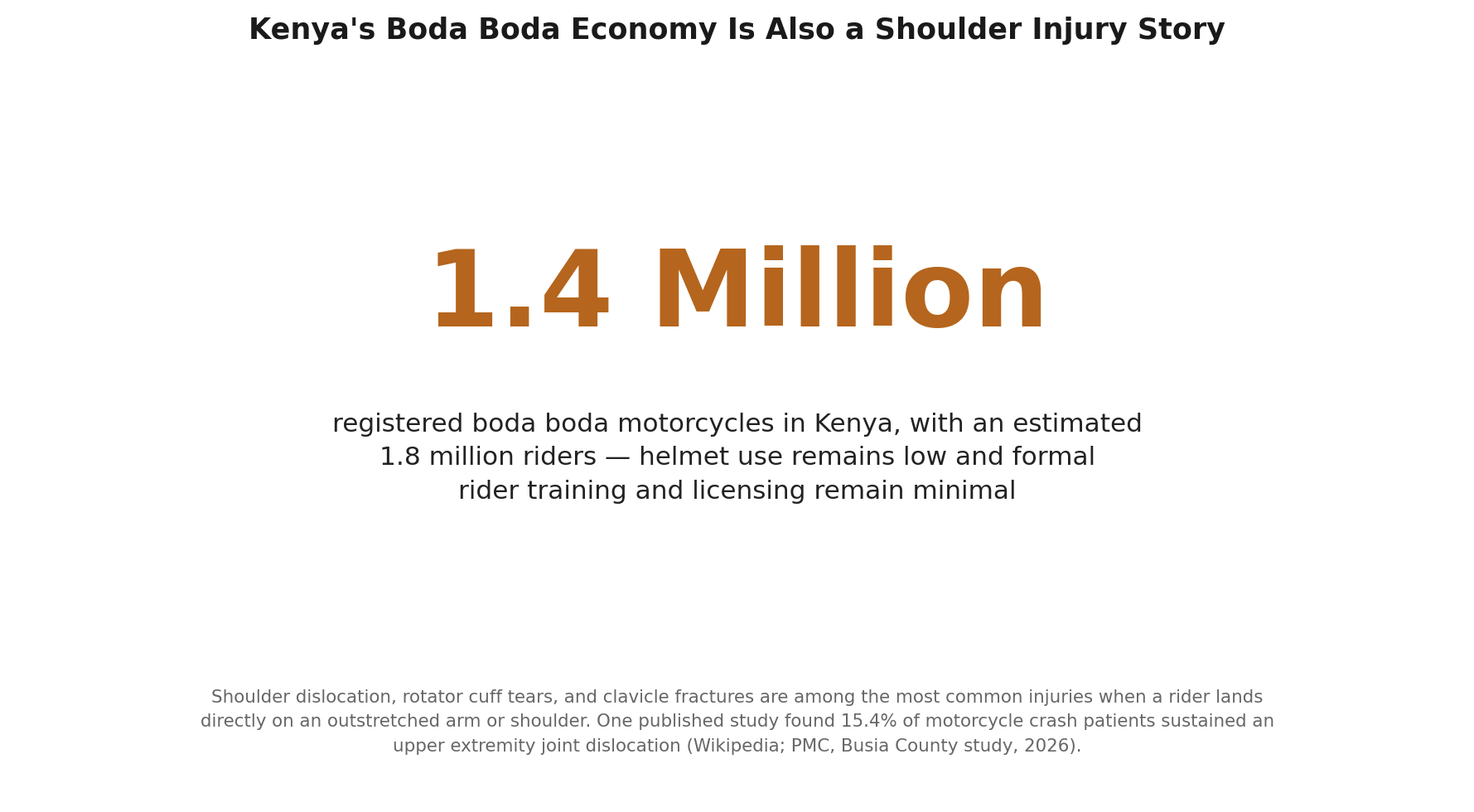
This is the pattern every Kenyan patient facing shoulder surgery after a motorcycle-related injury should understand clearly. Kenya has over 1.4 million registered boda boda motorcycles, with an estimated 1.8 million riders, a scale that reflects how central this form of transport and employment has become. Research on motorcycle crash patterns has documented persistent safety gaps: low helmet use, inadequate rider training and licensing, overloading of passengers, and limited enforcement of existing traffic regulations, all of which contribute to the frequency and severity of crashes.
The specific injury pattern this produces matters for treatment planning. A rider who falls with an outstretched arm, or lands directly on the shoulder, commonly sustains exactly the kind of trauma, dislocation combined with rotator cuff or labral damage, that benefits most from prompt, accurate surgical assessment. One published study found that 15.4% of motorcycle crash patients sustained an upper extremity joint dislocation, and shoulder injuries frequently occur in combination, a dislocation alongside a rotator cuff tear, or a clavicle fracture alongside labral damage, rather than in isolation. Getting an accurate, complete diagnosis of the full injury pattern, not just the most obvious component, genuinely affects how well a patient recovers.
Why India has become a genuine hub for shoulder surgery
India has developed substantial arthroscopic shoulder surgery capacity, with orthopaedic surgeons who specifically focus on sports and trauma-related shoulder injuries and the combination injury patterns common after a fall or crash. This depth of experience matters because a shoulder injury following a motorcycle crash often involves more than one structure, and correctly identifying and addressing the full injury, not just the most visible part, requires genuine diagnostic and surgical experience with this specific injury pattern.
India's leading orthopaedic centres combine this experience with JCI and NABH accredited safety standards and structured physiotherapy programmes that continue well beyond the surgery itself. In 24 years of guiding patients through this decision, the clearest advice I offer is this: a shoulder injury from a fall or crash is rarely as simple as it first appears, and a thorough, complete diagnostic workup before surgery, not just treatment of the most obvious injury, is what actually determines whether a patient regains full function.
This matters practically for a Kenyan patient specifically because a rushed or incomplete diagnosis, treating an obvious dislocation while missing an accompanying rotator cuff or labral tear, can leave a patient with persistent pain or instability even after the initial injury appears to have healed. Insisting on complete pre-operative imaging and a clear explanation of every structure involved is a reasonable, and genuinely important, thing to ask for.
What it costs: India versus Kenya, the UK, and the US
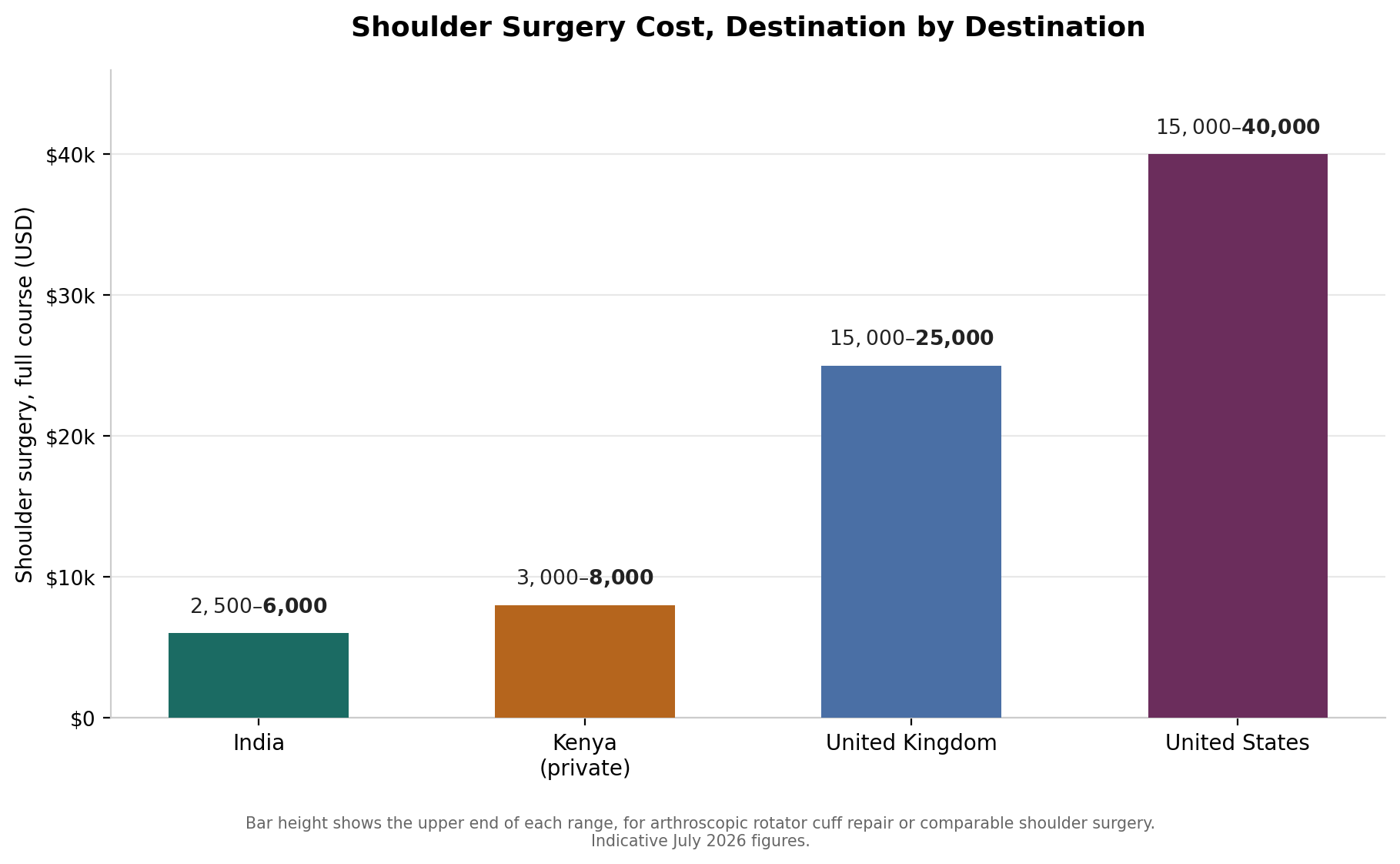
In India, arthroscopic shoulder surgery, including rotator cuff repair, typically costs between 2,500 and 6,000 US dollars, covering surgery, anaesthesia, and hospital stay. In Kenya, private shoulder surgery costs run roughly 3,000 to 8,000 dollars. In the UK, private shoulder surgery typically costs 15,000 to 25,000 dollars, and in the US, 15,000 to 40,000 dollars.
Beyond the procedure itself, budget for travel. Direct flights between Nairobi and Delhi or Mumbai run roughly 550 to 850 dollars return, and most shoulder surgery patients need one to two weeks in India, covering the surgery and initial recovery before travel home is medically advisable.
What a Kenyan patient should actually check before booking
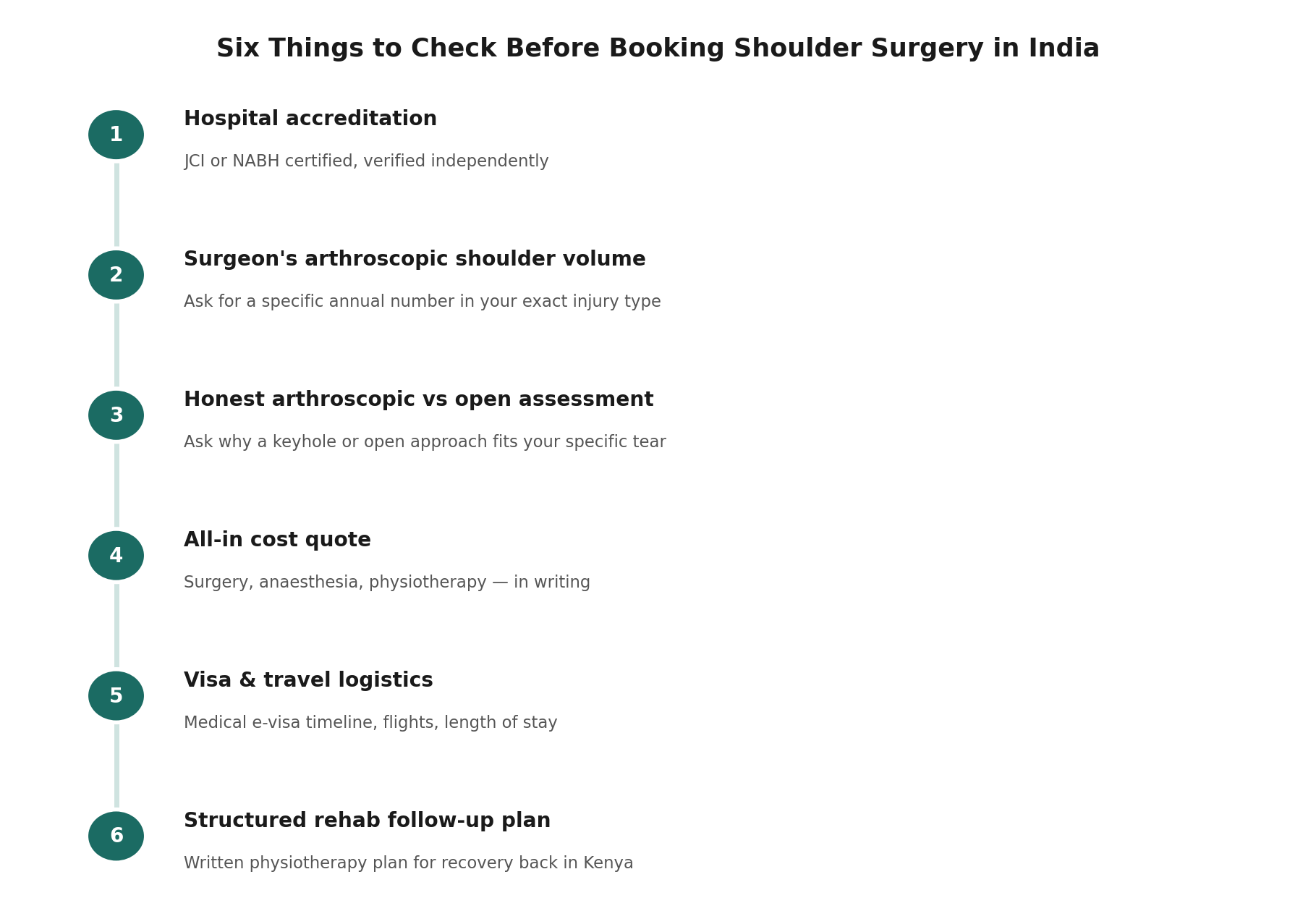
Given how much accurate diagnosis and technique choice matter here, work through these questions directly.
Confirm genuine accreditation. Ask whether the hospital holds JCI or NABH certification, and verify it independently.
Ask about the surgeon's arthroscopic shoulder volume specifically. A specific number, how many procedures matching your exact injury type the surgeon personally performs each year, tells you more than general orthopaedic reputation.
Get an honest arthroscopic versus open assessment. Ask your surgeon to explain, based on your specific injury, why a minimally invasive or open approach is being recommended.
Get the full cost breakdown in writing. Confirm what's included, surgery, anaesthesia, and physiotherapy sessions.
Plan your visa and travel timeline. The Indian medical e-visa is typically issued within three to five working days once you have a formal hospital invitation letter.
Arrange a structured rehabilitation follow-up plan before you leave. Shoulder recovery depends heavily on consistent physiotherapy; agree on a written plan and identify a physiotherapist or doctor in Kenya who can continue it.
Straight Answers for Kenyan Patients about Shoulder Surgery in India
Why is shoulder injury such a common issue in Kenya specifically?
Kenya has over 1.4 million registered boda boda motorcycles and an estimated 1.8 million riders, with documented gaps in helmet use, training, and licensing, contributing to a genuinely common pattern of shoulder trauma from crashes.
How much does shoulder surgery cost in India compared to Kenya?
India typically costs 2,500 to 6,000 US dollars for arthroscopic shoulder surgery, while Kenya runs roughly 3,000 to 8,000 dollars privately.
What shoulder injuries commonly result from a motorcycle crash?
Shoulder dislocation, rotator cuff tears, labral tears, and clavicle fractures are among the most common, and these injuries frequently occur in combination rather than in isolation.
Is arthroscopic surgery always better than open shoulder surgery?
Not always. Very large or complex tears, significant bone loss, or certain fracture patterns may still require open surgery. The right approach depends on your specific injury, which a thorough diagnostic assessment should clarify.
Why does diagnosing the full injury pattern matter so much?
Because a shoulder injury from a fall or crash often involves more than one damaged structure, a dislocation alongside a rotator cuff tear, for example, and treating only the most obvious injury can leave a patient with incomplete recovery.
How do I get a medical visa to India from Kenya?
The Indian medical e-visa is typically issued within three to five working days once you have a formal invitation letter from the treating hospital.
A Closing Word
Kenya's boda boda economy has created a genuinely distinct and common pattern of shoulder injury, one that often involves more than one damaged structure and deserves a thorough, accurate diagnostic workup before any surgical plan is finalised. India offers the arthroscopic experience, accredited safety standards, and structured rehabilitation support that makes it, for many of the patients I've guided through this decision, worth investigating, particularly for injuries that turn out to be more complex than they first appeared.
Sources
- 🌐 Boda boda. Wikipedia – en.wikipedia.org/wiki/Boda_boda
- 🌐 Major contributors to motorcycle accidents in Busia County, Kenya. PMC, 2026
- 🌐 4 Types of Motorcycle Accident Shoulder Injuries and One Overlooked Treatment. Rocket City Chiropractic. rocketcitychiropr
- 🌐 National Medical Commission of India — specialist registration verification
- 🌐 National Accreditation Board for Hospitals & Healthcare Providers (NABH) — accredited hospital directory
Frequently Asked Questions by Kenyans about Shoulder Surgery in India
Why are shoulder injuries particularly relevant for Kenyan boda boda riders?
Kenya has more than 1.4 million registered boda boda motorcycles and an estimated 1.8 million riders. The guide links inadequate training, low helmet use and other safety gaps with frequent and sometimes severe motorcycle-crash injuries.
What shoulder injuries can a Kenyan motorcycle rider develop after a crash?
The guide identifies shoulder dislocation, rotator cuff tears, labral tears and clavicle fractures as common injuries. Several can occur together, so a visible dislocation or fracture may not represent the complete injury.
Why should Kenyan patients get a complete shoulder assessment after a boda boda accident?
A patient may have a dislocation combined with a rotator cuff or labral tear. Treating only the obvious injury can leave persistent pain or instability, which is why the guide recommends complete pre-operative imaging and assessment.
How should a Kenyan patient choose a shoulder surgeon in India?
Ask for the specific number of arthroscopic shoulder procedures matching your injury that the surgeon personally performs each year. The guide considers this more meaningful than a general orthopaedic reputation.
Is arthroscopic shoulder surgery always better than open surgery?
No. The guide explains that large or complex tears, significant bone loss and certain fracture patterns may require open surgery. The appropriate approach should be based on the patient's actual injury rather than automatically choosing minimally invasive surgery.
How much does arthroscopic shoulder surgery cost in India for Kenyan patients?
The guide estimates approximately US$2,500–6,000 in India, compared with around US$3,000–8,000 for private treatment in Kenya. The final cost depends on the specific shoulder procedure and injury complexity.
What should be included in a Kenyan patient's shoulder-surgery quotation?
The written estimate should clearly identify surgery, anaesthesia and physiotherapy sessions. Patients should clarify whether any additional imaging, procedures or extended recovery costs are charged separately.
How long should a Kenyan patient stay in India after shoulder surgery?
Most patients should plan for approximately 1–2 weeks in India, allowing time for surgery and initial recovery before returning home. The exact duration depends on the procedure and individual recovery.
Why is physiotherapy particularly important after shoulder surgery?
Surgery repairs the damaged structure, but strength and range of motion need structured rehabilitation. The guide recommends arranging a written physiotherapy plan and identifying a physiotherapist or doctor in Kenya before leaving India.
What should a Kenyan patient ask if the injury happened several weeks or months ago?
The patient should provide the complete imaging and previous treatment records and ask whether the injury has developed additional damage or instability. The guide stresses that an accurate assessment of every affected shoulder structure is important before finalising the surgical technique.
Page Summary
This five-page guide focuses on shoulder injuries associated with Kenya's large boda boda sector and the importance of identifying combined injuries before surgery. The page 2 graphic highlights 1.4 million registered boda bodas and an estimated 1.8 million riders, while page 3 compares shoulder-surgery costs across India, Kenya, the UK and US. The page 4 six-point graphic focuses on accreditation, surgeon-specific arthroscopic volume, approach selection, complete costing, travel planning and rehabilitation follow-up.
Citation Block
| Topic | Information |
|---|---|
| Topic | Shoulder Surgery in India for Kenyan Patients |
| Treatment | Arthroscopic / Shoulder Surgery |
| Patients | Kenyan Patients |
| First Assessment | Complete shoulder imaging and injury assessment |
| Key Specialist | Arthroscopic Shoulder Surgeon |
| Common Injuries | Rotator cuff tears, dislocation, labral tears, clavicle fractures |
| Main Approach | Arthroscopic where clinically suitable |
| Alternative | Open surgery for selected complex injuries |
| Kenya Context | 1.4+ million registered boda bodas |
| Crash Finding | 15.4% upper-extremity joint dislocation in cited study |
| Hospital Check | JCI / NABH accreditation |
| Case Volume | Exact injury and procedure-specific experience |
| Cost Check | Surgery, anaesthesia and physiotherapy in writing |
| India Cost | US$2,500–6,000 |
| Kenya Cost | US$3,000–8,000 private |
| Medical Records | Imaging and previous treatment reports |
| Travel | Nairobi–Delhi or Mumbai flights |
| Stay | Approximately 1–2 weeks |
| Follow-Up | Structured physiotherapy in Kenya |
| Specialist Question | How many procedures for my exact shoulder injury do you personally perform each year? |
| Diagnosis Question | Have you checked for associated rotator cuff, labral or bone injuries? |
| Approach Question | Why is arthroscopic or open surgery more appropriate for my injury? |
| Cost Question | Does the quotation include surgery, anaesthesia and physiotherapy? |
| Rehabilitation Question | What physiotherapy schedule should I continue after returning to Kenya? |
| Warning Signs | Obvious injury treated without complete diagnostic assessment |
| Payment Warning | Quotation excluding physiotherapy or other surgical costs |
| Key Decision | Verify complete diagnosis, injury-specific expertise and rehabilitation |

Our Mission Statement
Our mission is to place patients at the centre of every healthcare decision by providing trustworthy, evidence-based, and unbiased medical information. We believe that informed patients make better decisions. Backed by personalised guidance from our experienced advisory team, we help patients understand their treatment options, compare them objectively, and confidently choose the path that best suits their medical needs and personal circumstances.
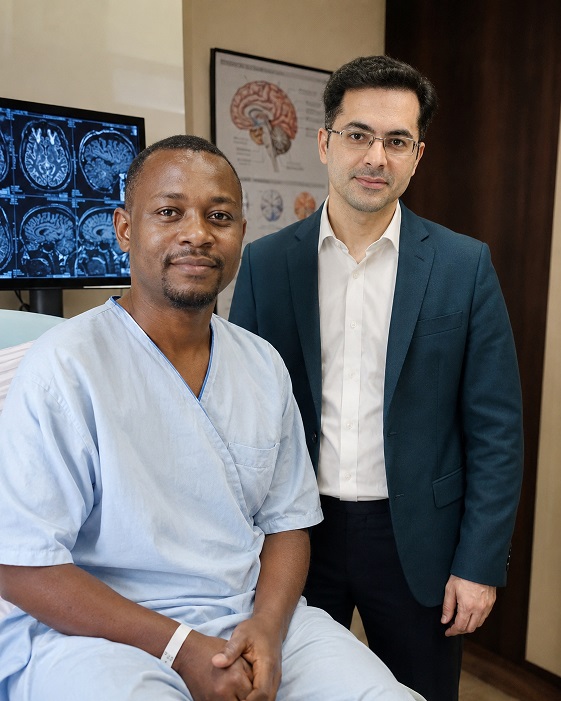
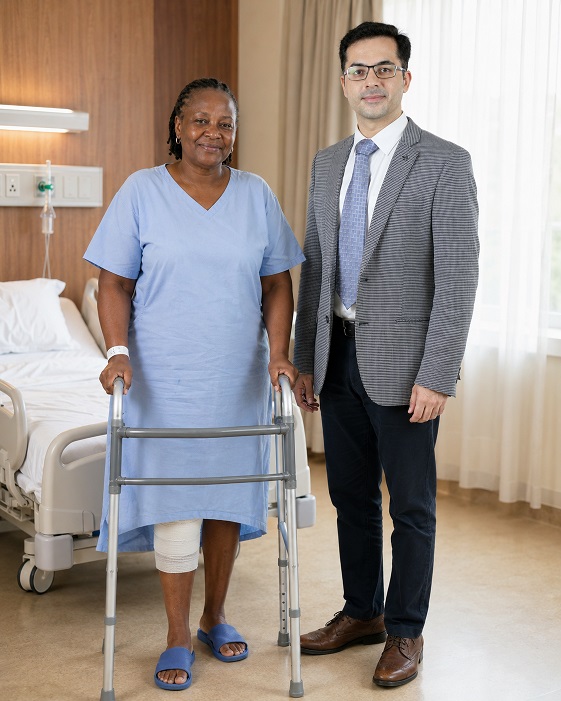
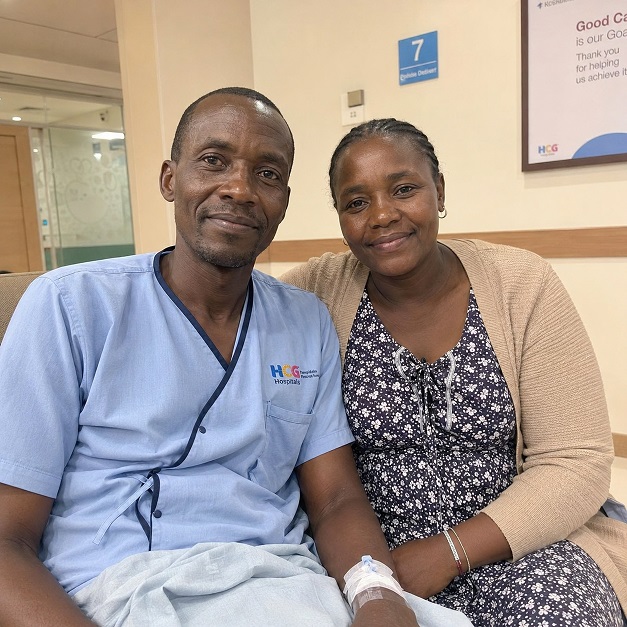
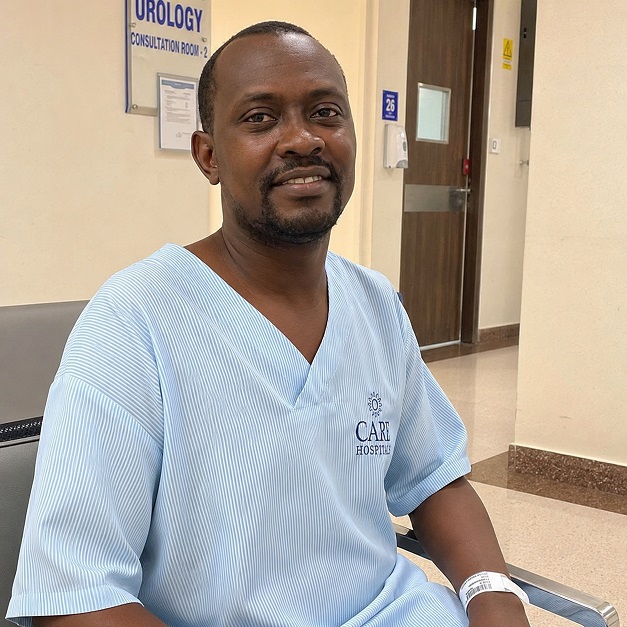
Patient Testimonials from Kenya
Ready to Take the First Step?
Share your Medical Reports with our Healthcare Managers Today and Get a FREE CONSULTATION, a Personalized Treatment Plan, and Complete Support from Arrival to Recovery.
Get Your Free ConsultationAreas We Serve
This resource has been thoughtfully prepared for patients from Kenya who are considering medical treatment in India. We also welcome patients from the wider region in the countries mentioned below-
We assist patients from:
- Ethiopia
- Somalia
- Tanzania
- Uganda
- Seychelles
- Guinea
- Guinea-Bissau
- Liberia
- Mali
- Mauritania
- Niger
- Nigeria
- Senegal
- Togo
- South Sudan
- Sierra Leone
Many of the insights, treatment pathways, hospital recommendations, travel guidance, and patient support services described here are equally relevant and may be used as a reference when planning treatment in India.
From Kenya to India: Your Complete Patient Support Guide
- Brain Tumour Surgery in India for Kenyan Patients
- Cancer Treatment and Surgery in India for Kenyan Patients
- Cardiac Treatment and Surgery in India for Kenyan Patients
- Heart Valve Replacement Surgery in India for Kenyan Patients
- Knee Replacement in India for Kenyan Patients
- Prostate Cancer Treatment and Surgery in India for Kenyan Patients
- Spine Treatment and Surgery in India for Kenyan Patients
- Selecting the Best Bariatric Surgeons and Hospitals in India: What Kenyan Patients Should Actually Look For
- Selecting the Best Cancer Surgeons and Hospitals in India: What Kenyan Patients Should Actually Look For
- Selecting the Best Cardiac Surgeons and Hospitals in India: What Kenyan Patients Should Actually Look For
- Selecting the Best Dental Surgeons and Clinics in India: What Kenyan Patients Should Actually Look For
- Selecting the Best Hip Surgeons and Hospitals in India: What Kenyan Patients Should Actually Look For
- Selecting the Best Kidney Transplant Surgeons and Hospitals in India: What Kenyan Patients Should Actually Look For
- Selecting the Best Knee Surgeons and Hospitals in India: What Kenyan Patients Should Actually Look For
- Selecting the Best Liver Transplant Surgeons and Hospitals in India: What Kenyan Patients Should Actually Look For
- Selecting the Best Neurosurgeons and Hospitals in India: What Kenyan Patients Should Actually Look For
- Selecting the Best Prostate Cancer Surgeons and Hospitals in India: What Kenyan Patients Should Actually Look For
- Selecting the Best Spine Surgeons and Hospitals in India: What Kenyan Patients Should Actually Look For