

Selecting the Best Kidney Transplant Surgeons and Hospitals in India: What Kenyan Patients Should Actually Look For
Indian law is precise about who may donate a kidney — settle the donor question before you spend a single month researching hospitals.
A kidney transplant is different from every other operation in this series in one specific way: you cannot simply choose a good surgeon and a good hospital and book a flight. You need a donor first, and Indian law is precise and unbending about who that donor can be. Across 24 years of guiding international patients through Indian hospitals, the single most common and most painful mistake I see Kenyan families make is researching hospitals for months before establishing whether they actually have a legally eligible donor at all. This is the framework I use when a Kenyan patient is weighing a kidney transplant in India. It follows the surgeon-then-hospital structure of this series, but the donor question comes first, because nothing else in this guide matters until it is settled.
Healing Journeys of Kenyan Patients









Key Takeaways
- For a Kenyan patient considering kidney transplantation in India, the donor question comes before surgeon or hospital selection. The guide states that foreign patients cannot join India's deceased-donor kidney waiting list; the pathway described for Kenyan patients is living donation from an eligible close relative, with the relationship verified through documentation and hospital ethics review.
- The document specifically identifies a parent, sibling, adult child or spouse as typical close-relative donors. It strongly warns against anyone offering an unrelated or purchased donor arrangement, describing this as illegal and carrying serious legal, ethical and medical risks.
- For most patients with end-stage kidney disease who have a suitable donor, the guide explains that transplantation generally offers better long-term survival and quality of life than indefinite dialysis and can become less expensive cumulatively. However, transplant suitability must still be assessed individually by a nephrologist.
- Kenya already performs kidney transplantation. The guide therefore recommends investigating a domestic transplant first when the patient has a suitable donor and a Kenyan centre has capacity, particularly because Kenya's Social Health Authority provides domestic renal-care support.
- According to the document, SHA funds pre-transplant recipient evaluation up to KES 150,000 per household and contributes toward transplant surgery and postoperative care performed within Kenya. Routine kidney transplantation in India is not included in the overseas benefit described in the guide because the procedure is available domestically.
- The most important surgeon/team criterion is having a genuine transplant team rather than a solo surgeon. The team should include a transplant surgeon, nephrologist, immunologist or histocompatibility specialist and transplant coordinator.
Quick Facts
- Treatment
- Living-Donor Kidney Transplantation
- Country
- India
- Intended Audience
- Kenyan Patients and Families
- Primary Condition
- End-Stage Kidney Disease Requiring Renal Replacement Therapy
- First Question
- Does the Patient Have an Eligible, Willing and Medically Suitable Living Donor?
- Donor Type for Kenyan Patients
- Living Donor
- Typical Eligible Donors Mentioned
- Parent, Sibling, Adult Child or Spouse
- Deceased-Donor Kidney in India
- Foreign Patients Cannot Join the Deceased-Donor Waiting List According to the Guide
- Unrelated/Purchased Donor
- Described as Illegal and a Serious Red Flag
- Donor Verification
- Documentary Proof of Relationship and Hospital Ethics Committee Review
- Alternative to Transplant
- Continued Dialysis
- Transplant vs Dialysis
- Transplantation Generally Offers Better Long-Term Survival and Quality of Life for Suitable Patients With an Appropriate Donor
- Kidney Transplant in Kenya
- Available at Kenyatta National Hospital and a Small Number of Other Centres According to the Guide
- Kenya CKD Burden Mentioned
- Approximately 3.1 Million Kenyans
- SHA Pre-Transplant Evaluation
- Up to KES 150,000 Per Household According to the Guide
- SHA Domestic Support
- Contributes Toward Transplant Surgery and Postoperative Care Performed Within Kenya
- SHA Overseas Kidney Transplant Funding
- Routine Kidney Transplantation.
In Brief
Kenyan patients considering kidney transplantation in India should establish that they have an eligible, willing and medically suitable living donor before choosing a surgeon or hospital. The guide places 62% of the selection weighting on surgeon/team factors and 38% on hospital factors, with the highest importance given to a genuine multidisciplinary transplant team, donor safety, transparent immunosuppression planning and the surgeon's personal living-donor transplant volume. Indicative kidney transplant costs in India are approximately USD 11,000–24,000, while lifelong immunosuppressant medication is estimated separately at around USD 300–500 per month. Patients should also ensure that their prescribed medicines are available in Kenya and obtain a written long-term monitoring plan before returning home.
Before anything else: do you have a donor?
India's Transplantation of Human Organs and Tissues Act restricts deceased-donor kidneys to Indian citizens and permanent residents. Foreign patients cannot join that waiting list, and there is no legal route to a deceased-donor transplant in India as a Kenyan patient. The only path available to you is a living-donor transplant, and the donor must be a close relative — typically a parent, sibling, adult child, or spouse — verified through documentation and reviewed by a hospital ethics committee before surgery is authorised.
This is not a formality to work around. It is the defining fact of your entire journey. If you do not yet have a willing, medically suitable close relative, that is the question to resolve before you spend another hour researching hospitals or surgeons, because no amount of surgical excellence changes this legal requirement. Any programme, broker or contact suggesting an unrelated or purchased donor arrangement in India is describing something illegal, and involvement in it carries serious legal risk for both you and your donor, quite apart from the ethical and medical dangers of an unregulated arrangement.
Transplant or continued dialysis?
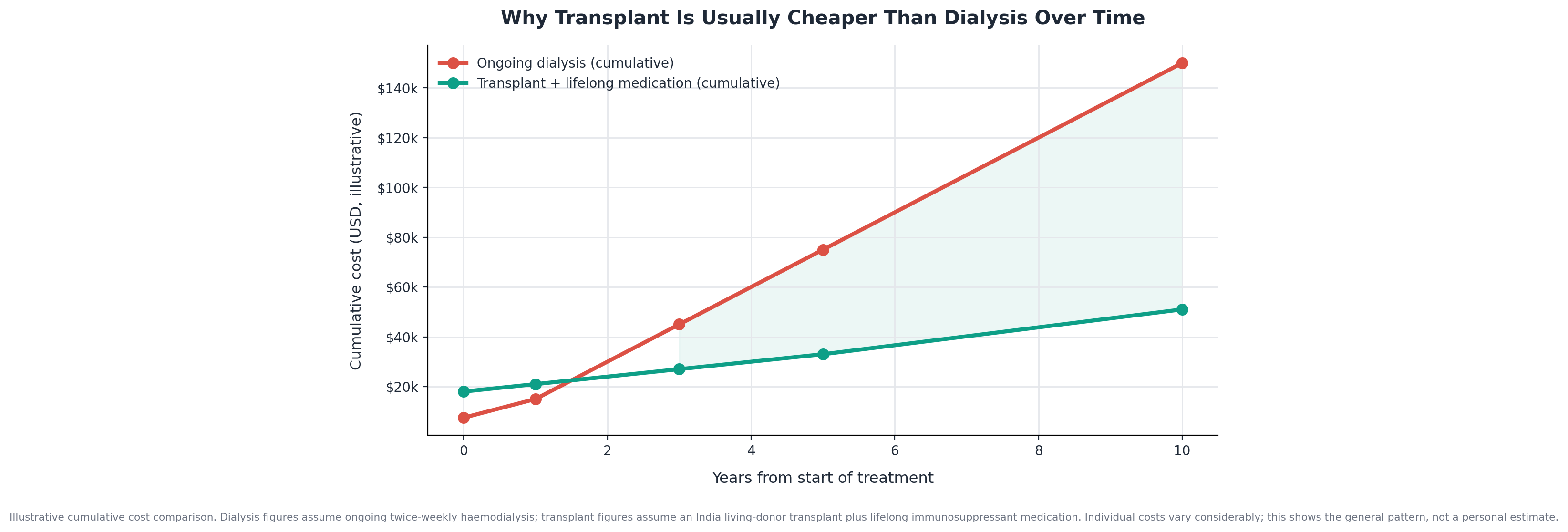
For most patients with end-stage kidney disease and a suitable donor, transplantation offers meaningfully better long-term survival and quality of life than remaining on dialysis indefinitely, and it is usually the less expensive path once you compare cumulative costs over several years rather than the upfront number alone. But this is a decision for a nephrologist to make with you, based on your specific health, not an assumption to walk in with. Certain heart, lung or other conditions can make major surgery genuinely unsafe even when dialysis remains manageable, and a good transplant team will tell you honestly if you are not currently a suitable candidate.
Should you travel at all?
Kenya performs kidney transplants, and chronic kidney disease is a large and growing burden here — the Ministry of Health estimates around 3.1 million Kenyans are living with the condition. Kenyatta National Hospital and a small number of other centres perform transplants domestically, and Kenya, like India, permits only living-related donation; there is no deceased-donor programme here either. Since October 2024, Kenya's Social Health Authority has meaningfully expanded coverage, funding pre-transplant recipient evaluation up to 150,000 shillings per household and contributing toward the transplant surgery and post-operative care itself for procedures performed inside Kenya.
Given this, a domestic transplant is genuinely worth investigating first if you have a suitable donor and a Kenyan centre has capacity, since SHA's domestic coverage makes it considerably cheaper than travelling abroad. The case for India strengthens where Kenyan capacity is constrained, where your case has complicating factors needing a more experienced team, or where you have researched local options and concluded that the wait or the specific expertise you need is not readily available domestically.
On funding for the India route specifically: SHA's overseas treatment benefit is separate from its domestic renal package, capped at 500,000 shillings and reserved for 36 gazetted procedures unavailable in Kenya. Routine kidney transplantation does not qualify, since Kenya performs it domestically. Plan to pay for a transplant in India yourself, and use SHA's domestic renal coverage only for care received inside Kenya, such as dialysis while you prepare for travel.
Part one: judging the surgeon and transplant team
1. A genuine transplant team, not a solo surgeon
I weight this above every other single factor, and the chart below reflects that. A kidney transplant properly involves a transplant surgeon, a nephrologist, an immunologist or histocompatibility specialist, and a transplant coordinator working as a team, not a surgeon operating in isolation. Ask directly who is on your team, and specifically who manages the immunosuppression protocol that will govern the rest of your life, since this is arguably as important as the surgery itself.
2. Your donor's safety and long-term follow-up, not just yours
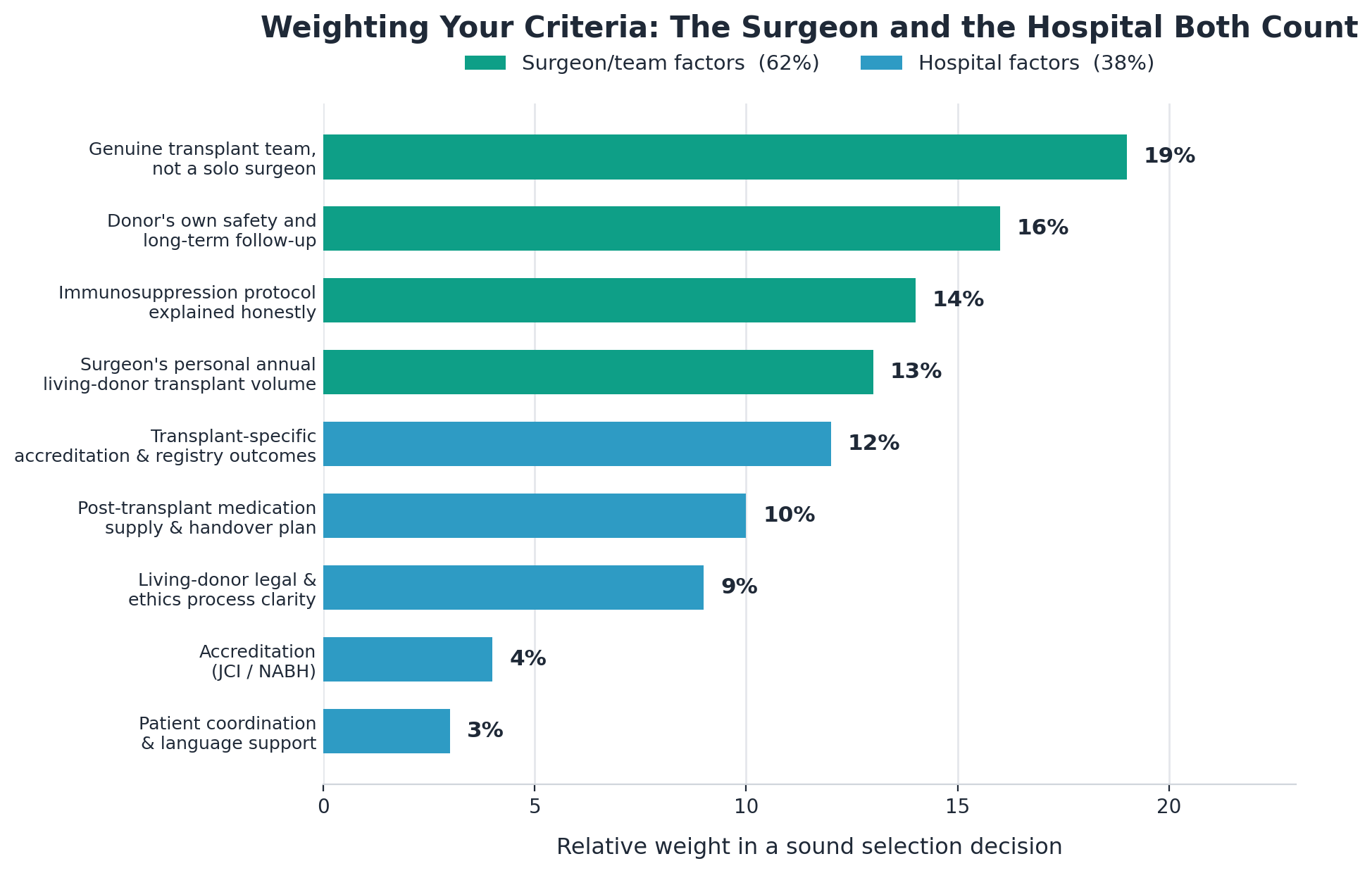
This is the criterion most patients forget to ask about, focused as they naturally are on their own recovery. Your donor is a healthy person undergoing major surgery for no medical benefit to themselves. Ask specifically what the donor's surgical approach is (laparoscopic donor nephrectomy is now standard at good centres and involves a shorter recovery than open surgery), what long-term follow-up is offered to the donor after they return to Kenya, and what the team's own donor complication rate is. A programme that cannot answer confidently about donor safety is not one I would trust with a family member.
3. Immunosuppression protocol, explained honestly
Ask what immunosuppressant regimen is planned, why that specific combination, and what the realistic monthly medication cost will be once you are back in Kenya — this is a lifelong commitment, not a short course. A good team explains the trade-offs between rejection risk and side effects plainly, and gives you a genuine estimate of ongoing cost rather than a vague reassurance.
4. Personal annual volume in living-donor transplants
Ask for the surgeon's personal annual living-donor transplant volume specifically, since deceased- donor and living-donor procedures, while related, are not identical in technique or timing pressure. India's high-volume transplant centres perform hundreds of living-donor procedures a year; ask for the individual surgeon's number, not the hospital's total.
Part two: judging the hospital
Transplant surgery depends on institutional systems more heavily than almost any procedure in this series — reflected in the meaningful hospital-side weighting below, even as team factors still carry the majority.
5. Transplant-specific accreditation and registry outcomes
General hospital accreditation such as JCI or NABH is a meaningful baseline, but ask specifically whether the transplant programme itself reports outcomes to a national or international transplant registry, and whether it can show you graft and patient survival figures at one and five years, not just an overall "success rate" claim that may be defined loosely.
6. Living-donor legal and ethics process clarity
Ask the hospital to walk you through exactly what documentation will be required to prove your donor's relationship to you, and what the ethics committee review process involves and how long it typically takes. A hospital experienced with international patients will have this process well organised; one that seems uncertain or vague about it is a hospital you have not fully vetted yet.
7. Post-transplant medication supply and handover plan
Ask whether the hospital will provide a written, detailed medication and monitoring protocol that a Kenyan nephrologist can follow, and confirm that the specific immunosuppressant brands prescribed are actually available in Kenya — not every drug used in an Indian hospital has a straightforward equivalent on Kenyan pharmacy shelves, and discovering this after you return home is a genuinely dangerous position to be in.
8. Accreditation, read properly
JCI and NABH accreditation are meaningful filters on infection control and safety systems generally, which matter considerably given that transplant recipients are deliberately immunosuppressed and therefore more vulnerable to infection. Use accreditation to exclude candidates, not to choose between the remaining ones.
9. The cost you will actually pay
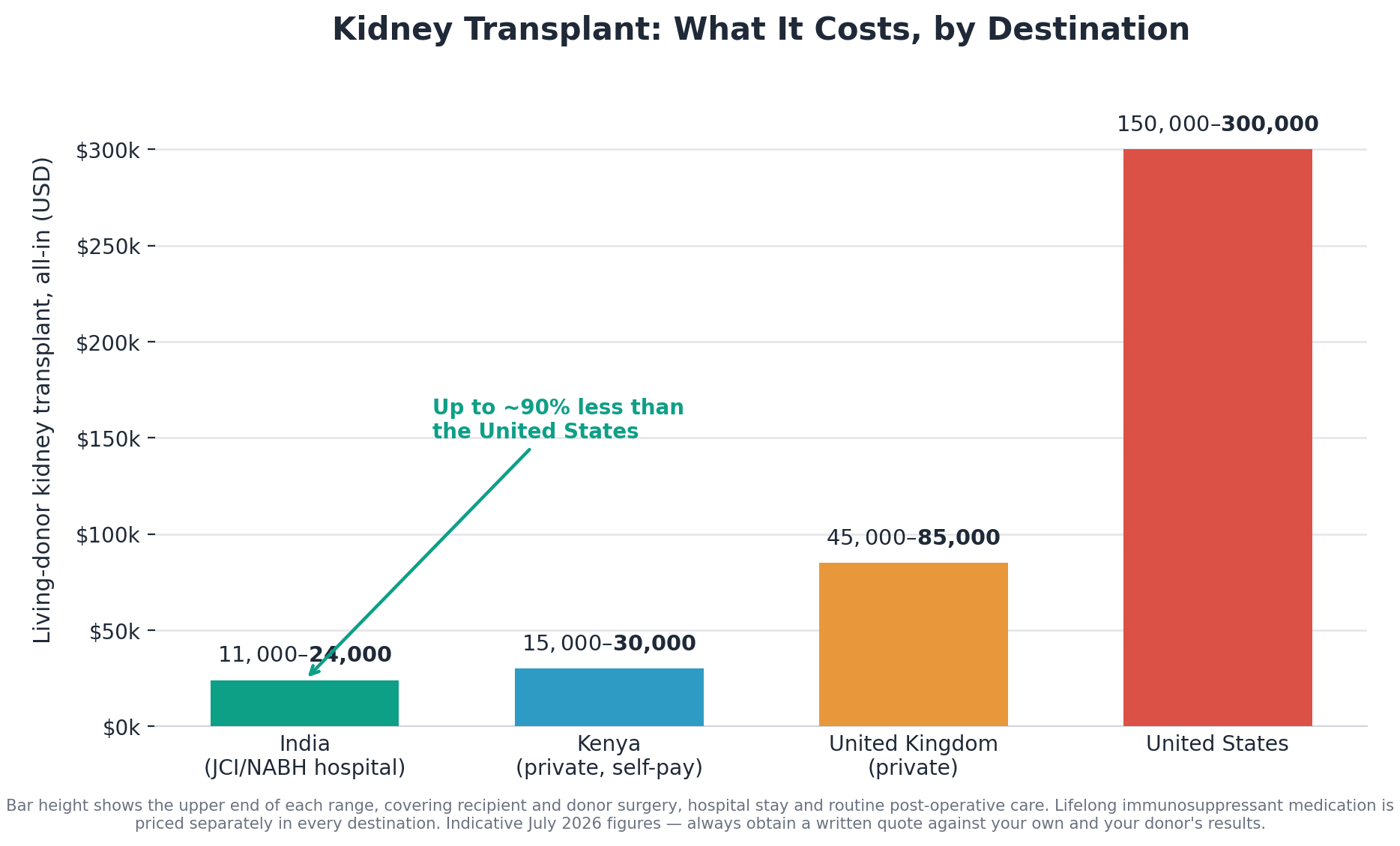
Let me be emphatic about this, because 24 years of handling these cases has taught me nothing more consistently: disputes almost never concern the quoted price. They concern what the quote silently omitted. For a kidney transplant specifically, insist the written estimate separates recipient surgery, donor surgery, and hospital stay for each of you individually, and states clearly that immunosuppressant medication is priced separately and ongoing, not a one-time cost bundled into the package.
Budget beyond the surgery. Direct Nairobi–Delhi and Nairobi–Mumbai flights run roughly 550 to 850 dollars return for each of you, and three to four weeks of accommodation for recipient, donor and possibly a third attendant adds a genuine sum that needs planning for two or three people, not one.
Four signals that should make you pause
Certain patterns reliably precede a difficult outcome. Any suggestion, however indirect, that an unrelated or purchased donor can be arranged — this is illegal and dangerous, and you should end that conversation immediately. Vagueness about the ethics committee process or required documentation. No clear answer about your donor's own long-term follow-up. And a quoted medication cost that sounds implausibly low for lifelong immunosuppression.
None of the first three alone proves a bad hospital, though the first is disqualifying on its own. Together they warrant walking away and seeking a second, more transparent programme.
The Kenya-specific practicalities
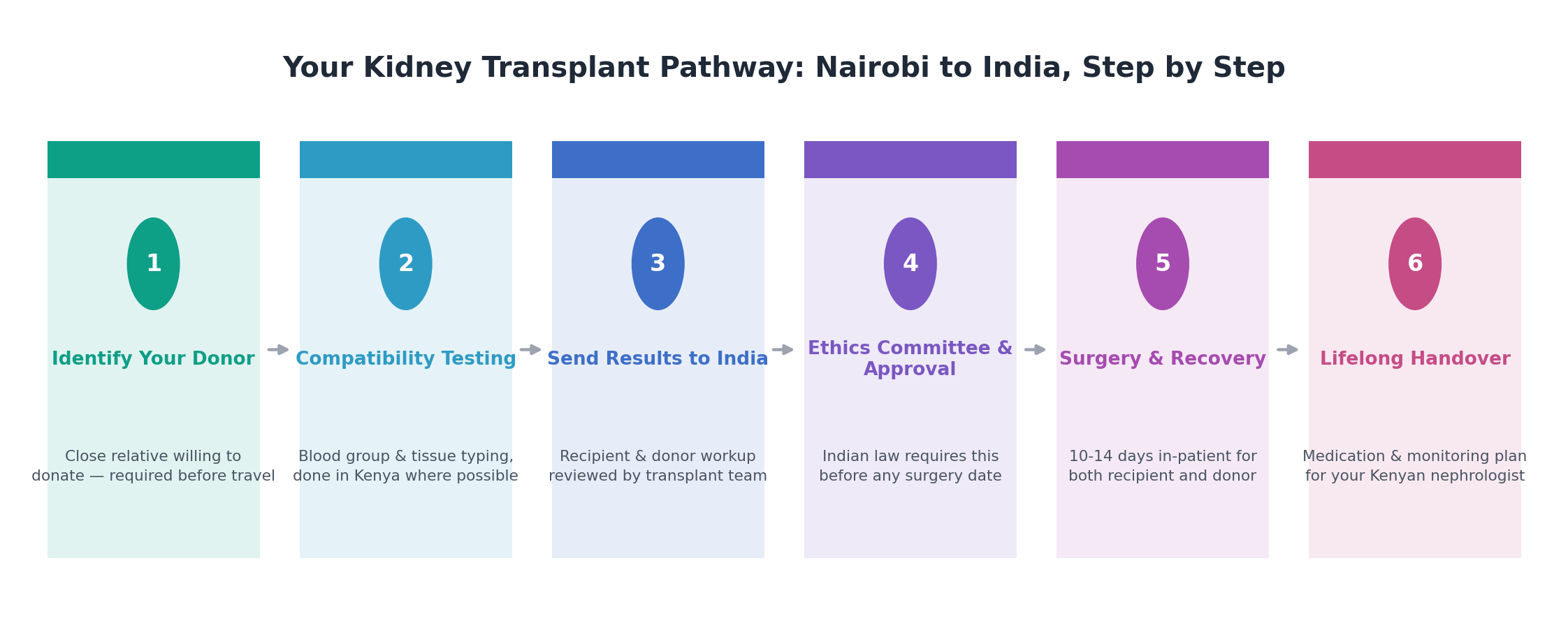
Complete as much compatibility testing as possible in Kenya before travelling — blood group and initial tissue typing can often be done locally, reducing the time and cost of the India leg. Direct Nairobi–Delhi and Nairobi–Mumbai flights make the journey roughly six hours. The Indian medical e-visa is issued to Kenyan passport holders within three to five working days against a hospital letter; your donor will need a separate medical attendant or donor visa arranged alongside yours, so raise this explicitly with the hospital's international patient team early.
Before you fly, confirm which immunosuppressant brands will be prescribed and check with a Kenyan pharmacist or your local nephrologist that equivalent medication is available and affordable once you are home — this single check can prevent a genuinely dangerous gap in your care three months after you return.
The questions I would ask before paying a deposit
Of the transplant team:
- Who exactly is on my transplant team, and who manages my immunosuppression protocol?
- What is your personal annual volume in living-donor kidney transplants specifically?
- What immunosuppressant regimen do you propose, and what will it realistically cost monthly in Kenya?
- What is my donor's surgical approach, and what long-term follow-up is offered to them?
Of the hospital:
- What are your one- and five-year graft and patient survival figures, reported to a registry?
- What documentation will you require to verify my donor's relationship to me?
- How long does the ethics committee review typically take?
- Will you confirm my prescribed medications are available in Kenya before I travel?
- Is the quote broken down separately for my surgery and my donor's surgery?
- What exactly is excluded from the quoted price?
- May I speak to a previous patient-and-donor pair from East Africa?
A team that answers all eleven without irritation is very likely the right team. One that becomes vague at the first, the fourth, or the ninth has told you what you needed to know at no cost at all.
Straight Answers for Kenyan Patients about Kidney Transplant Surgeons and Hospitals in India
How do I choose the best kidney transplant surgeon and hospital in India?
Start with the fact that you need an identified, willing, compatible living donor who is a close relative — Indian law does not permit a deceased-donor or unrelated-donor transplant for foreign patients. Once your donor is confirmed, ask about the transplant team's genuine multidisciplinary structure, personal surgeon volume in living-donor transplants, and registry-reported long-term outcomes.
How much does a kidney transplant cost in India for a Kenyan patient?
Typically 11,000 to 24,000 US dollars all in, covering recipient and donor surgery, hospital stay and routine post-operative care. Immunosuppressant medication is priced separately, usually 300 to 500 dollars monthly. The same transplant costs roughly 15,000 to 30,000 in Kenyan private care, 45,000 to 85,000 in the UK, and 150,000 to 300,000 in the United States.
Can I get a kidney transplant in India without bringing my own donor?
No. India restricts deceased-donor kidneys to its own citizens and residents, and foreign patients cannot join that list. The only legal route is a living-donor transplant where the donor is a close relative, verified through documentation and ethics committee review. Any suggestion of an unrelated or purchased donor is illegal and should be treated as a serious warning sign.
Is a kidney transplant available for free or subsidised in Kenya?
Partially. Since October 2024, Kenya's Social Health Authority funds dialysis, pre-transplant evaluation up to 150,000 shillings per household, and support toward transplant surgery and care performed inside Kenya. This makes a domestic transplant considerably cheaper than travelling abroad if a suitable donor and local capacity are both available. SHA's overseas benefit does not cover routine transplants, since Kenya performs them domestically.
Is dialysis or a transplant the better option?
For most patients with a suitable donor, transplantation offers better long-term survival and quality of life than indefinite dialysis, and is usually cheaper cumulatively over several years. But it is not automatically right for everyone — certain conditions make surgery unsafe even when dialysis remains manageable, and this decision should be made with a nephrologist reviewing your specific health.
How long must I and my donor stay in India for a kidney transplant?
Around three to four weeks for both of you: several days for final testing and ethics committee review, roughly ten to fourteen days as an in-patient each, and a recovery period before fit-to-fly clearance is given separately for recipient and donor, since your recovery timelines differ.
A closing word
The best kidney transplant programme in India for you begins with a straightforward, unambiguous conversation about your donor — who they are, how their relationship to you will be verified, and how their own safety and recovery will be managed, not just yours. From there, the best team is the one that explains immunosuppression honestly, reports real outcomes to a registry, and writes down in advance exactly how your medication and monitoring continue once you are back in Kenya, for the rest of your life. If you would like me to talk through your situation, including whether a Kenyan transplant might in fact be the better first option to investigate, get in touch.
Sources
- 🌐 The Current State of Kidney Transplantation in Kenya. International Journal of Clinical Medicine , 2025
- 🌐 Global Dialysis Perspective: Kenya. Kidney360
- 🌐 Ministry of Health Kenya — chronic kidney disease burden and Social Health Authority renal care coverage, World Kidney Day briefing, 2026
- 🌐 National Medical Commission of India — surgeon and specialist registration verification
- 🌐 National Accreditation Board for Hospitals & Healthcare Providers (NABH) — accredited hospital directory
- 🌐 Kenya Social Health Authority (SHA) — renal care and overseas treatment benefit guidance
Frequently Asked Questions by Kenyans about Kidney Transplant Surgeons and Hospitals in India
Can a Kenyan patient get a kidney transplant in India without bringing a donor?
No, according to the guide. It states that foreign patients cannot join India's deceased-donor kidney waiting list, so the pathway described is a living-donor transplant involving an eligible close relative whose relationship is documented and reviewed.
Who can donate a kidney to a Kenyan patient undergoing transplantation in India?
The document identifies close relatives such as a parent, sibling, adult child or spouse as typical donors. The donor must also be willing, medically suitable and approved through the required legal and ethics process.
How much does a kidney transplant in India cost for Kenyan patients?
The guide gives an indicative cost of approximately USD 11,000–24,000, covering recipient and donor surgery, hospitalisation and routine postoperative care. Lifelong immunosuppressant medication is separate.
How much do anti-rejection medicines cost after kidney transplant?
The document estimates ongoing immunosuppressant medication at approximately USD 300–500 per month. Patients should confirm that the exact prescribed medicines are available in Kenya before returning home.
Is kidney transplantation available in Kenya?
Yes. The guide states that Kenyatta National Hospital and a small number of other centres perform kidney transplantation, making a domestic transplant worth investigating first when a suitable donor and local capacity are available.
Will Kenya's SHA pay for a kidney transplant in India?
According to the document, routine kidney transplantation does not qualify for the overseas SHA pathway because Kenya already performs it. SHA does, however, provide domestic renal-care support described in the guide.
How should Kenyan patients choose a kidney transplant team in India?
Look for a genuine multidisciplinary team involving a transplant surgeon, nephrologist, immunology or histocompatibility expertise and a transplant coordinator. The guide gives this factor the highest individual weighting at 19%.
What should patients ask about kidney donor safety?
Ask about the donor's surgical approach, the team's donor complication rate and long-term follow-up after returning to Kenya. The guide describes laparoscopic donor nephrectomy as standard at good centres.
How long should a Kenyan patient and donor stay in India?
The guide recommends approximately 3–4 weeks for both, including final testing, ethics committee review, roughly 10–14 inpatient days each and sufficient recovery before separate fit-to-fly clearance.
What are the biggest red flags when choosing a kidney transplant programme in India?
The strongest warning is any suggestion that an unrelated or purchased donor can be arranged. Other red flags include vagueness about ethics approval, no clear long-term donor follow-up and unrealistically low estimates for lifelong immunosuppressant medication.
Page Summary
This guide explains that kidney transplantation differs from most medical-travel procedures because the donor must be established before the surgeon and hospital are selected. For Kenyan patients, the document describes living donation from an eligible close relative as the legal pathway in India and warns strongly against unrelated or purchased donor arrangements.
Citation Block
| Topic | Information |
|---|---|
| Topic Information | Selecting Kidney Transplant Surgeons and Hospitals in India for Kenyan Patients |
| Procedure | Living-Donor Kidney Transplant |
| Country | India |
| Intended Audience | Kenyan Patients and Families |
| Condition Covered | End-Stage Kidney Disease Requiring Kidney Transplantation |
| Donor Requirement | Eligible, Willing and Medically Suitable Living Close Relative |
| Typical Donors Mentioned | Parent, Sibling, Adult Child or Spouse |
| Donor Procedure | Laparoscopic Donor Nephrectomy Discussed as Standard at Good Centres |
| Primary Team Requirement | Genuine Multidisciplinary Kidney Transplant Team |
| Surgeon/Team Weighting | 62% |
| Hospital Weighting | 38% |
| Critical Long-Term Treatment | Lifelong Immunosuppression |
| India Transplant Cost | Approximately USD 11,000–24,000 |
| Monthly Immunosuppressant Cost | Approximately USD 300–500 |
| Typical Stay | Approximately 3–4 Weeks for Recipient and Donor |
| Hospital Stay | Approximately 10–14 Days Each According to the Guide |
| Accreditation Mentioned | JCI and NABH |
| Kenya Follow-Up | Lifelong Nephrology Monitoring and Immunosuppression Management |
| Author | Dr. Dheeraj Bojwani |
| Experience | 24 Years' Experience |


Our Mission Statement
Our mission is to place patients at the centre of every healthcare decision by providing trustworthy, evidence-based, and unbiased medical information. We believe that informed patients make better decisions. Backed by personalised guidance from our experienced advisory team, we help patients understand their treatment options, compare them objectively, and confidently choose the path that best suits their medical needs and personal circumstances.
Patient Testimonials from Kenya







Ready to Take the First Step?
Share your Medical Reports with our Healthcare Managers Today and Get a FREE CONSULTATION, a Personalized Treatment Plan, and Complete Support from Arrival to Recovery.
Get Your Free ConsultationAreas We Serve
This resource has been thoughtfully prepared for patients from Kenya who are considering medical treatment in India. We also welcome patients from the wider region in the countries mentioned below-
We assist patients from:
- Ethiopia
- Somalia
- Tanzania
- Uganda
- Seychelles
- Guinea
- Guinea-Bissau
- Liberia
- Mali
- Mauritania
- Niger
- Nigeria
- Senegal
- Togo
- South Sudan
- Sierra Leone
Many of the insights, treatment pathways, hospital recommendations, travel guidance, and patient support services described here are equally relevant and may be used as a reference when planning treatment in India.
From Kenya to India: Your Complete Patient Support Guide
- Brain Tumour Surgery in India for Kenyan Patients
- Cancer Treatment and Surgery in India for Kenyan Patients
- Cardiac Treatment and Surgery in India for Kenyan Patients
- Heart Valve Replacement Surgery in India for Kenyan Patients
- Knee Replacement in India for Kenyan Patients
- Prostate Cancer Treatment and Surgery in India for Kenyan Patients
- Spine Treatment and Surgery in India for Kenyan Patients
- Selecting the Best Bariatric Surgeons and Hospitals in India: What Kenyan Patients Should Actually Look For
- Selecting the Best Cancer Surgeons and Hospitals in India: What Kenyan Patients Should Actually Look For
- Selecting the Best Cardiac Surgeons and Hospitals in India: What Kenyan Patients Should Actually Look For
- Selecting the Best Dental Surgeons and Clinics in India: What Kenyan Patients Should Actually Look For
- Selecting the Best Hip Surgeons and Hospitals in India: What Kenyan Patients Should Actually Look For
- Selecting the Best Kidney Transplant Surgeons and Hospitals in India: What Kenyan Patients Should Actually Look For
- Selecting the Best Knee Surgeons and Hospitals in India: What Kenyan Patients Should Actually Look For
- Selecting the Best Liver Transplant Surgeons and Hospitals in India: What Kenyan Patients Should Actually Look For
- Selecting the Best Neurosurgeons and Hospitals in India: What Kenyan Patients Should Actually Look For
- Selecting the Best Prostate Cancer Surgeons and Hospitals in India: What Kenyan Patients Should Actually Look For
- Selecting the Best Spine Surgeons and Hospitals in India: What Kenyan Patients Should Actually Look For