

Selecting the Best Cardiac Surgeons and Hospitals in India: What Kenyan Patients Should Actually Look For
The East African cardiac patient is usually younger, with valve disease rather than blocked arteries — and that changes what to look for.
Heart surgery is not one operation, and the version most commonly discussed in international medical coverage — an older man with blocked coronary arteries needing a bypass — is often not the version that brings a Kenyan patient to my inbox. Across 24 years of guiding international patients through Indian hospitals, the East African cardiac cases I see most often are younger, and the disease is usually in the valves rather than the arteries. That difference changes what you should actually be looking for in a surgeon and a hospital, and most generic advice about cardiac surgery abroad does not account for it. This is the framework I use when a Kenyan patient is weighing cardiac surgery in India. It follows the same surgeon-then-hospital structure as the rest of this series, but starts with a fact about East African heart disease that shapes everything else.
Healing Journeys of Kenyan Patients





Key Takeaways
- Kenyan patients considering cardiac surgery in India should first establish the exact cardiac diagnosis and operation required before comparing surgeons, hospitals or package prices. A quotation for “heart surgery” alone is not enough to judge whether two hospitals are actually proposing the same treatment.
- The surgeon's experience should match the patient's specific operation. Experience with coronary artery bypass grafting does not automatically establish the same level of expertise in complex valve repair, congenital cardiac surgery or other specialised cardiac procedures.
- For valve disease, the guide places importance on determining whether a diseased valve can be repaired rather than automatically replaced. This is particularly relevant when the anatomy and disease pattern make durable repair technically possible.
- Patients should therefore ask how many procedures of the exact type being proposed the named surgeon personally performs, rather than relying only on the hospital's overall annual cardiac-surgery volume.
- Cardiac surgery depends on a broader heart team, not the operating surgeon alone. Anaesthesia, perfusion, cardiology, cardiac imaging, intensive care and postoperative rehabilitation all contribute to the treatment pathway.
- Hospital infrastructure is particularly important because serious complications after heart surgery can require immediate specialist intervention. A dedicated cardiac ICU with appropriately trained staff is therefore a critical selection factor.
- Patients should determine whether the hospital has the necessary diagnostic and interventional support for the condition being treated, rather than judging the institution only by its brand name or general accreditation.
- Accreditation such as NABH and JCI can provide a useful baseline indication of institutional systems and safety processes, but the guide treats accreditation as a filter rather than proof that the hospital has deep expertise in the patient's exact cardiac procedure.
Quick Facts
- Treatment
- Cardiac Surgery and Advanced Heart Care
- Country
- India
- Intended Audience
- Kenyan Patients
- Primary Focus
- Selecting the Right Cardiac Surgeon and Hospital
- Conditions Covered
- Heart Conditions Requiring Surgical or Advanced Cardiac Treatment
- Major Procedures Discussed
- Cardiac Surgery, Coronary Artery Bypass Surgery and Heart Valve Surgery
- First Treatment Question
- What Exact Cardiac Operation Is Being Recommended?
- Surgeon Selection
- Procedure-Specific Experience Is More Important Than General Cardiac-Surgery Reputation
- Surgeon Verification
- Named Operating Surgeon Should Be Confirmed Before Payment
- Important Volume Question
- How Many of the Exact Proposed Procedures Does the Surgeon Personally Perform?
- Valve Surgery Question
- Can the Diseased Valve Be Repaired Rather Than Replaced?
- Valve Replacement Options
- Mechanical Valve and Tissue/Bioprosthetic Valve Where Replacement Is Required
In Brief
Kenyan patients selecting a cardiac surgeon and hospital in India should first confirm the exact heart condition and operation being proposed, because surgeon expertise is procedure-specific and apparently similar quotations may represent different treatments. Patients should evaluate the named surgeon's personal experience with the required operation together with the hospital's heart team, dedicated cardiac ICU, diagnostic support and postoperative systems. For valve surgery, the possibility of repair should be discussed before replacement, and if replacement is necessary, the long-term implications of mechanical versus tissue valves should be considered. A written postoperative handover plan is also important for continued cardiology follow-up after returning to Kenya.
The pattern that changes the whole decision
In much of the world, cardiac surgery referrals are dominated by coronary artery disease: narrowed arteries in patients typically in their sixties, treated with bypass grafting. In Kenya and across East Africa, rheumatic heart disease remains the leading cause of cardiac surgery, and it strikes decades earlier.
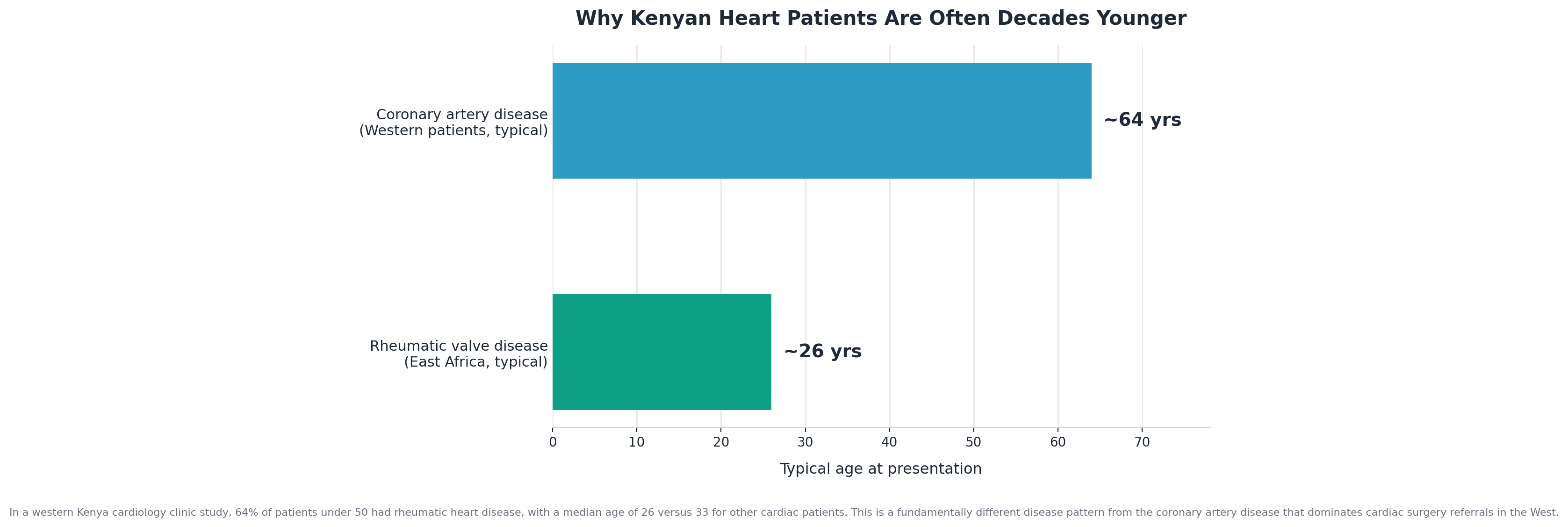
A study of the cardiology clinic at a national referral hospital in western Kenya found that 64 percent of patients under 50 attending the clinic had rheumatic heart disease, with a median age of 26. Rheumatic heart disease follows untreated or inadequately treated streptococcal throat infection in childhood, and it progressively damages the heart valves — usually the mitral valve, often the aortic — over years, frequently presenting in patients in their twenties and thirties who are otherwise fit and working.
This matters practically because it means the surgeon and centre you want are not necessarily the ones with the deepest coronary bypass volume — a metric heavily marketed by Indian hospitals to a largely Western clientele — but ones with genuine depth in valve repair and replacement, often in young patients, sometimes with complications from years of undiagnosed disease. Ask specifically about this experience rather than assuming general cardiac surgery volume covers it.
Should you travel at all?
Kenya performs cardiac surgery, and capacity has grown. Kenyatta National Hospital and a small number of private centres in Nairobi run cardiac programmes, and Kenyan cardiac surgeons trained abroad are doing genuinely skilled work. For straightforward, early-diagnosed valve disease or single- vessel coronary disease, treatment in Nairobi is a reasonable option worth exploring first.
The honest reality, documented across East African cardiac literature, is that domestic surgical capacity remains limited relative to the scale of rheumatic heart disease in the region, and waiting times for elective cardiac surgery can be long — regional studies describe waiting lists measured in months to years, with meaningful mortality among patients still waiting. If your cardiologist has told you surgery is needed and a firm date in Kenya is not readily available, that gap is where India's much higher-volume cardiac centres offer a genuine and sometimes time-critical advantage.
On funding: Kenya's Social Health Authority funds overseas treatment only for 36 gazetted procedures unavailable domestically, capped at 500,000 shillings per patient per year. Routine bypass and valve surgery are not on that list, because Kenya can perform them. Plan to pay for cardiac surgery in India yourself, though it is worth checking your private insurance policy specifically, since some Kenyan health covers do include an international cardiac benefit that catches patients by surprise when they finally read the small print.
Part one: judging the surgeon
1. Rheumatic and congenital case experience, specifically
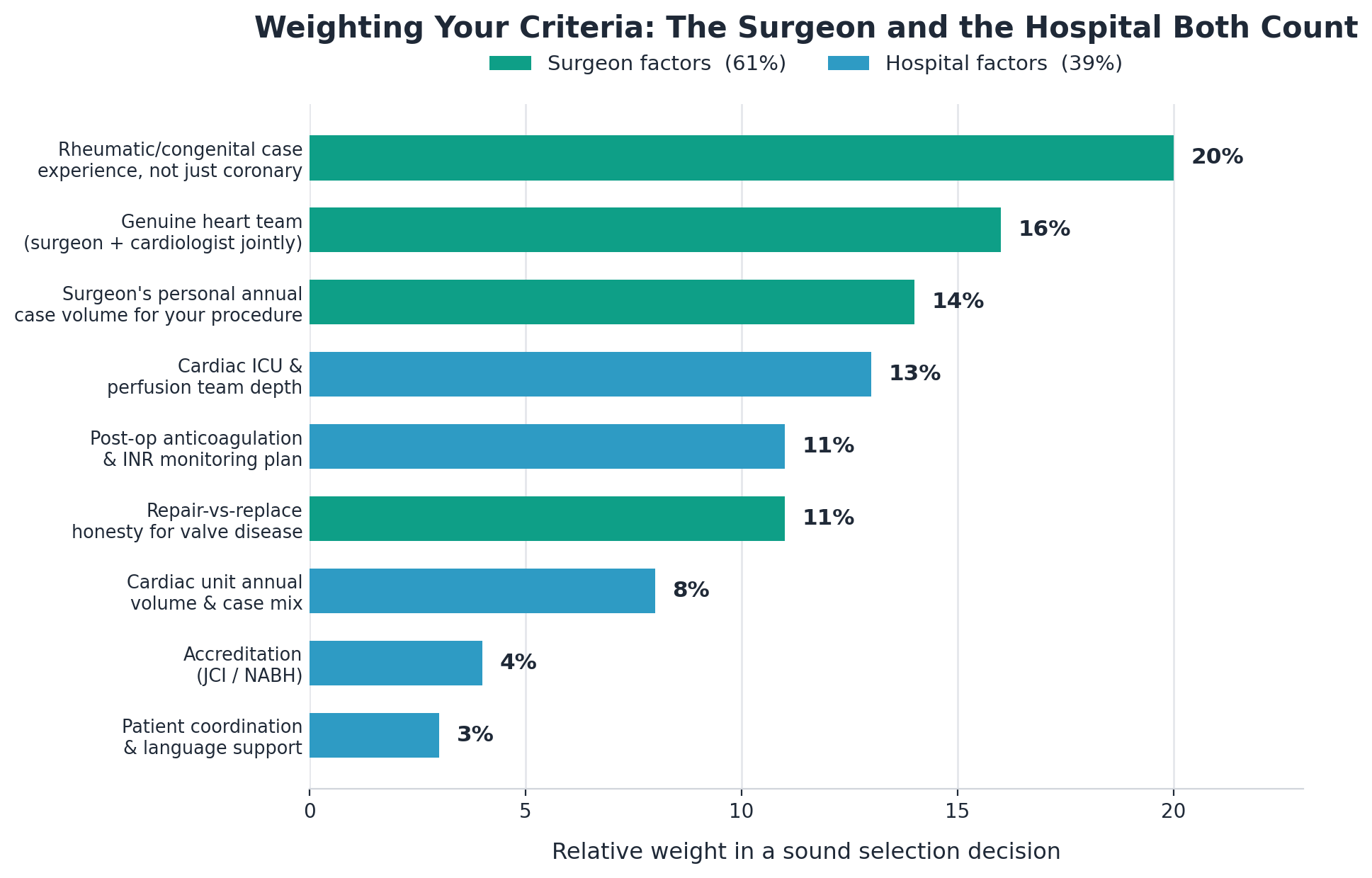
I weight this above every other single factor for East African patients, and the chart below reflects that. Ask directly: how much of your practice is rheumatic valve disease, and how many mitral valve repairs — not just replacements — do you perform each year on patients under 40? A surgeon whose reputation rests on coronary bypass volume in older Western patients is not automatically the right answer to a 28-year-old Kenyan patient's mitral stenosis.
2. A genuine heart team, not a surgeon acting alone
Cardiac surgery decisions — whether to operate now or manage medically a while longer, which valve to address first if more than one is affected, which prosthesis to use — should be reached jointly by a cardiac surgeon and a cardiologist, sometimes with an anaesthetist and imaging specialist included. Ask whether your case will be discussed by a genuine heart team before a date is fixed, and whether you can hear the reasoning, not just the conclusion.
3. Repair versus replacement, argued honestly
For valve disease, repair is generally preferable to replacement where anatomy allows it: no lifelong prosthesis, often better preserved heart function, no forced choice between mechanical and biological trade-offs. But not every damaged valve, particularly in advanced rheumatic disease with heavy calcification or scarring, can be durably repaired. Ask plainly whether repair was considered for your valve specifically, and why replacement is being recommended if that is the plan. A surgeon who defaults to replacement without explaining why repair was set aside is taking the technically easier path, not necessarily the best one for you.
4. Personal annual volume for your specific procedure
Ask for the number that matches your actual operation — mitral valve repair, not "valve surgery" broadly; redo surgery, if this is a second operation, specifically. General cardiac surgery experience does not transfer evenly across procedure types, and the busiest Indian cardiac centres have surgeons with genuinely deep, procedure-specific volume.
Part two: judging the hospital
Cardiac surgery depends on institutional infrastructure more than almost any other operation in this series — a fact reflected in the meaningful hospital-side weighting below, even though surgeon-side factors still carry the majority.
5. Cardiac ICU and perfusion team depth
Every open-heart operation depends on a perfusion team running the heart-lung bypass machine and a dedicated cardiac ICU managing the first 48 to 72 hours, when most serious complications declare themselves. Ask about the ICU's nurse-to-patient ratio, whether an intensivist or cardiac surgeon is physically present overnight, and how many perfusionists the unit employs. This is institutional capability no individual surgeon can supply alone.
6. Cardiac unit annual volume and case mix
Ask what the department as a whole does each year, and specifically what proportion is valve disease versus coronary disease versus congenital and paediatric work. A unit that predominantly handles Western bypass referrals may have less concentrated experience in the rheumatic and congenital cases that dominate East African referrals, even if its headline volume looks impressive.
7. The post-operative anticoagulation and monitoring plan
If a mechanical valve is fitted, you will need lifelong warfarin with regular INR blood testing to keep your blood at the correct thinness — too little risks clot and stroke, too much risks dangerous bleeding. Ask the hospital directly how this monitoring plan will be established for your return to Kenya, and factor honestly whether reliable, regular INR testing is realistic for you. This single practical question should influence the mechanical-versus-biological valve decision as much as the clinical factors do, and a good team will raise it with you rather than waiting for you to ask.
8. Accreditation, read properly
JCI and NABH accreditation audit infection control, medication safety and incident reporting, and are meaningful filters, particularly given how much can go wrong around a sternotomy wound and prosthetic material. But accreditation says nothing about whether the unit has genuine rheumatic and congenital depth. Use it to exclude candidates, not to choose between the remaining ones.
9. The cost you will actually pay
Let me be emphatic about this, because 24 years of handling these cases has taught me nothing more consistently: disputes almost never concern the quoted price. They concern what the quote silently omitted. For cardiac surgery specifically, insist the written estimate states the valve type or bypass approach assumed, what happens if additional grafts or a second valve are found to need treatment intraoperatively, and how many ICU days are included before extra days are billed separately. Budget beyond the surgery. Direct Nairobi–Delhi and Nairobi–Mumbai flights run roughly 550 to 850 dollars return, and three to four weeks of accommodation for you and an attendant adds a meaningful sum — cardiac recovery cannot safely be compressed to save on hotel nights.
Four signals that should make you pause
Certain patterns reliably precede a difficult outcome. Valve replacement recommended without any mention of whether repair was considered. A heart team that turns out, on questioning, to be one surgeon. A quotation that does not distinguish which valve type or prosthesis is assumed. And no discussion at all of your practical ability to manage anticoagulation once home, for a mechanical valve recommendation.
None alone proves a bad hospital. Together they warrant a second opinion before you commit to an operation you cannot easily undo.
The Kenya-specific practicalities
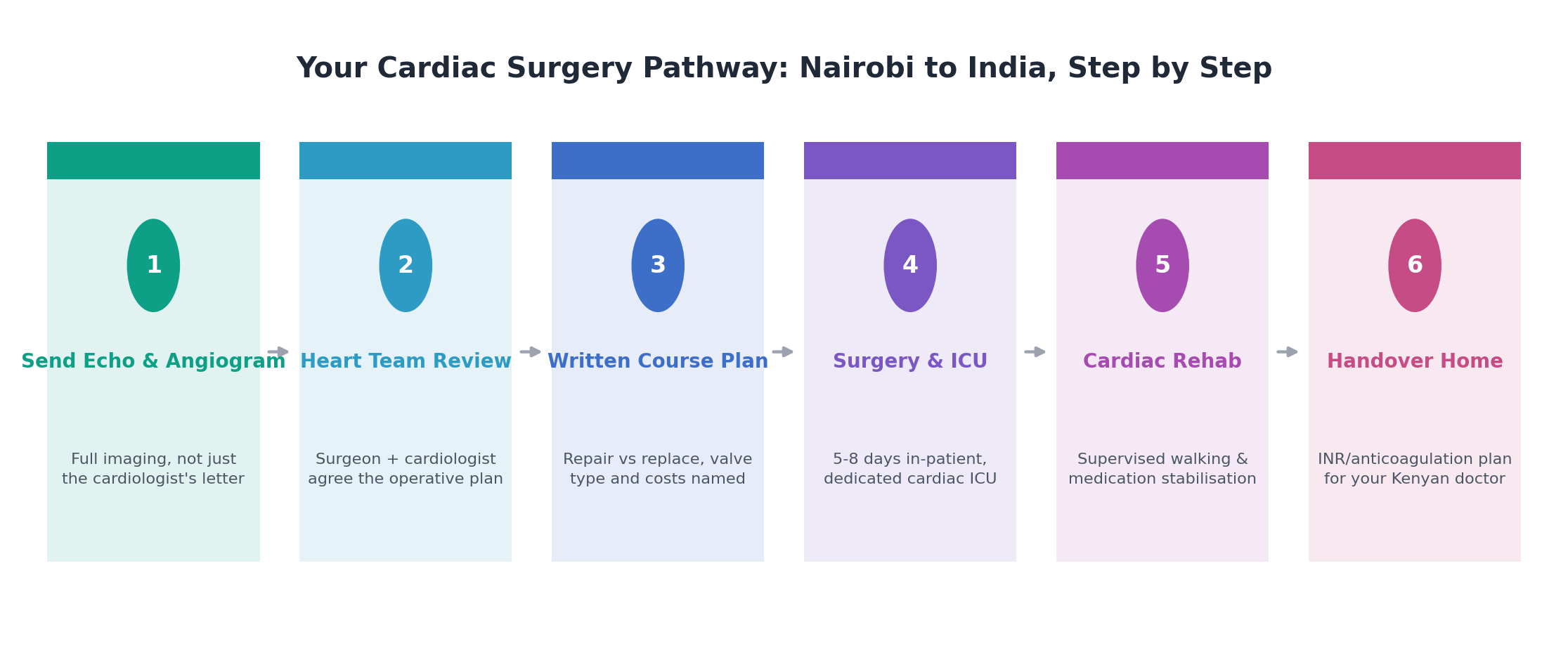
Send your full echocardiogram images and, if you have had one, your angiogram — not just your cardiologist's summary letter. A heart team cannot properly plan from a typed report alone. Direct Nairobi–Delhi and Nairobi–Mumbai flights make this roughly a six-hour journey. The Indian medical e-visa is issued to Kenyan passport holders within three to five working days against a hospital letter, and up to two attendants can travel on a medical attendant visa — genuinely necessary given the physical dependency of the first fortnight after open-heart surgery.
If a mechanical valve is recommended, have a frank conversation before you travel about INR monitoring access near where you live — whether that is a private lab in Nairobi, a county hospital, or a longer journey, since this will be a lifelong, regular commitment, not a one-off test.
The questions I would ask before paying a deposit
Of the surgeon:
- How much of your practice is rheumatic or congenital valve disease specifically?
- Was repair genuinely considered for my valve, and why is replacement recommended if that is the plan?
- How many procedures matching mine specifically — not general cardiac surgery — do you perform each year?
- If a mechanical valve is proposed, how does that weigh against my realistic access to INR monitoring at home?
Of the hospital:
- Is my case reviewed by a genuine heart team, and can I hear the reasoning?
- What is your cardiac ICU's nurse ratio, and is a cardiac specialist present overnight?
- What proportion of your cardiac caseload is valve and congenital work versus coronary bypass?
- How many ICU days are included, and what happens if I need more?
- Will you provide a written anticoagulation and follow-up plan for my doctor in Kenya?
- What exactly is excluded from the quoted price?
- May I speak to a previous patient from East Africa?
A team that answers all eleven without irritation is very likely the right team. One that becomes vague at the first or the sixth has told you what you needed to know at no cost at all.
Straight Answers for Kenyan Patients about Cardiac Surgeons and Hospitals in India
How do I choose the best cardiac surgeon in India as a Kenyan patient?
Confirm your case is reviewed by a genuine heart team, not a surgeon acting alone. Ask specifically about his rheumatic and congenital heart disease experience, not just coronary bypass, since these dominate in East African patients. For valve disease, ask whether repair rather than replacement was genuinely considered, and for his personal volume in your exact procedure.
How much does heart surgery cost in India for a Kenyan patient?
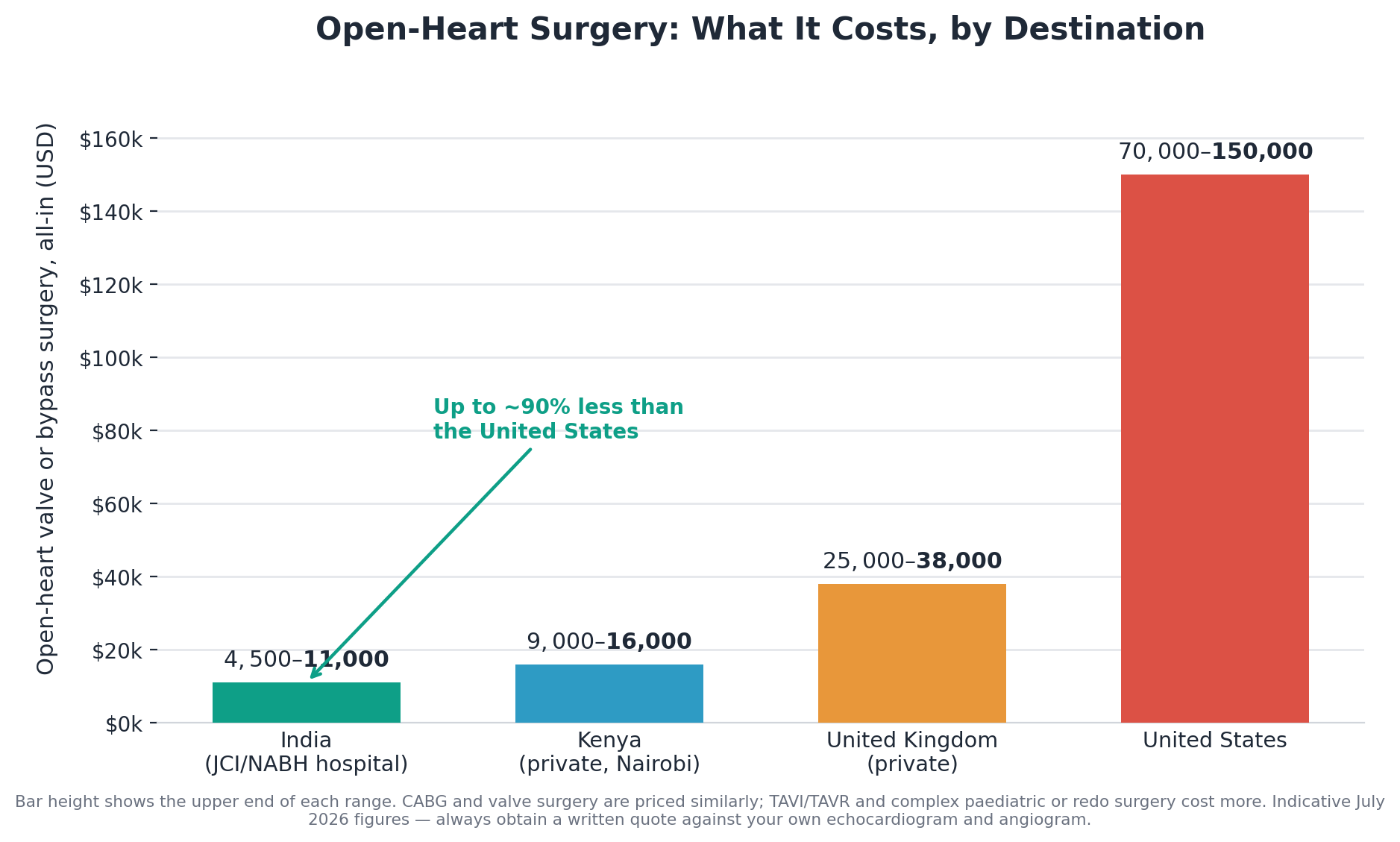
Open-heart valve or bypass surgery typically costs 4,500 to 11,000 US dollars all in. The same surgery is roughly 9,000 to 16,000 in Nairobi private care, 25,000 to 38,000 in the UK, and 70,000 to 150,000 in the United States. TAVI, redo surgery and complex congenital cases cost more than this baseline.
Why do so many Kenyan cardiac patients need valve surgery rather than bypass surgery?
Because rheumatic heart disease, not coronary artery disease, dominates cardiac surgery in East Africa. A western Kenya clinic study found 64 percent of patients under 50 had rheumatic heart disease, median age 26 — decades younger than typical Western coronary patients. This means you need a surgeon and hospital with genuine valve repair depth in young patients, not primarily bypass volume.
Should a damaged heart valve be repaired or replaced?
Repair is generally preferable where anatomy allows it, avoiding lifelong prosthesis risks and often preserving better heart function. But advanced rheumatic disease with heavy scarring cannot always be durably repaired. Ask directly whether repair was considered for your valve and why replacement is recommended if that is the plan.
Mechanical or biological valve, and does it matter where I live?
Considerably. Mechanical valves last longer but need lifelong warfarin with regular INR testing; biological valves avoid this but wear out sooner, often within 10 to 15 years in younger patients. If reliable INR monitoring will be hard to sustain in Kenya, that real-world risk can outweigh a mechanical valve's durability advantage — this should be discussed explicitly, not assumed by default.
Will SHA pay for my heart surgery in India?
Not for standard cardiac surgery. SHA's overseas benefit covers only 36 gazetted procedures unavailable in Kenya, capped at 500,000 shillings a year, and routine bypass or valve surgery is not among them since Kenya performs these domestically. Plan to self-fund, though check your private insurance policy, since some Kenyan covers include an international cardiac benefit.
How long must I stay in India after heart surgery?
Around three to four weeks: several days for assessment and heart team review, five to eight days as an in-patient including cardiac ICU time, then one to two weeks of supervised rehabilitation before fit-to-fly clearance. Long-haul flights carry real risk soon after open-heart surgery, so do not compress this period.
A closing word
The best cardiac surgeon in India for a Kenyan patient is not necessarily the one with the largest bypass numbers — it is the one who understands that your valve disease may be rheumatic, that you may be decades younger than his typical Western patient, and who explains repair-versus-replacement against your actual anatomy rather than a default protocol. The best hospital pairs him with a genuine heart team, a cardiac ICU staffed for the first critical days, and a written plan for how your care continues once you are home, whether that means warfarin and INR testing for the rest of your life or a straightforward return to normal activity.
If you would like me to look at your echocardiogram and cardiologist's notes and talk through honestly what a heart team is likely to recommend, send them across.
Sources
- 🌐 Nkomo VT, et al. Clinical and geographic patterns of rheumatic heart disease in outpatients attending a cardiology clinic in western Kenya
- 🌐 Rheumatic Heart Disease in Africa: a geographic perspective on surgical access. Global Heart , 2025
- 🌐 Snelgrove JW, et al. Prevalence of Rheumatic Heart Disease and Other Cardiac Conditions in Low-Risk Pregnancies in Kenya
- 🌐 National Medical Commission of India — surgeon and specialist registration verification
- 🌐 National Accreditation Board for Hospitals & Healthcare Providers (NABH) — accredited hospital directory
- 🌐 Kenya Social Health Authority (SHA) — benefits packages and overseas treatment guidance
Frequently Asked Questions by Kenyans about Cardiac Surgeons and Hospitals in India
How should Kenyan patients choose a cardiac surgeon in India?
Choose according to the surgeon's personal experience with the exact operation required, not simply the hospital's reputation or overall cardiac volume. Ask how many similar procedures the named surgeon personally performs.
Is the surgeon or hospital more important for cardiac surgery?
Both are important. The surgeon provides procedure-specific technical expertise, while the hospital provides cardiac anaesthesia, perfusion, imaging, ICU care and emergency support needed around the operation.
What should Kenyan patients ask before heart valve replacement in India?
Ask whether the valve can be repaired before accepting replacement. If replacement is necessary, discuss whether a mechanical or tissue/bioprosthetic valve better suits the patient's long-term circumstances.
Why does INR monitoring matter after heart valve surgery?
Patients with certain mechanical valves may require long-term anticoagulation and regular INR testing. Reliable access to monitoring after returning to Kenya should therefore form part of the valve-selection discussion.
What hospital facility is particularly important for cardiac surgery?
A dedicated cardiac ICU with appropriately trained staff is a critical consideration. Cardiac patients can require intensive postoperative monitoring and rapid specialist intervention if complications develop.
Are NABH and JCI accreditation enough to choose a cardiac hospital?
No. They can be useful baseline safety indicators, but accreditation alone does not prove that a hospital or surgeon has strong experience with the patient's specific cardiac procedure.
What should be included in a cardiac surgery quotation?
The proposal should clearly name the operating surgeon, specify the exact operation, expected hospital and ICU stay, and identify implants or valves where applicable. Important exclusions and possible additional charges should also be stated.
Should Kenyan patients choose the cheapest cardiac surgery package in India?
Not solely on price. A cheaper quotation may exclude extended ICU care, investigations, blood products, implants or management of complications. Compare what each package actually includes before deciding.
What documents should patients take home after cardiac surgery in India?
Patients should obtain the operative report, discharge summary, medication list, implant or valve information where applicable, and a written follow-up plan for their Kenyan cardiologist.
What follow-up is required in Kenya after cardiac surgery in India?
Ongoing cardiology review should be arranged according to the procedure and condition. Valve patients may require cardiac imaging and lifelong surveillance, while some patients also need regular anticoagulation and INR monitoring.
Page Summary
This guide explains how Kenyan patients should evaluate cardiac surgeons and hospitals in India without allowing package price or hospital branding to dominate the decision. The first requirement is establishing the exact cardiac diagnosis and operation, because different procedures require different technical experience and two hospitals may recommend substantially different approaches for the same patient.
Citation Block
| Topic | Information |
|---|---|
| Topic Information | Selecting Cardiac Surgeons and Hospitals in India for Kenyan Patients |
| Treatment | Cardiac Surgery and Advanced Heart Care |
| Country | India |
| Intended Audience | Kenyan Patients |
| Conditions Covered | Heart Conditions Requiring Cardiac Surgery or Advanced Intervention |
| Procedures | CABG, Heart Valve Repair and Heart Valve Replacement Where Applicable |
| First Decision | Confirm the Exact Cardiac Procedure Being Recommended |
| Surgeon Selection | Procedure-Specific Personal Experience |
| Hospital Selection | Cardiac-Specific Infrastructure and Multidisciplinary Heart-Team Support |
| Critical Facility | Dedicated Cardiac ICU |
| Valve Options | Repair Where Appropriate; Mechanical or Tissue/Bioprosthetic Replacement Where Required |
| Long-Term Consideration | Anticoagulation and INR Monitoring for Relevant Valve Patients |
| Accreditation Mentioned | NABH and JCI |
| Pre-Travel Assessment | Relevant Cardiac Imaging and Medical Records |
| Post-Surgery Monitoring | Cardiology Follow-Up and Relevant Cardiac Imaging |
| Kenya Follow-Up | Ongoing Care With a Kenyan Cardiologist |
| Author | Dr. Dheeraj Bojwani |
| Experience | 24 Years' Experience |


Our Mission Statement
Our mission is to place patients at the centre of every healthcare decision by providing trustworthy, evidence-based, and unbiased medical information. We believe that informed patients make better decisions. Backed by personalised guidance from our experienced advisory team, we help patients understand their treatment options, compare them objectively, and confidently choose the path that best suits their medical needs and personal circumstances.
Patient Testimonials from Kenya

Ready to Take the First Step?
Share your Medical Reports with our Healthcare Managers Today and Get a FREE CONSULTATION, a Personalized Treatment Plan, and Complete Support from Arrival to Recovery.
Get Your Free ConsultationAreas We Serve
This resource has been thoughtfully prepared for patients from Kenya who are considering medical treatment in India. We also welcome patients from the wider region in the countries mentioned below-
We assist patients from:
- Ethiopia
- Somalia
- Tanzania
- Uganda
- Seychelles
- Guinea
- Guinea-Bissau
- Liberia
- Mali
- Mauritania
- Niger
- Nigeria
- Senegal
- Togo
- South Sudan
- Sierra Leone
Many of the insights, treatment pathways, hospital recommendations, travel guidance, and patient support services described here are equally relevant and may be used as a reference when planning treatment in India.
From Kenya to India: Your Complete Patient Support Guide
- Brain Tumour Surgery in India for Kenyan Patients
- Cancer Treatment and Surgery in India for Kenyan Patients
- Cardiac Treatment and Surgery in India for Kenyan Patients
- Heart Valve Replacement Surgery in India for Kenyan Patients
- Knee Replacement in India for Kenyan Patients
- Prostate Cancer Treatment and Surgery in India for Kenyan Patients
- Spine Treatment and Surgery in India for Kenyan Patients
- Selecting the Best Bariatric Surgeons and Hospitals in India: What Kenyan Patients Should Actually Look For
- Selecting the Best Cancer Surgeons and Hospitals in India: What Kenyan Patients Should Actually Look For
- Selecting the Best Cardiac Surgeons and Hospitals in India: What Kenyan Patients Should Actually Look For
- Selecting the Best Dental Surgeons and Clinics in India: What Kenyan Patients Should Actually Look For
- Selecting the Best Hip Surgeons and Hospitals in India: What Kenyan Patients Should Actually Look For
- Selecting the Best Kidney Transplant Surgeons and Hospitals in India: What Kenyan Patients Should Actually Look For
- Selecting the Best Knee Surgeons and Hospitals in India: What Kenyan Patients Should Actually Look For
- Selecting the Best Liver Transplant Surgeons and Hospitals in India: What Kenyan Patients Should Actually Look For
- Selecting the Best Neurosurgeons and Hospitals in India: What Kenyan Patients Should Actually Look For
- Selecting the Best Prostate Cancer Surgeons and Hospitals in India: What Kenyan Patients Should Actually Look For
- Selecting the Best Spine Surgeons and Hospitals in India: What Kenyan Patients Should Actually Look For