

Selecting the Best Liver Transplant Surgeons and Hospitals in India: What Kenyan Patients Should Actually Look For
Kenya has no routine liver transplant programme, so the question was never Kenya or India — it is which country, and within it, which team.
A liver transplant is the operation in this series where Kenya's honest answer to "should you travel at all" is usually yes, not as a preference but as a necessity — Kenya does not currently have a routine liver transplant programme. Across 24 years of guiding international patients through Indian hospitals, liver transplant cases from East Africa are almost always patients for whom the question was never really Kenya versus India. It was which country abroad, and within that, which team. This is the framework I use when a Kenyan patient is weighing a liver transplant in India. It follows the surgeon-then-hospital structure of this series, but like the kidney transplant guide before it, the donor question comes first, because very little else matters until it is settled.
Healing Journeys of Kenyan Patients






Key Takeaways
- Kenyan patients considering a liver transplant in India should begin with the donor question before comparing hospitals or surgeons. The guide explains that most international liver transplants in India use a living donor, usually a compatible, willing and medically suitable close relative.
- A potential living liver donor should generally be an adult in good health, commonly under about 55, with a compatible blood group and no significant liver disease. A small number of deceased-donor livers may be available to foreign nationals in specific circumstances, but the document describes this route as limited and unpredictable and advises families not to build their treatment plan around it.
- Kenya's liver-disease profile is especially relevant to transplant planning. The guide states that chronic hepatitis B and C contribute to an estimated 80% of hepatocellular carcinoma cases across sub-Saharan Africa, while liver cancer is described as Kenya's second leading cause of cancer death.
- Hepatitis B prevalence is described as roughly 3% nationally but exceeding 10% in counties including Turkana, West Pokot and Baringo. Hepatitis C is described as being more concentrated along the Coast, including Lamu and Mombasa, as well as Nairobi.
- If liver disease is hepatitis-related, the underlying infection must continue to be treated even after transplantation. The transplant replaces the damaged liver but does not itself eliminate hepatitis B or C, meaning untreated infection could affect the transplanted liver.
- Unlike kidney transplantation, Kenya does not currently have an established routine liver-transplant programme according to the guide. For a Kenyan patient who genuinely requires transplantation, travelling abroad is therefore often described as a necessity rather than simply a preference.
Quick Facts
- Treatment
- Living-Donor Liver Transplantation
- Country
- India
- Intended Audience
- Kenyan Patients and Families
- Primary Conditions
- End-Stage Liver Disease, Liver Failure and Selected Liver-Cancer Cases Requiring Transplantation
- First Question
- Does the Patient Have a Potential Living Donor?
- Standard International Route Mentioned
- Living-Donor Liver Transplant
- Typical Donor
- Compatible, Willing and Medically Suitable Close Relative
- Typical Donor Age Mentioned
- Usually Under About 55
- Donor Health Requirement
- Good General Health With No Significant Liver Disease
- Deceased-Donor Route
- Limited and Uncertain for Foreign Patients According to the Guide
- Important Kenya-Specific Condition
- Hepatitis-Related Chronic Liver Disease and Liver Cancer
- Hepatocellular Carcinoma Link
- Chronic Hepatitis B and C Are Described as Driving About 80% of HCC Across Sub-Saharan Africa
- Kenya Liver Cancer Position
- Described as Kenya's Second Leading Cause of Cancer Death
- Kenya Hepatitis B Prevalence Mentioned
- Around 3% Nationally
- Higher Hepatitis B Areas Mentioned
- Turkana, West Pokot and Baringo, Where Prevalence Is Described as Above 10%
- Hepatitis C Areas Mentioned
- Lamu, Mombasa and Nairobi
- Hepatitis After Transplant
- Underlying Hepatitis Infection Still Requires Ongoing Treatment
- Routine Liver Transplant Programme in Kenya
- Not Established According to the Guide
In Brief
Kenyan patients considering liver transplantation in India should identify and assess a suitable living donor before selecting a surgeon or hospital. The guide gives 58% of the overall decision weight to surgeon/team factors and 42% to hospital factors, with particular emphasis on a genuine hepatology-plus-transplant-surgery team, the surgeon's personal living-donor transplant volume, lifelong immunosuppression planning and donor safety. Indicative liver transplant costs in India are approximately USD 25,000–40,000, covering recipient and donor surgery, ICU, hospital stay and routine postoperative care, while lifelong medicines are separate. Kenyan patients should also ensure that hepatitis treatment, medication availability and long-term monitoring are organised before returning home.
Before anything else: do you have a donor?
Most international liver transplants performed in India are living-donor procedures, following broadly the same principle as kidney transplantation: a compatible, willing, medically suitable donor, typically a close relative, gives a portion of their liver. A small number of deceased-donor livers are allocated to foreign nationals under specific circumstances, but this route is limited and uncertain in timing, and I would not advise anyone to plan a treatment journey around the hope of a deceased-donor allocation.
So the first practical step, before researching hospitals, is identifying a potential living donor and having them assessed for blood group compatibility and general suitability. A donor typically needs to be an adult in good general health, usually under about 55, with a compatible blood type and no significant liver disease of their own. If you do not yet have a plausible donor, that is the conversation to have first.
Why Kenya's liver disease picture matters to your decision
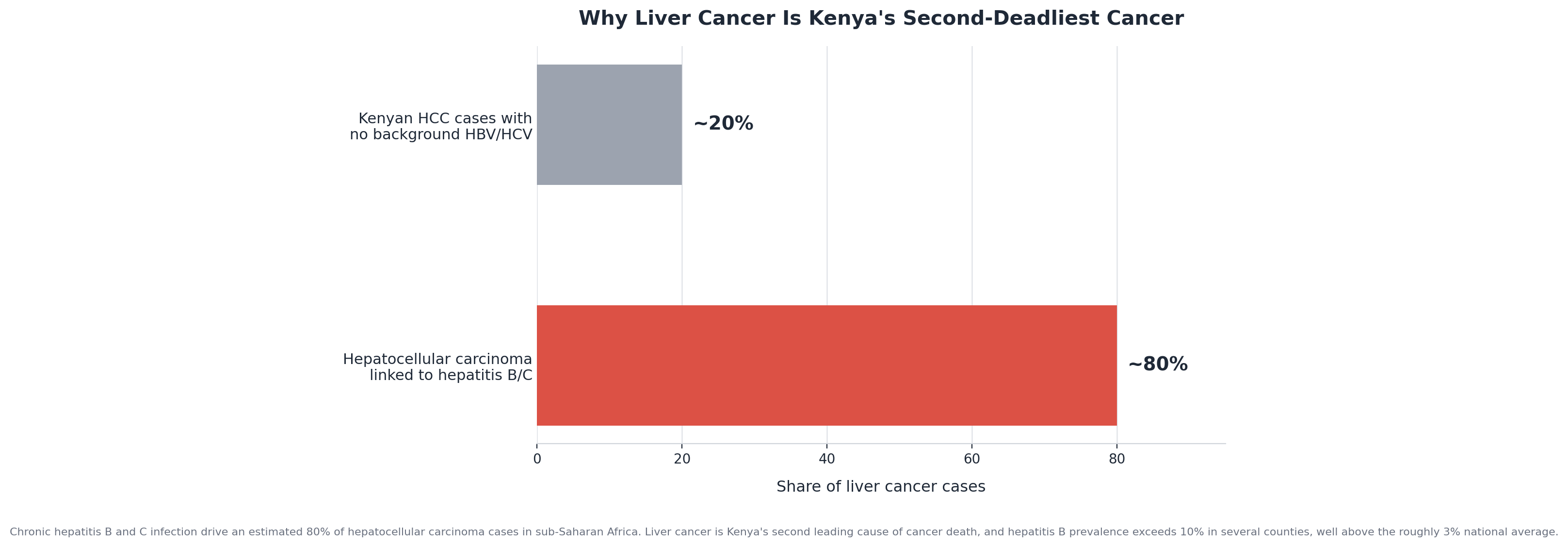
Chronic hepatitis B and C infection drive an estimated 80 percent of hepatocellular carcinoma across sub-Saharan Africa, and liver cancer is Kenya's second leading cause of cancer death. Hepatitis B prevalence nationally sits around 3 percent, similar to HIV prevalence, but climbs well above 10 percent in counties including Turkana, West Pokot and Baringo. Hepatitis C burden concentrates along the Coast, with Lamu, Mombasa and Nairobi carrying the highest reported rates.
This matters practically for two reasons. First, if your liver disease is hepatitis-related, that underlying infection needs active, ongoing management alongside any transplant plan — a transplant replaces the damaged liver, but does not by itself cure the hepatitis virus, which can otherwise damage the new liver too if untreated. Second, ask explicitly whether you have been tested for hepatitis B and C if this has not already been established, since the answer shapes both your pre-transplant workup and your long-term medical plan.
Should you travel at all?
This is where liver transplant genuinely differs from every other procedure in this series. Kenya does not have an established, routine liver transplant programme comparable to its capacity for joint replacement, spine surgery, or even kidney transplantation. Research into paediatric liver transplant readiness in Kenya has found that, of the hospitals surveyed, only a small number possessed even the minimum workforce and resources to consider attempting the procedure, reflecting genuine constraints in ICU capacity, hepatobiliary surgical volume, and specialised transplant infrastructure nationally.
This means the honest starting point for a Kenyan patient needing a liver transplant is usually not "Nairobi or India" but "which country abroad, and which team." On funding, this is precisely the situation Kenya's Social Health Authority overseas treatment benefit exists for — funding specific procedures genuinely unavailable domestically. Unlike hip, knee, spine or routine kidney transplantation, all of which Kenya performs and are therefore excluded from SHA's overseas list, liver transplant is a strong candidate for inclusion given the lack of domestic capacity. Check directly and currently with SHA whether liver transplant appears among the 36 gazetted procedures at the time you need it, since the list is reviewed periodically and this is genuinely worth confirming rather than assuming either way.
Part one: judging the surgeon and transplant team
1. A genuine hepatology-plus-transplant-surgery team
I weight this above every other single factor, and the chart below reflects that. Liver transplant care properly involves a hepatologist managing the underlying liver disease, a transplant surgeon, an anaesthesia team experienced specifically in liver surgery, and dedicated transplant coordination — not a surgeon operating with general hospital support around him. Ask who manages your hepatitis B or C treatment, if relevant, both before and after transplant, since this is a distinct expertise from the surgery itself.
2. Personal annual volume in living-donor liver transplants
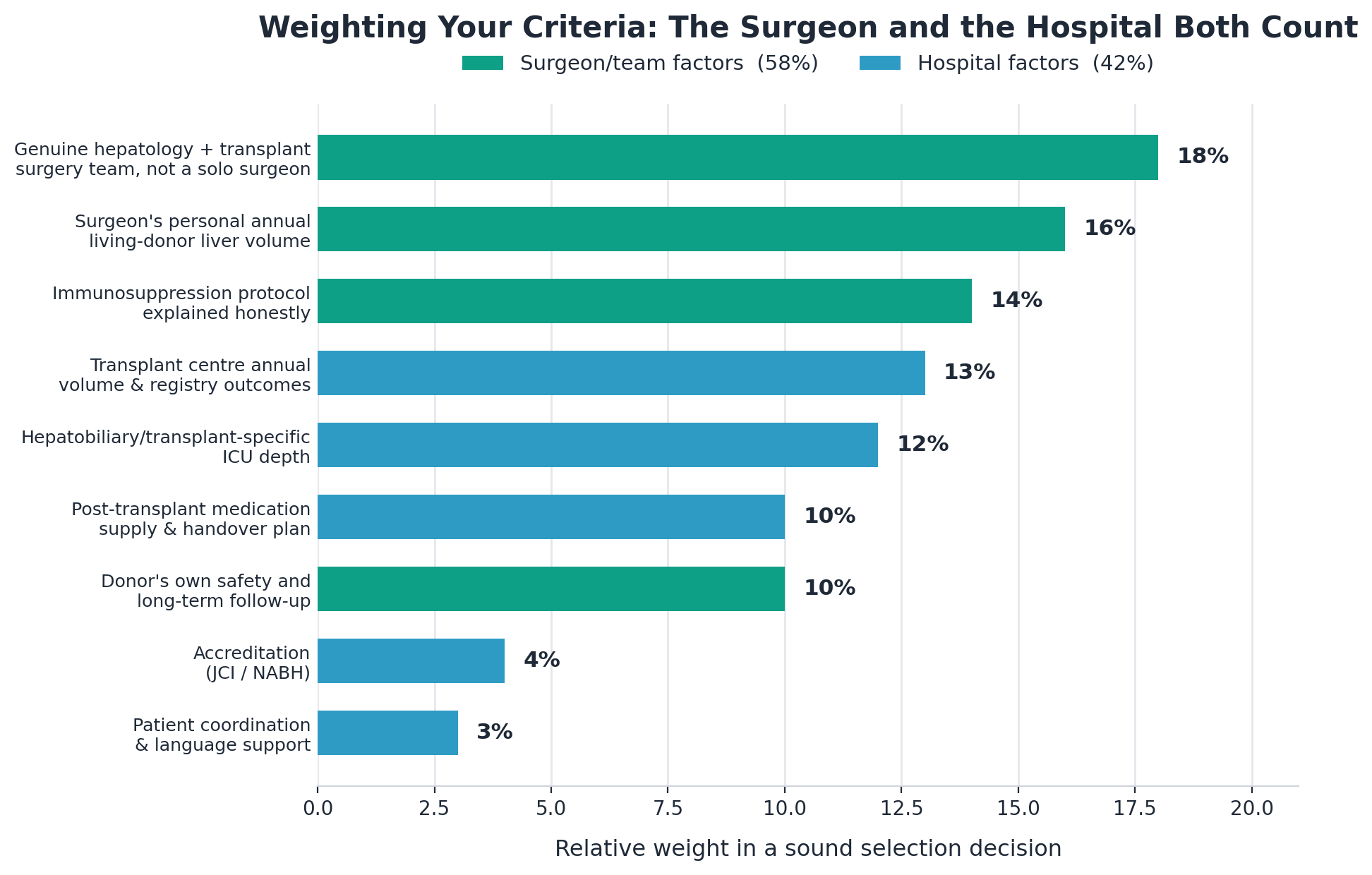
Ask for the surgeon's personal annual volume specifically in living-donor liver transplants, which is technically more demanding than deceased-donor surgery because it involves precisely dividing a healthy liver for two patients rather than implanting a single deceased-donor organ. India's leading transplant centres perform hundreds of these procedures a year collectively; ask for the individual surgeon's number.
3. Immunosuppression protocol, explained honestly
Ask what immunosuppressant regimen is planned, why, and what the realistic ongoing monthly medication cost will be once you are back in Kenya. As with kidney transplantation, this is a lifelong commitment, and a good team explains the trade-offs plainly rather than offering vague reassurance.
4. Your donor's safety and long-term follow-up
Your donor is undergoing genuinely major surgery — removing roughly half their liver — for no direct medical benefit to themselves. Ask what surgical approach is used for the donor procedure, what the team's own donor complication rate is, and what long-term follow-up the donor receives after returning to Kenya. A programme confident and transparent about donor safety, not just recipient outcomes, is the one to trust with a family member.
Part two: judging the hospital
Liver transplant surgery depends on institutional depth as heavily as any procedure in this series — reflected in the meaningful hospital-side weighting below, even as team factors carry the majority.
5. Transplant centre annual volume and registry outcomes
Ask how many liver transplants the centre performs annually as a whole, and whether it reports outcomes to a national or international transplant registry with real graft and patient survival figures at one and five years, rather than a general "success rate" claim whose definition may vary considerably between hospitals.
6. Hepatobiliary and transplant-specific ICU depth
Liver transplant recipients require intensive, specialised post-operative monitoring, distinct from general surgical ICU care. Ask whether the hospital has a dedicated hepatobiliary or transplant ICU, how many liver transplant patients it manages concurrently, and what the nursing ratio is in the critical first days.
7. Post-transplant medication supply and handover plan
Ask whether the hospital will provide a detailed, written medication and monitoring protocol your Kenyan physician can follow, and confirm that the specific immunosuppressant and, if relevant, ongoing hepatitis medications prescribed are actually available in Kenya. Discovering a supply gap after you are home, managing a newly transplanted liver, is a genuinely dangerous position.
8. Accreditation, read properly
JCI and NABH accreditation are meaningful filters on infection control and safety systems, particularly relevant given that transplant recipients are deliberately immunosuppressed. Use accreditation to exclude candidates, not to choose between the remaining ones.
9. The cost you will actually pay
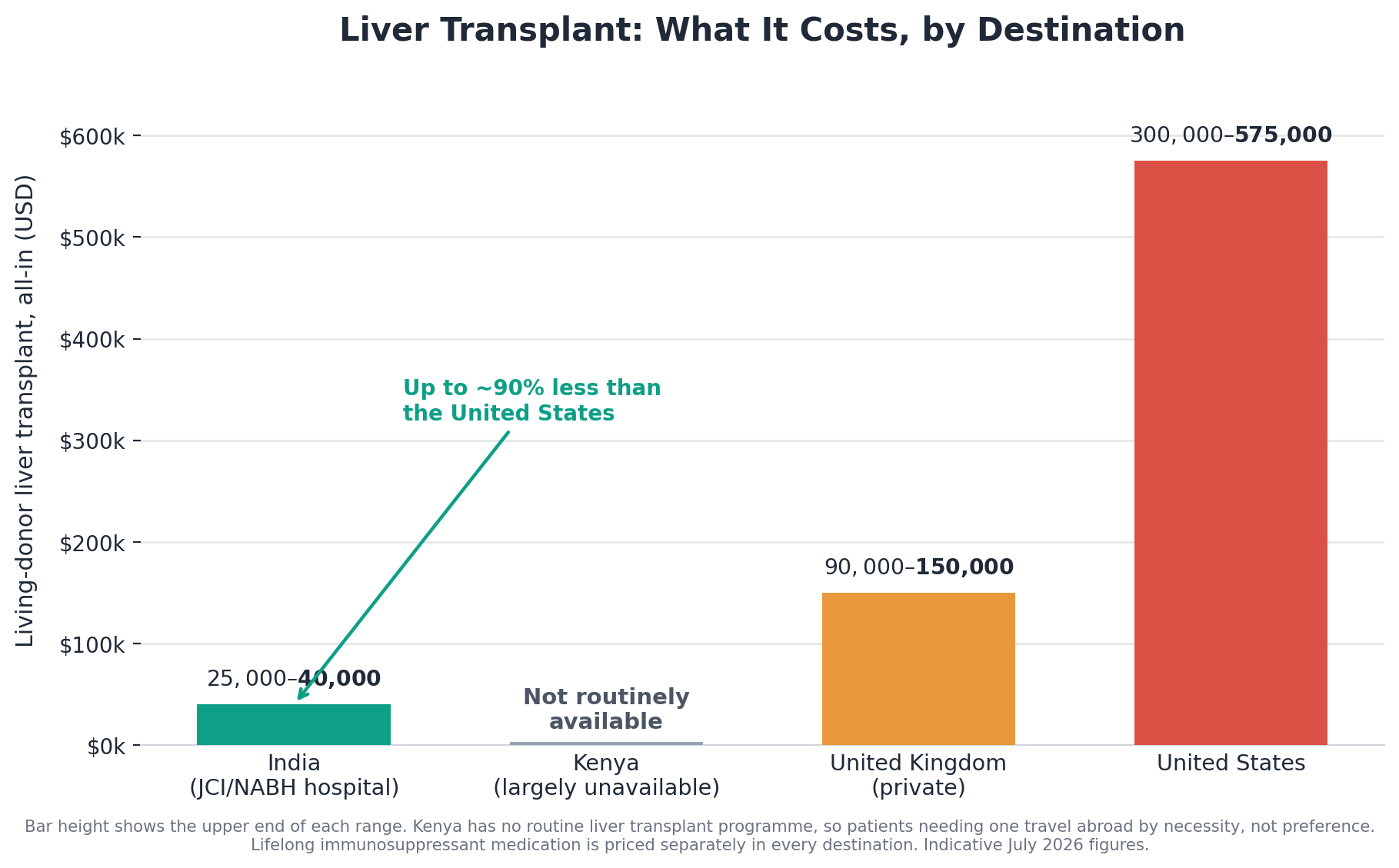
Let me be emphatic about this, because 24 years of handling these cases has taught me nothing more consistently: disputes almost never concern the quoted price. They concern what the quote silently omitted. For a liver transplant specifically, insist the written estimate separates recipient and donor surgery clearly, states what happens if either of you needs an extended ICU stay, and confirms that immunosuppressant and any ongoing hepatitis medication is priced separately and ongoing, not folded into a one-time package figure.
Budget beyond the surgery. Direct Nairobi–Delhi and Nairobi–Mumbai flights run roughly 550 to 850 dollars return for each traveller, and five to eight weeks of accommodation for recipient, donor and possibly a third attendant is a genuine, considerable sum that needs planning for from the outset.
How the donor's liver actually recovers
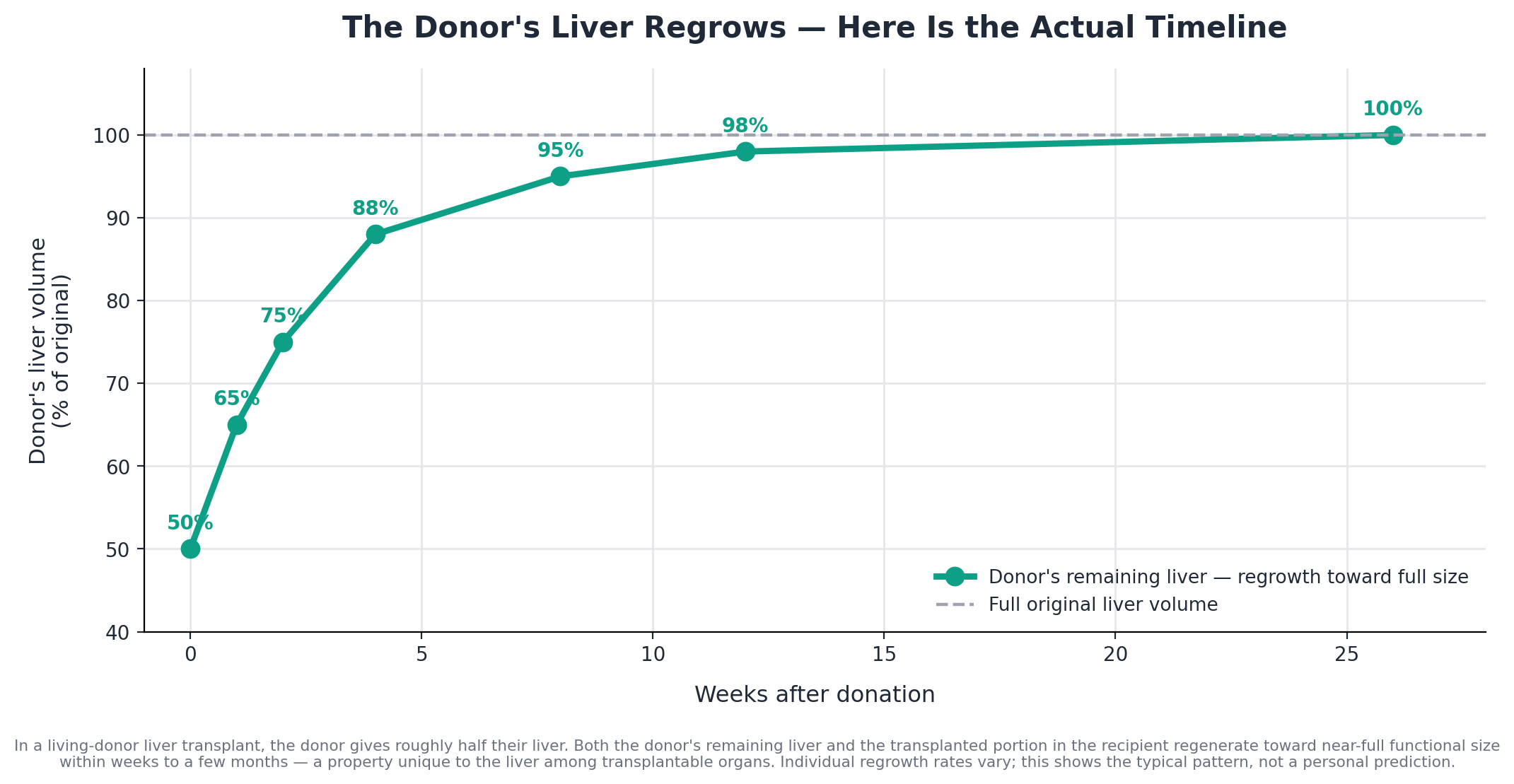
This is worth understanding candidly before you or a family member commits to donating, because it is genuinely different from what most people expect. A living liver donor typically gives roughly half their liver. Unlike a kidney, the liver has a remarkable capacity to regenerate: the donor's remaining portion, and the segment transplanted into you, both grow back toward near-full functional size within weeks to a few months. This regenerative property is precisely what makes living-donor liver transplantation possible in the first place, and it is why donor recovery, while still major surgery with real risk, follows a genuinely different trajectory from kidney donation.
Four signals that should make you pause
Certain patterns reliably precede a difficult outcome. No clear plan for managing an underlying hepatitis B or C infection alongside the transplant itself. Vagueness about the donor's own surgical approach or long-term follow-up. A quoted medication cost that sounds implausibly low for lifelong immunosuppression, particularly if ongoing hepatitis treatment is also needed. And any suggestion of an unrelated or informally arranged donor, which raises the same serious legal and ethical concerns here as it does for kidney transplantation.
None alone proves a bad hospital, though the last is disqualifying on its own. Together they warrant a second, more transparent opinion before you commit.
The Kenya-specific practicalities
Get hepatitis B and C testing done in Kenya before travelling if this has not already been established, since it materially affects both your and, if relevant, your donor's suitability and workup. Direct Nairobi–Delhi and Nairobi–Mumbai flights make the journey roughly six hours. The Indian medical e-visa is issued to Kenyan passport holders within three to five working days against a hospital letter; your donor will need a separate visa arranged alongside yours, so raise this explicitly and early with the hospital's international patient team.
Before you fly, confirm which specific immunosuppressant and any ongoing hepatitis medications will be prescribed, and check with a Kenyan pharmacist or physician that equivalent medication is available and affordable once you are home. Given the longer recovery period involved, also plan realistically for an extended absence from work for both you and your donor, and discuss this openly with employers in advance rather than underestimating it.
The questions I would ask before paying a deposit
Of the transplant team:
- Who manages my underlying hepatitis B or C treatment, before and after transplant?
- What is your personal annual volume in living-donor liver transplants specifically?
- What immunosuppressant regimen do you propose, and what will it realistically cost monthly in Kenya?
- What is my donor's surgical approach, and what long-term follow-up is offered to them?
Of the hospital:
- What are your one- and five-year graft and patient survival figures, reported to a registry?
- Do you have a dedicated hepatobiliary or transplant ICU, and what is the nursing ratio?
- How many liver transplants does the centre perform annually?
- Will you confirm my prescribed medications are available in Kenya before I travel?
- Is the quote broken down separately for my surgery and my donor's surgery?
- What exactly is excluded from the quoted price?
- May I speak to a previous patient-and-donor pair from East Africa?
A team that answers all eleven without irritation is very likely the right team. One that becomes vague at the first, the second, or the ninth has told you what you needed to know at no cost at all.
Straight Answers for Kenyan Patients about Liver Transplant Surgeons and Hospitals in India
How do I choose the best liver transplant surgeon and hospital in India?
Start with your donor — most international liver transplants use a living donor, usually a close relative, identified before serious hospital research begins. Once settled, ask about the hospital's genuine hepatology-plus-transplant-surgery team, the surgeon's personal annual volume in living- donor liver transplants, and registry-reported outcomes.
How much does a liver transplant cost in India for a Kenyan patient?
Typically 25,000 to 40,000 US dollars all in, covering recipient and donor surgery, ICU and ward stay, and routine post-operative care. Immunosuppressant medication is priced separately. The same transplant is roughly 90,000 to 150,000 in the UK and 300,000 to 575,000 in the United States. Kenya has no routine domestic programme for comparison.
Why is liver cancer such a significant problem in Kenya specifically?
Chronic hepatitis B and C drive an estimated 80 percent of liver cancer cases in sub-Saharan Africa, and liver cancer is Kenya's second leading cause of cancer death. Hepatitis B prevalence exceeds 10 percent in several counties, well above the roughly 3 percent national average, with hepatitis C concentrated along the Coast.
Does the donor's liver grow back after a living-donor transplant?
Yes — this is one of the liver's genuinely unusual properties. A donor typically gives roughly half their liver, and both the donor's remaining portion and the transplanted segment regenerate toward near-full functional size within weeks to a few months. This regenerative capacity is what makes living-donor liver transplantation possible at all.
Can I get a liver transplant in India without bringing my own donor?
A living-donor transplant using a close relative is the standard, practical route for international patients. A small number of deceased-donor livers are allocated to foreign nationals under specific circumstances, but this is limited and uncertain in timing — identify and assess a potential living donor before committing to travel.
Will SHA pay for my liver transplant in India?
It is a genuinely strong candidate for SHA's overseas benefit, precisely because Kenya lacks a routine domestic liver transplant programme — unlike hip, knee, spine or kidney transplant, which Kenya performs and which are excluded from overseas funding. Check directly with SHA whether liver transplant currently appears among the 36 gazetted procedures, since the list is reviewed periodically.
How long must I and my donor stay in India for a liver transplant?
Around five to eight weeks: pre-operative assessment and donor evaluation, an in-patient stay typically longer than for a kidney transplant given the complexity of liver surgery, and a longer recovery period before fit-to-fly clearance for both of you. The recipient's stay is usually longer than the donor's.
A closing word
The best liver transplant programme in India for you begins with an honest conversation about your donor and, if relevant, your underlying hepatitis status, not just the surgery itself. From there, the best team is the one that manages your liver disease as seriously as the operation, reports real outcomes to a registry, and writes down in advance exactly how your medication and monitoring continue once you are back in Kenya, for the rest of your life. If you would like me to talk through your situation, including realistic timelines and what a suitable donor assessment involves, get in touch.
Sources
- 🌐 Examining need and capacity for the development of a pediatric liver transplantation program in Kenya. PubMed
- 🌐 The burden of Hepatitis B virus infection in Kenya: A systematic review and meta-analysis
- 🌐 The Prevalence and Genotype Distribution of Hepatitis C Virus in Kenya: A Systematic Review and Meta- Analysis. PMC
- 🌐 National Medical Commission of India — surgeon and specialist registration verification
- 🌐 National Accreditation Board for Hospitals & Healthcare Providers (NABH) — accredited hospital directory
- 🌐 Kenya Social Health Authority (SHA) — overseas treatment benefit and gazetted procedures
Frequently Asked Questions by Kenyans about Liver Transplant Surgeons and Hospitals in India
How should Kenyan patients choose a liver transplant surgeon and hospital in India?
Begin with donor identification. Once a suitable living donor is available, evaluate the hepatology-plus-transplant team, the surgeon's personal volume in living-donor liver transplantation, donor safety and the centre's registry-reported outcomes.
Can a Kenyan patient get a liver transplant in India without bringing a donor?
A living donor is described as the standard practical route for international patients. Deceased-donor allocation to foreign nationals exists only in limited circumstances and is too uncertain to form the basis of a treatment plan.
How much does a liver transplant in India cost for Kenyan patients?
The guide gives approximately USD 25,000–40,000 all-in, covering recipient and donor surgery, ICU, ward stay and routine postoperative care. Immunosuppressant medication is priced separately.
Does Kenya currently perform routine liver transplantation?
According to the guide, Kenya does not currently have an established routine liver-transplant programme. This is why treatment abroad is often necessary when transplantation is genuinely indicated.
Will Kenya's SHA pay for liver transplant treatment in India?
The guide describes liver transplantation as a strong candidate for SHA's overseas-treatment pathway because Kenya lacks routine domestic capacity. Patients should confirm current inclusion directly with SHA because the gazetted list is reviewed periodically.
Why does hepatitis matter before liver transplantation?
Hepatitis B or C can be the underlying cause of liver failure or liver cancer. A transplant replaces the damaged liver but does not itself cure the viral infection, so ongoing hepatitis treatment may still be required.
Does a living liver donor's liver grow back after surgery?
Yes. The guide explains that a donor typically gives roughly half of the liver, and both the remaining donor liver and the transplanted portion regenerate toward near-full functional size within weeks to a few months.
How long should a Kenyan patient and donor stay in India?
The guide recommends approximately 5–8 weeks for the overall transplant journey, including assessment, surgery, inpatient care and recovery before fit-to-fly clearance. The recipient's stay is normally longer.
What hospital facilities are most important for liver transplant?
Important factors include a dedicated hepatobiliary/transplant ICU, substantial transplant-centre volume, registry-reported graft and patient survival outcomes, and a written medication and follow-up handover plan.
What warning signs should Kenyan families watch for when choosing a liver transplant programme?
Major red flags include no clear plan for hepatitis B or C management, vague answers about donor surgery and donor follow-up, unrealistically low lifelong medication estimates and any suggestion of an unrelated or informally arranged donor.
Page Summary
This guide explains that the liver-transplant journey for Kenyan patients begins with identifying a suitable living donor, rather than simply choosing a surgeon or hospital. Most international liver transplants in India are described as living-donor procedures, while deceased-donor allocation to foreign patients is limited and uncertain.
Citation Block
| Topic | Information |
|---|---|
| Topic Information | Selecting Liver Transplant Surgeons and Hospitals in India for Kenyan Patients |
| Procedure | Living-Donor Liver Transplant |
| Country | India |
| Intended Audience | Kenyan Patients and Families |
| Conditions Covered | End-Stage Liver Disease, Liver Failure and Selected Liver-Cancer Cases Requiring Transplantation |
| Donor Requirement | Compatible, Willing and Medically Suitable Living Donor |
| Primary Team Requirement | Hepatology-Plus-Transplant-Surgery Team |
| Surgeon/Team Weighting | 58% |
| Hospital Weighting | 42% |
| Important Kenya-Specific Condition | Hepatitis B/C-Related Liver Disease and Hepatocellular Carcinoma |
| Critical Hospital Facility | Dedicated Hepatobiliary or Transplant ICU |
| Liver Transplant Cost in India | Approximately USD 25,000–40,000 |
| Typical Stay | Approximately 5–8 Weeks |
| Recipient Stay | Usually Longer Than the Donor's |
| Recovery | Major Recovery Over Several Weeks; Donor Liver Regeneration Continues Over Weeks to Months |
| Long-Term Treatment | Lifelong Immunosuppression |
| Kenya Follow-Up | Lifelong Monitoring, Medication Management and Hepatitis Treatment Where Relevant |
| Accreditation Mentioned | JCI and NABH |
| Author | Dr. Dheeraj Bojwani |
| Experience | 24 Years' Experience |


Our Mission Statement
Our mission is to place patients at the centre of every healthcare decision by providing trustworthy, evidence-based, and unbiased medical information. We believe that informed patients make better decisions. Backed by personalised guidance from our experienced advisory team, we help patients understand their treatment options, compare them objectively, and confidently choose the path that best suits their medical needs and personal circumstances.
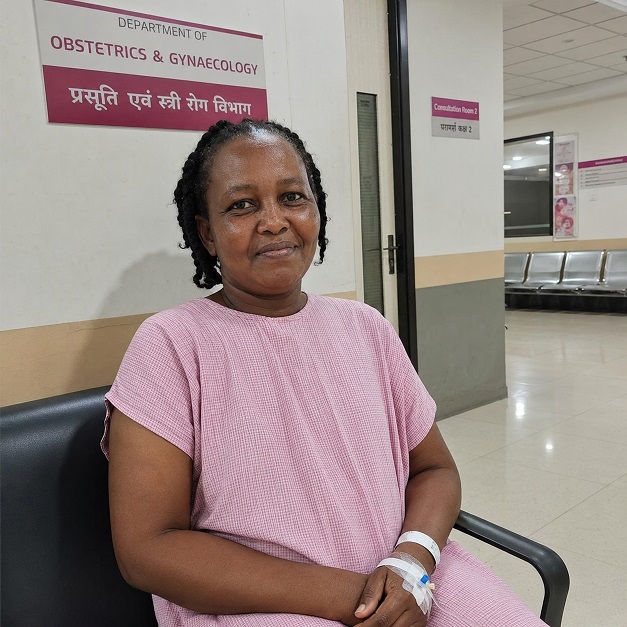
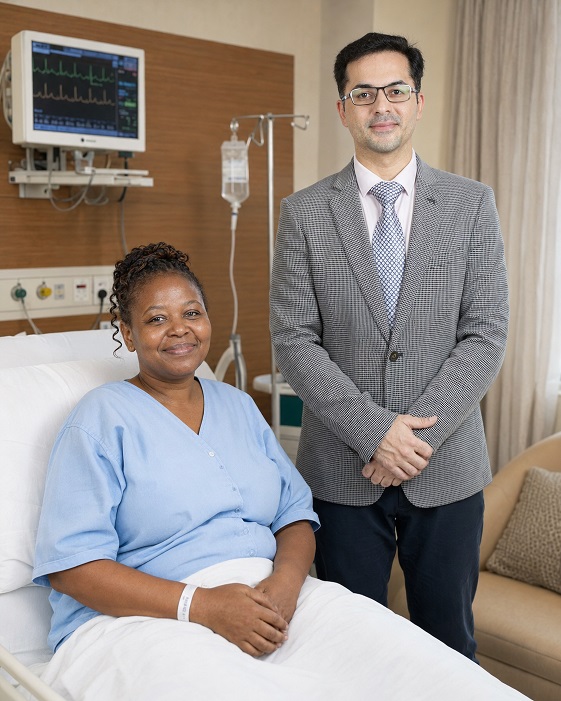
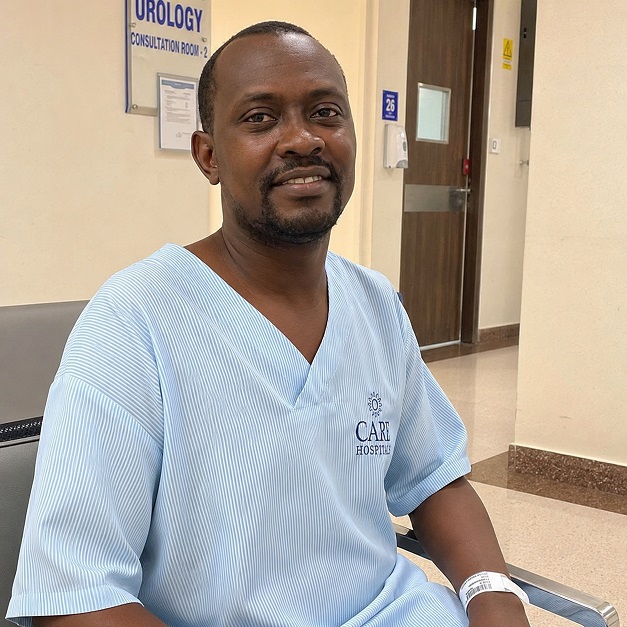
Patient Testimonials from Kenya


Ready to Take the First Step?
Share your Medical Reports with our Healthcare Managers Today and Get a FREE CONSULTATION, a Personalized Treatment Plan, and Complete Support from Arrival to Recovery.
Get Your Free ConsultationAreas We Serve
This resource has been thoughtfully prepared for patients from Kenya who are considering medical treatment in India. We also welcome patients from the wider region in the countries mentioned below-
We assist patients from:
- Ethiopia
- Somalia
- Tanzania
- Uganda
- Seychelles
- Guinea
- Guinea-Bissau
- Liberia
- Mali
- Mauritania
- Niger
- Nigeria
- Senegal
- Togo
- South Sudan
- Sierra Leone
Many of the insights, treatment pathways, hospital recommendations, travel guidance, and patient support services described here are equally relevant and may be used as a reference when planning treatment in India.
From Kenya to India: Your Complete Patient Support Guide
- Brain Tumour Surgery in India for Kenyan Patients
- Cancer Treatment and Surgery in India for Kenyan Patients
- Cardiac Treatment and Surgery in India for Kenyan Patients
- Heart Valve Replacement Surgery in India for Kenyan Patients
- Knee Replacement in India for Kenyan Patients
- Prostate Cancer Treatment and Surgery in India for Kenyan Patients
- Spine Treatment and Surgery in India for Kenyan Patients
- Selecting the Best Bariatric Surgeons and Hospitals in India: What Kenyan Patients Should Actually Look For
- Selecting the Best Cancer Surgeons and Hospitals in India: What Kenyan Patients Should Actually Look For
- Selecting the Best Cardiac Surgeons and Hospitals in India: What Kenyan Patients Should Actually Look For
- Selecting the Best Dental Surgeons and Clinics in India: What Kenyan Patients Should Actually Look For
- Selecting the Best Hip Surgeons and Hospitals in India: What Kenyan Patients Should Actually Look For
- Selecting the Best Kidney Transplant Surgeons and Hospitals in India: What Kenyan Patients Should Actually Look For
- Selecting the Best Knee Surgeons and Hospitals in India: What Kenyan Patients Should Actually Look For
- Selecting the Best Liver Transplant Surgeons and Hospitals in India: What Kenyan Patients Should Actually Look For
- Selecting the Best Neurosurgeons and Hospitals in India: What Kenyan Patients Should Actually Look For
- Selecting the Best Prostate Cancer Surgeons and Hospitals in India: What Kenyan Patients Should Actually Look For
- Selecting the Best Spine Surgeons and Hospitals in India: What Kenyan Patients Should Actually Look For