

Selecting the Best Dental Surgeons and Clinics in India: What Kenyan Patients Should Actually Look For
One casual dental decision costs little today and compounds for decades — how to compare implant quotes that are not quoting the same thing.
Dental treatment is different from the surgical procedures elsewhere in this series in one important way: the stakes of a single bad decision are lower in the moment, but the cumulative cost of repeated poor choices compounds over decades in a mouth you cannot simply replace again cheaply. Across 24 years of guiding international patients through Indian hospitals and clinics, dental cases are where I most often see patients treat the decision too casually, comparing quoted prices for "implants" as though every clinic and every implant system were the same thing. This is the framework I use when a Kenyan patient is weighing dental treatment, and particularly dental implants, in India. It follows the same structure as the rest of this series — the dentist, then the clinic — with one addition specific to dentistry: understanding that "dentist" is not a single job.
Healing Journeys of Kenyan Patients

Key Takeaways
- Kenyan patients considering dental treatment in India should not compare quotations for “implants” as though every dentist, clinic and implant system offers the same treatment. The guide explains that poor dental decisions can create cumulative costs over many years, making specialist selection and long-term repairability important considerations.
- Access to oral healthcare remains uneven in Kenya. The guide cites an estimated national dentist-to-population ratio of approximately one dentist per 37,800–42,000 people, compared with the WHO recommendation of one per 7,000.
- Only around 13% of Kenyan health facilities are described as offering oral-health services, with much of the available workforce concentrated in Nairobi and other major urban areas.
- The oral-disease burden described in the guide is also substantial. Its page 1 chart reports 98.1% of adults affected by gum disease, 46.3% of five-year-old children with tooth decay, and 41.4% of children affected by dental fluorosis.
- Travelling to India is not automatically necessary. The guide states that good local care exists in Kenya for routine fillings, a single implant and general restorative dentistry, particularly in Nairobi. India becomes more relevant for full-mouth rehabilitation, complex implant treatment, bone grafting, sinus lifts and extensive work where the cost difference can justify international travel.
- The first major selection issue is understanding that “dentist” is not a single job. A general dentist, periodontist, prosthodontist and oral and maxillofacial surgeon have different areas of expertise.
- For implant treatment, patients should ask who will actually place the implant and who will design the final crown or bridge. In a strong multidisciplinary dental clinic, these may be different specialists working together.
- The guide recommends a conservative-first treatment philosophy. Before extracting a tooth and replacing it with an implant, patients should ask whether options such as root-canal treatment and a crown could reasonably preserve the natural tooth.
Quick Facts
- Treatment
- Dental Surgery, Dental Implants and Restorative Dental Care
- Country
- India
- Intended Audience
- Kenyan Patients
- Primary Focus
- Selecting the Right Dental Specialist and Clinic
- Important Kenya-Specific Issue
- Limited Access to Oral Health Services Outside Major Urban Centres
- Kenya Dentist-to-Population Ratio Mentioned
- Approximately 1 Dentist Per 37,800–42,000 People
- WHO Recommendation Mentioned
- Approximately 1 Dentist Per 7,000 People
- Kenyan Facilities Offering Oral Health Services
- Approximately 13%
- Adults With Gum Disease in Chart
- 98.1%
- Five-Year-Old Children With Tooth Decay in Chart
- 46.3%
- Children Affected by Dental Fluorosis in Chart
- 41.4%
- Treatment That May Be Available Locally
- Routine Fillings, Single Implants and General Restorative Dentistry
- When India Becomes More Relevant
- Full-Mouth Rehabilitation, Complex Implant Cases, Bone Grafting, Sinus Lifts and Extensive Dental Work
- Specialists Discussed
- General Dentist, Periodontist, Prosthodontist and Oral & Maxillofacial Surgeon
- Implant Placement
- Patients Should Confirm Which Named Specialist Will Actually Place the Implants
- Prosthetic Treatment
- Patients Should Confirm Who Will Design and Fit the Final Crowns or Bridge
- Treatment Philosophy
- Conservative-First Approach Recommended
- Tooth Preservation
- Root Canal and Crown May Sometimes Be Considered Before Extraction and Implant Placement
In Brief
Kenyan patients choosing dental surgeons and clinics in India should first identify the correct dental specialist for each part of treatment rather than assuming every dentist has the same expertise. For implant cases, the guide gives greater overall weighting to dentist factors at 58%, compared with 42% for clinic factors, and emphasises personal implant volume, conservative treatment planning and honest explanation of the approximately 8–16-week osseointegration period. Clinic selection should include CBCT-based planning, prosthetics quality control, appropriate registration or accreditation and written documentation of the implant brand, model and size so future maintenance can be performed safely in Kenya.
Why access to dental care in Kenya is genuinely difficult
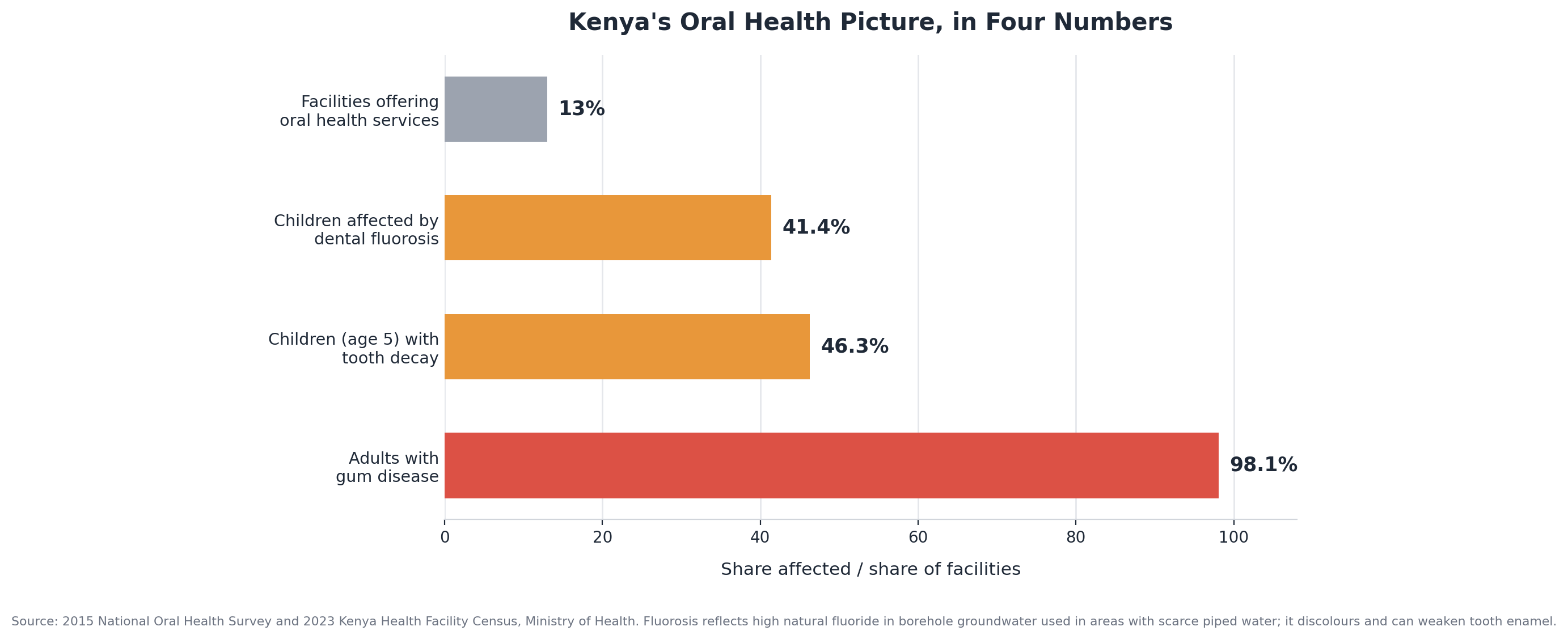
This is worth understanding candidly before deciding where to seek treatment. Kenya's dentist-to- population ratio is estimated at roughly one dentist per 37,800 to 42,000 people nationally, against a World Health Organization recommendation of one per 7,000 — a gap of more than five times. Only around 13 percent of health facilities nationally offer any oral health services at all, and the workforce that does exist is heavily concentrated in Nairobi and a handful of urban centres; large parts of the country, particularly less urbanised and sparsely populated counties, have minimal or no dental access.
This shortage sits alongside a genuinely high burden of oral disease. National survey data found 98.1 percent of Kenyan adults affected by gum disease and 46.3 percent of five-year-olds with tooth decay. Dental fluorosis, caused by high natural fluoride in borehole groundwater used where piped water is scarce, affects over 41 percent of Kenyan children to some degree, and often presents later in life as a cosmetic concern patients want addressed. Understanding this background helps explain both why many Kenyan patients arrive at a dental decision later and with more advanced disease than ideal, and why a rushed, cost-only comparison between clinics can be a genuinely costly mistake.
Should you travel at all?
Kenya has genuinely skilled dentists, particularly in Nairobi, and for straightforward treatment — routine fillings, a single implant, general restorative work — good local care exists and is worth exploring first, especially given the added logistics of international travel for what may be a modest procedure. The case for India strengthens for full-mouth rehabilitation, complex implant cases involving bone grafting or sinus lifts, and situations where the cost differential for extensive work is large enough to justify travel, accommodation and the two-visit structure most implant treatment requires.
On funding: Kenya's Social Health Authority does not cover overseas dental treatment, and its domestic dental coverage carries significant gaps, particularly for implants and advanced restorative work. Plan to pay for dental treatment in India yourself.
Part one: judging the dentist
1. Which specialist for which treatment
I weight this above almost every other factor, because it is the single most common source of disappointment I see. "Dentist" is not one job. A general dentist, a periodontist (specialising in gums and the structures supporting teeth, including implant placement), a prosthodontist (specialising in the crowns, bridges and dentures that sit on top of implants), and an oral and maxillofacial surgeon
(handling more complex surgical extractions, bone grafting and jaw procedures) are different training pathways with different depths of expertise in different parts of the process.
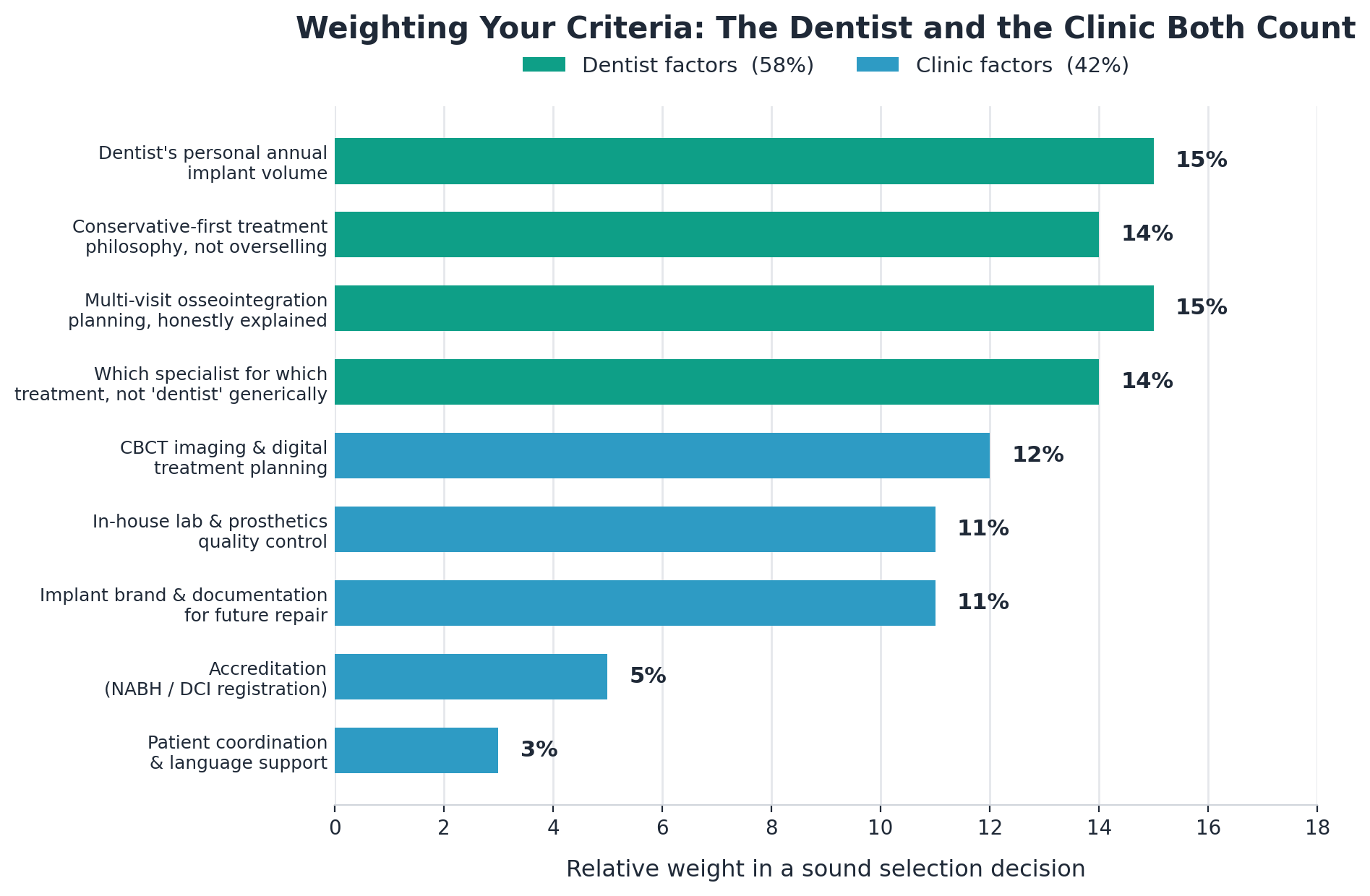
Ask directly which specialist is actually placing your implants and which is designing your final crowns or bridge — in a good clinic these are often two different people working together, not one generalist doing everything. A general dentist confidently offering full-mouth implant surgery is not automatically the wrong choice, but it is worth asking why a specialist referral is not part of the plan.
2. Conservative-first treatment philosophy
Ask whether less invasive options were genuinely considered before extraction and implants were proposed — a root canal and crown, for instance, can sometimes save a tooth that a less careful assessment would simply remove. A dentist who explains why extraction is the right call for your specific tooth, rather than defaulting to it, is thinking about your case rather than running the more profitable option by default.
3. Personal annual implant volume
Ask how many implants the treating dentist personally places each year, and specifically how many full-arch cases if that is what you need. Implant placement, particularly in cases needing bone grafting or sinus lifts, is a skill that improves meaningfully with volume, and a clinic's overall reputation does not tell you the individual practitioner's actual experience.
4. Multi-visit osseointegration planning, explained honestly
Ask your dentist to walk you through the realistic timeline: implant placement, then eight to sixteen weeks for osseointegration — the biological process of the implant fusing with your jawbone — before the final crown or bridge can safely be fitted. Any clinic promising a complete implant-to- crown result in one short trip is either describing an unusually straightforward case or not being fully honest about the biology involved.
Part two: judging the clinic
Dental treatment depends on institutional quality control in ways that are easy to overlook — reflected in the meaningful clinic-side weighting below, even as the individual dentist's expertise still carries the majority.
5. CBCT imaging and digital treatment planning
Ask whether the clinic uses cone-beam CT (CBCT) imaging for implant planning rather than relying solely on standard two-dimensional X-rays. CBCT gives a three-dimensional view of your jawbone, nerve position and sinus anatomy, materially reducing the risk of complications during implant placement, particularly in the upper jaw or near the lower jaw's nerve canal.
6. In-house laboratory and prosthetics quality control
Ask whether crowns, bridges and dentures are fabricated in-house or outsourced to a third-party lab, and if outsourced, which one and with what quality oversight. A clinic with its own laboratory generally offers tighter control over fit and finish, and faster turnaround if an adjustment is needed during your stay.
7. Implant brand and documentation for future repair
Ask exactly which implant system and brand will be used, and insist on written documentation — brand, model, size — before you leave India. Implant systems from different manufacturers are generally not interchangeable at the connection between implant and crown. If anything needs adjustment or replacement years later, whoever treats you next, in India or Kenya, needs to know precisely what was placed. This single piece of paperwork is arguably the most valuable thing you take home besides your new teeth.
8. Accreditation, read properly
Look for clinics registered appropriately with Indian dental regulatory bodies and, for larger hospital- based dental departments, NABH accreditation. This is a meaningful baseline filter on hygiene, sterilisation and safety protocols, though it says less about the specific expertise of the individual treating you than the questions above.
9. The cost you will actually pay
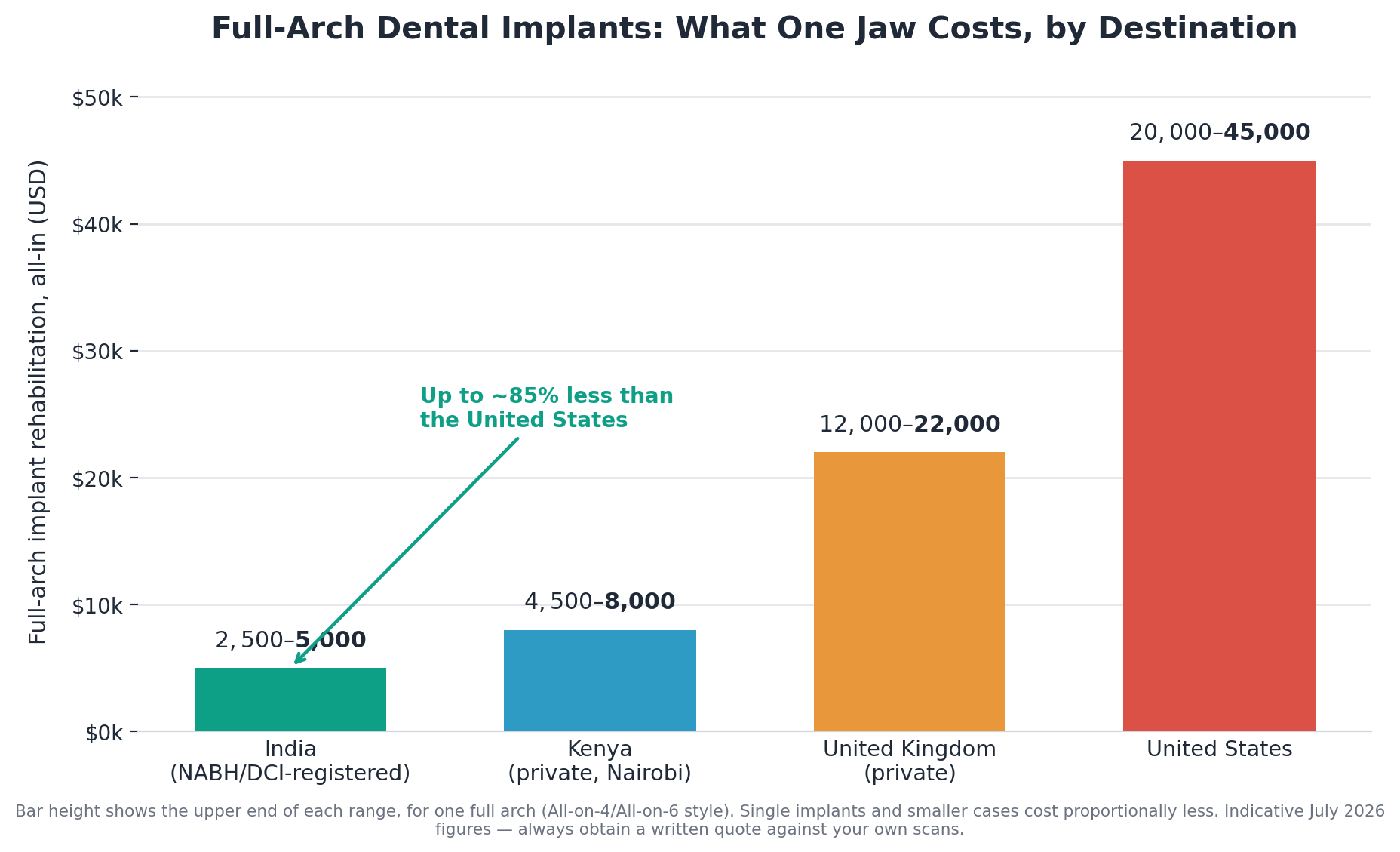
Let me be emphatic about this, because 24 years of handling these cases has taught me nothing more consistently: disputes almost never concern the quoted price. They concern what the quote silently omitted. For dental treatment specifically, insist the written estimate states the exact implant brand assumed, whether the crown is included in the headline price or billed separately, whether bone grafting or extractions are included or additional, and what the plan and cost is if a second visit reveals a complication requiring extra work.
Budget beyond the treatment itself. Direct Nairobi–Delhi and Nairobi–Mumbai flights run roughly 550 to 850 dollars return, and you will need to budget for two separate trips given the osseointegration waiting period, each requiring several days to a week of accommodation.
Your dental implant journey, in two visits
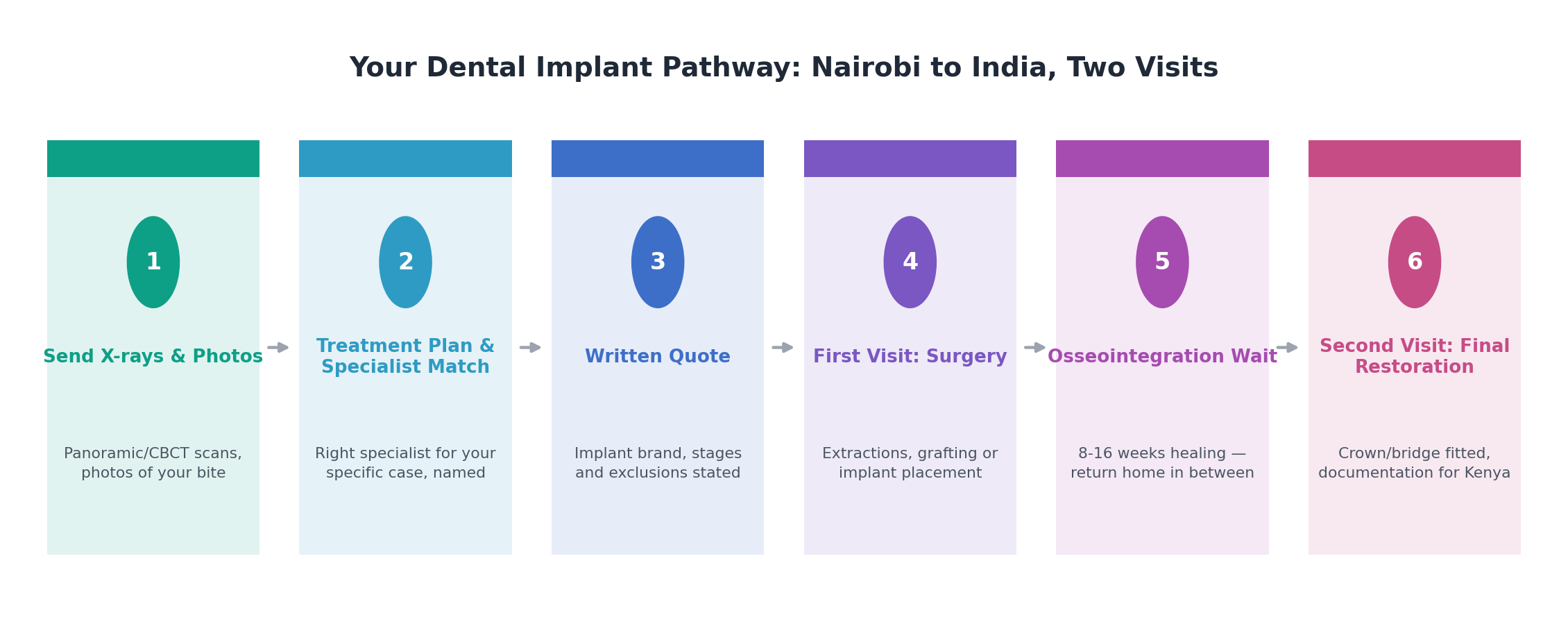
Send panoramic X-rays or, ideally, a CBCT scan along with photographs of your bite before your first consultation, so the treatment plan and quote are based on your actual anatomy rather than a generic estimate. Direct Nairobi–Delhi and Nairobi–Mumbai flights make each trip roughly six hours. The Indian medical or tourist e-visa is generally sufficient for dental treatment given its shorter, staged nature, though confirm the appropriate visa category with the clinic for your specific case.
Four signals that should make you pause
Certain patterns reliably precede a disappointing result. A quote for "implants" with no named brand or system attached. A promise of a complete implant-to-crown result within days rather than the realistic eight-to-sixteen-week osseointegration window. Extraction proposed for a tooth without any discussion of whether it could reasonably be saved. And a clinic unable to clearly state which specific person, by name and qualification, will be placing your implants.
None alone proves a bad clinic. Together they warrant a second opinion before you commit.
The questions I would ask before paying a deposit
Of the dentist:
- Which specialist — periodontist, prosthodontist, oral surgeon, or general dentist — is actually treating me, and for which part of the process?
- Was a less invasive option genuinely considered before extraction was proposed?
- How many implants, and specifically full-arch cases, do you personally place each year?
- What is the realistic timeline for osseointegration in my specific case?
Of the clinic:
- Do you use CBCT imaging for implant planning?
- Are crowns and bridges made in-house or outsourced, and to where?
- Exactly which implant brand and model will be used, and will you document this in writing?
- Is the crown included in the quoted price, or billed separately?
- What happens to the cost if extra work is discovered during treatment?
- May I speak to a previous patient from East Africa?
A clinic that answers all ten without irritation is very likely the right clinic. One that becomes vague at the first or the third has told you what you needed to know at no cost at all.
Straight Answers for Kenyan Patients about Dental Surgeons and Clinics in India
How do I choose the best dental surgeon and clinic in India as a Kenyan patient?
Recognise that "dentist" is not one job. Ask whether you're being treated by a periodontist, prosthodontist, or oral surgeon rather than a general dentist doing implants occasionally, ask their personal annual implant volume, and insist on written documentation of the exact implant brand and model before you leave.
How much do dental implants cost in India for a Kenyan patient?
A single implant with crown typically costs 400 to 900 US dollars. A full-arch rehabilitation (All-on- 4/All-on-6 style) typically costs 2,500 to 5,000 dollars per arch all in. The same full-arch treatment is roughly 4,500 to 8,000 in Nairobi private care, 12,000 to 22,000 in the UK, and 20,000 to 45,000 in the United States.
Why is dental care access so limited in Kenya?
Kenya's dentist-to-population ratio is roughly one per 37,800 to 42,000 people, against a WHO recommendation of one per 7,000. Only around 13 percent of facilities nationally offer oral health services, concentrated mainly in Nairobi and urban centres. This sits alongside a high disease burden: 98.1 percent of adults have gum disease and 46.3 percent of five-year-olds have tooth decay.
What is dental fluorosis and why does it matter for Kenyan patients specifically?
Fluorosis is enamel discolouration, and in severe cases weakening, from excess fluoride in childhood, commonly from borehole groundwater in areas with limited piped water. Over 41 percent of Kenyan children are affected to some degree. It's a common presenting concern for cosmetic dental work in India and worth mentioning explicitly, since it shapes the right treatment approach.
How many trips to India does a dental implant actually require?
Plan on two visits. The first covers extractions, grafting if needed, and implant placement, typically five to seven days. The implant then needs eight to sixteen weeks to fuse with the jawbone before the second, shorter visit for the final crown or bridge. Any promise of a complete result in one short trip is not describing a biologically realistic timeline.
Does Kenya's SHA cover dental treatment in India?
No. SHA's overseas benefit covers only 36 gazetted procedures, and routine dental treatment isn't among them. Domestic dental coverage under SHA also has significant gaps, particularly for implants and advanced restorative work. Plan to pay for dental treatment in India yourself.
Why does the exact implant brand matter so much?
Implant systems from different manufacturers are generally not interchangeable at the connection to the crown. If your implant ever needs repair or a new crown years later, whoever treats you needs to know exactly which system and model was used. Get this documented in writing before you leave India — it's the single most valuable record for your future care.
A closing word
The best dental team in India for you is not the clinic with the lowest advertised price per implant — it is the one that puts the right specialist, not just any dentist, on the right part of your treatment, considers conservative options before reaching for extraction, and hands you a written implant brand and model before you fly home. The best clinic pairs that expertise with proper three-dimensional imaging, its own quality-controlled laboratory, and honesty about the real timeline your mouth actually needs to heal. If you would like me to look at your dental photographs or X-rays and talk through what a sensible treatment plan should look like, send them across.
Sources
- 🌐 Kenya Ministry of Health — World Oral Health Day 2025 briefing, National Oral Health Survey and 2023 Kenya Health Facility Census data
- 🌐 Geospatial Analysis of Dental Access and Workforce Distribution in Kenya. Annals of Global Health / PMC
- 🌐 Integrating oral health into Kenya's primary health care system: opportunities and challenges. The Lancet Primary Care , 2025
- 🌐 Dental Council of India (DCI) — dentist and specialist registration verification
- 🌐 National Accreditation Board for Hospitals & Healthcare Providers (NABH) — accredited facility directory
- 🌐 Kenya Social Health Authority (SHA) — benefit packages and overseas treatment guidance
Frequently Asked Questions by Kenyans about Dental Surgeons and Clinics in India
How should Kenyan patients choose a dental implant specialist in India?
Patients should identify which specialist will perform each part of treatment. Periodontists, prosthodontists, oral surgeons and general dentists have different expertise, so patients should ask who will place the implant and who will create the final restoration.
Is it necessary for Kenyan patients to travel to India for dental treatment?
Not always. The guide states that good local care exists for routine fillings, single implants and general restorative treatment. India becomes more relevant for complex implants, full-mouth rehabilitation, bone grafting and extensive treatment.
Should a damaged tooth always be extracted and replaced with an implant?
No. The guide recommends a conservative-first approach. Patients should ask whether treatments such as a root canal and crown could reasonably save the natural tooth before agreeing to extraction.
How much experience should an implant dentist have?
The guide does not specify a fixed minimum number. Instead, patients should ask how many implants the named dentist personally places each year and how many full-arch cases they perform if full-mouth treatment is planned.
Why is CBCT important for dental implants?
CBCT provides a three-dimensional view of the jawbone, nerve position and sinus anatomy. This can improve implant planning, particularly in complex cases or when implants are close to important anatomical structures.
Can dental implants and permanent crowns be completed in one short trip?
Not routinely according to this guide. It describes approximately 8–16 weeks for osseointegration before the definitive crown or bridge can safely be fitted, although individual treatment circumstances can vary.
Why should Kenyan patients know the implant brand and model?
Implant systems are not universally interchangeable. Written documentation of the brand, model and size can help a dentist in Kenya identify compatible components if maintenance or repair is required years later.
Is the dentist or dental clinic more important?
Both matter, but the guide gives the dentist greater overall weight: 58% for dentist factors and 42% for clinic factors. Individual expertise is therefore slightly more important, while imaging, laboratory quality and safety systems remain significant.
What should be included in a dental implant quotation?
The written quote should identify the implant brand, clarify whether the crown is included, state whether extractions or bone grafting cost extra and explain what happens financially if additional treatment is required.
What are the main warning signs when choosing a dental clinic in India?
The guide highlights four: an implant quote with no named brand, a promise of definitive implants and crowns within only a few days, extraction without discussing whether the tooth can be saved, and failure to identify the implant dentist by name and qualification.
Page Summary
This guide helps Kenyan patients choose dental surgeons and clinics in India by separating the decision into dentist factors and clinic factors. It begins by explaining Kenya's limited oral-health access and significant burden of gum disease, tooth decay and dental fluorosis, while also making clear that international travel is not necessary for every dental problem. Routine care may be available
Citation Block
| Topic | Information |
|---|---|
| Topic Information | Selecting Dental Surgeons and Clinics in India for Kenyan Patients |
| Treatment | Dental Surgery, Dental Implants and Restorative Dentistry |
| Country | India |
| Intended Audience | Kenyan Patients |
| Conditions/Treatments Covered | Dental Implants, Full-Mouth Rehabilitation, Restorative Dentistry, Bone Grafting and Related Dental Procedures |
| Specialists | General Dentist, Periodontist, Prosthodontist and Oral & Maxillofacial Surgeon |
| Primary Selection Principle | Match the Correct Specialist to Each Part of Treatment |
| Dentist Factors | 58% Overall Weighting |
| Clinic Factors | 42% Overall Weighting |
| Critical Imaging | CBCT for Implant Planning |
| Implant Healing Period | Approximately 8–16 Weeks for Osseointegration |
| Typical Travel Structure | Often Two Visits for Conventional Implant Treatment |
| Pre-Travel Records | Panoramic X-Ray or Preferably CBCT and Bite Photographs |
| Indicative Return Airfare | Approximately USD 550–850 |
| Kenya Funding | Overseas Dental Treatment Not Covered by SHA According to the Guide |
| Author | Dr. Dheeraj Bojwani |
| Experience | 24 Years' Experience |

Our Mission Statement
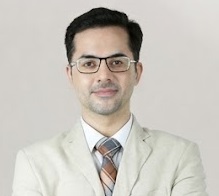
Our mission is to place patients at the centre of every healthcare decision by providing trustworthy, evidence-based, and unbiased medical information. We believe that informed patients make better decisions. Backed by personalised guidance from our experienced advisory team, we help patients understand their treatment options, compare them objectively, and confidently choose the path that best suits their medical needs and personal circumstances.
Patient Testimonials from Kenya
Ready to Take the First Step?
Share your Medical Reports with our Healthcare Managers Today and Get a FREE CONSULTATION, a Personalized Treatment Plan, and Complete Support from Arrival to Recovery.
Get Your Free ConsultationAreas We Serve
This resource has been thoughtfully prepared for patients from Kenya who are considering medical treatment in India. We also welcome patients from the wider region in the countries mentioned below-
We assist patients from:
- Ethiopia
- Somalia
- Tanzania
- Uganda
- Seychelles
- Guinea
- Guinea-Bissau
- Liberia
- Mali
- Mauritania
- Niger
- Nigeria
- Senegal
- Togo
- South Sudan
- Sierra Leone
Many of the insights, treatment pathways, hospital recommendations, travel guidance, and patient support services described here are equally relevant and may be used as a reference when planning treatment in India.
From Kenya to India: Your Complete Patient Support Guide
- Brain Tumour Surgery in India for Kenyan Patients
- Cancer Treatment and Surgery in India for Kenyan Patients
- Cardiac Treatment and Surgery in India for Kenyan Patients
- Heart Valve Replacement Surgery in India for Kenyan Patients
- Knee Replacement in India for Kenyan Patients
- Prostate Cancer Treatment and Surgery in India for Kenyan Patients
- Spine Treatment and Surgery in India for Kenyan Patients
- Selecting the Best Bariatric Surgeons and Hospitals in India: What Kenyan Patients Should Actually Look For
- Selecting the Best Cancer Surgeons and Hospitals in India: What Kenyan Patients Should Actually Look For
- Selecting the Best Cardiac Surgeons and Hospitals in India: What Kenyan Patients Should Actually Look For
- Selecting the Best Dental Surgeons and Clinics in India: What Kenyan Patients Should Actually Look For
- Selecting the Best Hip Surgeons and Hospitals in India: What Kenyan Patients Should Actually Look For
- Selecting the Best Kidney Transplant Surgeons and Hospitals in India: What Kenyan Patients Should Actually Look For
- Selecting the Best Knee Surgeons and Hospitals in India: What Kenyan Patients Should Actually Look For
- Selecting the Best Liver Transplant Surgeons and Hospitals in India: What Kenyan Patients Should Actually Look For
- Selecting the Best Neurosurgeons and Hospitals in India: What Kenyan Patients Should Actually Look For
- Selecting the Best Prostate Cancer Surgeons and Hospitals in India: What Kenyan Patients Should Actually Look For
- Selecting the Best Spine Surgeons and Hospitals in India: What Kenyan Patients Should Actually Look For