

Selecting the Best Paediatric Orthopaedic Surgeons and Hospitals in India: What Kenyan Families Should Actually Look For
A child’s bones are still growing, which changes both the operation and who should perform it — how a Kenyan family judges the paediatric orthopaedic surgeon and the hospital in India.
A child's broken arm looks, to most parents, like an adult's broken arm made small. It is not. Across 24 years of guiding international patients through Indian hospitals, the paediatric orthopaedic cases that go wrong are almost never the dramatic ones. They are the quietly mishandled fracture near a growth plate, treated as though the child were a small adult, that turns into a worsening deformity years later. This is the framework I use when a Kenyan family is weighing orthopaedic surgery in India for a child, whether the problem is a malunited fracture, a congenital limb deformity, hip dysplasia, or growth-plate damage. It follows the surgeon-then-hospital structure of this series, and opens with the fact that makes children genuinely different from adult patients in orthopaedics.
Healing Journeys of Kenyan Patients
Key Takeaways
- The guide explains why children's bones cannot simply be treated like smaller adult bones, particularly when a fracture involves a growth plate. Approximately one in four childhood fractures involves the growth plate, and damage can progressively cause deformity as the child continues growing.
- For Kenyan families, the guide highlights the importance of obtaining X-ray imaging and specialist assessment before manipulation or traditional bonesetter treatment, particularly for fractures around the wrist, elbow, knee or ankle. It cites data suggesting that up to 84% of Kenyans with fractures may first seek traditional bonesetter care.
- Routine uncomplicated childhood fractures without growth-plate involvement can be managed in Kenya. The guide considers India more relevant for complex cases such as established malunion, growth-plate bar excision, congenital limb deformity, hip dysplasia beyond infancy and cases requiring Ilizarov or circular-frame reconstruction.
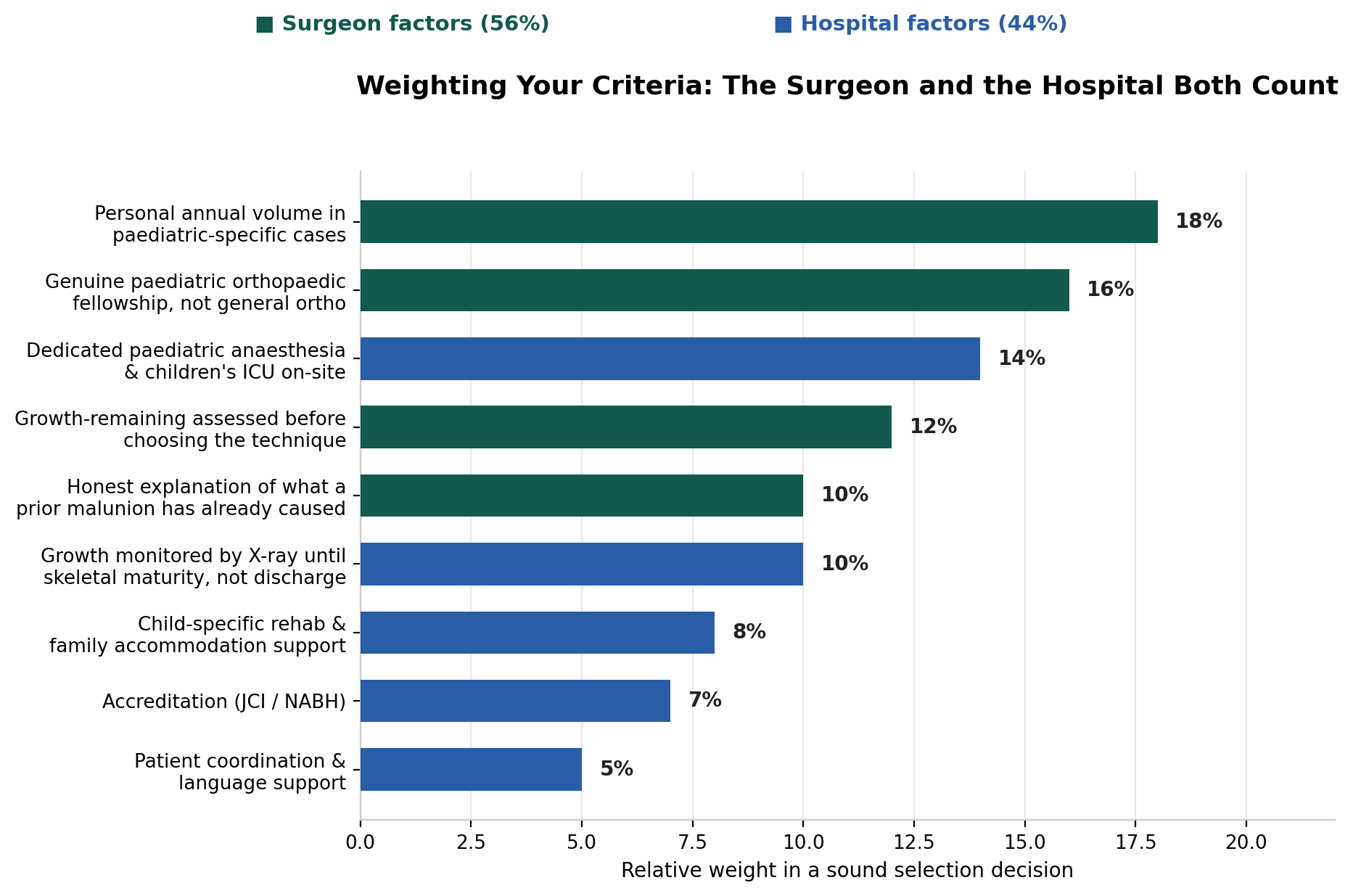
- The surgeon carries 56% of the selection weighting, while hospital factors account for 44%. The page 3 weighting chart gives the highest individual score of 18% to personal annual volume in paediatric-specific cases, followed by genuine paediatric orthopaedic fellowship at 16%.
- Hospital evaluation focuses on dedicated paediatric anaesthesia and children's ICU availability, long-term growth monitoring, child-specific rehabilitation and family accommodation support. The guide also explains that JCI and NABH accreditation are useful safety filters but do not by themselves prove paediatric orthopaedic subspecialisation.
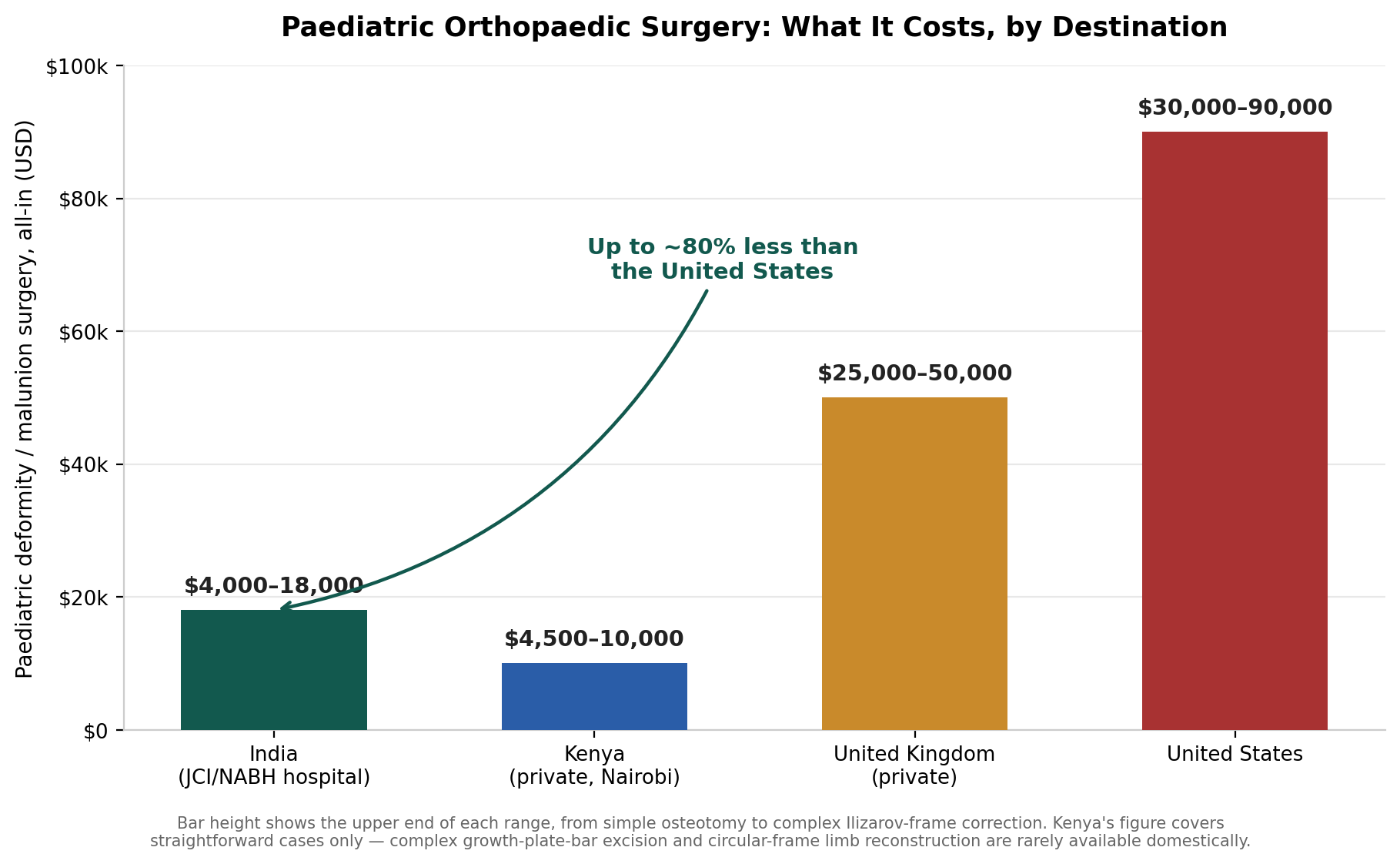
- The page 5 cost chart gives an illustrative range of US$4,000–18,000 in India, compared with US$4,500–10,000 in Kenya, US$25,000–50,000 in the UK and US$30,000–90,000 in the US. Families are advised to confirm what is included, particularly long-term follow-up, circular-frame or implant removal and physiotherapy.
Quick Facts
- Treatment
- Paediatric Orthopaedic Surgery
- Country
- India
- Patients
- Kenyan Families
- Main Conditions
- Growth-Plate Injuries, Malunion, Limb Deformity & Hip Dysplasia
- Complex Procedures
- Corrective Osteotomy, Growth-Plate Bar Excision & Circular-Frame Reconstruction
- Key Specialist
- Paediatric Orthopaedic Surgeon
- Main Focus
- Growing Bone & Long-Term Development
- Selection Criteria
- Weighted Surgeon & Hospital Criteria
- Surgeon Weight
- 56%
- Hospital Weight
- 44%
- Highest Criterion
- Personal Annual Paediatric-Specific Volume
- Key Qualification
- Paediatric Orthopaedic Fellowship
- Growth Assessment
- Remaining Growth Before Technique Selection
- Key Safety Check
- Growth-Plate Assessment
- Anaesthesia
- Dedicated Paediatric Anaesthetist
- Hospital Support
- Children's ICU
- Rehabilitation
- Child-Specific Physiotherapy
- Monitoring
- X-Ray Follow-Up Until Skeletal Maturity
- Accreditation
- JCI / NABH
- Key Cost Check
- Follow-Up, Frame/Implant Removal & Physiotherapy
- Travel Route
- Nairobi–Delhi / Nairobi–Mumbai
- Visa
- Indian Medical E-Visa
- Follow-Up
- Kenyan Doctor
- Key Records
- Full Imaging & Previous Treatment History
- Warning Signs
- No Growth Assessment or Dedicated Paediatric Anaesthesia
- Author
- Dr. Dheeraj Bojwani
- Experience
- 24+ Years
In Brief
For Kenyan families considering paediatric orthopaedic treatment in India, the guide recommends sending the full imaging and complete history of previous treatment, including traditional bonesetter care where applicable. Families should ask about the surgeon's paediatric-specific annual volume, dedicated paediatric orthopaedic fellowship and how much growth the child has remaining before the technique is selected. The hospital should provide dedicated paediatric anaesthesia, children's ICU access, child-specific rehabilitation and long-term X-ray monitoring until skeletal maturity. A written follow-up schedule should also be provided for the Kenyan doctor.
Before the surgeon: why a child's bone is a moving target
A child's skeleton is still growing, and the growth plate, the cartilage layer near each joint where new bone forms, is both the engine of that growth and its most vulnerable point. Roughly one in four childhood fractures involves the growth plate, and damage there does not simply heal crooked and stay crooked, as it would in an adult. It can progressively worsen for years, as the undamaged parts of the bone keep growing around an injury that has stopped.
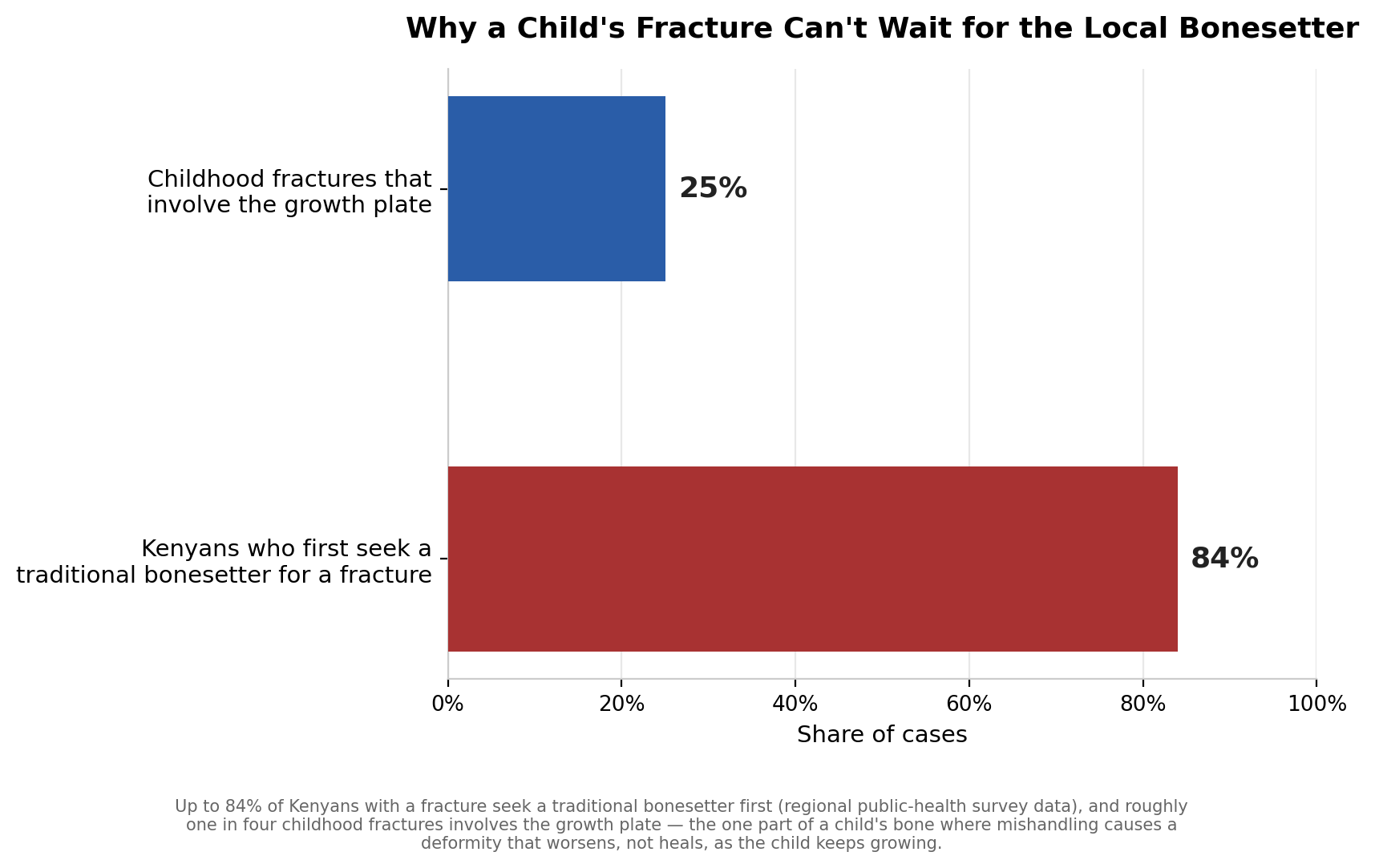
This matters enormously for Kenyan families because up to 84% of Kenyans with a fracture seek out a traditional bonesetter before, or instead of, formal orthopaedic care. For an adult limb fracture, a bonesetter's manipulation without imaging is already risky. For a child's fracture near a growth plate, it removes the one thing that could catch the injury early enough to prevent a lifelong deformity: an X-ray and a specialist's assessment of exactly where the fracture line sits.
The practical takeaway is to treat any childhood fracture near a joint, wrist, elbow, knee, ankle, as one that needs imaging and a specialist opinion before any manipulation, cast, or traditional treatment is accepted. If your child already has a deformity from a fracture treated elsewhere, ask specifically whether the growth plate was affected and whether the deformity is likely to progress as your child continues to grow.
Should you travel at all?
Kenya manages routine childhood fractures well, and Aga Khan University Hospital Nairobi, The Nairobi Hospital, and a growing number of dedicated paediatric orthopaedic clinics in Nairobi handle straightforward casting and simple fracture fixation competently. For an uncomplicated fracture with no growth plate involvement, treatment in Kenya is entirely reasonable.
For anything more complex, India is where I steer families, confidently. Established malunion needing corrective osteotomy, growth-plate bar excision, congenital limb deformity, hip dysplasia beyond infancy, and any case needing an Ilizarov or circular-frame reconstruction sit at a level of paediatric sub-specialisation, dedicated children's anaesthesia, growth-remaining calculations, and long-term monitoring protocols, that very few facilities in Kenya currently provide at scale. This is not a marginal cost saving; it is access to a genuine paediatric orthopaedic subspecialty built specifically around growing bone.
Part one: judging the surgeon
1. Personal annual volume in paediatric-specific cases
I weight this above every other factor, and the chart below reflects that. Ask how many cases matching your child's condition, specifically in paediatric patients, the surgeon performs each year. A surgeon whose real volume is in adult joint replacement is not automatically the right choice for a growing child's bone.
2. A genuine paediatric orthopaedic fellowship
Ask whether the surgeon trained specifically in paediatric orthopaedics, not general orthopaedics with occasional child patients. Growing bone behaves differently under load, heals differently, and responds to fixation differently, and this distinction matters more than general surgical reputation.
3. Growth-remaining assessed before choosing the technique
Ask how the surgeon calculates how much growth your child has left, and how that number shapes the treatment plan. A technique appropriate for a child close to skeletal maturity can be entirely wrong for a five-year-old with years of growth ahead.
4. An honest explanation of what a prior malunion has already caused
If your child has an existing deformity, ask the surgeon to explain, specifically, what has already happened to the growth plate and bone, and what correction can realistically achieve now. A generic reassurance is a warning sign here.
Part two: judging the hospital
For paediatric orthopaedic surgery, the surgeon and the hospital carry close to equal weight, reflected in the balance above, because the infrastructure around a child, anaesthesia, monitoring, family support, matters as much as the operation itself.
5. Dedicated paediatric anaesthesia and children's ICU on-site
Ask whether anaesthesia for your child's case is administered by a paediatric anaesthetist, not a general anaesthetist who occasionally treats children, and whether a children's ICU is available if needed.
6. Growth monitored by X-ray until skeletal maturity, not discharge
Ask what the follow-up imaging schedule looks like, not just after surgery, but for years afterward, since growth- plate cases need monitoring until the child stops growing. A hospital that treats discharge as the finish line is not thinking about your child's whole growth trajectory.
7. Child-specific rehabilitation and family accommodation support
Ask what rehabilitation looks like for a child specifically, and what accommodation support exists for a parent staying alongside them for what is often a longer recovery than an adult case.
8. Accreditation, read properly
JCI and NABH accreditation are meaningful filters on safety and infection control, but say nothing about paediatric orthopaedic sub-specialisation. Use accreditation to exclude weak candidates, not to choose between the strong ones.
9. The cost you will actually pay
Let me be emphatic about this, because 24 years of handling these cases has taught me nothing more consistently: disputes almost never concern the quoted price. They concern what the quote silently omitted. For paediatric orthopaedic surgery specifically, insist the estimate states whether follow-up visits over the growth years are included or separate, what a circular frame or implant removal costs later, and how many physiotherapy sessions are covered.
Budget beyond the surgery. Direct Nairobi–Delhi and Nairobi–Mumbai flights run roughly 550 to 850 dollars return, and a parent typically needs to stay with the child throughout, so budget accommodation for two.
Four signals that should make you pause
Certain patterns reliably precede a difficult outcome.
- A surgeon who cannot say how many paediatric-specific cases, as opposed to adult cases, he treats each year.
- No mention of growth-remaining calculations before the technique is chosen.
- A vague answer about long-term follow-up once your child returns home.
- A hospital without dedicated paediatric anaesthesia.
None alone proves a bad hospital. Together they warrant a second opinion before you commit to surgery.
The Kenya-specific practicalities
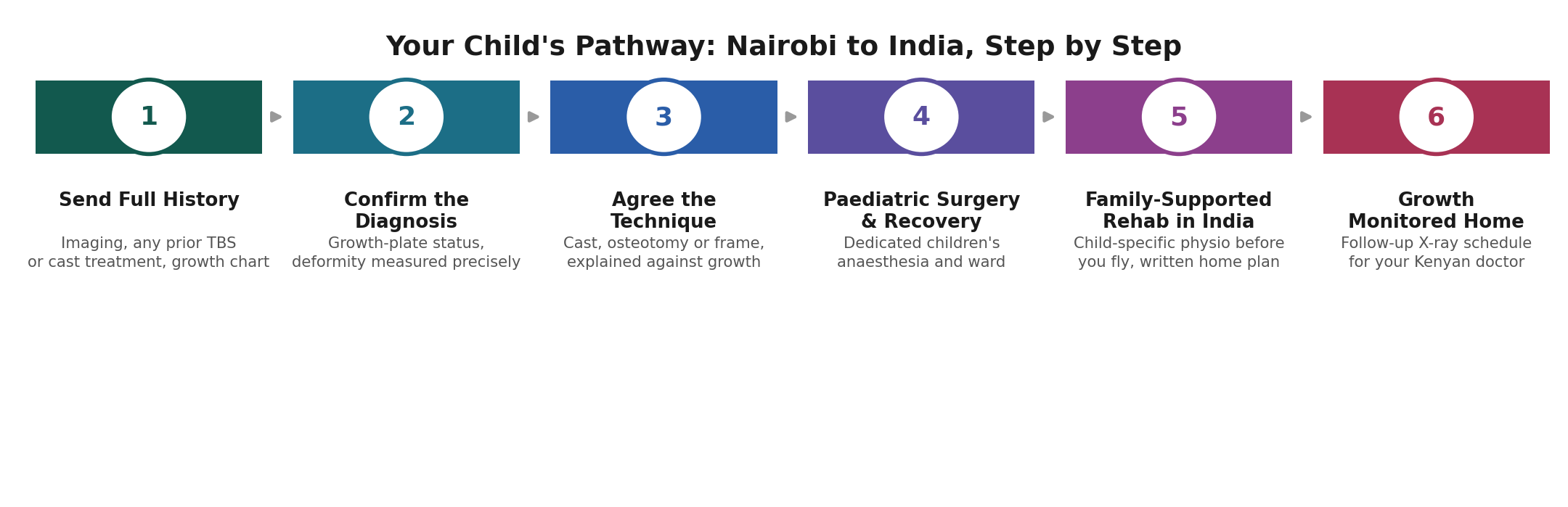
Send the full imaging, not just a written report, along with a clear timeline of any prior treatment, including traditional bonesetter care if that occurred. A team planning around a growing child needs to know exactly what has already happened to the bone.
Direct Nairobi–Delhi and Nairobi–Mumbai flights make this roughly a six-hour journey. The Indian medical e-visa is issued within three to five working days against a hospital letter, and up to two attendants can travel on a medical attendant visa, which matters since a parent will need to accompany a child throughout.
Agree in advance on a written follow-up imaging schedule your Kenyan doctor can continue, since growth-plate monitoring often continues for years after the trip itself.
The questions I would ask before paying a deposit
Of the surgeon:
- How many cases matching my child's condition do you personally treat each year?
- Did you train specifically in paediatric orthopaedics?
- How much growth does my child have left, and how does that shape the plan?
- What has already happened to the growth plate, specifically, if there is a prior injury?
Of the hospital:
- Is anaesthesia administered by a dedicated paediatric anaesthetist?
- What does growth monitoring look like for years after discharge?
- What does rehabilitation involve for a child specifically?
- What exactly is excluded from the quoted price?
- May I speak to a previous East African family treated for a similar condition?
A team that answers all nine without irritation is very likely the right team. One that turns vague at the first or third has told you what you needed to know at no cost at all.
Straight Answers for Kenyan Patients about Paediatric Orthopaedic Surgeons and Hospitals in India
How do I choose the best surgeon in India for my child's orthopaedic condition?
Ask his annual volume in paediatric-specific cases, whether he trained specifically in paediatric orthopaedics, and how he calculates your child's remaining growth before recommending a technique.
How much does paediatric orthopaedic surgery cost in India for a Kenyan family?
Typically 4,000 to 18,000 US dollars all in, depending on complexity. The same surgery runs roughly 4,500 to 10,000 dollars in Kenya for straightforward cases, 25,000 to 50,000 in the UK, and 30,000 to 90,000 in the US.
Why is a growth-plate fracture more serious than an ordinary fracture?
Because the growth plate drives how the bone lengthens as a child grows. Damage there can cause a deformity that worsens over years, not one that simply heals crooked once. Roughly a quarter of childhood fractures involve the growth plate, making early imaging and specialist assessment important.
Is it safe to use a traditional bonesetter for my child's fracture?
For fractures near a joint, wrist, elbow, knee, or ankle, it carries real risk, since manipulation without imaging can miss growth-plate involvement entirely. Up to 84% of Kenyans with a fracture seek a bonesetter first; for a child's joint-area fracture, an X-ray and specialist opinion first is the safer path.
My child already has a deformity from a past fracture. Can it still be corrected?
Often yes, through corrective osteotomy or, for more complex cases, gradual correction with a circular frame. The right approach depends on what has already happened to the growth plate and how much growth remains, which is why a specific, imaging-based explanation from the surgeon matters.
How long is recovery for a child after deformity correction surgery?
It varies by technique, from weeks for a straightforward osteotomy to many months if a circular frame is used for gradual correction. Growth-plate cases also need monitoring by X-ray for years afterward to confirm the growth pattern has normalised.
A closing word
For a child, India offers something Kenya's current orthopaedic infrastructure very often cannot: a genuine paediatric sub-specialty built around growing bone, at a fraction of UK or US cost. The best surgeon is the one whose paediatric-specific volume and growth-remaining calculations show he treats children as children, not small adults. The best hospital pairs him with dedicated paediatric anaesthesia and a monitoring plan that follows your child's growth, not just the operation. If you would like me to look at your child's scans and history and talk through honestly what the right plan looks like, send them across.
Sources
- 🌐 Utilization and associated factors of traditional bone setting service among patients with musculoskeletal injuries in Northeast Ethiopia (citing Kenya/Ghana traditional bonesetter preference rates)
- 🌐 Juma S, Kuria EM. A study on fracture management by traditional bonesetters and its effects to clients in Lungalunga Constituency
- 🌐 Growth plate injuries and management. Orthopaedics and Trauma journal
- 🌐 Complications of traditional bonesetting in contemporary fracture care in low- and middle-income countries: a systematic review
- 🌐 National Medical Commission of India — surgeon and specialist registration verification
- 🌐 National Accreditation Board for Hospitals & Healthcare Providers (NABH) — accredited hospital directory
Frequently Asked Questions by Kenyans about Paediatric Orthopaedic Surgeons and Hospitals in India
Why are children's fractures different from adult fractures?
Children are still growing, and injuries involving the growth plate can progressively affect bone development and cause deformity over several years.
How common are growth-plate fractures?
The guide states that roughly one in four childhood fractures involves the growth plate, making appropriate imaging and specialist assessment particularly important.
Should a child with a fracture see a specialist before traditional treatment?
For fractures around the wrist, elbow, knee or ankle, the guide recommends imaging and specialist assessment before manipulation, casting or traditional bonesetter treatment is accepted.
Which paediatric cases may require specialised treatment in India?
The guide highlights established malunion, growth-plate bar excision, congenital limb deformity, hip dysplasia beyond infancy and cases requiring Ilizarov or circular-frame reconstruction.
What is the most important surgeon-selection criterion?
Personal annual volume in paediatric-specific cases receives the highest individual weighting of 18%. Families should ask how many cases matching their child's condition the surgeon treats each year.
Why is a paediatric orthopaedic fellowship important?
The guide recommends confirming that the surgeon received specific paediatric orthopaedic training rather than treating children only occasionally as part of general orthopaedic practice.
Why does remaining growth matter?
A technique suitable for a child close to skeletal maturity may be inappropriate for a much younger child with many years of growth remaining. Growth remaining should therefore influence treatment selection.
What hospital facilities should Kenyan families check?
Families should confirm access to a dedicated paediatric anaesthetist, children's ICU, child-specific rehabilitation and long-term growth monitoring.
What should families check in the treatment quotation?
The estimate should clarify whether long-term follow-up visits, circular-frame or implant removal and physiotherapy sessions are included or charged separately.
What records should families send before travelling?
They should send the full imaging and a clear timeline of previous treatment, including traditional bonesetter care if it occurred, so the Indian team understands what has already happened to the child's bone.
Page Summary
This eight-page guide helps Kenyan families evaluate paediatric orthopaedic surgeons and hospitals in India for growth-plate injuries, malunions, limb deformities and complex childhood orthopaedic conditions. It explains why growing bones require specialist assessment and gives 56% weight to the surgeon and 44% to the hospital. Paediatric-specific surgical volume receives the highest individual weighting of 18%, followed by dedicated paediatric orthopaedic fellowship and growth-remaining assessment. The guide also highlights children's anaesthesia, ICU support, rehabilitation and long-term X-ray monitoring. The page 5 chart compares illustrative treatment costs across India, Kenya, the UK and US, while the page 6 pathway covers imaging, diagnosis, technique selection, surgery, rehabilitation and long-term monitoring.
Citation Block
| Topic | Information |
|---|---|
| Topic | Paediatric Orthopaedic Surgeons & Hospitals |
| Treatment | Paediatric Orthopaedic Surgery |
| Country | India |
| Patients | Kenyan Families |
| Main Conditions | Growth-Plate Injury, Malunion, Limb Deformity & Hip Dysplasia |
| Complex Procedures | Corrective Osteotomy, Bar Excision & Circular-Frame Reconstruction |
| Key Specialist | Paediatric Orthopaedic Surgeon |
| Main Focus | Growing Bone & Long-Term Development |
| Selection Framework | Weighted Surgeon & Hospital Criteria |
| Surgeon Weight | 56% |
| Hospital Weight | 44% |
| Highest Criterion | Personal Annual Paediatric-Specific Volume |
| Key Qualification | Paediatric Orthopaedic Fellowship |
| Growth Assessment | Remaining Growth Before Technique Selection |
| Key Safety Check | Growth-Plate Assessment |
| Anaesthesia | Dedicated Paediatric Anaesthetist |
| Hospital Support | Children's ICU |
| Rehabilitation | Child-Specific Rehabilitation |
| Monitoring | X-Ray Until Skeletal Maturity |
| Accreditation | JCI / NABH |
| Cost Check | Follow-Up, Frame/Implant Removal & Physiotherapy |
| Travel Route | Nairobi–Delhi / Nairobi–Mumbai |
| Visa | Indian Medical E-Visa |
| Follow-Up | Kenyan Doctor |
| Key Records | Full Imaging & Previous Treatment History |
| Warning Signs | No Growth Assessment or Paediatric Anaesthesia |
| Key Questions | Volume, Fellowship, Growth, Anaesthesia & Follow-Up |

Our Mission Statement
Our mission is to place patients at the centre of every healthcare decision by providing trustworthy, evidence-based, and unbiased medical information. We believe that informed patients make better decisions. Backed by personalised guidance from our experienced advisory team, we help patients understand their treatment options, compare them objectively, and confidently choose the path that best suits their medical needs and personal circumstances.
Patient Testimonials from Kenya
Ready to Take the First Step?
Share your Medical Reports with our Healthcare Managers Today and Get a FREE CONSULTATION, a Personalized Treatment Plan, and Complete Support from Arrival to Recovery.
Get Your Free ConsultationAreas We Serve
This resource has been thoughtfully prepared for patients from Kenya who are considering medical treatment in India. We also welcome patients from the wider region in the countries mentioned below-
We assist patients from:
- Ethiopia
- Somalia
- Tanzania
- Uganda
- Seychelles
- Guinea
- Guinea-Bissau
- Liberia
- Mali
- Mauritania
- Niger
- Nigeria
- Senegal
- Togo
- South Sudan
- Sierra Leone
Many of the insights, treatment pathways, hospital recommendations, travel guidance, and patient support services described here are equally relevant and may be used as a reference when planning treatment in India.
From Kenya to India: Your Complete Patient Support Guide
- Brain Tumour Surgery in India for Kenyan Patients
- Cancer Treatment and Surgery in India for Kenyan Patients
- Cardiac Treatment and Surgery in India for Kenyan Patients
- Heart Valve Replacement Surgery in India for Kenyan Patients
- Knee Replacement in India for Kenyan Patients
- Prostate Cancer Treatment and Surgery in India for Kenyan Patients
- Spine Treatment and Surgery in India for Kenyan Patients
- Selecting the Best Bariatric Surgeons and Hospitals in India: What Kenyan Patients Should Actually Look For
- Selecting the Best Cancer Surgeons and Hospitals in India: What Kenyan Patients Should Actually Look For
- Selecting the Best Cardiac Surgeons and Hospitals in India: What Kenyan Patients Should Actually Look For
- Selecting the Best Dental Surgeons and Clinics in India: What Kenyan Patients Should Actually Look For
- Selecting the Best Hip Surgeons and Hospitals in India: What Kenyan Patients Should Actually Look For
- Selecting the Best Kidney Transplant Surgeons and Hospitals in India: What Kenyan Patients Should Actually Look For
- Selecting the Best Knee Surgeons and Hospitals in India: What Kenyan Patients Should Actually Look For
- Selecting the Best Liver Transplant Surgeons and Hospitals in India: What Kenyan Patients Should Actually Look For
- Selecting the Best Neurosurgeons and Hospitals in India: What Kenyan Patients Should Actually Look For
- Selecting the Best Prostate Cancer Surgeons and Hospitals in India: What Kenyan Patients Should Actually Look For
- Selecting the Best Spine Surgeons and Hospitals in India: What Kenyan Patients Should Actually Look For