

Selecting the Best Joint Arthroscopy and Sports Medicine Surgeons and Hospitals in India: What Kenyan Patients Should Actually Look For
The operation is half the result and the rehabilitation is the other half — how a Kenyan patient judges an ACL and meniscus surgeon in India, and the unit that will get them back to sport.
A torn ACL rarely stops someone from walking around. It stops them from playing, and that gap between "I can function" and "I can compete" is exactly where the wrong decision gets made. Across 24 years of guiding international patients through Indian hospitals, the sports injuries that end careers are almost never the ones operated on quickly. They are the ones treated with rest, hope, and a long wait for a scan that finally gets read properly. This is the framework I use when a Kenyan patient, or the parent of a young athlete, is weighing arthroscopic knee or joint surgery in India for an ACL tear, meniscus damage, or cartilage injury. It follows the surgeon-then-hospital structure of this series, and opens with the fact that should drive every decision after a sports injury: time is not neutral here.
Healing Journeys of Kenyan Patients
Key Takeaways
- The guide focuses on ACL tears, meniscus injuries and cartilage damage, particularly for Kenyan athletes and patients who want to return to sport rather than simply regain everyday mobility. It stresses that waiting after an unstable knee injury can allow additional meniscus damage to develop.
- The page 2 chart illustrates the relationship between surgical delay and meniscus tears found at surgery, showing 18% when surgery occurs within 3 months, 32% at 3–12 months and 48% after 12 months. The guide uses these figures to emphasise that prolonged "wait and see" management should not replace timely assessment.
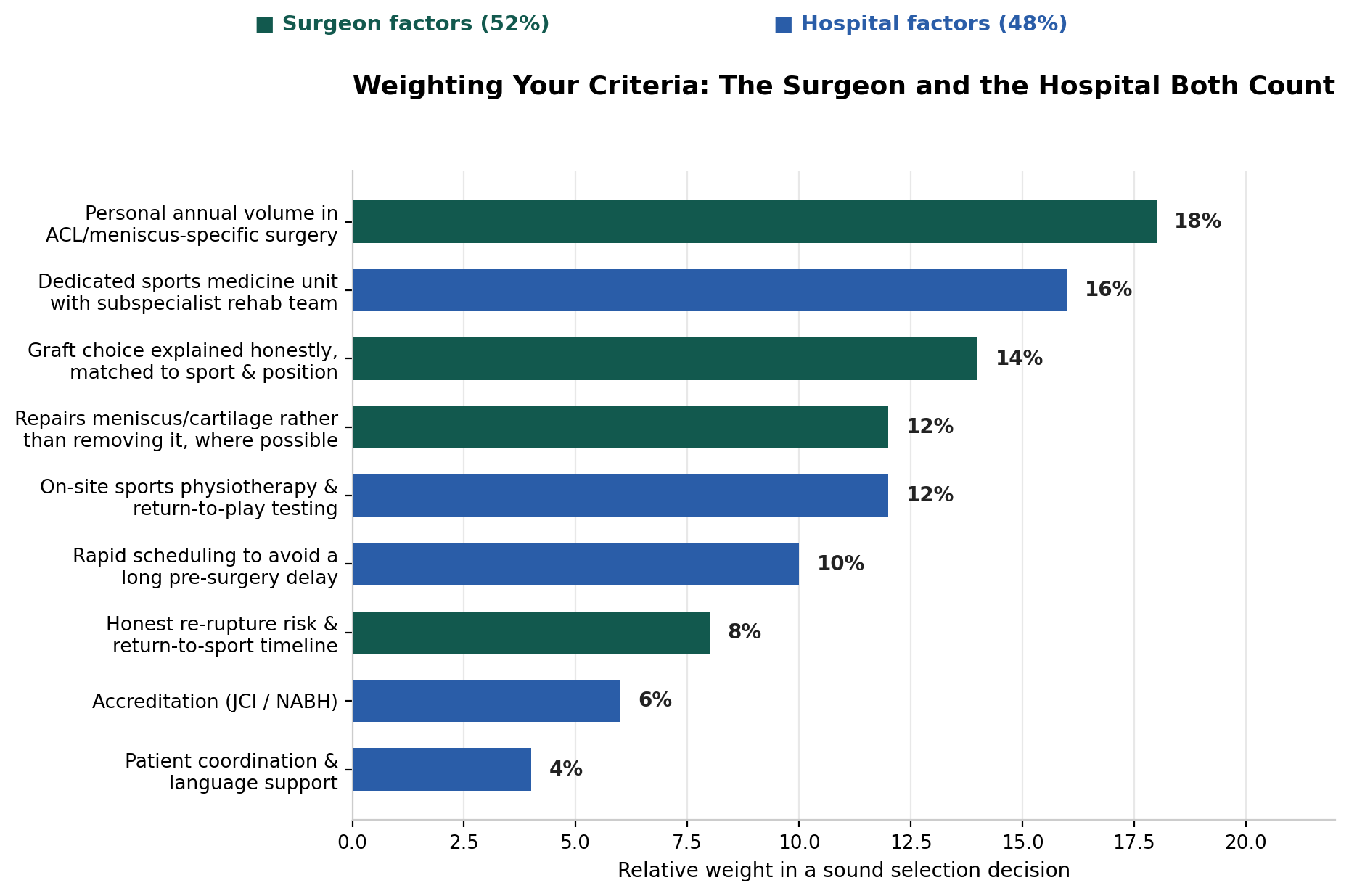
- The surgeon accounts for 52% of the selection weighting, with personal annual ACL and meniscus-specific volume receiving the highest individual weight of 18%. Graft choice, meniscus repair rather than removal and honest re-rupture and return-to-sport expectations are also major considerations.
- The hospital accounts for 48% of the weighting. Important factors include a dedicated sports medicine unit, on-site sports physiotherapy, objective return-to-play testing, rapid scheduling, accreditation and patient coordination and language support.
- The page 5 cost chart gives an indicative range of US$2,500–6,000 in India, compared with US$4,500–9,000 in private Nairobi care, US$9,000–18,000 in the UK and US$15,000–50,000 in the US. The guide stresses that patients should check whether meniscus repair, physiotherapy and donor-site graft costs are included.
- The guide identifies four warning signs: unclear ACL or meniscus-specific volume, quotations that do not specify whether meniscus repair is included, no structured return-to-play testing and no clear sport-specific rehabilitation plan. It recommends sending complete MRI files and injury history before travelling.
Quick Facts
- Treatment
- Joint Arthroscopy & Sports Medicine
- Country
- India
- Patients
- Kenyan Patients
- Main Procedures
- ACL Reconstruction, Meniscus Repair & Cartilage Surgery
- Key Specialist
- Sports Orthopaedic Surgeon
- Main Focus
- Return to Sport
- Selection Criteria
- Weighted Surgeon & Hospital Criteria
- Surgeon Weight
- 52%
- Hospital Weight
- 48%
- Highest Criterion
- ACL & Meniscus-Specific Surgical Volume
- Key Assessment
- MRI & Injury History
- Graft Options
- Hamstring, Patellar Tendon & Allograft
- Meniscus Strategy
- Repair Where Possible
- Outcome Check
- Re-Rupture Risk & Return-to-Sport Timeline
- Hospital Requirement
- Dedicated Sports Medicine Unit
- Rehabilitation
- Sport-Specific Physiotherapy
- Clearance Method
- Strength, Hop & Stability Testing
- Scheduling
- Rapid Post-Diagnosis Surgery
- Key Pricing Check
- Meniscus Repair, Physiotherapy & Graft Costs
- Funding
- Kenya Social Health Authority
- Funding Cap
- 500,000 Kenyan Shillings Per Patient Per Year
- Travel Route
- Nairobi–Delhi / Nairobi–Mumbai
- Follow-Up
- Kenyan Physiotherapist / Club Physio
- Warning Signs
- Unclear Volume or No Return-to-Play Testing
- Author
- Dr. Dheeraj Bojwani
- Experience
- 24+ Years
In Brief
For Kenyan patients considering arthroscopic sports injury surgery in India, the guide recommends sending the full MRI files together with the injury mechanism, sport and playing position so the Indian team can plan the procedure before arrival. Patients should ask about the surgeon's annual ACL and meniscus-specific volume, graft choice and whether the meniscus can be repaired rather than removed. The hospital should have a dedicated sports medicine unit, sport-specific rehabilitation and objective return-to-play testing. A written rehabilitation and return-to-sport protocol should also be prepared for the Kenyan physiotherapist or club physiotherapist.
Before the surgeon: why waiting quietly makes the injury worse
A knee that gives way once after an ACL tear will usually give way again, and each episode risks tearing the meniscus, the shock absorber protecting the joint surface underneath. Published cohort data shows the risk of finding a meniscus tear at surgery climbs steadily the longer reconstruction is delayed, and this matters in Kenya, where a 2025 study of youth footballers in Nairobi recorded 17.2 injuries per 1,000 playing hours, with the ankle and knee most affected and ligament sprains the most common injury type.
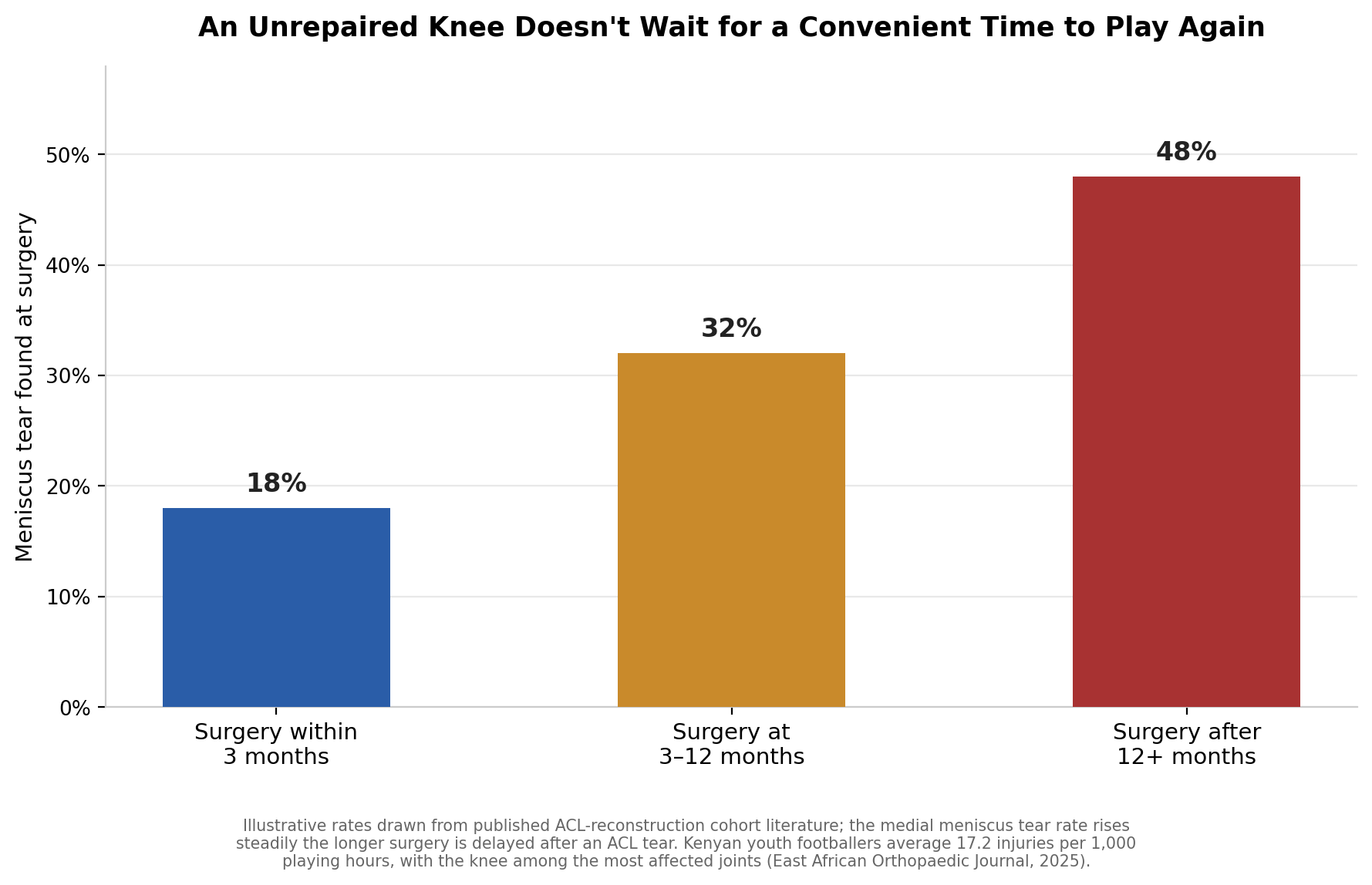
The practical takeaway is that "wait and see" for a suspected ACL or meniscus tear is rarely neutral. Ask for an MRI as soon as instability or persistent swelling suggests more than a simple sprain, and treat a positive scan as a genuine decision point, not something to sit on for months hoping the knee settles.
Should you travel at all?
Kenya has orthopaedic surgeons who perform arthroscopy competently, and Kenyatta National Hospital, Aga Khan University Hospital Nairobi and The Nairobi Hospital can manage a straightforward diagnostic arthroscopy or a simple meniscus trim. For a minor, partial tear with a clear conservative pathway, a first opinion in Nairobi is a reasonable start.
For almost everything beyond that, India is where I steer patients, confidently. A confirmed ACL tear, a repairable meniscus injury, cartilage damage, or any athlete with real ambitions, school or club trials abroad, a professional contract, deserves the volume, graft-choice expertise and dedicated sports rehabilitation infrastructure that Indian sports medicine centres have built around returning athletes to competition, not just daily life. The gap between a general orthopaedic repair and a genuine sports medicine unit is real, and it is precisely the gap India closes.
On funding: Kenya's Social Health Authority funds overseas treatment only for 36 gazetted procedures unavailable domestically, capped at 500,000 shillings per patient per year. Arthroscopic ACL and meniscus surgery aren't on that list, so budget to self-fund it. Given how much less India costs than the UK or US for this exact surgery, that self-funded trip is still, for most families, the most affordable route to a properly reconstructed knee.
Part one: judging the surgeon
1. Personal annual volume in ACL and meniscus-specific surgery
I weight this above every other factor, and the chart below reflects that. Ask how many ACL reconstructions and meniscus repairs the surgeon performs each year, specifically, not knee procedures overall. Sports arthroscopy is a distinct skill from general knee surgery, and volume in this exact category is the strongest predictor of a good outcome.
2. Graft choice explained honestly
Ask which graft, hamstring, patellar tendon or allograft, the surgeon recommends, and why. The right choice depends on your sport, position, and how soon you need to return, and a surgeon who explains this against your specific case is engaging with it rather than reaching for a default.
3. Repairs the meniscus rather than removing it, where possible
Ask directly whether a torn meniscus will be repaired or trimmed away. Repair preserves long-term knee health far better than removal, but demands more surgical skill and a longer, more disciplined rehabilitation. A surgeon who defaults to removal because it's simpler is trading your future knee for a shorter operation.
4. An honest re-rupture risk and return-to-sport timeline
Ask what your realistic risk of re-injury is and how long a genuine return to competitive sport actually takes. Nine to twelve months is typical for serious reconstruction, and a surgeon promising a much faster timeline for everyone isn't being straight with you.
Part two: judging the hospital
For sports arthroscopy, the surgeon and the hospital carry close to equal weight, reflected in the balance above, because rehabilitation infrastructure genuinely determines whether excellent surgery translates into a genuinely restored knee.
5. A dedicated sports medicine unit, not general orthopaedics
Ask whether the hospital has a sports medicine team built around athletes, with physiotherapists trained in return- to-play protocols, rather than a general orthopaedic department applying standard care to every patient regardless of goals.
6. On-site sports physiotherapy and return-to-play testing
Ask whether strength, hop, and stability testing clears you for sport, rather than a calendar date alone. Objective testing before clearance is what separates a sports medicine programme from a general surgical recovery pathway.
7. Rapid scheduling that avoids a long pre-surgery delay
Given how strongly delay predicts secondary meniscus damage, ask how quickly surgery can be scheduled once diagnosis is confirmed. A hospital that can operate within weeks, not months, is protecting the parts of your knee still intact.
8. Accreditation, read properly
JCI and NABH accreditation are meaningful filters on safety and infection control, but say nothing about sports medicine sub-specialisation. Use accreditation to exclude weak candidates, not to choose between the strong ones.
9. The cost you will actually pay
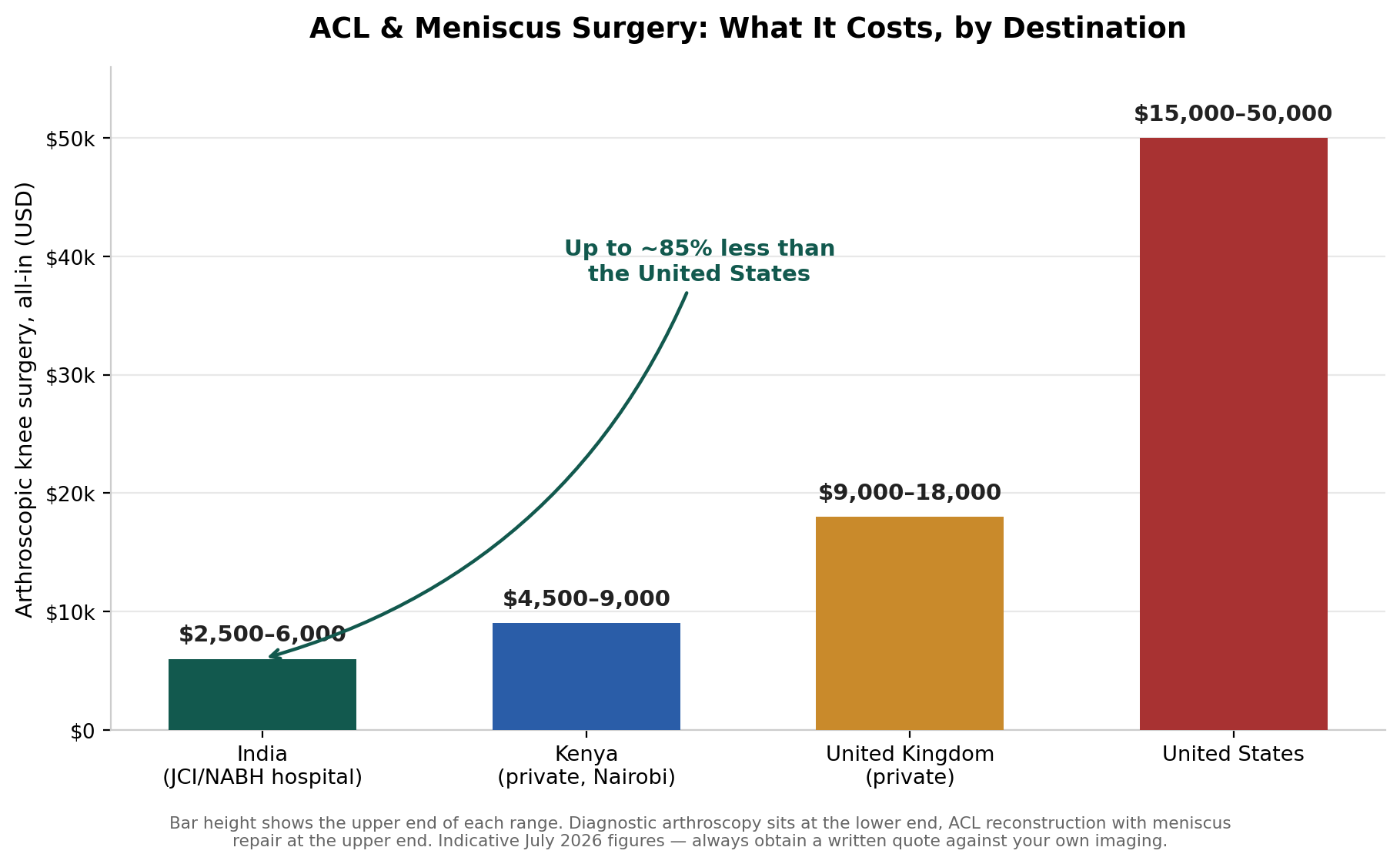
Let me be emphatic about this, because 24 years of handling these cases has taught me nothing more consistently: disputes almost never concern the quoted price. They concern what the quote silently omitted. For arthroscopic surgery specifically, insist the estimate states whether meniscus repair, if needed, is included or billed as an add-on, how many physiotherapy sessions are covered, and whether a donor-site graft carries a separate charge.
Budget beyond the surgery. Direct Nairobi–Delhi and Nairobi–Mumbai flights run roughly 550 to 850 dollars return, and given how much less the surgery itself costs in India, most families still come out well ahead of UK or US pricing even after accommodation for the patient and an attendant.
Four signals that should make you pause
Certain patterns reliably precede a difficult outcome.
- A surgeon who cannot say how many ACL or meniscus procedures he performs each year.
- A quote that doesn't specify whether meniscus repair is included.
- No structured return-to-play testing before clearance to train.
- A hospital unable to describe sport-specific rehabilitation in your first month.
None alone proves a bad hospital. Together they warrant a second opinion before you commit to surgery.
The Kenya-specific practicalities
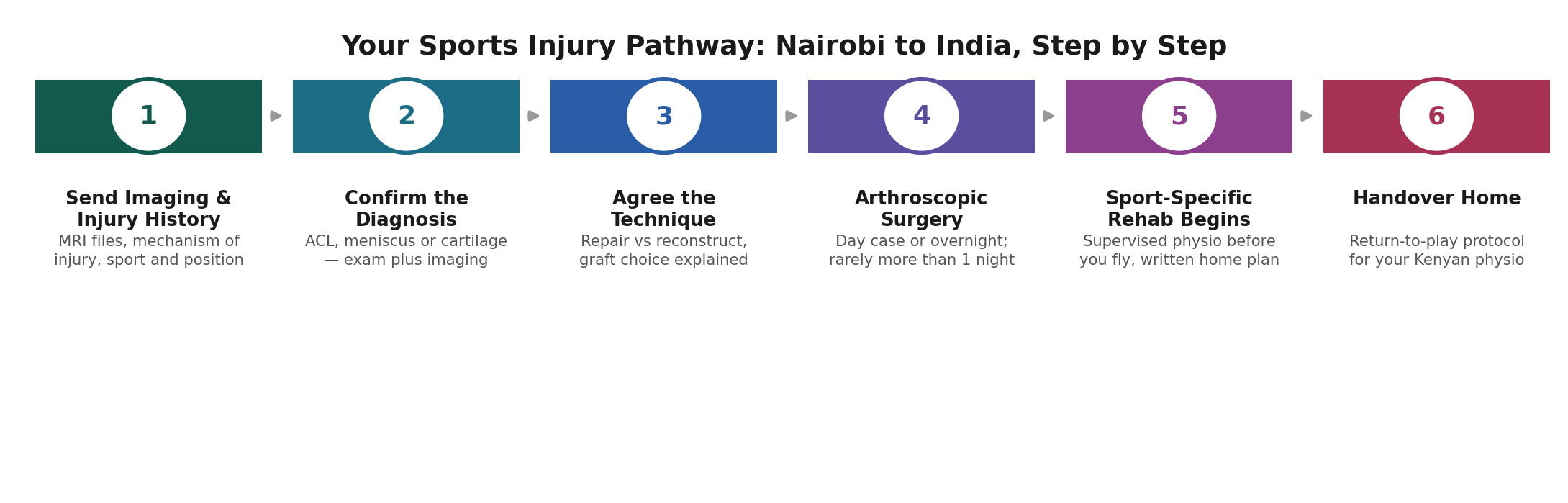
Send the full MRI files, not just the written report, with a clear account of the injury mechanism and your sport, so the Indian team can plan the exact procedure before you arrive rather than reassessing from scratch on landing.
Direct Nairobi–Delhi and Nairobi–Mumbai flights make this roughly a six-hour journey. The Indian medical e-visa is issued within three to five working days against a hospital letter, and up to two attendants can travel on a medical attendant visa.
Agree in advance on a written return-to-play protocol your Kenyan physiotherapist or club physio can follow, with clear milestones rather than a vague instruction to "build up gradually."
The questions I would ask before paying a deposit
Of the surgeon:
- How many ACL reconstructions and meniscus repairs do you perform each year?
- Which graft would you use for me, and why?
- Will my meniscus be repaired or removed, and what decides that?
- What is my realistic re-injury risk, and when could I return to sport?
Of the hospital:
- Do you have a dedicated sports medicine unit with sport-specific rehab?
- How is return-to-play cleared, by testing or by calendar date alone?
- How soon after a confirmed diagnosis can surgery be scheduled?
- What exactly is excluded from the quoted price?
- May I speak to a previous East African athlete treated for a similar injury?
A team that answers all nine without irritation is very likely the right team. One that turns vague at the first or third has told you what you needed to know at no cost at all.
Straight Answers for Kenyan Patients about Joint Arthroscopy and Sports Medicine Surgeons and Hospitals in India
How do I choose the best surgeon in India for ACL or sports injury surgery as a Kenyan patient?
Ask the surgeon's annual volume in ACL and meniscus-specific procedures, not general orthopaedics, whether he repairs or removes a torn meniscus by default, and which graft he'd use and why.
How much does ACL or meniscus surgery cost in India for a Kenyan patient?
Typically 2,500 to 6,000 US dollars all in. The same surgery runs roughly 4,500 to 9,000 dollars in private Nairobi care, 9,000 to 18,000 in the UK, and 15,000 to 50,000 in the US, making India the clear value leader without any drop in surgical standard.
Why shouldn't I just rest and see if my knee settles?
Delay carries a real cost. Published data shows the rate of meniscus tears found at ACL surgery rises substantially the longer reconstruction is delayed, and Kenyan youth athletes already face a high baseline injury rate of 17.2 per 1,000 playing hours in one Nairobi study.
Will SHA pay for my arthroscopic surgery in India?
Not for standard cases. SHA's overseas benefit covers only 36 gazetted procedures unavailable in Kenya, capped at 500,000 shillings a year, and routine ACL or meniscus surgery isn't among them. India's pricing still makes self- funding the most affordable route to a properly repaired knee.
Should my meniscus be repaired or removed?
Repair, wherever the tear pattern allows it, since it preserves long-term knee health far better than removal. Ask your surgeon what decides which applies to you, and be wary of a default toward removal simply because it's quicker.
How long until I can return to sport after ACL reconstruction in India?
Genuine return typically takes nine to twelve months, built around tested milestones rather than a fixed date. A dedicated sports medicine programme, where India's advantage is largest, is what makes that timeline reliable rather than optimistic.
A closing word
India is, for almost every serious ACL, meniscus or cartilage injury a Kenyan athlete faces, the destination giving the knee the best realistic chance of a full return to sport, at a fraction of what the same standard of surgery and rehab costs in the UK or US. The best surgeon is the one whose volume, graft choice and repair-first instinct show he treats athletes, not just knees. The best hospital pairs him with a sports medicine team built to test you back into competition, not just discharge you home. If you would like me to look at your scans and talk through honestly what your path back to sport should look like, send them across.
Sources
- 🌐 Incidence and patterns of musculoskeletal injuries among youth football players in Nairobi: a prospective cohort study
- 🌐 Delayed anterior cruciate ligament reconstruction and risk of meniscus injury: exploring the safest delay interval. PMC, 2024
- 🌐 Longer time between anterior cruciate ligament injury and reconstruction is associated with a greater risk of medial meniscus injury
- 🌐 National Medical Commission of India — surgeon and specialist registration verification
- 🌐 National Accreditation Board for Hospitals & Healthcare Providers (NABH) — accredited hospital directory
- 🌐 Kenya Social Health Authority (SHA) — benefits packages and overseas treatment guidance
Frequently Asked Questions by Kenyans about Joint Arthroscopy and Sports Medicine Surgeons and Hospitals in India
What sports injuries does the guide cover?
The guide focuses mainly on ACL tears, meniscus injuries and cartilage damage, particularly for patients and athletes seeking arthroscopic treatment and a return to sport.
Why should an ACL injury be assessed promptly?
The guide explains that repeated instability after an ACL tear can increase the risk of additional meniscus damage. The page 2 chart illustrates higher meniscus-tear rates with longer delays before reconstruction.
What is the most important surgeon-selection criterion?
Personal annual volume in ACL and meniscus-specific surgery receives the highest weighting of 18%. Patients should ask about these procedures specifically rather than general knee surgery volume.
What graft options may be considered for ACL reconstruction?
The guide identifies hamstring, patellar tendon and allograft options. The appropriate choice should be explained according to the patient's sport, position and return-to-sport requirements.
Should a torn meniscus always be removed?
No. The guide recommends asking whether the meniscus can be repaired rather than removed, because preserving the meniscus can provide better long-term knee protection when the tear pattern allows repair.
How long does return to competitive sport take?
The guide states that serious ACL reconstruction typically requires around nine to twelve months, with return based on rehabilitation milestones and testing rather than simply reaching a fixed calendar date.
What should a sports medicine hospital provide?
Patients should look for a dedicated sports medicine unit, sport-specific physiotherapy and objective return-to-play testing, including strength, hop and stability assessments.
What should be included in the surgical quotation?
The quotation should clearly state whether meniscus repair, physiotherapy sessions and donor-site graft costs are included or charged separately.
What are the main warning signs?
The guide identifies unclear ACL or meniscus volume, unspecified meniscus-repair costs, lack of return-to-play testing and inability to describe sport-specific rehabilitation as reasons to seek a second opinion.
What should Kenyan patients send before travelling?
They should send the full MRI files, together with the injury mechanism, sport and playing position, so the Indian team can assess and plan the procedure before arrival.
Page Summary
This eight-page guide helps Kenyan patients evaluate joint arthroscopy and sports medicine surgeons and hospitals in India for ACL, meniscus and cartilage injuries. It focuses on athletes seeking a safe return to competitive sport, with 52% weight given to the surgeon and 48% to the hospital. ACL and meniscus-specific surgical volume receives the highest individual weighting of 18%, along with graft selection, meniscus repair and re-injury risk. The guide also highlights dedicated sports rehabilitation and objective return-to-play testing, while the pathway covers imaging, diagnosis, surgery, rehabilitation and handover to the Kenyan physiotherapist.
Citation Block
| Topic | Information |
|---|---|
| Topic | Joint Arthroscopy & Sports Medicine |
| Treatment | Arthroscopic Sports Injury Surgery |
| Country | India |
| Patients | Kenyan Patients |
| Main Procedures | ACL Reconstruction, Meniscus Repair & Cartilage Surgery |
| Key Specialist | Sports Orthopaedic Surgeon |
| Main Focus | Return to Sport |
| Selection Framework | Weighted Surgeon & Hospital Criteria |
| Surgeon Weight | 52% |
| Hospital Weight | 48% |
| Highest Criterion | ACL & Meniscus-Specific Volume |
| Key Assessment | MRI & Injury History |
| Graft Options | Hamstring, Patellar Tendon & Allograft |
| Meniscus Strategy | Repair Where Possible |
| Outcome Check | Re-Rupture Risk & Return-to-Sport Timeline |
| Hospital Requirement | Dedicated Sports Medicine Unit |
| Rehabilitation | Sport-Specific Physiotherapy |
| Clearance Method | Strength, Hop & Stability Testing |
| Scheduling | Rapid Post-Diagnosis Surgery |
| Pricing Check | Meniscus Repair, Physiotherapy & Graft Costs |
| Funding | Kenya Social Health Authority |
| Funding Cap | 500,000 KES Per Patient Per Year |
| Travel Route | Nairobi–Delhi / Nairobi–Mumbai |
| Follow-Up | Kenyan Physiotherapist / Club Physio |
| Warning Signs | Unclear Volume or No Return-to-Play Testing |
| Key Questions | Volume, Graft, Meniscus Repair, Rehab & Return to Sport |

Our Mission Statement
Our mission is to place patients at the centre of every healthcare decision by providing trustworthy, evidence-based, and unbiased medical information. We believe that informed patients make better decisions. Backed by personalised guidance from our experienced advisory team, we help patients understand their treatment options, compare them objectively, and confidently choose the path that best suits their medical needs and personal circumstances.
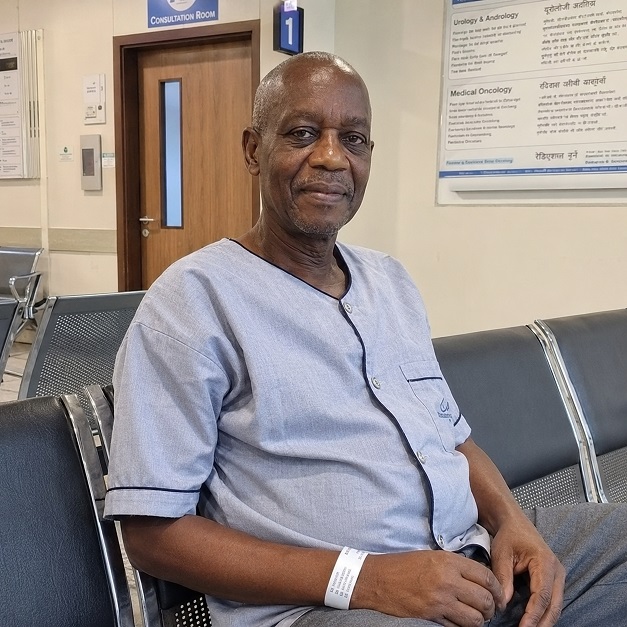
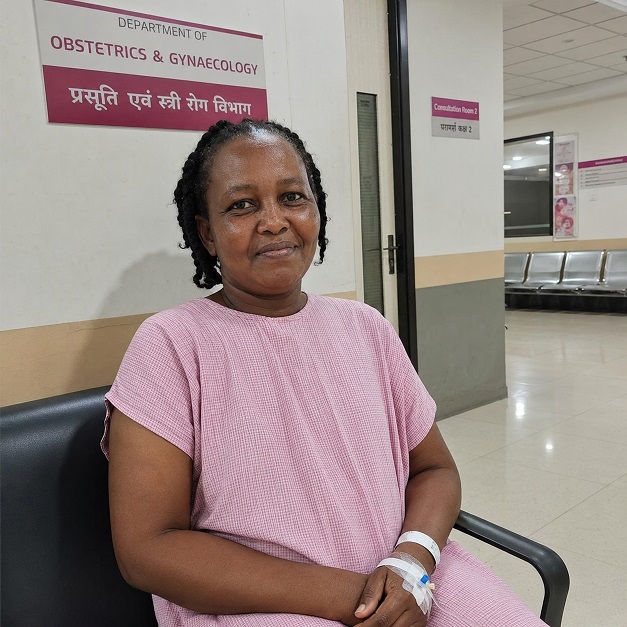
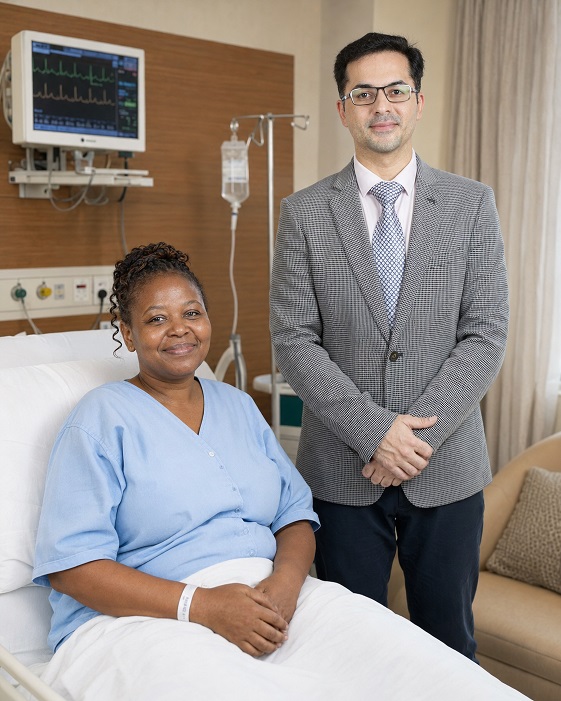
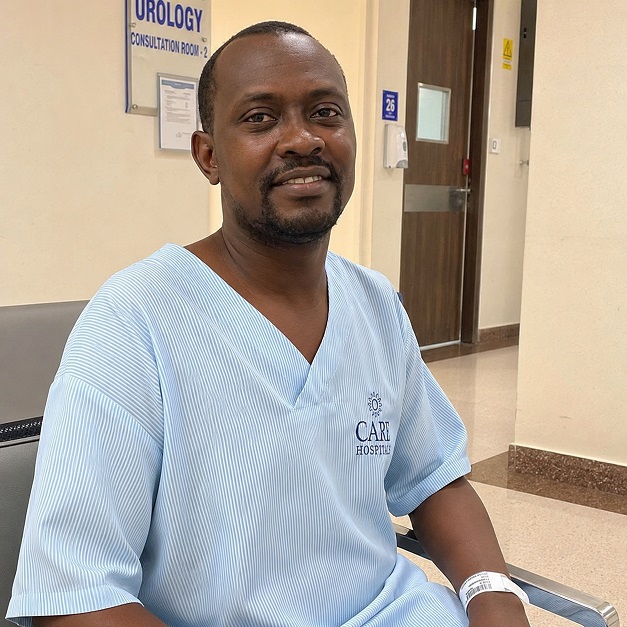
Patient Testimonials from Kenya
Ready to Take the First Step?
Share your Medical Reports with our Healthcare Managers Today and Get a FREE CONSULTATION, a Personalized Treatment Plan, and Complete Support from Arrival to Recovery.
Get Your Free ConsultationAreas We Serve
This resource has been thoughtfully prepared for patients from Kenya who are considering medical treatment in India. We also welcome patients from the wider region in the countries mentioned below-
We assist patients from:
- Ethiopia
- Somalia
- Tanzania
- Uganda
- Seychelles
- Guinea
- Guinea-Bissau
- Liberia
- Mali
- Mauritania
- Niger
- Nigeria
- Senegal
- Togo
- South Sudan
- Sierra Leone
Many of the insights, treatment pathways, hospital recommendations, travel guidance, and patient support services described here are equally relevant and may be used as a reference when planning treatment in India.
From Kenya to India: Your Complete Patient Support Guide
- Brain Tumour Surgery in India for Kenyan Patients
- Cancer Treatment and Surgery in India for Kenyan Patients
- Cardiac Treatment and Surgery in India for Kenyan Patients
- Heart Valve Replacement Surgery in India for Kenyan Patients
- Knee Replacement in India for Kenyan Patients
- Prostate Cancer Treatment and Surgery in India for Kenyan Patients
- Spine Treatment and Surgery in India for Kenyan Patients
- Selecting the Best Bariatric Surgeons and Hospitals in India: What Kenyan Patients Should Actually Look For
- Selecting the Best Cancer Surgeons and Hospitals in India: What Kenyan Patients Should Actually Look For
- Selecting the Best Cardiac Surgeons and Hospitals in India: What Kenyan Patients Should Actually Look For
- Selecting the Best Dental Surgeons and Clinics in India: What Kenyan Patients Should Actually Look For
- Selecting the Best Hip Surgeons and Hospitals in India: What Kenyan Patients Should Actually Look For
- Selecting the Best Kidney Transplant Surgeons and Hospitals in India: What Kenyan Patients Should Actually Look For
- Selecting the Best Knee Surgeons and Hospitals in India: What Kenyan Patients Should Actually Look For
- Selecting the Best Liver Transplant Surgeons and Hospitals in India: What Kenyan Patients Should Actually Look For
- Selecting the Best Neurosurgeons and Hospitals in India: What Kenyan Patients Should Actually Look For
- Selecting the Best Prostate Cancer Surgeons and Hospitals in India: What Kenyan Patients Should Actually Look For
- Selecting the Best Spine Surgeons and Hospitals in India: What Kenyan Patients Should Actually Look For