

Parkinson's Treatment and DBS Surgery in India for Kenyan Patients
From medication management to deep brain stimulation: who DBS actually suits, how a Kenyan patient judges the team in India, and what it costs.
Before any conversation about deep brain stimulation surgery for Parkinson's disease can genuinely happen, a more basic question needs answering first: is the medication that manages Parkinson's day to day even reliably available? For a large share of Kenyan patients, the honest answer is no. Just 3% of countries in the WHO African Region have levodopa/carbidopa, the foundational Parkinson's medication, consistently available at the primary care level, and qualitative research specifically examining Kenya found the medicine largely unavailable and unaffordable for people living with the condition. Across 24 years of guiding Kenyan patients through treatment in India, Parkinson's care is an area where the gap starts well before surgery even becomes a relevant question. This article explains what Parkinson's treatment and DBS surgery involve, why basic medication access remains a genuine barrier in Kenya, what treatment costs in India compared with Western countries, and the practical factors to weigh before deciding where to seek care.
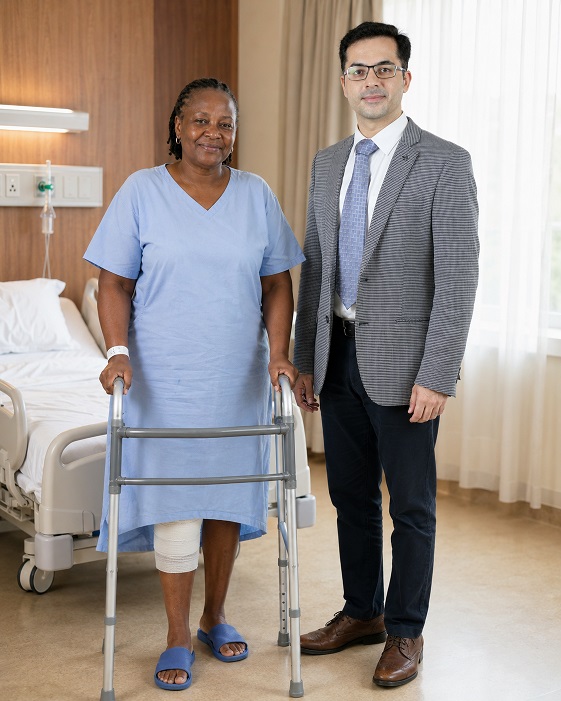
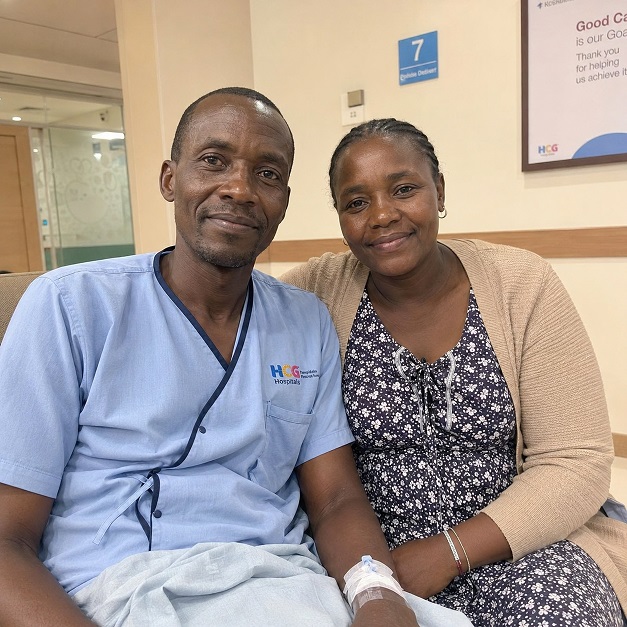
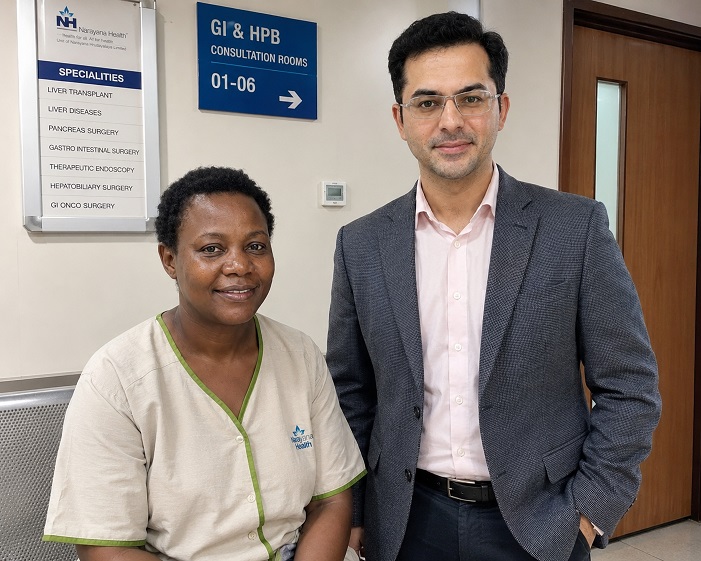
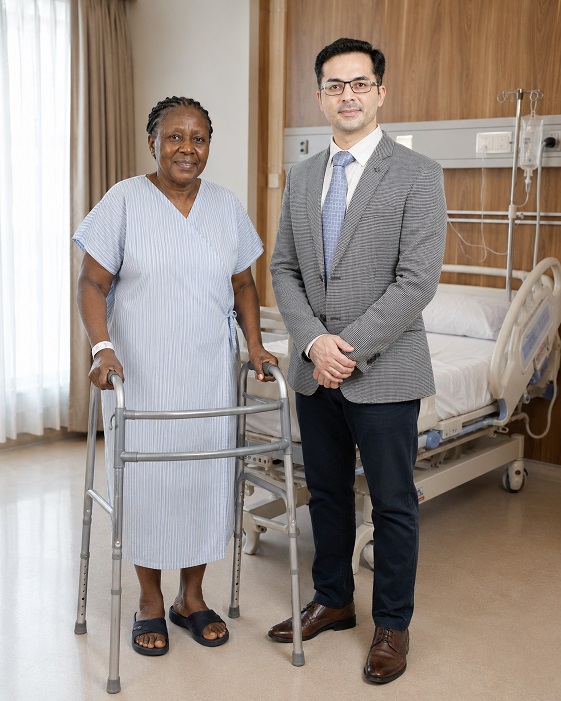
Healing Journeys of Kenyan Patients
Key Takeaways
- The guide explains that Parkinson's treatment usually begins with long-term medication management, particularly levodopa combined with carbidopa. Deep brain stimulation (DBS) is considered for a more specific group of patients who initially respond well to medication but later develop significant motor fluctuations or dyskinesias that medication adjustments cannot adequately control.
- For Kenyan patients, the problem begins before DBS is even considered. The guide highlights that only 3% of countries in the WHO African Region have levodopa/carbidopa consistently available at primary-care level, while research specifically examining Kenya found Parkinson's medicines to be largely unavailable and unaffordable. The page 2 graphic presents this as roughly 1 in 33 African countries having reliable access, highlighting the medication-access challenge.
- This medication gap can also complicate DBS candidacy assessment. DBS assessment partly depends on understanding how well a patient's symptoms respond to levodopa over time. If medication has been unavailable or unaffordable, doctors may not have a reliable record of the patient's genuine response. The guide therefore recommends establishing consistent medication management and a documented treatment history before making a DBS decision.
- India provides access to movement-disorder neurologists and neurosurgeons working together in dedicated DBS programmes, along with JCI and NABH-accredited hospital infrastructure. The guide stresses that Kenyan patients should seek an honest DBS assessment based on their medication response rather than assuming that surgery is appropriate simply because DBS is available.
- The guide estimates DBS surgery at approximately US$15,000–32,000 in India. DBS is described as not an established domestic procedure in Kenya, while costs are estimated at US$32,000–77,000 in the UK and US$60,000–100,000 in the US. The page 3 cost graphic highlights India's substantially lower range. Patients should generally plan for approximately 2–3 weeks in India, including assessment, surgery and initial device programming.
- The page 4 “Six Things to Check” graphic highlights hospital accreditation, DBS-specific surgeon volume, honest candidacy assessment, a complete quotation covering the device and programming, visa and travel planning, and long-term programming follow-up. The guide notes that DBS devices require periodic adjustment for years after surgery, making a long-term programming plan particularly important for Kenyan patients returning home.
Quick Facts
- Author
- Dr. Dheeraj Bojwani
- Experience
- 24+ Years
- Treatment
- Parkinson's Treatment & Deep Brain Stimulation
- Patients
- Kenyan Patients
- First Assessment
- Parkinson's symptoms and documented medication response
- Key Specialist
- Movement Disorder Neurologist / DBS Neurosurgeon
- Main Treatment
- Medication management
- Advanced Treatment
- Deep Brain Stimulation for selected patients
- DBS Candidate
- Patients with good medication response but disabling motor fluctuations or dyskinesias
- Medication Access
- Only 3% of WHO African Region countries have consistent primary-care levodopa/carbidopa availability
- Kenya Issue
- Parkinson's medicines reported as largely unavailable and unaffordable
- Hospital Check
- JCI / NABH accreditation
- Case Volume
- Parkinson's DBS-specific surgical experience
- Cost Check
- Written estimate covering surgery, device and programming
- India Cost
- US$15,000–32,000
- Kenya
- DBS not an established domestic procedure
- Medical Records
- Medication history, neurological reports and treatment records
- Visa
- Indian medical e-visa with hospital invitation
- Travel
- Nairobi–Delhi or Mumbai flights
- Stay
- Approximately 2–3 weeks
- Follow-Up
- Long-term DBS programming and neurological monitoring
- Key Warning
- DBS recommended without a clear documented medication-response assessment
- Decision Principle
- Prioritise accurate DBS candidacy assessment, specialist experience and long-term programming support.
In Brief
For Kenyan patients considering DBS, the most important first step is establishing reliable Parkinson's medication management and documenting genuine medication response. Before travelling to India, patients should verify DBS-specific surgeon experience, confirm candidacy with a movement-disorder team, obtain a complete device and programming quotation, and establish how long-term DBS programming will be managed after returning to Kenya.
What Parkinson's treatment and DBS surgery actually involve
Parkinson's disease is a progressive neurological condition caused by the loss of dopamine-producing brain cells, leading to tremor, stiffness, slowed movement, and, over time, other motor and non-motor symptoms. The foundational treatment is medication, most commonly levodopa combined with carbidopa, which replaces the dopamine the brain can no longer produce enough of. For most patients, medication management, adjusted carefully over years by a neurologist experienced with Parkinson's, is the primary treatment for the entire course of the disease.
Deep brain stimulation becomes relevant for a specific group of patients: those who have responded well to medication but, after years of treatment, begin experiencing significant motor fluctuations or dyskinesias that medication adjustment alone can no longer adequately control. DBS involves implanting thin electrodes into specific brain regions, connected to a small pulse generator placed under the skin near the collarbone, delivering carefully calibrated electrical impulses that help regulate the abnormal brain activity driving Parkinson's motor symptoms. It doesn't cure Parkinson's, but for well-selected patients, it can meaningfully improve quality of life and reduce medication requirements.
The surgery itself is typically performed with the patient partially awake, allowing the surgical team to test electrode placement in real time by observing the immediate effect on tremor and movement before finalising the position. This precision is part of why DBS demands such specific, accumulated surgical experience; small differences in electrode placement can meaningfully affect how well the final result controls symptoms.
Why basic medication access remains a genuine barrier in Kenya
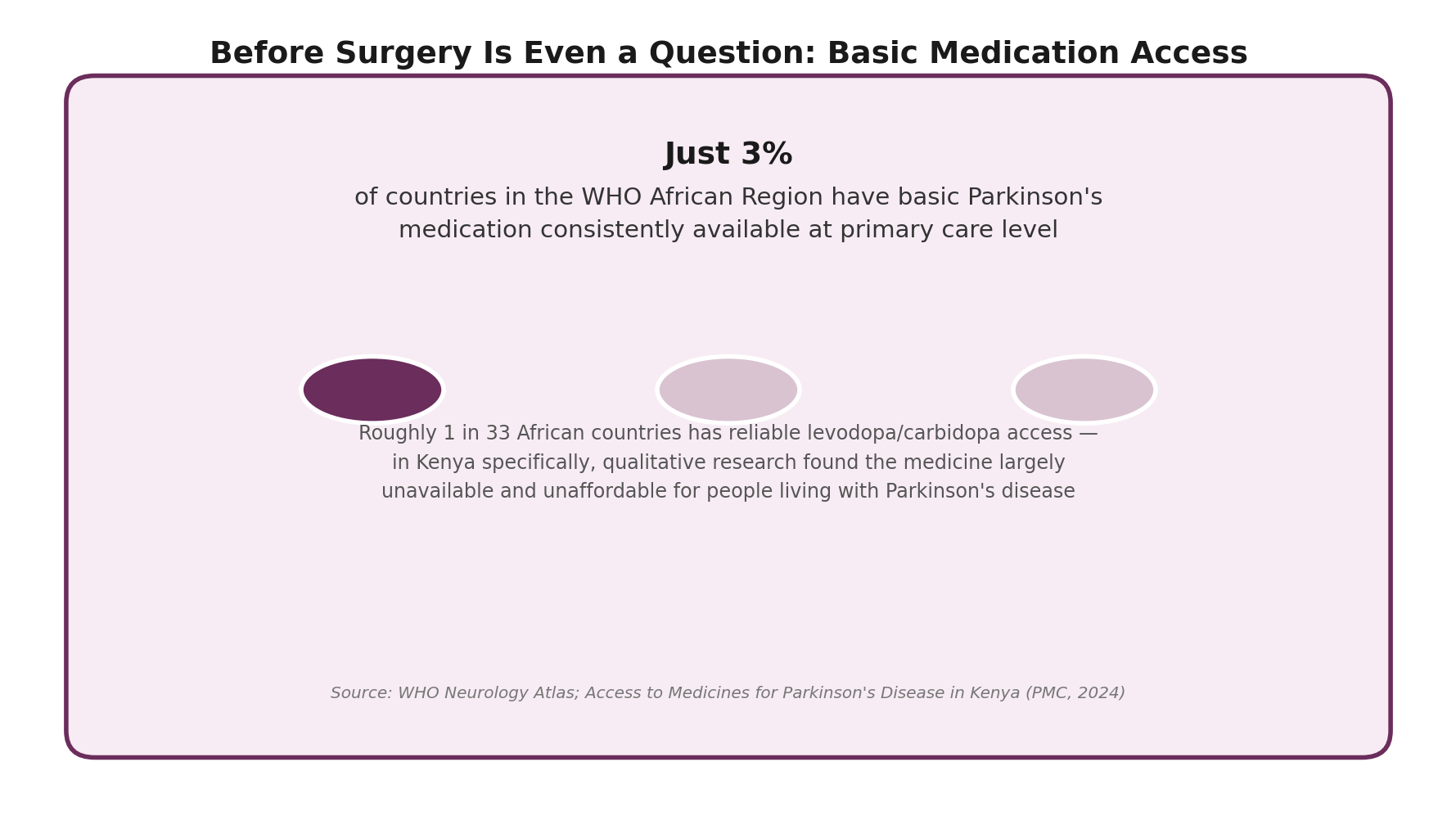
This is the fact every Kenyan patient or family navigating a Parkinson's diagnosis needs to understand clearly, because it shapes the entire treatment picture, not just the question of surgery. The WHO's Neurology Atlas found that just 3% of countries in the WHO African Region have levodopa/carbidopa consistently available at the primary care level. A qualitative study specifically examining the situation in Kenya, drawing on interviews with people living with Parkinson's, their caregivers, and neurologists, found Parkinson's medicines largely unavailable and unaffordable across the country, with the absence of health insurance coverage forcing most patients to pay out of pocket for a condition requiring lifelong treatment.
This matters enormously for how a Kenyan patient should think about DBS specifically. DBS candidacy is typically assessed based on how well a patient has responded to medication over time, since the surgery works best for patients whose symptoms were genuinely well controlled by levodopa before motor fluctuations set in. When medication access itself has been inconsistent, due to unavailability or unaffordability rather than the medication simply not working, it becomes much harder to get an accurate picture of true DBS candidacy. Getting consistent, reliable access to foundational medication, and an accurate assessment of how well it has genuinely worked, matters as a first step before DBS becomes a meaningful conversation at all.
Why India has become a genuine hub for Parkinson's care and DBS surgery
India offers both consistent access to the full range of Parkinson's medications and dedicated DBS surgery programmes staffed by movement disorder neurologists and neurosurgeons working together as a team, precisely the combination that a fragmented, access-limited care pathway struggles to provide. This matters because accurate DBS candidacy assessment depends on a clean, well-documented medication history, something genuinely difficult to establish when medication access itself has been the primary obstacle.
India's leading DBS centres combine this movement-disorder-specific expertise with JCI and NABH accredited safety standards and surgeons who have performed DBS procedures across careers spanning decades. In 24 years of guiding patients through this decision, the clearest advice I offer Kenyan families facing a Parkinson's diagnosis is this: establishing genuinely consistent medication management first, ideally through a movement disorder specialist, is what makes any future DBS conversation a meaningful one, rather than a decision made without a clear picture of how the disease actually responds to treatment.
This doesn't mean every patient needs to travel immediately for surgery. For many, the more urgent first step is simply establishing reliable, ongoing access to medication and a movement disorder specialist who can properly track the disease's progression over months and years, since that documented history is precisely what makes a future DBS assessment, if it becomes appropriate, genuinely meaningful rather than a decision made on incomplete information.
What it costs: India versus Kenya, the UK, and the US
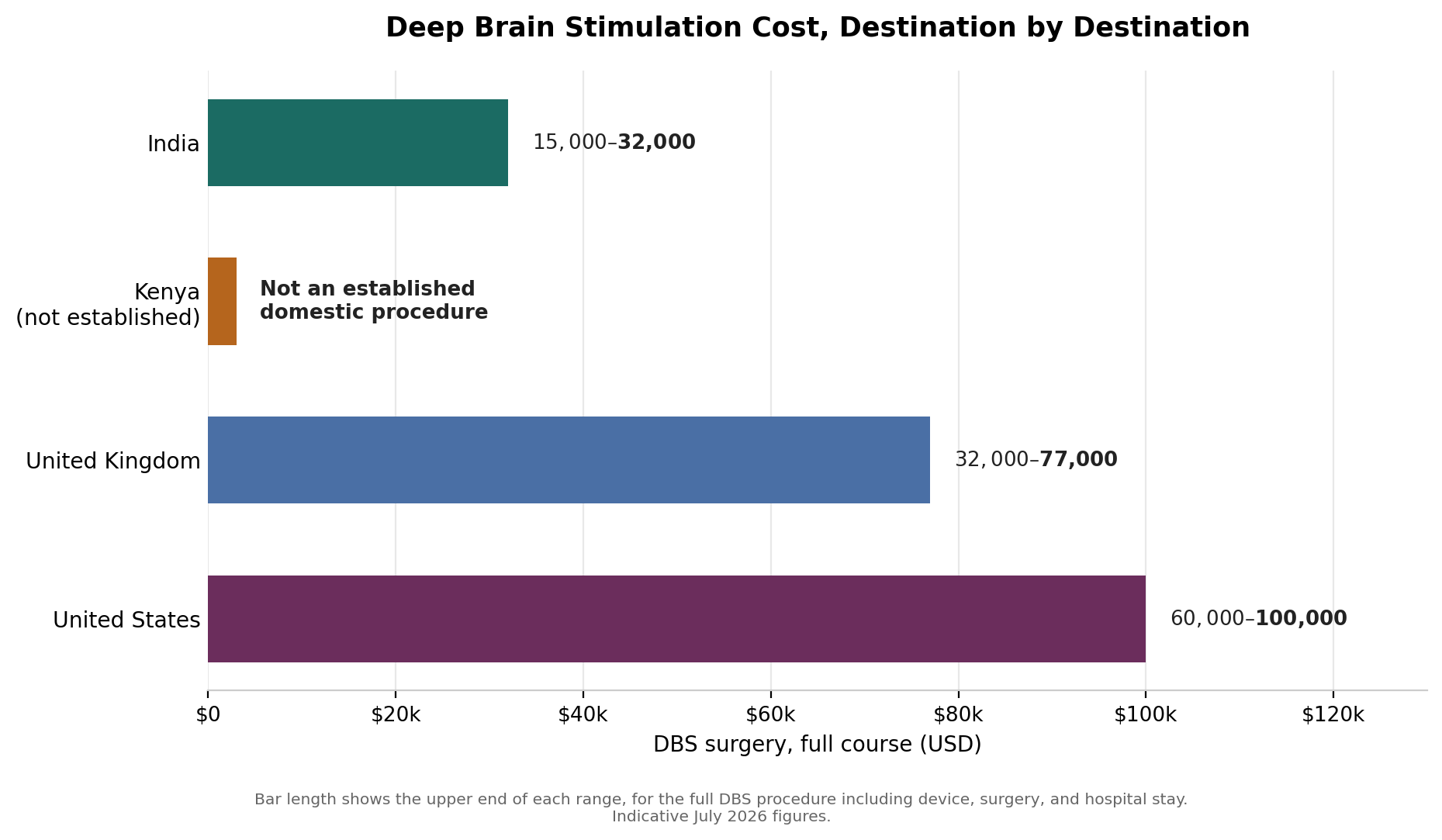
In India, DBS surgery typically costs between 15,000 and 32,000 US dollars, covering the surgical procedure, the device, and hospital stay. In Kenya, DBS is not an established domestic procedure. In the UK, DBS surgery typically costs 32,000 to 77,000 dollars, and in the US, 60,000 to 100,000 dollars, up to roughly 85% more than the equivalent treatment in India.
Beyond the procedure itself, budget for travel. Direct flights between Nairobi and Delhi or Mumbai run roughly 550 to 850 dollars return, and DBS surgery typically requires two to three weeks in India, covering pre-operative assessment, the surgery itself, and initial device programming before travel home is medically advisable.
What a Kenyan patient should actually check before booking
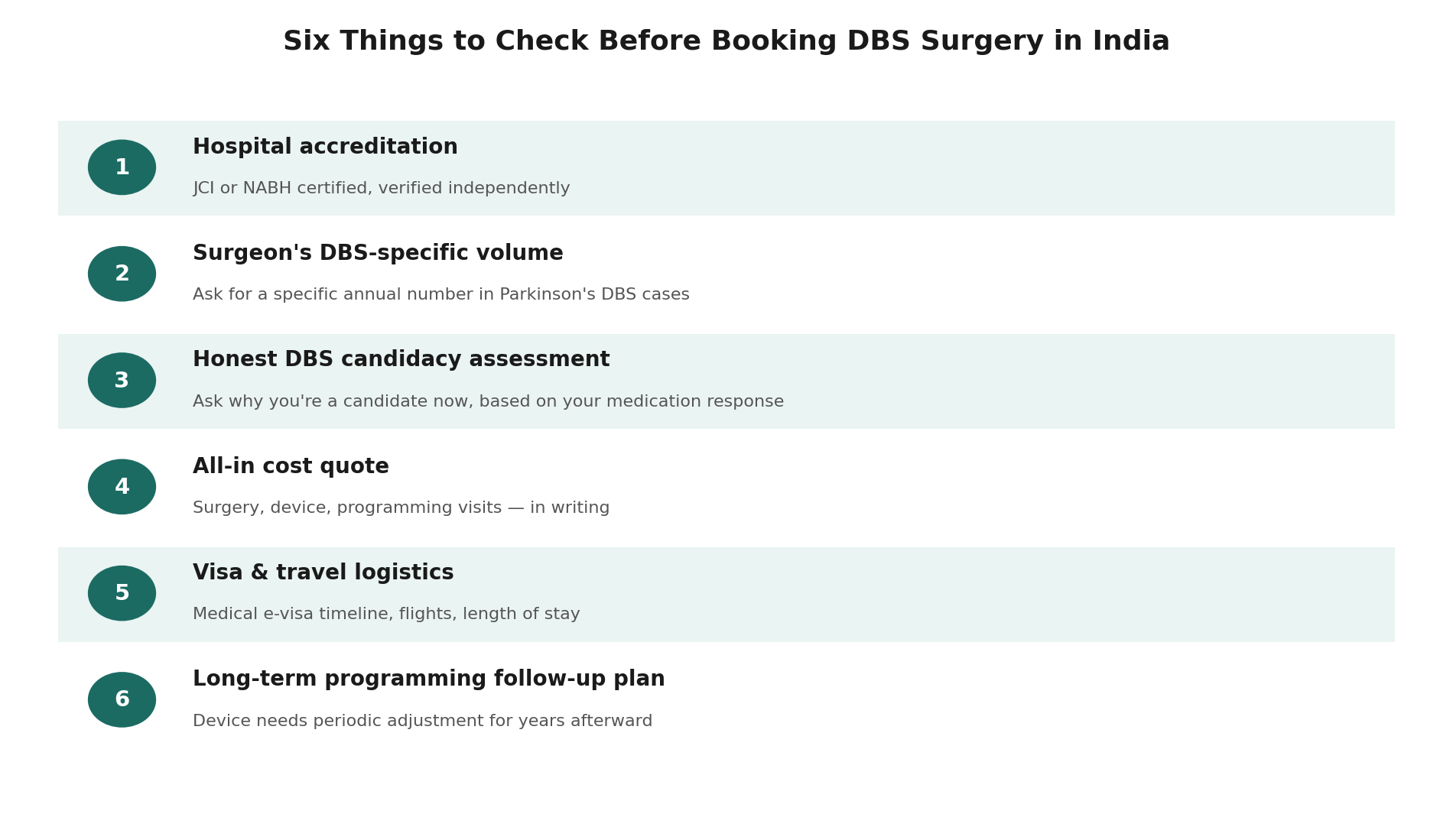
Given how much accurate assessment and long-term follow-up matter here, work through these questions directly.
Confirm genuine accreditation. Ask whether the hospital holds JCI or NABH certification, and verify it independently.
Ask about the surgeon's DBS-specific volume. A specific number, how many DBS procedures for Parkinson's the surgeon personally performs each year, tells you more than general neurosurgical reputation.
Get an honest DBS candidacy assessment. Ask your treating team to explain, based on your documented medication response history, why you're genuinely a candidate now.
Get the full cost breakdown in writing. Confirm what's included, surgery, the device, and follow-up programming visits.
Plan your visa and travel timeline. The Indian medical e-visa is typically issued within three to five working days once you have a formal hospital invitation letter.
Arrange your long-term programming follow-up plan before you leave. DBS devices need periodic adjustment for years afterward. Agree on a written plan and identify how ongoing programming support will work once you're home.
Straight Answers for Kenyan Patients about Parkinson's Treatment and DBS Surgery in India
Is Parkinson's medication reliably available in Kenya?
No, generally. Just 3% of countries in the WHO African Region have levodopa/carbidopa consistently available at primary care level, and qualitative research specifically examining Kenya found the medicine largely unavailable and unaffordable for most patients.
How much does DBS surgery cost in India compared to the US?
India typically costs 15,000 to 32,000 US dollars, against 60,000 to 100,000 dollars in the US, a saving of up to roughly 85%.
Who is actually a candidate for DBS surgery?
Generally patients who responded well to Parkinson's medication initially but, after years of treatment, develop significant motor fluctuations or dyskinesias that medication adjustment alone can no longer adequately control.
Why does inconsistent medication access complicate DBS candidacy assessment?
Because DBS candidacy is judged partly on how well a patient has responded to medication over time, and unreliable access to medication makes it difficult to establish an accurate picture of true treatment response.
Does DBS surgery cure Parkinson's disease?
No. It doesn't cure the underlying condition, but for well-selected patients, it can meaningfully improve quality of life and reduce motor symptoms and medication requirements.
How do I get a medical visa to India from Kenya?
The Indian medical e-visa is typically issued within three to five working days once you have a formal invitation letter from the treating hospital.
A Closing Word
For a Kenyan patient facing Parkinson's disease, the honest starting point isn't DBS surgery, it's establishing genuinely consistent access to the foundational medication that most patients rely on for years before surgery ever becomes relevant. India offers both that consistent medication access and, for well-selected patients further along in the disease course, dedicated DBS expertise at a fraction of Western cost, making it, for the great majority of
Kenyan patients and families I've guided through this decision, worth investigating at whichever stage of the disease you're currently navigating.
Sources
- 🌐 Access to Medicines for Parkinson's Disease in Kenya: A Qualitative Exploration. PMC, 2024
- 🌐 "Old people problems", uncertainty and legitimacy: Challenges with diagnosing Parkinson's disease in Kenya. PubMed. pub
- 🌐 Global Parkinson's Disease Crisis: Epidemiology & Risks
- 🌐 National Medical Commission of India — specialist registration verification
- 🌐 National Accreditation Board for Hospitals & Healthcare Providers (NABH) — accredited hospital directory
Frequently Asked Questions by Kenyans about Parkinson's Treatment and DBS Surgery in India
Is Parkinson's medication reliably available for Kenyan patients?
Not reliably. The guide states that only 3% of countries in the WHO African Region have consistent primary-care access to levodopa/carbidopa, while Kenya-specific research found Parkinson's medicines largely unavailable and unaffordable.
Why should a Kenyan patient establish consistent medication access before considering DBS?
DBS candidacy partly depends on how well Parkinson's symptoms genuinely respond to medication over time. If levodopa has been difficult to obtain in Kenya, an inconsistent treatment history can make it harder to determine whether DBS is truly appropriate.
Which Kenyan Parkinson's patients may be considered for DBS in India?
The guide describes DBS as relevant mainly to patients who initially responded well to medication but later developed significant motor fluctuations or dyskinesias that medication adjustments alone can no longer adequately control.
How should Kenyan patients choose a DBS surgeon in India?
Ask for the specific number of DBS procedures for Parkinson's that the surgeon personally performs each year. The guide considers DBS-specific experience more meaningful than general neurosurgical reputation.
Why is a movement-disorder neurologist important before DBS surgery?
A movement-disorder specialist can assess the patient's Parkinson's diagnosis, medication response and progression before surgery. The guide emphasises that DBS should follow a properly documented candidacy assessment rather than being selected simply because surgery is available.
How much does DBS surgery cost in India for Kenyan patients?
The guide estimates approximately US$15,000–32,000 in India, while DBS is described as not being an established domestic procedure in Kenya. The Indian estimate includes the surgical procedure, device and hospital stay.
Does the DBS quotation for a Kenyan patient include future programming?
Patients should specifically ask this before booking. The guide recommends confirming whether the quotation includes the device and follow-up programming visits, because DBS requires periodic adjustment for years after implantation.
How long should a Kenyan DBS patient stay in India?
The guide recommends approximately 2–3 weeks in India, covering pre-operative assessment, DBS surgery and initial device programming before travelling home is medically advisable.
What should Kenyan patients arrange for DBS programming after returning home?
A long-term programming plan should be agreed before leaving India. Since DBS devices require periodic adjustment, patients should know how programming support and neurological follow-up will be handled after they return to Kenya.
How can a Kenyan patient obtain an Indian medical visa for Parkinson's treatment or DBS?
The guide states that the Indian medical e-visa is typically issued within 3–5 working days after receiving a formal hospital invitation letter. Patients should arrange the invitation and travel timeline after the treatment plan is confirmed.
Page Summary
This five-page guide focuses on Parkinson's medication access and DBS availability for Kenyan patients. Page 2 highlights the finding that only 3% of countries in the WHO African Region have consistent primary-care access to levodopa/carbidopa, while Kenya-specific research describes medicines as largely unavailable and unaffordable. Page 3 compares DBS costs in India, Kenya, the UK and US. The page 4 “Six Things to Check” graphic focuses on accreditation, DBS-specific surgeon volume, candidacy assessment, complete costing, travel planning and long-term programming follow-up.
Citation Block
| Topic | Information |
|---|---|
| Topic | Parkinson's Treatment & DBS Surgery in India for Kenyan Patients |
| Treatment | Parkinson's Treatment / Deep Brain Stimulation |
| Patients | Kenyan Patients |
| First Assessment | Symptoms and documented medication response |
| Key Specialist | Movement Disorder Neurologist / DBS Neurosurgeon |
| Main Treatment | Medication management |
| Advanced Treatment | DBS for selected patients |
| DBS Candidate | Good medication response with disabling motor fluctuations or dyskinesias |
| Medication Access | 3% of WHO African Region countries have consistent primary-care levodopa/carbidopa access |
| Kenya Issue | Parkinson's medicines reported as largely unavailable and unaffordable |
| Hospital Check | JCI / NABH accreditation |
| Case Volume | Parkinson's DBS-specific experience |
| Cost Check | Written estimate including surgery, device and programming |
| India Cost | US$15,000–32,000 |
| Kenya | DBS not an established domestic procedure |
| Medical Records | Medication history and neurological reports |
| Travel | Nairobi–Delhi or Mumbai flights |
| Stay | Approximately 2–3 weeks |
| Follow-Up | Long-term DBS programming |
| Specialist Question | How many DBS procedures for Parkinson's do you personally perform each year? |
| Candidacy Question | Based on my medication response history, why am I a suitable DBS candidate? |
| Cost Question | Does the quotation include the DBS device and follow-up programming visits? |
| Travel Question | How long should I remain in India after surgery and initial programming? |
| Follow-Up Question | How will my DBS device be programmed and adjusted after I return to Kenya? |
| Warning Signs | DBS recommended without a clear medication-response assessment |
| Payment Warning | Quotation excluding the device or programming |
| Key Decision | Verify DBS candidacy, specialist experience and long-term programming support |

Our Mission Statement
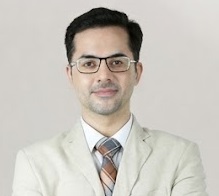
Our mission is to place patients at the centre of every healthcare decision by providing trustworthy, evidence-based, and unbiased medical information. We believe that informed patients make better decisions. Backed by personalised guidance from our experienced advisory team, we help patients understand their treatment options, compare them objectively, and confidently choose the path that best suits their medical needs and personal circumstances.
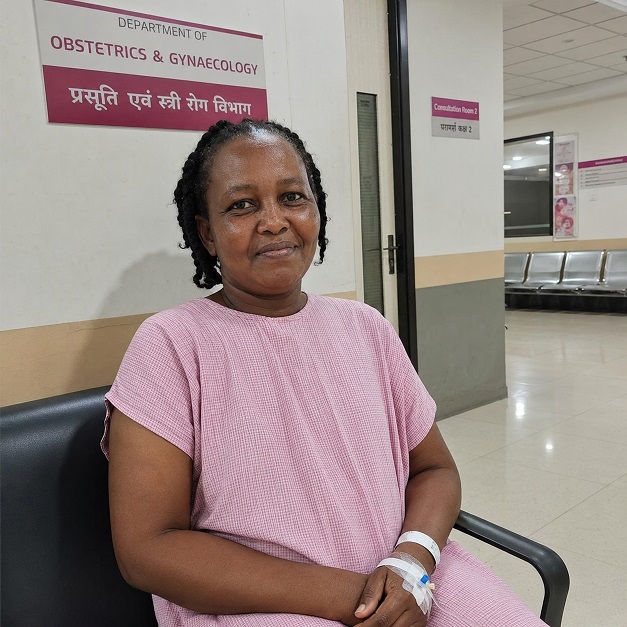
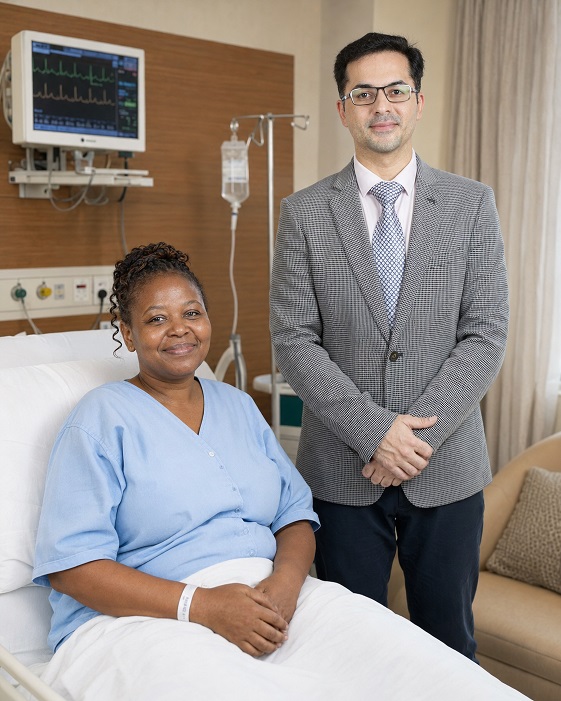
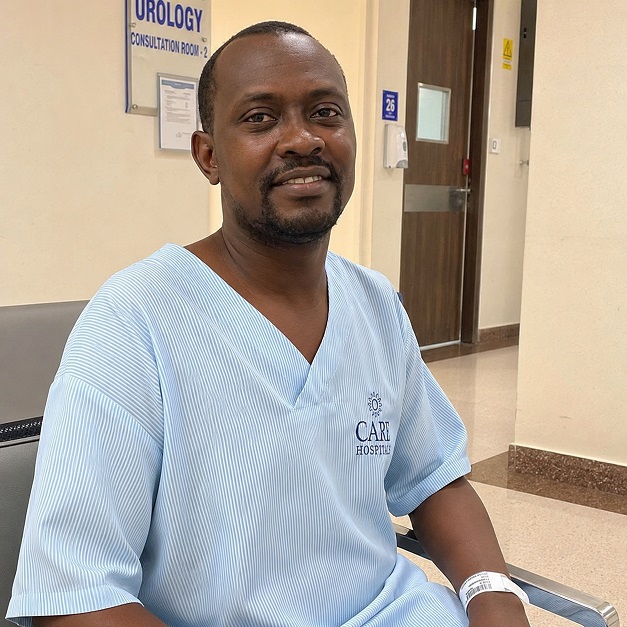
Patient Testimonials from Kenya
Ready to Take the First Step?
Share your Medical Reports with our Healthcare Managers Today and Get a FREE CONSULTATION, a Personalized Treatment Plan, and Complete Support from Arrival to Recovery.
Get Your Free ConsultationAreas We Serve
This resource has been thoughtfully prepared for patients from Kenya who are considering medical treatment in India. We also welcome patients from the wider region in the countries mentioned below-
We assist patients from:
- Ethiopia
- Somalia
- Tanzania
- Uganda
- Seychelles
- Guinea
- Guinea-Bissau
- Liberia
- Mali
- Mauritania
- Niger
- Nigeria
- Senegal
- Togo
- South Sudan
- Sierra Leone
Many of the insights, treatment pathways, hospital recommendations, travel guidance, and patient support services described here are equally relevant and may be used as a reference when planning treatment in India.
From Kenya to India: Your Complete Patient Support Guide
- Brain Tumour Surgery in India for Kenyan Patients
- Cancer Treatment and Surgery in India for Kenyan Patients
- Cardiac Treatment and Surgery in India for Kenyan Patients
- Heart Valve Replacement Surgery in India for Kenyan Patients
- Knee Replacement in India for Kenyan Patients
- Prostate Cancer Treatment and Surgery in India for Kenyan Patients
- Spine Treatment and Surgery in India for Kenyan Patients
- Selecting the Best Bariatric Surgeons and Hospitals in India: What Kenyan Patients Should Actually Look For
- Selecting the Best Cancer Surgeons and Hospitals in India: What Kenyan Patients Should Actually Look For
- Selecting the Best Cardiac Surgeons and Hospitals in India: What Kenyan Patients Should Actually Look For
- Selecting the Best Dental Surgeons and Clinics in India: What Kenyan Patients Should Actually Look For
- Selecting the Best Hip Surgeons and Hospitals in India: What Kenyan Patients Should Actually Look For
- Selecting the Best Kidney Transplant Surgeons and Hospitals in India: What Kenyan Patients Should Actually Look For
- Selecting the Best Knee Surgeons and Hospitals in India: What Kenyan Patients Should Actually Look For
- Selecting the Best Liver Transplant Surgeons and Hospitals in India: What Kenyan Patients Should Actually Look For
- Selecting the Best Neurosurgeons and Hospitals in India: What Kenyan Patients Should Actually Look For
- Selecting the Best Prostate Cancer Surgeons and Hospitals in India: What Kenyan Patients Should Actually Look For
- Selecting the Best Spine Surgeons and Hospitals in India: What Kenyan Patients Should Actually Look For