

Neuronavigation and Advanced Brain Surgery in India for Kenyan Patients
What neuronavigation adds to brain surgery, why that technology gap matters for a Kenyan patient, and what advanced brain surgery costs in India.
A nationwide survey of Kenyan neurosurgical consultants and residents found that more than two-thirds of Kenya's counties have no neurosurgical oncology services at all. Layered onto this, research across Africa has found that only around a quarter of young neurosurgeons report having access to neuronavigation, the image-guidance technology that functions essentially as GPS for the brain, allowing surgeons to remove tumours precisely while avoiding critical, function-controlling tissue nearby. These two facts, taken together, describe a genuine structural gap in advanced brain surgery capacity across Kenya, not a gap in surgical skill or willingness, but in the specific technology that makes safely removing certain tumours possible at all. Across 24 years of guiding Kenyan patients through treatment in India, neuronavigation and advanced brain surgery is a category where this precise, technology-driven gap deserves direct explanation. This article explains what neuronavigation and advanced brain surgery involve, why this specific technology gap matters so much for Kenyan patients, what treatment costs in India compared with Kenya and Western countries, and the practical factors to weigh before deciding where to be treated.
Healing Journeys of Kenyan Patients


Key Takeaways
- The guide explains that neuronavigation works like GPS for the brain, using pre-operative MRI or CT scans to create a three-dimensional map that helps surgeons track instruments relative to the tumour and surrounding healthy tissue. This becomes particularly important when a tumour lies close to areas controlling speech, movement or vision, where surgical precision is critical to preserving neurological function.
- Kenyan patients face a significant technology-access gap. A nationwide survey found that more than two-thirds of Kenyan counties have no neurosurgical oncology services, while broader African research indicates that only around one-quarter of young neurosurgeons report access to neuronavigation. The page 2 graphic presents these figures as 2 in 3 Kenyan counties and approximately 25% access among young African neurosurgeons.
- The guide emphasises that neuronavigation is not simply an optional technology for every brain tumour. Its importance depends on tumour location, accessibility and proximity to critical brain structures. Advanced surgery may also incorporate awake craniotomy, intraoperative mapping and fluorescence-guided surgery to support maximal safe tumour removal while protecting important brain functions.
- India has developed substantial capacity in neuronavigation and advanced brain surgery, with major centres combining image-guidance systems, intraoperative monitoring and fluorescence-guided techniques with multidisciplinary neuro-oncology teams. Kenyan patients are advised to confirm that the technology will actually be used for their specific tumour, rather than assuming that its presence somewhere in the hospital means it forms part of their surgical plan.
- The guide estimates neuronavigation-guided brain tumour surgery at approximately US$5,500–15,000 in India, compared with US$8,000–20,000 for complex brain surgery in Kenya, US$30,000–60,000 in the UK and US$50,000–150,000 in the US. The page 3 cost graphic clearly shows India's lower treatment-cost range.
- Kenyan patients should send their MRI or CT scans and relevant medical records before travelling and ask whether neuronavigation, awake craniotomy or intraoperative mapping is appropriate. The guide recommends approximately 2–3 weeks in India, including pre-operative planning, surgery and ICU-monitored initial recovery.
- The page 4 “Six Things to Check Before Booking Advanced Brain Surgery” graphic highlights hospital accreditation, confirmation that neuronavigation is part of the patient's actual surgical plan, tumour-specific surgeon volume, a complete cost quotation, urgent visa and travel planning, and a written long-term neuro-oncology follow-up schedule in Kenya.
Quick Facts
- Author
- Dr. Dheeraj Bojwani
- Experience
- 24+ Years
- Treatment
- Neuronavigation & Advanced Brain Surgery
- Patients
- Kenyan Patients
- First Assessment
- Tumour location, imaging and proximity to critical brain structures
- Key Specialist
- Neurosurgeon / Neuro-Oncology Specialist
- Main Technology
- Neuronavigation
- Additional Technology
- Awake craniotomy, intraoperative mapping and fluorescence guidance where appropriate
- Purpose
- Maximal safe tumour removal while protecting brain function
- Kenya Gap
- More than two-thirds of counties lack neurosurgical oncology services
- Technology Access
- Around 25% of young African neurosurgeons report access to neuronavigation
- Hospital Check
- JCI / NABH accreditation
- Case Volume
- Tumour-specific annual surgical experience
- Cost Check
- Written estimate covering surgery, ICU and follow-up imaging
- India Cost
- US$5,500–15,000
- Kenya Cost
- US$8,000–20,000 private for complex brain surgery
- Medical Records
- MRI / CT scans and previous treatment reports
- Visa
- Indian medical e-visa with hospital invitation
- Travel
- Nairobi–Delhi or Mumbai flights
- Stay
- Approximately 2–3 weeks
- Follow-Up
- Written neuro-oncology imaging schedule in Kenya
- Key Warning
- Advanced technology advertised without confirming it will be used for the patient's tumour
- Decision Principle
- Verify technology, tumour-specific expertise and long-term follow-up.
In Brief
For Kenyan patients with brain tumours near critical brain structures, the most important priorities are confirming access to appropriate image-guided technology, choosing a surgeon with experience in the specific tumour type and establishing how neurological function will be protected during surgery. Patients should verify the actual technology planned for their case, obtain a complete quotation and arrange long-term neuro-oncology follow-up in Kenya before travelling.
What neuronavigation and advanced brain surgery actually involve
Neuronavigation uses a patient's pre-operative MRI or CT scans to create a real-time, three-dimensional map of the brain, tracked continuously during surgery so the surgical team always knows precisely where their instruments sit relative to the tumour and surrounding healthy tissue. This matters enormously for tumours located near eloquent brain areas, regions controlling speech, movement, or vision, where even small deviations in surgical approach can mean the difference between a tumour safely removed and permanent neurological damage.
Beyond neuronavigation itself, advanced brain surgery increasingly incorporates awake craniotomy, where a patient is kept conscious during critical portions of the operation so the surgical team can directly test speech and motor function in real time, and fluorescence-guided surgery, where a special dye makes tumour tissue glow under specific lighting, helping surgeons distinguish tumour from healthy brain more precisely than visual inspection alone. These technologies work together, allowing what's called maximal safe resection, removing as much tumour as possible while genuinely protecting brain function, an approach that has been shown to meaningfully extend both progression-free and overall survival for many tumour types.
Not every brain tumour requires this full technological suite; smaller, more accessible tumours away from critical structures can sometimes be safely removed with more standard surgical technique. But for tumours near speech, motor, or visual pathways specifically, or those requiring especially precise removal to preserve function, these tools genuinely change what's surgically achievable, turning what might otherwise be an inoperable or high-risk tumour into one that can be approached with real confidence.
Why this specific technology gap matters so much for Kenyan patients
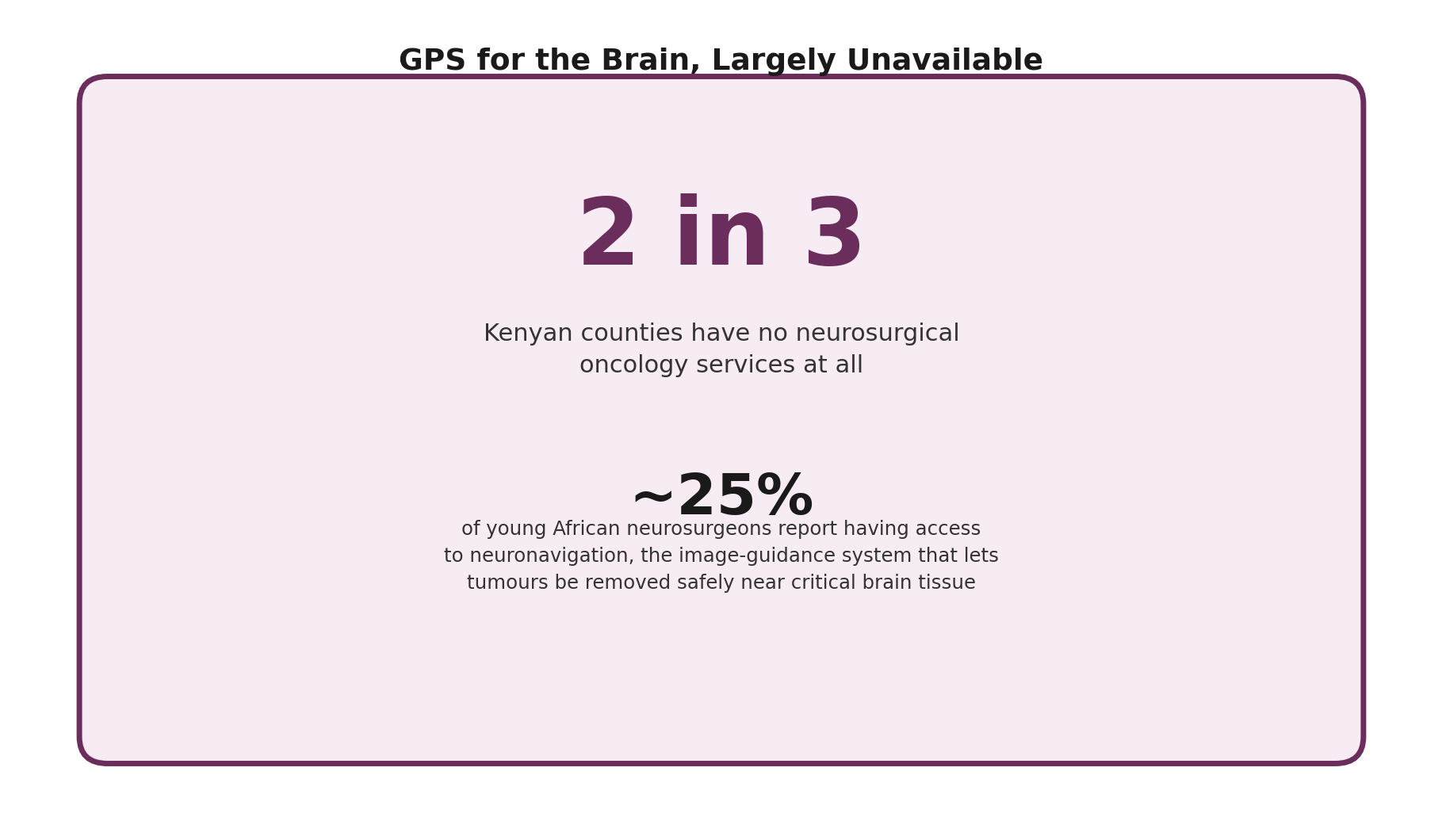
This is the fact every Kenyan patient or family facing a brain tumour diagnosis needs to understand clearly, because it directly shapes what treatment options are realistically available close to home. Beyond the two-thirds of Kenyan counties lacking neurosurgical oncology services entirely, broader research across Africa has found that only 33.7% of institutions in low- and middle-income countries have any neuronavigation system available in their operating rooms at all, and among young African neurosurgeons specifically, only around a quarter report genuine access to imaging guidance systems in their daily practice.
This matters because neuronavigation isn't a luxury add-on; for tumours located near critical brain structures, it can be the difference between a surgery that's safely attemptable and one that isn't attemptable at all without unacceptable risk. The same nationwide Kenyan survey found that 84% of neurosurgeons agreed delays in referrals between specialties represent a major challenge, and 78% agreed treatment abandonment is a significant problem, patterns consistent with a system where the specific technology needed for certain tumours simply isn't available at every facility a patient might first encounter.
Why India has become a genuine hub for neuronavigation and advanced brain surgery
India has developed extensive neuronavigation and advanced brain surgery capacity, with major neurosurgical centres routinely equipped with the imaging guidance systems, intraoperative monitoring, and fluorescence-guided surgical tools that remain scarce across much of Africa. This matters because it means the specific technological barrier limiting treatment options in Kenya, not a lack of surgical willingness or general skill, but a lack of the equipment certain tumours genuinely require, simply doesn't apply at India's leading centres.
India's leading neurosurgical centres combine this technology with JCI and NABH accredited safety standards, genuinely high-volume tumour-specific surgical experience, and multidisciplinary neuro-oncology teams that plan treatment collaboratively. In 24 years of guiding patients through this decision, the clearest advice I offer is direct:
for a brain tumour located near critical brain structures specifically, ask explicitly whether neuronavigation and the full range of modern surgical technology are genuinely available and will be used for your case, since this specific detail can determine both how much of the tumour can be safely removed and how much brain function is preserved afterward.
This distinction matters enormously in practice, and it's worth asking about directly rather than assuming. Two hospitals can both offer "brain tumour surgery," but the actual surgical approach, and the outcome it makes possible, can differ substantially depending on whether neuronavigation, intraoperative mapping, and fluorescence guidance are genuinely part of the plan, or simply available somewhere in the building but not routinely used for cases like yours.
What it costs: India versus Kenya, the UK, and the US
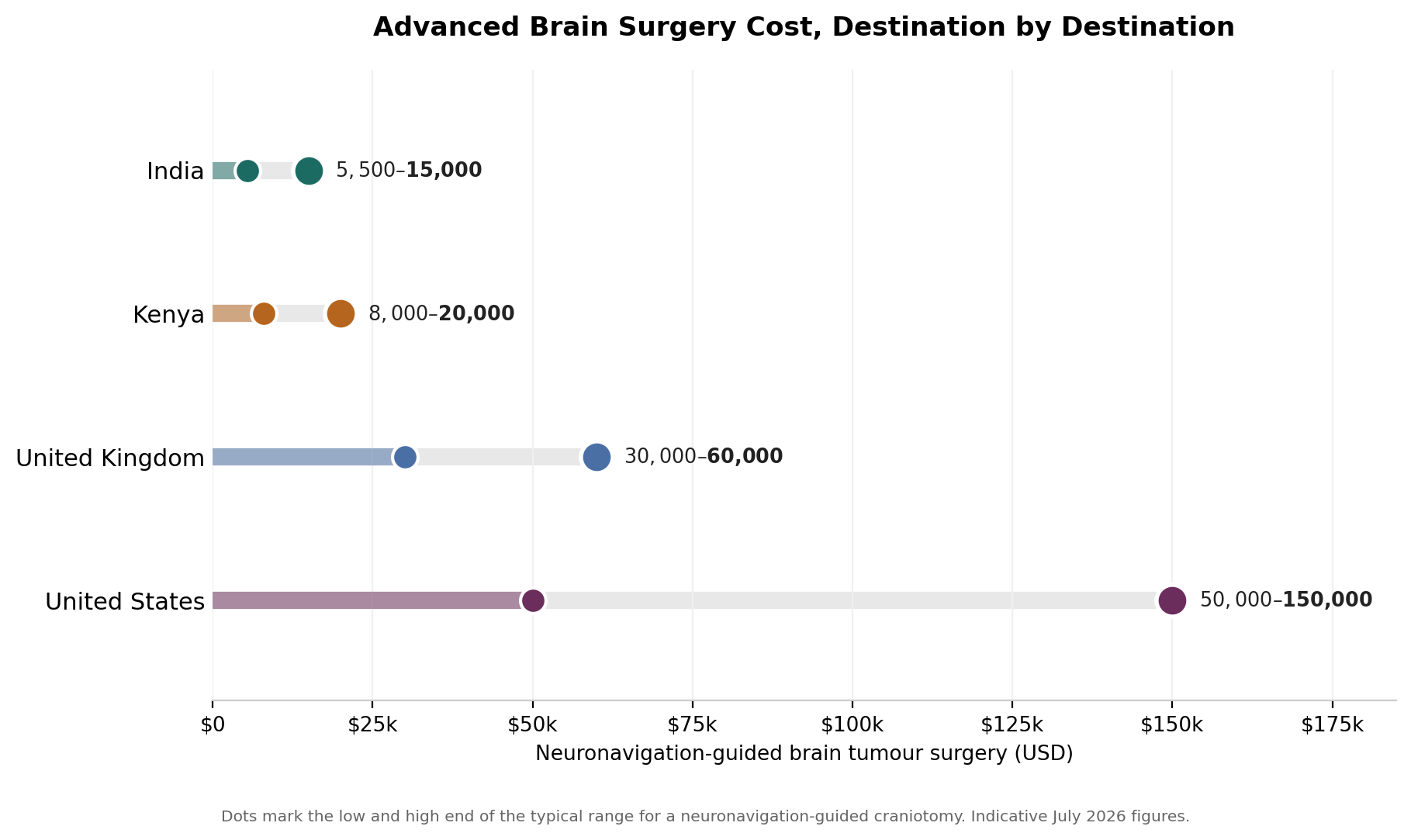
In India, neuronavigation-guided brain tumour surgery typically costs between 5,500 and 15,000 US dollars. In Kenya, where this level of technology remains limited, private costs for complex brain surgery run roughly 8,000 to 20,000 dollars. In the UK, comparable surgery typically costs 30,000 to 60,000 dollars, and in the US, 50,000 to 150,000 dollars.
Beyond the procedure itself, budget for an extended stay. Direct flights between Nairobi and Delhi or Mumbai run roughly 550 to 850 dollars return, and brain tumour surgery typically requires two to three weeks in India, covering pre-operative imaging and planning, the surgery itself, and the ICU-monitored initial recovery period.
What a Kenyan patient should actually check before booking
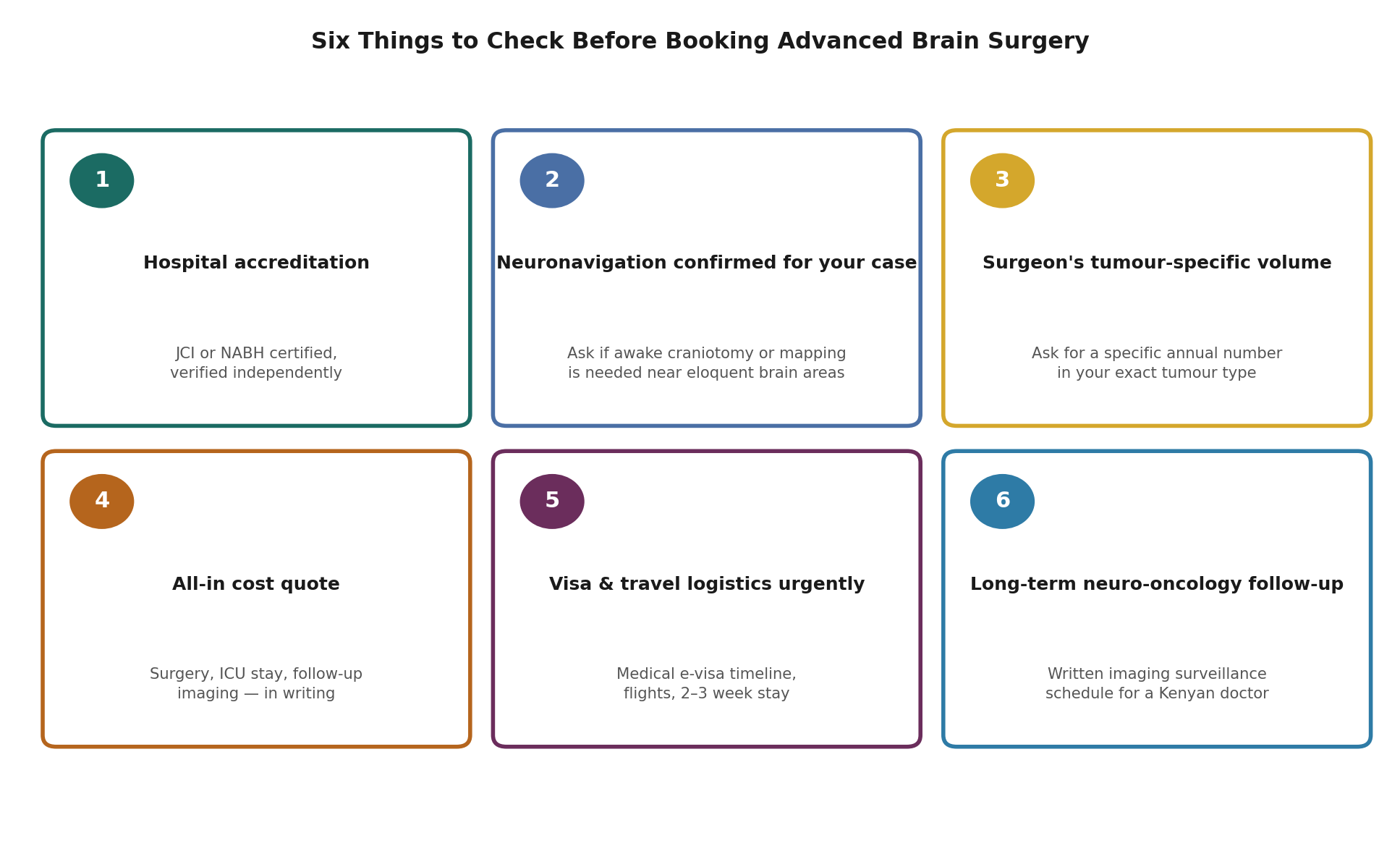
Given how much technology and surgical precision matter here, work through these questions directly.
Confirm genuine accreditation. Ask whether the hospital holds JCI or NABH certification, and verify it independently.
Confirm neuronavigation is genuinely part of your surgical plan. Ask whether your specific tumour's location, particularly near eloquent brain areas, requires awake craniotomy or intraoperative mapping.
Ask about the surgeon's tumour-specific volume. A specific number, how many cases matching your exact tumour type the surgeon personally treats each year, tells you more than general neurosurgical reputation.
Get the full cost breakdown in writing. Confirm what's included, surgery, ICU stay, and follow-up imaging.
Plan your visa and travel logistics urgently. The Indian medical e-visa is typically issued within three to five working days once you have a formal hospital invitation letter.
Arrange your long-term neuro-oncology follow-up plan before you leave. Agree on a written imaging surveillance schedule and identify a doctor in Kenya who can continue that monitoring.
Straight Answers for Kenyan Patients about Neuronavigation and Advanced Brain Surgery in India
How significant is the neuronavigation access gap in Kenya and Africa?
Only about a quarter of young African neurosurgeons report having genuine access to neuronavigation, and only 33.7% of institutions across low- and middle-income countries have any navigation system available in their operating rooms.
How much of Kenya lacks neurosurgical oncology services?
A nationwide survey found more than two-thirds of Kenyan counties have no neurosurgical oncology services at all.
How much does neuronavigation-guided brain surgery cost in India compared to the US?
India typically costs 5,500 to 15,000 US dollars, against 50,000 to 150,000 dollars in the US.
What is neuronavigation used for?
It creates a real-time, three-dimensional map of the brain during surgery, allowing surgeons to precisely track their instruments relative to the tumour and critical surrounding structures like speech and motor areas.
Why does neuronavigation matter so much for certain brain tumours?
For tumours near eloquent brain areas controlling speech, movement, or vision, neuronavigation can be the difference between a surgery that's safely possible and one that carries unacceptable risk without it.
How do I get a medical visa to India from Kenya?
The Indian medical e-visa is typically issued within three to five working days once you have a formal invitation letter from the treating hospital.
A Closing Word
Two-thirds of Kenyan counties have no neurosurgical oncology services at all, and across Africa, only around a quarter of young neurosurgeons have genuine access to neuronavigation, the technology that makes certain brain tumour surgeries safely possible. This is a technology gap, not a skill gap, and India's combination of widely available advanced surgical technology, accredited safety standards, and accessible cost makes it, for many Kenyan patients facing a brain tumour diagnosis near critical brain structures, worth investigating directly.
Sources
- 🌐 Neurosurgical Oncology Capacity in Kenya: Results From a Nationwide Survey of Consultants and Residents. PMC. pmc.nc
- 🌐 Situating Sub-Saharan Africa Within Intra-Operative Innovations in Neurooncology. PMC
- 🌐 Bridging the Global Technology Gap in Neurosurgery: Disparities in Access to Advanced Tools for Brain Tumor Resection. Neurosurgery Practice
- 🌐 National Medical Commission of India — specialist registration verification
- 🌐 National Accreditation Board for Hospitals & Healthcare Providers (NABH) — accredited hospital directory
Frequently Asked Questions by Kenyans about Neuronavigation and Advanced Brain Surgery in India
Why are some Kenyan brain tumour patients referred abroad for advanced surgery?
The guide identifies a major capacity gap: more than two-thirds of Kenyan counties have no neurosurgical oncology services, making access to advanced tumour surgery uneven across the country.
How limited is neuronavigation access for African neurosurgeons?
Broader African research cited in the guide indicates that only around one-quarter of young African neurosurgeons report access to neuronavigation, while only 33.7% of institutions in low- and middle-income countries have a navigation system in their operating rooms.
Why should a Kenyan patient ask whether neuronavigation will actually be used?
Having a navigation system in the hospital does not automatically mean it will be used for every tumour. Kenyan patients should ask the Indian neurosurgeon to confirm that neuronavigation is part of their specific surgical plan, particularly when the tumour is close to speech, movement or visual areas.
Should Kenyan patients send their MRI before travelling to India?
Yes. Sending the actual MRI or CT imaging before travel allows the Indian neurosurgical team to assess tumour location, surgical accessibility and whether technologies such as neuronavigation, awake craniotomy or mapping may be appropriate.
How much does neuronavigation-guided brain surgery cost in India for Kenyan patients?
The guide estimates approximately US$5,500–15,000 in India, compared with roughly US$8,000–20,000 for complex brain surgery privately in Kenya.
What should Kenyan patients verify about the Indian neurosurgeon?
Patients should ask for the specific number of cases matching their tumour type that the surgeon personally treats each year. The guide considers tumour-specific volume more useful than relying only on a surgeon's general reputation.
When might a Kenyan patient need awake craniotomy or intraoperative mapping?
These techniques may be considered when the tumour is located near eloquent brain areas responsible for speech, movement or other critical functions. The treating neurosurgeon should determine whether they are necessary based on the patient's imaging.
How long should Kenyan patients plan to remain in India?
The guide recommends approximately 2–3 weeks in India, allowing time for pre-operative imaging and planning, surgery and ICU-monitored initial recovery.
What should Kenyan patients check in the hospital before booking surgery?
The guide recommends independently verifying JCI or NABH accreditation, confirming that the required neuronavigation technology is genuinely available for the case, checking the surgeon's tumour-specific experience and obtaining a complete written cost estimate.
How should Kenyan patients manage brain tumour follow-up after returning from India?
Before leaving India, patients should obtain a written imaging surveillance schedule and identify a doctor in Kenya who can continue neuro-oncology monitoring. This allows postoperative surveillance to continue without depending entirely on repeated international travel.
Page Summary
This five-page guide focuses on the technology gap affecting advanced brain tumour surgery for Kenyan patients. Page 2 highlights that more than two-thirds of Kenyan counties lack neurosurgical oncology services, while only around 25% of young African neurosurgeons report access to neuronavigation. Page 3 compares advanced brain surgery costs in India, Kenya, the UK and US. The page 4 six-point graphic focuses on accreditation, technology confirmation, tumour-specific surgeon volume, complete costing, travel planning and long-term neuro-oncology follow-up.
Citation Block
| Topic | Information |
|---|---|
| Topic | Neuronavigation & Advanced Brain Surgery in India for Kenyan Patients |
| Treatment | Neuronavigation-Guided Brain Tumour Surgery |
| Patients | Kenyan Patients |
| First Assessment | Tumour location, imaging and proximity to critical brain structures |
| Key Specialist | Neurosurgeon / Neuro-Oncology Specialist |
| Main Technology | Neuronavigation |
| Additional Technology | Awake craniotomy, intraoperative mapping and fluorescence guidance |
| Main Goal | Maximal safe tumour removal while preserving brain function |
| Kenya Gap | More than two-thirds of counties lack neurosurgical oncology services |
| Technology Access | Around 25% of young African neurosurgeons report neuronavigation access |
| Hospital Check | JCI / NABH accreditation |
| Case Volume | Tumour-specific surgical experience |
| Cost Check | Written estimate including surgery, ICU and follow-up imaging |
| India Cost | US$5,500–15,000 |
| Kenya Cost | US$8,000–20,000 private |
| Medical Records | MRI / CT scans and previous treatment reports |
| Travel | Nairobi–Delhi or Mumbai flights |
| Stay | Approximately 2–3 weeks |
| Follow-Up | Written neuro-oncology imaging plan in Kenya |
| Surgeon Question | How many patients with my specific tumour type do you operate on each year? |
| Technology Question | Will neuronavigation actually be used during my surgery? |
| Function Question | Will awake craniotomy or intraoperative mapping be needed for my tumour location? |
| Cost Question | Does the quotation include surgery, ICU stay and follow-up imaging? |
| Follow-Up Question | Who will monitor my brain imaging after I return to Kenya? |
| Warning Signs | Technology advertised without confirming its use for the patient's case |
| Payment Warning | Incomplete quotation excluding ICU or follow-up imaging |
| Key Decision | Verify technology, tumour-specific expertise and follow-up |


Our Mission Statement
Our mission is to place patients at the centre of every healthcare decision by providing trustworthy, evidence-based, and unbiased medical information. We believe that informed patients make better decisions. Backed by personalised guidance from our experienced advisory team, we help patients understand their treatment options, compare them objectively, and confidently choose the path that best suits their medical needs and personal circumstances.
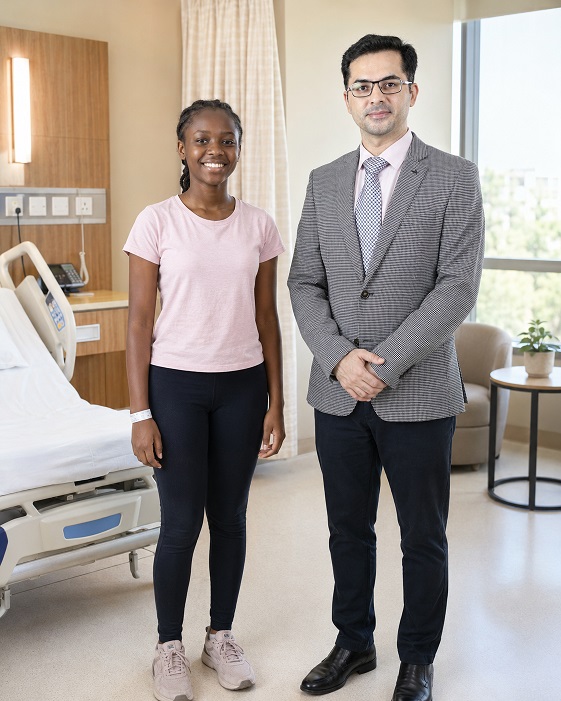
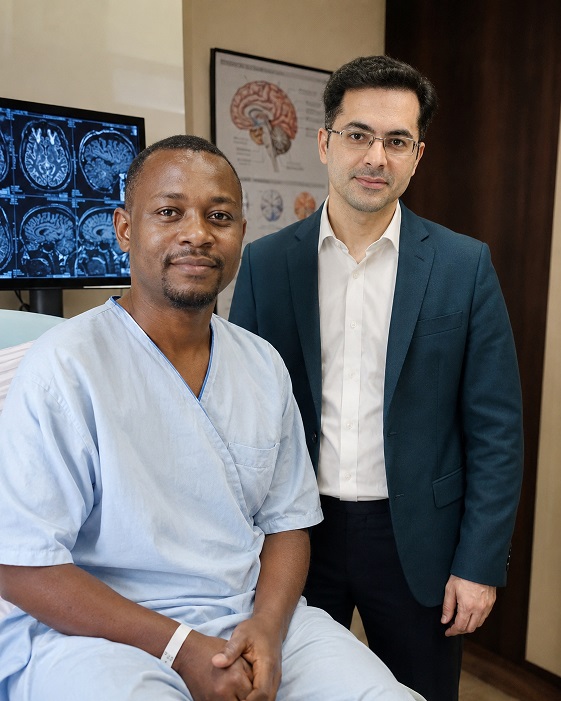
Patient Testimonials from Kenya
Ready to Take the First Step?
Share your Medical Reports with our Healthcare Managers Today and Get a FREE CONSULTATION, a Personalized Treatment Plan, and Complete Support from Arrival to Recovery.
Get Your Free ConsultationAreas We Serve
This resource has been thoughtfully prepared for patients from Kenya who are considering medical treatment in India. We also welcome patients from the wider region in the countries mentioned below-
We assist patients from:
- Ethiopia
- Somalia
- Tanzania
- Uganda
- Seychelles
- Guinea
- Guinea-Bissau
- Liberia
- Mali
- Mauritania
- Niger
- Nigeria
- Senegal
- Togo
- South Sudan
- Sierra Leone
Many of the insights, treatment pathways, hospital recommendations, travel guidance, and patient support services described here are equally relevant and may be used as a reference when planning treatment in India.
From Kenya to India: Your Complete Patient Support Guide
- Brain Tumour Surgery in India for Kenyan Patients
- Cancer Treatment and Surgery in India for Kenyan Patients
- Cardiac Treatment and Surgery in India for Kenyan Patients
- Heart Valve Replacement Surgery in India for Kenyan Patients
- Knee Replacement in India for Kenyan Patients
- Prostate Cancer Treatment and Surgery in India for Kenyan Patients
- Spine Treatment and Surgery in India for Kenyan Patients
- Selecting the Best Bariatric Surgeons and Hospitals in India: What Kenyan Patients Should Actually Look For
- Selecting the Best Cancer Surgeons and Hospitals in India: What Kenyan Patients Should Actually Look For
- Selecting the Best Cardiac Surgeons and Hospitals in India: What Kenyan Patients Should Actually Look For
- Selecting the Best Dental Surgeons and Clinics in India: What Kenyan Patients Should Actually Look For
- Selecting the Best Hip Surgeons and Hospitals in India: What Kenyan Patients Should Actually Look For
- Selecting the Best Kidney Transplant Surgeons and Hospitals in India: What Kenyan Patients Should Actually Look For
- Selecting the Best Knee Surgeons and Hospitals in India: What Kenyan Patients Should Actually Look For
- Selecting the Best Liver Transplant Surgeons and Hospitals in India: What Kenyan Patients Should Actually Look For
- Selecting the Best Neurosurgeons and Hospitals in India: What Kenyan Patients Should Actually Look For
- Selecting the Best Prostate Cancer Surgeons and Hospitals in India: What Kenyan Patients Should Actually Look For
- Selecting the Best Spine Surgeons and Hospitals in India: What Kenyan Patients Should Actually Look For