

Laparoscopic and Robotic Myomectomy in India for Kenyan Patients
Fibroid surgery that protects fertility: what laparoscopic and robotic myomectomy in India offer a Kenyan patient, and what the surgery and stay cost.
If you've been diagnosed with uterine fibroids and still hope to have children, one statistic from Kenyan hospital data should prompt a genuinely important conversation with your doctor before you agree to any surgery. At a major Kenyan teaching hospital, hysterectomy, the complete removal of the uterus, was performed more often than myomectomy, the fibroid-only removal that preserves fertility, even though the same study found the highest prevalence of fibroids among women who hadn't yet had children. Across 24 years of guiding Kenyan patients through treatment in India, this is one of the clearer cases I see where the treatment a woman actually receives may not match the treatment she'd choose if every option were genuinely available to her. This article explains what laparoscopic and robotic myomectomy involve, why fertility-preserving surgery is less available in Kenya than the need for it suggests, what treatment costs in India compared with Kenya and Western countries, and the practical factors to weigh before deciding where to be treated.
Healing Journeys of Kenyan Patients



Key Takeaways
- The guide explains that myomectomy removes uterine fibroids while preserving the uterus, unlike hysterectomy, which removes the uterus and permanently ends the ability to carry a pregnancy. Laparoscopic and robotic myomectomy use small abdominal incisions and may provide less blood loss, shorter hospitalisation and faster recovery than open surgery when the fibroids are suitable for a minimally invasive approach.
- The guide highlights a significant treatment pattern in Kenya. At Jaramogi Oginga Odinga Teaching and Referral Hospital in Kisumu, hysterectomy accounted for 42% of fibroid surgeries compared with 27% for myomectomy, while fibroid prevalence was highest among women who had not yet given birth. The page 2 graphic presents this comparison and highlights why fertility-preserving options deserve careful discussion.
- Not every fibroid can be removed laparoscopically or robotically. Size, number and location can make minimally invasive surgery technically difficult, meaning open surgery may sometimes be safer. The guide therefore stresses that the important question is not whether minimally invasive surgery is always better, but whether an experienced surgeon considers it appropriate for the individual patient's fibroids.
- India has developed dedicated capacity in laparoscopic and robotic fertility-preserving fibroid surgery, with gynaecological surgeons who perform these procedures regularly. The guide reports success rates of approximately 97–99% at leading centres and recommends checking JCI or NABH accreditation and the surgeon's specific annual myomectomy volume rather than relying only on general gynaecological experience.
- The guide estimates laparoscopic or robotic myomectomy at US$3,000–8,000 in India, compared with US$2,500–8,000 privately in Kenya, US$10,000–20,000 in the UK and US$15,000–30,000 in the US. The page 3 cost chart shows that Kenya's overall price range is similar, but much of its domestic surgery remains open abdominal myomectomy rather than the minimally invasive approaches specifically discussed in the guide.
- The page 4 “Six Things to Check” graphic highlights hospital accreditation, the surgeon's fertility-preserving surgical volume, confirmation that a minimally invasive approach genuinely suits the patient's fibroids, a complete written cost estimate, visa and travel planning, and follow-up with pregnancy-planning guidance. Most patients should plan for approximately 1–2 weeks in India for surgery and initial recovery.
Quick Facts
- Author
- Dr. Dheeraj Bojwani
- Experience
- 24+ Years
- Treatment
- Laparoscopic & Robotic Myomectomy
- Patients
- Kenyan Patients
- First Assessment
- Fibroid size, number and location
- Key Specialist
- Gynaecological Surgeon with Myomectomy Experience
- Main Goal
- Fibroid removal while preserving the uterus
- Approaches
- Laparoscopic, robotic or open surgery when appropriate
- Fertility
- Uterus preserved for potential future pregnancy
- Case Volume
- Specific laparoscopic / robotic myomectomy experience
- Hospital Check
- JCI / NABH accreditation
- Cost Check
- Written estimate covering surgery, anaesthesia and follow-up
- India Cost
- US$3,000–8,000
- Kenya Cost
- US$2,500–8,000 private
- Medical Records
- Ultrasound / MRI and previous treatment reports
- Visa
- Indian medical e-visa with hospital invitation
- Travel
- Nairobi–India flights
- Stay
- Approximately 1–2 weeks
- Follow-Up
- Pregnancy planning and postoperative care in Kenya
- Key Warning
- Hysterectomy recommended without discussing fertility-preserving options
- Decision Principle
- Prioritise fertility-preserving expertise, appropriate surgical approach and clear pregnancy follow-up.
In Brief
For Kenyan women with fibroids who want to preserve fertility, the key priorities are obtaining a genuine second opinion, confirming whether laparoscopic or robotic surgery is technically suitable and choosing a surgeon with specific fertility-preserving myomectomy experience. Patients should also obtain a complete written quotation and establish postoperative and future-pregnancy guidance before travelling to India.
What laparoscopic and robotic myomectomy actually involve
A myomectomy removes uterine fibroids, benign but often symptomatic growths, while leaving the uterus itself intact, preserving a woman's ability to carry a future pregnancy. This distinguishes it fundamentally from a hysterectomy, which removes the uterus entirely and ends fertility permanently. For women who haven't completed their families, or who simply want to keep that option open, myomectomy is the clinically appropriate choice whenever the fibroids' size, number, and location make it technically feasible.
Laparoscopic myomectomy removes fibroids through several small abdominal incisions, using a camera and long instruments, rather than the single large incision an open abdominal myomectomy requires. Robotic myomectomy uses the same minimally invasive approach but with robotic-assisted instruments controlled from a console, offering the surgeon greater precision and range of motion, particularly valuable for fibroids in technically difficult positions. Both approaches typically mean less blood loss, a shorter hospital stay, faster recovery, and less scar tissue than open surgery, the last of which matters specifically for future fertility, since excess scarring can itself affect conception.
Not every fibroid case is suitable for a minimally invasive approach. Very large fibroids, a high number of individual growths, or fibroids in certain positions within the uterine wall can make laparoscopic or robotic removal technically difficult or, in some cases, inadvisable, in which case open surgery may genuinely be the safer choice. The point isn't that minimally invasive surgery is always right; it's that the decision should be based on your specific fibroids, assessed by a surgeon experienced enough to make that judgement accurately, rather than defaulting to whatever technique happens to be available.
Why fertility-preserving surgery is less available in Kenya than the need suggests
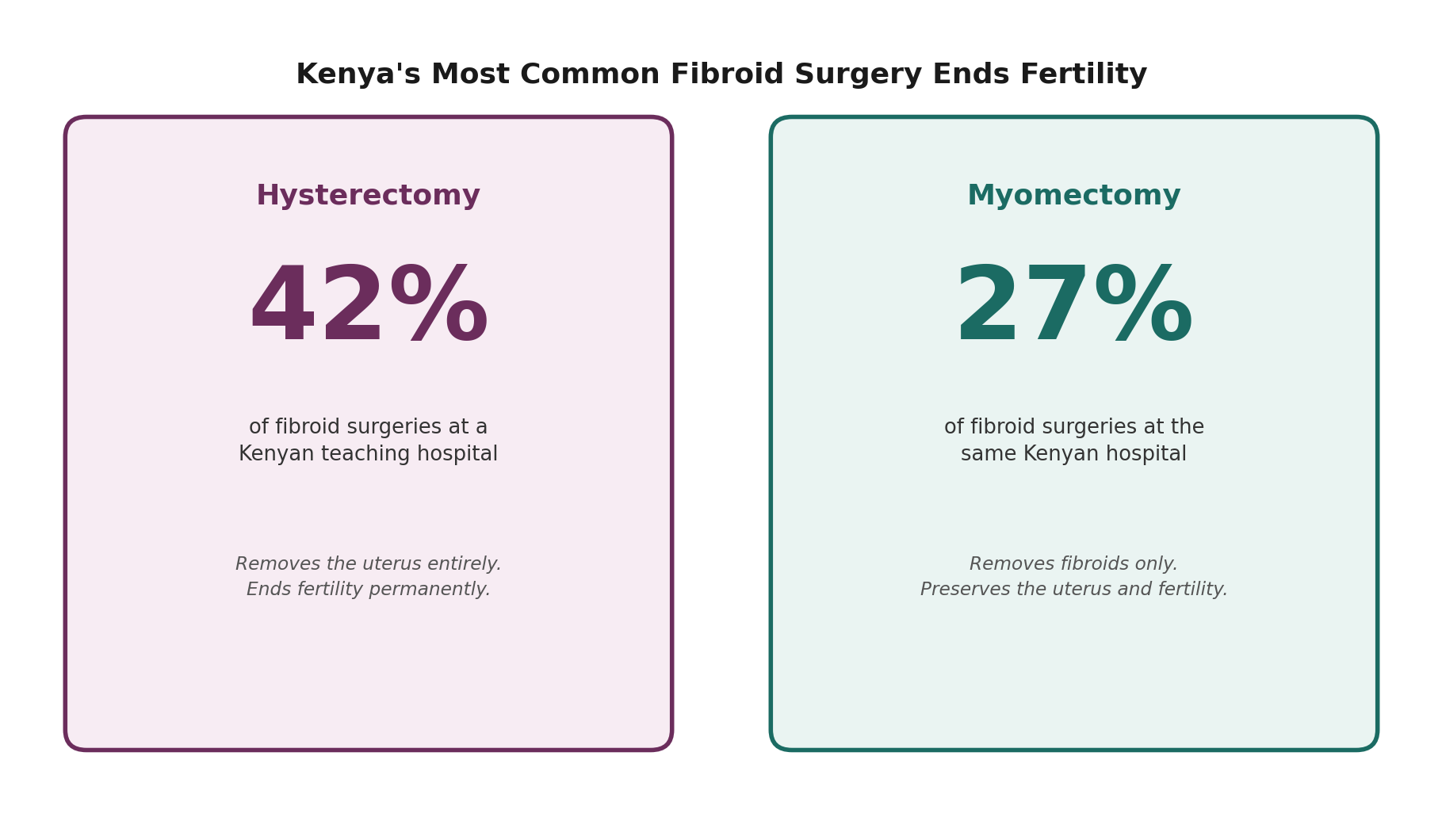
This is the pattern every Kenyan woman facing a fibroid diagnosis should understand clearly. A study of fibroid treatment at Jaramogi Oginga Odinga Teaching and Referral Hospital in Kisumu found total abdominal hysterectomy was the most common treatment, performed in 42% of cases, against myomectomy at just 27%. The same study found fibroid prevalence was actually highest among nulliparous women, those who hadn't yet given birth, at 27% of cases, precisely the group for whom preserving fertility matters most.
A separate study from a major Nigerian teaching hospital found a similar regional pattern: abdominal hysterectomy performed roughly twice as often as myomectomy, and notably, no cases of laparoscopic or other minimally invasive surgery at all, every procedure was done through open abdominal incision. Taken together, this points to a genuine access gap rather than a simple clinical preference: myomectomy is technically more demanding than hysterectomy, particularly through a minimally invasive approach, and where that specific surgical capacity isn't consistently available, hysterectomy becomes the default, even for younger women who might have preferred to preserve their fertility.
Why India has become a genuine hub for fertility-preserving fibroid surgery
India has developed substantial, dedicated capacity in both laparoscopic and robotic myomectomy specifically, with gynaecological surgeons who build careers around fertility-preserving technique rather than treating myomectomy as an occasional variation on hysterectomy. This depth of experience matters enormously for a procedure where the surgical goal, removing fibroids completely while preserving the uterus's structural integrity for a future pregnancy, requires meaningfully more skill and judgement than simply removing the organ entirely.
India's leading centres combine this technique-specific experience with JCI and NABH accredited safety standards and reported success rates in the 97 to 99% range. In 24 years of guiding women through this exact decision, the ones who insist on a genuine second opinion before accepting hysterectomy, particularly when fertility preservation matters to them, are consistently the ones who end up with a treatment plan that actually matches what they wanted. For a Kenyan woman who has been told hysterectomy is her only realistic option, or who hasn't been offered a genuine minimally invasive alternative, seeking a second opinion from a centre with real fertility-preserving surgical volume, in India where domestic access is limited, is a decision that can change a permanent, irreversible outcome into a preserved option.
What it costs: India versus Kenya, the UK, and the US
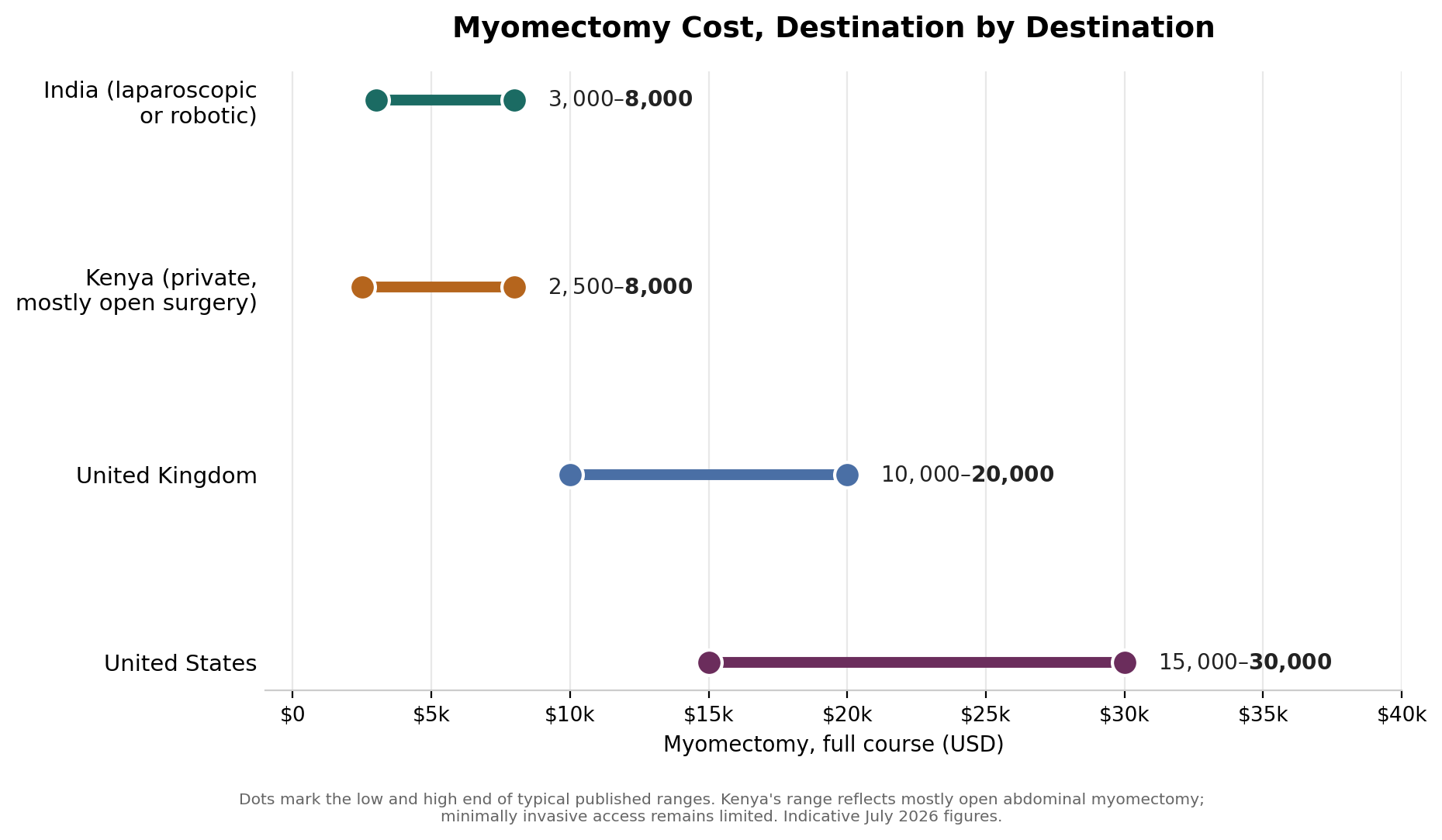
In India, laparoscopic or robotic myomectomy typically costs between 3,000 and 8,000 US dollars, covering surgery, anaesthesia, and hospital stay. In Kenya, private myomectomy costs run roughly 2,500 to 8,000 dollars, though as the hospital data shows, much of what's performed domestically remains open abdominal surgery rather than the minimally invasive approach specifically. In the UK, private myomectomy typically costs 10,000 to 20,000 dollars, and in the US, 15,000 to 30,000 dollars.
Beyond the procedure itself, budget for travel. Direct flights between Nairobi and Delhi or Mumbai run roughly 550 to 850 dollars return, and most myomectomy patients need one to two weeks in India, covering the surgery and initial recovery before travel home is medically advisable.
What a Kenyan patient should actually check before booking
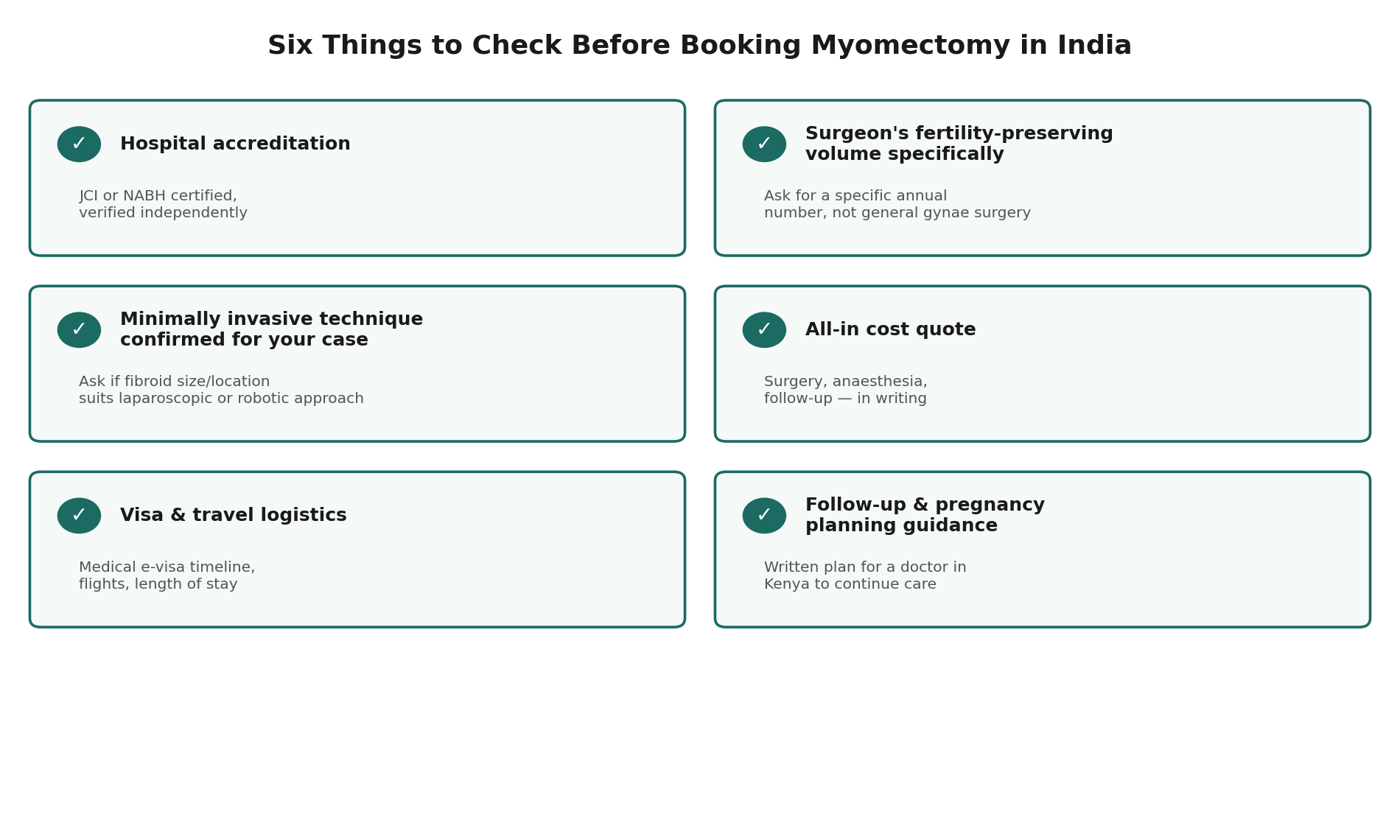
Given how much this decision can affect future fertility, these questions matter.
Confirm genuine accreditation. Ask whether the hospital holds JCI or NABH certification, and verify it independently.
Ask about the surgeon's fertility-preserving surgical volume specifically. A specific number, how many laparoscopic or robotic myomectomies the surgeon personally performs each year, tells you far more than general gynaecological surgery experience.
Confirm a minimally invasive approach genuinely suits your case. Ask your surgeon to explain, based on your fibroids' size, number, and location, whether laparoscopic or robotic myomectomy is technically appropriate for you specifically.
Get the full cost breakdown in writing. Confirm what's included, surgery, anaesthesia, and follow-up consultations.
Plan your visa and travel timeline. The Indian medical e-visa is typically issued within three to five working days once you have a formal hospital invitation letter.
Arrange your follow-up and pregnancy planning guidance before you leave. Agree on a written follow-up plan, including realistic guidance on timing any future pregnancy, and identify a doctor in Kenya who can continue that care.
Straight Answers for Kenyan Patients about Laparoscopic and Robotic Myomectomy in India
Is hysterectomy really more common than myomectomy in Kenya?
Yes, according to a study at a major Kenyan teaching hospital, which found hysterectomy performed in 42% of fibroid cases against myomectomy at 27%, despite the highest fibroid prevalence being among women who hadn't yet had children.
How much does myomectomy cost in India compared to Kenya?
India typically costs 3,000 to 8,000 US dollars for laparoscopic or robotic myomectomy. Kenya runs a similar 2,500 to 8,000 dollars privately, though much of Kenya's domestic capacity remains open abdominal surgery rather than minimally invasive.
What's the difference between myomectomy and hysterectomy?
Myomectomy removes only the fibroids, preserving the uterus and future fertility. Hysterectomy removes the entire uterus, ending fertility permanently. Myomectomy is the appropriate choice for women who want to preserve the option of pregnancy.
Why is minimally invasive myomectomy less available in parts of Africa?
It's technically more demanding than open surgery or hysterectomy, and where that specific surgical skill and equipment aren't consistently available, hysterectomy or open surgery often becomes the default, even for women who might prefer a fertility-preserving option.
Can I still get pregnant after a myomectomy?
Many women do, though pregnancy rates after myomectomy vary and aren't guaranteed; roughly 4 to 5 in 10 women conceive and give birth following the procedure, depending on individual factors.
How do I get a medical visa to India from Kenya?
The Indian medical e-visa is typically issued within three to five working days once you have a formal invitation letter from the treating hospital.
A Closing Word
Fibroids are common, and for many women hysterectomy genuinely is the right choice. But the Kenyan hospital data suggests that for a meaningful number of women, particularly younger women who haven't yet had children, the decision may be shaped more by what's locally available than by what's clinically ideal for their situation. India offers the fertility-preserving surgical volume, accredited safety standards, and cost that makes it, for many of the women I've guided through this decision, worth investigating before accepting hysterectomy as the only option.
Sources
- 🌐 Prevalence and Management of Uterine Fibroids among Women of Reproductive Age at Jaramogi Oginga Odinga Teaching and Referral Hospital
- 🌐 Surgical Management of Uterine Fibroids at Aminu Kano Teaching Hospital. PMC
- 🌐 Surgical management of uterine fibroids. International Journal of Gynecology & Obstetrics, 2026. obgyn.onlinelibrary.wiley.c om
- 🌐 National Medical Commission of India — specialist registration verification
- 🌐 National Accreditation Board for Hospitals & Healthcare Providers (NABH) — accredited hospital directory
Frequently Asked Questions by Kenyans about Laparoscopic and Robotic Myomectomy in India
What is a myomectomy?
Myomectomy removes uterine fibroids while leaving the uterus intact, unlike hysterectomy, which removes the uterus and permanently ends the ability to carry a pregnancy.
What is the difference between laparoscopic and robotic myomectomy?
Both are minimally invasive approaches using small abdominal incisions. Robotic surgery gives the surgeon robotic-assisted instruments with greater precision and range of motion in technically difficult cases.
Is minimally invasive myomectomy suitable for every fibroid?
No. Fibroid size, number and location determine whether laparoscopic or robotic removal is technically appropriate. Some cases may require open surgery.
Why should Kenyan women consider a second opinion?
The guide reports that hysterectomy was performed in 42% of fibroid surgeries at one Kenyan teaching hospital, compared with 27% for myomectomy. A second opinion can help clarify whether fertility-preserving surgery is feasible.
Does myomectomy preserve fertility?
Yes, myomectomy preserves the uterus and therefore keeps the possibility of future pregnancy, although pregnancy is not guaranteed and depends on individual fertility factors.
How much does laparoscopic or robotic myomectomy cost in India?
The guide estimates approximately US$3,000–8,000, including surgery, anaesthesia and hospital stay.
How does India's cost compare with Kenya?
Private myomectomy in Kenya is estimated at approximately US$2,500–8,000, although much of the domestic capacity remains open abdominal surgery rather than minimally invasive surgery.
How long should Kenyan patients stay in India?
Most myomectomy patients should plan for approximately 1–2 weeks for surgery and initial recovery before travelling home.
What should I ask the surgeon before surgery?
Ask about the surgeon's annual laparoscopic or robotic myomectomy volume, whether your fibroids are suitable for the approach and how the uterus will be repaired for future pregnancy.
What should Kenyan patients check before booking?
The guide recommends checking hospital accreditation, fertility-preserving surgical experience, suitability of the minimally invasive approach, complete costs, visa and travel arrangements and postoperative pregnancy guidance.
Page Summary
This five-page guide focuses on laparoscopic and robotic myomectomy for Kenyan women seeking fertility-preserving fibroid treatment. Page 2 highlights the Kenyan hospital data showing hysterectomy at 42% versus myomectomy at 27%, while also noting the high prevalence of fibroids among women who had not yet given birth. Page 3 compares myomectomy costs in India, Kenya, the UK and US. The page 4 “Six Things to Check” graphic focuses on accreditation, fertility-preserving surgical volume, suitability of the minimally invasive approach, complete costing, travel planning and pregnancy-focused follow-up.
Citation Block
| Topic | Information |
|---|---|
| Topic | Laparoscopic & Robotic Myomectomy in India for Kenyan Patients |
| Treatment | Laparoscopic / Robotic Myomectomy |
| Patients | Kenyan Patients |
| First Assessment | Fibroid size, number and location |
| Key Specialist | Gynaecological Surgeon with Myomectomy Experience |
| Main Goal | Remove fibroids while preserving the uterus |
| Approaches | Laparoscopic, robotic or open when appropriate |
| Fertility Focus | Preserve future pregnancy options |
| Case Volume | Specific laparoscopic / robotic myomectomy experience |
| Hospital Check | JCI / NABH accreditation |
| Suitability Check | Confirm minimally invasive approach fits the fibroids |
| Cost Check | Written estimate covering surgery, anaesthesia and follow-up |
| India Cost | US$3,000–8,000 |
| Kenya Cost | US$2,500–8,000 private |
| Medical Records | Ultrasound / MRI and previous treatment reports |
| Travel | Nairobi–India flights |
| Stay | Approximately 1–2 weeks |
| Follow-Up | Postoperative and pregnancy-planning guidance |
| Surgeon Question | How many laparoscopic or robotic myomectomies do you personally perform each year? |
| Approach Question | Are my fibroids suitable for laparoscopic or robotic removal? |
| Fertility Question | How will the uterine wall be repaired to support future pregnancy? |
| Cost Question | Does the quotation include surgery, anaesthesia and follow-up consultations? |
| Follow-Up Question | When can I consider pregnancy after surgery? |
| Warning Signs | Hysterectomy recommended without discussing myomectomy |
| Payment Warning | Incomplete quotation excluding important treatment costs |
| Key Decision | Verify fertility-preserving expertise, surgical suitability and pregnancy follow-up |


Our Mission Statement
Our mission is to place patients at the centre of every healthcare decision by providing trustworthy, evidence-based, and unbiased medical information. We believe that informed patients make better decisions. Backed by personalised guidance from our experienced advisory team, we help patients understand their treatment options, compare them objectively, and confidently choose the path that best suits their medical needs and personal circumstances.
Patient Testimonials from Kenya
Ready to Take the First Step?
Share your Medical Reports with our Healthcare Managers Today and Get a FREE CONSULTATION, a Personalized Treatment Plan, and Complete Support from Arrival to Recovery.
Get Your Free ConsultationAreas We Serve
This resource has been thoughtfully prepared for patients from Kenya who are considering medical treatment in India. We also welcome patients from the wider region in the countries mentioned below-
We assist patients from:
- Ethiopia
- Somalia
- Tanzania
- Uganda
- Seychelles
- Guinea
- Guinea-Bissau
- Liberia
- Mali
- Mauritania
- Niger
- Nigeria
- Senegal
- Togo
- South Sudan
- Sierra Leone
Many of the insights, treatment pathways, hospital recommendations, travel guidance, and patient support services described here are equally relevant and may be used as a reference when planning treatment in India.
From Kenya to India: Your Complete Patient Support Guide
- Brain Tumour Surgery in India for Kenyan Patients
- Cancer Treatment and Surgery in India for Kenyan Patients
- Cardiac Treatment and Surgery in India for Kenyan Patients
- Heart Valve Replacement Surgery in India for Kenyan Patients
- Knee Replacement in India for Kenyan Patients
- Prostate Cancer Treatment and Surgery in India for Kenyan Patients
- Spine Treatment and Surgery in India for Kenyan Patients
- Selecting the Best Bariatric Surgeons and Hospitals in India: What Kenyan Patients Should Actually Look For
- Selecting the Best Cancer Surgeons and Hospitals in India: What Kenyan Patients Should Actually Look For
- Selecting the Best Cardiac Surgeons and Hospitals in India: What Kenyan Patients Should Actually Look For
- Selecting the Best Dental Surgeons and Clinics in India: What Kenyan Patients Should Actually Look For
- Selecting the Best Hip Surgeons and Hospitals in India: What Kenyan Patients Should Actually Look For
- Selecting the Best Kidney Transplant Surgeons and Hospitals in India: What Kenyan Patients Should Actually Look For
- Selecting the Best Knee Surgeons and Hospitals in India: What Kenyan Patients Should Actually Look For
- Selecting the Best Liver Transplant Surgeons and Hospitals in India: What Kenyan Patients Should Actually Look For
- Selecting the Best Neurosurgeons and Hospitals in India: What Kenyan Patients Should Actually Look For
- Selecting the Best Prostate Cancer Surgeons and Hospitals in India: What Kenyan Patients Should Actually Look For
- Selecting the Best Spine Surgeons and Hospitals in India: What Kenyan Patients Should Actually Look For