

IVF and Fertility Treatment in India for Kenyan Patients
What IVF and fertility treatment in India involves for a Kenyan couple: the investigations, the success rates worth asking about, the timeline and the cost.
Infertility in Kenya carries a stigma that, in practice, still falls overwhelmingly on women, even though the clinical reality tells a different story. At one leading Nairobi fertility clinic, doctors now report that male-factor infertility accounts for nearly half of the cases they see, a figure that quietly challenges an assumption many couples, and their extended families, still carry into a fertility diagnosis. Kenya Association of Urological Surgeons estimates suggest 10 to 15% of Kenyan couples experience infertility, yet the conversation around it has remained largely private, shaped by stigma and misinformation, according to reproductive health specialists tracking the country's fertility landscape. Across 24 years of guiding Kenyan patients through treatment in India, IVF is a category where I see this specific mismatch, between where blame falls and where the clinical factor actually lies, shape entire treatment journeys. This article explains what IVF and fertility treatment involve, why the stigma gap in Kenya matters for how couples approach treatment, what treatment costs in India compared with Kenya and Western countries, and the practical factors to weigh before deciding where to be treated.
Healing Journeys of Kenyan Patients







Key Takeaways
- The guide explains that infertility should be assessed as a shared medical issue involving both partners, rather than automatically placing responsibility on the woman. At one leading Kenyan fertility clinic, male-factor infertility accounts for nearly half of the cases, while estimates suggest that 10–15% of Kenyan couples experience infertility.
- IVF involves ovarian stimulation, egg retrieval, laboratory fertilisation and embryo transfer. ICSI, in which a single sperm is injected directly into an egg, may be used particularly when male-factor infertility affects fertilisation. The guide also notes that IVF is not always the first option; couples with milder fertility problems may first be considered for intrauterine insemination.
- The guide stresses that a proper fertility evaluation should examine both partners equally. For women this may include hormone testing, ovarian reserve assessment and imaging, while men may require semen analysis and further andrological assessment where indicated. This approach helps ensure that the treatment plan is based on the actual fertility factor rather than assumptions.
- India has developed extensive fertility-treatment capacity, including ICMR-compliant clinics operating under India's ART Regulation Act and experienced embryology laboratories. The guide emphasises that laboratory quality and embryologist expertise are important factors in IVF outcomes, alongside the clinical expertise of the fertility specialist.
- The guide gives approximate IVF costs of US$2,500–4,500 per cycle in India, compared with US$3,800–7,700 in Kenya, US$8,000–12,000 in the UK and US$15,000–25,000 in the US. The page 3 cost chart visually compares these figures. Kenyan couples should also account for medications, additional procedures such as ICSI and the possibility of requiring more than one IVF cycle.
- The guide states that first-cycle IVF success rates are typically around 30–35%, while cumulative success may reach 50–60% by the third cycle for women under 35, with success declining with increasing maternal age. These figures should be treated as general expectations rather than guarantees for an individual couple.
- The page 4 “Six Things to Check” graphic highlights clinic accreditation and ART registration, a complete workup for both partners, embryology laboratory quality, an all-inclusive cost quotation, visa and travel logistics, and a plan for a possible second cycle. A complete IVF cycle generally requires approximately 3–4 weeks in India for stimulation, retrieval, embryo transfer and initial rest before returning home.
Quick Facts
- Author
- Dr. Dheeraj Bojwani
- Experience
- 24+ Years
- Treatment
- IVF & Fertility Treatment
- Patients
- Kenyan Patients
- First Assessment
- Fertility evaluation of both partners
- Key Specialist
- Fertility / Reproductive Medicine Specialist
- Main Treatment
- IVF
- Additional Treatment
- ICSI where clinically indicated
- Alternative
- IUI for selected milder fertility problems
- Female Assessment
- Hormones, ovarian reserve and imaging
- Male Assessment
- Semen analysis and andrological evaluation
- Laboratory Check
- Embryologist experience and laboratory quality
- Clinic Check
- ICMR compliance and ART Regulation Act registration
- Success Rate
- Approximately 30–35% first-cycle success; varies with age and individual factors
- Cost Check
- Written estimate including medications, retrieval, fertilisation and transfer
- India Cost
- US$2,500–4,500 per cycle
- Kenya Cost
- US$3,800–7,700 per cycle
- Medical Records
- Fertility reports, hormone tests, semen analysis and imaging
- Visa
- Indian medical e-visa with clinic invitation
- Travel
- Nairobi–India flights
- Stay
- Approximately 3–4 weeks
- Follow-Up
- Embryo and pregnancy follow-up plan
- Communication
- Clear treatment and travel coordination
- Key Warning
- Fertility treatment planned without evaluating both partners
- Decision Principle
- Prioritise comprehensive diagnosis, laboratory quality, specialist expertise and realistic IVF expectations.
In Brief
For Kenyan couples considering IVF in India, the most important priorities are complete fertility evaluation of both partners, qualified fertility specialists, strong embryology laboratory standards and realistic expectations about success. Couples should obtain a complete written quotation, understand the cost of possible additional cycles or ICSI, and plan the 3–4 week stay before travelling.
What IVF and fertility treatment actually involve
In vitro fertilisation combines a woman's egg and a man's sperm in a laboratory setting, outside the body, with the resulting embryo transferred into the uterus to establish a pregnancy. A typical cycle involves several stages: ovarian stimulation with hormonal medication to encourage multiple eggs to mature, egg retrieval through a minor surgical procedure, fertilisation in the laboratory, often using ICSI, where a single sperm is injected directly into an egg for cases involving male-factor infertility, and finally embryo transfer.
IVF isn't always the first step. For couples with milder fertility challenges, doctors often recommend starting with intrauterine insemination, a simpler, less expensive procedure, before progressing to IVF if that approach doesn't succeed. Success isn't guaranteed on the first attempt; first-cycle success rates typically run around 30 to 35%, with cumulative success rates reaching 50 to 60% by the third cycle for women under 35, figures that decline with maternal age, which is why a clear, honest conversation about realistic expectations matters as much as the treatment itself.
A proper fertility evaluation, before any treatment decision is made, should assess both partners equally: hormone testing, ovarian reserve assessment, and imaging for the woman, alongside semen analysis and, where indicated, further andrological evaluation for the man. Skipping or minimising either half of this workup risks misdiagnosing where the actual fertility challenge lies, which can lead a couple toward the wrong treatment approach entirely.
Why the stigma gap in Kenya matters for how couples approach treatment
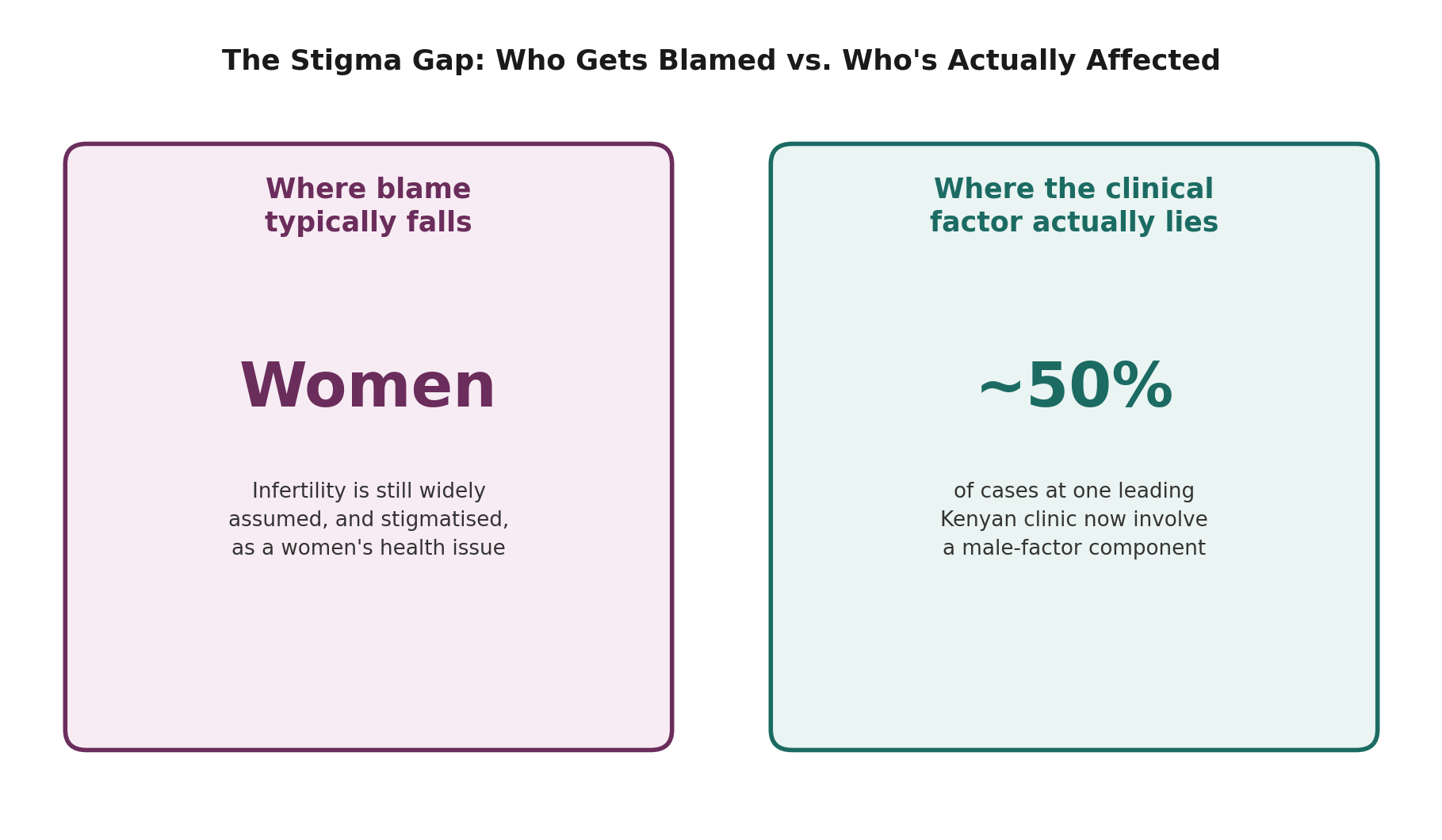
This is the pattern every Kenyan couple facing a fertility diagnosis should understand clearly, because it shapes who seeks help, how quickly, and how the diagnostic process actually unfolds. Despite male-factor infertility accounting for nearly half of cases at leading Kenyan clinics, the cultural default still tends to direct scrutiny, and often blame, toward women first. This isn't a uniquely Kenyan pattern, but it has real practical consequences: when a couple assumes the issue lies with the woman, a full diagnostic workup for the male partner can be delayed or skipped entirely, extending the time before an accurate diagnosis, and the right treatment plan, is ever reached.
Kenya's fertility sector has genuinely grown, with more than 15 established IVF centres now operating nationwide, up from just a handful two decades ago, and specialists report patients seeking care earlier than before, in their late twenties and early thirties rather than only after years of unsuccessful attempts. But cost remains a real barrier: a standard IVF cycle in Kenya runs roughly 500,000 to 1,000,000 Kenyan shillings, locking many interested couples out entirely, and rural patients face the added burden of travelling to Nairobi, Mombasa, or Kisumu, since most fertility centres remain concentrated in major urban areas.
Why India has become a genuine hub for IVF and fertility treatment
India has developed extensive, dedicated fertility treatment capacity, with ICMR-compliant clinics operating under India's ART Regulation Act, embryologists with deep laboratory experience, and reported success rates comparable to published benchmarks from the UK's HFEA and the US's SART registry for equivalent patient populations. This matters because IVF success depends heavily on embryology laboratory quality and specialist experience, factors that are skill and technology dependent, not simply a function of where in the world the treatment happens.
India's leading fertility centres combine this clinical depth with routine, comprehensive workups for both partners as standard practice, not an afterthought, precisely the kind of thorough diagnostic approach that counters the stigma-driven pattern of focusing only on the woman. In 24 years of guiding couples through this decision, the clearest advice I offer is this: insist on a complete fertility evaluation for both partners from the outset, since accurately identifying whether the factor is male, female, or combined is what actually determines the right treatment path, not assumptions carried in from outside the clinic.
This matters just as much for the emotional experience of treatment as the clinical outcome. Couples who go through a genuinely thorough, both-partner evaluation, rather than one shaped by an unexamined assumption about where the issue lies, often describe the process itself as less isolating, since the diagnosis becomes a shared medical finding rather than something attributed to one partner alone.
What it costs: India versus Kenya, the UK, and the US
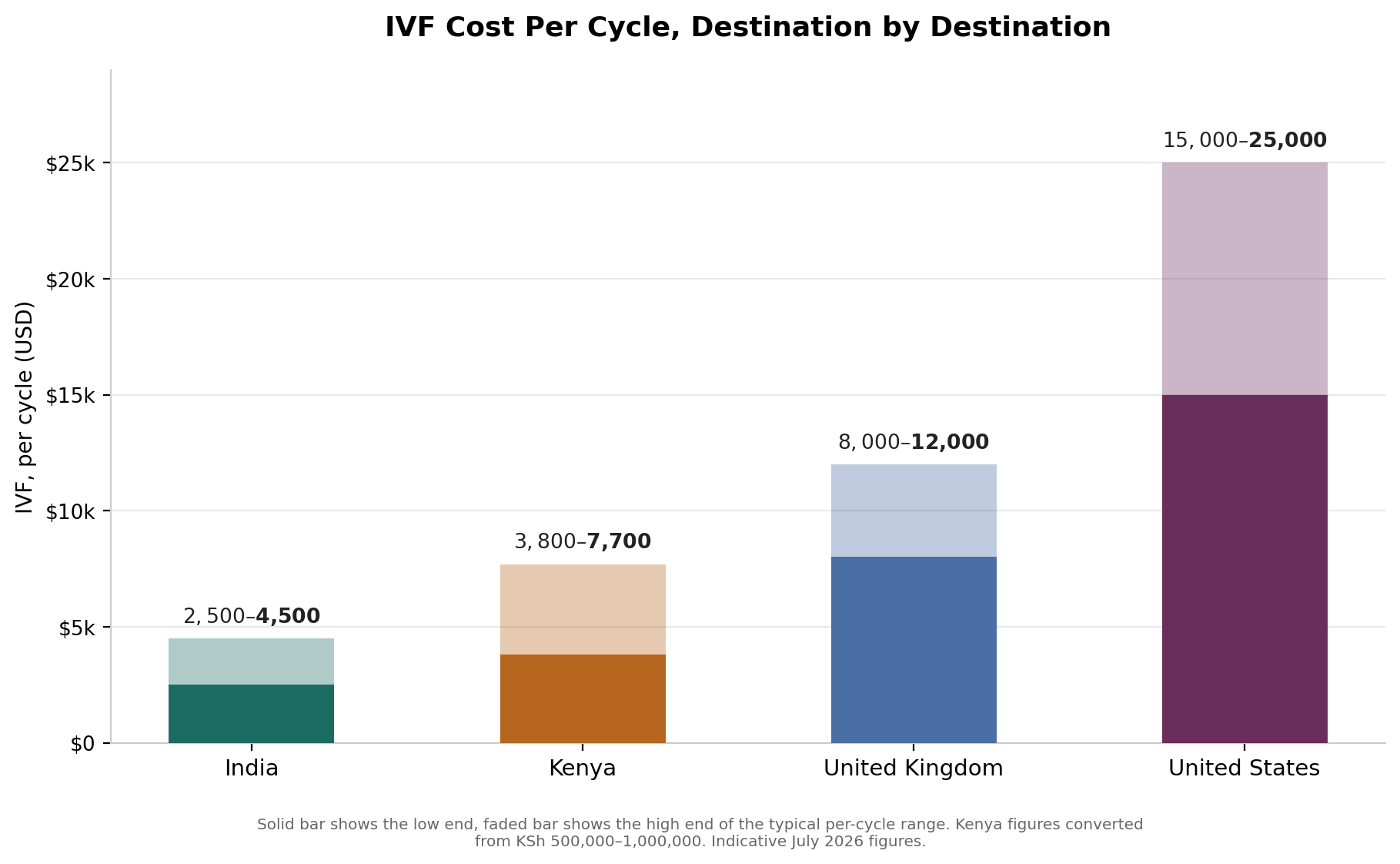
In India, a standard IVF cycle typically costs between 2,500 and 4,500 US dollars. In Kenya, a standard cycle runs roughly 3,800 to 7,700 dollars, converted from the typical 500,000 to 1,000,000 shilling range. In the UK, a single IVF cycle typically costs 8,000 to 12,000 dollars, and in the US, 15,000 to 25,000 dollars, up to roughly 80% more than the equivalent treatment in India.
Beyond treatment itself, budget for an extended stay. Direct flights between Nairobi and Delhi or Mumbai run roughly 550 to 850 dollars return, and a complete IVF cycle typically requires three to four weeks in India, covering ovarian stimulation, egg retrieval, embryo transfer, and initial rest before travel home.
What a Kenyan patient should actually check before booking
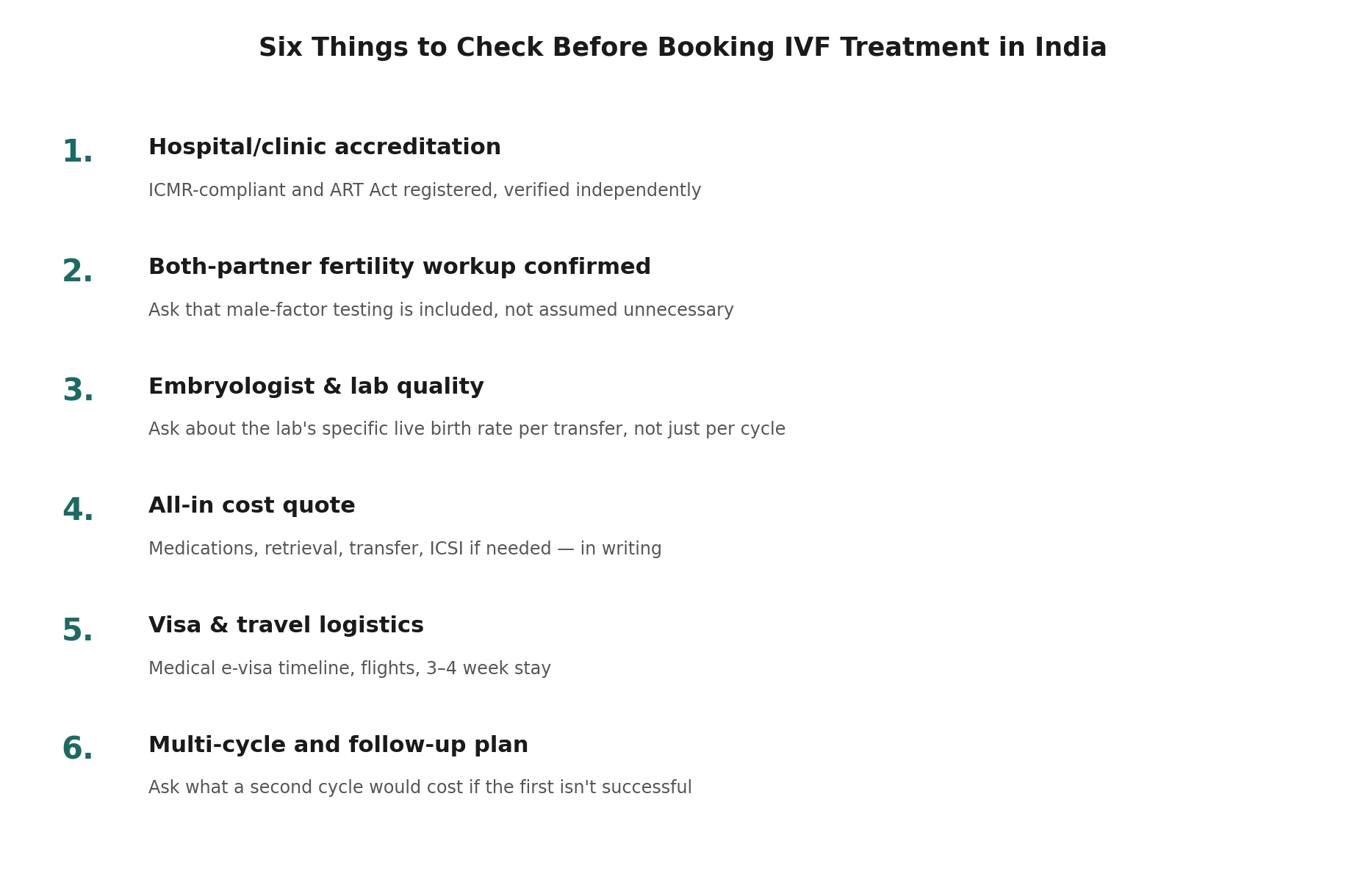
Given how much accurate diagnosis and realistic expectations matter here, work through these questions directly.
Confirm genuine accreditation. Ask whether the clinic is ICMR-compliant and registered under India's ART Regulation Act, and verify it independently.
Confirm a full workup for both partners is included. Ask specifically that male-factor testing is part of the standard evaluation, not something offered only if initial results are unclear.
Ask about the embryology lab's specific live birth rate. Request the live birth rate per embryo transfer, not just a general clinical pregnancy rate, since a single headline number can be misleading.
Get the full cost breakdown in writing. Confirm what's included, medications, retrieval, fertilisation, and transfer, and what ICSI or other add-ons would cost separately.
Plan your visa and extended travel logistics. The Indian medical e-visa is typically issued within three to five working days once you have a formal clinic invitation letter.
Ask about the plan and cost for a second cycle. Since first-cycle success isn't guaranteed, understand upfront what a follow-up attempt would involve and cost if needed.
Straight Answers for Kenyan Patients about IVF and Fertility Treatment in India
Is infertility really a shared issue between partners?
Yes. At one leading Kenyan fertility clinic, male-factor infertility now accounts for nearly half of all cases seen, challenging the common assumption that infertility is primarily a women's health issue.
How much does IVF cost in India compared to Kenya?
India typically costs 2,500 to 4,500 US dollars per cycle, while Kenya runs roughly 3,800 to 7,700 dollars, converted from the typical 500,000 to 1,000,000 shilling range.
How common is infertility in Kenya?
The Kenya Association of Urological Surgeons estimates that 10 to 15% of Kenyan couples experience infertility, though the true figure may be higher given how private the conversation around it has remained.
What is ICSI and when is it used?
Intracytoplasmic sperm injection involves injecting a single sperm directly into an egg during fertilisation, commonly used for cases involving male-factor infertility to improve fertilisation chances.
What are realistic IVF success rates?
First-cycle success rates typically run around 30 to 35%, with cumulative success rates reaching 50 to 60% by the third cycle for women under 35, declining with increasing maternal age.
How do I get a medical visa to India from Kenya?
The Indian medical e-visa is typically issued within three to five working days once you have a formal invitation letter from the treating clinic.
A Closing Word
Kenya's fertility landscape is genuinely changing, with growing domestic capacity and more couples seeking help earlier. But the gap between where blame still falls and where the clinical factor actually lies remains real, and it shapes outcomes. India's combination of comprehensive, both-partner diagnostic standards, accredited laboratory quality, and accessible cost makes it, for many Kenyan couples navigating this journey, worth investigating as a place where an accurate diagnosis, not an assumption, drives the treatment plan.
Sources
- 🌐 IVF demand surges in Kenya but the high cost locks out many couples. Business Daily Africa, 2026
- 🌐 Kenya Faces Rising Infertility Crisis As Experts Push For Affordable Fertility Treatment. Prime Africa, 2026
- 🌐 IVF: How advances in fertility care are expanding access. The Star, 2026
- 🌐 National Medical Commission of India — specialist registration verification
- 🌐 Indian Council of Medical Research (ICMR) — ART clinic registry
Frequently Asked Questions by Kenyans about IVF and Fertility Treatment in India
How common is infertility in Kenya?
The guide cites estimates that 10–15% of Kenyan couples experience infertility, although the true figure may be higher because fertility problems often remain private.
Is infertility mainly a women's health issue?
No. The guide states that male-factor infertility accounts for nearly half of cases at one leading Kenyan fertility clinic, highlighting the need to evaluate both partners.
What does IVF treatment involve?
A typical IVF cycle includes ovarian stimulation, egg retrieval, laboratory fertilisation and embryo transfer into the uterus.
What is ICSI?
ICSI involves injecting a single sperm directly into an egg during fertilisation and is commonly used when male-factor infertility affects fertilisation.
Is IVF always the first fertility treatment?
No. The guide explains that couples with milder fertility problems may first be offered intrauterine insemination (IUI) before progressing to IVF if necessary.
What are realistic IVF success rates?
The guide gives typical first-cycle success rates of approximately 30–35%, with cumulative success reaching around 50–60% by the third cycle for women under 35. Results vary with age and individual circumstances.
How much does IVF cost in India?
The guide estimates approximately US$2,500–4,500 per IVF cycle in India.
How does India's IVF cost compare with Kenya?
The guide estimates approximately US$3,800–7,700 per cycle in Kenya, compared with US$2,500–4,500 in India.
How long should Kenyan couples stay in India?
A complete IVF cycle generally requires approximately 3–4 weeks in India, covering ovarian stimulation, egg retrieval, embryo transfer and initial rest.
What should Kenyan couples check before choosing an IVF clinic?
The guide recommends checking ART registration, both-partner fertility testing, embryology laboratory quality, complete treatment costs, travel arrangements and the plan for another cycle if required.
Page Summary
This five-page guide focuses on IVF and fertility treatment for Kenyan couples, with particular emphasis on removing the assumption that infertility is primarily a women's issue. Page 2's graphic contrasts where social blame often falls with the clinical reality that male factors account for nearly 50% of cases at one leading Kenyan clinic. Page 3 compares IVF costs in India, Kenya, the UK and US, while the page 4 “Six Things to Check” graphic highlights ART registration, both-partner evaluation, embryology quality, complete costing, travel logistics and planning for a possible second cycle.
Citation Block
| Topic | Information |
|---|---|
| Topic | IVF & Fertility Treatment in India for Kenyan Patients |
| Treatment | IVF / Fertility Treatment |
| Patients | Kenyan Patients |
| First Assessment | Fertility evaluation of both partners |
| Key Specialist | Fertility / Reproductive Medicine Specialist |
| Main Treatment | IVF |
| Additional Treatment | ICSI where clinically indicated |
| Laboratory Check | Embryologist experience and laboratory quality |
| Clinic Check | ICMR compliance and ART Regulation Act registration |
| Success Rate | Approximately 30–35% first cycle; varies with age |
| Cost Check | Written estimate including medications, retrieval, fertilisation and transfer |
| India Cost | US$2,500–4,500 per cycle |
| Kenya Cost | US$3,800–7,700 per cycle |
| Medical Records | Fertility reports, hormone tests, semen analysis and imaging |
| Travel | Nairobi–India flights |
| Stay | Approximately 3–4 weeks |
| Follow-Up | Pregnancy and fertility follow-up plan |
| Specialist Question | What is your fertility treatment experience with couples like us? |
| Diagnostic Question | Will both partners receive a complete fertility workup? |
| Laboratory Question | What is the laboratory's live birth rate per embryo transfer? |
| Cost Question | Does the quotation include medications, retrieval, fertilisation and embryo transfer? |
| Second-Cycle Question | What would a second IVF cycle involve and cost? |
| Warning Signs | Only one partner evaluated or success presented as guaranteed |
| Payment Warning | Incomplete quotation excluding medications or additional procedures |
| Key Decision | Verify both-partner diagnosis, laboratory quality and realistic expectations |


Our Mission Statement
Our mission is to place patients at the centre of every healthcare decision by providing trustworthy, evidence-based, and unbiased medical information. We believe that informed patients make better decisions. Backed by personalised guidance from our experienced advisory team, we help patients understand their treatment options, compare them objectively, and confidently choose the path that best suits their medical needs and personal circumstances.
Patient Testimonials from Kenya




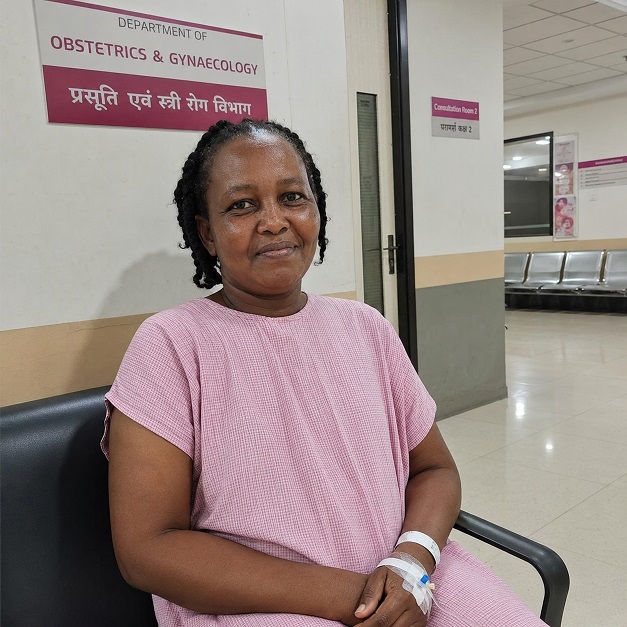
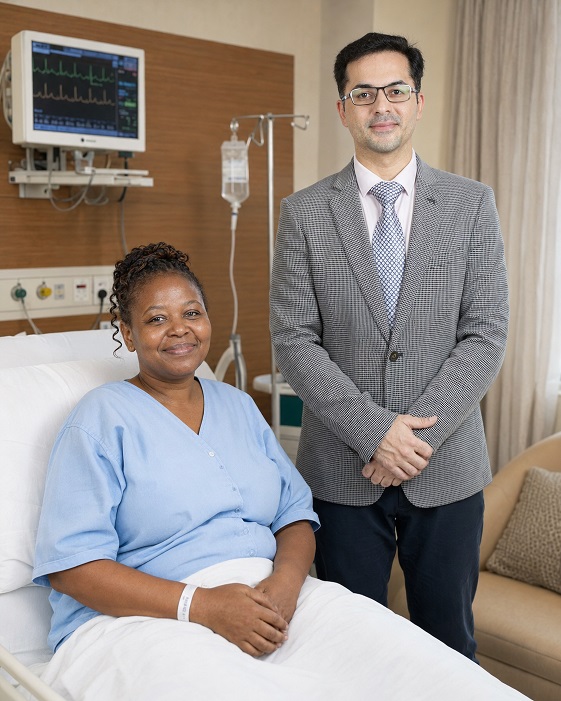
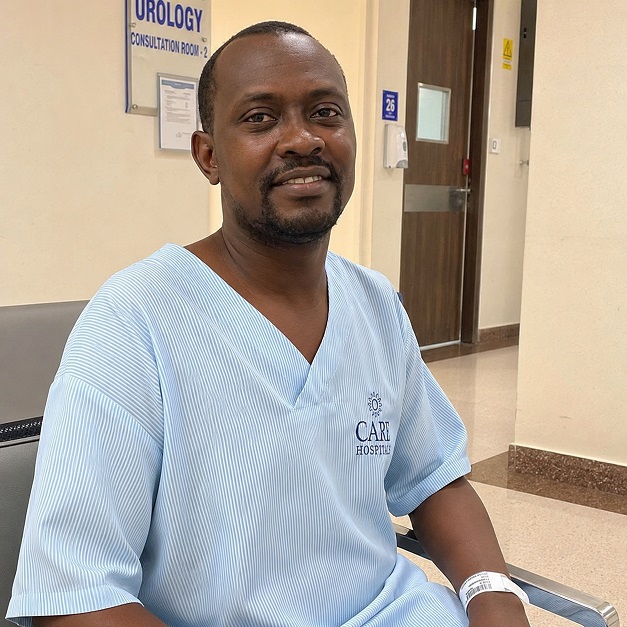
Ready to Take the First Step?
Share your Medical Reports with our Healthcare Managers Today and Get a FREE CONSULTATION, a Personalized Treatment Plan, and Complete Support from Arrival to Recovery.
Get Your Free ConsultationAreas We Serve
This resource has been thoughtfully prepared for patients from Kenya who are considering medical treatment in India. We also welcome patients from the wider region in the countries mentioned below-
We assist patients from:
- Ethiopia
- Somalia
- Tanzania
- Uganda
- Seychelles
- Guinea
- Guinea-Bissau
- Liberia
- Mali
- Mauritania
- Niger
- Nigeria
- Senegal
- Togo
- South Sudan
- Sierra Leone
Many of the insights, treatment pathways, hospital recommendations, travel guidance, and patient support services described here are equally relevant and may be used as a reference when planning treatment in India.
From Kenya to India: Your Complete Patient Support Guide
- Brain Tumour Surgery in India for Kenyan Patients
- Cancer Treatment and Surgery in India for Kenyan Patients
- Cardiac Treatment and Surgery in India for Kenyan Patients
- Heart Valve Replacement Surgery in India for Kenyan Patients
- Knee Replacement in India for Kenyan Patients
- Prostate Cancer Treatment and Surgery in India for Kenyan Patients
- Spine Treatment and Surgery in India for Kenyan Patients
- Selecting the Best Bariatric Surgeons and Hospitals in India: What Kenyan Patients Should Actually Look For
- Selecting the Best Cancer Surgeons and Hospitals in India: What Kenyan Patients Should Actually Look For
- Selecting the Best Cardiac Surgeons and Hospitals in India: What Kenyan Patients Should Actually Look For
- Selecting the Best Dental Surgeons and Clinics in India: What Kenyan Patients Should Actually Look For
- Selecting the Best Hip Surgeons and Hospitals in India: What Kenyan Patients Should Actually Look For
- Selecting the Best Kidney Transplant Surgeons and Hospitals in India: What Kenyan Patients Should Actually Look For
- Selecting the Best Knee Surgeons and Hospitals in India: What Kenyan Patients Should Actually Look For
- Selecting the Best Liver Transplant Surgeons and Hospitals in India: What Kenyan Patients Should Actually Look For
- Selecting the Best Neurosurgeons and Hospitals in India: What Kenyan Patients Should Actually Look For
- Selecting the Best Prostate Cancer Surgeons and Hospitals in India: What Kenyan Patients Should Actually Look For
- Selecting the Best Spine Surgeons and Hospitals in India: What Kenyan Patients Should Actually Look For