

Hip Surgery in India for Kenyans?
What hip surgery in India involves for a Kenyan patient — implant choice, surgeon volume, how soon you walk again, and the full cost compared with home.
If you or a family member has been told you need hip surgery, the question of where to have it done is not a small one. It affects how much you pay, how soon you can walk normally again, and, over the following decades, how well that new joint holds up. Across 24 years of guiding Kenyan patients through treatment in India, hip surgery is one of the procedures I'm asked about most often, and the honest answer to "should I go to India?" depends on understanding a few things clearly first. This article explains what hip surgery involves, why it matters more than usual to get this specific procedure right, what it costs in India compared with Kenya and Western countries, and the practical factors a Kenyan patient should genuinely weigh before booking.
Healing Journeys of Kenyan Patients








Key Takeaways
- The guide explains that total hip replacement replaces the damaged ball-and-socket surfaces with an artificial joint and is one of the most reliably successful modern orthopaedic procedures. A well-positioned implant can last 15–25 years or more, but implant selection becomes particularly important for younger patients who may need the joint to function for several decades.
- A major concern for Kenyan patients is avascular necrosis associated with sickle cell disease. The guide notes that sickle cell disease affects an estimated 14,000 Kenyan newborns each year, with prevalence of the sickle cell gene reaching 18% in some communities. Avascular necrosis can damage the hip at a much younger age than ordinary wear-and-tear arthritis and may affect both hips.
- The page 2 graphic illustrates this age difference, showing typical hip surgery around 68 years for age-related osteoarthritis compared with approximately 35 years for sickle-cell-related avascular necrosis. This makes younger-patient experience, durable implant selection and appropriate perioperative management particularly important.
- India performs hip replacement surgery at substantial volume, with leading orthopaedic centres offering modern ceramic, metal and advanced plastic bearing surfaces, as well as cemented and uncemented fixation. The guide recommends choosing a surgeon with genuine experience in younger patients and avascular necrosis rather than relying only on general hospital reputation.
- For patients with sickle cell disease, the guide specifically recommends confirming that the surgical and anaesthesia team has experience managing sickle cell patients, including appropriate hydration, oxygen monitoring and transfusion planning where clinically required. These precautions are important because the physiological stress of surgery can trigger a sickle cell crisis.
- The guide estimates a single hip replacement at US$4,500–12,000 in India, compared with US$6,000–18,000 privately in Kenya, US$20,000–40,000 in the UK and US$40,000–75,000 in the US. The page 3 cost chart shows India as the lowest-cost destination among the four compared. Patients should generally plan for approximately 2–3 weeks in India for assessment, surgery and early monitored recovery.
- The page 4 “Six Things to Check” graphic highlights hospital accreditation, the surgeon's annual hip-replacement volume, a complete cost quotation, visa and travel planning, realistic length of stay and a follow-up plan in Kenya. Kenyan patients should also clarify what happens financially if complications require an extended hospital stay.
Quick Facts
- Author
- Dr. Dheeraj Bojwani
- Experience
- 24+ Years
- Treatment
- Hip Surgery / Total Hip Replacement
- Patients
- Kenyan Patients
- First Assessment
- Hip damage, cause, age and activity level
- Key Specialist
- Orthopaedic Hip Replacement Surgeon
- Main Condition
- Avascular necrosis and hip osteoarthritis
- Implant Options
- Ceramic, metal and advanced plastic bearing surfaces
- Fixation
- Cemented or uncemented
- Case Volume
- Hip replacements performed annually
- Hospital Check
- JCI / NABH accreditation
- Sickle Cell Check
- Experienced surgical and anaesthesia team
- Cost Check
- Written estimate covering implant, surgery, hospital stay and physiotherapy
- India Cost
- US$4,500–12,000
- Kenya Private Cost
- US$6,000–18,000
- Medical Records
- Hip imaging and relevant medical reports
- Visa
- Indian medical e-visa with hospital invitation
- Travel
- Nairobi–India flights
- Stay
- Approximately 2–3 weeks
- Follow-Up
- Physiotherapy and orthopaedic monitoring in Kenya
- Communication
- Clear treatment and travel coordination
- Key Warning
- Surgeon has limited experience with younger patients or avascular necrosis
- Decision Principle
- Prioritise hip-specific surgical experience, appropriate implant selection and safe long-term follow-up.
In Brief
For Kenyan patients considering hip surgery in India, the key priorities are surgeon experience with the specific hip condition, appropriate implant selection and a safe perioperative plan. Younger patients with sickle-cell-related avascular necrosis should specifically verify the team's experience with both hip replacement and sickle cell management, while all patients should obtain a complete cost quotation and arrange postoperative physiotherapy and follow-up in Kenya.
What hip surgery actually is
The hip is a ball-and-socket joint: the rounded top of your thighbone sits inside a curved socket in your pelvis, cushioned by cartilage that allows smooth, pain-free movement. When that cartilage wears away, from age, injury, or a condition that damages the bone directly, the result is pain, stiffness, and a joint that no longer moves the way it should. Total hip replacement removes the damaged surfaces and replaces them with an artificial ball and socket, usually made of metal, ceramic, or a combination with medical-grade plastic. It's one of the most reliably successful operations in modern medicine, and a well-placed implant can last fifteen to twenty-five years or more.
Why this matters differently for Kenyan patients
Most public information about hip replacement assumes an older patient, someone in their sixties or seventies whose joint has simply worn out over a long life. That's true for many Kenyan patients too. But a significant number arrive at this surgery decades earlier, for a reason specific to this part of the world.
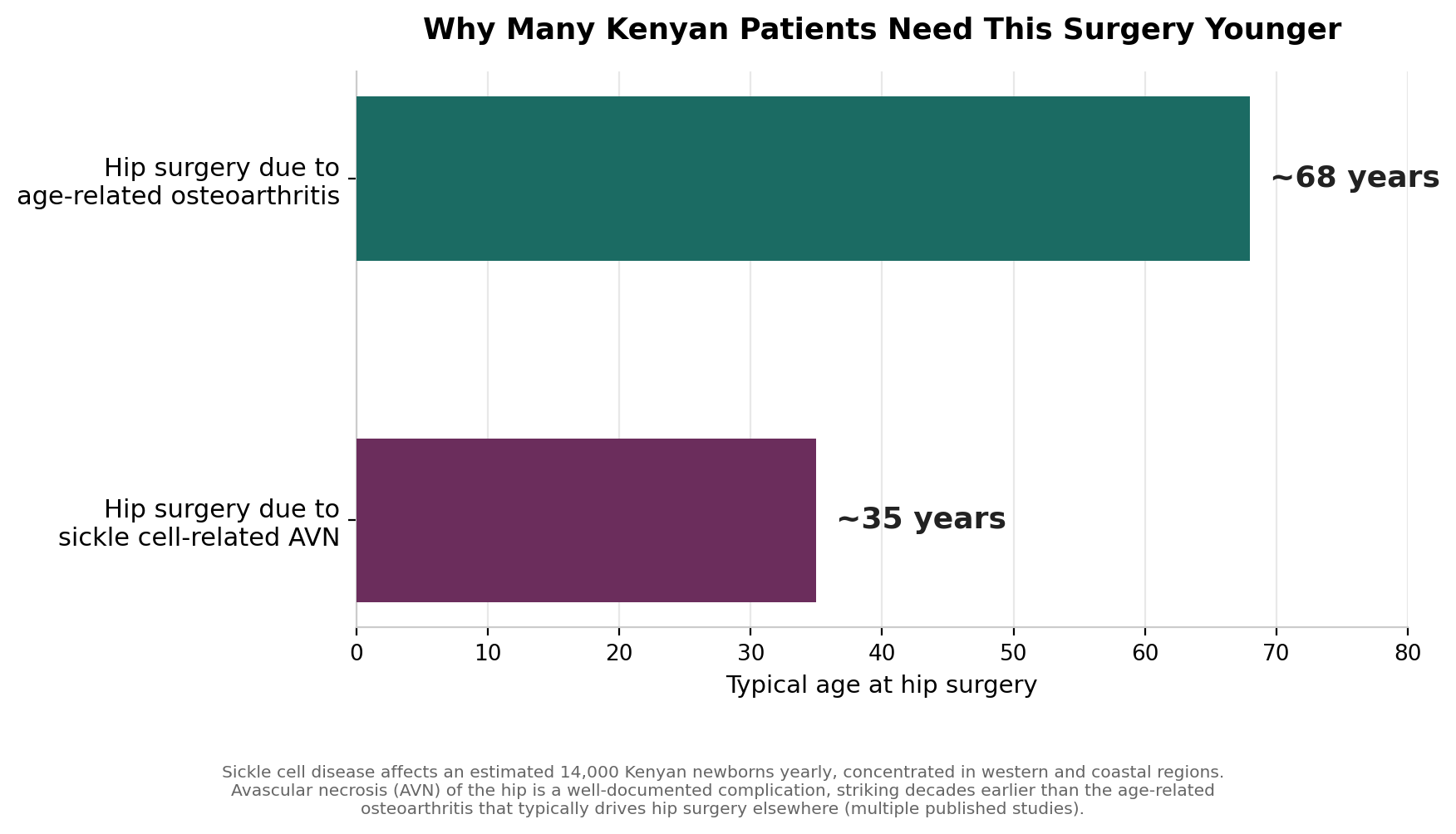
Sickle cell disease affects an estimated 14,000 Kenyan newborns every year, with the heaviest burden in western Kenya and along the coast, where the prevalence of the sickle cell gene can reach 18% in some communities. One of the disease's well-documented complications is avascular necrosis of the hip: sickled blood cells repeatedly block the small vessels supplying the femoral head, and over time the bone tissue dies and the joint surface collapses. Unlike ordinary wear-and-tear arthritis, this process strikes young, often in patients' twenties and thirties, and often in both hips at once.
This matters practically. A hip implant placed in a 25-year-old needs to keep working for potentially fifty years, a genuinely different engineering and surgical challenge than one placed in someone twice that age. It calls for a surgical team with real experience in younger patients, careful implant selection built for decades of use rather than fifteen years, and, specifically for sickle cell patients, precise perioperative management, since the physical stress of surgery can trigger a sickle cell crisis if not properly managed with hydration, oxygen support, and sometimes a blood transfusion beforehand.
Why India has become the go-to destination for this surgery
India performs one of the highest volumes of hip replacement surgery anywhere in the world, and that scale matters more than it might seem. Surgeons at India's leading orthopaedic centres routinely perform hundreds of these operations each year, a level of repetition that translates directly into fewer complications and more consistent long- term results. Many have specific experience with younger patients and avascular necrosis, exactly the profile many Kenyan patients present with.
India's top hospitals hold JCI and NABH accreditation, the same international safety standards recognised in the UK and US, and stock the full range of modern implants, ceramic, metal, and advanced plastic bearing surfaces, cemented and uncemented fixation, so your surgeon can genuinely match the implant to your age and activity level rather than being limited to what's on hand. Scheduling is typically fast, often within days of a decision being made, without the long waiting lists that affect many public health systems. Put together, that combination of surgical volume, accreditation, implant choice, and speed, at a fraction of what the same standard of care costs in the West, is difficult to find anywhere else.
What it costs: India versus Kenya, the UK, and the US
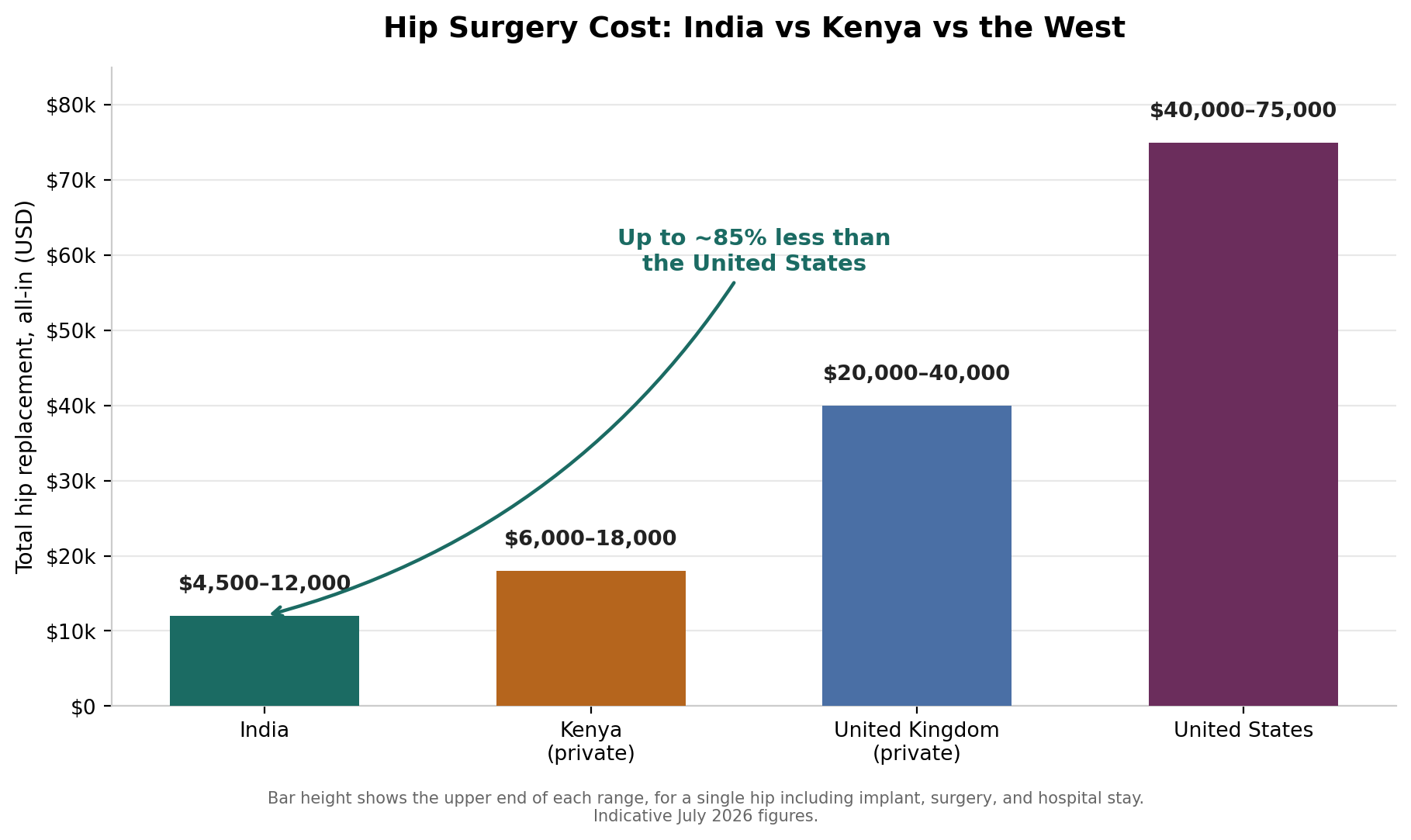
Cost is usually the first question, and it's a fair one. In India, JCI and NABH accredited hospitals typically charge between 4,500 and 12,000 US dollars for a single hip replacement, covering the implant, surgery, and hospital stay. The same procedure privately in Kenya runs roughly 6,000 to 18,000 dollars, meaning India is often genuinely cheaper than the local private option while offering greater surgical volume and implant choice. In the UK, private hip replacement typically costs 20,000 to 40,000 dollars, and in the US, 40,000 to 75,000 dollars, up to roughly 85% more than the same surgery in India. If both hips need replacing, expect the total to run 60 to 80% higher than a single hip, though many surgeons prefer to stage the two sides some weeks apart rather than operating on both at once.
Beyond the surgery itself, budget for travel. Direct flights between Nairobi and Delhi or Mumbai run roughly 550 to 850 dollars return, and most patients should plan on two to three weeks in India to cover the surgery and the early, most closely monitored phase of recovery before travelling home.
What a Kenyan patient should actually check before booking
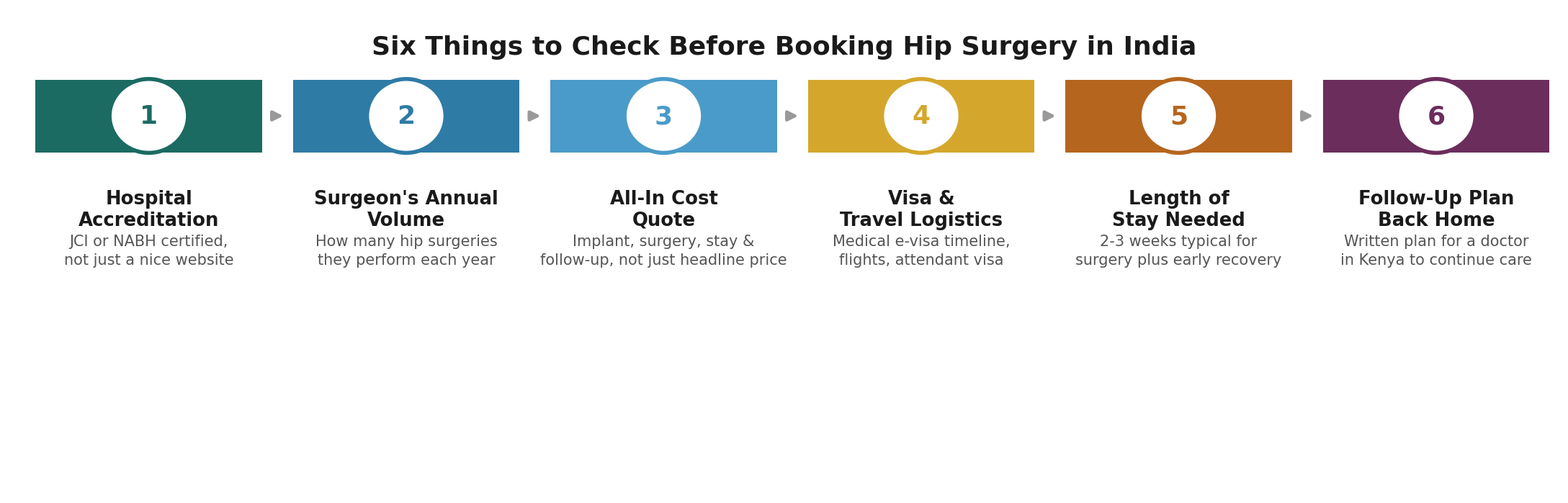
Price alone is not enough information to make this decision well. Before committing to a hospital or surgeon, it's worth working through a short list of practical questions.
Confirm genuine accreditation. Ask specifically whether the hospital holds JCI or NABH certification, and verify it independently rather than taking a brochure's word for it. This is the baseline filter for safety and infection control standards.
Ask about the surgeon's actual experience. A specific number, how many hip replacements they personally perform each year, and how many of those involve younger patients or avascular necrosis if that's your situation, tells you far more than a general reputation. In 24 years of watching patients make this decision, the ones who ask this question directly, and get a specific number in reply, are consistently the ones who end up satisfied with their outcome.
Get the full cost breakdown in writing. Make sure the quote states clearly what's included: the implant itself, the surgery, the hospital stay, and any physiotherapy sessions, and what would happen, and cost, if a complication requires an extended stay.
Plan your visa and travel timeline. The Indian medical e-visa is generally issued within three to five working days once you have a hospital's formal invitation letter, and an attendant can usually travel with you on a linked medical attendant visa, worth arranging in advance if a family member is accompanying you.
Understand the realistic length of stay. Most hip replacement patients need roughly two to three weeks in India, covering pre-operative assessment, the surgery itself, and enough recovery time to be cleared for the flight home safely.
Arrange your follow-up plan before you leave. Physiotherapy in the weeks after surgery genuinely determines how well you recover, and you'll need a written plan for what continues once you're home, along with a doctor in Kenya who can pick up monitoring and manage the early follow-up period.
For patients with sickle cell disease specifically , raise this directly and early. Confirm the surgical and anaesthesia team has explicit experience managing sickle cell patients through surgery, and ask what specific precautions, hydration protocols, oxygen monitoring, transfusion planning, will be in place.
Straight Answers for Kenyan Patients about Hip Surgery in India
How much cheaper is hip surgery in India compared to the US?
India typically costs 4,500 to 12,000 US dollars for a single hip replacement, against 40,000 to 75,000 dollars in the US, a saving of up to roughly 85%, without compromising on accreditation or implant quality.
Why do young Kenyan patients often need hip surgery?
Sickle cell disease, which affects an estimated 14,000 Kenyan newborns annually, commonly causes avascular necrosis of the hip, a complication that typically requires surgery in patients' twenties or thirties, decades earlier than typical age-related arthritis.
Is India safe for a Kenyan patient with sickle cell disease to have hip surgery?
Yes, provided the surgical and anaesthesia team has explicit experience managing sickle cell patients, with proper hydration, oxygen monitoring, and transfusion planning in place to reduce the risk of triggering a crisis during surgery.
How long do I need to stay in India for hip surgery?
Most patients plan on two to three weeks, covering pre-operative assessment, the surgery itself, and the early recovery period before being cleared to fly home.
What should be included in a hip surgery cost quote from India?
A complete quote should state the implant cost, surgical fees, hospital stay, and physiotherapy sessions clearly, along with what additional costs would apply if a complication extends your stay.
How do I get a medical visa to India from Kenya?
The Indian medical e-visa is typically issued within three to five working days once you have a formal invitation letter from the treating hospital, and an accompanying attendant can usually apply for a linked medical attendant visa.
A Closing Word
Hip surgery is not an emergency decision, but it also isn't one to delay indefinitely once conservative treatment has stopped working, particularly for younger patients whose pain is already limiting daily life. India offers a combination of surgical volume, accredited safety standards, full implant choice, and cost that makes it, for the great majority of Kenyan patients I've guided through this decision, the clearest starting point to investigate. Ask the right questions, get everything in writing, and arrange your follow-up care before you travel, and this becomes one of the more straightforward and successful medical journeys a patient can make.
Sources
- 🌐 Building a Comprehensive Sickle Cell Disease Program in Western Kenya: A Decade of Experience and Growth. Annals of Global Health
- 🌐 High acceptability of newborn screening for sickle cell disease among post-natal mothers in Western Kenya. PLOS One. jour
- 🌐 Total Hip Replacement in Sickle Cell Disease Patients with Avascular Necrosis of Head of Femur
- 🌐 National Medical Commission of India — surgeon and specialist registration verification
- 🌐 National Accreditation Board for Hospitals & Healthcare Providers (NABH) — accredited hospital directory
Frequently Asked Questions by Kenyans about Hip Surgery in India
Why do some Kenyan patients need hip surgery at a younger age?
The guide highlights sickle-cell-related avascular necrosis, which can damage the hip in patients in their twenties and thirties rather than the later age typical of ordinary osteoarthritis.
How common is sickle cell disease in Kenya?
The guide states that sickle cell disease affects an estimated 14,000 Kenyan newborns annually, with a particularly heavy burden in western Kenya and coastal areas.
What is avascular necrosis of the hip?
It occurs when the blood supply to the femoral head is repeatedly disrupted, causing bone tissue to die and eventually collapse, damaging the hip joint.
How long can a hip replacement last?
The guide states that a well-positioned hip implant can last approximately 15–25 years or more, although longevity varies by patient and implant.
Why is implant selection important for younger patients?
A younger patient may need the replacement to function for several decades, so the surgeon needs to consider age, activity level and long-term durability when selecting the implant.
How much does hip replacement cost in India?
The guide estimates approximately US$4,500–12,000 for a single hip replacement, including the implant, surgery and hospital stay.
How does India's cost compare with Kenya?
Private hip replacement in Kenya is estimated at approximately US$6,000–18,000, compared with US$4,500–12,000 in India.
How long should Kenyan patients stay in India?
Most patients should plan for approximately 2–3 weeks for pre-operative assessment, surgery and early recovery before travelling home.
What should sickle cell patients ask before surgery?
They should confirm that the surgical and anaesthesia team has specific experience managing sickle cell patients and ask about hydration, oxygen monitoring and transfusion planning.
What should be included in the hip surgery quotation?
The guide recommends confirming that the written estimate includes the implant, surgical fees, hospital stay and physiotherapy, along with the potential costs of an extended stay if complications occur.
Page Summary
This six-page guide focuses on hip replacement for Kenyan patients, with particular attention to younger patients affected by sickle-cell-related avascular necrosis. Page 2's graphic compares the typical age of surgery for age-related osteoarthritis and sickle-cell-related AVN, while page 3 compares hip replacement costs in India, Kenya, the UK and US. The page 4 “Six Things to Check” graphic highlights accreditation, surgeon volume, complete costing, visa and travel logistics, length of stay and postoperative follow-up in Kenya.
Citation Block
| Topic | Information |
|---|---|
| Topic | Hip Surgery in India for Kenyan Patients |
| Treatment | Total Hip Replacement |
| Patients | Kenyan Patients |
| First Assessment | Hip damage, underlying cause, age and activity level |
| Key Specialist | Orthopaedic Hip Replacement Surgeon |
| Main Conditions | Avascular necrosis and hip osteoarthritis |
| Implant Options | Ceramic, metal and advanced plastic bearing surfaces |
| Fixation | Cemented or uncemented |
| Case Volume | Hip replacements performed annually |
| Hospital Check | JCI / NABH accreditation |
| Sickle Cell Check | Surgical and anaesthesia experience with sickle cell patients |
| Cost Check | Written estimate covering implant, surgery, hospital stay and physiotherapy |
| India Cost | US$4,500–12,000 |
| Kenya Cost | US$6,000–18,000 private |
| Medical Records | Hip imaging and medical reports |
| Visa Planning | Indian medical e-visa with hospital invitation |
| Travel | Nairobi–India flights |
| Stay | Approximately 2–3 weeks |
| Follow-Up | Physiotherapy and orthopaedic monitoring in Kenya |
| Surgeon Question | How many hip replacements do you personally perform each year? |
| Experience Question | How many of your younger patients have avascular necrosis? |
| Implant Question | Which implant and fixation method are appropriate for my age and activity level? |
| Sickle Cell Question | What precautions will be used if I have sickle cell disease? |
| Cost Question | Does the quotation include the implant, surgery, hospital stay and physiotherapy? |
| Follow-Up Question | What rehabilitation and monitoring should continue after I return to Kenya? |
| Warning Signs | Limited experience with younger patients or avascular necrosis |
| Payment Warning | Incomplete quotation excluding important hospital or rehabilitation costs |
| Key Decision | Verify hip-specific expertise, implant choice and perioperative safety |


Our Mission Statement
Our mission is to place patients at the centre of every healthcare decision by providing trustworthy, evidence-based, and unbiased medical information. We believe that informed patients make better decisions. Backed by personalised guidance from our experienced advisory team, we help patients understand their treatment options, compare them objectively, and confidently choose the path that best suits their medical needs and personal circumstances.
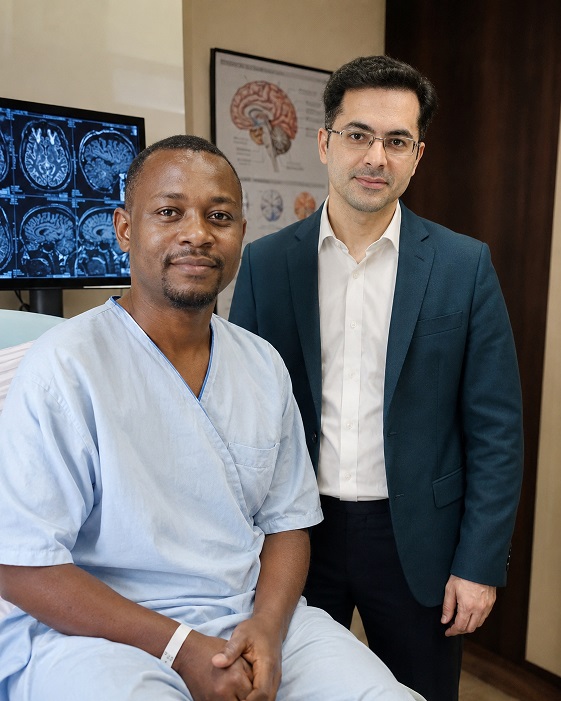
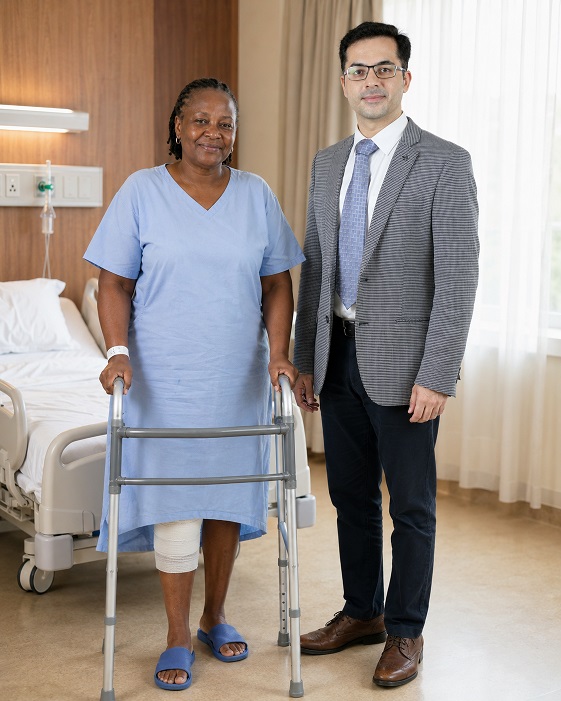
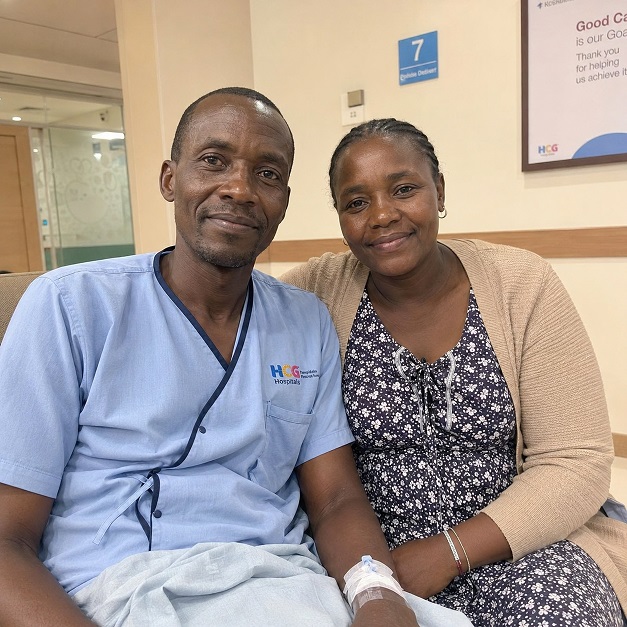
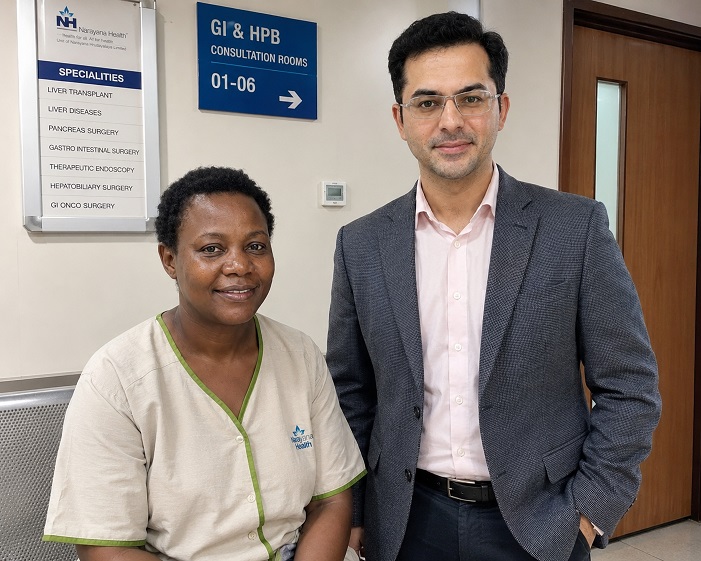
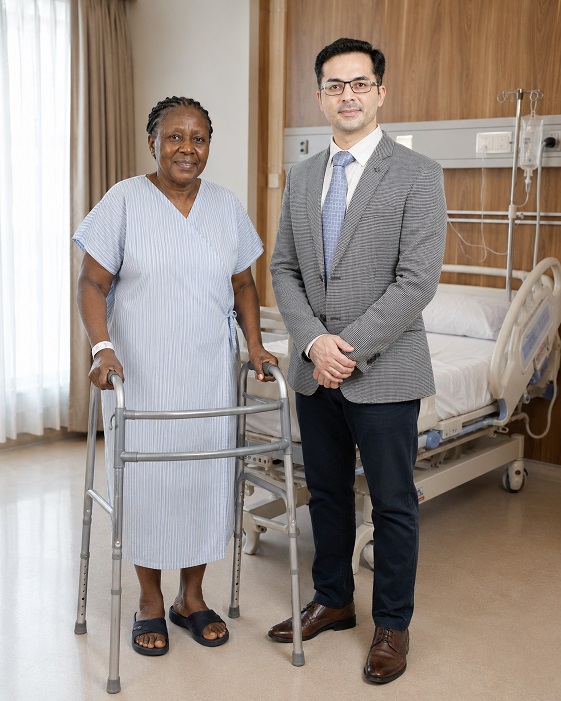
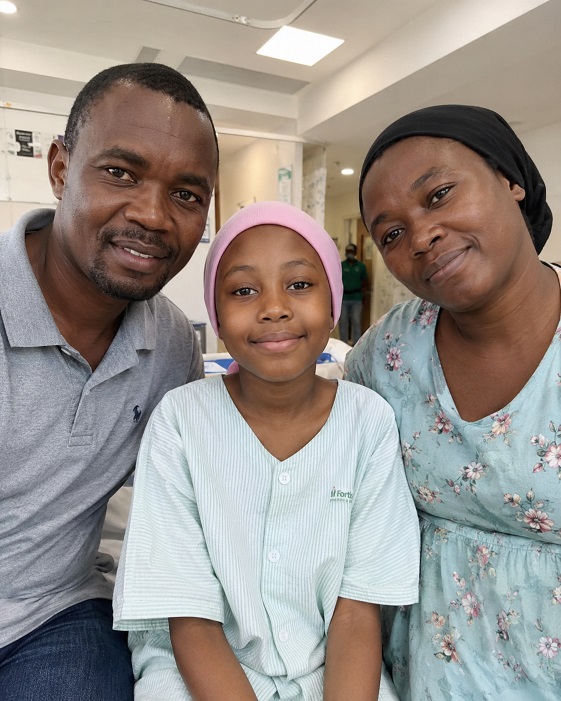
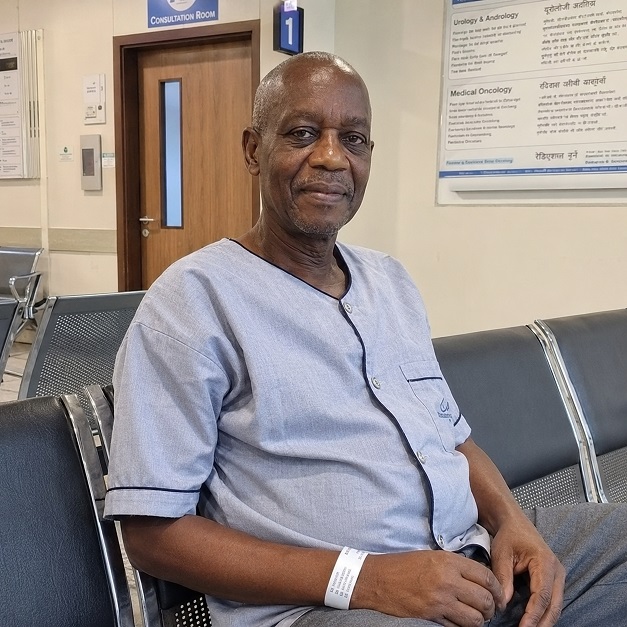
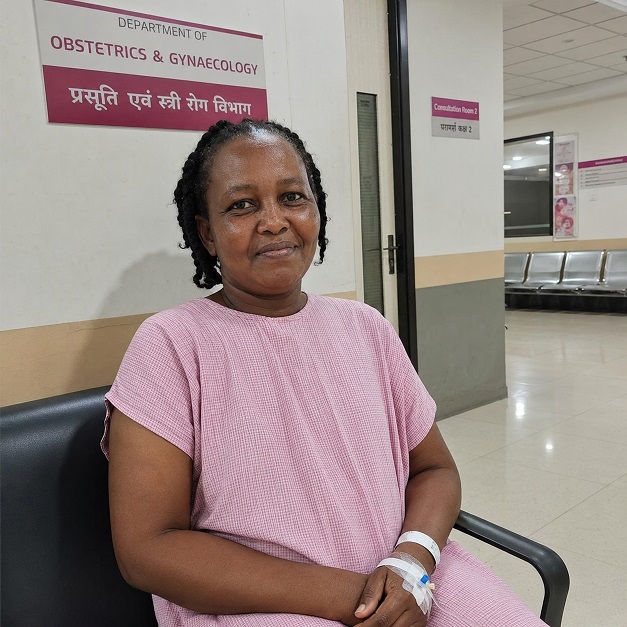
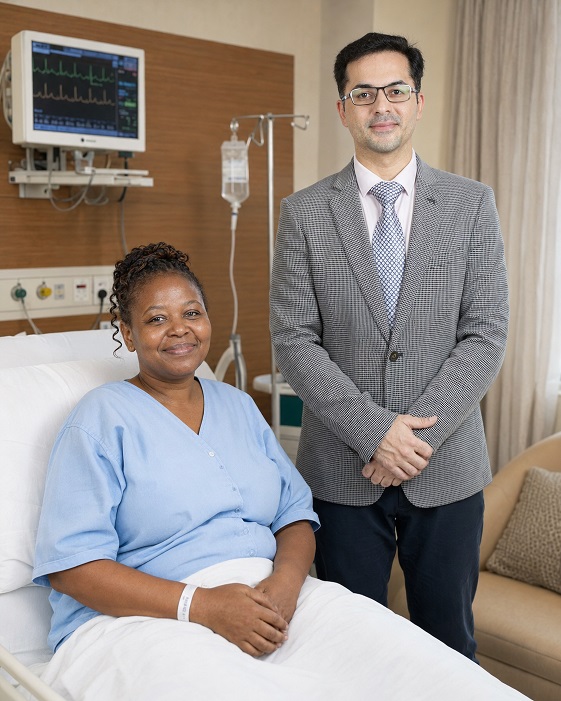
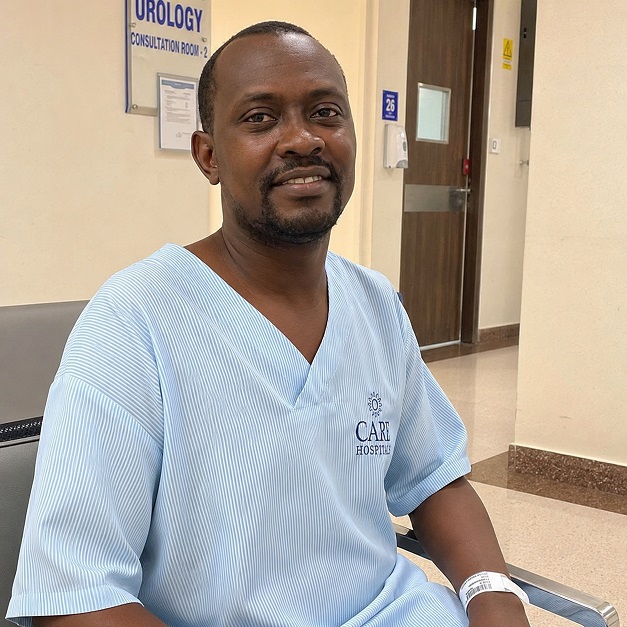
Patient Testimonials from Kenya


Ready to Take the First Step?
Share your Medical Reports with our Healthcare Managers Today and Get a FREE CONSULTATION, a Personalized Treatment Plan, and Complete Support from Arrival to Recovery.
Get Your Free ConsultationAreas We Serve
This resource has been thoughtfully prepared for patients from Kenya who are considering medical treatment in India. We also welcome patients from the wider region in the countries mentioned below-
We assist patients from:
- Ethiopia
- Somalia
- Tanzania
- Uganda
- Seychelles
- Guinea
- Guinea-Bissau
- Liberia
- Mali
- Mauritania
- Niger
- Nigeria
- Senegal
- Togo
- South Sudan
- Sierra Leone
Many of the insights, treatment pathways, hospital recommendations, travel guidance, and patient support services described here are equally relevant and may be used as a reference when planning treatment in India.
From Kenya to India: Your Complete Patient Support Guide
- Brain Tumour Surgery in India for Kenyan Patients
- Cancer Treatment and Surgery in India for Kenyan Patients
- Cardiac Treatment and Surgery in India for Kenyan Patients
- Heart Valve Replacement Surgery in India for Kenyan Patients
- Knee Replacement in India for Kenyan Patients
- Prostate Cancer Treatment and Surgery in India for Kenyan Patients
- Spine Treatment and Surgery in India for Kenyan Patients
- Selecting the Best Bariatric Surgeons and Hospitals in India: What Kenyan Patients Should Actually Look For
- Selecting the Best Cancer Surgeons and Hospitals in India: What Kenyan Patients Should Actually Look For
- Selecting the Best Cardiac Surgeons and Hospitals in India: What Kenyan Patients Should Actually Look For
- Selecting the Best Dental Surgeons and Clinics in India: What Kenyan Patients Should Actually Look For
- Selecting the Best Hip Surgeons and Hospitals in India: What Kenyan Patients Should Actually Look For
- Selecting the Best Kidney Transplant Surgeons and Hospitals in India: What Kenyan Patients Should Actually Look For
- Selecting the Best Knee Surgeons and Hospitals in India: What Kenyan Patients Should Actually Look For
- Selecting the Best Liver Transplant Surgeons and Hospitals in India: What Kenyan Patients Should Actually Look For
- Selecting the Best Neurosurgeons and Hospitals in India: What Kenyan Patients Should Actually Look For
- Selecting the Best Prostate Cancer Surgeons and Hospitals in India: What Kenyan Patients Should Actually Look For
- Selecting the Best Spine Surgeons and Hospitals in India: What Kenyan Patients Should Actually Look For