

Gamma Knife Treatment in India for Kenyan Patients
Gamma Knife is unavailable anywhere in Africa: what the treatment involves for a Kenyan patient, which conditions it suits, and what it costs in India.
Gamma Knife radiosurgery is widely considered the gold standard treatment for brain metastases and several other neurological conditions, precise enough to treat lesions deep inside the brain without a single incision. It's also, as of today, a technology that doesn't exist anywhere on the African continent. Across 24 years of guiding Kenyan patients through treatment in India, this is one of the clearest examples in this series of a genuinely superior treatment that simply isn't accessible closer to home, for reasons that have nothing to do with the specific hospital or doctor a Kenyan patient happens to consult. This article explains what Gamma Knife treatment involves, why it remains completely unavailable across Africa, what treatment costs in India compared with Western countries, and the practical factors to weigh before deciding where to seek care.
Healing Journeys of Kenyan Patients


Key Takeaways
- The guide explains that Gamma Knife is a form of stereotactic radiosurgery that treats brain lesions without a surgical incision. Precisely focused gamma radiation is delivered from multiple angles to target the lesion while limiting exposure to surrounding healthy brain tissue. It can be used for brain metastases, selected brain tumours, arteriovenous malformations, trigeminal neuralgia and certain tremor conditions.
- A major consideration for Kenyan patients is that true Gamma Knife technology remains unavailable across Africa. The guide cites a continent-wide survey identifying three CyberKnife machines—two in Egypt and one in Kenya—but no true Gamma Knife systems. This makes international treatment an important consideration for patients who specifically require or may benefit from Gamma Knife.
- India has several dedicated Gamma Knife centres supported by neurosurgeons, radiation oncologists and medical physicists. The guide stresses that equipment alone is not enough; sustained experience and multidisciplinary planning are important when assessing a centre. JCI and NABH accreditation should also be independently verified.
- Gamma Knife is not automatically appropriate for every patient. The guide states that it works best for smaller, well-defined lesions, while very large tumours or certain lesion characteristics may require open surgery or another radiosurgery technique. Patients should therefore obtain an imaging-based assessment before finalising treatment.
- The guide estimates Gamma Knife treatment at US$4,500–8,500 in India, compared with approximately US$30,000–50,000 in both the UK and US. Gamma Knife is not domestically available in Kenya. The page 3 cost chart visually highlights this difference between India and Western treatment destinations.
- Most Gamma Knife treatments are completed in one session, with many patients able to resume normal activities within a day or two. However, the therapeutic effect develops gradually over weeks to months, and some larger tumours or AVMs may require more than one treatment session.
- The page 4 “Six Things to Check” graphic highlights hospital accreditation, confirmation that Gamma Knife genuinely suits the patient's condition, radiosurgery-team experience with the exact diagnosis, a complete written quotation, visa and travel planning, and a follow-up imaging plan. Kenyan patients should also arrange a doctor in Kenya who can review follow-up results after returning home.
Quick Facts
- Author
- Dr. Dheeraj Bojwani
- Experience
- 24+ Years
- Treatment
- Gamma Knife Stereotactic Radiosurgery
- Patients
- Kenyan Patients
- First Assessment
- Lesion type, size, location and imaging
- Key Specialist
- Neurosurgeon / Radiation Oncologist
- Technology
- Gamma Knife radiosurgery
- Main Conditions
- Brain metastases, selected brain tumours, AVMs and trigeminal neuralgia
- Treatment Sessions
- Usually one session
- Case Volume
- Experience with the patient's exact condition
- Hospital Check
- JCI / NABH accreditation
- Suitability Check
- Imaging-based assessment
- Cost Check
- Written estimate covering planning, treatment and follow-up
- India Cost
- US$4,500–8,500
- Kenya Availability
- True Gamma Knife unavailable domestically
- Medical Records
- MRI and relevant medical reports
- Visa
- Indian medical e-visa with hospital invitation
- Travel
- Nairobi–India flights
- Stay
- Approximately 7–14 days
- Follow-Up
- Written imaging follow-up plan
- Communication
- Clear treatment and travel coordination
- Key Warning
- Gamma Knife recommended without explaining why it is appropriate for the specific lesion
- Decision Principle
- Prioritise verified Gamma Knife capability, condition-specific expertise and appropriate treatment selection.
In Brief
For Kenyan patients considering Gamma Knife treatment in India, the key priorities are confirming that Gamma Knife is appropriate for the specific lesion, verifying genuine hospital accreditation and checking the radiosurgery team's experience with the exact condition. Patients should obtain a complete written treatment quotation and arrange follow-up imaging with a doctor in Kenya before travelling.
What Gamma Knife treatment actually involves
Gamma Knife is a form of stereotactic radiosurgery that uses precisely focused beams of gamma radiation, converging from multiple angles, to treat lesions inside the brain without any surgical incision. Despite the name, no cutting is involved; the "surgical" precision comes from how tightly the radiation beams converge on the target, delivering a therapeutic dose to the lesion while sparing the surrounding healthy brain tissue almost entirely.
It's used to treat a range of conditions: brain metastases, tumours that have spread to the brain from cancer elsewhere in the body; certain primary brain tumours like meningiomas and acoustic neuromas; arteriovenous malformations, abnormal tangles of blood vessels that carry a risk of dangerous bleeding; trigeminal neuralgia, a severe facial pain condition; and select cases of tremor from Parkinson's disease or essential tremor. Treatment is typically completed in a single session, sometimes with the head held still by a lightweight frame or precision mask, and most patients resume normal activities within a day or two, with the treatment's full effect developing gradually over the following weeks to months.
What makes Gamma Knife particularly valuable is its usefulness in situations where conventional surgery would be genuinely risky or impossible: lesions deep inside the brain, close to structures controlling speech, movement, or vital functions, where open surgical access could cause serious harm. For these specific cases, the choice often isn't between Gamma Knife and surgery, it's between Gamma Knife and no treatment at all, which is part of why access to this technology carries such weight for the patients who need it.
Why Gamma Knife remains completely unavailable across Africa
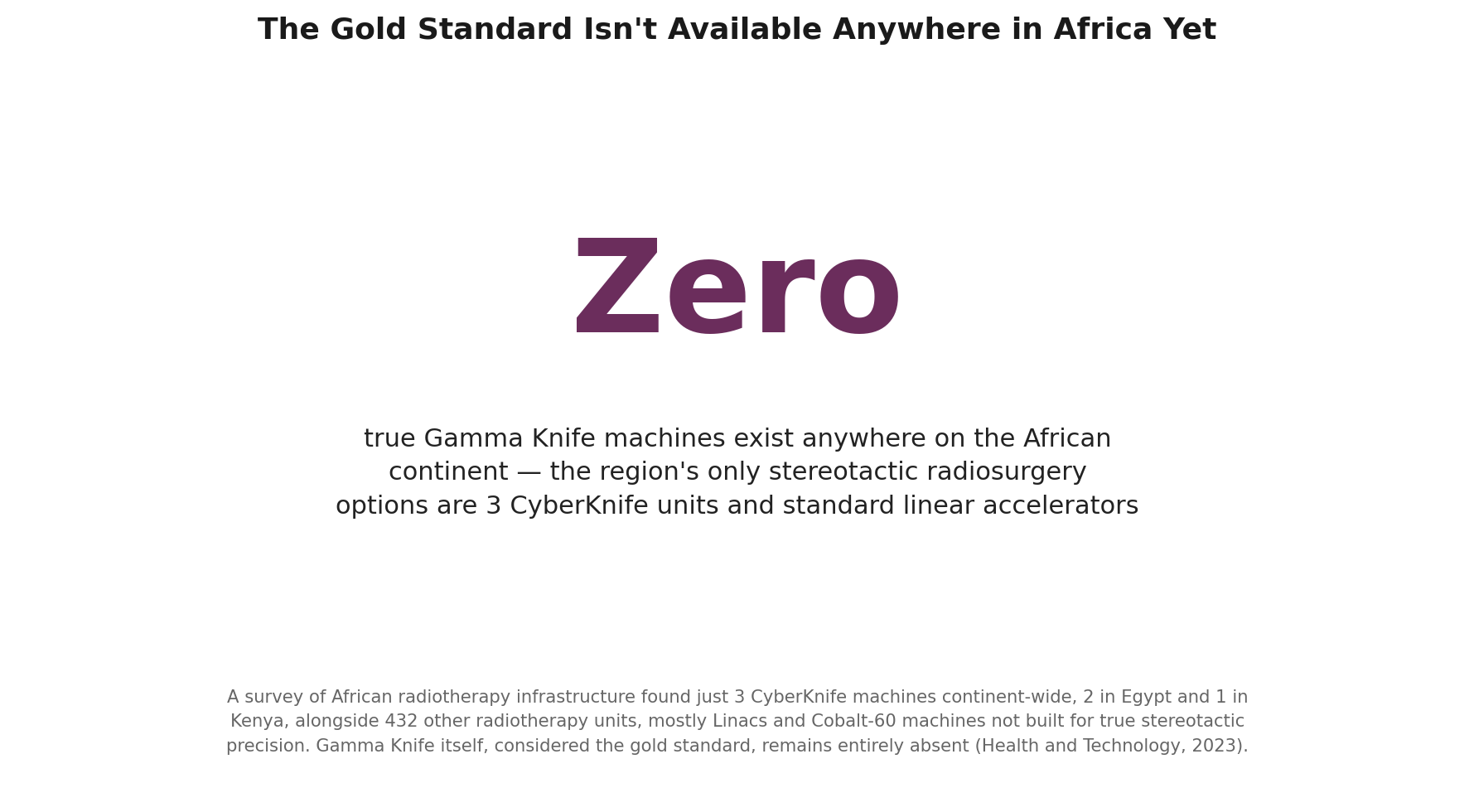
This is the fact every Kenyan patient considering this treatment needs to understand clearly, because it isn't specific to Kenya at all. A comprehensive survey of radiotherapy infrastructure across Africa found just three CyberKnife machines on the entire continent, two in Egypt and one in Kenya, alongside 432 other radiotherapy units, the great majority of them conventional linear accelerators and Cobalt-60 machines not built for the sub-millimetre precision true stereotactic radiosurgery requires. True Gamma Knife technology, considered the gold standard specifically for brain metastases, remains entirely absent from the continent.
This gap is largely explained by cost: a Gamma Knife unit can cost up to 7 million US dollars, roughly double the cost of a CyberKnife system and nearly three times that of a standard linear accelerator, and the study found a country's per capita GDP was a strong predictor of whether it had acquired any dedicated radiosurgery equipment at all. For a Kenyan patient with a brain metastasis, AVM, or trigeminal neuralgia, this means the decision isn't really "domestic versus international care" in the way it is for many other conditions; it's a decision about whether to pursue a genuinely superior, non-invasive treatment option that simply cannot be found anywhere closer to home.
Why India has become a genuine hub for Gamma Knife treatment
India operates several dedicated Gamma Knife centres at leading hospitals, staffed by radiosurgery teams with genuine, accumulated experience treating the full range of conditions this technology addresses. This matters because Gamma Knife planning and delivery require close collaboration between neurosurgeons, radiation oncologists, and medical physicists, a team-based expertise that develops specifically through sustained case volume, not equipment ownership alone.
India's leading Gamma Knife centres combine this experience with JCI and NABH accredited safety standards and treatment protocols that match those used at major centres in the US and Europe. In 24 years of guiding patients toward decisions like this one, few situations are as clear-cut: when a genuinely superior technology doesn't exist anywhere on your continent, and an accredited, experienced alternative exists at a fraction of Western cost, the case for pursuing it becomes straightforward rather than a difficult trade-off between comparable options.
That clarity doesn't mean every patient is automatically a candidate. Gamma Knife works best for smaller, well- defined lesions; very large tumours or certain lesion characteristics may still require open surgery or a different radiosurgery technique, and an honest, imaging-based assessment from an experienced radiosurgery team is essential before any treatment plan is finalised.
What it costs: India versus Kenya, the UK, and the US
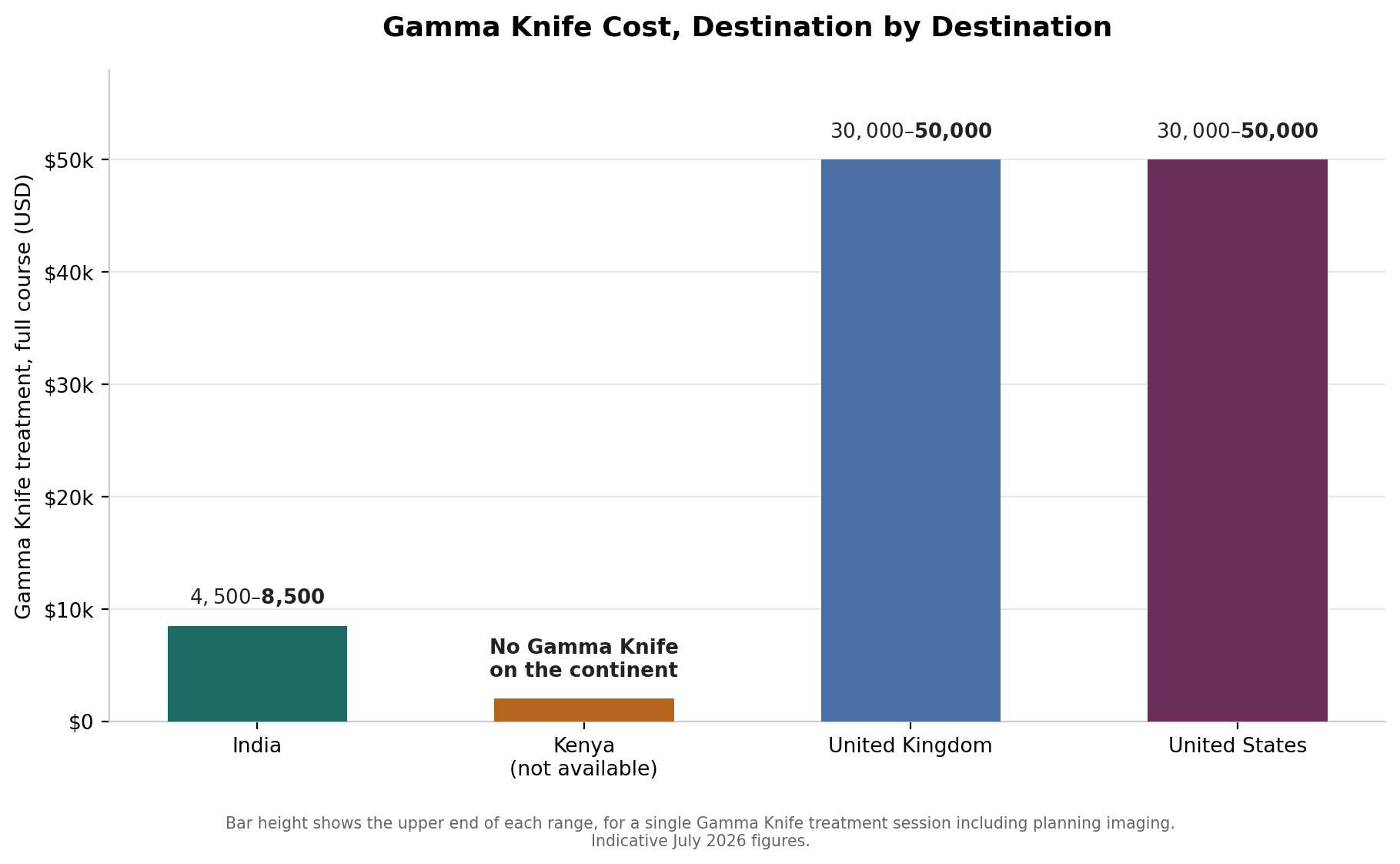
In India, a complete Gamma Knife treatment typically costs between 4,500 and 8,500 US dollars, covering planning imaging and the treatment session itself. In Kenya, and across Africa more broadly, the treatment simply isn't available domestically at any price. In the UK, Gamma Knife treatment typically costs 30,000 to 50,000 dollars, and in the US, a similar 30,000 to 50,000 dollars, up to roughly 85% more than the equivalent treatment in India.
Beyond the treatment itself, budget for travel. Direct flights between Nairobi and Delhi or Mumbai run roughly 550 to 850 dollars return, and most Gamma Knife patients need seven to fourteen days in India, covering consultation, planning imaging, the treatment session, and initial follow-up. Some conditions, particularly larger tumours or certain AVMs, may require staged treatment across more than one session, which affects both timeline and total cost.
What a Kenyan patient should actually check before booking
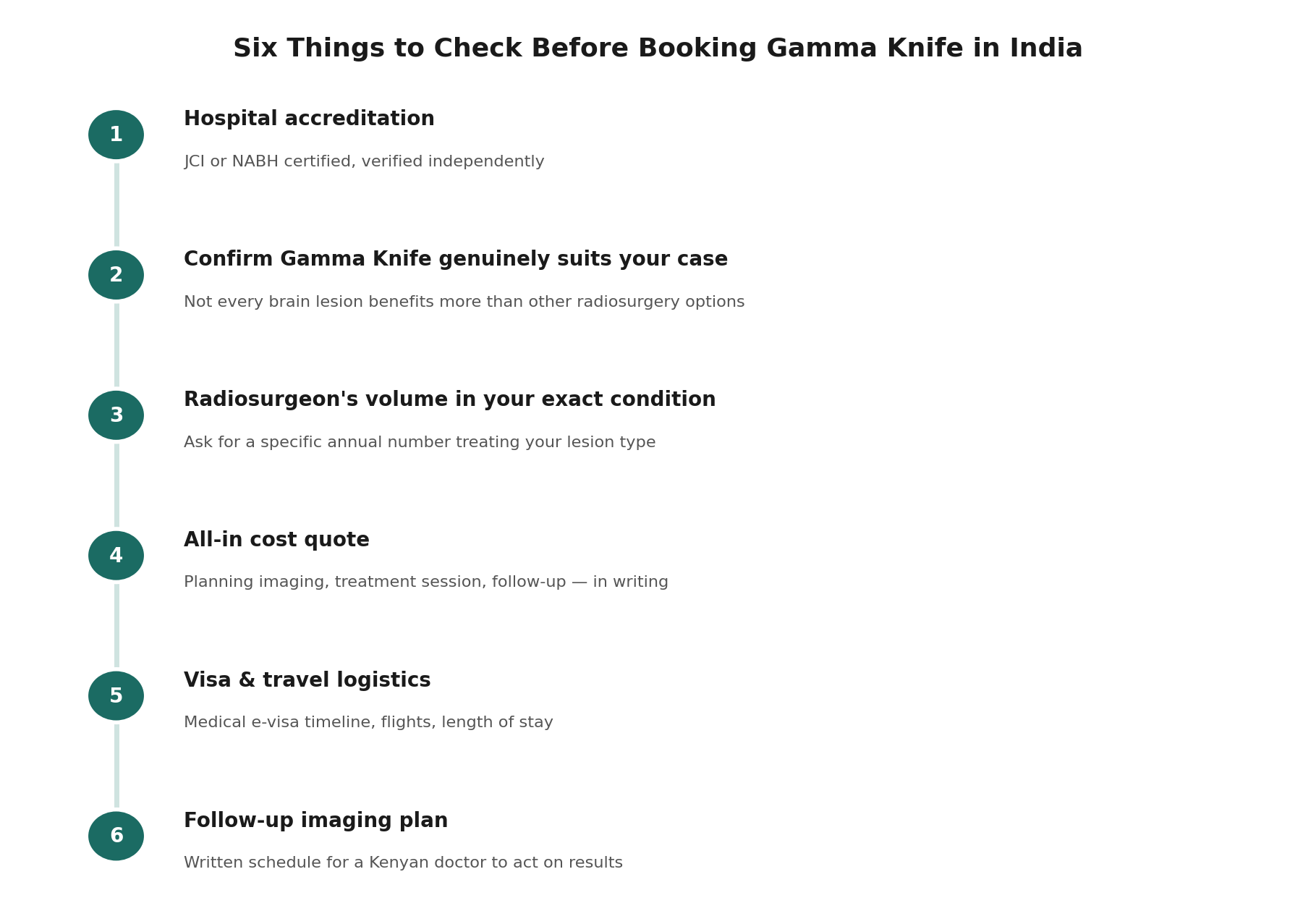
Given how specialised this technology is, these questions matter.
Confirm genuine accreditation. Ask whether the treating hospital holds JCI or NABH certification, and verify it independently.
Confirm Gamma Knife genuinely suits your specific case. Not every brain lesion benefits more from Gamma Knife than from other radiosurgery or surgical options, so ask your treating team to explain specifically why it's being recommended for your condition.
Ask about the radiosurgery team's volume in your exact condition. A specific number, how many cases matching your exact diagnosis the team personally treats each year, tells you more than general facility reputation.
Get the full cost breakdown in writing. Confirm what's included, planning imaging, the treatment session, and follow-up scans.
Plan your visa and travel timeline. The Indian medical e-visa is typically issued within three to five working days once you have a formal hospital invitation letter.
Arrange your follow-up imaging plan before you leave. Agree on a written follow-up schedule and identify a doctor in Kenya who can act on results once you're home, since Gamma Knife's full effect develops gradually.
Straight Answers for Kenyan Patients about Gamma Knife Treatment in India
Is Gamma Knife treatment available anywhere in Africa?
No. A comprehensive survey found true Gamma Knife technology entirely absent from the African continent, with only three CyberKnife machines, a related but distinct technology, available continent-wide, two in Egypt and one in Kenya.
How much does Gamma Knife treatment cost in India compared to the US?
India typically costs 4,500 to 8,500 US dollars for a complete treatment, against 30,000 to 50,000 dollars in the US, a saving of up to roughly 85%.
What conditions does Gamma Knife treat?
Brain metastases, certain primary brain tumours like meningiomas and acoustic neuromas, arteriovenous malformations, trigeminal neuralgia, and select tremor conditions from Parkinson's disease or essential tremor.
Why doesn't Gamma Knife exist anywhere in Africa yet?
Primarily cost. A single Gamma Knife unit can cost up to 7 million US dollars, and a country's per capita GDP has been found to strongly predict whether it has acquired any dedicated radiosurgery equipment at all.
How long does Gamma Knife treatment take?
Most conditions are treated in a single session, and most patients resume normal activities within a day or two, though the treatment's full effect develops gradually over the following weeks to months.
How do I get a medical visa to India from Kenya?
The Indian medical e-visa is typically issued within three to five working days once you have a formal invitation letter from the treating hospital.
A Closing Word
Gamma Knife is one of the clearest examples in this series of a genuinely superior treatment technology that simply doesn't exist anywhere on the African continent yet, not because of any individual hospital's limitations, but because of the sheer cost and infrastructure this equipment requires. India offers accredited, high-volume Gamma Knife centres at a fraction of Western cost, making it, for the great majority of Kenyan patients facing conditions this treatment addresses, the clearest option to investigate.
Sources
- 🌐 Radiotherapy infrastructure for brain metastasis treatment in Africa
- 🌐 Gamma Knife® Radiosurgery for Patients. Elekta
- 🌐 Stereotactic Radiosurgery — Gamma Knife. UF Health. ufhealth.org/conditions-and-treatments/stereotactic-radiosurgery-ga mma-knife
- 🌐 National Medical Commission of India — specialist registration verification
- 🌐 National Accreditation Board for Hospitals & Healthcare Providers (NABH) — accredited hospital directory
Frequently Asked Questions by Kenyans about Gamma Knife Treatment in India
Is Gamma Knife available in Kenya?
No. The guide states that true Gamma Knife technology is absent across Africa. Africa has three CyberKnife machines, including one in Kenya, but CyberKnife is a different technology.
What conditions can Gamma Knife treat?
The guide lists brain metastases, selected brain tumours, AVMs, trigeminal neuralgia and certain tremor conditions.
Is Gamma Knife suitable for every brain tumour?
No. It generally works best for smaller, well-defined lesions. Some larger tumours may require open surgery or another radiosurgery approach.
Does Gamma Knife involve an incision?
No. Gamma Knife is non-invasive stereotactic radiosurgery and does not involve cutting into the brain.
How many sessions are usually required?
Most conditions can be treated in one session, although some larger tumours or AVMs may require staged treatment.
How much does Gamma Knife cost in India?
The guide estimates approximately US$4,500–8,500, including planning imaging and the treatment session.
How does India's cost compare with the US?
The guide estimates approximately US$30,000–50,000 in the US, compared with US$4,500–8,500 in India.
How long should Kenyan patients stay in India?
The guide recommends approximately 7–14 days for consultation, planning, treatment and initial follow-up.
What should patients check before booking?
Patients should verify JCI or NABH accreditation, Gamma Knife suitability, condition-specific radiosurgery experience, complete costs, travel arrangements and follow-up imaging.
Why is follow-up imaging important?
The treatment's full effect develops gradually over weeks to months, so patients should have a written imaging schedule and a doctor in Kenya who can act on the results.
Page Summary
This five-page guide focuses on Gamma Knife access and treatment planning for Kenyan patients. Pages 1–2 explain the technology, its clinical uses and the absence of true Gamma Knife systems across Africa, while highlighting India's dedicated centres and multidisciplinary expertise. Page 3 compares treatment costs in India, Kenya, the UK and US, and the page 4 “Six Things to Check” graphic covers accreditation, case suitability, condition-specific experience, complete costing, travel planning and follow-up imaging.
Citation Block
| Topic | Information |
|---|---|
| Topic | Gamma Knife Treatment in India for Kenyan Patients |
| Treatment | Gamma Knife Stereotactic Radiosurgery |
| Patients | Kenyan Patients |
| First Assessment | Lesion type, size, location and imaging |
| Key Specialist | Neurosurgeon / Radiation Oncologist |
| Technology | Gamma Knife radiosurgery |
| Main Conditions | Brain metastases, selected brain tumours, AVMs and trigeminal neuralgia |
| Treatment Sessions | Usually one session |
| Case Volume | Experience with the patient's exact condition |
| Hospital Check | JCI / NABH accreditation |
| Suitability Check | Imaging-based assessment |
| Cost Check | Written estimate covering planning, treatment and follow-up |
| India Cost | US$4,500–8,500 |
| Kenya Availability | True Gamma Knife unavailable domestically |
| Medical Records | MRI and relevant medical reports |
| Visa Planning | Indian medical e-visa with hospital invitation |
| Travel | Nairobi–India flights |
| Stay | Approximately 7–14 days |
| Follow-Up | Written imaging follow-up plan |
| Specialist Question | How many cases matching my exact condition do you treat with Gamma Knife each year? |
| Suitability Question | Why is Gamma Knife appropriate for my lesion instead of surgery or another radiosurgery option? |
| Cost Question | Does the quotation include planning imaging, treatment and follow-up scans? |
| Follow-Up Question | Who will review my imaging after I return to Kenya? |
| Warning Signs | Gamma Knife recommended without a clear case-specific assessment |
| Payment Warning | Incomplete treatment quotation |
| Key Decision | Verify genuine Gamma Knife capability, condition-specific expertise and treatment suitability |


Our Mission Statement
Our mission is to place patients at the centre of every healthcare decision by providing trustworthy, evidence-based, and unbiased medical information. We believe that informed patients make better decisions. Backed by personalised guidance from our experienced advisory team, we help patients understand their treatment options, compare them objectively, and confidently choose the path that best suits their medical needs and personal circumstances.
Patient Testimonials from Kenya
Ready to Take the First Step?
Share your Medical Reports with our Healthcare Managers Today and Get a FREE CONSULTATION, a Personalized Treatment Plan, and Complete Support from Arrival to Recovery.
Get Your Free ConsultationAreas We Serve
This resource has been thoughtfully prepared for patients from Kenya who are considering medical treatment in India. We also welcome patients from the wider region in the countries mentioned below-
We assist patients from:
- Ethiopia
- Somalia
- Tanzania
- Uganda
- Seychelles
- Guinea
- Guinea-Bissau
- Liberia
- Mali
- Mauritania
- Niger
- Nigeria
- Senegal
- Togo
- South Sudan
- Sierra Leone
Many of the insights, treatment pathways, hospital recommendations, travel guidance, and patient support services described here are equally relevant and may be used as a reference when planning treatment in India.
From Kenya to India: Your Complete Patient Support Guide
- Brain Tumour Surgery in India for Kenyan Patients
- Cancer Treatment and Surgery in India for Kenyan Patients
- Cardiac Treatment and Surgery in India for Kenyan Patients
- Heart Valve Replacement Surgery in India for Kenyan Patients
- Knee Replacement in India for Kenyan Patients
- Prostate Cancer Treatment and Surgery in India for Kenyan Patients
- Spine Treatment and Surgery in India for Kenyan Patients
- Selecting the Best Bariatric Surgeons and Hospitals in India: What Kenyan Patients Should Actually Look For
- Selecting the Best Cancer Surgeons and Hospitals in India: What Kenyan Patients Should Actually Look For
- Selecting the Best Cardiac Surgeons and Hospitals in India: What Kenyan Patients Should Actually Look For
- Selecting the Best Dental Surgeons and Clinics in India: What Kenyan Patients Should Actually Look For
- Selecting the Best Hip Surgeons and Hospitals in India: What Kenyan Patients Should Actually Look For
- Selecting the Best Kidney Transplant Surgeons and Hospitals in India: What Kenyan Patients Should Actually Look For
- Selecting the Best Knee Surgeons and Hospitals in India: What Kenyan Patients Should Actually Look For
- Selecting the Best Liver Transplant Surgeons and Hospitals in India: What Kenyan Patients Should Actually Look For
- Selecting the Best Neurosurgeons and Hospitals in India: What Kenyan Patients Should Actually Look For
- Selecting the Best Prostate Cancer Surgeons and Hospitals in India: What Kenyan Patients Should Actually Look For
- Selecting the Best Spine Surgeons and Hospitals in India: What Kenyan Patients Should Actually Look For