

CyberKnife Treatment in India for Kenyan Patients
What CyberKnife treatment involves, why Kenyan patients still travel for it even with a machine now installed at home, and what it costs in India.
If you've been told CyberKnife treatment might be right for you, a piece of good news comes with a piece of information every Kenyan patient should understand clearly: Kenya actually has this technology, and yet accessing it in good time remains genuinely difficult. Across 24 years of guiding Kenyan patients through treatment in India, this is one of the more unusual situations in this series, a case where the equipment gap has already closed, but access hasn't followed. This article explains what CyberKnife treatment involves, why owning the machine hasn't translated into timely access in Kenya, what treatment costs in India compared with Kenya and Western countries, and the practical factors to weigh before deciding where to be treated.
Healing Journeys of Kenyan Patients






Key Takeaways
- The guide explains that CyberKnife is a non-invasive form of stereotactic radiosurgery that uses a robotic system to deliver highly targeted radiation from multiple angles while using real-time imaging to track tumour movement. Treatment typically requires one to five sessions, with each session lasting around 30–90 minutes and generally requiring no anaesthesia or hospital admission.
- Kenya does have CyberKnife technology. The machine was installed at Kenyatta University Teaching, Referral and Research Hospital in 2022, with the first patient treated in September 2023. However, the guide highlights that having the machine does not necessarily mean timely access, with documented human-resource shortages leaving many patients waiting for specialised radiation treatment.
- India offers multiple accredited CyberKnife centres with dedicated radiosurgery teams and substantially higher treatment volume. The guide emphasises that this greater volume can provide faster scheduling and deeper experience with specific tumour types, including brain, spine, lung, liver and prostate applications.
- The guide gives approximate CyberKnife costs of US$4,500–10,000 in India, compared with approximately US$2,700 in Kenya when national insurance access is available, US$30,000–60,000 in the UK and US$50,000–100,000 in the US. It stresses that for Kenyan patients, access and treatment timing may be more important than the price difference.
- The page 4 “Six Things to Check” graphic highlights hospital accreditation, the radiosurgeon's experience with the patient's specific tumour type, a confirmed treatment schedule, a complete cost quotation, visa and travel logistics, and a written follow-up imaging plan.
- Kenyan patients should send their actual imaging and medical reports to the centres being compared and confirm the number of treatment sessions required before travelling. The guide recommends allowing approximately 7–14 days in India for planning, CyberKnife sessions and initial follow-up, with ongoing imaging follow-up arranged with a doctor in Kenya.
Quick Facts
- Author
- Dr. Dheeraj Bojwani
- Experience
- 24+ Years
- Treatment
- CyberKnife Stereotactic Radiosurgery
- Patients
- Kenyan Patients
- First Assessment
- Tumour type, location and suitability for CyberKnife
- Key Specialist
- Radiosurgeon / Radiation Oncology Specialist
- Technology
- Robotic stereotactic radiosurgery
- Treatment Sessions
- Typically 1–5 sessions
- Session Duration
- Approximately 30–90 minutes
- Applications
- Brain, spine, lung, liver and prostate tumours
- Case Volume
- Specific tumour-type CyberKnife experience
- Hospital Check
- JCI / NABH accreditation
- Schedule Check
- Confirm number of sessions and treatment timeframe
- Cost Check
- Written estimate covering sessions, imaging and specialist fees
- India Cost
- US$4,500–10,000
- Kenya Cost
- Approximately US$2,700 when covered and accessible
- Medical Records
- Actual imaging and medical reports
- Visa
- Indian medical e-visa with hospital invitation
- Travel
- Nairobi–India flights
- Stay
- Approximately 7–14 days
- Follow-Up
- Written imaging follow-up plan
- Communication
- Clear treatment and travel coordination
- Key Warning
- Treatment availability or scheduling cannot be confirmed
- Decision Principle
- Prioritise tumour-specific expertise, timely access and a clearly confirmed treatment plan.
In Brief
For Kenyan patients considering CyberKnife treatment in India, the key priorities are timely access, tumour-specific radiosurgery expertise and a confirmed treatment schedule. Patients should verify hospital accreditation, the specialist's experience with their specific tumour type, the complete treatment cost and a written follow-up imaging plan before travelling.
What CyberKnife treatment actually involves
CyberKnife is a form of stereotactic radiosurgery, a robotic system that delivers precisely targeted, high-dose radiation to a tumour from multiple angles, using real-time imaging to track and adjust for the tumour's movement, even accounting for breathing. Despite the name, no cutting is involved. It's a genuinely non-invasive alternative to conventional surgery, particularly valuable for tumours in locations that are difficult or risky to reach surgically, near the spine, brain, or major blood vessels, or for patients whose overall health makes traditional surgery too risky.
Treatment is typically completed in one to five sessions, each lasting 30 to 90 minutes, with no anaesthesia or hospital stay required. It's used across a wide range of conditions: brain and spinal tumours, early-stage lung cancer, liver tumours, prostate cancer, and select cases previously considered inoperable due to their location. The precision involved, accurate to a fraction of a millimetre, is what allows it to deliver a therapeutic radiation dose while sparing the healthy tissue immediately surrounding the tumour.
Because the treatment relies on real-time image tracking rather than a fixed target, the technique is particularly well suited to tumours that move slightly with normal body function, a lung tumour shifting with each breath, for example. The robotic arm's ability to continuously recalculate and adjust the radiation beam's angle in response means the treatment stays accurate throughout each session, something conventional radiotherapy equipment, which typically assumes a fixed target, cannot replicate to the same degree.
Why owning the machine hasn't translated into timely access in Kenya
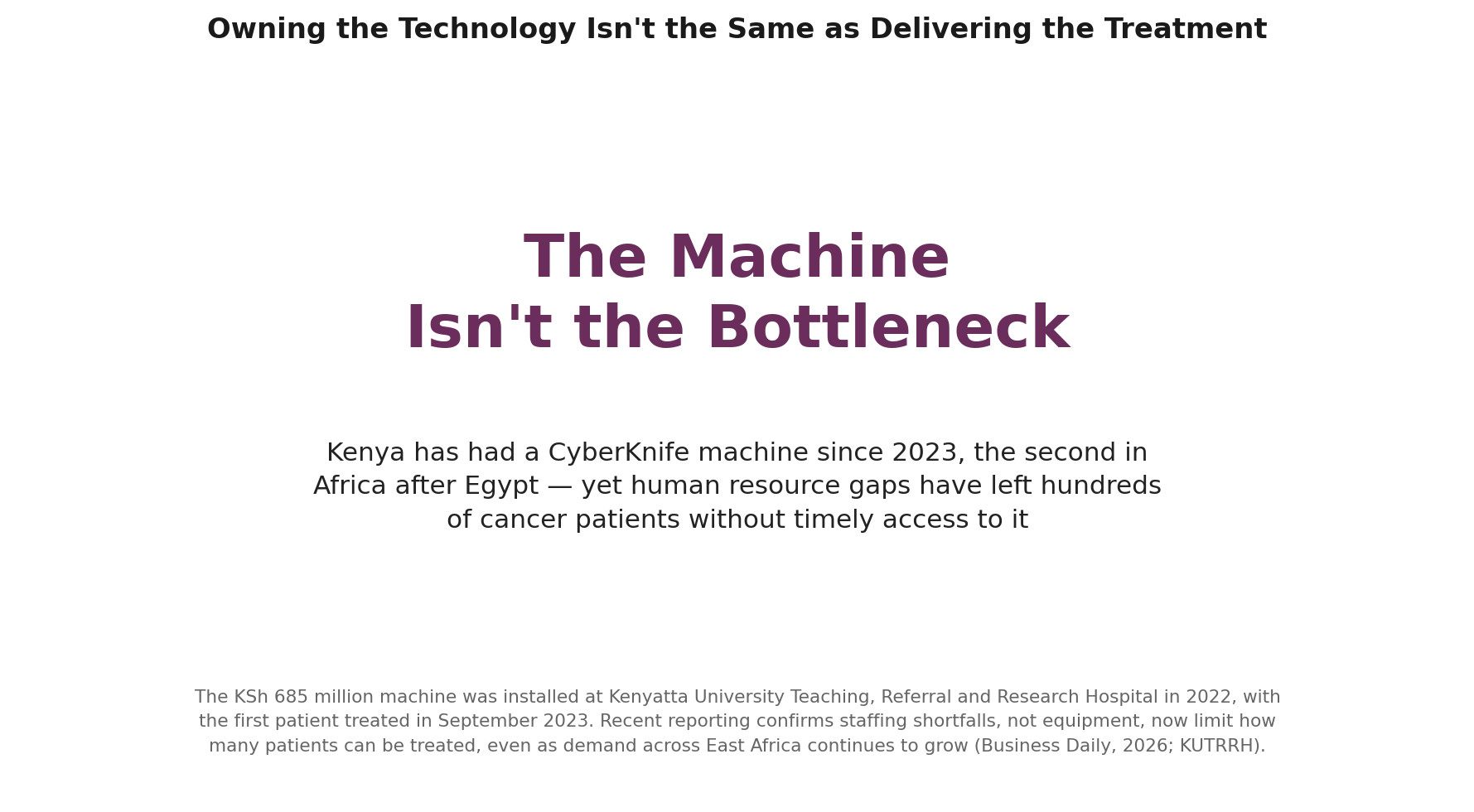
This is the fact every Kenyan patient considering this treatment needs to understand clearly, because it changes what "available in Kenya" actually means in practice. Kenya installed a CyberKnife machine at Kenyatta University Teaching, Referral and Research Hospital in 2022, becoming only the second country in Africa, after Egypt, to acquire the technology. The first patient was treated in September 2023. On paper, this was a genuine breakthrough, and the treatment is fully covered by Kenya's national health insurance, meaning covered patients pay nothing out of pocket for the procedure itself.
But recent reporting confirms what many patients have discovered directly: human resource gaps, not the machine itself, have left hundreds of cancer patients without access to specialised radiation therapy despite the equipment being installed and functional. When the service first launched, the hospital's own leadership noted a waiting list of 34 patients and openly stated that urgent cases had already had to seek treatment elsewhere while capacity caught up. This is a genuinely important distinction for a Kenyan patient to understand: the technology existing in the country is not the same as the technology being accessible to you within a timeframe that matters for your specific diagnosis.
Why India remains a strong option even with Kenya's machine now installed
India performs a substantially higher volume of CyberKnife treatments than Kenya's single unit currently can, spread across multiple accredited centres with dedicated radiosurgery teams who treat this specific technology's full range of applications daily, not occasionally. That volume translates directly into two things that matter enormously for time-sensitive cancer treatment: faster scheduling and deeper case-specific experience with your particular tumour type and location.
India's leading CyberKnife centres combine this volume with JCI and NABH accredited safety standards and radiosurgeons with genuinely deep experience across brain, spine, lung, liver, and prostate applications. For a Kenyan patient facing a diagnosis where treatment timing matters, and for the substantial number of Kenyan patients who have already found domestic capacity limited despite the machine's presence, India's combination of speed, volume, and cost remains, for the great majority of patients I've guided through this decision, the more reliable path to timely treatment.
This isn't a criticism of the effort Kenya has put into acquiring this technology, which represents genuine, meaningful progress. It's a practical observation about where things currently stand: a single machine, however capable, serving a population and demand base this large will inevitably face capacity constraints that a country with dozens of accredited CyberKnife centres, treating thousands of patients annually, simply doesn't face in the same way.
What it costs: India versus Kenya, the UK, and the US
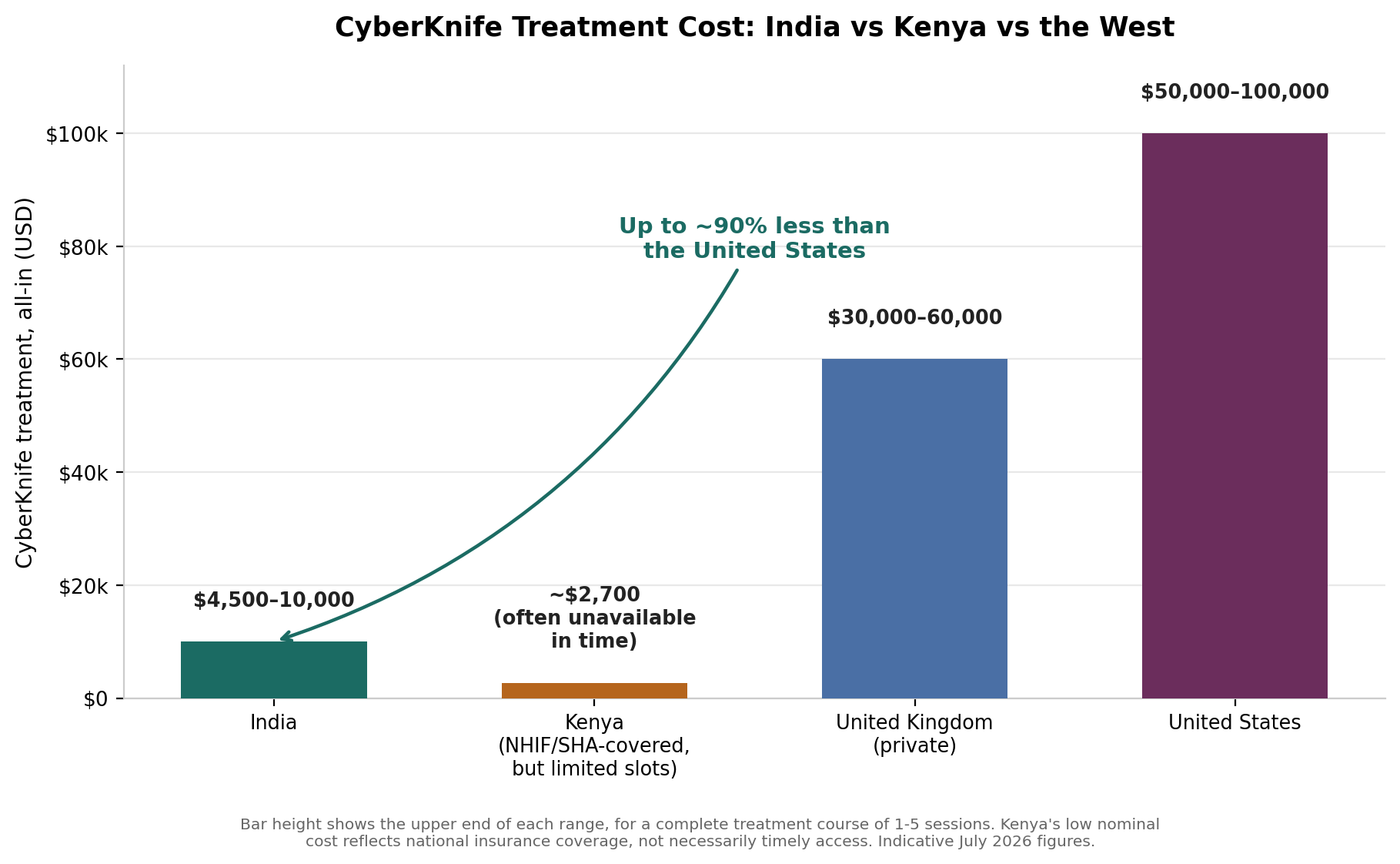
In Kenya, CyberKnife treatment is fully covered by national health insurance, costing patients roughly 350,000 Kenyan shillings, around 2,700 US dollars, when access is available, making cost genuinely not the barrier here, access timing is. In India, the same treatment typically costs between 4,500 and 10,000 US dollars, covering the full course of sessions, imaging, and specialist fees. In the UK, private CyberKnife treatment typically runs 30,000 to 60,000 dollars, and in the US, 50,000 to 100,000 dollars, up to roughly 90% more than the equivalent treatment in India.
Beyond the procedure itself, budget for travel. Direct flights between Nairobi and Delhi or Mumbai run roughly 550 to 850 dollars return, and most CyberKnife patients need seven to fourteen days in India, covering planning imaging, the treatment sessions themselves, and initial follow-up.
What a Kenyan patient should actually check before booking
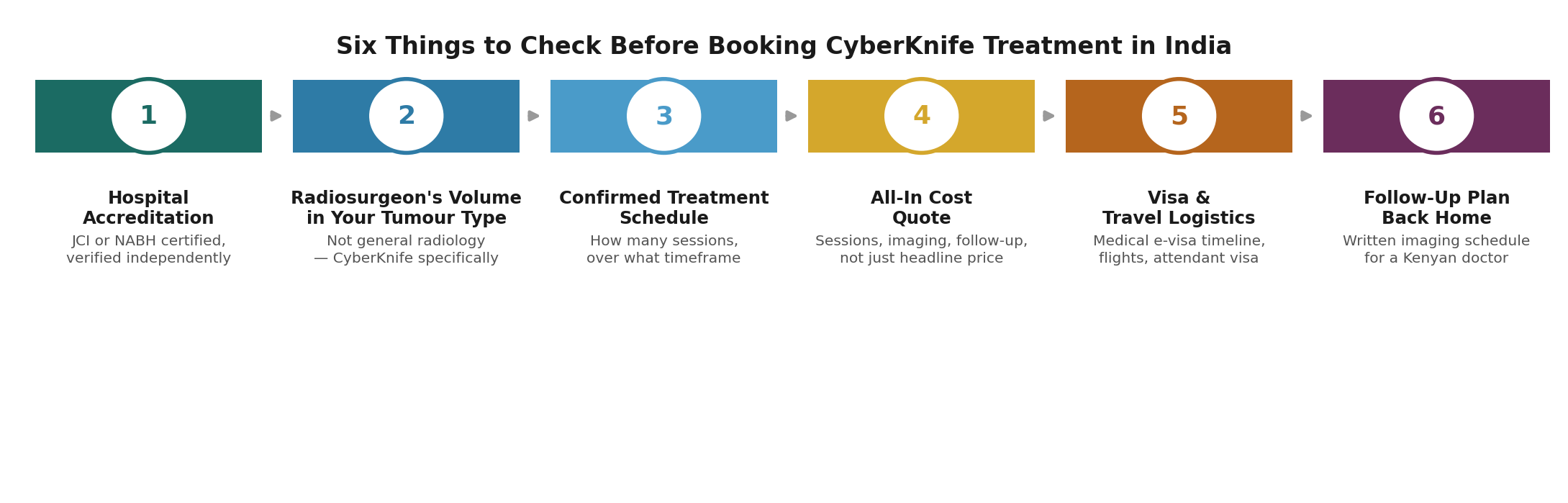
Given how much timing and precision matter for this specific technology, work through these questions directly.
Confirm genuine accreditation. Ask whether the hospital holds JCI or NABH certification, and verify it independently.
Ask about the radiosurgeon's volume in your specific tumour type. CyberKnife spans very different applications, brain, spine, lung, prostate, each requiring specific expertise. A specific number, how many cases matching your exact diagnosis the radiosurgeon personally treats each year, tells you far more than general reputation. In 24 years of watching patients navigate this decision, the ones who ask this specific question consistently arrive better informed.
Get a confirmed treatment schedule upfront. Ask exactly how many sessions your case requires and over what timeframe, so you can plan your trip accurately rather than discovering the schedule once you arrive.
Get the full cost breakdown in writing. Confirm what's included, sessions, planning imaging, specialist consultations, and what would happen, and cost, if additional sessions are needed.
Plan your visa and travel timeline. The Indian medical e-visa is typically issued within three to five working days once you have a formal hospital invitation letter, and an attendant can travel on a linked medical attendant visa.
Arrange your follow-up imaging plan before you leave. Agree on a written follow-up imaging schedule and identify a doctor in Kenya who can act on results once you're home, since ongoing monitoring continues for months to years afterward.
Straight Answers for Kenyan Patients about CyberKnife Treatment in India
Is CyberKnife treatment available in Kenya?
Yes, since 2023, at Kenyatta University Teaching, Referral and Research Hospital, the second such machine in Africa after Egypt. However, documented human resource gaps have left hundreds of patients without timely access despite the equipment being functional.
How much does CyberKnife treatment cost in India compared to Kenya?
India typically costs 4,500 to 10,000 US dollars. In Kenya, the treatment is covered by national insurance at roughly 2,700 dollars, but access timing, not cost, is often the greater barrier.
Why would I choose India if Kenya has a CyberKnife machine?
India performs a substantially higher volume of CyberKnife treatments across multiple accredited centres, translating into faster scheduling and deeper case-specific experience, which matters significantly given documented access delays at Kenya's single unit.
What conditions can CyberKnife treat?
Brain and spinal tumours, early-stage lung cancer, liver tumours, prostate cancer, and select tumours in locations difficult or risky to reach with conventional surgery.
How many sessions does CyberKnife treatment require?
Typically one to five sessions, each lasting 30 to 90 minutes, with no hospital stay or anaesthesia required, though the exact number depends on your specific tumour type and location.
How do I get a medical visa to India from Kenya?
The Indian medical e-visa is typically issued within three to five working days once you have a formal invitation letter from the treating hospital, and an accompanying attendant can usually apply for a linked medical attendant visa.
A Closing Word
Kenya's acquisition of CyberKnife technology was a genuine milestone, but the documented gap between having the machine and delivering timely treatment means it hasn't yet closed the case for looking elsewhere. India offers substantially greater treatment volume, dedicated radiosurgery teams, and accredited safety standards, at a modest premium over Kenya's insurance-covered price but with dramatically better odds of being treated within a timeframe that matters for your diagnosis. Ask the right questions, confirm your schedule upfront, and arrange your follow-up care before you travel.
Sources
- 🌐 Kenya acquires new Cyberknife device to aid cancer treatment. Daily Nation, 2022
- 🌐 The First Cyberknife Treatment In Sub-Saharan Africa Treats A Delicate Tumor. KUTRRH, 2023
- 🌐 Human resource gaps leave cancer patients without access to radiation therapy despite CyberKnife installation. Business Daily Africa, 2026
- 🌐 National Medical Commission of India — specialist registration verification
- 🌐 National Accreditation Board for Hospitals & Healthcare Providers (NABH) — accredited hospital directory
Frequently Asked Questions by Kenyans about CyberKnife Treatment in India
Is CyberKnife treatment available in Kenya?
Yes. Kenya has had a CyberKnife machine at Kenyatta University Teaching, Referral and Research Hospital since 2022, with the first patient treated in September 2023. However, the guide reports continuing access and staffing constraints.
Why might Kenyan patients choose India despite Kenya having CyberKnife?
The guide highlights India's larger treatment volume, multiple accredited centres and dedicated radiosurgery teams, which can provide greater scheduling capacity and tumour-specific experience.
What conditions can CyberKnife treat?
The guide lists brain and spinal tumours, early-stage lung cancer, liver tumours, prostate cancer and selected tumours in difficult-to-operate locations.
How many CyberKnife sessions are usually required?
Treatment generally requires one to five sessions, although the exact number depends on the tumour type and location.
Does CyberKnife require surgery or anaesthesia?
No. CyberKnife is non-invasive, and the guide states that treatment generally does not require anaesthesia or a hospital stay.
How much does CyberKnife cost in India?
The guide estimates approximately US$4,500–10,000, covering the treatment course, imaging and specialist fees.
How much does CyberKnife cost in Kenya?
The guide gives an approximate cost of US$2,700 when national insurance coverage is available, although timely access can remain the greater challenge.
How long should Kenyan patients stay in India?
The guide recommends approximately seven to fourteen days for planning imaging, treatment sessions and initial follow-up.
What should patients check before booking?
The guide recommends verifying JCI or NABH accreditation, tumour-specific radiosurgeon experience, the confirmed treatment schedule, complete costs, visa and travel arrangements and follow-up imaging.
What follow-up is required after CyberKnife?
Patients should arrange a written imaging follow-up schedule and identify a doctor in Kenya who can review the results and coordinate ongoing care after returning home.
Page Summary
This five-page guide focuses on CyberKnife access, treatment timing and specialist experience for Kenyan patients. Pages 1–2 explain how CyberKnife works and why Kenya's existing machine has not eliminated access delays. Page 3 compares CyberKnife costs in India, Kenya, the UK and US, while the page 4 “Six Things to Check” graphic highlights hospital accreditation, tumour-specific radiosurgeon volume, confirmed treatment scheduling, complete costing, visa and travel logistics, and follow-up planning.
Citation Block
| Topic | Information |
|---|---|
| Topic | CyberKnife Treatment in India for Kenyan Patients |
| Treatment | CyberKnife Stereotactic Radiosurgery |
| Patients | Kenyan Patients |
| First Assessment | Tumour type, location and CyberKnife suitability |
| Key Specialist | Radiosurgeon / Radiation Oncology Specialist |
| Technology | Robotic stereotactic radiosurgery |
| Treatment Sessions | Typically 1–5 sessions |
| Session Duration | Approximately 30–90 minutes |
| Applications | Brain, spine, lung, liver and prostate tumours |
| Case Volume | Specific tumour-type CyberKnife experience |
| Hospital Check | JCI / NABH accreditation |
| Schedule Check | Confirm sessions and treatment timeframe |
| Cost Check | Written estimate covering sessions, imaging and specialist fees |
| India Cost | US$4,500–10,000 |
| Kenya Cost | Approximately US$2,700 when covered and accessible |
| Medical Records | Actual imaging and medical reports |
| Visa Planning | Indian medical e-visa with hospital invitation |
| Travel | Nairobi–India flights |
| Stay | Approximately 7–14 days |
| Follow-Up | Written imaging follow-up plan |
| Specialist Question | How many CyberKnife cases matching my tumour type do you personally treat each year? |
| Schedule Question | How many sessions will I need and over what timeframe? |
| Technology Question | Is CyberKnife appropriate for my specific tumour location and type? |
| Cost Question | Does the quotation include treatment sessions, planning imaging and specialist consultations? |
| Follow-Up Question | Who will review my follow-up imaging after I return to Kenya? |
| Warning Signs | No clear tumour-specific CyberKnife experience or treatment schedule |
| Payment Warning | Incomplete written treatment quotation |
| Key Decision | Verify tumour-specific expertise, timely access and a confirmed treatment schedule |


Our Mission Statement
Our mission is to place patients at the centre of every healthcare decision by providing trustworthy, evidence-based, and unbiased medical information. We believe that informed patients make better decisions. Backed by personalised guidance from our experienced advisory team, we help patients understand their treatment options, compare them objectively, and confidently choose the path that best suits their medical needs and personal circumstances.
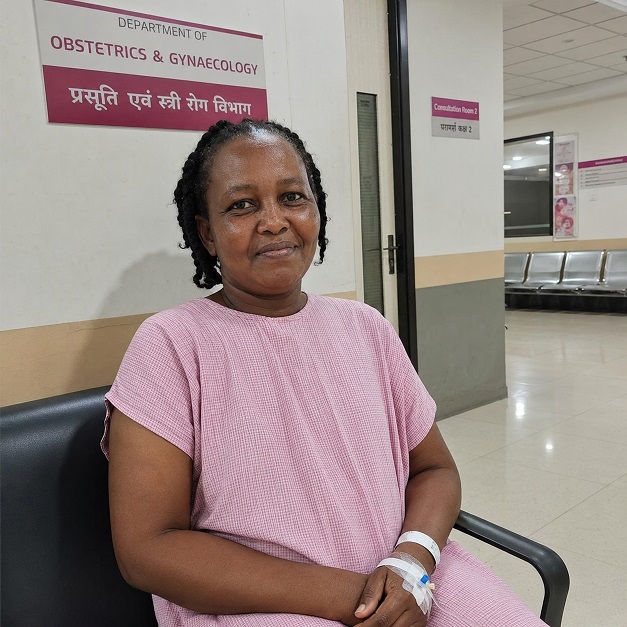
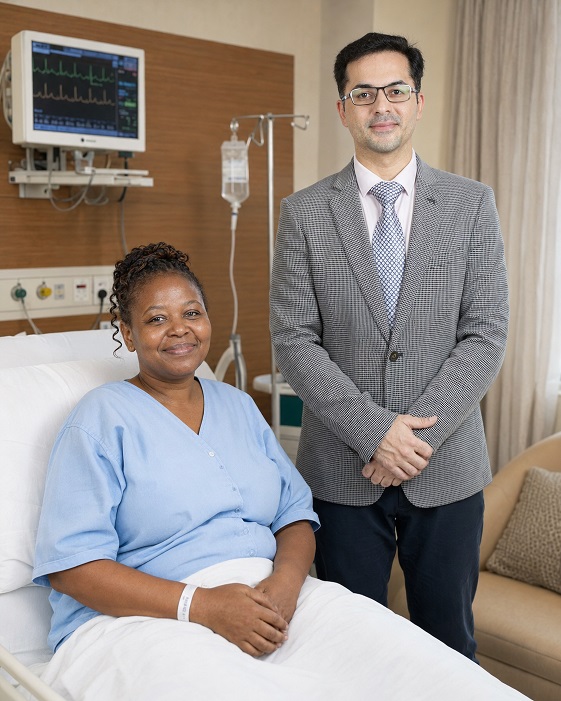
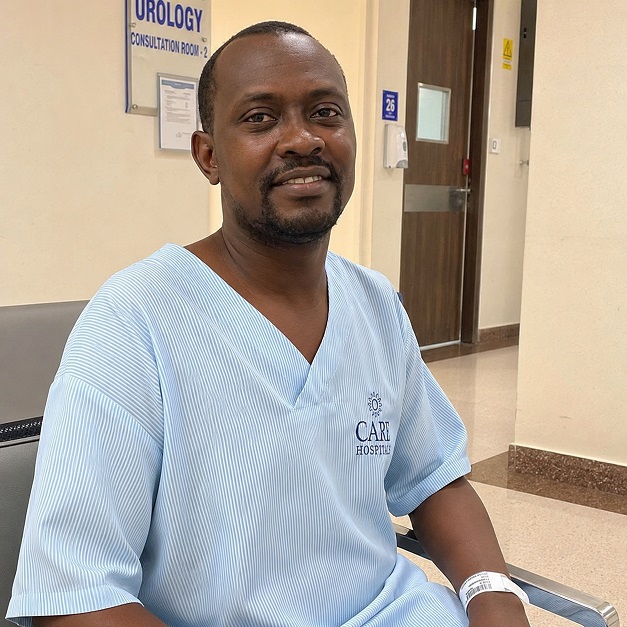
Patient Testimonials from Kenya

Ready to Take the First Step?
Share your Medical Reports with our Healthcare Managers Today and Get a FREE CONSULTATION, a Personalized Treatment Plan, and Complete Support from Arrival to Recovery.
Get Your Free ConsultationAreas We Serve
This resource has been thoughtfully prepared for patients from Kenya who are considering medical treatment in India. We also welcome patients from the wider region in the countries mentioned below-
We assist patients from:
- Ethiopia
- Somalia
- Tanzania
- Uganda
- Seychelles
- Guinea
- Guinea-Bissau
- Liberia
- Mali
- Mauritania
- Niger
- Nigeria
- Senegal
- Togo
- South Sudan
- Sierra Leone
Many of the insights, treatment pathways, hospital recommendations, travel guidance, and patient support services described here are equally relevant and may be used as a reference when planning treatment in India.
From Kenya to India: Your Complete Patient Support Guide
- Brain Tumour Surgery in India for Kenyan Patients
- Cancer Treatment and Surgery in India for Kenyan Patients
- Cardiac Treatment and Surgery in India for Kenyan Patients
- Heart Valve Replacement Surgery in India for Kenyan Patients
- Knee Replacement in India for Kenyan Patients
- Prostate Cancer Treatment and Surgery in India for Kenyan Patients
- Spine Treatment and Surgery in India for Kenyan Patients
- Selecting the Best Bariatric Surgeons and Hospitals in India: What Kenyan Patients Should Actually Look For
- Selecting the Best Cancer Surgeons and Hospitals in India: What Kenyan Patients Should Actually Look For
- Selecting the Best Cardiac Surgeons and Hospitals in India: What Kenyan Patients Should Actually Look For
- Selecting the Best Dental Surgeons and Clinics in India: What Kenyan Patients Should Actually Look For
- Selecting the Best Hip Surgeons and Hospitals in India: What Kenyan Patients Should Actually Look For
- Selecting the Best Kidney Transplant Surgeons and Hospitals in India: What Kenyan Patients Should Actually Look For
- Selecting the Best Knee Surgeons and Hospitals in India: What Kenyan Patients Should Actually Look For
- Selecting the Best Liver Transplant Surgeons and Hospitals in India: What Kenyan Patients Should Actually Look For
- Selecting the Best Neurosurgeons and Hospitals in India: What Kenyan Patients Should Actually Look For
- Selecting the Best Prostate Cancer Surgeons and Hospitals in India: What Kenyan Patients Should Actually Look For
- Selecting the Best Spine Surgeons and Hospitals in India: What Kenyan Patients Should Actually Look For