

Cornea Transplant and Advanced Eye Surgery in India for Kenyan Patients
Donor tissue is the barrier at home: what a Kenyan patient should know about cornea transplant and advanced eye surgery in India, from graft type to cost and follow-up.
Corneal blindness is one of the more genuinely fixable causes of vision loss in medicine, a condition where a relatively routine, decades-proven surgery can restore sight that would otherwise be permanently lost. Kenya's eye banks estimate the country needs at least 30,000 corneas to treat the backlog of preventable corneal blindness nationwide, a number that reflects both the scale of need and the deep, culturally rooted resistance to eye donation that makes meeting it genuinely difficult. Layer onto that a documented higher-than-average prevalence of keratoconus, a progressive corneal condition, across Kenya and Eastern Africa specifically, and the picture becomes clear: many Kenyan patients with a genuinely treatable cause of vision loss face a severe, specific shortage standing between them and a fixable outcome. Across 24 years of guiding Kenyan patients through treatment in India, cornea transplant is a case where the gap between "treatable" and "actually treated" comes down almost entirely to tissue access. This article explains what cornea transplant and advanced eye surgery involve, why donor tissue shortage remains such a specific barrier in Kenya, what treatment costs in India compared with Kenya and Western countries, and the practical factors to weigh before deciding where to be treated.
Healing Journeys of Kenyan Patients


Key Takeaways
- The guide highlights a significant corneal donor-tissue shortage in Kenya, with eye banks estimating that at least 30,000 corneas are needed nationwide to address preventable corneal blindness. Kenya and Eastern Africa also have a documented higher-than-average prevalence of keratoconus, making access to specialised corneal care particularly important.
- Cornea transplantation is not a single technique. Penetrating keratoplasty replaces the full thickness of the cornea and may be used for severe scarring or advanced disease, while DALK and DMEK replace selected damaged layers and can preserve healthier corneal tissue. For early keratoconus, corneal cross-linking may stabilise the condition in roughly 90% of cases and potentially delay or avoid transplantation.
- India's developed eye-banking infrastructure can provide donor tissue that Kenyan patients may struggle to access within a reasonable timeframe. Leading Indian eye centres also offer DALK, DMEK and corneal cross-linking, alongside JCI or NABH-accredited safety standards and reported success rates of 90% or higher for standard procedures.
- The guide recommends that Kenyan patients verify which certified eye bank supplies the donor cornea, how tissue quality and safety are checked, and how much experience the surgeon has with the patient's specific keratoplasty procedure. The page 4 “Six Things to Check” graphic highlights hospital accreditation, donor tissue sourcing, surgeon-specific keratoplasty volume, complete costing, visa and travel planning, and long-term follow-up.
- The guide gives an approximate complete cornea transplant cost of US$1,500–5,000 in India, compared with US$3,000–8,000 privately in Kenya, US$10,000–20,000 in the UK and US$15,000–30,000 in the US. The Indian estimate includes donor tissue and surgery. Kenyan patients should obtain a written quotation covering donor tissue, surgery and follow-up visits.
- A cornea transplant generally requires approximately one to two weeks in India for the procedure and early follow-up, although complete visual recovery can take considerably longer, particularly after a full-thickness graft. Patients should send their actual eye reports and imaging before travelling and arrange a written follow-up plan with an ophthalmologist in Kenya.
Quick Facts
- Author
- Dr. Dheeraj Bojwani
- Experience
- 24+ Years
- Treatment
- Cornea Transplant & Advanced Eye Surgery
- Patients
- Kenyan Patients
- First Assessment
- Corneal condition, severity and imaging
- Key Specialist
- Corneal Surgeon / Ophthalmologist
- Surgical Options
- Penetrating Keratoplasty, DALK and DMEK
- Keratoconus Option
- Corneal cross-linking where appropriate
- Donor Check
- Certified eye bank and tissue sourcing
- Case Volume
- Procedure-specific keratoplasty experience
- Hospital Check
- JCI / NABH accreditation
- Cost Check
- Written estimate covering donor tissue, surgery and follow-up
- India Cost
- US$1,500–5,000
- Kenya Private Cost
- US$3,000–8,000
- Medical Records
- Eye reports and imaging
- Visa
- Indian medical e-visa with hospital invitation
- Travel
- Nairobi–India flights
- Stay
- Approximately 1–2 weeks
- Follow-Up
- Long-term ophthalmology monitoring
- Communication
- Clear treatment and travel coordination
- Key Warning
- Donor tissue source or surgeon-specific keratoplasty experience is unclear
- Decision Principle
- Prioritise verified donor tissue, procedure-specific corneal expertise and appropriate technique selection.
In Brief
For Kenyan patients considering cornea transplant in India, the key priorities are reliable donor tissue availability, procedure-specific corneal expertise and selection of the correct keratoplasty technique. Patients should verify the certified eye bank, surgeon's relevant experience, complete treatment cost and long-term follow-up plan before travelling.
What cornea transplant and advanced eye surgery actually involve
The cornea is the clear, dome-shaped front surface of the eye, responsible for the majority of the eye's light- focusing power. When it becomes scarred, swollen, or misshapen due to disease, injury, infection, or a genetic condition like keratoconus, no glasses or contact lenses can fully correct the resulting blurred or distorted vision. A cornea transplant, or keratoplasty, replaces the damaged corneal tissue with healthy donor tissue, restoring clarity in a way no other treatment can achieve for advanced cases.
Modern keratoplasty has moved well beyond a single one-size-fits-all technique. Penetrating keratoplasty replaces the full thickness of the cornea and remains the standard for severe scarring or advanced keratoconus. Lamellar techniques, including DALK and DMEK, replace only the specific damaged layer, preserving healthy tissue, reducing rejection risk, and speeding recovery considerably compared with a full-thickness graft. For keratoconus specifically, corneal cross-linking, a minimally invasive procedure using ultraviolet light to strengthen the cornea, can stabilise the condition in roughly 90% of cases and, when caught early enough, may delay or even avoid the need for a full transplant altogether.
Recovery timelines vary meaningfully by technique. A full-thickness penetrating keratoplasty typically requires 12 to 18 months for complete healing, with sutures selectively removed as the cornea's shape stabilises, while lamellar techniques like DMEK often allow for faster visual recovery, sometimes within weeks, since less tissue is disturbed during the procedure. Understanding which technique genuinely fits your specific corneal condition, rather than assuming one approach applies universally, is worth a detailed conversation with your surgeon before any surgery is scheduled.
Why donor tissue shortage remains such a specific barrier in Kenya
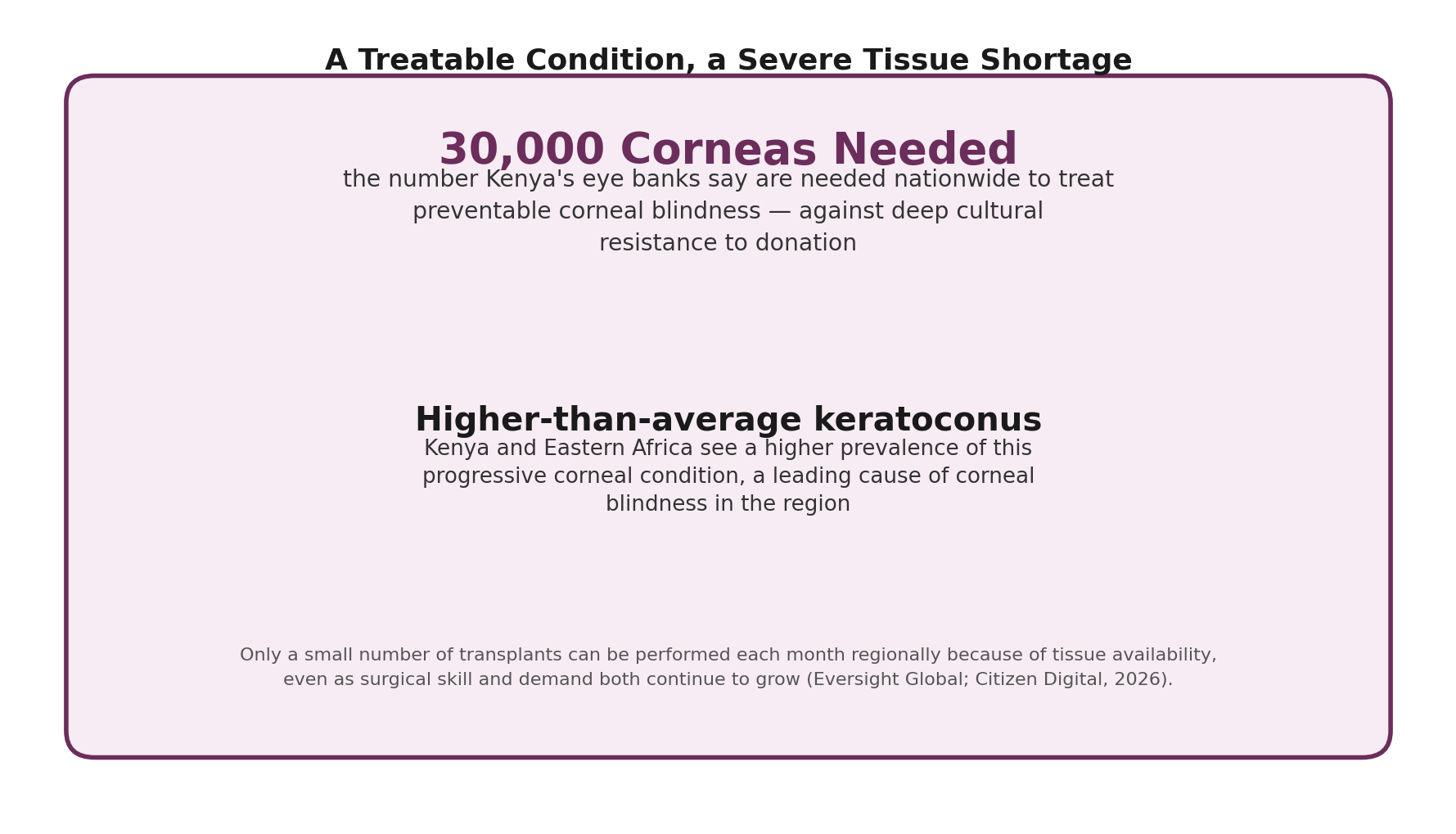
This is the fact every Kenyan patient facing corneal blindness needs to understand clearly, because it's genuinely different from most other access gaps in this series. Kenya's eye banks report needing at least 30,000 corneas nationwide to treat the backlog of preventable blindness, and securing donations remains a genuinely uphill struggle; in many Kenyan communities, the human body is considered sacred after death, deeply tied to burial rituals and ancestral identity, making eye donation a request that runs against real, deeply held cultural values, even though only the cornea itself is harvested, with no visible change to the deceased.
Compounding this, Kenya and Eastern Africa see a documented higher-than-average prevalence of keratoconus specifically, a leading cause of corneal blindness across the region. Regional corneal surgeons report that patients often travel hundreds of miles for specialised care, only to face long waiting lists once they arrive, because the constraint isn't surgical skill, it's the physical availability of donor tissue. This is a genuinely unusual situation in modern medicine: the surgery itself is safe, effective, and well understood; what's missing is the raw material to perform it.
Why India has become a genuine hub for cornea transplant and advanced eye surgery
India has built one of the world's most extensive eye banking networks, supported by dedicated public awareness and donation infrastructure that has developed over decades, meaning Indian corneal surgery centres routinely have donor tissue availability that Kenyan patients often cannot access domestically in any reasonable timeframe. This matters enormously for a condition where the barrier isn't clinical capability but tissue supply.
India's leading eye care centres combine this tissue availability with JCI and NABH accredited safety standards, the full range of modern techniques including DALK, DMEK, and corneal cross-linking, and reported success rates of
90% or higher for standard procedures. In 24 years of guiding patients through this decision, the clearest advice I offer is this: for a condition where the treatment itself is genuinely reliable and the only real obstacle is access to donor tissue, India's developed eye banking infrastructure removes precisely the barrier that keeps so many otherwise treatable Kenyan patients waiting indefinitely at home.
This distinction matters enormously in practice. A patient facing corneal blindness in Kenya isn't waiting because the surgery is unproven or because local surgeons lack the necessary skill; regional ophthalmologists are genuinely capable of performing these procedures well. The wait exists specifically because there's no tissue to operate with, which is precisely the kind of structural gap that travelling to a country with a mature eye banking system solves directly, rather than requiring years of infrastructure development to resolve domestically.
What it costs: India versus Kenya, the UK, and the US
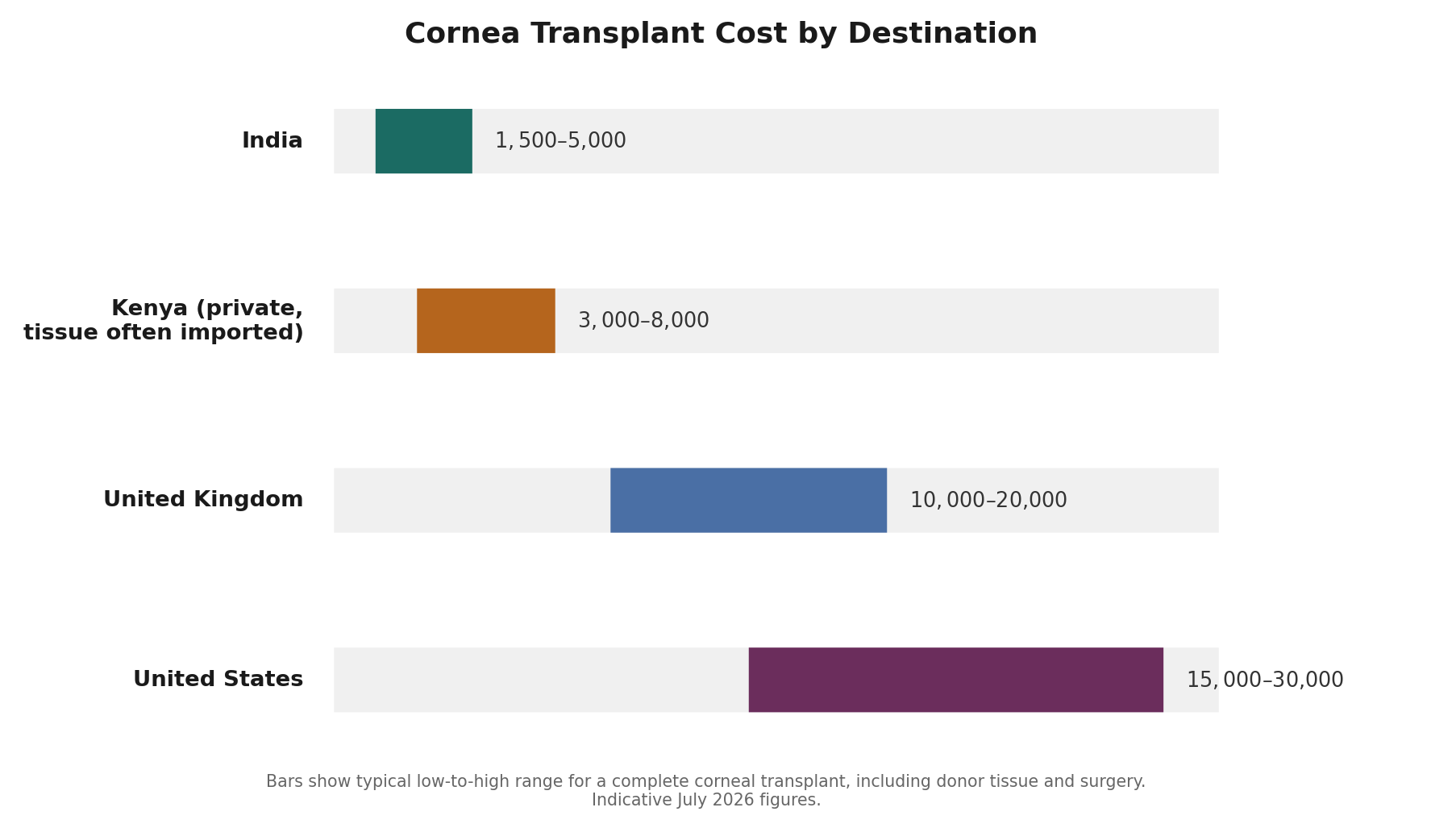
In India, a complete cornea transplant typically costs between 1,500 and 5,000 US dollars, covering donor tissue and surgery. In Kenya, private cornea transplant costs run roughly 3,000 to 8,000 dollars, where tissue is often imported internationally given the domestic shortage. In the UK, cornea transplant typically costs 10,000 to 20,000 dollars, and in the US, 15,000 to 30,000 dollars.
Beyond the procedure itself, budget for your stay. Direct flights between Nairobi and Delhi or Mumbai run roughly 550 to 850 dollars return, and cornea transplant typically requires one to two weeks in India for the initial procedure and early follow-up, though full visual recovery, particularly after a full-thickness graft, can take several months.
What a Kenyan patient should actually check before booking
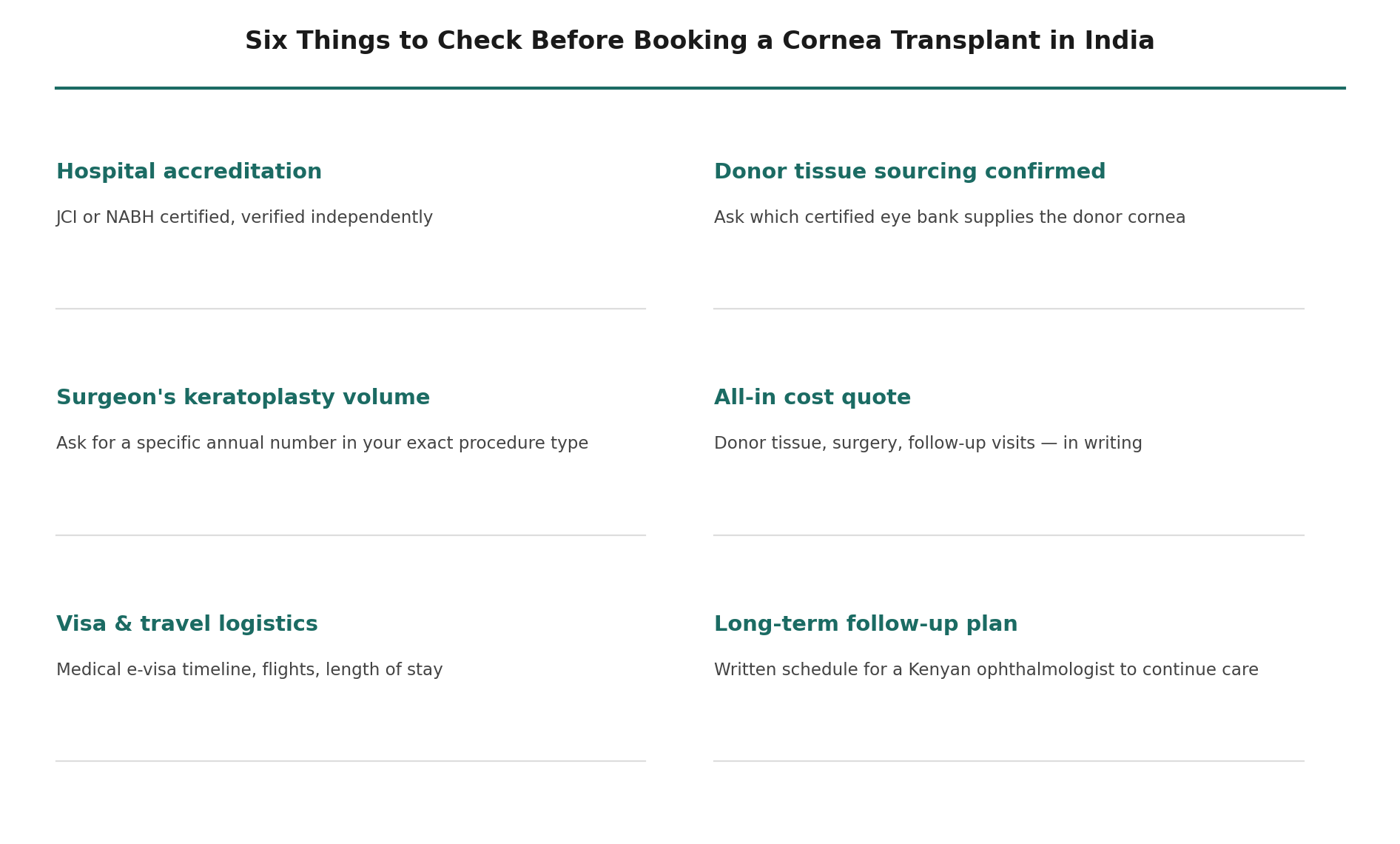
Given how much tissue sourcing and technique matter here, work through these questions directly.
Confirm genuine accreditation. Ask whether the hospital holds JCI or NABH certification, and verify it independently.
Confirm donor tissue sourcing. Ask which certified eye bank supplies the donor cornea and how tissue quality and safety are verified.
Ask about the surgeon's keratoplasty volume specifically. A specific number, how many procedures matching your exact condition the surgeon personally performs each year, tells you more than general ophthalmology reputation.
Get the full cost breakdown in writing. Confirm what's included, donor tissue, surgery, and follow-up visits.
Plan your visa and travel timeline. The Indian medical e-visa is typically issued within three to five working days once you have a formal hospital invitation letter.
Arrange your long-term follow-up plan before you leave. Agree on a written follow-up schedule and identify an ophthalmologist in Kenya who can continue monitoring your recovery.
Straight Answers for Kenyan Patients about Cornea Transplant and Advanced Eye Surgery in India
How severe is Kenya's cornea shortage?
Kenya's eye banks estimate the country needs at least 30,000 corneas nationwide to treat the backlog of preventable corneal blindness, with donations remaining difficult to secure due to deep cultural resistance around body donation after death.
How much does a cornea transplant cost in India compared to the US?
India typically costs 1,500 to 5,000 US dollars for a complete transplant, against 15,000 to 30,000 dollars in the US.
Why does Kenya specifically face higher rates of corneal blindness?
Kenya and Eastern Africa see a documented higher-than-average prevalence of keratoconus, a progressive corneal condition and a leading cause of corneal blindness across the region.
What's the difference between full-thickness and lamellar corneal transplant?
Penetrating keratoplasty replaces the full thickness of the cornea, used for severe damage. Lamellar techniques like DALK and DMEK replace only the specific damaged layer, preserving healthy tissue and generally offering faster recovery and lower rejection risk.
Can corneal cross-linking avoid the need for a transplant?
For keratoconus caught early, corneal cross-linking can stabilise the condition in roughly 90% of cases, potentially delaying or avoiding the need for a full transplant.
How do I get a medical visa to India from Kenya?
The Indian medical e-visa is typically issued within three to five working days once you have a formal invitation letter from the treating hospital.
A Closing Word
Corneal blindness is a genuinely fixable condition facing a genuinely specific obstacle in Kenya: not surgical skill, but donor tissue availability, compounded by a higher regional prevalence of keratoconus. India's developed eye banking infrastructure removes precisely that barrier, offering accredited, high-volume care at a fraction of Western cost, making it, for the great majority of Kenyan patients facing this diagnosis, a genuinely reliable path back to sight.
Sources
- 🌐 Kenya confronts critical cornea shortage amid cultural resistance. Citizen Digital, 2026
- 🌐 From Kenya to communities worldwide: Building partnerships to restore sight. Eversight Global, 2026. eversightvision.org/bl og
- 🌐 Corneal transplantation at Tenwek Hospital, Kenya, East Africa: Analysis of outcomes and associated patient socioeconomic characteristics
- 🌐 National Medical Commission of India — specialist registration verification
- 🌐 National Accreditation Board for Hospitals & Healthcare Providers (NABH) — accredited hospital directory
Frequently Asked Questions by Kenyans about Cornea Transplant and Advanced Eye Surgery in India
How serious is Kenya's cornea shortage?
Kenya's eye banks estimate that at least 30,000 corneas are needed nationwide to address the backlog of preventable corneal blindness.
Why is keratoconus important for Kenyan patients?
The guide highlights a higher-than-average prevalence of keratoconus in Kenya and Eastern Africa, making access to specialised corneal treatment particularly relevant.
What is the difference between DMEK, DALK and penetrating keratoplasty?
Penetrating keratoplasty replaces the full corneal thickness, while DALK and DMEK replace specific damaged layers and preserve healthier tissue.
Can cross-linking prevent a cornea transplant?
For early keratoconus, the guide states that corneal cross-linking can stabilise the condition in roughly 90% of cases, potentially delaying or avoiding transplantation.
Why does donor tissue sourcing matter?
The guide recommends confirming which certified eye bank supplies the donor cornea and how tissue quality and safety are verified before treatment.
How much does a cornea transplant cost in India?
The guide gives an approximate cost of US$1,500–5,000, including donor tissue and surgery.
How does India's cost compare with Kenya?
Private cornea transplantation in Kenya is estimated at approximately US$3,000–8,000, compared with US$1,500–5,000 in India.
How long should Kenyan patients stay in India?
The guide recommends approximately one to two weeks for the procedure and early follow-up, although visual recovery may take much longer.
What should patients check before booking?
The guide recommends verifying JCI or NABH accreditation, donor tissue sourcing, procedure-specific surgeon volume, complete costs, travel arrangements and long-term follow-up.
What should be arranged before returning to Kenya?
Patients should have a written ophthalmology follow-up schedule and identify an ophthalmologist in Kenya who can continue monitoring recovery.
Page Summary
This five-page guide focuses on corneal blindness, donor tissue availability and advanced keratoplasty options for Kenyan patients. Pages 1–2 explain Kenya's estimated 30,000-cornea shortage, higher regional prevalence of keratoconus and the differences between full-thickness and lamellar transplantation. Page 3 compares cornea transplant costs in India, Kenya, the UK and US, while the page 4 “Six Things to Check” graphic highlights accreditation, donor tissue sourcing, surgeon-specific keratoplasty volume, complete costing, visa and travel logistics, and long-term follow-up.
Citation Block
| Topic | Information |
|---|---|
| Topic | Cornea Transplant & Advanced Eye Surgery in India for Kenyan Patients |
| Treatment | Cornea Transplant / Keratoplasty |
| Patients | Kenyan Patients |
| First Assessment | Corneal condition, severity and imaging |
| Key Specialist | Corneal Surgeon / Ophthalmologist |
| Surgical Options | Penetrating Keratoplasty, DALK and DMEK |
| Keratoconus Treatment | Corneal cross-linking where appropriate |
| Donor Tissue | Certified eye bank sourcing |
| Case Volume | Procedure-specific keratoplasty experience |
| Hospital Check | JCI / NABH accreditation |
| Cost Check | Written estimate covering donor tissue, surgery and follow-up |
| India Cost | US$1,500–5,000 |
| Kenya Cost | US$3,000–8,000 private |
| Medical Records | Eye reports and imaging |
| Visa Planning | Indian medical e-visa with hospital invitation |
| Travel | Nairobi–India flights |
| Stay | Approximately 1–2 weeks |
| Follow-Up | Written ophthalmology follow-up plan |
| Surgeon Question | How many procedures matching my corneal condition do you perform each year? |
| Tissue Question | Which certified eye bank supplies my donor cornea? |
| Technique Question | Why is DMEK, DALK or penetrating keratoplasty appropriate for my condition? |
| Cost Question | Does the quotation include donor tissue, surgery and follow-up visits? |
| Follow-Up Question | Which ophthalmologist in Kenya will continue my monitoring? |
| Warning Signs | Unclear donor tissue source or limited procedure-specific experience |
| Payment Warning | Incomplete written treatment quotation |
| Key Decision | Verify donor tissue sourcing, corneal expertise and appropriate transplant technique |


Our Mission Statement
Our mission is to place patients at the centre of every healthcare decision by providing trustworthy, evidence-based, and unbiased medical information. We believe that informed patients make better decisions. Backed by personalised guidance from our experienced advisory team, we help patients understand their treatment options, compare them objectively, and confidently choose the path that best suits their medical needs and personal circumstances.
Patient Testimonials from Kenya

Ready to Take the First Step?
Share your Medical Reports with our Healthcare Managers Today and Get a FREE CONSULTATION, a Personalized Treatment Plan, and Complete Support from Arrival to Recovery.
Get Your Free ConsultationAreas We Serve
This resource has been thoughtfully prepared for patients from Kenya who are considering medical treatment in India. We also welcome patients from the wider region in the countries mentioned below-
We assist patients from:
- Ethiopia
- Somalia
- Tanzania
- Uganda
- Seychelles
- Guinea
- Guinea-Bissau
- Liberia
- Mali
- Mauritania
- Niger
- Nigeria
- Senegal
- Togo
- South Sudan
- Sierra Leone
Many of the insights, treatment pathways, hospital recommendations, travel guidance, and patient support services described here are equally relevant and may be used as a reference when planning treatment in India.
From Kenya to India: Your Complete Patient Support Guide
- Brain Tumour Surgery in India for Kenyan Patients
- Cancer Treatment and Surgery in India for Kenyan Patients
- Cardiac Treatment and Surgery in India for Kenyan Patients
- Heart Valve Replacement Surgery in India for Kenyan Patients
- Knee Replacement in India for Kenyan Patients
- Prostate Cancer Treatment and Surgery in India for Kenyan Patients
- Spine Treatment and Surgery in India for Kenyan Patients
- Selecting the Best Bariatric Surgeons and Hospitals in India: What Kenyan Patients Should Actually Look For
- Selecting the Best Cancer Surgeons and Hospitals in India: What Kenyan Patients Should Actually Look For
- Selecting the Best Cardiac Surgeons and Hospitals in India: What Kenyan Patients Should Actually Look For
- Selecting the Best Dental Surgeons and Clinics in India: What Kenyan Patients Should Actually Look For
- Selecting the Best Hip Surgeons and Hospitals in India: What Kenyan Patients Should Actually Look For
- Selecting the Best Kidney Transplant Surgeons and Hospitals in India: What Kenyan Patients Should Actually Look For
- Selecting the Best Knee Surgeons and Hospitals in India: What Kenyan Patients Should Actually Look For
- Selecting the Best Liver Transplant Surgeons and Hospitals in India: What Kenyan Patients Should Actually Look For
- Selecting the Best Neurosurgeons and Hospitals in India: What Kenyan Patients Should Actually Look For
- Selecting the Best Prostate Cancer Surgeons and Hospitals in India: What Kenyan Patients Should Actually Look For
- Selecting the Best Spine Surgeons and Hospitals in India: What Kenyan Patients Should Actually Look For