

Selecting the Best Radiotherapy and Cancer Treatment Centres in India: What Kenyan Patients Should Actually Look For
Radiotherapy only cures as a complete course — ask whether the centre can finish your treatment, brachytherapy included, not merely start it.
Modern cancer treatment rarely means one thing anymore. A cure, where a cure is possible, usually comes from a specific combination, surgery, radiotherapy, chemotherapy, sometimes immunotherapy or targeted drugs, delivered in a particular sequence within a particular timeframe. Across 24 years of guiding international patients through Indian hospitals, the cases I find hardest to accept are not the ones where a cancer proved too advanced to treat. They are the ones where the right combination existed, was medically indicated, and simply wasn't completed. This is the framework I use when a Kenyan patient is weighing radiotherapy and modern cancer treatment in India, across the many cancer types this covers. It follows the surgeon-then-hospital structure of this series, and opens with a statistic that should change how every Kenyan family thinks about what "getting radiotherapy" actually means.
Healing Journeys of Kenyan Patients
Key Takeaways
- The guide stresses that starting cancer treatment is not the same as completing the medically required treatment combination. Cervical cancer is used as the clearest example, where curative treatment for locally advanced disease may require external beam radiotherapy, chemotherapy and brachytherapy.
- A prospective study of 355 cervical cancer patients at Kenyatta National Hospital found that only 6.7% received the complete curative-intent combination. More than 80% presented with advanced disease and 42% were lost to follow-up, highlighting the importance of treatment continuity.
- The guide does not suggest that every Kenyan cancer patient needs to travel to India. Early-stage cancers that can be cured with surgery alone, or straightforward radiotherapy where brachytherapy is not required, may reasonably be treated in Kenya. India becomes more relevant when complete multi-modality treatment, brachytherapy or complex chemoradiation is required.
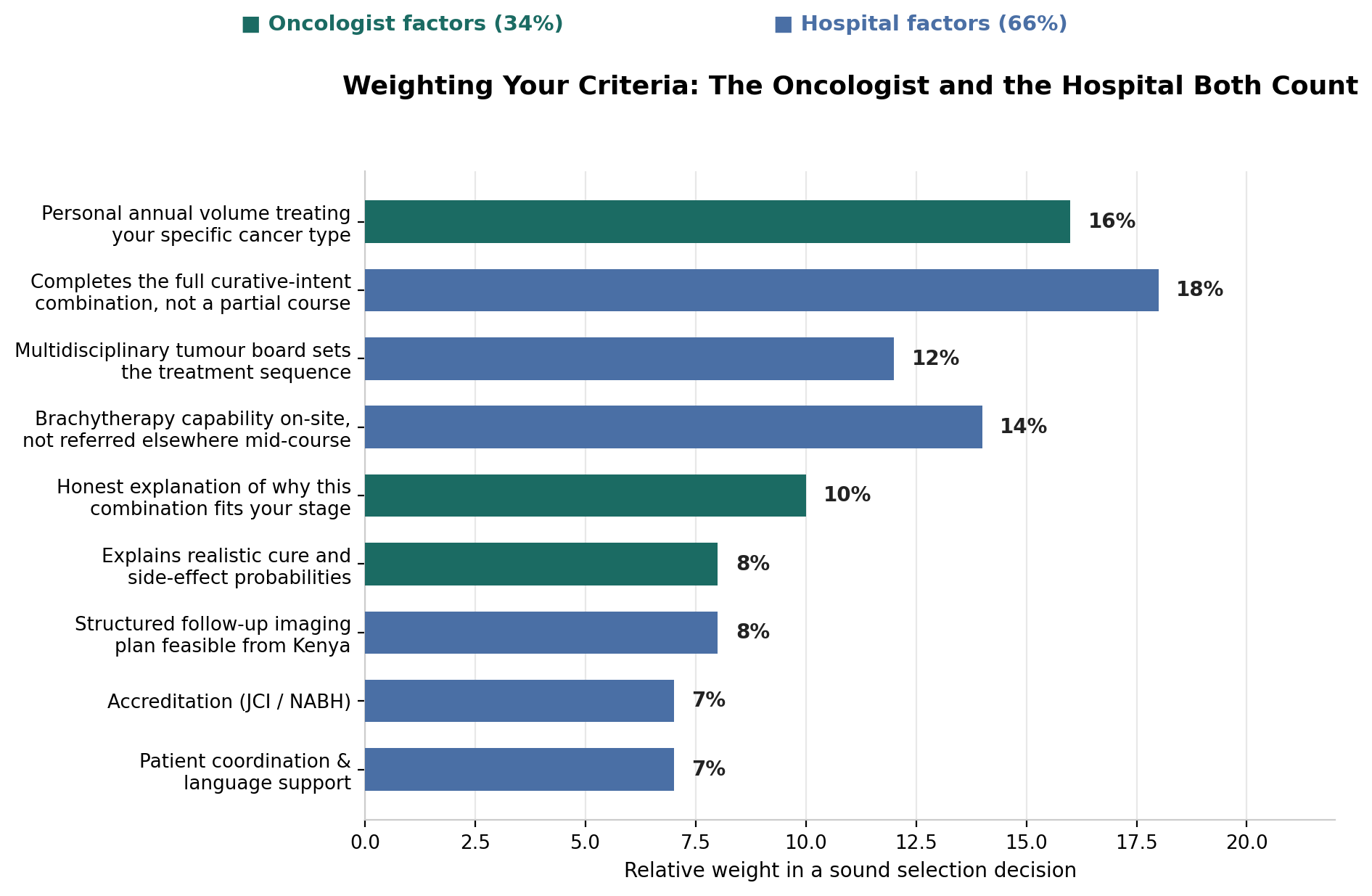
- The page 3 weighting chart gives 34% to oncologist factors and 66% to hospital factors. Personal annual treatment volume for the specific cancer type receives 16%, while completing the full curative-intent combination receives the highest individual weighting at 18%. Brachytherapy capability receives 14%.
- Hospital selection should focus on whether all medically indicated treatment components can be delivered at the same centre. A multidisciplinary tumour board, on-site brachytherapy where required, structured follow-up imaging and coordinated surgery, radiotherapy and chemotherapy are key considerations. JCI/NABH accreditation is presented as a safety filter rather than proof of complete cancer-treatment capability.
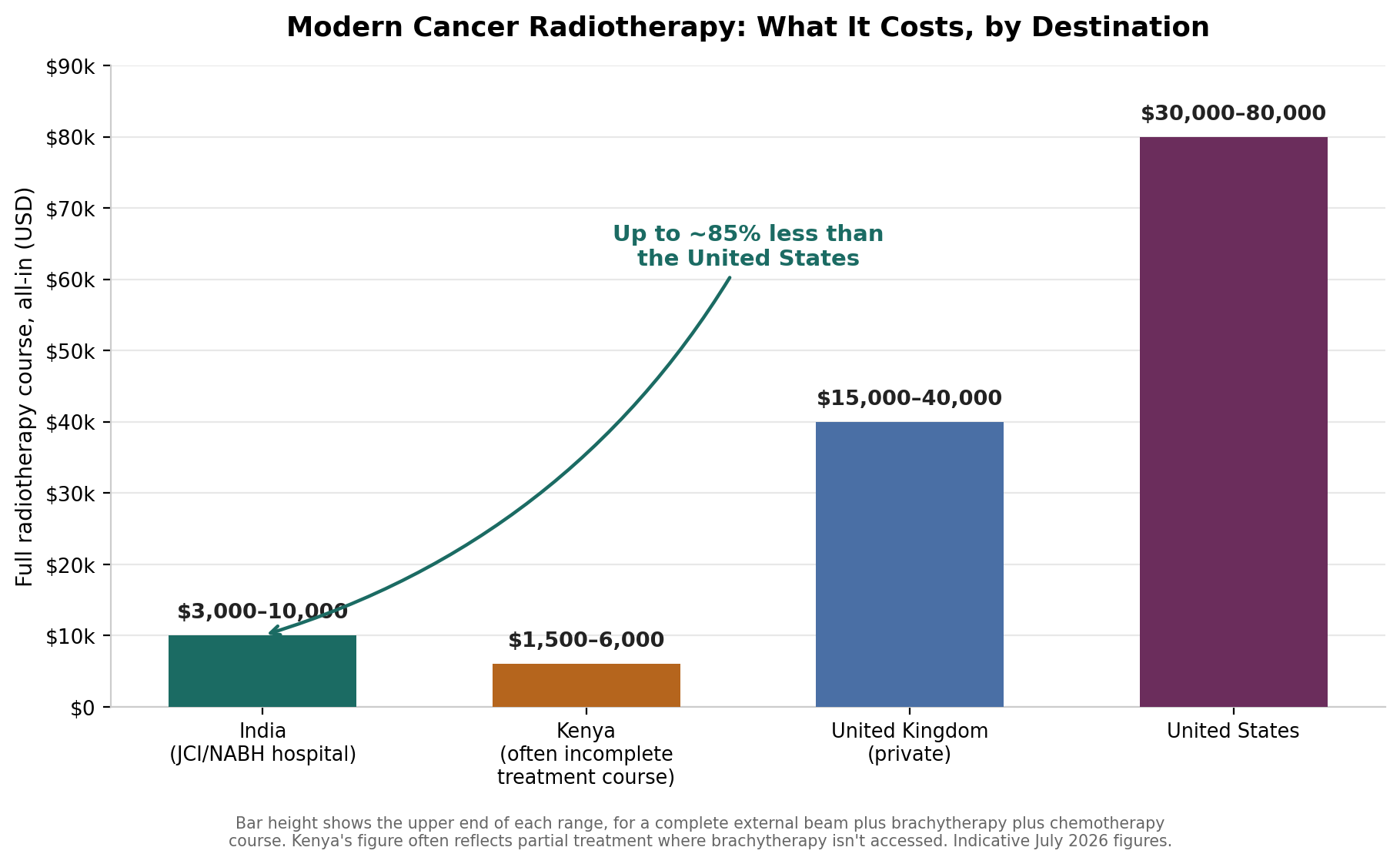
- The page 4 cost chart gives an indicative range of US$3,000–10,000 in India for a complete radiotherapy-based combination course, compared with US$1,500–6,000 in Kenya, US$15,000–40,000 in the UK and US$30,000–80,000 in the US. Patients should confirm that every required component is included rather than receiving separate quotations that could create treatment gaps.
Quick Facts
- Author
- Dr. Dheeraj Bojwani
- Experience
- 24+ Years of Experience
- Treatment
- Radiotherapy & Modern Cancer Treatment
- Patients
- Kenyan Cancer Patients
- Key Specialist
- Radiation / Medical Oncologist
- Main Assessment
- Cancer type, stage and complete treatment requirement
- Key Priority
- Complete the medically indicated treatment combination
- Important Treatment
- Brachytherapy where clinically required
- Key Selection Factor
- Specific cancer-type treatment volume
- Hospital Requirement
- Complete multi-modality cancer treatment under one programme
- India Cost
- Approximately US$3,000–10,000
- Pre-Travel Records
- Full imaging and pathology
- Follow-Up
- Written imaging plan with Kenyan oncologist
- Key Warning Signs
- Missing treatment components or referral gaps
- Decision Principle
- Choose completeness, coordination and cancer-specific expertise
In Brief
For Kenyan cancer patients considering treatment in India, the guide recommends focusing on completeness of the treatment plan rather than radiotherapy alone. Patients should confirm their exact cancer stage, identify every medically indicated component—including chemotherapy, external beam radiotherapy and brachytherapy where applicable—and ensure these can be coordinated without referral gaps. The guide gives an indicative cost of US$3,000–10,000 for a complete course in India.
Before the oncologist: treatment that starts is not the same as treatment that finishes
Cervical cancer is the leading cause of cancer death among Kenyan women, and it also illustrates this problem more starkly than almost any other cancer. Curative-intent treatment for locally advanced cervical cancer requires a specific combination: external beam radiotherapy, chemotherapy, and critically, brachytherapy, radioactive sources placed directly inside or near the tumour, described in the medical literature as the gold standard component without which cure rates fall sharply.
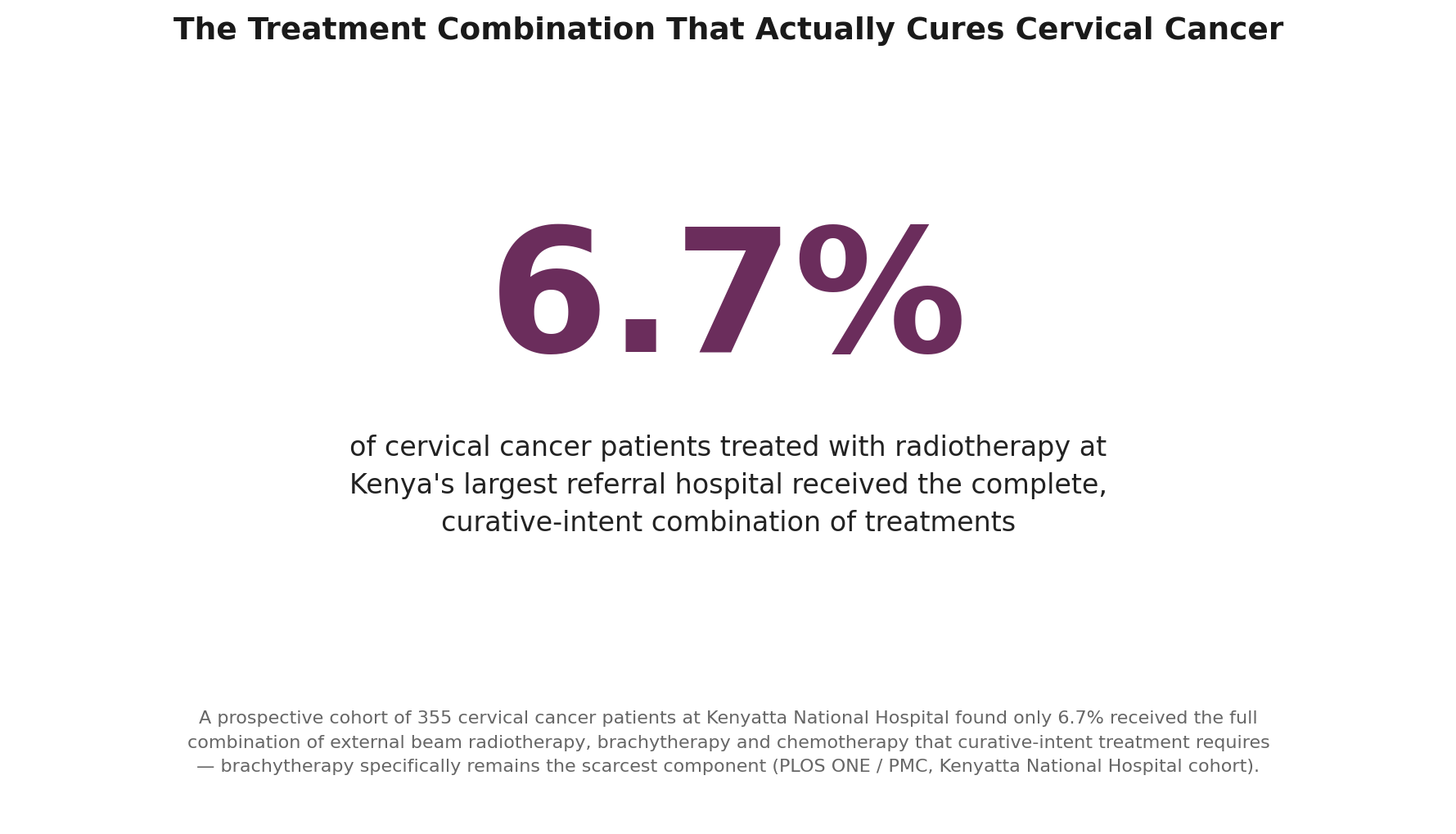
A prospective study of 355 cervical cancer patients treated at Kenyatta National Hospital found that only 6.7% received this complete combination. Just over 80% presented with advanced stage disease already, and 42% were lost to follow-up entirely. Brachytherapy specifically remains the scarcest link in the chain, since the specialised equipment and expertise it requires are concentrated in very few centres across the whole of Africa.
This pattern isn't unique to cervical cancer, but it illustrates a broader truth for cancer care in Kenya: the question that matters most isn't simply whether treatment is available, it's whether the complete, medically indicated combination is available, in the right sequence, without a gap that lets the cancer progress in the meantime. The practical takeaway is to ask, specifically, what the full recommended treatment combination is for your cancer type and stage, and to treat any plan that omits a component without a clear medical reason as a signal to get a second opinion.
Should you travel at all?
Kenya's cancer centres, including Kenyatta National Hospital, Aga Khan University Hospital Nairobi, and a small number of others, deliver genuine cancer care, and for early-stage cancers where surgery alone is curative, or where a straightforward radiotherapy course without brachytherapy is all that's medically indicated, treatment in Kenya is a reasonable starting point.
For cancers where the complete curative combination, particularly one involving brachytherapy, complex chemoradiation, or coordinated multi-modality treatment, is the standard of care, India is where I steer patients, confidently. India's leading cancer centres deliver the full combination in one place, on one timeline, without the gaps and referrals elsewhere that so often break the treatment chain, at a fraction of UK or US cost.
Part one: judging the oncologist
1. Personal annual volume treating your specific cancer type
I weight this above every other factor, and the chart below reflects that. Ask how many cases matching your specific cancer type and stage the oncologist personally treats each year.
2. An honest explanation of why this combination fits your stage
Ask the oncologist to explain, specifically, why the recommended combination of treatments fits your cancer's stage and type, referencing your own imaging and pathology, not a generic protocol.
3. Explains realistic cure and side-effect probabilities
Ask what your realistic chances of cure are with the complete recommended treatment, and what side effects to expect, both during treatment and afterward.
Part two: judging the hospital
For modern cancer treatment, hospital completeness carries even more weight than the individual oncologist, reflected in the balance above, because a treatment plan that cannot be delivered in full at one place is a plan at genuine risk of breaking down.
4. Completes the full curative-intent combination, not a partial course
Ask directly whether the hospital can deliver every component of your recommended treatment on-site, surgery, external beam radiotherapy, brachytherapy, and chemotherapy, without referring you elsewhere partway through.
5. Brachytherapy capability on-site, where relevant
If brachytherapy is part of your treatment, ask specifically about the hospital's brachytherapy volume and equipment, since this is precisely the component most often missing in incomplete treatment courses.
6. A multidisciplinary tumour board sets the treatment sequence
Ask whether your case is reviewed by a full tumour board including surgical, medical, and radiation oncology, not decided by a single specialist working in isolation.
7. A structured follow-up imaging plan feasible from Kenya
Ask what the follow-up imaging schedule looks like, and how results will be shared with a doctor in Kenya who can act on them locally.
8. Accreditation, read properly
JCI and NABH accreditation are meaningful filters on safety and infection control, but say nothing about completeness of cancer treatment capability specifically. Use accreditation to exclude weak candidates, not to
choose between the strong ones.
9. The cost you will actually pay
Let me be emphatic about this, because 24 years of handling these cases has taught me nothing more consistently: disputes almost never concern the quoted price. They concern what the quote silently omitted. For modern cancer treatment specifically, insist the estimate states every component of the combination and whether all are included in one package, not priced and scheduled separately in ways that create gaps.
Budget beyond the treatment. Direct Nairobi–Delhi and Nairobi–Mumbai flights run roughly 550 to 850 dollars return, and a complete radiotherapy and chemotherapy course often runs several weeks, so budget accommodation accordingly.
Four signals that should make you pause
Certain patterns reliably precede a difficult outcome. A treatment plan that omits a medically indicated component without a specific reason. No brachytherapy capability on-site when it's part of your plan. A quote that prices components separately in a way that could create scheduling gaps. And a hospital unable to describe how your specific combination will be sequenced.
None alone proves a bad hospital. Together they warrant a second opinion before you commit to treatment.
The Kenya-specific practicalities
Send the full imaging and pathology results, not just a summary letter, so the tumour board can confirm the
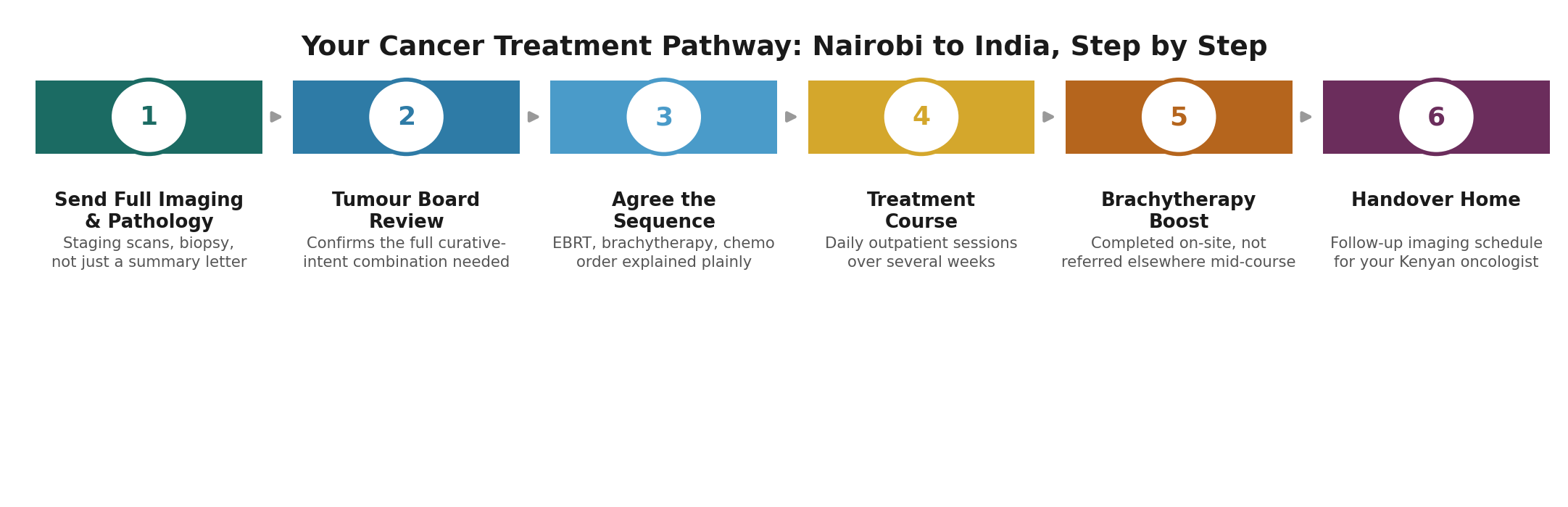
complete recommended treatment plan before you arrive.
Direct Nairobi–Delhi and Nairobi–Mumbai flights make this roughly a six-hour journey. The Indian medical e-visa is issued within three to five working days against a hospital letter, and an attendant can travel with you on a medical attendant visa.
Agree in advance on a written follow-up imaging schedule your Kenyan oncologist can act on, since ongoing monitoring is where much of your long-term cancer care will continue once you are home.
The questions I would ask before committing
Of the oncologist:
- How many cases matching my specific cancer type and stage do you personally treat each year?
- Why does this specific combination of treatments fit my stage?
- What are my realistic chances of cure, and what side effects should I expect?
Of the hospital:
- Can you deliver every component of my treatment on-site, without referring me elsewhere partway through?
- What is your brachytherapy volume and capability, if relevant to my case?
- Is my case reviewed by a full multidisciplinary tumour board?
- What exactly is excluded from the quoted price?
- May I speak to a previous East African patient treated for a similar cancer?
A team that answers all eight without irritation is very likely the right team. One that turns vague at the first or fourth has told you what you needed to know at no cost at all.
Straight Answers for Kenyan Patients about Radiotherapy and Cancer Treatment Centres in India
Why does treatment completeness matter more than just getting started?
Because many cancers, cervical cancer being a clear example, require a specific combination of treatments to achieve a cure, and a partial course, missing even one component like brachytherapy, can leave the cancer under- treated even though treatment technically began.
How much does a complete cancer treatment course cost in India for a Kenyan patient?
Typically 3,000 to 10,000 US dollars all in for a full combination course. The same treatment often runs incomplete in Kenya at 1,500 to 6,000 dollars, while the UK runs 15,000 to 40,000 and the US 30,000 to 80,000 for the complete course.
Why is cervical cancer treatment specifically so often incomplete in Kenya?
A study of 355 patients at Kenyatta National Hospital found only 6.7% received the complete combination of external beam radiotherapy, brachytherapy, and chemotherapy that curative-intent treatment requires, largely because brachytherapy equipment and expertise remain concentrated in very few centres across Africa.
What is brachytherapy, and why is it so important?
It's a form of radiation therapy where radioactive sources are placed directly inside or near a tumour, delivering a high, precise dose while sparing surrounding tissue. For cancers like cervical cancer, it's described as the gold- standard component of curative treatment, and its absence significantly reduces cure rates.
How do I know if my recommended treatment combination is complete?
Ask your oncologist to state, specifically, every component of your recommended treatment, surgery, radiotherapy type, chemotherapy, and whether brachytherapy applies to your case, then confirm whether all components are available at the same hospital without a referral gap.
Is India's cancer care really more complete than Kenya's?
For complex, multi-modality treatment combinations, generally yes. India's leading cancer centres are built to deliver surgery, radiotherapy, brachytherapy, and chemotherapy together, at the volume and continuity that prevents the kind of treatment gaps documented in Kenyan cohort studies.
A closing word
Modern cancer treatment succeeds or fails on completeness as much as on skill, and India offers what too many Kenyan patients currently go without: the full, medically indicated combination of treatments, delivered in one place, on one timeline, at a fraction of UK or US cost. The best oncologist is the one who explains exactly why your specific combination fits your case. The best hospital is the one that can deliver every part of it without a gap. If you would like me to look at your imaging and pathology and talk through honestly what your complete treatment plan should look like, send them across.
Sources
- 🌐 Analysis of Factors Contributing to the Low Survival of Cervical Cancer Patients Undergoing Radiotherapy in Kenya. PLOS ONE / PMC
- 🌐 Access to brachytherapy treatment for cervical cancer management in Africa
- 🌐 IAEA Study Reveals Global Potential of Image-Guided Cervical Cancer Treatment. International Atomic Energy Agency, 2026
- 🌐 National Medical Commission of India — surgeon and specialist registration verification
- 🌐 National Accreditation Board for Hospitals & Healthcare Providers (NABH) — accredited hospital directory
- 🌐 Kenya Social Health Authority (SHA) — benefits packages and overseas treatment guidance
Frequently Asked Questions by Kenyans about Radiotherapy and Cancer Treatment Centres in India
Why is treatment completeness important?
Some cancers require a specific combination of treatments to achieve the intended outcome. Missing a medically necessary component can leave treatment incomplete even when radiotherapy or chemotherapy has already started.
How important is brachytherapy?
For cancers such as cervical cancer, brachytherapy can be a critical component of curative treatment. The guide recommends confirming whether it applies to the patient's specific cancer and whether it is available on-site.
Should every Kenyan cancer patient travel to India?
No. Early-stage cancers and straightforward cases can be treated appropriately in Kenya. India may be more relevant when complex multi-modality treatment is required.
What did the Kenyan cervical cancer study find?
Among 355 patients at Kenyatta National Hospital, only 6.7% received the complete combination of external beam radiotherapy, brachytherapy and chemotherapy described as required for curative-intent treatment.
How should I choose an oncologist?
Ask how many patients with your specific cancer type and stage the oncologist personally treats each year and why the proposed treatment combination is appropriate for your case.
What should a suitable cancer hospital provide?
The hospital should ideally coordinate all required treatment components, including surgery, radiotherapy, brachytherapy and chemotherapy where applicable, through a multidisciplinary tumour board.
How much does a complete cancer treatment course cost in India?
The guide gives an indicative range of US$3,000–10,000 for a complete radiotherapy-based combination course. The exact cost depends on the cancer and treatment plan.
What should patients confirm in the quotation?
Ask whether every component of the recommended treatment combination is included and whether any component will require referral to another facility.
What should Kenyan patients send before travelling?
Send the full imaging and pathology results, rather than only a summary letter, so the tumour board can establish the complete treatment plan before travel.
How should follow-up be handled after returning to Kenya?
Agree on a written follow-up imaging schedule that can be shared with and acted upon by the patient's Kenyan oncologist, so monitoring continues after treatment in India.
Page Summary
This seven-page Kenya patient guide explains how patients can evaluate radiotherapy and modern cancer treatment centres in India, focusing on treatment completeness rather than radiotherapy alone. It highlights the 6.7% complete-treatment rate in the cited Kenyan cervical cancer study, the importance of brachytherapy where indicated, multidisciplinary treatment planning, hospital completeness and structured follow-up. The page 3 chart assigns 34% to oncologist factors and 66% to hospital factors, while the page 4 chart compares indicative treatment costs across India, Kenya, the UK and US. The page 5 pathway shows full imaging and pathology → tumour-board review → treatment sequence → treatment course → brachytherapy where required → handover to the Kenyan oncologist.
Citation Block
| Topic | Information |
|---|---|
| Topic | Radiotherapy & Modern Cancer Treatment in India for Kenyan Patients |
| Treatment | Radiotherapy, Chemotherapy & Brachytherapy where indicated |
| Patients | Kenyan Cancer Patients |
| Specialist | Radiation / Medical Oncologist |
| Main Assessment | Cancer type, stage and complete treatment requirement |
| Key Priority | Complete medically indicated treatment |
| Key Treatment | External beam radiotherapy + chemotherapy + brachytherapy where required |
| Surgeon/Oncologist Check | Annual volume for specific cancer type |
| Hospital Check | Full treatment combination available on-site |
| Tumour Board | Surgical, medical and radiation oncology |
| Brachytherapy | On-site capability where relevant |
| India Cost | Approximately US$3,000–10,000 |
| Kenya Cost | Approximately US$1,500–6,000 |
| UK Cost | Approximately US$15,000–40,000 |
| US Cost | Approximately US$30,000–80,000 |
| Pre-Travel Records | Full imaging and pathology |
| Follow-Up | Structured imaging plan with Kenyan oncologist |
| Selection Weighting | 34% oncologist and 66% hospital |
| Top Criterion | Complete curative-intent combination – 18% |
| Key Statistic | 6.7% received the complete combination in the cited KNH study |
| Warning Signs | Missing treatment component, absent brachytherapy or referral gaps |
| Patient Pathway | Imaging/pathology → tumour board → treatment sequence → treatment → brachytherapy → Kenya follow-up |
| Decision Principle | Choose a centre that can deliver the complete treatment plan without gaps |


Our Mission Statement
Our mission is to place patients at the centre of every healthcare decision by providing trustworthy, evidence-based, and unbiased medical information. We believe that informed patients make better decisions. Backed by personalised guidance from our experienced advisory team, we help patients understand their treatment options, compare them objectively, and confidently choose the path that best suits their medical needs and personal circumstances.
Patient Testimonials from Kenya
Ready to Take the First Step?
Share your Medical Reports with our Healthcare Managers Today and Get a FREE CONSULTATION, a Personalized Treatment Plan, and Complete Support from Arrival to Recovery.
Get Your Free ConsultationAreas We Serve
This resource has been thoughtfully prepared for patients from Kenya who are considering medical treatment in India. We also welcome patients from the wider region in the countries mentioned below-
We assist patients from:
- Ethiopia
- Somalia
- Tanzania
- Uganda
- Seychelles
- Guinea
- Guinea-Bissau
- Liberia
- Mali
- Mauritania
- Niger
- Nigeria
- Senegal
- Togo
- South Sudan
- Sierra Leone
Many of the insights, treatment pathways, hospital recommendations, travel guidance, and patient support services described here are equally relevant and may be used as a reference when planning treatment in India.
From Kenya to India: Your Complete Patient Support Guide
- Brain Tumour Surgery in India for Kenyan Patients
- Cancer Treatment and Surgery in India for Kenyan Patients
- Cardiac Treatment and Surgery in India for Kenyan Patients
- Heart Valve Replacement Surgery in India for Kenyan Patients
- Knee Replacement in India for Kenyan Patients
- Prostate Cancer Treatment and Surgery in India for Kenyan Patients
- Spine Treatment and Surgery in India for Kenyan Patients
- Selecting the Best Bariatric Surgeons and Hospitals in India: What Kenyan Patients Should Actually Look For
- Selecting the Best Cancer Surgeons and Hospitals in India: What Kenyan Patients Should Actually Look For
- Selecting the Best Cardiac Surgeons and Hospitals in India: What Kenyan Patients Should Actually Look For
- Selecting the Best Dental Surgeons and Clinics in India: What Kenyan Patients Should Actually Look For
- Selecting the Best Hip Surgeons and Hospitals in India: What Kenyan Patients Should Actually Look For
- Selecting the Best Kidney Transplant Surgeons and Hospitals in India: What Kenyan Patients Should Actually Look For
- Selecting the Best Knee Surgeons and Hospitals in India: What Kenyan Patients Should Actually Look For
- Selecting the Best Liver Transplant Surgeons and Hospitals in India: What Kenyan Patients Should Actually Look For
- Selecting the Best Neurosurgeons and Hospitals in India: What Kenyan Patients Should Actually Look For
- Selecting the Best Prostate Cancer Surgeons and Hospitals in India: What Kenyan Patients Should Actually Look For
- Selecting the Best Spine Surgeons and Hospitals in India: What Kenyan Patients Should Actually Look For