

Selecting the Best Proton Therapy Centres in India: What Kenyan Patients Should Actually Look For
Not one proton therapy centre operates in Africa — for a child with a tumour beside the developing brain, that gap is the whole decision.
Proton therapy is radiotherapy with a fundamentally different physics behind it. Conventional radiation passes through the body, depositing damaging energy along the entire path in and out of the tumour. A proton beam stops precisely where the tumour is, depositing most of its energy right there and almost nothing beyond it. For most cancers, this distinction matters less than the marketing suggests. For a specific group of patients, tumours near the brainstem, spine, or eye, and above all, children, it can be the difference between curing cancer and curing cancer while sparing a developing brain, spine, or set of organs from radiation damage that lasts a lifetime. Across 24 years of guiding international patients through Indian hospitals, this is the technology I am most careful never to oversell, and most insistent on when a case is genuinely right for it. This is the framework I use when a Kenyan patient, often a parent of a child with cancer, is weighing proton therapy in India. It follows the surgeon-then-hospital structure of this series, and opens with a fact that has no exception in this report: proton therapy does not currently exist anywhere in Sub-Saharan Africa.
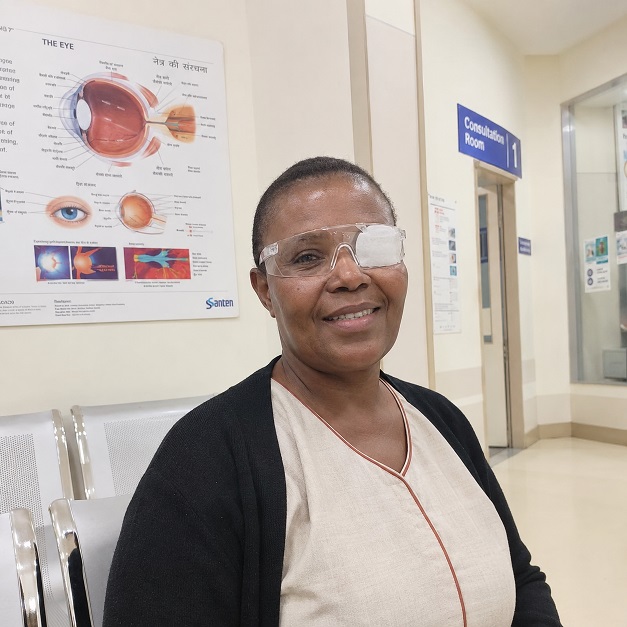
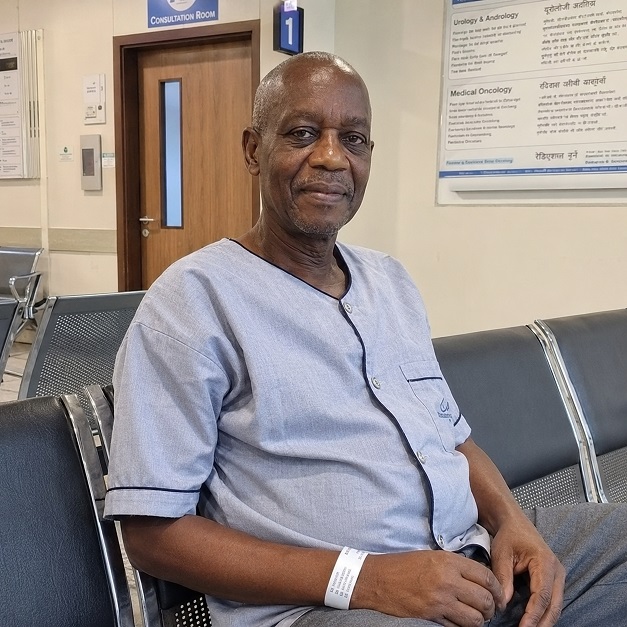
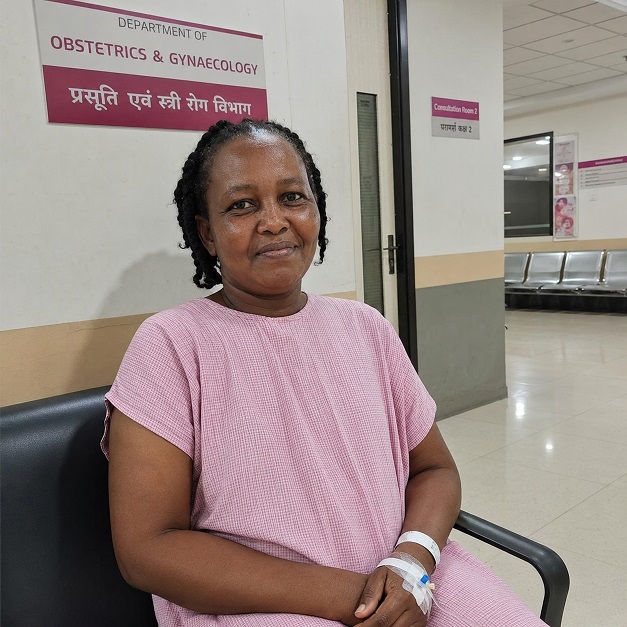
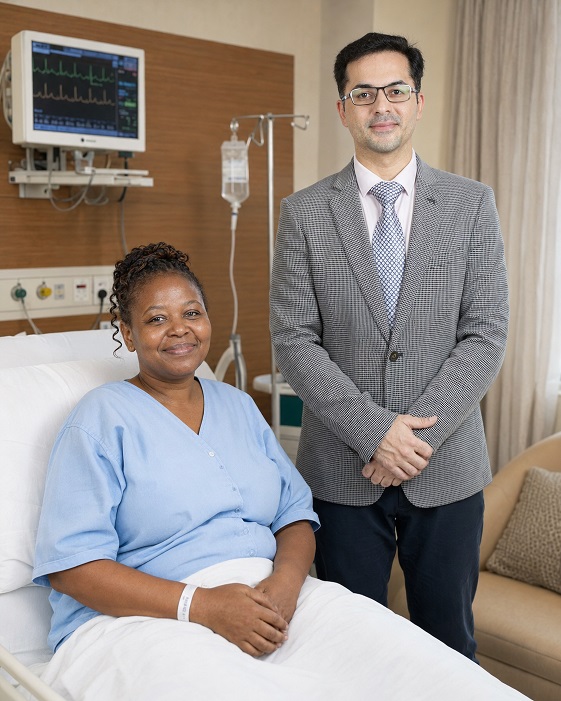
Healing Journeys of Kenyan Patients


Key Takeaways
- The guide explains that proton therapy is not automatically better than conventional radiotherapy. Its main advantage is the ability to reduce radiation exposure beyond the tumour, making it particularly relevant for selected tumours near critical structures such as the brainstem, spine and eye, and especially for children.
- The guide highlights a major regional access gap: no proton therapy centre currently operates in Sub-Saharan Africa. This means Kenyan patients who are genuine candidates must travel internationally, with India presented as the nearest established and accessible option discussed in the guide.
- Children are given particular emphasis because developing organs can be more vulnerable to radiation-related long-term effects. Proton therapy may help reduce risks involving growth, hormonal function, cognition and second cancers, but the oncologist should first explain whether proton therapy provides a meaningful benefit for the child's specific tumour.
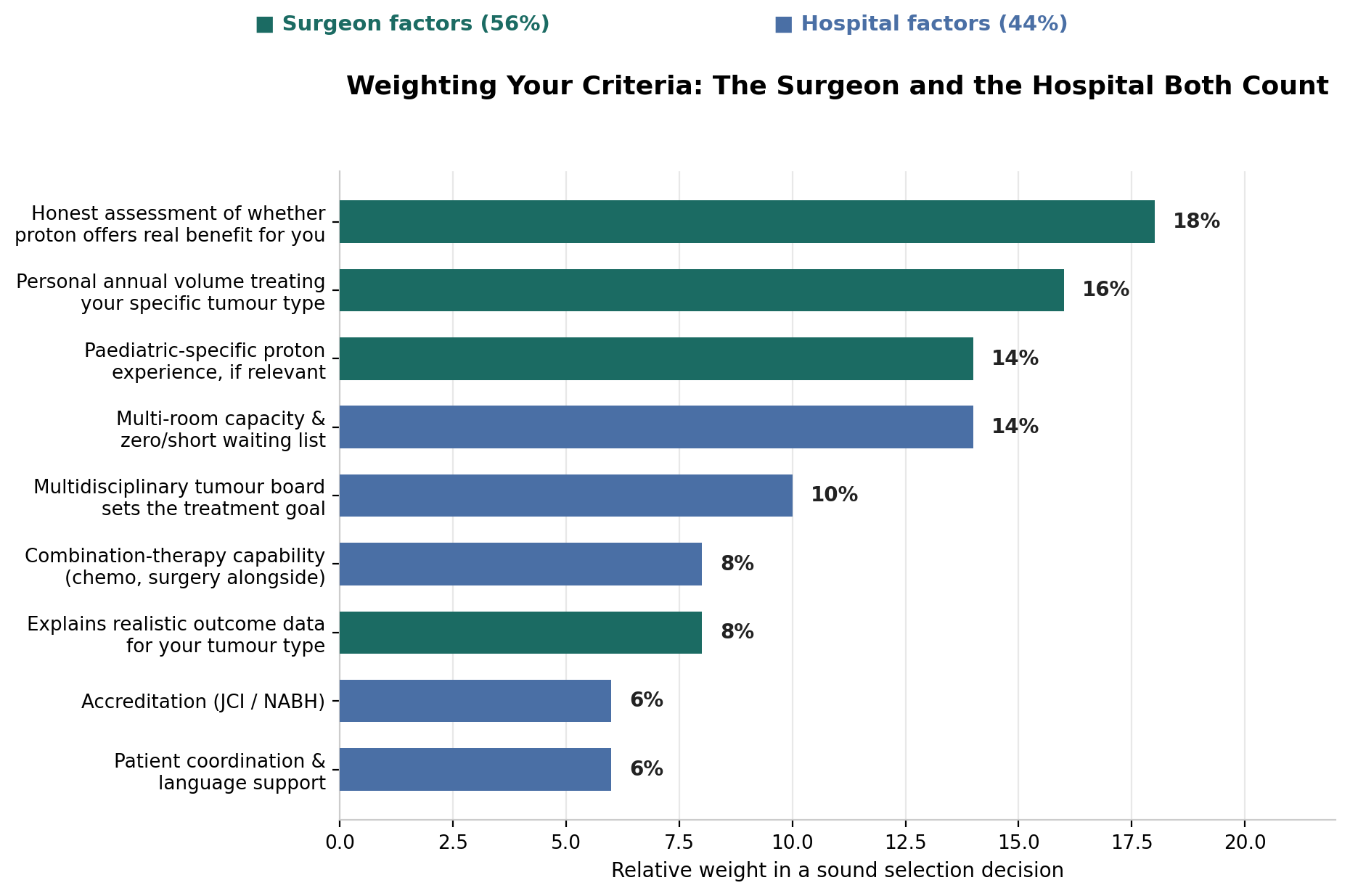
- The page 3 weighting chart assigns 56% to oncologist factors and 44% to hospital factors. An honest assessment of whether proton therapy genuinely benefits the patient receives the highest weighting at 18%, followed by personal annual experience with the specific tumour type at 16% and paediatric proton experience at 14%.
- Hospital selection should focus on multi-room capacity, short waiting times, multidisciplinary tumour-board review and the ability to coordinate chemotherapy or surgery when required. The guide also recommends checking the specific proton programme's experience rather than relying only on the hospital's overall reputation or accreditation.
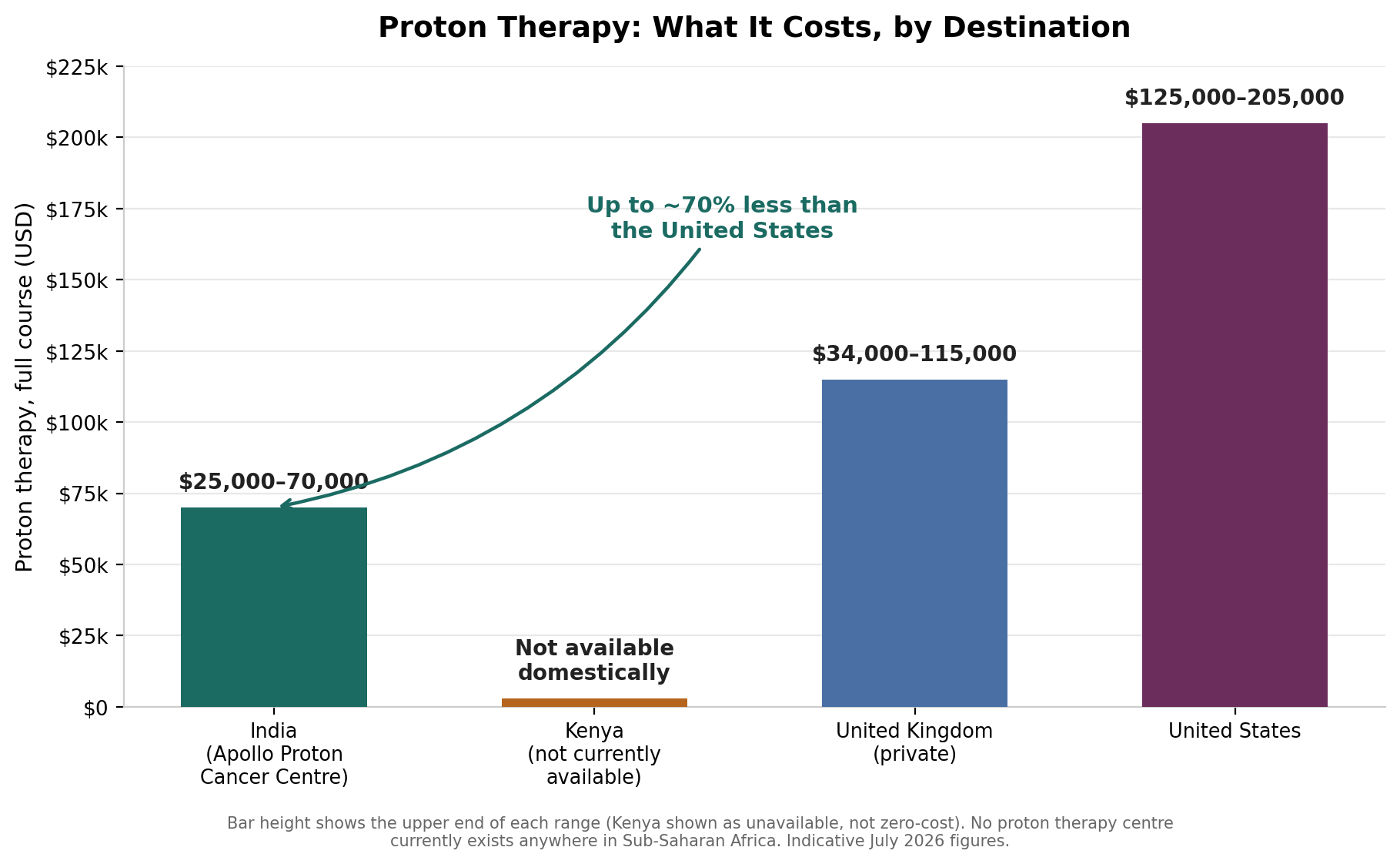
- The page 4 cost chart gives an indicative range of US$25,000–70,000 for a full proton therapy course in India, compared with US$34,000–115,000 in the UK and US$125,000–205,000 in the US. Treatment commonly lasts five to seven weeks with daily outpatient sessions, so accommodation and the full duration of stay should be planned in advance.
Quick Facts
- Author
- Dr. Dheeraj Bojwani
- Experience
- 24+ Years of Experience
- Treatment
- Proton Therapy
- Patients
- Kenyan Cancer Patients
- Key Specialist
- Radiation Oncologist / Proton Therapy Specialist
- Main Assessment
- Tumour type, location and potential benefit over conventional radiotherapy
- Key Priority
- Confirm genuine proton therapy candidacy
- Best-Suited Cases
- Selected tumours near critical structures and paediatric cancers
- Key Selection Factor
- Experience with the specific tumour type
- Hospital Requirement
- Multi-room proton facility with short waiting time
- Treatment Duration
- Approximately 5–7 weeks
- India Cost
- Approximately US$25,000–70,000
- UK Cost
- Approximately US$34,000–115,000
- US Cost
- Approximately US$125,000–205,000
- Pre-Travel Records
- Complete imaging and pathology
- Follow-Up
- Written imaging plan with Kenyan oncologist
- Key Warning Signs
- Proton recommended without explaining its specific benefit or unclear treatment timeline
- Decision Principle
- Choose proton therapy only when it offers a meaningful clinical advantage
In Brief
For Kenyan patients considering proton therapy in India, the guide recommends first confirming that proton therapy will provide a meaningful advantage over modern conventional radiotherapy for the specific tumour. This is particularly important for children and tumours near critical structures. The guide gives an indicative cost of US$25,000–70,000 for a full course in India, with treatment commonly lasting five to seven weeks.
Before the oncologist: a continent-wide gap, and why children carry the heaviest cost
As of the most recent global count, roughly 106 proton therapy centres operate worldwide. None are in Africa. A centre is in the planning stages in Cape Town, but as of today, a Kenyan patient who is a genuine proton therapy candidate has no domestic or even regional option; the nearest established centres are in Egypt's early development, India, Europe, or the Gulf.
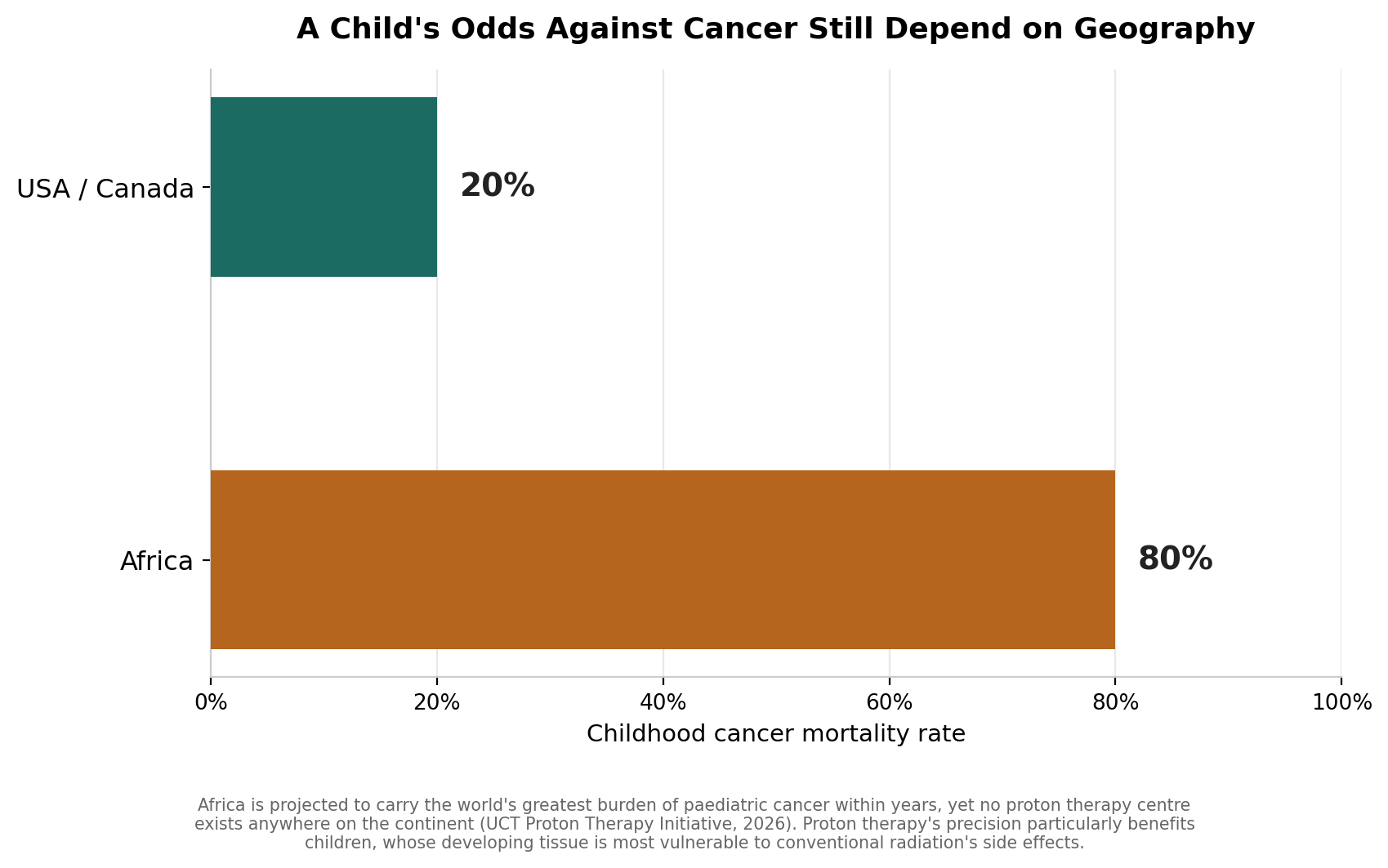
This gap falls hardest on children. Africa's childhood cancer mortality rate stands at roughly 80%, against roughly 20% in the United States and Canada, and the continent is projected to carry the world's greatest burden of paediatric cancer within the next few years as its child population grows. Part of this gap is diagnosis and general treatment access, covered elsewhere in this series. But part of it is specific to radiotherapy technique: a child's developing brain, spine, and organs are far more vulnerable to the scatter radiation of conventional treatment than an adult's, and proton therapy's precision exists specifically to reduce that harm, lowering the risk of growth problems, hormone deficiencies, cognitive effects, and second cancers that can follow standard radiotherapy in a child.
The practical takeaway is to ask early, and directly, whether your case, or your child's, is a genuine proton therapy candidate. Not every tumour benefits meaningfully from this technology, and an honest oncologist should be able to explain specifically why proton therapy would or wouldn't change your outcome compared to modern conventional radiotherapy, rather than presenting it as automatically superior.
Should you travel at all?
There is no straightforward-case exception in this report. Kenya's radiation oncology capacity, including the radiation oncology department at Kenyatta National Hospital, is genuinely engaged with the global conversation about paediatric radiotherapy, but no facility in the country, or the region, offers proton therapy. For a genuine candidate, travel is not a matter of preference between options; it is the only way to access this treatment at all.
India is where I steer patients, confidently and without qualification here, because it is the closest, most accessible, most cost-effective option, and it is not incidental that the Kenyan government signed a memorandum of understanding with Apollo Hospitals specifically covering cancer treatment, including proton therapy, in 2022. Apollo's Chennai centre is South Asia, the Middle East, and Africa's only fully established proton therapy facility, treats international patients without the waiting lists common in Europe, and has a dedicated paediatric oncology programme built around exactly this population.
Part one: judging the oncologist
1. An honest assessment of whether proton offers real benefit for you
I weight this above every other factor, and the chart below reflects that. Ask the oncologist to explain specifically why proton therapy would improve your outcome compared to modern conventional radiotherapy for your tumour, not a generic answer about precision.
2. Personal annual volume treating your specific tumour type
Ask how many cases matching your tumour type and location the oncologist has personally treated with proton therapy. Brain, spinal, and paediatric cases each demand different expertise.
3. Paediatric-specific proton experience, if relevant
For a child, ask specifically about paediatric proton experience, including how anaesthesia is managed for young children who need to stay still for daily sessions over several weeks.
4. Explains realistic outcome data for your tumour type
Ask what outcomes look like specifically for your tumour type and stage, referencing published data, not a general statement about proton therapy's advantages.
Part two: judging the hospital
For proton therapy, facility capacity carries real weight alongside the oncologist, reflected in the balance above, because a treatment plan delayed by a long waiting list can undermine even the best clinical decision.
5. Multi-room capacity and a short or zero waiting list
Ask how quickly treatment can begin once your case is confirmed. Single-room centres in Europe often carry long waiting lists; ask directly what the realistic timeline is wherever you're considering.
6. A multidisciplinary tumour board sets the treatment goal
Ask whether your case is reviewed by a team including radiation oncology, medical oncology, and paediatric oncology if relevant, not decided by one specialist alone.
7. Combination-therapy capability
Ask whether the centre can coordinate chemotherapy or surgery alongside proton therapy if your case needs combined treatment.
8. Accreditation, read properly
JCI and NABH accreditation are meaningful filters on safety and infection control, but confirm the specific proton therapy programme's own track record and volume, not just the hospital group's general reputation.
9. The cost you will actually pay
Let me be emphatic about this, because 24 years of handling these cases has taught me nothing more consistently: disputes almost never concern the quoted price. They concern what the quote silently omitted. For proton therapy specifically, insist the estimate states how many sessions are included, what happens if more are needed, and whether anaesthesia for a young child is included or billed separately.
Budget beyond the treatment. Direct Nairobi–Delhi and Nairobi–Mumbai flights run roughly 550 to 850 dollars return, and because proton therapy courses often run five to seven weeks of daily outpatient sessions, budget accommodation for the full duration, longer than almost any other treatment in this series.
Four signals that should make you pause
Certain patterns reliably precede a difficult outcome. An oncologist who recommends proton therapy without explaining specifically why it beats conventional radiotherapy for your case. No clear personal volume figure in your tumour type. A quote that doesn't specify the number of sessions included. And a centre unable to describe its realistic waiting time honestly.
None alone proves a bad centre. Together they warrant a second opinion before you commit to treatment.
The Kenya-specific practicalities
Send the full imaging and pathology results, not just a summary letter, so the tumour board can assess genuine
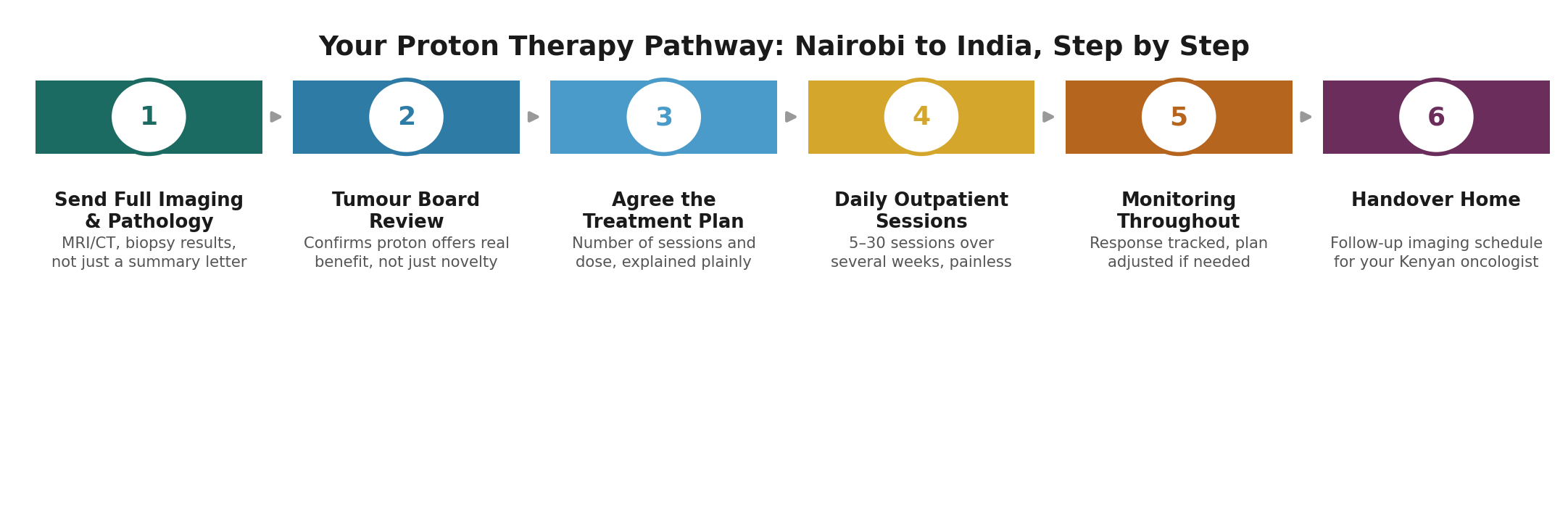
proton candidacy before you travel, since not every case will qualify.
Direct Nairobi–Delhi and Nairobi–Mumbai flights make this roughly a six-hour journey. The Indian medical e-visa is issued within three to five working days against a hospital letter, and up to two attendants can travel on a medical attendant visa, which matters given how long treatment courses run.
Given the length of stay, ask about accommodation support near the treatment centre in advance, and agree on a written follow-up imaging plan your Kenyan oncologist can act on once you are home.
The questions I would ask before committing
Of the oncologist:
- Why does proton therapy specifically improve my outcome compared to conventional radiotherapy?
- How many cases matching my tumour type have you personally treated with proton therapy?
- If this is for my child, what is your specific paediatric proton experience?
- What does published outcome data show for my specific tumour type?
Of the hospital:
- What is the realistic waiting time before treatment can begin?
- Is my case reviewed by a full multidisciplinary tumour board?
- Can you coordinate chemotherapy or surgery alongside this if needed?
- What exactly is excluded from the quoted price?
- May I speak to a previous East African family treated for a similar case?
A team that answers all nine without irritation is very likely the right team. One that turns vague at the first or second has told you what you needed to know at no cost at all.
Straight Answers for Kenyan Patients about Proton Therapy Centres in India
Is proton therapy available anywhere in Africa?
No. As of today, no proton therapy centre operates anywhere in Sub-Saharan Africa. A centre is in early planning in Cape Town, but for now, India remains the nearest accessible, established option for Kenyan patients.
How much does proton therapy cost in India for a Kenyan patient?
Typically 25,000 to 70,000 US dollars for a full treatment course, compared to 34,000 to 115,000 in the UK and 125,000 to 205,000 in the US, a saving of up to roughly 70% against US pricing.
Is proton therapy always better than conventional radiotherapy?
No. For many cancers, modern conventional radiotherapy achieves equivalent results. Proton therapy's real advantage is concentrated in specific situations, tumours near critical structures like the brainstem or spine, and especially children, where sparing healthy developing tissue matters most.
Why does proton therapy matter so much for children specifically?
Because a child's brain, spine, and organs are still developing and are more vulnerable to radiation scatter than an adult's. Proton therapy's precision reduces the risk of long-term growth, hormonal, cognitive, and second-cancer effects that can follow conventional radiotherapy in children.
Does Kenya have any government support for proton therapy in India?
Kenya's government signed a memorandum of understanding with Apollo Hospitals in 2022 specifically covering cancer treatment access, including proton therapy, reflecting the absence of any domestic or regional alternative.
How long does a proton therapy course take?
Typically five to seven weeks of daily outpatient sessions, five days a week, each session lasting under an hour. This is a longer commitment than most other treatments in this series, so plan accommodation accordingly.
A closing word
For the specific patients who genuinely need it, above all children with tumours near critical developing structures, proton therapy in India is not simply the more affordable option, it is currently the only accessible one anywhere near Kenya. The best oncologist is the one honest enough to say when proton therapy won't meaningfully change your outcome, not just when it will. The best hospital pairs that honesty with genuine capacity, a real paediatric programme, and no unnecessary wait. If you would like me to look at your or your child's scans and pathology and talk through honestly whether proton therapy is the right call, send them across.
Sources
- 🌐 UCT Proton Therapy Initiative — background on childhood cancer burden and African proton therapy access. protontherapy
- 🌐 Global democratisation of proton radiotherapy. The Lancet Oncology, 2023
- 🌐 Selection of the Most Appropriate Radiation Treatment Modality for Children's Cancers
- 🌐 Kenyans can now access proton therapy treatment for cancer. The Star, 2022
- 🌐 National Medical Commission of India — surgeon and specialist registration verification
- 🌐 National Accreditation Board for Hospitals & Healthcare Providers (NABH) — accredited hospital directory
Frequently Asked Questions by Kenyans about Proton Therapy Centres in India
Is proton therapy available in Kenya?
No. The guide states that no proton therapy centre currently operates in Sub-Saharan Africa, making international travel necessary for Kenyan patients who genuinely require this treatment.
Is proton therapy better than conventional radiotherapy?
Not for every cancer. Its main advantage is reducing radiation exposure to healthy tissue beyond the tumour, which can be particularly valuable for selected tumours near critical structures and in children.
Why is proton therapy especially relevant for children?
Children's developing organs can be more sensitive to radiation. Reducing unnecessary radiation exposure may help lower certain long-term risks involving growth, hormones, cognition and second cancers.
How should a Kenyan patient determine if proton therapy is appropriate?
Ask the oncologist to explain why proton therapy would provide a meaningful benefit over modern conventional radiotherapy for the specific tumour, rather than relying on general claims about precision.
How should I choose a proton therapy specialist?
Ask how many patients with your specific tumour type and location the oncologist has personally treated using proton therapy.
What should a suitable proton therapy centre provide?
The guide recommends multi-room capacity, a realistic short waiting time, multidisciplinary tumour-board review and the ability to coordinate chemotherapy or surgery when required.
How much does proton therapy cost in India?
The guide gives an indicative full-course cost of US$25,000–70,000 in India. The final amount depends on the treatment plan and should be confirmed before travel.
How long does proton therapy treatment take?
A typical course may involve five to seven weeks of daily outpatient sessions, usually five days per week, so accommodation for the entire treatment period should be planned.
What records should Kenyan patients send before travelling?
Send the complete imaging and pathology results, not only a summary letter, so the tumour board can determine whether the patient genuinely qualifies for proton therapy before travel.
What are the main warning signs when choosing a centre?
Be cautious if proton therapy is recommended without a case-specific explanation of its benefit, if the oncologist cannot provide relevant tumour-specific experience, if the quotation does not specify sessions, or if the centre cannot clearly state the expected waiting time.
Page Summary
This seven-page Kenya patient guide explains how patients can evaluate proton therapy centres in India, with emphasis on determining whether proton therapy genuinely offers an advantage over conventional radiotherapy. It highlights the absence of proton therapy in Sub-Saharan Africa, the particular relevance of proton therapy for selected paediatric and critical-location tumours, oncologist and hospital selection factors, treatment capacity, multidisciplinary planning, costs and long-term follow-up. The page 3 chart assigns 56% to oncologist factors and 44% to hospital factors, while the page 4 cost chart compares full-course costs across India, Kenya, the UK and US. The page 5 pathway shows full imaging and pathology → tumour-board review → treatment plan → daily outpatient proton sessions → monitoring → handover to the Kenyan oncologist.
Citation Block
| Topic | Information |
|---|---|
| Topic | Proton Therapy in India for Kenyan Patients |
| Treatment | Proton Therapy |
| Patients | Kenyan Cancer Patients |
| Specialist | Radiation Oncologist / Proton Specialist |
| Main Assessment | Tumour type, location and proton benefit |
| Key Priority | Confirm genuine proton candidacy |
| Best-Suited Cases | Selected critical-location and paediatric tumours |
| Specialist Check | Specific tumour-type experience |
| Paediatric Check | Paediatric proton expertise |
| Hospital Check | Multi-room capacity and short waiting time |
| Tumour Board | Multidisciplinary treatment planning |
| India Cost | Approximately US$25,000–70,000 |
| UK Cost | Approximately US$34,000–115,000 |
| US Cost | Approximately US$125,000–205,000 |
| Treatment Duration | Approximately 5–7 weeks |
| Quote Check | Number of sessions and paediatric anaesthesia costs |
| Pre-Travel Records | Full imaging and pathology |
| Follow-Up | Written imaging plan with Kenyan oncologist |
| Warning Signs | No case-specific benefit explanation or unclear waiting time |
| Selection Weighting | 56% oncologist factors and 44% hospital factors |
| Top Criterion | Honest assessment of proton benefit – 18% |
| Regional Access | No established proton therapy centre in Sub-Saharan Africa |
| Patient Pathway | Imaging/pathology → tumour board → treatment plan → proton sessions → monitoring → Kenya follow-up |
| Decision Principle | Use proton therapy when it provides a meaningful advantage over conventional radiotherapy |


Our Mission Statement
Our mission is to place patients at the centre of every healthcare decision by providing trustworthy, evidence-based, and unbiased medical information. We believe that informed patients make better decisions. Backed by personalised guidance from our experienced advisory team, we help patients understand their treatment options, compare them objectively, and confidently choose the path that best suits their medical needs and personal circumstances.
Patient Testimonials from Kenya
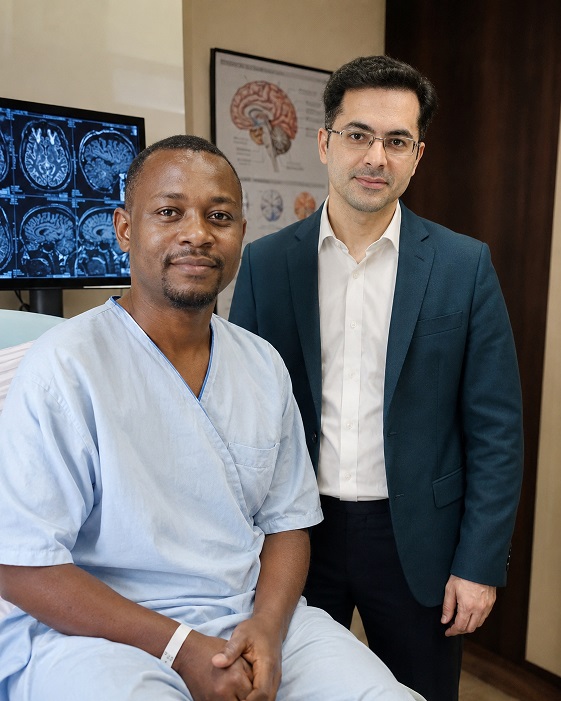
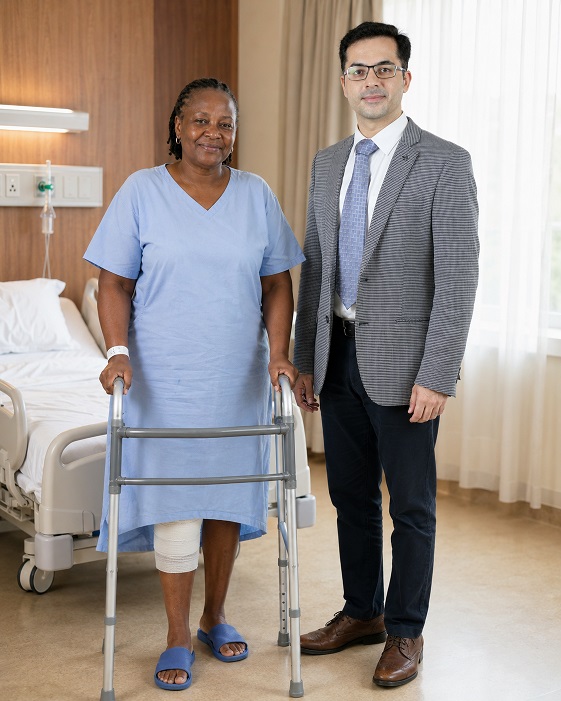
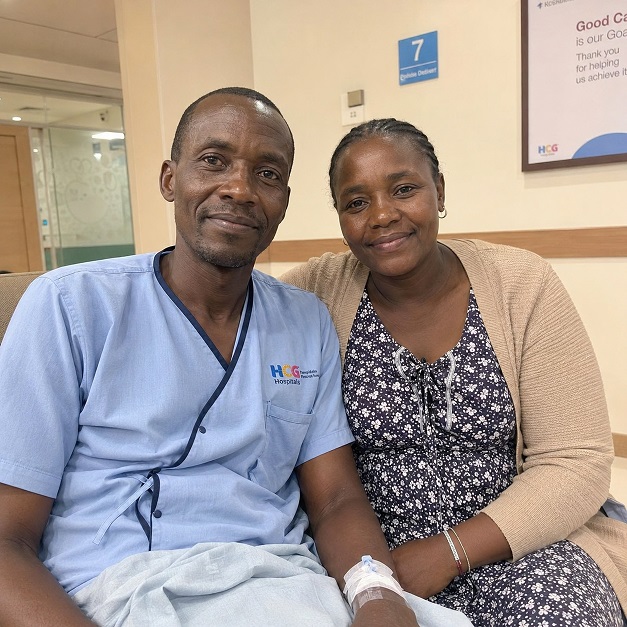
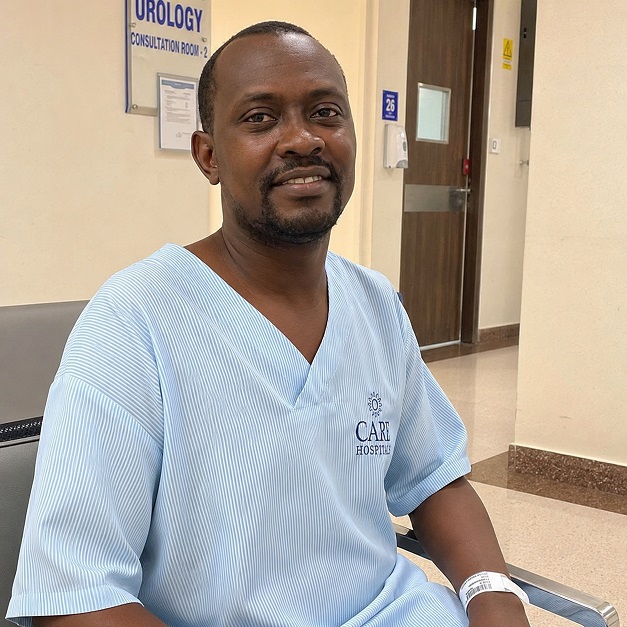
Ready to Take the First Step?
Share your Medical Reports with our Healthcare Managers Today and Get a FREE CONSULTATION, a Personalized Treatment Plan, and Complete Support from Arrival to Recovery.
Get Your Free ConsultationAreas We Serve
This resource has been thoughtfully prepared for patients from Kenya who are considering medical treatment in India. We also welcome patients from the wider region in the countries mentioned below-
We assist patients from:
- Ethiopia
- Somalia
- Tanzania
- Uganda
- Seychelles
- Guinea
- Guinea-Bissau
- Liberia
- Mali
- Mauritania
- Niger
- Nigeria
- Senegal
- Togo
- South Sudan
- Sierra Leone
Many of the insights, treatment pathways, hospital recommendations, travel guidance, and patient support services described here are equally relevant and may be used as a reference when planning treatment in India.
From Kenya to India: Your Complete Patient Support Guide
- Brain Tumour Surgery in India for Kenyan Patients
- Cancer Treatment and Surgery in India for Kenyan Patients
- Cardiac Treatment and Surgery in India for Kenyan Patients
- Heart Valve Replacement Surgery in India for Kenyan Patients
- Knee Replacement in India for Kenyan Patients
- Prostate Cancer Treatment and Surgery in India for Kenyan Patients
- Spine Treatment and Surgery in India for Kenyan Patients
- Selecting the Best Bariatric Surgeons and Hospitals in India: What Kenyan Patients Should Actually Look For
- Selecting the Best Cancer Surgeons and Hospitals in India: What Kenyan Patients Should Actually Look For
- Selecting the Best Cardiac Surgeons and Hospitals in India: What Kenyan Patients Should Actually Look For
- Selecting the Best Dental Surgeons and Clinics in India: What Kenyan Patients Should Actually Look For
- Selecting the Best Hip Surgeons and Hospitals in India: What Kenyan Patients Should Actually Look For
- Selecting the Best Kidney Transplant Surgeons and Hospitals in India: What Kenyan Patients Should Actually Look For
- Selecting the Best Knee Surgeons and Hospitals in India: What Kenyan Patients Should Actually Look For
- Selecting the Best Liver Transplant Surgeons and Hospitals in India: What Kenyan Patients Should Actually Look For
- Selecting the Best Neurosurgeons and Hospitals in India: What Kenyan Patients Should Actually Look For
- Selecting the Best Prostate Cancer Surgeons and Hospitals in India: What Kenyan Patients Should Actually Look For
- Selecting the Best Spine Surgeons and Hospitals in India: What Kenyan Patients Should Actually Look For