

Selecting the Best Penile Implant Surgeons and Hospitals in India: What Kenyan Patients Should Actually Look For
Erectile dysfunction is one of the most treatable conditions in men's health and one of the most quietly endured — the years of delay cost more than the operation does.
Erectile dysfunction is one of the most treatable conditions in men's health, and also one of the most quietly endured. Most men who eventually need a penile implant have already spent years managing the problem privately, often trying unverified remedies before ever discussing it with a doctor. Across 24 years of guiding international patients through Indian hospitals, penile implant surgery is one of the most reliably successful procedures in this series, with satisfaction rates that consistently outperform most other interventions in medicine. But the path to that surgery matters, and in Kenya, that path is shaped heavily by stigma before it ever reaches a surgeon's office. This is the framework I use when a Kenyan patient is weighing penile implant surgery in India. It follows the surgeon-then-hospital structure of this series, and opens with a pattern that should shape the entire conversation before implant surgery is even discussed.
Healing Journeys of Kenyan Patients




Key Takeaways
- The guide explains that penile implants should generally be considered a last-resort treatment after properly supervised trials of oral medication, injections and vacuum devices have genuinely failed. It also highlights a 2026 Nairobi study reporting erectile dysfunction in roughly 1 in 10 men aged 18–35, with self-sourced medication use concentrated among affected men.
- Before considering surgery, the guide recommends assessing underlying factors such as diabetes, blood pressure and cardiovascular health, because these conditions can contribute to erectile dysfunction and may influence both candidacy and healing. It stresses that self-medication should not be treated as equivalent to a properly supervised conservative treatment trial.
- For penile implant surgery, India is presented as an option because prosthetic urology is a specialised field with limited domestic availability in Kenya. The guide recommends selecting surgeons who specifically perform penile implants regularly and have dedicated prosthetic urology training rather than relying on general urology experience.
- The page 3 weighting chart gives 70% to surgeon factors and 30% to hospital factors. Confirming that conservative treatment has genuinely been tried and failed receives the highest weighting at 20%, followed by personal annual penile implant volume at 16% and specific prosthetic urology training at 14%.
- Hospital selection places particular emphasis on infection prevention, because implant infection can threaten the entire outcome and may require removal of the device. Patients should ask about the hospital's implant-specific infection rate, sterile technique protocols, privacy and confidentiality procedures, and whether the centre can clearly explain both malleable and inflatable implant options.
- The page 4 cost chart gives an indicative range of US$3,000–15,000 in India, compared with very limited case-by-case access in Kenya, US$15,000–25,000 in the UK and US$20,000–30,000 in the US. Patients should confirm the exact device brand and model included in the quotation and ask about future revision costs.
Quick Facts
- Author
- Dr. Dheeraj Bojwani
- Experience
- 24+ Years of Experience
- Treatment
- Penile Implant Surgery
- Patients
- Kenyan Men with Erectile Dysfunction
- Key Specialist
- Prosthetic Urologist / Urologist
- Main Assessment
- Previous treatment, underlying health and erectile dysfunction severity
- Key Priority
- Confirm conservative treatment has genuinely failed
- Key Selection Factor
- Personal annual penile implant volume
- Implant Options
- Malleable and inflatable
- Hospital Requirement
- Implant-specific infection prevention protocols
- India Cost
- Approximately US$3,000–15,000
- UK Cost
- Approximately US$15,000–25,000
- US Cost
- Approximately US$20,000–30,000
- Pre-Travel Records
- Full medical history and previous treatment details
- Follow-Up
- Written plan for device activation and post-operative concerns
- Key Warning Signs
- No discussion of previous treatment, implant-specific infection rates or device options
- Decision Principle
- Choose prosthetic urology expertise with strong infection-control and follow-up support
In Brief
For Kenyan men considering penile implant surgery in India, the guide recommends first confirming that medication, injections and vacuum devices have genuinely been tried under medical supervision. Surgeon selection should focus on prosthetic urology training and personal implant volume, while hospital selection should prioritise infection prevention, discretion and a clear explanation of malleable versus inflatable devices. The guide gives an indicative Indian cost of US$3,000–15,000.
Before the surgeon: stigma delays care long before surgery is the question
A 2026 community-based study in Nairobi County found erectile dysfunction affecting roughly one in ten men aged 18 to 35, consistently linked to physical inactivity and psychological distress, a notably young population for a condition often assumed to affect only older men. The same study flagged something specific and concerning: unprescribed, self-sourced medication use was concentrated among the men affected, a pattern the researchers identified as a marker of stigma-related barriers to proper care.
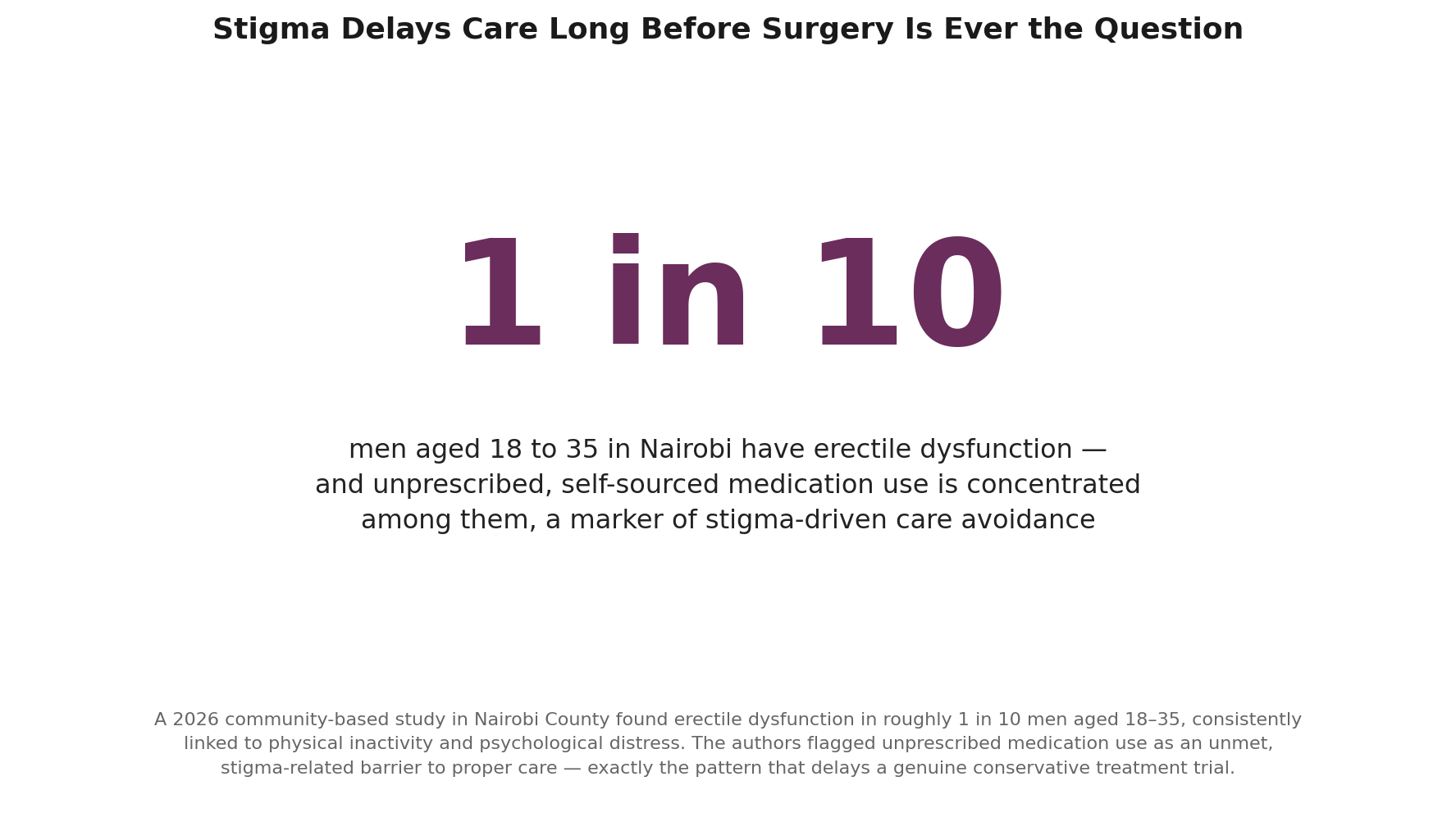
This matters directly for implant candidacy. A penile implant is, appropriately, a last-resort treatment, reserved for men who have genuinely tried and failed conservative options: oral medications, injections, and vacuum devices. But if stigma is driving men toward years of self-medication with unverified remedies rather than a structured, doctor-supervised trial of first-line treatments, then some men may arrive at a surgical conversation without ever having had a genuine, properly managed attempt at the options that come before surgery. Diabetes and hypertension, both major drivers of ED across East Africa, with some Kenyan studies finding ED in as many as 46% of hypertensive men, can also sometimes improve with better underlying disease control, which should be part of this conversation too.
The practical takeaway is to insist on an honest accounting of what has genuinely been tried before implant surgery is discussed, medication at proper doses under medical supervision, not self-sourced pills, and to make sure diabetes, blood pressure, and cardiovascular risk factors have been properly assessed and addressed, since these often coexist with ED and shape both candidacy and outcomes.
Should you travel at all?
Kenya has urologists managing ED medically, and awareness and treatment-seeking have genuinely improved in recent years, with more men in Nairobi seeking help than in the past. For medication management, injections, and vacuum device trials, engaging with Kenyan urology services first is a reasonable and sensible starting point.
For penile implant surgery itself, India is where I steer patients, confidently, because prosthetic urology, implant surgery specifically, is a distinct subspecialty with very limited domestic presence in Kenya. India's leading urology centres perform this surgery routinely, with surgeons specifically trained in prosthetic techniques, low infection rates, and the volume needed to handle both straightforward and complex cases, including patients with diabetes or previous pelvic surgery, at a fraction of UK or US cost.
Part one: judging the surgeon
1. Confirms conservative treatment has genuinely been tried and failed
I weight this above every other factor, and the chart below reflects that. Ask the surgeon to confirm, specifically, that medication, injections, and vacuum devices have been properly trialled under medical supervision, not simply that other options exist.
2. Personal annual volume in penile implant surgery specifically
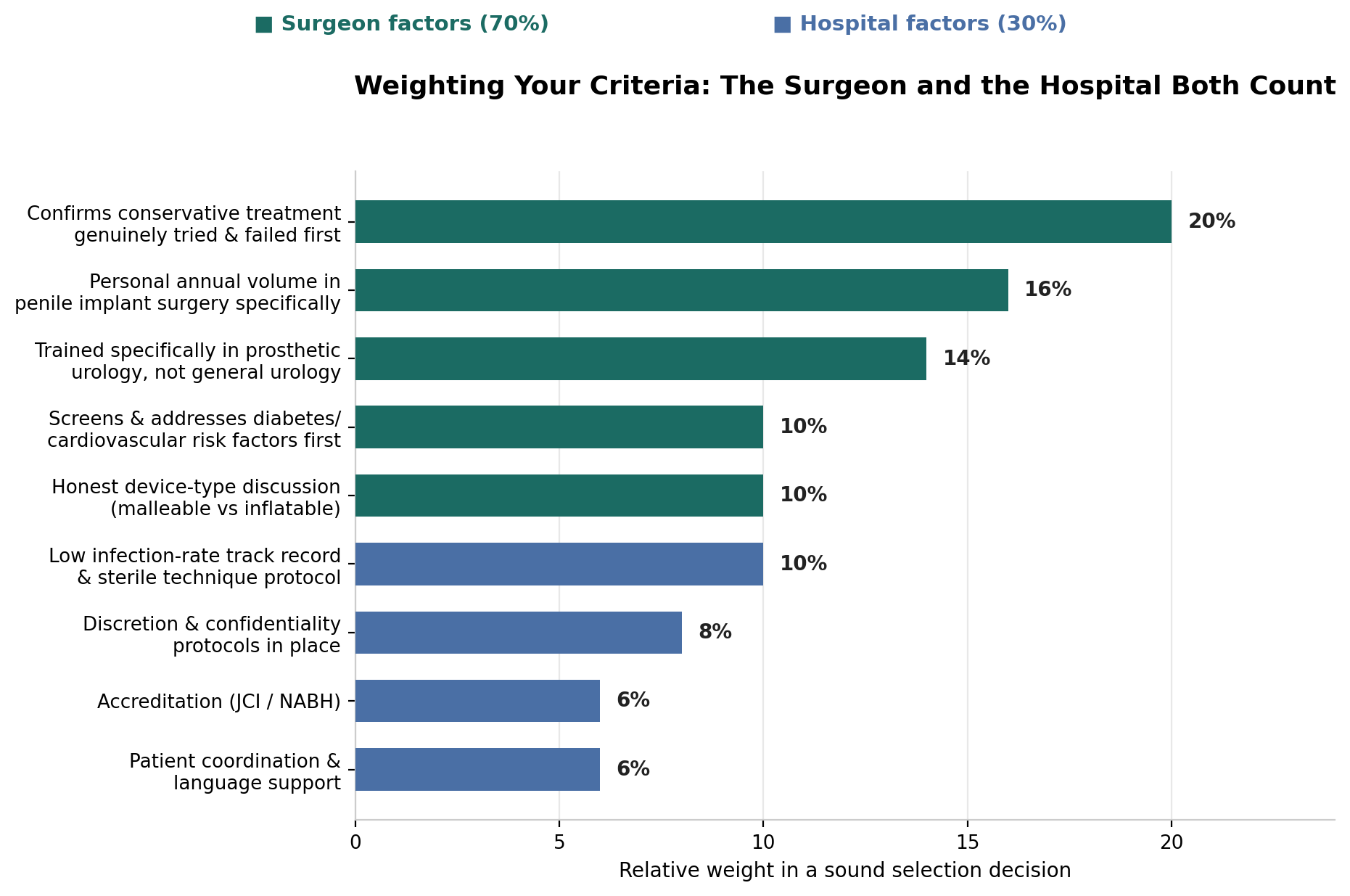
Ask how many penile implants the surgeon personally places each year. This is a distinct technical skill, and volume strongly predicts both success rates and complication avoidance.
3. Trained specifically in prosthetic urology
Confirm the surgeon has specific training in prosthetic urology, not simply general urology with occasional implant cases, since this surgery has a genuinely steep learning curve.
4. Screens and addresses diabetes or cardiovascular risk factors first
Ask whether your diabetes, blood pressure, or cardiovascular health has been assessed and optimised, since these conditions affect both candidacy and healing.
Part two: judging the hospital
For penile implant surgery, infection prevention protocol carries real weight alongside the surgeon, reflected in the balance above, because infection is the complication that most seriously threatens the outcome of this specific surgery.
5. A low infection-rate track record and sterile technique protocol
Ask about the hospital's infection rate for implant surgery specifically, and what sterile technique protocols are followed, since implant infection can mean losing the device entirely.
6. Genuine discretion and confidentiality protocols
Ask how patient privacy is protected throughout your visit, from admission to discharge, since discretion matters enormously for a procedure many men prefer to keep private.
7. An honest device-type discussion
Ask the surgeon to walk through malleable versus inflatable options against your specific circumstances, lifestyle, and dexterity, rather than defaulting to whichever device the hospital stocks.
8. Accreditation, read properly
JCI and NABH accreditation are meaningful filters on safety and infection control, but say nothing about prosthetic urology sub-specialisation specifically. Use accreditation to exclude weak candidates, not to choose between the strong ones.
9. The cost you will actually pay
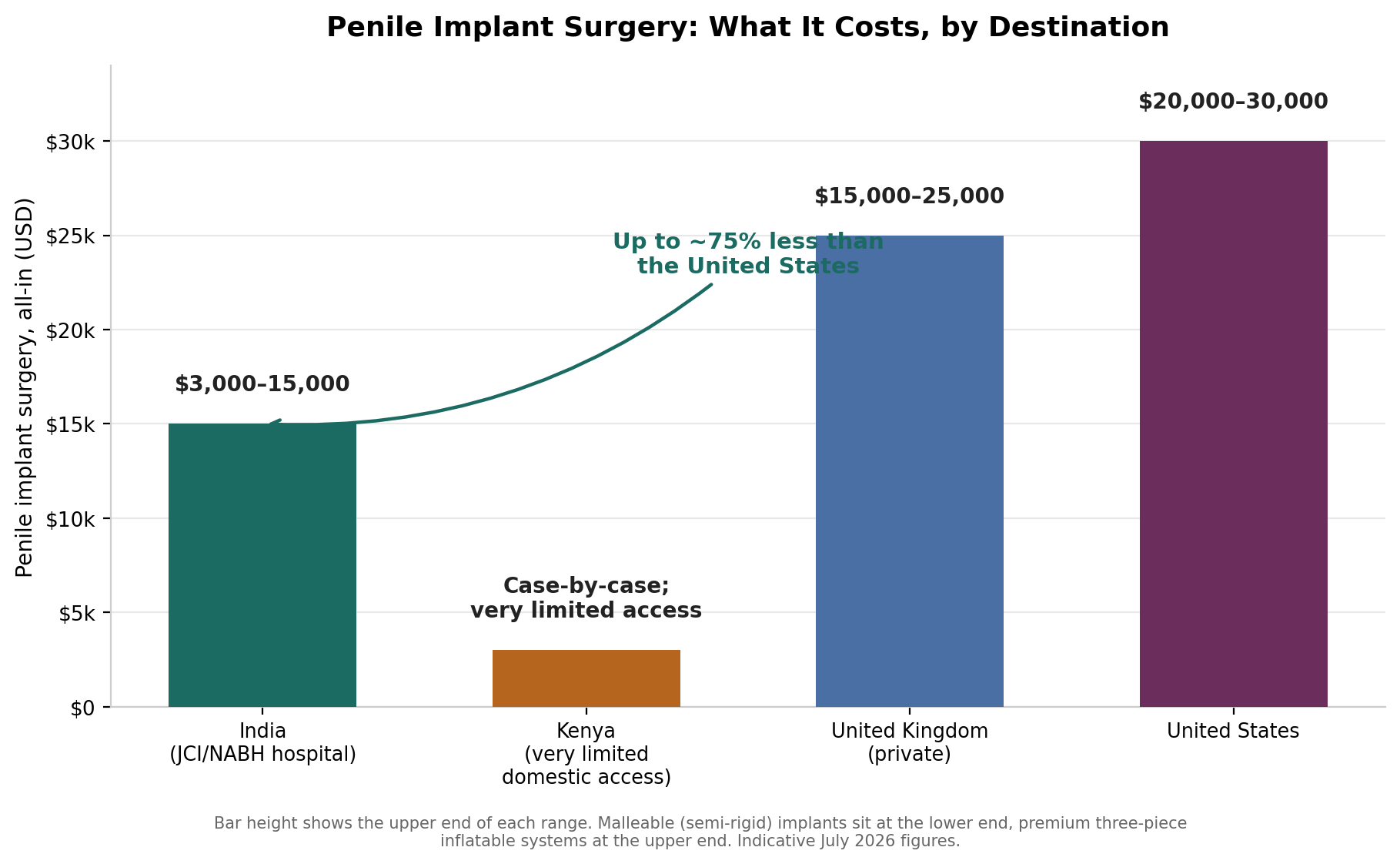
Let me be emphatic about this, because 24 years of handling these cases has taught me nothing more consistently: disputes almost never concern the quoted price. They concern what the quote silently omitted. For penile implant surgery specifically, insist the estimate states which device brand and model is included, and what a revision procedure would cost if a mechanical issue arises later.
Budget beyond the surgery. Direct Nairobi–Delhi and Nairobi–Mumbai flights run roughly 550 to 850 dollars return, and a short hospital stay, usually one to three days, keeps accommodation costs modest.
Four signals that should make you pause
Certain patterns reliably precede a difficult outcome. A surgeon who doesn't ask what conservative treatments have genuinely been tried under medical supervision. No clear personal volume figure in implant surgery specifically. No discussion of diabetes or cardiovascular risk factors. And a hospital unable to describe its infection-prevention protocol.
None alone proves a bad hospital. Together they warrant a second opinion before you commit to surgery.
The Kenya-specific practicalities
Send your full medical history, including what treatments have genuinely been tried, at what doses, and for how
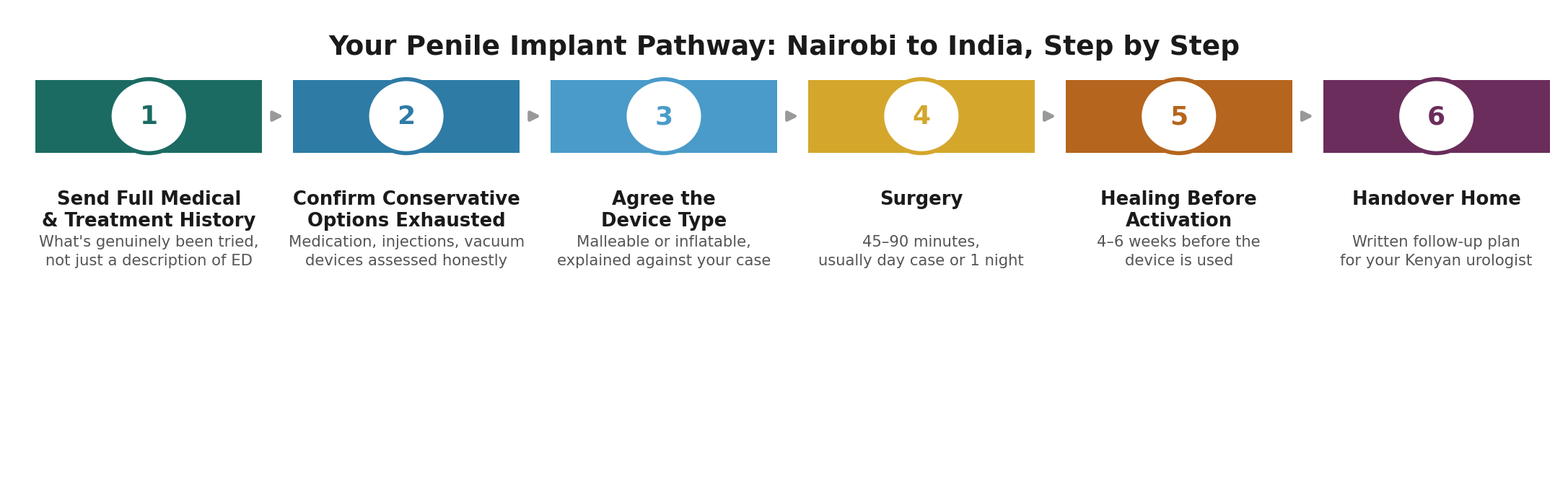
long, not just a description of the problem, so the surgical team can properly assess your candidacy before you arrive.
Direct Nairobi–Delhi and Nairobi–Mumbai flights make this roughly a six-hour journey. The Indian medical e-visa is issued within three to five working days against a hospital letter, and an attendant can travel with you if needed.
Agree in advance on a written follow-up plan, including who will manage device activation guidance and any concerns once you are back in Kenya.
The questions I would ask before paying a deposit
Of the surgeon:
- Have I genuinely tried medication, injections, and vacuum devices under medical supervision?
- How many penile implants do you personally place each year?
- Are you specifically trained in prosthetic urology?
- Have my diabetes, blood pressure, and cardiovascular health been properly assessed?
Of the hospital:
- What is your infection rate for implant surgery specifically?
- What discretion and confidentiality protocols are in place?
- Can you walk me through malleable versus inflatable options for my situation?
- What exactly is excluded from the quoted price?
- May I speak to a previous East African patient treated with a similar device?
A team that answers all nine without irritation is very likely the right team. One that turns vague at the first or second has told you what you needed to know at no cost at all.
Straight Answers for Kenyan Patients about Penile Implant Surgeons and Hospitals in India
How do I choose the best surgeon in India for penile implant surgery as a Kenyan patient?
Confirm conservative treatment has genuinely been tried under medical supervision, ask his annual volume in implant surgery specifically, and verify he is trained in prosthetic urology, not general urology with occasional implant cases.
How much does penile implant surgery cost in India for a Kenyan patient?
Typically 3,000 to 15,000 US dollars, depending on whether a malleable or premium inflatable device is used. The same surgery is very limited domestically in Kenya, and runs roughly 15,000 to 25,000 dollars in the UK and 20,000 to 30,000 in the US.
Why does stigma matter so much for this condition specifically in Kenya?
A 2026 Nairobi study found erectile dysfunction in roughly 1 in 10 men aged 18 to 35, with unprescribed, self- sourced medication use concentrated among them, a sign that stigma is driving men toward unsupervised self- treatment rather than proper medical care that could resolve the problem without surgery.
Is a penile implant really the last resort?
Yes, appropriately so. It's reserved for men who have genuinely tried and failed oral medications, injections, and vacuum devices under medical supervision. Ask your surgeon to confirm this history specifically before proceeding.
What's the difference between malleable and inflatable implants?
Malleable implants are simpler, always semi-rigid, and manually positioned; they suit men wanting the simplest solution or with limited dexterity. Inflatable implants feel more natural and are only firm when activated, but involve a pump and slightly more complex mechanics.
How successful is penile implant surgery?
Very. Reported satisfaction rates typically run 80 to 95%, among the highest of any procedure in men's health, though infection risk and mechanical durability over ten-plus years are real considerations to discuss with your surgeon beforehand.
A closing word
For a Kenyan man who has genuinely exhausted conservative treatment for erectile dysfunction, India offers dedicated prosthetic urology expertise that remains rare domestically, with the volume and infection-prevention track record this specific surgery demands, at a fraction of UK or US cost. The best surgeon is the one who confirms, honestly, that conservative options were properly tried before ever discussing implants. The best hospital pairs him with rigorous infection control and genuine discretion. If you would like me to look at your history and talk through honestly what your options are, send them across.
Sources
- 🌐 Erectile dysfunction in young men in Nairobi County, Kenya: A community-based study. medRxiv
- 🌐 Awareness of erectile dysfunction sees surge in number of men seeking treatment. The Standard Health, 2025. standardme
- 🌐 Prevalence of erectile dysfunction and associated factors among men with diabetes mellitus (Kenyatta National Hospital
Sources
- 🌐 ). OA Text – oatext.com
- 🌐 National Medical Commission of India — surgeon and specialist registration verification
- 🌐 National Accreditation Board for Hospitals & Healthcare Providers (NABH) — accredited hospital directory
Frequently Asked Questions by Kenyans about Penile Implant Surgeons and Hospitals in India
Is a penile implant a first-line treatment for erectile dysfunction?
No. The guide describes it as a last-resort option after oral medications, injections and vacuum devices have been properly tried under medical supervision.
Why is conservative treatment history important?
A patient may appear to have treatment-resistant erectile dysfunction simply because previous treatments were not taken consistently or were not properly supervised. The surgeon should establish what was genuinely tried before recommending an implant.
Why should Kenyan patients consider a prosthetic urologist?
Penile implant surgery is a specialised area of urology. The guide recommends a surgeon with specific prosthetic urology training and substantial personal implant experience.
What should be checked before penile implant surgery?
Diabetes, blood pressure and cardiovascular health should be assessed and appropriately managed because these factors can affect candidacy and healing.
What is the difference between malleable and inflatable implants?
Malleable implants remain semi-rigid and are manually positioned. Inflatable implants are activated when needed and generally provide a more natural appearance and feel, but involve more complex mechanics and a pump.
Why is infection prevention so important?
An infection involving a penile implant can seriously compromise the outcome and may require removal of the device. The hospital should therefore be able to explain its implant-specific infection-control protocols.
How much does penile implant surgery cost in India?
The guide gives an indicative range of US$3,000–15,000, depending partly on the type of implant selected.
What should be included in the quotation?
Ask for the device brand and model, surgical costs and what is excluded. The guide also recommends asking what a future revision would cost if a mechanical problem develops.
What should Kenyan patients send before travelling?
Send the complete medical history and details of previous treatments, including what was tried, the doses used and how long each treatment was attempted.
When is the implant activated?
The page 5 pathway indicates that patients generally undergo a healing period of approximately 4–6 weeks before device use, with activation guidance included in the follow-up plan.
Page Summary
This seven-page Kenya patient guide explains how men can evaluate penile implant surgeons and hospitals in India, beginning with the need to confirm that conservative erectile dysfunction treatments have genuinely been tried under medical supervision. It covers prosthetic urology training, personal implant volume, diabetes and cardiovascular risk assessment, infection prevention, privacy, device selection and costs. The page 3 weighting chart assigns 70% to surgeon factors and 30% to hospital factors, while the page 4 cost chart compares indicative costs across India, Kenya, the UK and US. The page 5 pathway shows the journey from full medical history → confirmation of exhausted conservative options → device selection → surgery → healing before activation → handover and follow-up in Kenya.
Citation Block
| Topic | Information |
|---|---|
| Topic | Penile Implant Surgery in India for Kenyan Patients |
| Treatment | Penile Implant Surgery |
| Patients | Kenyan Men with Erectile Dysfunction |
| Specialist | Prosthetic Urologist / Urologist |
| Main Assessment | Previous treatment, health factors and ED severity |
| Key Priority | Confirm conservative treatment has failed |
| Surgeon Check | Personal annual penile implant volume |
| Training Check | Specific prosthetic urology training |
| Risk Assessment | Diabetes, blood pressure and cardiovascular health |
| Implant Options | Malleable and inflatable |
| Hospital Check | Implant-specific infection prevention |
| Privacy | Discretion and confidentiality protocols |
| India Cost | Approximately US$3,000–15,000 |
| UK Cost | Approximately US$15,000–25,000 |
| US Cost | Approximately US$20,000–30,000 |
| Quote Check | Device brand/model and revision costs |
| Pre-Travel Records | Full medical history and previous treatment details |
| Follow-Up | Written activation and post-operative plan |
| Quality Check | JCI/NABH accreditation |
| Warning Signs | No treatment history review or unclear infection-control protocol |
| Selection Weighting | 70% surgeon factors and 30% hospital factors |
| Top Criterion | Conservative treatment genuinely tried and failed – 20% |
| Kenya Context | Penile implant surgery has very limited domestic availability |
| Patient Pathway | Medical history → conservative options → device selection → surgery → healing/activation → Kenya follow-up |
| Decision Principle | Match prosthetic urology expertise with infection control, privacy and appropriate device selection |

Our Mission Statement
Our mission is to place patients at the centre of every healthcare decision by providing trustworthy, evidence-based, and unbiased medical information. We believe that informed patients make better decisions. Backed by personalised guidance from our experienced advisory team, we help patients understand their treatment options, compare them objectively, and confidently choose the path that best suits their medical needs and personal circumstances.
Patient Testimonials from Kenya
Ready to Take the First Step?
Share your Medical Reports with our Healthcare Managers Today and Get a FREE CONSULTATION, a Personalized Treatment Plan, and Complete Support from Arrival to Recovery.
Get Your Free ConsultationAreas We Serve
This resource has been thoughtfully prepared for patients from Kenya who are considering medical treatment in India. We also welcome patients from the wider region in the countries mentioned below-
We assist patients from:
- Ethiopia
- Somalia
- Tanzania
- Uganda
- Seychelles
- Guinea
- Guinea-Bissau
- Liberia
- Mali
- Mauritania
- Niger
- Nigeria
- Senegal
- Togo
- South Sudan
- Sierra Leone
Many of the insights, treatment pathways, hospital recommendations, travel guidance, and patient support services described here are equally relevant and may be used as a reference when planning treatment in India.
From Kenya to India: Your Complete Patient Support Guide
- Brain Tumour Surgery in India for Kenyan Patients
- Cancer Treatment and Surgery in India for Kenyan Patients
- Cardiac Treatment and Surgery in India for Kenyan Patients
- Heart Valve Replacement Surgery in India for Kenyan Patients
- Knee Replacement in India for Kenyan Patients
- Prostate Cancer Treatment and Surgery in India for Kenyan Patients
- Spine Treatment and Surgery in India for Kenyan Patients
- Selecting the Best Bariatric Surgeons and Hospitals in India: What Kenyan Patients Should Actually Look For
- Selecting the Best Cancer Surgeons and Hospitals in India: What Kenyan Patients Should Actually Look For
- Selecting the Best Cardiac Surgeons and Hospitals in India: What Kenyan Patients Should Actually Look For
- Selecting the Best Dental Surgeons and Clinics in India: What Kenyan Patients Should Actually Look For
- Selecting the Best Hip Surgeons and Hospitals in India: What Kenyan Patients Should Actually Look For
- Selecting the Best Kidney Transplant Surgeons and Hospitals in India: What Kenyan Patients Should Actually Look For
- Selecting the Best Knee Surgeons and Hospitals in India: What Kenyan Patients Should Actually Look For
- Selecting the Best Liver Transplant Surgeons and Hospitals in India: What Kenyan Patients Should Actually Look For
- Selecting the Best Neurosurgeons and Hospitals in India: What Kenyan Patients Should Actually Look For
- Selecting the Best Prostate Cancer Surgeons and Hospitals in India: What Kenyan Patients Should Actually Look For
- Selecting the Best Spine Surgeons and Hospitals in India: What Kenyan Patients Should Actually Look For