

Selecting the Best Paediatric Heart Surgeons and Hospitals in India: What Kenyan Families Should Actually Look For
Kenya operates on roughly three of every hundred children who need congenital heart surgery — with these defects, waiting is itself a decision.
A hole in a newborn's heart, or a valve that formed the wrong way, arrives with a kind of dread different from any other diagnosis in this series. Across 24 years of guiding international patients through Indian hospitals, the families who navigate this best move quickly past the shock and toward two practical questions: exactly what is wrong with my child's heart, and how urgently does it need fixing. This is the framework I use when a Kenyan family is weighing paediatric heart surgery in India, for a newborn, infant, or older child with a congenital heart defect. It follows the surgeon-then-hospital structure of this series, and opens with the reality shaping almost every decision after it: in Kenya today, most children born with a heart defect needing surgery do not get it.
Healing Journeys of Kenyan Patients


Key Takeaways
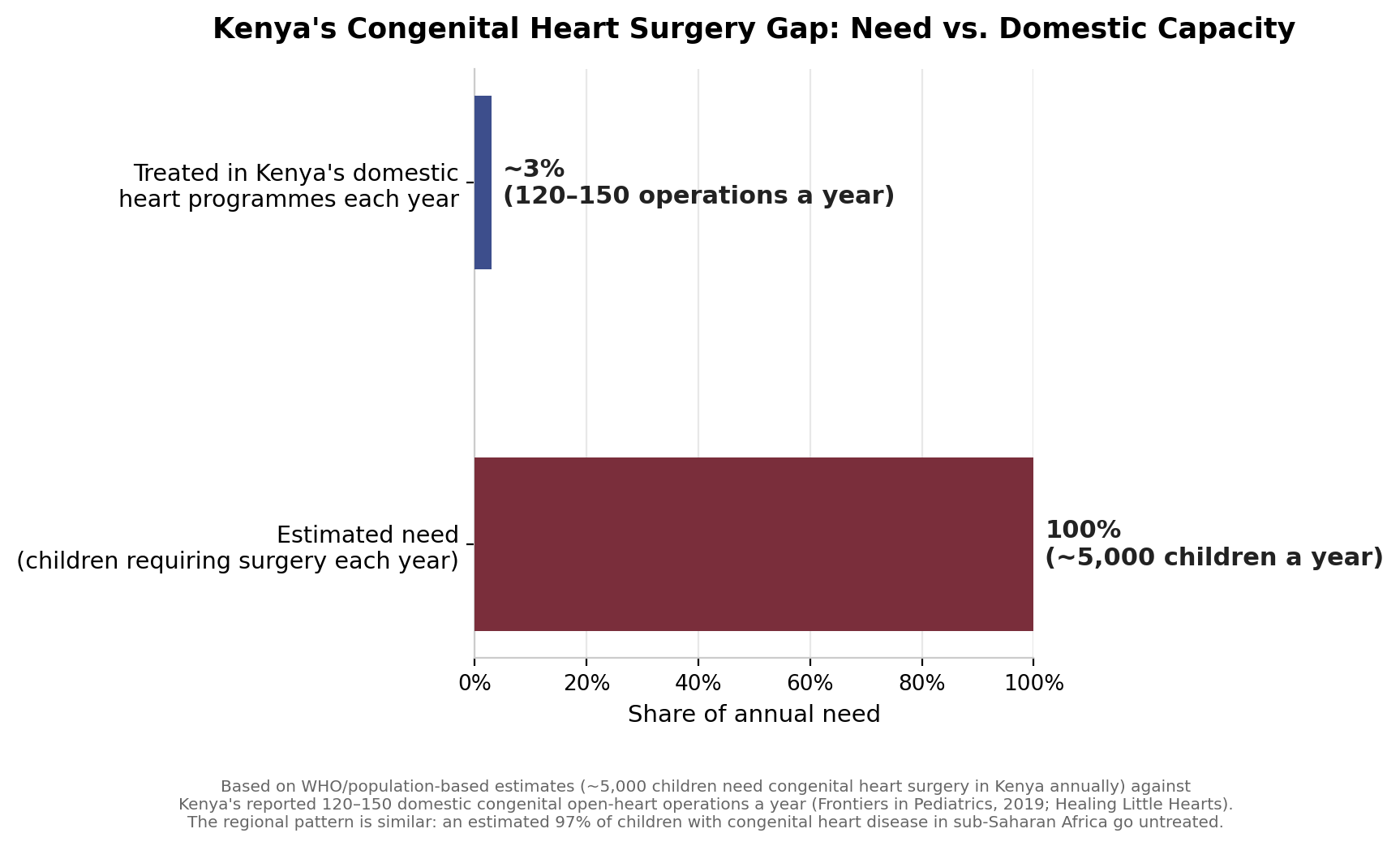
- The guide highlights a major gap between the need for congenital heart surgery in Kenya and domestic capacity. It estimates that around 5,000 children need congenital heart surgery each year, while Kenyan domestic programmes perform approximately 120–150 open-heart operations annually, meaning only about 3% of the estimated need is treated domestically.
- Timing is particularly important because congenital heart defects do not all have the same safe treatment window. Some conditions, such as transposition of the great arteries, may require correction within the first weeks of life, while a large ventricular septal defect may need repair before progressive lung damage occurs. Families should therefore ask specifically when surgery is safest for their child's individual defect.
- For straightforward isolated defects, experienced Kenyan cardiac centres can be a reasonable option when timely treatment is available. India becomes particularly relevant for complex neonatal repairs, ECMO-dependent cases, multi-stage single-ventricle palliation or children who cannot obtain timely surgery domestically, with dedicated paediatric cardiac ICUs and congenital-heart specialists.
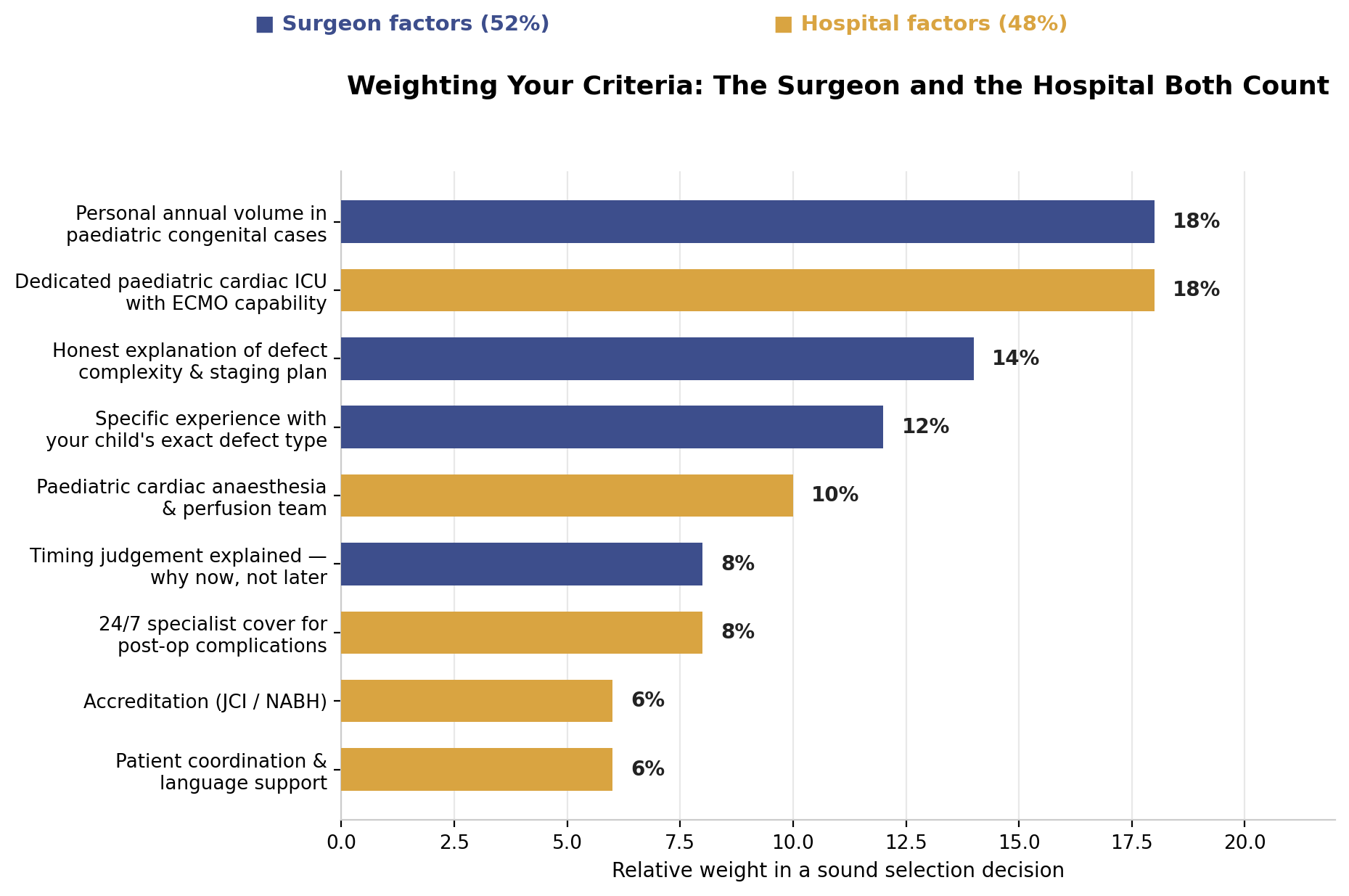
- Surgeon selection should focus on paediatric congenital heart surgery rather than general cardiac surgery experience. The page 3 weighting chart gives 52% to surgeon factors and 48% to hospital factors, with personal annual volume in paediatric congenital cases receiving the highest individual weighting at 18%. The guide also stresses exact-defect experience, honest staging and a clear explanation of surgical timing.
- Hospital selection should include a dedicated paediatric cardiac ICU with ECMO capability, paediatric-specific cardiac anaesthesia and perfusion, and genuine 24/7 specialist coverage. JCI/NABH accreditation is useful for safety and infection-control screening, but the guide cautions that accreditation alone does not demonstrate paediatric cardiac subspecialty expertise.
- The page 5 cost chart gives an indicative range of US$3,500–12,000 in India, compared with US$5,500–11,000 in Kenya, US$35,000–70,000 in the UK and US$50,000–150,000 in the US. Families should clarify ICU days, staged procedures and whether ECMO is charged separately. The guide also notes that complex congenital heart surgery requiring ECMO in paediatric patients is listed among Kenya's SHA overseas-funded procedures, subject to eligibility and the stated annual cap.
Quick Facts
- Author
- Dr. Dheeraj Bojwani
- Experience
- 24+ Years of Experience
- Treatment
- Paediatric Heart Surgery
- Patients
- Kenyan Children with Congenital Heart Defects
- Key Specialist
- Paediatric Cardiac Surgeon
- Main Assessment
- Exact heart defect, anatomy, severity and timing
- Key Priority
- Determine the safe window for surgery
- Common Defects
- VSD, TGA, Tetralogy of Fallot and complex congenital defects
- Key Selection Factor
- Personal annual volume in paediatric congenital cases
- Staged Treatment
- Important for selected complex and single-ventricle conditions
- Hospital Requirement
- Dedicated paediatric cardiac ICU with ECMO capability
- Specialist Support
- Paediatric cardiac anaesthesia and perfusion team
- India Cost
- Approximately US$3,500–12,000
- Kenya Cost
- Approximately US$5,500–11,000
- UK Cost
- Approximately US$35,000–70,000
- US Cost
- Approximately US$50,000–150,000
- Quality Check
- JCI/NABH accreditation
- Pre-Travel Records
- Echo images/reports, ECG and catheterisation studies where available
- Follow-Up
- Written plan with Kenyan paediatric cardiologist
- Key Warning Signs
- Unclear surgical timing, no exact-defect experience or no ECMO/paediatric ICU capability for complex cases
- Decision Principle
- Match the child's exact defect and timing needs with the right paediatric cardiac team
In Brief
For Kenyan families considering paediatric heart surgery in India, the guide recommends focusing first on the child's exact congenital defect and the safe timing for repair. The surgeon should have substantial experience with that specific defect, while the hospital should provide a dedicated paediatric cardiac ICU, ECMO capability, paediatric anaesthesia and perfusion expertise, and continuous specialist cover. The guide gives an indicative treatment cost of US$3,500–12,000 in India.
Before the surgeon: the scale of the gap, and why timing matters
Based on population and WHO estimates, roughly 5,000 children in Kenya need congenital heart surgery each year. Kenya's domestic programmes, concentrated in a handful of Nairobi hospitals and dependent partly on visiting charitable surgical teams, perform between 120 and 150 open-heart operations annually, roughly 3% of the children who need surgery actually receiving it inside the country. The regional picture across sub-Saharan Africa is similarly severe, with an estimated 97% of children with congenital heart disease going without the surgical care they need.
This matters for timing, because many congenital heart defects are not stable conditions that simply wait. Some, like transposition of the great arteries, need correction within the first weeks of life. Others, like a large ventricular septal defect, are best repaired before six months to a year, before the extra blood flow permanently damages the lungs. A defect straightforward to fix in infancy can become inoperable, or far riskier, if repair is delayed past the point where the changes it caused become irreversible.
The practical takeaway is to treat a confirmed diagnosis as time-sensitive by default, and ask directly, immediately, what the safe window for surgery actually is for your child's specific defect. A wait-and-see approach that feels natural elsewhere can quietly close the door on the best outcome here.
Should you travel at all?
Kenya's cardiac centres, including Aga Khan University Hospital Nairobi, Mater Hospital and MP Shah Hospital, treat children with straightforward, isolated defects, a simple atrial septal defect or small ventricular septal defect, competently. For these cases, where a reputable local team has capacity, Kenya is a reasonable place to start.
For anything more complex, neonatal repairs, defects requiring ECMO support, multi-stage single-ventricle palliation, or a case that cannot get a timely slot domestically, India is where I steer families, confidently. India's leading paediatric cardiac centres perform in a day the volume Kenya's entire domestic system manages in a year, with dedicated paediatric cardiac ICUs, ECMO capability, and surgeons whose experience is specifically in congenital defects, not adult cardiac surgery extended to children.
On funding, this is genuinely useful territory. Kenya's Social Health Authority funds overseas treatment for 36 gazetted procedures unavailable domestically, capped at 500,000 shillings per patient per year, and complex congenital heart surgery requiring ECMO support in paediatric patients is explicitly on that list, justified by Kenya's current lack of ECMO and paediatric ICU capacity. If your child's case is genuinely complex, ask your referring doctor whether it qualifies; this is one of the few procedures in this series where SHA's overseas benefit was built with almost exactly this situation in mind.
Part one: judging the surgeon
1. Personal annual volume in paediatric congenital cases
I weight this above every other factor, and the chart below reflects that. Ask how many congenital heart surgeries the surgeon performs on children specifically each year, not adult cardiac volume. This is a genuinely distinct subspecialty.
2. An honest explanation of defect complexity and staging
Ask the surgeon to explain your child's specific defect in plain terms, and whether the plan is a single surgery or a staged series. Complex defects, particularly single-ventricle physiology, often require more than one procedure over years, and a surgeon should map this out honestly upfront.
3. Specific experience with your child's exact defect type
Ask how many cases matching your child's specific diagnosis, not congenital heart surgery in general, the surgeon has personally handled. Tetralogy of Fallot, transposition of the great arteries, and hypoplastic left heart syndrome each demand different expertise.
4. Timing judgement explained clearly
Ask why surgery is recommended now rather than later, or vice versa, and what the medical reasoning is. A surgeon who can explain the window clearly, referencing your child's anatomy and growth, is engaging with the case rather than applying a generic timeline.
Part two: judging the hospital
For paediatric heart surgery, the hospital's infrastructure carries slightly more weight than for adult cases, reflected in the balance above, because a child's margin for error is thinner.
5. A dedicated paediatric cardiac ICU with ECMO capability
Ask whether the hospital has a paediatric-specific cardiac ICU, and whether ECMO support is available on-site if your child's heart or lungs need temporary mechanical support after surgery. This is precisely the capability gap driving SHA's overseas funding for complex cases.
6. Paediatric cardiac anaesthesia and perfusion expertise
Ask whether anaesthesia and the bypass perfusion team specialise in children, since a paediatric heart and circulation behave very differently from an adult's under anaesthesia and on bypass.
7. Genuine 24/7 specialist cover
Ask what happens if your child develops a complication at 2am. Dedicated paediatric cardiac specialists physically present overnight, not on call from home, is the standard to look for.
8. Accreditation, read properly
JCI and NABH accreditation are meaningful filters on safety and infection control, but say nothing about paediatric cardiac sub-specialisation. Use accreditation to exclude weak candidates, not to choose between the strong ones.
9. The cost you will actually pay
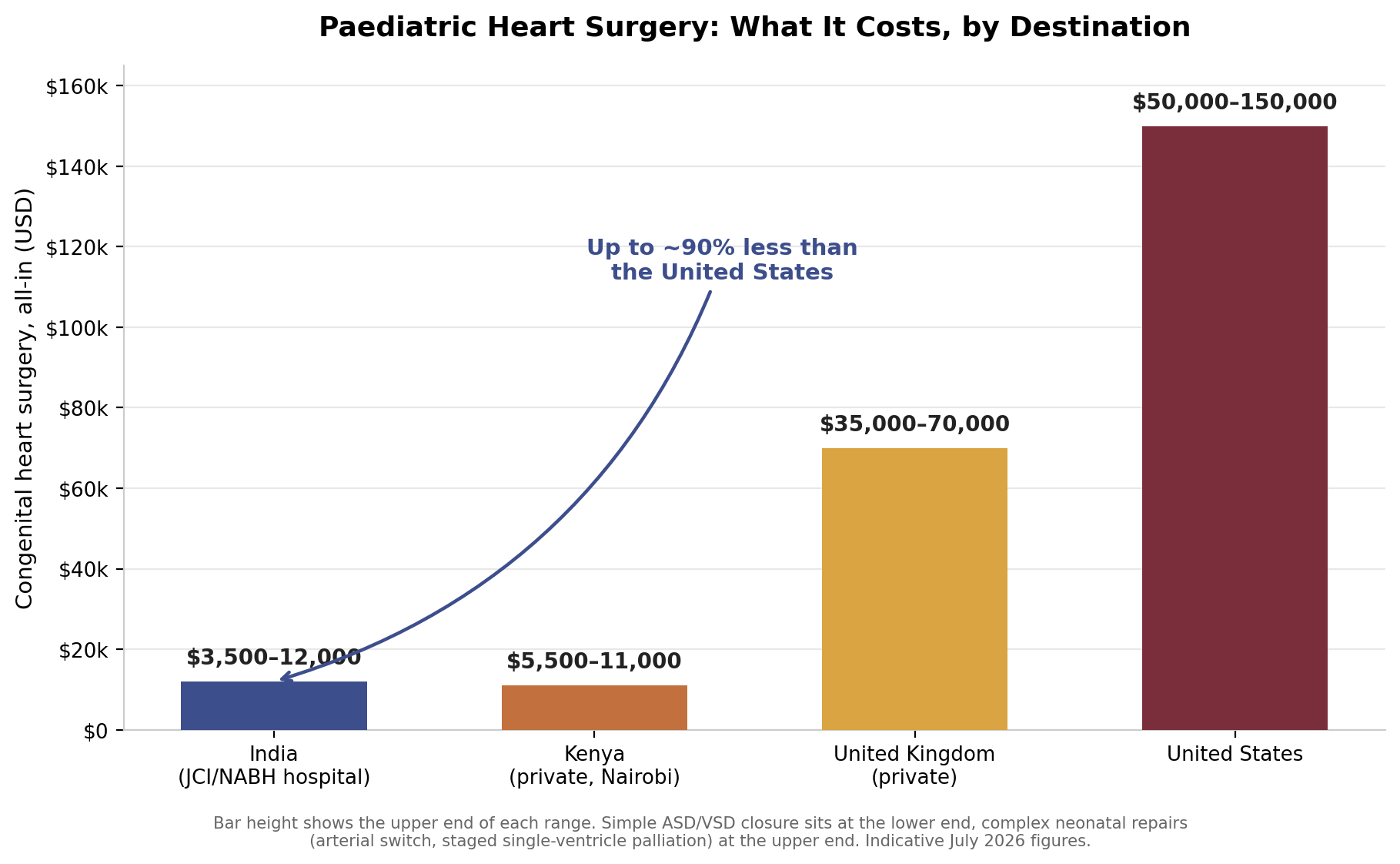
Let me be emphatic about this, because 24 years of handling these cases has taught me nothing more consistently: disputes almost never concern the quoted price. They concern what the quote silently omitted. For paediatric heart surgery specifically, insist the estimate states how many ICU days are included, whether a staged procedure is priced as one case or several, and whether ECMO, if needed, is billed separately.
Budget beyond the surgery. Direct Nairobi–Delhi and Nairobi–Mumbai flights run roughly 550 to 850 dollars return, and three to four weeks of accommodation for a parent adds a genuine sum, more if staged surgery or a longer ICU stay is needed.
Four signals that should make you pause
Certain patterns reliably precede a difficult outcome. A surgeon who cannot state his volume in cases matching your child's specific defect. No mention of ECMO or paediatric ICU capability for a complex case. A vague answer about why surgery is timed as proposed. And reluctance to state what is excluded from the quoted price.
None alone proves a bad hospital. Together they warrant a second opinion before you commit to your child's surgery.
The Kenya-specific practicalities
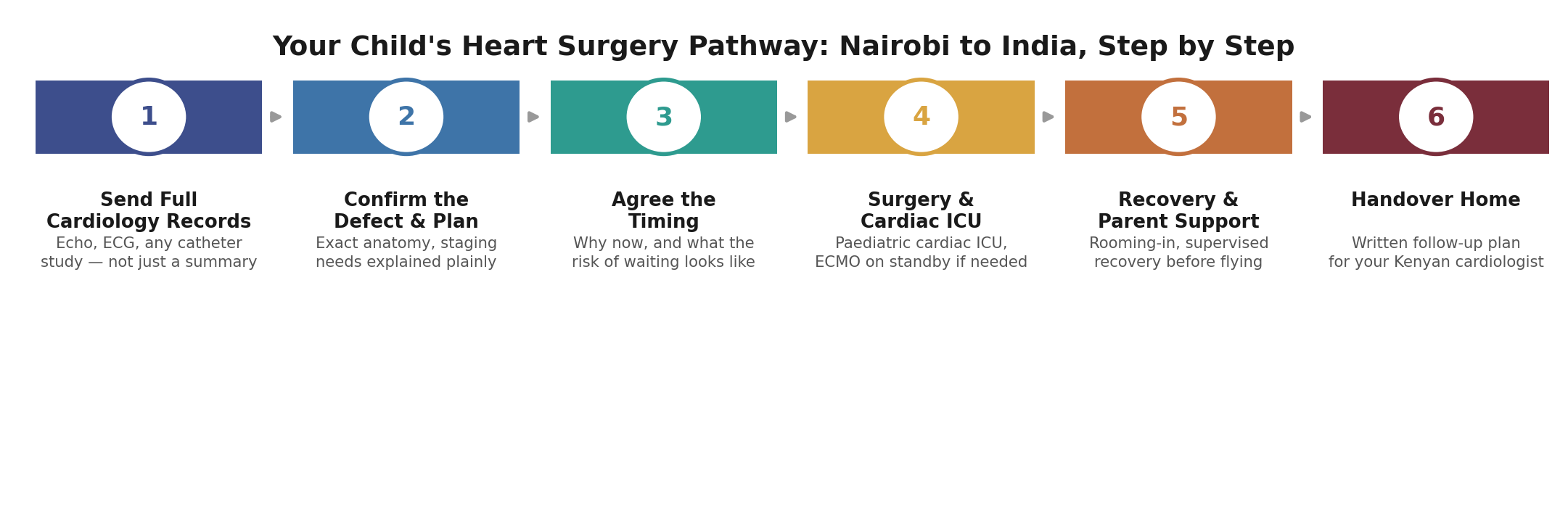
Send the full cardiology records, echo images and reports, ECG, and any catheterisation study, not just a summary letter. A team cannot plan precisely without the actual imaging.
Direct Nairobi–Delhi and Nairobi–Mumbai flights make this roughly a six-hour journey. The Indian medical e-visa is issued within three to five working days against a hospital letter, and up to two attendants can travel on a medical attendant visa.
If your child's defect requires staged surgery, ask for a written plan covering the full sequence and timing between stages, and whether follow-up stages can be coordinated with your Kenyan paediatric cardiologist between trips.
The questions I would ask before paying a deposit
Of the surgeon:
- How many paediatric congenital cases matching my child's defect do you perform each year?
- Is this a single surgery or a staged plan, and what does the full sequence look like?
- Why is surgery timed as proposed, specifically for my child's anatomy?
- What is the realistic risk, and what would change that risk?
Of the hospital:
- Do you have a dedicated paediatric cardiac ICU with ECMO capability?
- Is anaesthesia and perfusion handled by a paediatric-specific team?
- What happens if my child needs urgent attention overnight?
- What exactly is excluded from the quoted price?
- May I speak to a previous East African family treated for a similar defect?
A team that answers all nine without irritation is very likely the right team. One vague at the first or second has told you what you needed to know at no cost at all.
Straight Answers for Kenyan Patients about Paediatric Heart Surgeons and Hospitals in India
How do I choose the best surgeon in India for my child's heart surgery?
Ask his annual volume in paediatric congenital cases matching your child's specific defect, not general cardiac surgery, and have him explain the timing and staging plan in terms specific to your child's anatomy.
How much does paediatric heart surgery cost in India for a Kenyan family?
Typically 3,500 to 12,000 US dollars all in, depending on complexity. The same surgery runs roughly 5,500 to 11,000 dollars in Kenya where available, 35,000 to 70,000 in the UK, and 50,000 to 150,000 in the US.
How many children in Kenya actually get the heart surgery they need?
Only a small fraction. An estimated 5,000 children need congenital heart surgery in Kenya each year, while domestic programmes perform roughly 120 to 150 operations, meaning about 3% are treated inside the country.
Will SHA fund my child's heart surgery in India?
Possibly, for complex cases. Complex congenital heart surgery requiring ECMO support in paediatric patients is explicitly named among SHA's 36 gazetted overseas-funded procedures, capped at 500,000 shillings a year, justified by Kenya's current lack of ECMO and paediatric ICU capacity. Ask your referring doctor whether your child's case qualifies.
Why can't a congenital heart defect just wait until my child is older?
Because many defects cause progressive damage the longer they go uncorrected. Extra blood flow through a large hole can permanently injure the lungs, and some defects straightforward to fix in infancy become far riskier, or inoperable, if repair is delayed. Ask specifically what the safe window is for your child's defect.
What does recovery look like after paediatric heart surgery?
Most straightforward repairs involve one to two weeks in hospital, including ICU time, followed by restricted activity at home. Complex or staged cases need longer, individually assessed recovery, and your Kenyan paediatric cardiologist should receive a written follow-up plan before you travel home.
A closing word
For a Kenyan family facing a child's congenital heart diagnosis, India offers what the numbers make clear Kenya's domestic system currently cannot: capacity, at the volume this surgery demands, at a fraction of UK or US cost. The best surgeon is the one whose paediatric-specific volume and honest staging plan show he treats this as a distinct subspecialty. The best hospital pairs him with a dedicated paediatric cardiac ICU and ECMO capability ready before it's needed. If you would like me to look at your child's cardiology records and talk through honestly what the right plan looks like, send them across.
Sources
- 🌐 Congenital Heart Disease in East Africa. Frontiers in Pediatrics
- 🌐 Healing Little Hearts — Kenya congenital heart programme overview and annual surgical volume. healinglittlehearts.org/cou ntries/kenya
- 🌐 Surgical outcomes of congenital heart disease in African pediatric populations: a systematic review
- 🌐 List of 36 Medical Services Covered by SHA for Treatment Outside Kenya. Tuko.co.ke, 2025
- 🌐 National Medical Commission of India — surgeon and specialist registration verification
- 🌐 National Accreditation Board for Hospitals & Healthcare Providers (NABH) — accredited hospital directory
Frequently Asked Questions by Kenyans about Paediatric Heart Surgeons and Hospitals in India
How many Kenyan children need congenital heart surgery each year?
The guide estimates that approximately 5,000 children in Kenya need congenital heart surgery annually, while domestic programmes perform around 120–150 open-heart operations each year.
Why is timing so important for congenital heart surgery?
Some defects can cause irreversible lung or heart damage if treatment is delayed. The appropriate timing depends on the child's specific anatomy and diagnosis.
Which congenital heart defects may require early surgery?
The guide specifically mentions transposition of the great arteries as a condition that may require correction within the first weeks of life and large VSDs that may need repair before progressive lung damage develops.
Should every Kenyan child travel to India for heart surgery?
No. Straightforward isolated defects may be treated successfully in Kenya when an experienced team has capacity. India may be more relevant for complex or time-sensitive cases.
How should parents choose a paediatric cardiac surgeon?
Ask about the surgeon's personal annual volume in paediatric congenital cases and, importantly, their experience with the child's exact defect rather than general cardiac surgery.
Why is ECMO capability important?
ECMO can provide temporary mechanical support for the heart and lungs in critically ill children. The guide considers it particularly important for complex cases where postoperative mechanical support may be required.
What should a suitable paediatric heart hospital provide?
Look for a dedicated paediatric cardiac ICU, ECMO capability, paediatric-specific anaesthesia and perfusion teams and genuine 24/7 specialist coverage.
How much does paediatric heart surgery cost in India?
The guide gives an indicative range of US$3,500–12,000, depending on complexity. Families should confirm what ICU, staged surgery and ECMO-related costs are included.
Can SHA help fund paediatric heart surgery in India?
The guide states that complex congenital heart surgery requiring ECMO support in paediatric patients is among the overseas-funded procedures listed by SHA, subject to eligibility and the stated annual funding limit. Families should confirm qualification with their referring doctor.
What records should parents send before travelling?
Send the full cardiology records, echocardiogram images and reports, ECG and any catheterisation study, rather than only a summary letter. This allows the Indian team to assess the child's anatomy and plan treatment before arrival.
Page Summary
This eight-page Kenya patient guide explains how families can evaluate paediatric heart surgeons and hospitals in India, focusing on congenital heart defect expertise, treatment timing, surgical staging, ECMO capability, paediatric ICU support and costs. It highlights Kenya's large gap between estimated surgical need and domestic capacity, provides a 52% surgeon / 48% hospital weighting, compares indicative treatment costs across India, Kenya, the UK and US, and outlines the pathway from full cardiology records and imaging through defect confirmation, treatment planning, surgery and paediatric cardiac ICU care to follow-up with a Kenyan cardiologist.
Citation Block
| Topic | Information |
|---|---|
| Topic | Paediatric Heart Surgery in India for Kenyan Patients |
| Treatment | Congenital Heart Surgery |
| Patients | Kenyan Children with Congenital Heart Defects |
| Specialist | Paediatric Cardiac Surgeon |
| Main Assessment | Exact defect, anatomy, severity and timing |
| Key Priority | Determine the safe window for surgery |
| Key Defects | VSD, TGA, Tetralogy of Fallot and complex defects |
| Surgeon Check | Annual paediatric congenital case volume |
| Exact-Defect Experience | Experience matching the child's diagnosis |
| Staging | Clear single-stage or multi-stage treatment plan |
| Hospital Check | Dedicated paediatric cardiac ICU with ECMO |
| Specialist Support | Paediatric anaesthesia and perfusion |
| India Cost | Approximately US$3,500–12,000 |
| Kenya Cost | Approximately US$5,500–11,000 |
| UK Cost | Approximately US$35,000–70,000 |
| US Cost | Approximately US$50,000–150,000 |
| Quote Check | ICU days, staged procedures and ECMO charges |
| Pre-Travel Records | Echo, ECG and catheterisation records |
| Follow-Up | Written plan with Kenyan paediatric cardiologist |
| Quality Check | JCI/NABH accreditation |
| Warning Signs | Unclear timing, limited defect experience or inadequate ICU/ECMO support |
| Selection Weighting | 52% surgeon factors and 48% hospital factors |
| Top Criterion | Personal paediatric congenital case volume – 18% |
| Kenya Capacity Gap | About 5,000 children estimated to need surgery annually vs 120–150 domestic operations |
| Patient Pathway | Cardiology records → defect confirmation → timing/staging plan → surgery/ICU → recovery → Kenya follow-up |
| Decision Principle | Match defect-specific expertise, timing and paediatric infrastructure to the child's needs |

Our Mission Statement
Our mission is to place patients at the centre of every healthcare decision by providing trustworthy, evidence-based, and unbiased medical information. We believe that informed patients make better decisions. Backed by personalised guidance from our experienced advisory team, we help patients understand their treatment options, compare them objectively, and confidently choose the path that best suits their medical needs and personal circumstances.
Patient Testimonials from Kenya

Ready to Take the First Step?
Share your Medical Reports with our Healthcare Managers Today and Get a FREE CONSULTATION, a Personalized Treatment Plan, and Complete Support from Arrival to Recovery.
Get Your Free ConsultationAreas We Serve
This resource has been thoughtfully prepared for patients from Kenya who are considering medical treatment in India. We also welcome patients from the wider region in the countries mentioned below-
We assist patients from:
- Ethiopia
- Somalia
- Tanzania
- Uganda
- Seychelles
- Guinea
- Guinea-Bissau
- Liberia
- Mali
- Mauritania
- Niger
- Nigeria
- Senegal
- Togo
- South Sudan
- Sierra Leone
Many of the insights, treatment pathways, hospital recommendations, travel guidance, and patient support services described here are equally relevant and may be used as a reference when planning treatment in India.
From Kenya to India: Your Complete Patient Support Guide
- Brain Tumour Surgery in India for Kenyan Patients
- Cancer Treatment and Surgery in India for Kenyan Patients
- Cardiac Treatment and Surgery in India for Kenyan Patients
- Heart Valve Replacement Surgery in India for Kenyan Patients
- Knee Replacement in India for Kenyan Patients
- Prostate Cancer Treatment and Surgery in India for Kenyan Patients
- Spine Treatment and Surgery in India for Kenyan Patients
- Selecting the Best Bariatric Surgeons and Hospitals in India: What Kenyan Patients Should Actually Look For
- Selecting the Best Cancer Surgeons and Hospitals in India: What Kenyan Patients Should Actually Look For
- Selecting the Best Cardiac Surgeons and Hospitals in India: What Kenyan Patients Should Actually Look For
- Selecting the Best Dental Surgeons and Clinics in India: What Kenyan Patients Should Actually Look For
- Selecting the Best Hip Surgeons and Hospitals in India: What Kenyan Patients Should Actually Look For
- Selecting the Best Kidney Transplant Surgeons and Hospitals in India: What Kenyan Patients Should Actually Look For
- Selecting the Best Knee Surgeons and Hospitals in India: What Kenyan Patients Should Actually Look For
- Selecting the Best Liver Transplant Surgeons and Hospitals in India: What Kenyan Patients Should Actually Look For
- Selecting the Best Neurosurgeons and Hospitals in India: What Kenyan Patients Should Actually Look For
- Selecting the Best Prostate Cancer Surgeons and Hospitals in India: What Kenyan Patients Should Actually Look For
- Selecting the Best Spine Surgeons and Hospitals in India: What Kenyan Patients Should Actually Look For