

Selecting the Best Gamma Knife Centres in India: What Kenyan Patients Should Actually Look For
No Gamma Knife unit operates in Kenya or anywhere in East Africa — for the conditions it treats best, travelling is the only way to have it at all.
Gamma Knife is, despite its name, the gentlest-sounding way to treat some of the most serious conditions in neurosurgery. There is no blade, no incision, and for many patients, a single treatment session delivered while fully awake. Precisely focused beams of gamma radiation converge on a target inside the skull with sub-millimetre accuracy, treating brain tumours, arteriovenous malformations, and conditions like trigeminal neuralgia that cause some of the worst chronic pain in medicine. Across 24 years of guiding international patients through Indian hospitals, this is a technology I recommend often and specifically, because for the conditions it treats best, it genuinely has no domestically available equivalent for a Kenyan patient today. This is the framework I use when a Kenyan patient is weighing Gamma Knife treatment in India. It follows the surgeon-then-hospital structure of this series, and opens with a fact that is different, and more absolute, than the picture for CyberKnife, a related but distinct technology this series has already covered.
Healing Journeys of Kenyan Patients



Key Takeaways
- The guide explains that no Gamma Knife unit currently operates in Kenya or elsewhere in East Africa. The nearest African installation outside Egypt is in Johannesburg, South Africa, making India a practical destination for Kenyan patients who are specifically suitable for Gamma Knife.
- Gamma Knife is presented as a highly precise treatment for selected brain tumours and metastases, arteriovenous malformations, trigeminal neuralgia and certain functional brain disorders. It is particularly useful when precision around a small, deep or difficult-to-reach target is important.
- India has operated Gamma Knife technology since 1995 and has multiple established centres with substantial institutional experience. The guide therefore recommends considering India's accumulated experience rather than simply choosing the geographically nearest available centre.
- For specialist selection, the most important factor is personal experience with the patient's specific condition. The guide recommends asking about the number of Gamma Knife cases involving conditions such as brain metastases, AVMs or trigeminal neuralgia and asking why Gamma Knife is preferable to surgery, CyberKnife or another radiotherapy approach.
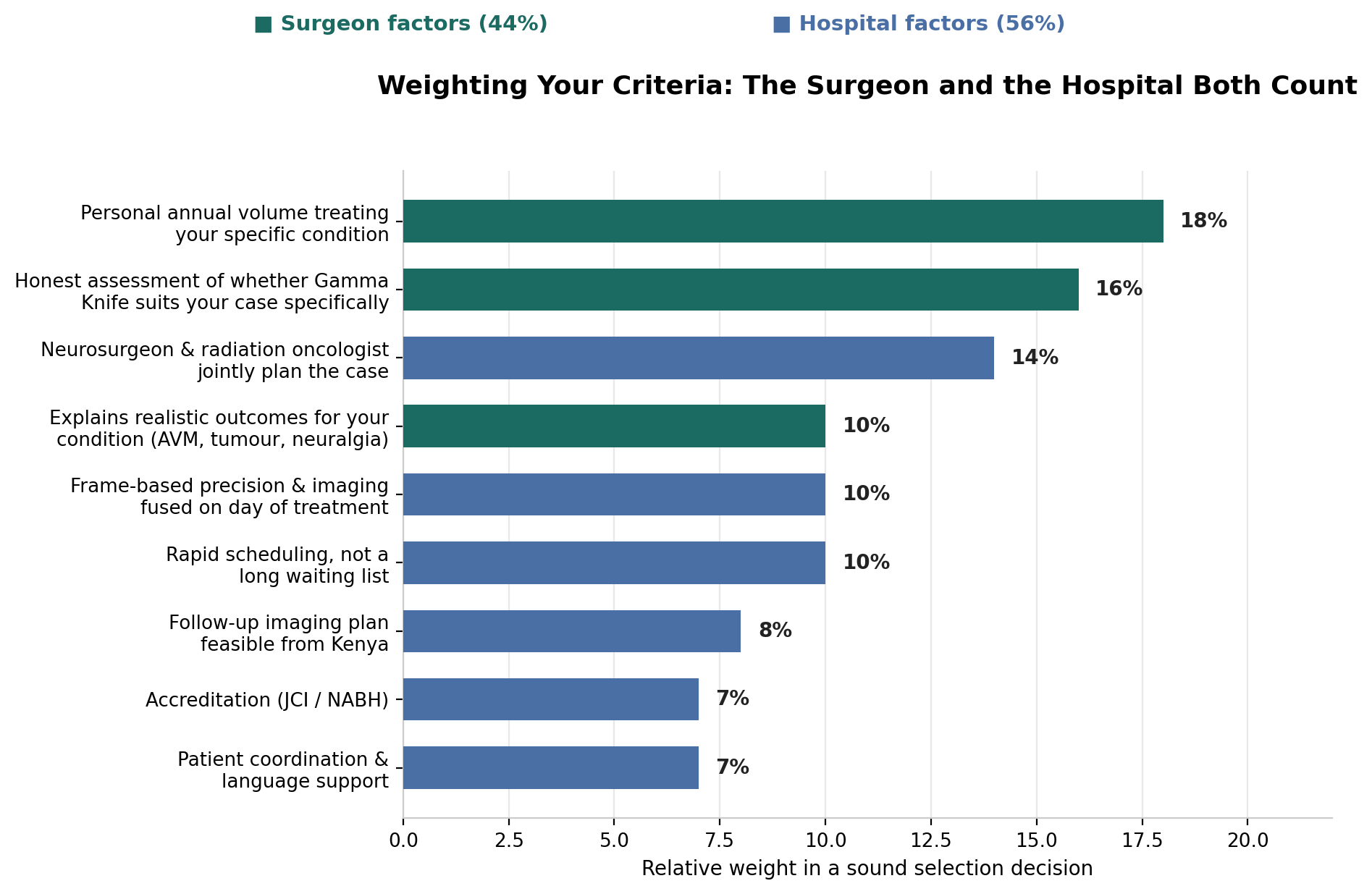
- Hospital selection focuses on joint neurosurgery and radiation oncology planning, frame-based precision, same-day imaging fusion, rapid scheduling and follow-up imaging that can be managed from Kenya. The page 3 chart assigns 44% to surgeon factors and 56% to hospital factors.
- The cost chart on page 4 gives an indicative range of US$5,000–12,000 in India, compared with US$13,000–32,000 in the UK and US$20,000–55,000 in the US. Gamma Knife is currently not domestically available in Kenya, so the guide does not provide a Kenyan treatment price.
- Before travelling, Kenyan patients should send complete MRI or CT imaging and relevant medical reports, confirm whether treatment will be single-session or staged, and obtain a written follow-up imaging plan. The page 5 pathway shows imaging review → joint specialist planning → treatment plan → frame placement and treatment → same-day discharge → follow-up in Kenya.
Quick Facts
- Author
- Dr. Dheeraj Bojwani
- Experience
- 24+ Years of Experience
- Treatment
- Gamma Knife Radiosurgery
- Patients
- Kenyan Neurosurgery / Oncology Patients
- Key Specialist
- Radiosurgeon / Neurosurgeon with Gamma Knife Experience
- Main Assessment
- Tumour or lesion type, size, location and treatment history
- Key Conditions
- Brain tumours, metastases, AVMs and trigeminal neuralgia
- Key Selection Factor
- Personal annual Gamma Knife volume for the specific condition
- Planning
- Joint neurosurgery and radiation oncology assessment
- Treatment
- Often a single session, depending on the condition
- Precision
- Sub-millimetre stereotactic targeting
- Kenya Availability
- No Gamma Knife unit currently available
- India Treatment Cost
- Approximately US$5,000–12,000
- UK Treatment Cost
- Approximately US$13,000–32,000
- US Treatment Cost
- Approximately US$20,000–55,000
- Quality Check
- JCI/NABH accreditation
- Pre-Travel Records
- Complete MRI/CT files and medical reports
- Travel Route
- Nairobi–Delhi or Nairobi–Mumbai
- Follow-Up
- Written imaging plan for Kenyan doctor
- Key Warning Signs
- No condition-specific experience, no joint planning or unclear scheduling
- Decision Principle
- Confirm that Gamma Knife is specifically appropriate before committing to treatment
In Brief
For Kenyan patients considering Gamma Knife in India, the guide recommends focusing on condition-specific radiosurgical experience, multidisciplinary planning, treatment suitability, scheduling and follow-up, rather than choosing a centre based only on technology availability. Gamma Knife is not currently available in Kenya or East Africa, while India has used the technology since 1995. The indicative Indian treatment cost is US$5,000–12,000, with the final quotation depending on whether treatment is single-session or staged and whether follow-up imaging is included.
Before the surgeon: a technology gap with real economics behind it
Kenya became home to Sub-Saharan Africa's first CyberKnife in 2023, a genuine milestone this series has covered honestly. Gamma Knife is a different story entirely. No Gamma Knife unit operates anywhere in Kenya, or indeed anywhere in East Africa. The only installation on the African continent outside Egypt sits in Johannesburg, South Africa, commissioned in 2017.
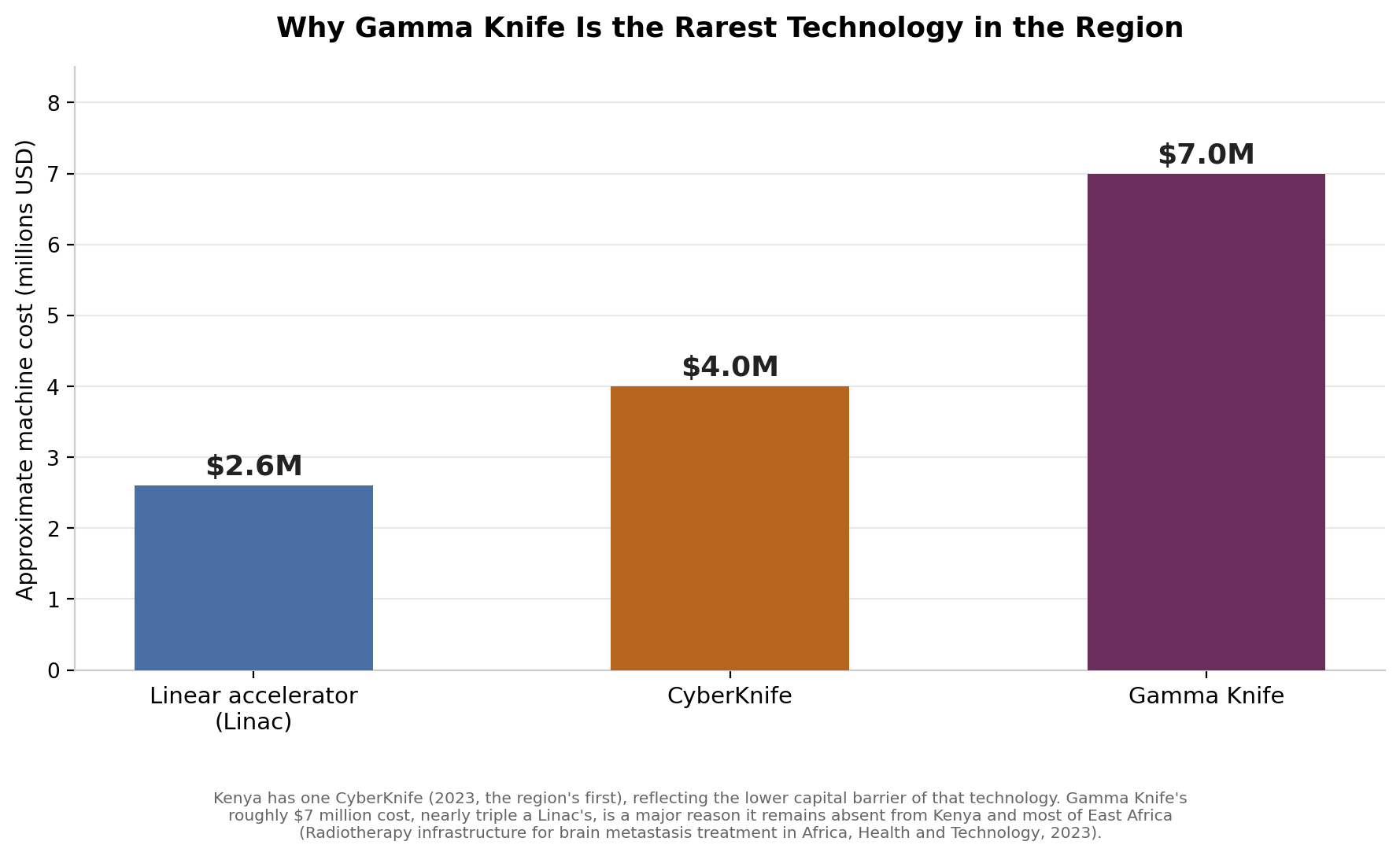
The reason isn't a lack of clinical will. A Gamma Knife installation costs in the region of seven million dollars, nearly triple the cost of a standard linear accelerator and meaningfully more than a CyberKnife system, on top of which sit substantial ongoing costs for the radioactive cobalt-60 sources that power it and require periodic replacement. This capital reality, not a gap in surgical or medical expertise, is the primary reason the technology remains absent from Kenya's healthcare system.
The practical takeaway is that for a genuine Gamma Knife candidate, this decision doesn't turn on comparing Kenyan and Indian options the way most reports in this series do. It turns on recognising, early, that Gamma Knife specifically requires travel, and planning accordingly rather than searching for a domestic alternative that doesn't currently exist.
Should you travel at all?
There is no straightforward-case exception here. For conditions where Gamma Knife is genuinely the right tool, small to medium brain tumours and metastases, arteriovenous malformations, trigeminal neuralgia, and select functional brain disorders, travel is not a matter of preference between a nearby and a distant option. It is the only way to access this specific technology without going considerably further afield than India.
India is where I steer patients, confidently and without the nuance this series usually applies. India has operated Gamma Knife technology since 1995, among the earliest adopters in Asia, and now has multiple established centres with decades of collective experience, treating thousands of patients from across Africa, the Middle East, and beyond. This depth of institutional experience, not just machine availability, is what makes India the clear destination rather than simply the nearest one.
Part one: judging the surgeon
1. Personal annual volume treating your specific condition
I weight this above every other factor, and the chart below reflects that. Ask how many Gamma Knife cases matching your specific condition, brain metastasis, AVM, trigeminal neuralgia, the treating team has personally handled. Each condition demands different planning expertise.
2. An honest assessment of whether Gamma Knife suits your case specifically
Ask directly why Gamma Knife is the right choice for your condition rather than conventional surgery, CyberKnife, or another radiotherapy technique. Not every brain lesion is a good candidate, and a team should explain the reasoning against your own imaging.
3. Explains realistic outcomes for your specific condition
Ask what success looks like specifically for your condition and its size or location, referencing real outcome data, not a general statement about Gamma Knife's precision.
Part two: judging the hospital
For Gamma Knife specifically, joint planning between neurosurgery and radiation oncology carries real weight alongside individual surgeon volume, reflected in the balance above, because the treatment plan itself is where much of the precision comes from.
4. Neurosurgeon and radiation oncologist jointly plan the case
Ask whether your treatment plan is developed jointly by a neurosurgeon and radiation oncologist, since Gamma Knife planning genuinely benefits from both perspectives working together, not one specialist deciding alone.
5. Frame-based precision and same-day imaging fusion
Ask how the treatment frame and imaging are used together on the day of treatment to achieve sub-millimetre accuracy, and confirm this is standard practice at the centre you're considering.
6. Rapid scheduling, not a long waiting list
Ask how quickly treatment can begin once your case is confirmed. Established centres with dedicated Gamma Knife programmes should offer significantly shorter waits than smaller or newer units.
7. A follow-up imaging plan feasible from Kenya
Ask what the follow-up imaging schedule looks like, and how results will be shared with a doctor in Kenya who can act on them locally.
8. Accreditation, read properly
JCI and NABH accreditation are meaningful filters on safety and infection control, but say nothing about Gamma Knife sub-specialisation specifically. Use accreditation to exclude weak candidates, not to choose between the strong ones.
9. The cost you will actually pay
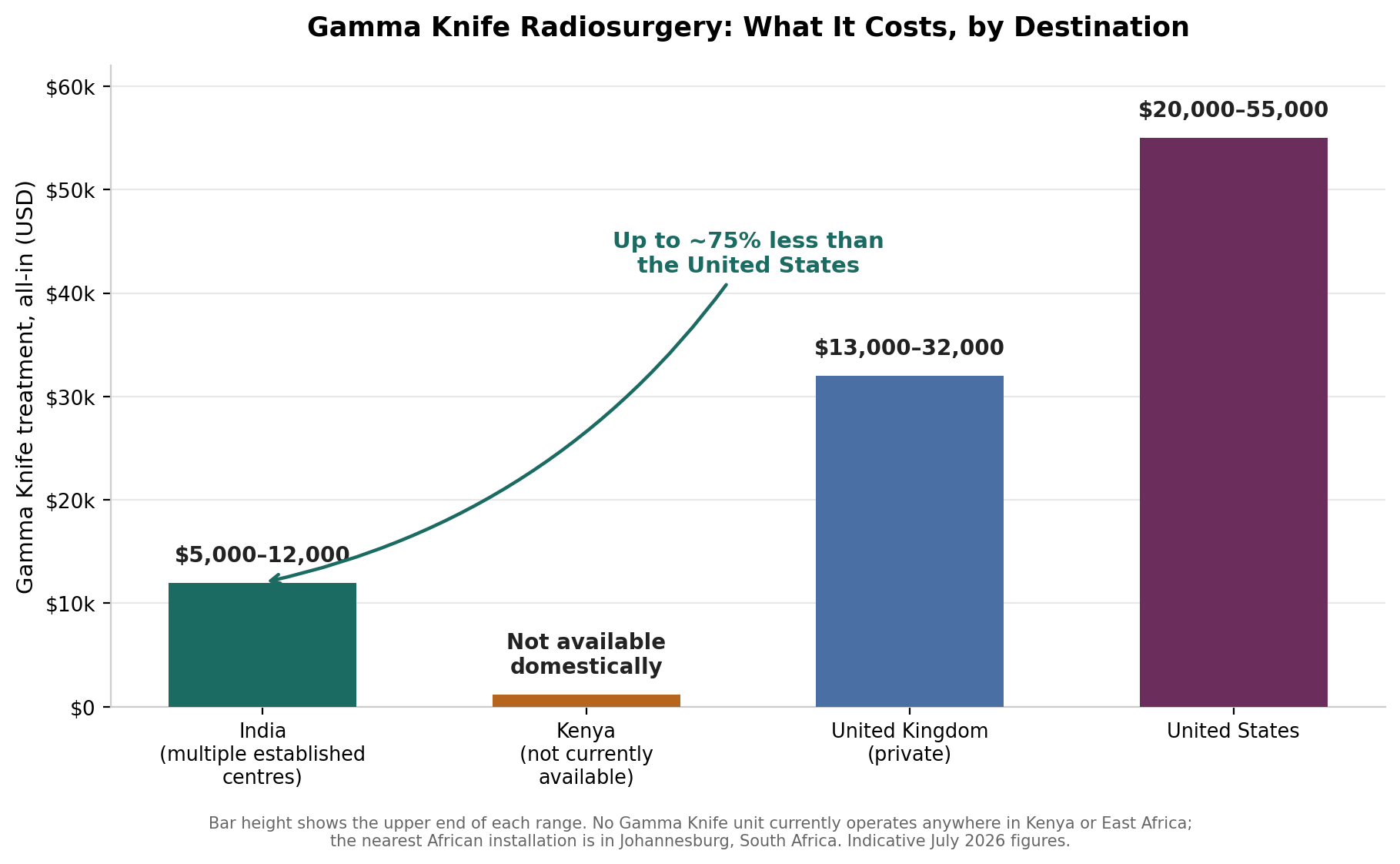
Let me be emphatic about this, because 24 years of handling these cases has taught me nothing more consistently: disputes almost never concern the quoted price. They concern what the quote silently omitted. For Gamma Knife specifically, insist the estimate states whether the treatment is single-session or staged, and whether follow-up imaging is included in the package.
Budget beyond the treatment. Direct Nairobi–Delhi and Nairobi–Mumbai flights run roughly 550 to 850 dollars return, and because Gamma Knife treatment is often a single day with same-day discharge, a stay of one to two weeks for planning and treatment keeps accommodation costs modest.
Four signals that should make you pause
Certain patterns reliably precede a difficult outcome. A team that cannot state personal volume in cases matching your specific condition. No joint neurosurgery and radiation oncology planning. A quote that doesn't specify whether treatment is single-session or staged. And a centre unable to describe its actual scheduling timeline honestly.
None alone proves a bad centre. Together they warrant a second opinion before you commit to treatment.
The Kenya-specific practicalities
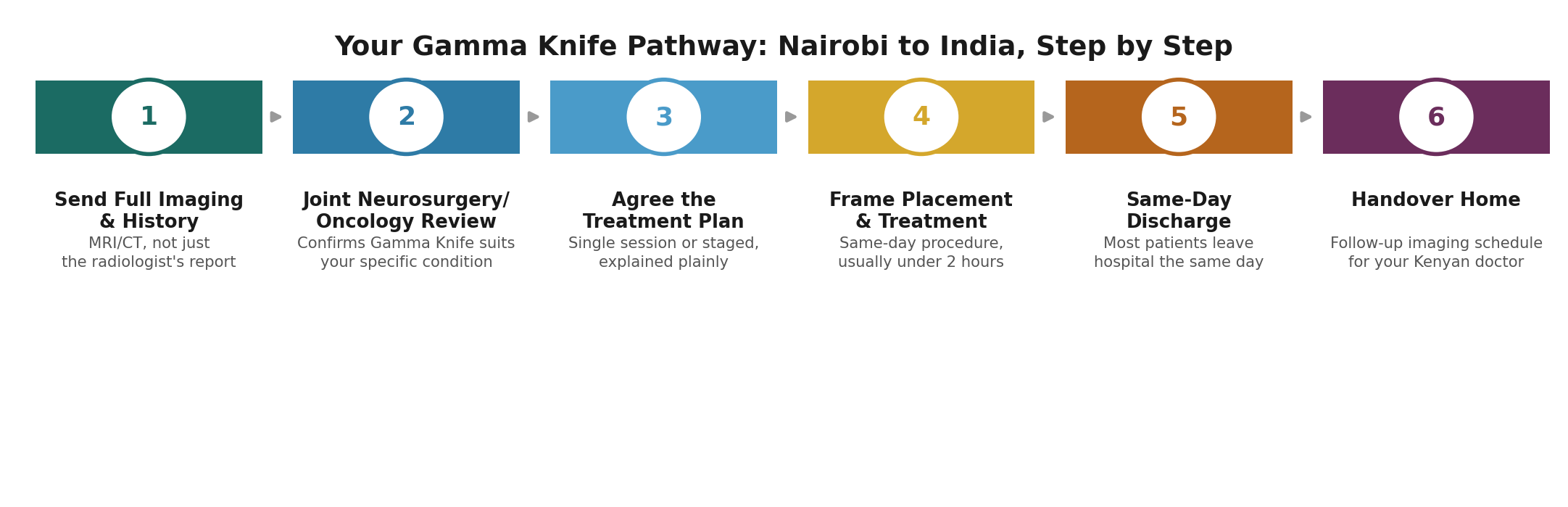
Send the full imaging, MRI or CT files, not just a summary letter, so the treating team can confirm Gamma Knife candidacy properly before you arrive.
Direct Nairobi–Delhi and Nairobi–Mumbai flights make this roughly a six-hour journey. The Indian medical e-visa is issued within three to five working days against a hospital letter, and an attendant can travel with you on a medical attendant visa.
Agree in advance on a written follow-up imaging schedule your Kenyan doctor can act on, since ongoing monitoring is where most of the long-term relationship with your care happens after a single treatment session.
The questions I would ask before committing
Of the surgeon:
- How many Gamma Knife cases matching my specific condition have you personally treated?
- Why is Gamma Knife the right choice for my condition, specifically?
- What is the realistic outcome data for my condition and its size or location?
Of the hospital:
- Is my treatment plan developed jointly by neurosurgery and radiation oncology?
- How quickly can treatment begin once my case is confirmed?
- Is treatment single-session or staged for my condition?
- What exactly is excluded from the quoted price?
- May I speak to a previous East African patient treated for a similar condition?
A team that answers all eight without irritation is very likely the right team. One that turns vague at the first or second has told you what you needed to know at no cost at all.
Straight Answers for Kenyan Patients about Gamma Knife Centres in India
Does Kenya have Gamma Knife?
No. Unlike CyberKnife, which Kenya has had since 2023, no Gamma Knife unit operates anywhere in Kenya or East Africa. The nearest African installation is in Johannesburg, South Africa.
How much does Gamma Knife cost in India for a Kenyan patient?
Typically 5,000 to 12,000 US dollars all in. The same treatment runs 13,000 to 32,000 dollars in the UK and 20,000 to 55,000 in the US.
Why doesn't Kenya have Gamma Knife if it already has CyberKnife?
Cost. A Gamma Knife installation runs roughly seven million dollars, nearly triple a standard linear accelerator and meaningfully more than a CyberKnife system, before accounting for the ongoing cost of its radioactive cobalt-60 sources.
What conditions does Gamma Knife actually treat?
Brain tumours and metastases, arteriovenous malformations, trigeminal neuralgia, and select functional brain disorders, particularly where precision around a small, deep, or hard-to-reach target matters most.
How is Gamma Knife different from CyberKnife?
Gamma Knife treats intracranial conditions specifically, using a fixed array of radiation sources and a stereotactic frame for extremely high precision, often in a single session. CyberKnife uses a robotic arm and can treat tumours throughout the body, including outside the skull, typically over several sessions.
Is Gamma Knife painful or does it require recovery time?
The frame placement involves local anaesthetic and mild discomfort, but the treatment itself is painless, and most patients go home the same day. Full effects on the treated area can take weeks to months to develop, depending on the condition.
A closing word
For the specific conditions Gamma Knife treats best, there is currently no domestic or even regional alternative accessible to a Kenyan patient short of India, and India's decades of institutional experience make it the clear, confident choice rather than simply the nearest one. The best team is the one whose combined neurosurgery and radiation oncology volume in your specific condition, and honest explanation of why Gamma Knife fits your case, show genuine sub-specialisation. If you would like me to look at your imaging and reports and talk through honestly whether Gamma Knife is right for you, send them across.
Sources
- 🌐 Radiotherapy infrastructure for brain metastasis treatment in Africa
- 🌐 Gamma Knife South Africa — unit history and location, Netcare Milpark Hospital, Johannesburg
- 🌐 MEA Gamma Knife Market Analysis Report. Market Data Forecast, 2022–2027
- 🌐 National Medical Commission of India — surgeon and specialist registration verification
- 🌐 National Accreditation Board for Hospitals & Healthcare Providers (NABH) — accredited hospital directory
Frequently Asked Questions by Kenyans about Gamma Knife Centres in India
Does Kenya have Gamma Knife treatment?
No. The guide states that no Gamma Knife unit currently operates in Kenya or elsewhere in East Africa. The nearest African installation is in Johannesburg, South Africa.
Why might a Kenyan patient choose India for Gamma Knife?
For a genuine Gamma Knife candidate, India provides established centres with decades of experience. The guide considers India the practical destination rather than requiring patients to travel farther afield.
What conditions can Gamma Knife treat?
The guide highlights brain tumours and metastases, arteriovenous malformations, trigeminal neuralgia and selected functional brain disorders.
Is Gamma Knife suitable for every brain tumour?
No. The treating team should assess the patient's imaging and explain why Gamma Knife is appropriate compared with conventional surgery, CyberKnife or another radiotherapy technique.
How should I choose a Gamma Knife specialist in India?
Ask about the specialist's personal experience with your specific condition, such as brain metastases, AVM or trigeminal neuralgia, rather than relying only on general Gamma Knife experience.
Does Gamma Knife require surgery or an incision?
Gamma Knife is a form of stereotactic radiosurgery and does not involve a conventional surgical incision. The guide describes frame placement with local anaesthetic and treatment that is generally painless.
How many Gamma Knife sessions are required?
Many cases can be treated in a single session, although some conditions may require staged treatment. Patients should confirm the planned schedule before accepting the quotation.
How much does Gamma Knife cost in India for Kenyan patients?
The guide gives an indicative range of US$5,000–12,000. Patients should confirm whether the quotation includes the treatment session and follow-up imaging.
What should Kenyan patients send before travelling?
Send the complete MRI or CT files and relevant medical reports, rather than only a summary letter, so the Indian team can properly assess Gamma Knife suitability before arrival.
How is follow-up managed after returning to Kenya?
The patient should leave India with a written follow-up imaging schedule that can be shared with and acted upon by the Kenyan doctor.
Page Summary
This guide explains how Kenyan patients can choose Gamma Knife centres and specialists in India, focusing on condition-specific experience, treatment suitability, joint neurosurgery and radiation oncology planning, precision, scheduling, costs and follow-up. It highlights that Gamma Knife is currently unavailable in Kenya and East Africa, while India has offered the technology since 1995, compares indicative costs with the UK and US, and outlines the patient pathway from imaging review through treatment and continued monitoring in Kenya.
Citation Block
| Topic | Information |
|---|---|
| Topic | Gamma Knife Radiosurgery in India for Kenyan Patients |
| Treatment | Gamma Knife Radiosurgery |
| Patients | Kenyan Neurosurgery / Oncology Patients |
| Specialist | Radiosurgeon / Neurosurgeon |
| Key Conditions | Brain tumours, metastases, AVMs and trigeminal neuralgia |
| Main Assessment | Lesion type, size, location and treatment history |
| Surgeon Check | Personal experience with the specific condition |
| Treatment Suitability | Explain why Gamma Knife is preferred over alternatives |
| Planning | Joint neurosurgery and radiation oncology review |
| Precision | Frame-based treatment with same-day imaging fusion |
| Treatment Timing | Often single-session, depending on the case |
| Kenya Availability | No Gamma Knife unit currently operates in Kenya or East Africa |
| India Experience | Gamma Knife technology used in India since 1995 |
| India Cost | Approximately US$5,000–12,000 |
| UK Cost | Approximately US$13,000–32,000 |
| US Cost | Approximately US$20,000–55,000 |
| Quote Check | Single-session or staged treatment and follow-up imaging |
| Pre-Travel Records | Full MRI/CT files and medical reports |
| Follow-Up | Written imaging schedule for Kenyan doctor |
| Quality Check | JCI/NABH accreditation |
| Travel Route | Nairobi–Delhi or Nairobi–Mumbai |
| Warning Signs | No specific case experience, no joint planning or unclear scheduling |
| Selection Weighting | 44% surgeon factors and 56% hospital factors |
| Patient Pathway | Imaging → joint planning → treatment plan → frame/treatment → discharge → Kenya follow-up |
| Decision Principle | Confirm Gamma Knife suitability and condition-specific expertise before treatment |


Our Mission Statement
Our mission is to place patients at the centre of every healthcare decision by providing trustworthy, evidence-based, and unbiased medical information. We believe that informed patients make better decisions. Backed by personalised guidance from our experienced advisory team, we help patients understand their treatment options, compare them objectively, and confidently choose the path that best suits their medical needs and personal circumstances.
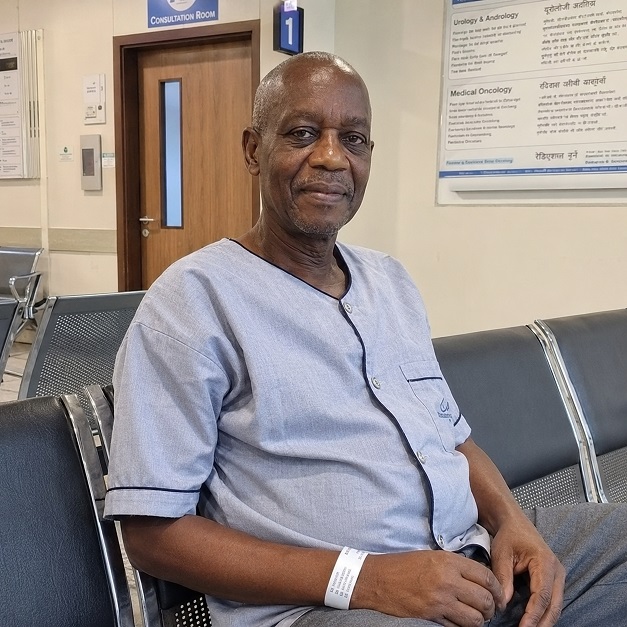
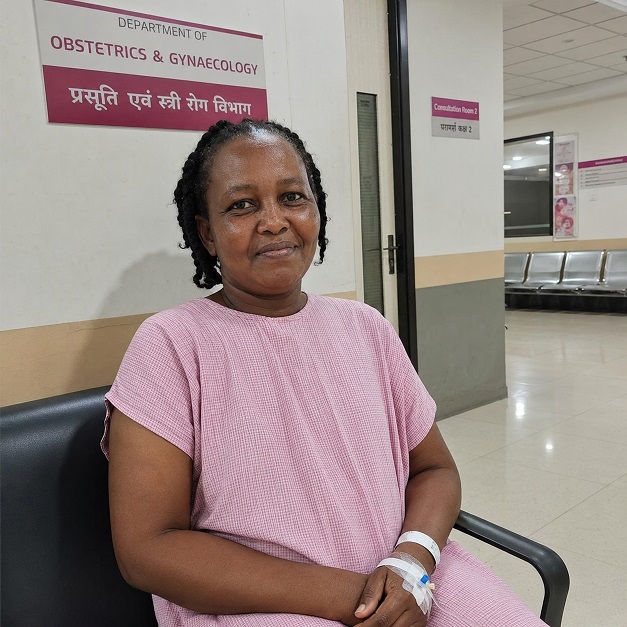
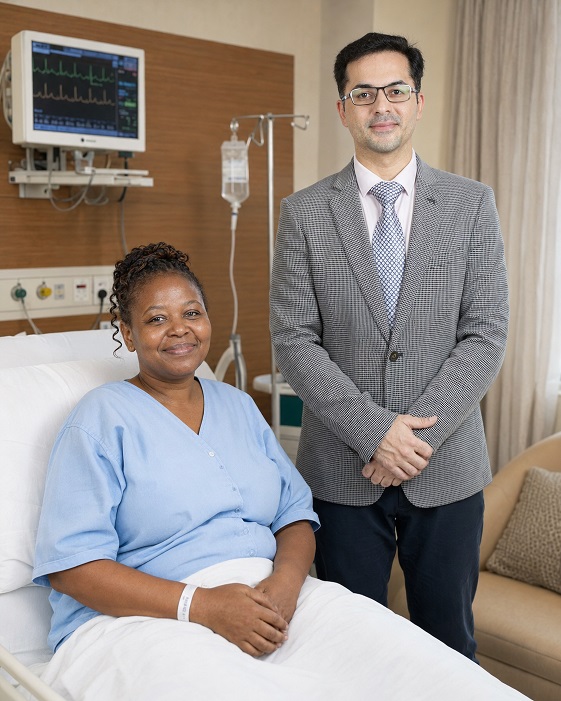
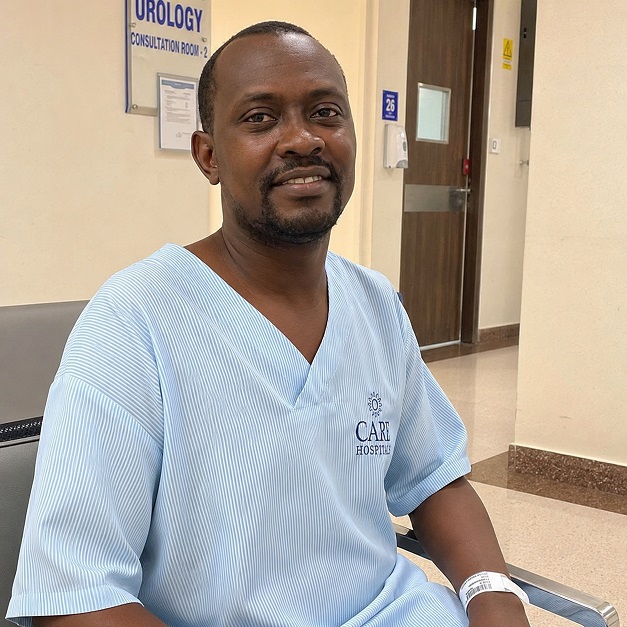
Patient Testimonials from Kenya
Ready to Take the First Step?
Share your Medical Reports with our Healthcare Managers Today and Get a FREE CONSULTATION, a Personalized Treatment Plan, and Complete Support from Arrival to Recovery.
Get Your Free ConsultationAreas We Serve
This resource has been thoughtfully prepared for patients from Kenya who are considering medical treatment in India. We also welcome patients from the wider region in the countries mentioned below-
We assist patients from:
- Ethiopia
- Somalia
- Tanzania
- Uganda
- Seychelles
- Guinea
- Guinea-Bissau
- Liberia
- Mali
- Mauritania
- Niger
- Nigeria
- Senegal
- Togo
- South Sudan
- Sierra Leone
Many of the insights, treatment pathways, hospital recommendations, travel guidance, and patient support services described here are equally relevant and may be used as a reference when planning treatment in India.
From Kenya to India: Your Complete Patient Support Guide
- Brain Tumour Surgery in India for Kenyan Patients
- Cancer Treatment and Surgery in India for Kenyan Patients
- Cardiac Treatment and Surgery in India for Kenyan Patients
- Heart Valve Replacement Surgery in India for Kenyan Patients
- Knee Replacement in India for Kenyan Patients
- Prostate Cancer Treatment and Surgery in India for Kenyan Patients
- Spine Treatment and Surgery in India for Kenyan Patients
- Selecting the Best Bariatric Surgeons and Hospitals in India: What Kenyan Patients Should Actually Look For
- Selecting the Best Cancer Surgeons and Hospitals in India: What Kenyan Patients Should Actually Look For
- Selecting the Best Cardiac Surgeons and Hospitals in India: What Kenyan Patients Should Actually Look For
- Selecting the Best Dental Surgeons and Clinics in India: What Kenyan Patients Should Actually Look For
- Selecting the Best Hip Surgeons and Hospitals in India: What Kenyan Patients Should Actually Look For
- Selecting the Best Kidney Transplant Surgeons and Hospitals in India: What Kenyan Patients Should Actually Look For
- Selecting the Best Knee Surgeons and Hospitals in India: What Kenyan Patients Should Actually Look For
- Selecting the Best Liver Transplant Surgeons and Hospitals in India: What Kenyan Patients Should Actually Look For
- Selecting the Best Neurosurgeons and Hospitals in India: What Kenyan Patients Should Actually Look For
- Selecting the Best Prostate Cancer Surgeons and Hospitals in India: What Kenyan Patients Should Actually Look For
- Selecting the Best Spine Surgeons and Hospitals in India: What Kenyan Patients Should Actually Look For