

Selecting the Best Dental Implant and Smile Makeover Specialists in India: What Kenyan Patients Should Actually Look For
An implant only fuses in a healthy mouth — the gum disease question has to be answered before the implant question.
A dental implant is, in one sense, a purely mechanical problem: a titanium post fuses with your jawbone and holds a crown in place. But that fusion, called osseointegration, only works reliably in a mouth that is otherwise healthy, and this is where a genuinely important fact about Kenya changes how implants and smile makeovers should actually be approached. Across 24 years of guiding international patients through Indian hospitals, the implant failures I see most often aren't caused by poor surgical technique. They're caused by implants placed into gums that were diseased from the start. This is the framework I use when a Kenyan patient is weighing dental implants or a smile makeover in India. It follows the surgeon-then-hospital structure of this series, and opens with a statistic that should be the first question in any implant consultation, not an afterthought.
Healing Journeys of Kenyan Patients






Key Takeaways
- The guide places gum health before implant or veneer selection, highlighting that 98.1% of Kenyan adults have some form of periodontal disease. Since implants depend on healthy supporting bone and tissue, untreated gum disease can substantially increase the risk of implant failure.
- Long-term evidence cited in the guide indicates that implants placed in patients with severe untreated periodontitis may fail at roughly eight times the rate seen in healthy gums. The practical recommendation is to complete a genuine periodontal assessment and treat active gum disease before implant placement.
- Kenya has skilled dentists and cosmetic clinics, particularly in Nairobi, and straightforward cases with healthy gums may reasonably be treated locally. India is presented as particularly useful for gum disease combined with implants, bone grafting, complex full-arch reconstruction and comprehensive treatment planning.
- Dentist selection should focus on specific implant experience, verified qualifications and honest bone-graft assessment. The page 3 chart gives 64% weighting to dentist factors and 36% to facility factors, with treating gum disease before implants receiving the highest individual weighting at 20%.
- Facility selection focuses on CT/CBCT imaging, structured osseointegration monitoring and appropriate accreditation. The guide recommends confirming that 3D imaging is available for precise implant planning and that accreditation applies specifically to the dental facility.
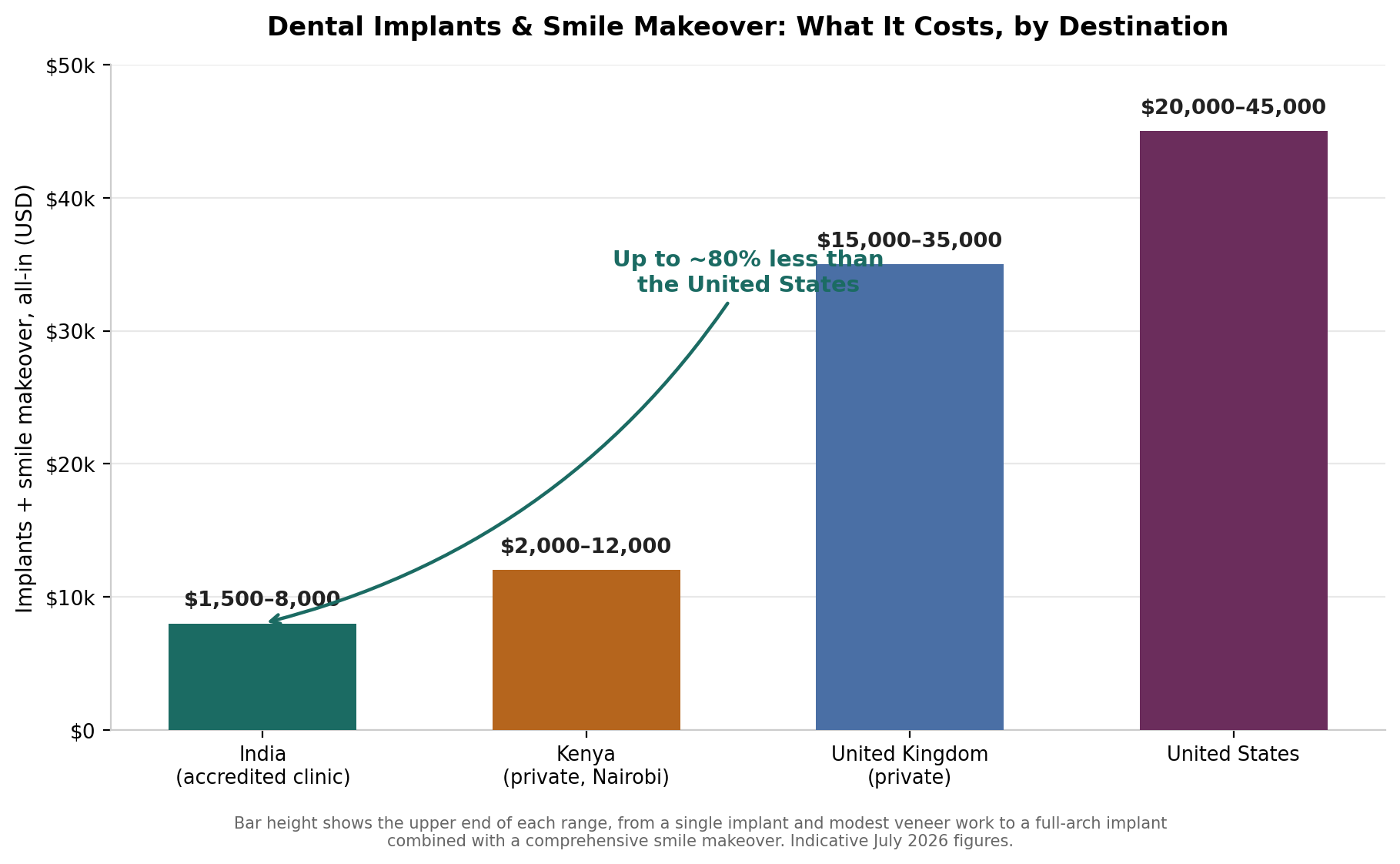
- The page 4 cost chart gives an indicative range of US$1,500–8,000 in India, compared with US$2,000–12,000 in Kenya, US$15,000–35,000 in the UK and US$20,000–45,000 in the US. Patients should confirm whether periodontal treatment, bone grafting, crowns and veneers are included in the quotation.
- Before travelling, Kenyan patients should send recent dental X-rays and clear photographs of their teeth and gums. The page 5 pathway moves from gum assessment through treatment planning, implant placement or veneer preparation, healing and osseointegration, and finally a written maintenance plan for the Kenyan dentist.
Quick Facts
- Author
- Dr. Dheeraj Bojwani
- Experience
- 24+ Years of Experience
- Treatment
- Dental Implants & Smile Makeover
- Patients
- Kenyan Dental Patients
- Key Specialist
- Implantologist / Prosthodontist
- Main Assessment
- Gum health, bone volume and cosmetic goals
- Key Priority
- Treat gum disease before implants or veneers
- Kenyan Gum Disease Rate
- 98.1% of adults cited as having some form of periodontal disease
- Implant Risk
- Untreated severe periodontitis may increase implant failure risk substantially
- Key Surgical Options
- Single-tooth implants, full-arch implants and bone grafting
- Cosmetic Options
- Dental veneers and smile makeover procedures
- Imaging
- CT / CBCT 3D implant planning
- India Treatment Cost
- Approximately US$1,500–8,000
- Kenya Treatment Cost
- Approximately US$2,000–12,000
- UK Treatment Cost
- Approximately US$15,000–35,000
- US Treatment Cost
- Approximately US$20,000–45,000
- Key Selection Factor
- Dentist's annual volume in cases matching the patient
- Facility Requirement
- Accredited dental facility with appropriate diagnostic imaging
- Healing
- Structured osseointegration monitoring
- Quality Check
- JCI/NABH accreditation
- Pre-Travel Records
- Recent dental X-rays and clear photographs
- Travel Route
- Nairobi–Delhi or Nairobi–Mumbai
- Follow-Up
- Written maintenance and gum-health plan with Kenyan dentist
- Key Warning Signs
- Implant discussion before gum assessment, unclear qualifications, incomplete pricing or reliance on 2D X-rays alone
- Decision Principle
- Confirm gum health before choosing implants, veneers or cosmetic materials
In Brief
For Kenyan patients considering dental implants or a smile makeover in India, the guide identifies gum health as the most important starting point. Patients should have periodontal disease assessed and treated before implants or veneers are planned, while complex cases may require bone grafting, CBCT-based planning and specialist implant or prosthodontic care. The guide gives an indicative cost of US$1,500–8,000 in India and stresses that the quotation should clearly state whether gum treatment, grafting and the final crown or veneer are included.
Before the dentist: the gum disease question comes before the implant question
Kenya's National Oral Health Survey found that 98.1% of Kenyan adults have some form of periodontal, or gum, disease. This is not a minor cosmetic issue sitting alongside the crooked tooth or missing incisor that brought you to a dentist in the first place. Periodontal disease is a bacterial infection that destroys the bone and tissue supporting your teeth, the exact structure an implant depends on to succeed.
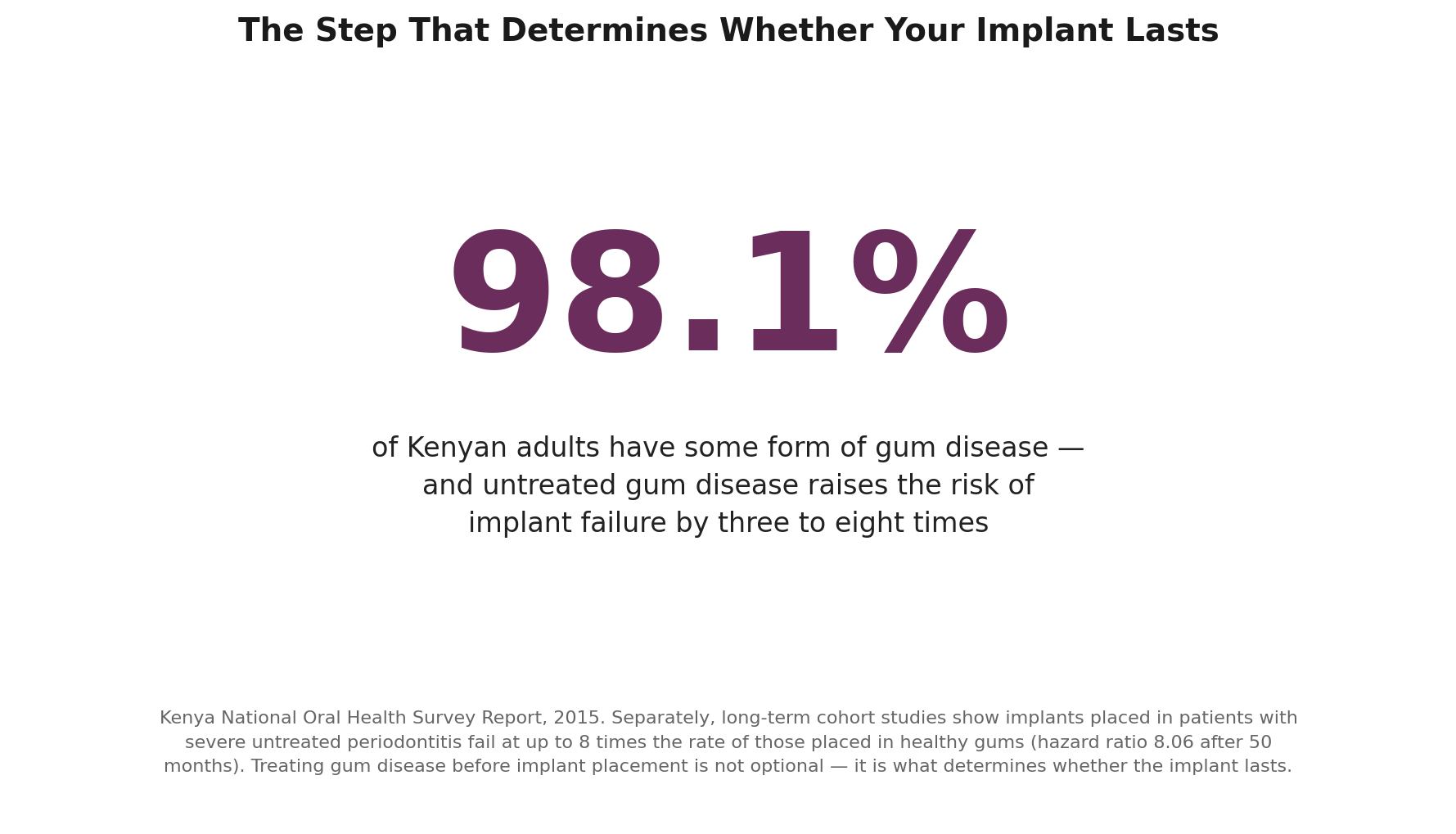
The clinical evidence on this is specific and sobering. Long-term cohort studies tracking dental implants over eight to ten years found that implants placed in patients with severe, untreated periodontitis failed at a hazard ratio of roughly eight times that of implants placed in healthy gums. Other research found implant survival dropping from around 95 to 96% in healthy or well-managed patients to as low as 86 to 88% in those with a history of unaddressed gum disease. Given how common gum disease is in Kenya, and that only around a third of Kenyan adults recognise bleeding gums as a sign of disease in the first place, a meaningful number of patients seeking implants or a smile makeover have active periodontal disease that has never been diagnosed, let alone treated.
The practical takeaway is to insist that any implant or veneer consultation begins with a genuine periodontal assessment, not a conversation that jumps straight to which implant brand or veneer material you'd like. If gum disease is present, ask for a clear treatment plan and timeline to address it before implant placement is even scheduled.
Should you travel at all?
Kenya has genuinely skilled dentists and cosmetic dental clinics, particularly in Nairobi, capable of both periodontal treatment and implant placement, and for a patient with healthy gums seeking straightforward cosmetic work, treatment in Kenya is a reasonable option, provided the clinic takes periodontal health seriously.
For patients with any degree of gum disease, cases needing bone grafting or complex full-arch reconstruction, or anyone who wants a genuinely comprehensive assessment before committing to implants, India is where I steer patients, confidently. India's leading implant and cosmetic dentistry centres combine specialist periodontal treatment, digital smile design, and high-volume implantology experience in one coordinated plan, at a fraction of UK or US cost, and treat gum health as the foundation the entire result depends on, not a box to tick.
Part one: judging the dentist
1. Treats gum disease first, before ever discussing implants or veneers
I weight this above every other factor, and the chart below reflects that. A dentist who moves straight to discussing implant brands or veneer shades without first assessing your periodontal health is skipping the step that determines whether any of it will last.
2. Verified board certification in implantology or prosthodontics
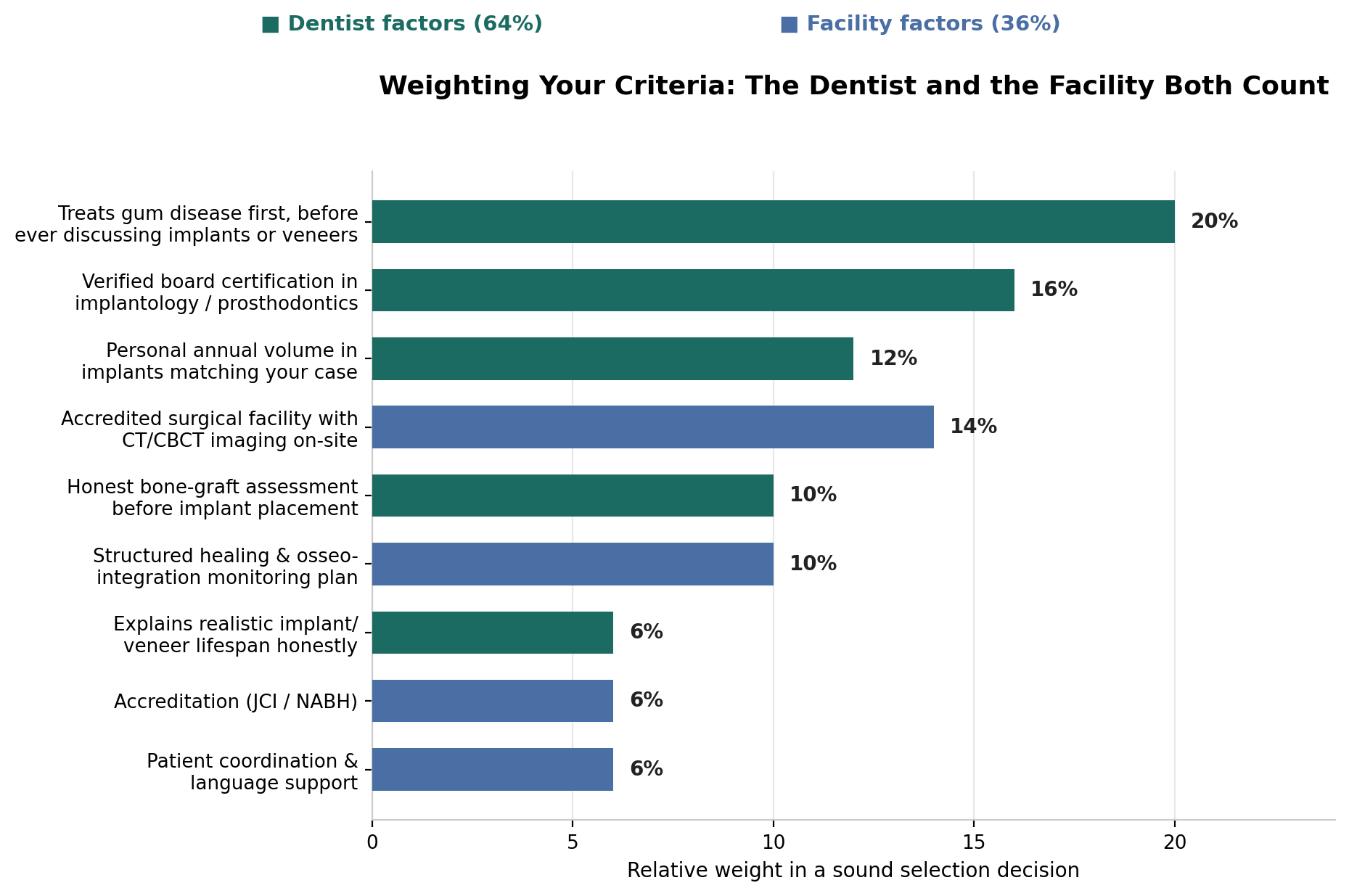
Confirm the dentist placing your implants is specifically qualified in implantology or oral surgery, and the dentist doing cosmetic work is a genuine prosthodontist or cosmetic specialist, not a general dentist offering both as a side service.
3. Personal annual volume in implants matching your case
Ask how many implants matching your specific situation, single tooth, full arch, cases needing bone grafting, the dentist personally places each year.
4. An honest bone-graft assessment before implant placement
Ask whether your jawbone has sufficient volume and density for an implant without grafting, and if grafting is needed, what that adds to the timeline and plan.
Part two: judging the facility
For implants and smile makeovers, the facility's diagnostic capability carries real weight alongside the dentist, reflected in the balance above, because accurate planning depends on seeing your bone and gum structure clearly before any work begins.
5. An accredited surgical facility with CT or CBCT imaging on-site
Ask whether 3D CT or CBCT imaging is used to plan implant placement precisely, rather than relying on 2D X- rays alone, since this significantly affects both safety and long-term success.
6. A structured healing and osseointegration monitoring plan
Ask what monitoring looks like during the weeks to months your implant needs to fuse with bone, and what happens if healing doesn't progress as expected.
7. Explains realistic implant and veneer lifespan honestly
Ask how long your specific implants or veneers are realistically expected to last, and what maintenance is required, rather than an unqualified promise of permanence.
8. Accreditation, read properly
JCI and NABH accreditation are meaningful filters on safety and infection control, but confirm they specifically cover the dental facility, not just a broader hospital group's other departments.
9. The cost you will actually pay
Let me be emphatic about this, because 24 years of handling these cases has taught me nothing more consistently: disputes almost never concern the quoted price. They concern what the quote silently omitted. For implants and smile makeovers specifically, insist the estimate states whether periodontal treatment, bone grafting, and the final crown or veneer are included, or priced as separate add-ons discovered partway through.
Budget beyond the treatment. Direct Nairobi–Delhi and Nairobi–Mumbai flights run roughly 550 to 850 dollars return, and implant cases requiring healing time before the final crown may need two separate trips, so ask early whether that applies to your case.
Four signals that should make you pause
Certain patterns reliably precede a difficult outcome. A dentist who discusses implant brands or veneer materials before assessing your gum health. No verified qualification specific to implantology or prosthodontics. A quote that doesn't specify whether periodontal treatment and bone grafting are included. And a facility relying on 2D X-rays alone for implant planning.
None alone proves a bad clinic. Together they warrant a second opinion before you commit to treatment.
The Kenya-specific practicalities
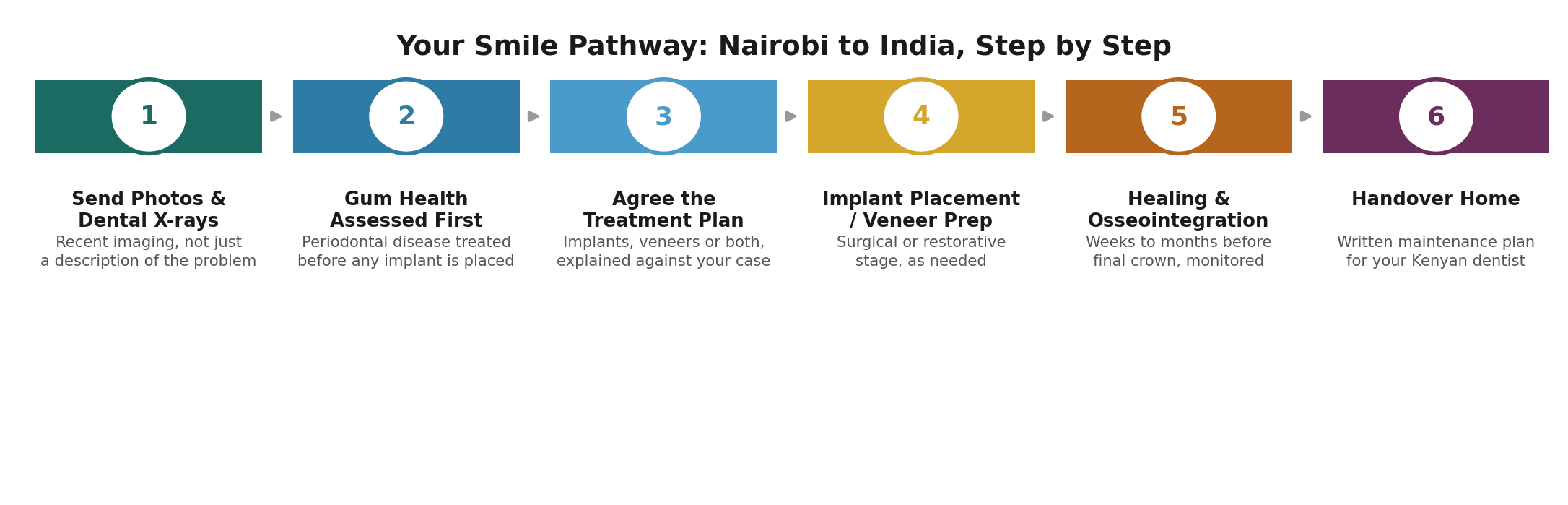
Send recent dental X-rays and clear photographs of your teeth and gums, not just a description of what bothers you, so the team can assess periodontal health and implant candidacy before you arrive.
Direct Nairobi–Delhi and Nairobi–Mumbai flights make this roughly a six-hour journey. The Indian medical e-visa is issued within three to five working days against a hospital letter, and an attendant can travel with you if needed.
Agree in advance on a written maintenance plan, cleaning schedule and gum health checks, your Kenyan dentist can continue once you are home, since implants and veneers both require ongoing care to last.
The questions I would ask before paying a deposit
Of the dentist:
- Do I have any degree of gum disease, and does it need treatment before implants?
- Are you specifically qualified in implantology or prosthodontics?
- How many implants matching my case do you personally place each year?
- Do I need bone grafting, and how does that change the timeline?
Of the facility:
- Do you use 3D CT or CBCT imaging to plan implant placement?
- What does monitoring look like during healing and osseointegration?
- What is the realistic lifespan of my specific implants or veneers?
- What exactly is excluded from the quoted price?
- May I speak to a previous East African patient treated for a similar case?
A team that answers all nine without irritation is very likely the right team. One that turns vague at the first has told you what you needed to know at no cost at all.
Straight Answers for Kenyan Patients about Dental Implant and Smile Makeover Specialists in India
How do I choose the best dentist in India for implants as a Kenyan patient?
Confirm gum health is genuinely assessed before implants are discussed, verify specific qualification in implantology or prosthodontics, and ask his annual volume in cases matching yours, single tooth versus full-arch reconstruction.
How much do implants and a smile makeover cost in India for a Kenyan patient?
Typically 1,500 to 8,000 US dollars for a complete case. The same treatment runs roughly 2,000 to 12,000 dollars in Kenya, 15,000 to 35,000 in the UK, and 20,000 to 45,000 in the US.
Why does gum disease matter so much for dental implants specifically?
Because an implant depends on fusing with healthy bone and gum tissue. Studies show implants placed in patients with untreated severe periodontitis fail at up to eight times the rate of those placed in healthy gums, and 98.1% of Kenyan adults have some form of gum disease, much of it undiagnosed.
Can I get veneers if I have gum disease?
Not safely, until the gum disease is treated first. Veneers placed over inflamed or receding gums often look poor and fail early as the underlying disease progresses. Insist gum health is assessed and, if needed, treated before any cosmetic work begins.
How long do dental implants actually last?
With healthy gums and good maintenance, implants can last 15 to 25 years or longer. In patients with untreated gum disease, failure can occur within just a few years. Ask your dentist for a realistic estimate specific to your gum health, not a generic promise.
What is CBCT imaging, and why does it matter for implants?
Cone-beam computed tomography creates a detailed 3D image of your jaw, allowing precise implant planning around your actual bone volume and nerve locations. It's a meaningfully more accurate planning tool than standard 2D dental X-rays, particularly for complex or multiple-implant cases.
A closing word
For a Kenyan patient considering implants or a smile makeover, the single most important step isn't choosing an implant brand or a veneer shade, it's confirming your gum health first, since that is what actually determines whether any of it lasts. India offers dentists who treat that step as non-negotiable, paired with the digital planning and implant volume to get complex cases right, at a fraction of UK or US cost. If you would like me to look at your dental photos and X-rays and talk through honestly what your treatment plan should look like, send them across.
Sources
- 🌐 Kenya National Oral Health Survey Report, 2015 — national periodontal disease prevalence data. Ministry of Health, Kenya
- 🌐 Periodontal disease as a risk for dental implant failure over time: a long-term historical cohort study. PubMed. pubmed.ncbi.n
- 🌐 Clinical Outcomes of Dental Implants in Patients with and Without a History of Periodontitis. Journal of Contemporary Healthcare Research
- 🌐 National Medical Commission of India — practitioner and specialist registration verification
- 🌐 National Accreditation Board for Hospitals & Healthcare Providers (NABH) — accredited facility directory
Frequently Asked Questions by Kenyans about Dental Implant and Smile Makeover Specialists in India
Why should gum health be checked before dental implants?
An implant depends on healthy supporting bone and gum tissue. The guide recommends treating active periodontal disease before implant placement because untreated disease can significantly increase the risk of failure.
How common is gum disease among Kenyan adults?
The guide cites Kenya's National Oral Health Survey and states that 98.1% of Kenyan adults have some form of periodontal disease. This makes periodontal assessment particularly important for Kenyan implant patients.
How should Kenyan patients choose an implant dentist in India?
Verify specific qualifications in implantology, oral surgery or prosthodontics and ask how many cases similar to yours the dentist personally treats each year.
Will I need a bone graft before getting an implant?
Not necessarily. The need depends on the amount and density of available jawbone. The dentist should perform an honest assessment and explain how grafting would change the treatment timeline.
Why is CBCT imaging important for dental implants?
CBCT provides a detailed 3D view of the jaw, helping the dentist assess bone volume and nerve locations and plan implant placement more precisely than standard 2D X-rays.
Can I have veneers if I have gum disease?
The guide recommends treating gum disease first. Veneers placed while gums are inflamed or receding may have poorer appearance and longevity.
How much do dental implants and a smile makeover cost in India?
The guide gives an indicative range of US$1,500–8,000 for a complete case. The final price depends on the treatment required and what is included in the quotation.
What should be included in the dental treatment quotation?
Confirm whether periodontal treatment, bone grafting and the final crown or veneer are included or charged separately. This helps prevent unexpected costs during treatment.
Can dental implant treatment require two trips to India?
It can. Some implant cases require a healing period before the final crown is fitted, so patients should ask before travelling whether their treatment can be completed in one visit or requires a second trip.
How should dental implant patients manage care after returning to Kenya?
Agree on a written maintenance plan covering cleaning, gum-health checks and ongoing monitoring so the Kenyan dentist can continue care after treatment in India.
Page Summary
This guide explains how Kenyan patients can choose dental implant and smile makeover specialists in India, focusing on gum health, specialist qualifications, implant experience, bone-graft assessment, CBCT imaging, healing monitoring, facility accreditation and costs. It highlights the cited 98.1% prevalence of periodontal disease among Kenyan adults, compares indicative treatment costs across India, Kenya, the UK and US, and outlines the patient journey from pre-travel dental imaging and gum assessment through treatment, osseointegration and long-term maintenance in Kenya.
Citation Block
| Topic | Information |
|---|---|
| Topic | Dental Implants & Smile Makeover in India for Kenyan Patients |
| Treatment | Dental Implants, Bone Grafting & Smile Makeover |
| Specialist | Implantologist / Prosthodontist |
| Key Priority | Treat gum disease before implants or veneers |
| Gum Disease Rate | 98.1% of Kenyan adults cited |
| Key Assessment | Gum health, bone volume and implant suitability |
| Imaging | CT/CBCT 3D implant planning |
| Surgeon Check | Verified qualification and case-specific implant experience |
| Bone Grafting | Assess need before implant placement |
| Healing | Structured osseointegration monitoring |
| Facility Check | Accredited facility with appropriate dental diagnostics |
| India Cost | Approximately US$1,500–8,000 |
| Kenya Cost | Approximately US$2,000–12,000 |
| Quote Check | Gum treatment, bone grafting, crowns and veneers |
| Pre-Travel Records | Dental X-rays and clear photographs |
| Travel Route | Nairobi–Delhi or Nairobi–Mumbai |
| Follow-Up | Written maintenance plan with Kenyan dentist |
| Warning Signs | No gum assessment, unclear qualifications or incomplete pricing |
| Decision Principle | Confirm gum health before choosing implants or cosmetic treatment |


Our Mission Statement
Our mission is to place patients at the centre of every healthcare decision by providing trustworthy, evidence-based, and unbiased medical information. We believe that informed patients make better decisions. Backed by personalised guidance from our experienced advisory team, we help patients understand their treatment options, compare them objectively, and confidently choose the path that best suits their medical needs and personal circumstances.
Patient Testimonials from Kenya

Ready to Take the First Step?
Share your Medical Reports with our Healthcare Managers Today and Get a FREE CONSULTATION, a Personalized Treatment Plan, and Complete Support from Arrival to Recovery.
Get Your Free ConsultationAreas We Serve
This resource has been thoughtfully prepared for patients from Kenya who are considering medical treatment in India. We also welcome patients from the wider region in the countries mentioned below-
We assist patients from:
- Ethiopia
- Somalia
- Tanzania
- Uganda
- Seychelles
- Guinea
- Guinea-Bissau
- Liberia
- Mali
- Mauritania
- Niger
- Nigeria
- Senegal
- Togo
- South Sudan
- Sierra Leone
Many of the insights, treatment pathways, hospital recommendations, travel guidance, and patient support services described here are equally relevant and may be used as a reference when planning treatment in India.
From Kenya to India: Your Complete Patient Support Guide
- Brain Tumour Surgery in India for Kenyan Patients
- Cancer Treatment and Surgery in India for Kenyan Patients
- Cardiac Treatment and Surgery in India for Kenyan Patients
- Heart Valve Replacement Surgery in India for Kenyan Patients
- Knee Replacement in India for Kenyan Patients
- Prostate Cancer Treatment and Surgery in India for Kenyan Patients
- Spine Treatment and Surgery in India for Kenyan Patients
- Selecting the Best Bariatric Surgeons and Hospitals in India: What Kenyan Patients Should Actually Look For
- Selecting the Best Cancer Surgeons and Hospitals in India: What Kenyan Patients Should Actually Look For
- Selecting the Best Cardiac Surgeons and Hospitals in India: What Kenyan Patients Should Actually Look For
- Selecting the Best Dental Surgeons and Clinics in India: What Kenyan Patients Should Actually Look For
- Selecting the Best Hip Surgeons and Hospitals in India: What Kenyan Patients Should Actually Look For
- Selecting the Best Kidney Transplant Surgeons and Hospitals in India: What Kenyan Patients Should Actually Look For
- Selecting the Best Knee Surgeons and Hospitals in India: What Kenyan Patients Should Actually Look For
- Selecting the Best Liver Transplant Surgeons and Hospitals in India: What Kenyan Patients Should Actually Look For
- Selecting the Best Neurosurgeons and Hospitals in India: What Kenyan Patients Should Actually Look For
- Selecting the Best Prostate Cancer Surgeons and Hospitals in India: What Kenyan Patients Should Actually Look For
- Selecting the Best Spine Surgeons and Hospitals in India: What Kenyan Patients Should Actually Look For