

Selecting the Best DBS Surgeons and Hospitals in India: What Kenyan Patients Should Actually Look For
DBS is decided long before the operating theatre — until a movement disorder neurologist has optimised your medication, you are not yet a surgical candidate.
Parkinson's disease is a strange condition to treat well, because the disease itself rarely announces a clear moment when medical management stops working and surgery becomes the answer. That transition happens gradually, over years, as medication that once controlled symptoms reliably starts producing side effects of its own, wearing off between doses, or losing effectiveness altogether. Deep brain stimulation exists for exactly this stage of the disease. Across 24 years of guiding international patients through Indian hospitals, the DBS cases that go best are never rushed into surgery. They arrive after years of properly managed medical therapy that has genuinely run its course. This is the framework I use when a Kenyan patient with Parkinson's disease, essential tremor, dystonia, or another movement disorder is weighing DBS surgery in India. It follows the surgeon-then-hospital structure of this series, and opens with a fact this report needs to state plainly before anything else: the step before DBS is often where things go wrong first.
Healing Journeys of Kenyan Patients
Key Takeaways
- The guide emphasises that medication optimisation must come before DBS surgery. DBS is generally considered only after years of properly managed medical therapy when symptoms such as motor fluctuations or dyskinesias can no longer be adequately controlled. A 2024 Kenyan study also identified significant financial and logistical barriers to consistent Parkinson’s medication access.
- This medication-access issue is important because unreliable treatment can make it difficult to determine whether a patient has genuinely failed medical therapy or simply never received consistent treatment. The guide therefore recommends confirming the diagnosis with a movement disorder specialist and establishing a period of properly optimised and consistently accessible medication before assessing DBS candidacy.
- The guide states that there is currently no functional DBS programme performing the procedure at meaningful volume in Kenya or East Africa. India is therefore presented as an important option for appropriately selected patients, with established centres offering high DBS volumes, movement disorder specialists and post-operative programming expertise.
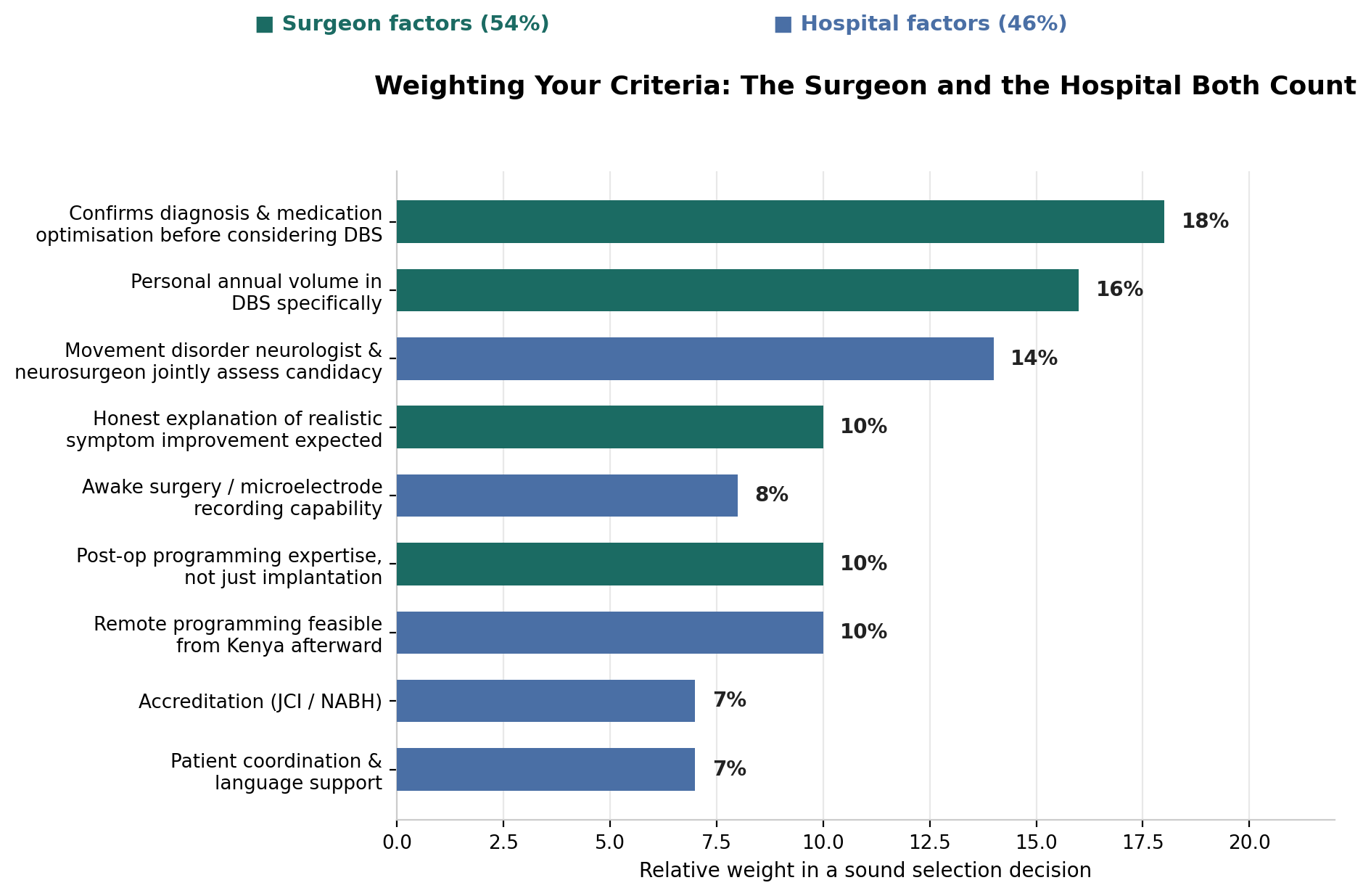
- Surgeon selection focuses on DBS-specific experience rather than general functional neurosurgery volume. The page 3 weighting chart assigns 54% to surgeon factors and 46% to hospital factors. Confirming diagnosis and medication optimisation receives the highest individual weighting at 18%, followed by personal annual DBS volume at 16%.
- Hospital selection should include joint assessment by a movement disorder neurologist and functional neurosurgeon, awake DBS with microelectrode recording where appropriate, and strong post-operative programming support. The guide also stresses that programming after returning to Kenya must be planned before surgery because device settings commonly require adjustment during the months following implantation.
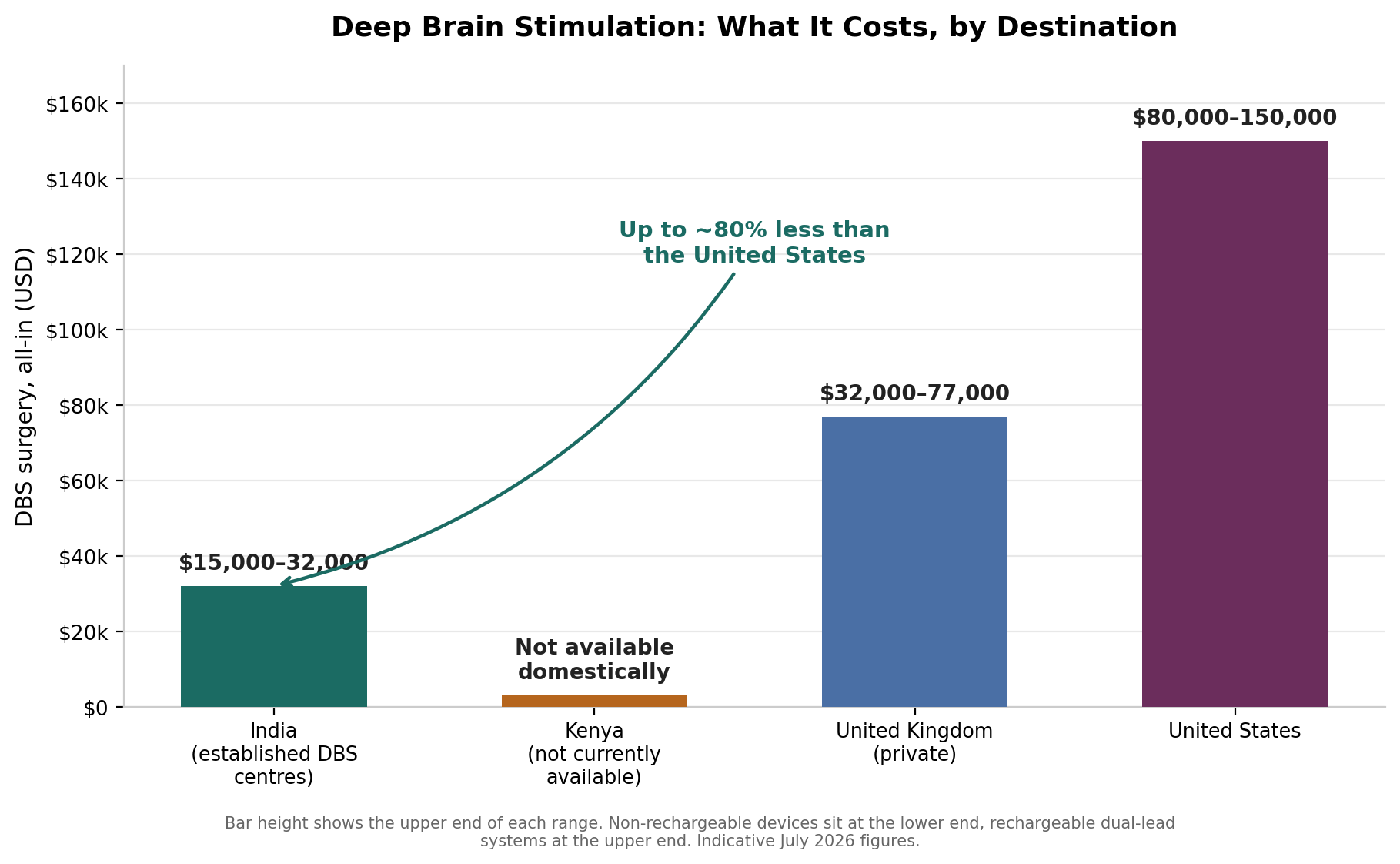
- The page 4 cost chart gives an indicative DBS cost of US$15,000–32,000 in India, compared with US$32,000–77,000 in the UK and US$80,000–150,000 in the US; DBS is described as not currently available domestically in Kenya at meaningful volume. Patients should confirm whether the device is rechargeable or non-rechargeable and how many programming sessions are included.
Quick Facts
- Author
- Dr. Dheeraj Bojwani
- Experience
- 24+ Years of Experience
- Treatment
- Parkinson’s Treatment & Deep Brain Stimulation (DBS)
- Patients
- Kenyan Parkinson’s & Movement Disorder Patients
- Key Specialist
- Movement Disorder Neurologist / Functional Neurosurgeon
- Main Assessment
- Diagnosis, disease stage and response to optimised medication
- Key Priority
- Confirm medical therapy has genuinely been exhausted
- Conditions
- Parkinson’s disease, essential tremor and dystonia
- Key Selection Factor
- Personal annual DBS volume
- Hospital Requirement
- Joint neurologist-neurosurgeon DBS assessment
- Programming
- Post-operative and remote programming plan
- India Cost
- Approximately US$15,000–32,000
- UK Cost
- Approximately US$32,000–77,000
- US Cost
- Approximately US$80,000–150,000
- Technology Check
- Awake DBS and microelectrode recording capability
- Pre-Travel Records
- Diagnosis history and detailed medication log
- Follow-Up
- Remote programming plan with Kenyan neurologist
- Key Warning Signs
- Surgery before medication optimisation or no clear programming plan
- Decision Principle
- Confirm appropriate DBS candidacy before proceeding with surgery
In Brief
For Kenyan patients considering DBS in India, the guide recommends confirming that medical therapy has genuinely been optimised and exhausted before surgery is considered. Patients should choose a DBS surgeon with substantial procedure-specific experience and a hospital where a movement disorder neurologist and neurosurgeon jointly assess candidacy. A clear plan for programming and follow-up from Kenya is essential. The guide gives an indicative Indian DBS cost of US$15,000–32,000.
Before the surgeon: the medication problem comes before the surgery problem
DBS is only appropriate for patients who have genuinely exhausted what medical therapy can offer, typically years of well-managed levodopa treatment that has begun producing motor fluctuations or dyskinesias medication alone
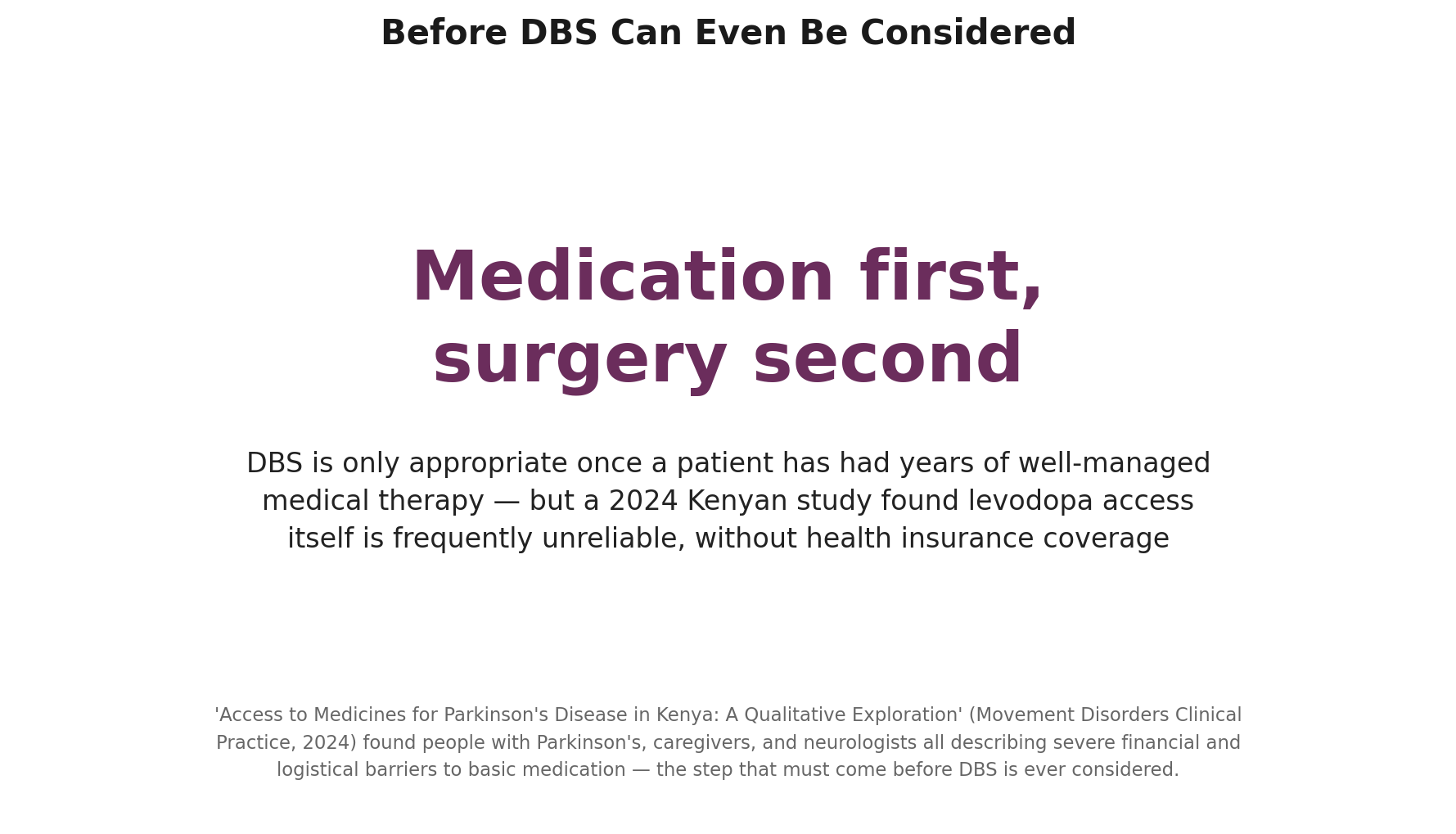
can no longer control. That precondition depends entirely on reliable access to medication in the first place.
A 2024 qualitative study specifically examining access to Parkinson's disease medicines in Kenya, involving people with Parkinson's, their caregivers, and neurologists, documented severe and recurring barriers: the financial burden of long-term treatment without health insurance coverage, and negative consequences for symptom control, social relationships, and quality of life. Patients who are never properly diagnosed, or who live in rural areas far from a neurologist, face even worse outcomes, sometimes going untreated entirely or receiving treatment only once the disease is already advanced.
This matters enormously for DBS candidacy specifically, because a patient whose medication access has been unreliable cannot be properly assessed for whether they have genuinely failed medical therapy, or simply never had consistent access to it. The practical takeaway is that the first, most urgent step for a Kenyan patient considering DBS is confirming the diagnosis with a genuine movement disorder specialist and establishing a period of properly optimised, consistently accessible medical therapy, before DBS candidacy can be honestly assessed at all.
Should you travel at all?
Kenya has neurologists capable of diagnosing and managing Parkinson's disease, and organisations like the Parkinson's Support Group of Kenya provide genuine community and patient support. For diagnosis, medication management, and the essential groundwork before DBS is even considered, engaging with Kenyan neurology services first is the right starting point.
For DBS surgery itself, India is where I steer patients, confidently, because there is currently no functional neurosurgery programme performing DBS at meaningful volume anywhere in Kenya or East Africa. Even across the wider African continent, DBS remains extremely limited, with some of the more developed programmes elsewhere on the continent reporting only a handful of procedures over several years. India's leading centres, by contrast, have neurosurgeons who have personally performed well over a thousand DBS procedures, alongside movement disorder neurologists experienced in both patient selection and the long-term programming that determines whether the device actually delivers lasting benefit.
Part one: judging the surgeon
1. Confirms diagnosis and medication optimisation before considering DBS
I weight this above every other factor, and the chart below reflects that. Ask the team to confirm, specifically, that your diagnosis has been reassessed and that your current medication regimen genuinely represents optimised therapy, not simply whatever has been available to you.
2. Personal annual volume in DBS specifically
Ask how many DBS procedures the neurosurgeon personally performs each year. This is a highly specialised procedure, and volume in DBS specifically, not general functional neurosurgery, is the strongest predictor of accurate electrode placement.
3. An honest explanation of realistic symptom improvement expected
Ask what DBS can realistically achieve for your specific symptoms and disease stage. DBS improves motor symptoms substantially for the right candidates but does not slow or reverse the underlying disease, and a surgeon should explain this distinction clearly.
4. Post-operative programming expertise, not just implantation
Ask who will programme your device after surgery, and how many programming sessions are typically needed to find the right settings. Programming expertise matters as much as the surgery itself for how well DBS ultimately works for you.
Part two: judging the hospital
For DBS, joint assessment between neurology and neurosurgery carries as much weight as the surgeon alone, reflected in the balance above, because patient selection is where much of DBS's success or failure is actually decided.
5. A movement disorder neurologist and neurosurgeon jointly assess candidacy
Ask whether your candidacy is assessed jointly by a movement disorder neurologist and a functional neurosurgeon, not decided by the surgeon alone based on a referral letter.
6. Awake surgery and microelectrode recording capability
Ask whether the centre performs DBS with the patient awake and using microelectrode recording, a technique that allows real-time verification of electrode placement and generally improves precision.
7. A remote programming plan feasible from Kenya
Ask how ongoing device programming will work once you are home, since settings often need adjustment in the months after surgery, and this should be planned before you travel, not figured out afterward.
8. Accreditation, read properly
JCI and NABH accreditation are meaningful filters on safety and infection control, but say nothing about DBS sub- specialisation specifically. Use accreditation to exclude weak candidates, not to choose between the strong ones.
9. The cost you will actually pay
Let me be emphatic about this, because 24 years of handling these cases has taught me nothing more consistently: disputes almost never concern the quoted price. They concern what the quote silently omitted. For DBS specifically, insist the estimate states whether the device is rechargeable or non-rechargeable, since this significantly affects both upfront cost and future battery replacement needs, and how many programming sessions are included before discharge.
Budget beyond the surgery. Direct Nairobi–Delhi and Nairobi–Mumbai flights run roughly 550 to 850 dollars return, and two to three weeks of accommodation for you and an attendant adds a genuine sum, covering surgery, initial recovery, and the first programming sessions.
Four signals that should make you pause
Certain patterns reliably precede a difficult outcome. A team that moves toward surgery without confirming your medication has genuinely been optimised. No clear personal volume figure in DBS specifically. A vague answer about who handles post-operative programming. And no plan for how programming will continue once you're back in Kenya.
None alone proves a bad team. Together they warrant a second opinion before you commit to surgery.
The Kenya-specific practicalities
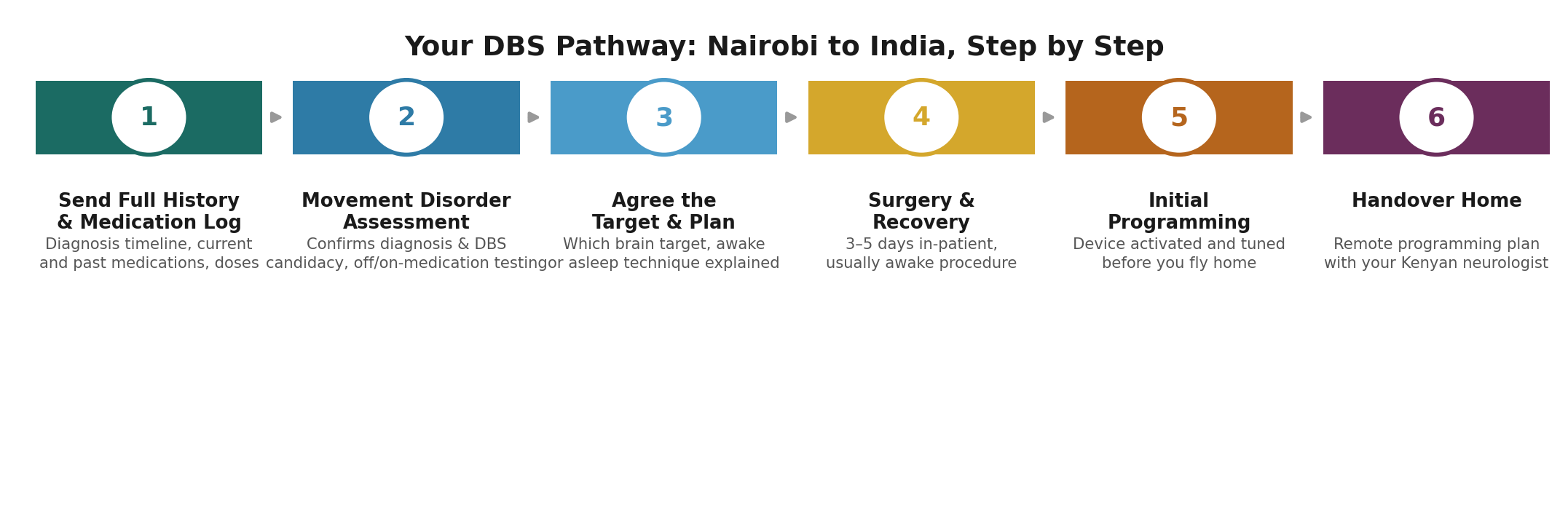
Send your full diagnosis history and a detailed medication log, doses, timing, and response over time, not just a current prescription list, so the team can properly assess whether medical therapy has genuinely been exhausted.
Direct Nairobi–Delhi and Nairobi–Mumbai flights make this roughly a six-hour journey. The Indian medical e-visa is issued within three to five working days against a hospital letter, and an attendant can travel with you on a medical attendant visa.
Before you leave India, confirm in writing exactly how remote programming will work, and identify a neurologist in Kenya who can coordinate with the Indian team if adjustments are needed.
The questions I would ask before paying a deposit
Of the surgeon:
- Has my diagnosis been reassessed, and has my medication genuinely been optimised?
- How many DBS procedures do you personally perform each year?
- What can DBS realistically achieve for my specific symptoms?
- Who handles post-operative programming, and how many sessions are typical?
Of the hospital:
- Is my candidacy assessed jointly by a movement disorder neurologist and neurosurgeon?
- Do you perform awake surgery with microelectrode recording?
- How will programming work once I'm back in Kenya?
- What exactly is excluded from the quoted price?
- May I speak to a previous East African patient treated with DBS?
A team that answers all nine without irritation is very likely the right team. One that turns vague at the first or second has told you what you needed to know at no cost at all.
Straight Answers for Kenyan Patients about DBS Surgeons and Hospitals in India
Is DBS surgery available in Kenya?
No, not at meaningful volume. There is currently no functional neurosurgery programme performing DBS regularly anywhere in Kenya, and DBS remains extremely limited across East Africa more broadly.
How much does DBS cost in India for a Kenyan patient?
Typically 15,000 to 32,000 US dollars, depending on whether a rechargeable or non-rechargeable device is used. The same procedure runs roughly 32,000 to 77,000 dollars in the UK and 80,000 to 150,000 in the US.
Why can't I just ask for DBS if my medication isn't working well?
Because DBS is only appropriate once medical therapy has genuinely been optimised and exhausted, and in Kenya, unreliable medication access itself can make it hard to tell whether therapy has truly failed or simply never been consistent. Confirming this with a movement disorder specialist is the essential first step.
What does DBS actually do?
It implants electrodes in specific brain regions connected to a pulse generator that delivers electrical impulses, reducing tremor, rigidity, and motor fluctuations for well-selected patients. It does not cure Parkinson's disease or slow its underlying progression.
How long does the DBS device last, and what happens afterward?
Non-rechargeable batteries typically last three to five years before requiring replacement; rechargeable systems can last considerably longer with regular recharging. Either way, programming adjustments continue for years, which is why a feasible plan for follow-up from Kenya matters as much as the surgery itself.
Can DBS be used for conditions other than Parkinson's disease?
Yes. It's also used for essential tremor, dystonia, and, in select cases, severe treatment-resistant obsessive- compulsive disorder. The target in the brain and the assessment process differ by condition, so ask specifically about experience with your diagnosis.
A closing word
For a Kenyan patient whose Parkinson's disease or movement disorder has genuinely outgrown medical therapy, India offers something that doesn't currently exist domestically or regionally at meaningful scale: real DBS volume, paired with the movement disorder expertise needed to select the right candidates and programme the device well afterward. The best team is the one that insists on confirming your medication has truly been optimised before ever discussing surgery. If you would like me to look at your diagnosis history and medication log and talk through honestly whether DBS is the right next step, send them across.
Sources
- 🌐 Access to Medicines for Parkinson's Disease in Kenya: A Qualitative Exploration. Movement Disorders Clinical Practice, 2024
- 🌐 Parkinson's Disease in Africa: A South African Perspective. World Neurology Online
- 🌐 Deep brain stimulation for movement disorders treatment in Africa: The current status, outcomes, and challenges. ScienceDirect, 2024
- 🌐 Parkinsons Support Group of Kenya (PSGK) — patient resources and community support
- 🌐 National Medical Commission of India — surgeon and specialist registration verification
- 🌐 National Accreditation Board for Hospitals & Healthcare Providers (NABH) — accredited hospital directory
Frequently Asked Questions by Kenyans about DBS Surgeons and Hospitals in India
Is DBS available in Kenya?
The guide states that there is currently no functional neurosurgery programme performing DBS regularly at meaningful volume in Kenya, with DBS remaining extremely limited across East Africa.
Why must medication be optimised before DBS?
DBS is intended for patients whose symptoms remain inadequately controlled despite properly managed medical therapy. Inconsistent medication access can make it difficult to determine whether treatment has genuinely failed.
Who should assess DBS candidacy?
The guide recommends assessment by both a movement disorder neurologist and a functional neurosurgeon, rather than having the decision made by a surgeon alone.
How should Kenyan patients choose a DBS surgeon in India?
Ask how many DBS procedures the surgeon personally performs each year. Procedure-specific DBS experience is more relevant than general functional neurosurgery volume.
What can DBS realistically improve?
DBS can substantially improve motor symptoms such as tremor, rigidity and motor fluctuations in appropriately selected patients. It does not cure Parkinson’s disease or stop its underlying progression.
Why is programming important after DBS?
Programming determines the electrical settings delivered by the implanted device. Several adjustments may be needed after surgery, making long-term programming expertise an important part of choosing a centre.
Can DBS programming be managed after returning to Kenya?
The guide recommends arranging a remote programming plan before travelling home and identifying a Kenyan neurologist who can coordinate with the Indian team when adjustments are required.
How much does DBS cost in India?
The guide gives an indicative cost of US$15,000–32,000, depending particularly on the type of implanted device and treatment requirements.
What is the difference between rechargeable and non-rechargeable DBS devices?
Non-rechargeable batteries typically last around three to five years, while rechargeable systems can last considerably longer with regular charging. The device type should be clearly specified in the quotation.
What records should Kenyan patients send before travelling?
Send the complete diagnosis history and detailed medication log, including doses, timing and response over time, rather than only the current prescription list.
Page Summary
This seven-page Kenya patient guide explains how patients can evaluate DBS surgeons and hospitals in India, with emphasis on medication optimisation, accurate movement-disorder diagnosis, DBS-specific surgical experience, joint neurological and neurosurgical assessment, electrode placement, programming and long-term follow-up. The page 3 weighting chart assigns 54% to surgeon factors and 46% to hospital factors, while the page 4 cost chart compares DBS costs across India, Kenya, the UK and US. The page 5 pathway illustrates the journey from medication history and movement-disorder assessment through target planning, DBS surgery, initial programming and handover to a Kenyan neurologist.
Citation Block
| Topic | Information |
|---|---|
| Topic | Parkinson’s Treatment & DBS Surgery in India for Kenyan Patients |
| Treatment | Deep Brain Stimulation (DBS) |
| Patients | Kenyan Parkinson’s & Movement Disorder Patients |
| Specialist | Movement Disorder Neurologist / Functional Neurosurgeon |
| Main Assessment | Diagnosis, disease stage and medication response |
| Key Priority | Confirm medication has been optimised |
| Conditions | Parkinson’s disease, essential tremor and dystonia |
| Surgeon Check | Personal annual DBS volume |
| Candidacy | Joint neurologist-neurosurgeon assessment |
| Technology | Awake surgery and microelectrode recording |
| Programming | Post-operative and remote programming |
| India Cost | Approximately US$15,000–32,000 |
| UK Cost | Approximately US$32,000–77,000 |
| US Cost | Approximately US$80,000–150,000 |
| Quote Check | Rechargeable/non-rechargeable device and programming sessions |
| Pre-Travel Records | Diagnosis history and detailed medication log |
| Follow-Up | Remote programming with Kenyan neurologist |
| Quality Check | JCI/NABH accreditation |
| Warning Signs | Surgery before medication optimisation or unclear programming |
| Selection Weighting | 54% surgeon factors and 46% hospital factors |
| Top Criterion | Diagnosis and medication optimisation – 18% |
| DBS Availability | No meaningful-volume DBS programme currently described in Kenya/East Africa |
| Patient Pathway | History/medication → movement assessment → target plan → DBS → initial programming → Kenya follow-up |
| Decision Principle | Establish genuine DBS candidacy before proceeding to surgery |

Our Mission Statement
Our mission is to place patients at the centre of every healthcare decision by providing trustworthy, evidence-based, and unbiased medical information. We believe that informed patients make better decisions. Backed by personalised guidance from our experienced advisory team, we help patients understand their treatment options, compare them objectively, and confidently choose the path that best suits their medical needs and personal circumstances.
Patient Testimonials from Kenya
Ready to Take the First Step?
Share your Medical Reports with our Healthcare Managers Today and Get a FREE CONSULTATION, a Personalized Treatment Plan, and Complete Support from Arrival to Recovery.
Get Your Free ConsultationAreas We Serve
This resource has been thoughtfully prepared for patients from Kenya who are considering medical treatment in India. We also welcome patients from the wider region in the countries mentioned below-
We assist patients from:
- Ethiopia
- Somalia
- Tanzania
- Uganda
- Seychelles
- Guinea
- Guinea-Bissau
- Liberia
- Mali
- Mauritania
- Niger
- Nigeria
- Senegal
- Togo
- South Sudan
- Sierra Leone
Many of the insights, treatment pathways, hospital recommendations, travel guidance, and patient support services described here are equally relevant and may be used as a reference when planning treatment in India.
From Kenya to India: Your Complete Patient Support Guide
- Brain Tumour Surgery in India for Kenyan Patients
- Cancer Treatment and Surgery in India for Kenyan Patients
- Cardiac Treatment and Surgery in India for Kenyan Patients
- Heart Valve Replacement Surgery in India for Kenyan Patients
- Knee Replacement in India for Kenyan Patients
- Prostate Cancer Treatment and Surgery in India for Kenyan Patients
- Spine Treatment and Surgery in India for Kenyan Patients
- Selecting the Best Bariatric Surgeons and Hospitals in India: What Kenyan Patients Should Actually Look For
- Selecting the Best Cancer Surgeons and Hospitals in India: What Kenyan Patients Should Actually Look For
- Selecting the Best Cardiac Surgeons and Hospitals in India: What Kenyan Patients Should Actually Look For
- Selecting the Best Dental Surgeons and Clinics in India: What Kenyan Patients Should Actually Look For
- Selecting the Best Hip Surgeons and Hospitals in India: What Kenyan Patients Should Actually Look For
- Selecting the Best Kidney Transplant Surgeons and Hospitals in India: What Kenyan Patients Should Actually Look For
- Selecting the Best Knee Surgeons and Hospitals in India: What Kenyan Patients Should Actually Look For
- Selecting the Best Liver Transplant Surgeons and Hospitals in India: What Kenyan Patients Should Actually Look For
- Selecting the Best Neurosurgeons and Hospitals in India: What Kenyan Patients Should Actually Look For
- Selecting the Best Prostate Cancer Surgeons and Hospitals in India: What Kenyan Patients Should Actually Look For
- Selecting the Best Spine Surgeons and Hospitals in India: What Kenyan Patients Should Actually Look For