

Selecting the Best Cardiac Pacemaker Surgeons and Hospitals in India: What Kenyan Patients Should Actually Look For
A pacemaker goes in within an hour and is checked for the next fifteen years — settle who does that follow-up before you settle where it is implanted.
A pacemaker is one of the few cardiac devices that genuinely changes a patient's life within days of implantation, fainting spells stop, exhaustion lifts, a dangerously slow heartbeat becomes a normal one. Across 24 years of guiding international patients through Indian hospitals, I have watched families treat the implant itself as the whole story. It isn't. A pacemaker is a device you will carry, and need checked, for the next five to fifteen years, and the plan for that entire stretch matters as much as the surgery that puts it in. This is the framework I use when a Kenyan patient is weighing pacemaker or ICD implantation in India. It follows the surgeon-then-hospital structure of this series, and opens with the one fact that should shape where you have this done: getting the device implanted well is only half the job.
Healing Journeys of Kenyan Patients


Key Takeaways
- The guide emphasises that pacemaker implantation is not a one-time treatment decision. The device may need monitoring for five to fifteen years, including checks of settings, battery status and leads, making long-term follow-up an important part of choosing where treatment is performed.
- Kenya has limited specialist cardiology access, with the guide estimating roughly 40 cardiologists serving around 30 million adults and about 70% of the population living in rural areas. This makes a realistic follow-up and remote-monitoring arrangement particularly important for patients returning home.
- For straightforward single- or dual-chamber pacemaker cases, treatment in Kenya may be reasonable when reliable local follow-up is available. India is presented as a stronger option for complex devices, CRT, ICD implantation, electrophysiology expertise or patients with limited access to specialist follow-up.
- When choosing a surgeon, patients should check their personal annual pacemaker and ICD implantation volume, electrophysiology specialisation, device recommendation and expected device longevity. The surgeon should clearly explain why a particular device type matches the patient's rhythm disorder.
- Hospital selection should focus heavily on remote-monitoring capability and long-term follow-up infrastructure. The page 3 chart gives equal overall weighting of 50% to surgeon factors and 50% to hospital factors, with remote monitoring and implantation volume among the highest individual criteria.
- The cost chart on page 4 gives an indicative range of US$3,500–15,000 in India, compared with US$6,000–15,000 in Kenya, US$16,000–38,000 in the UK and US$20,000–90,000 in the US. Patients should confirm the device brand and model, remote-monitoring equipment and future battery-replacement costs before paying a deposit.
- Before travelling, Kenyan patients should provide their ECG, Holter recordings and previous cardiology records, confirm the device type and remote-monitoring arrangement, and identify the Kenyan cardiologist who will manage follow-up. The guide's pathway runs from records review through device confirmation, remote-monitoring setup, implantation, initial checks and handover to the Kenyan cardiologist.
Quick Facts
- Author
- Dr. Dheeraj Bojwani
- Experience
- 24+ Years of Experience
- Treatment
- Cardiac Pacemaker / ICD Implantation
- Patients
- Kenyan Cardiac Patients
- Key Specialist
- Electrophysiologist / Cardiac Device Specialist
- Main Assessment
- Rhythm disorder and appropriate device type
- Device Options
- Single-chamber, dual-chamber, CRT or ICD
- Kenya Cardiologists
- Approximately 40 nationwide
- Key Selection Factor
- Personal annual device implantation volume
- Specialist Check
- Electrophysiology sub-specialisation
- Follow-Up Priority
- Remote monitoring compatible with Kenya
- Device Life
- Approximately 5–15 years
- India Treatment Cost
- Approximately US$3,500–15,000
- Kenya Treatment Cost
- Approximately US$6,000–15,000
- UK Treatment Cost
- Approximately US$16,000–38,000
- US Treatment Cost
- Approximately US$20,000–90,000
- Quote Check
- Device brand, model, monitoring equipment and replacement costs
- Hospital Requirement
- Written long-term follow-up plan
- Safety Requirement
- 24/7 cover or escalation plan for device complications
- Accreditation
- JCI/NABH as safety and infection-control filters
- Pre-Travel Records
- ECG, Holter recordings and cardiology notes
- Travel Route
- Nairobi–Delhi or Nairobi–Mumbai
- Hospital Stay
- Approximately 1–3 days for straightforward implantation
- Follow-Up
- Kenyan cardiologist with remote monitoring where available
- Funding
- Routine pacemaker/ICD implantation is not included in the cited SHA overseas-treatment list
In Brief
For Kenyan patients considering pacemaker or ICD implantation in India, the key decision is not simply where the device will be implanted but how it will be monitored for years afterwards. The guide prioritises implantation experience, electrophysiology expertise, appropriate device selection, remote monitoring and a written long-term follow-up plan. It gives an indicative cost of US$3,500–15,000 in India, with costs varying according to device type, and recommends confirming the device model, monitoring arrangements and future replacement costs before treatment.
Before the surgeon: a device is not a cure, it's a commitment
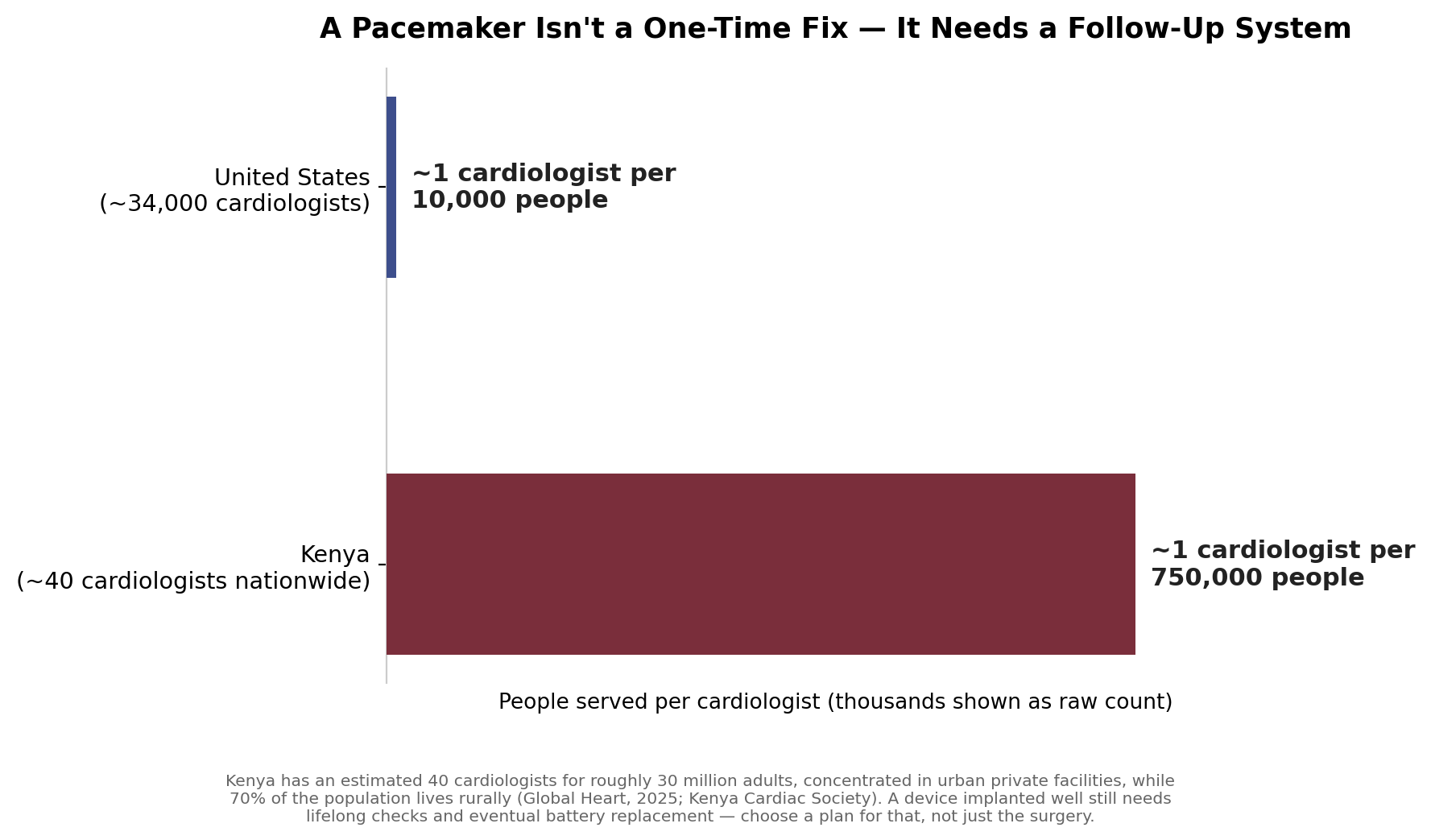
Kenya has an estimated 40 cardiologists serving a population of roughly 30 million adults, and the great majority practise in private facilities concentrated in Nairobi and a handful of other cities. Roughly 70% of Kenyans live in rural areas, where specialist cardiology access is genuinely thin. For most conditions in this series, that gap matters at the point of diagnosis and surgery. For a pacemaker, it matters every year for the rest of the device's working life, since a working pacemaker still needs periodic checks of its settings, battery status, and lead function, and a failing device that goes unchecked can become life-threatening in a patient who depends on it to keep their heart beating properly.
The practical takeaway is to treat the follow-up plan as part of the decision, not an afterthought. Ask, before you commit to a hospital or surgeon, exactly how your device will be monitored once you are back in Kenya, and whether that plan is realistic given where you actually live.
Should you travel at all?
Kenya's private cardiac centres, including Aga Khan University Hospital Nairobi and a small but growing number of others, implant standard single and dual-chamber pacemakers competently, and for a straightforward case near Nairobi with a cardiologist you trust for follow-up, treatment in Kenya is a reasonable option.
For more complex devices, cardiac resynchronisation therapy, implantable defibrillators, or any case needing an electrophysiologist's specific expertise, and for patients whose home follow-up access is genuinely limited, India is where I steer patients, confidently. India's leading cardiac centres implant this volume of devices routinely, offer a wider range of remote-monitoring-capable devices specifically suited to patients who cannot easily reach a specialist in person, and their electrophysiology programmes are simply deeper than what most Kenyan facilities currently offer.
On funding: Kenya's Social Health Authority funds overseas treatment only for 36 gazetted procedures unavailable domestically, capped at 500,000 shillings per patient per year, and routine pacemaker or ICD implantation is not on that list. Budget to self-fund the device and procedure, and weigh that cost against the genuine advantage of getting a remote-monitoring-capable device and a realistic long-term follow-up plan from the outset.
Part one: judging the surgeon
1. Personal annual volume in device implantation specifically
I weight this above every other factor, and the chart below reflects that. Ask how many pacemakers or ICDs the surgeon implants each year, specifically, not general cardiology procedures. Device implantation is a distinct technical skill.
2. An honest device-type recommendation matched to your rhythm disorder
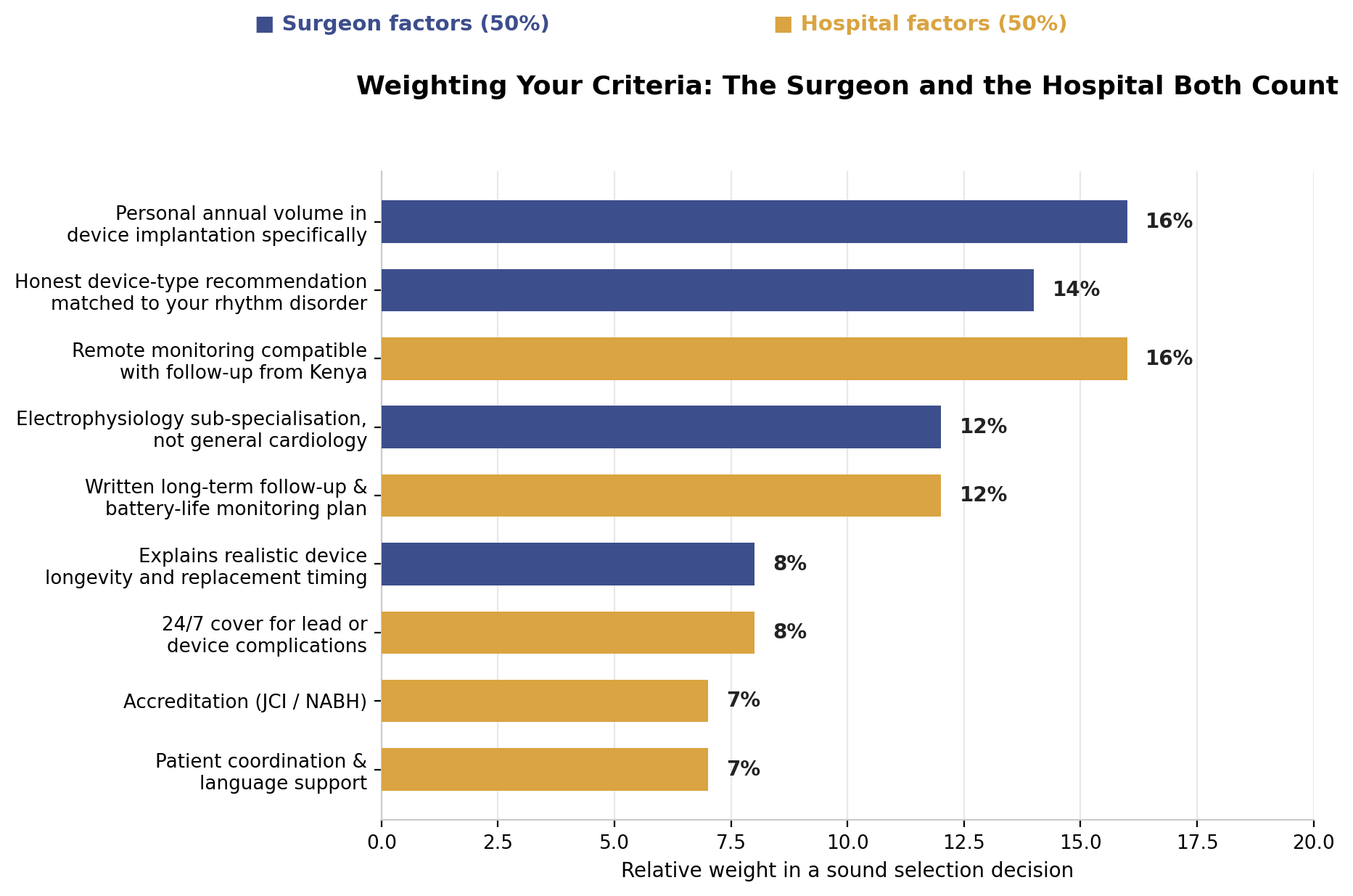
Ask why this specific device, single-chamber, dual-chamber, CRT, or ICD, is right for your diagnosis, and what would change that recommendation. A generic answer suggests a default choice rather than one built around your heart's actual rhythm problem.
3. Electrophysiology sub-specialisation
Ask whether the surgeon is a specialist electrophysiologist or a general cardiologist who also implants devices. For anything beyond a straightforward single-chamber pacemaker, this distinction matters.
4. Realistic device longevity and replacement timing
Ask how long your specific device is expected to last, and what happens when the battery needs replacing. This is not a one-time procedure; planning for the next decade starts with this conversation.
Part two: judging the hospital
For pacemaker implantation, the hospital's follow-up infrastructure carries as much weight as the surgeon, reflected in the balance above, because the device's success is measured over years, not the day of surgery.
5. Remote monitoring compatible with follow-up from Kenya
Ask specifically whether the device and hospital's systems support remote monitoring that can be accessed or coordinated with a cardiologist in Kenya, so battery and lead issues can be caught without a return trip to India for every check.
6. A written long-term follow-up and battery-life monitoring plan
Ask for a written schedule of checks, not a vague assurance. A hospital that hands you a specific plan, six weeks, three months, then annually, with clear ownership of who does each check, is treating your device's lifespan seriously.
7. Genuine 24/7 cover for device or lead complications
Ask what happens if you experience symptoms after you have returned to Kenya. A hospital with a clear escalation plan, not just a phone number that may or may not be answered, is the standard to look for.
8. Accreditation, read properly
JCI and NABH accreditation are meaningful filters on safety and infection control, but say nothing about electrophysiology sub-specialisation specifically. Use accreditation to exclude weak candidates, not to choose between the strong ones.
9. The cost you will actually pay
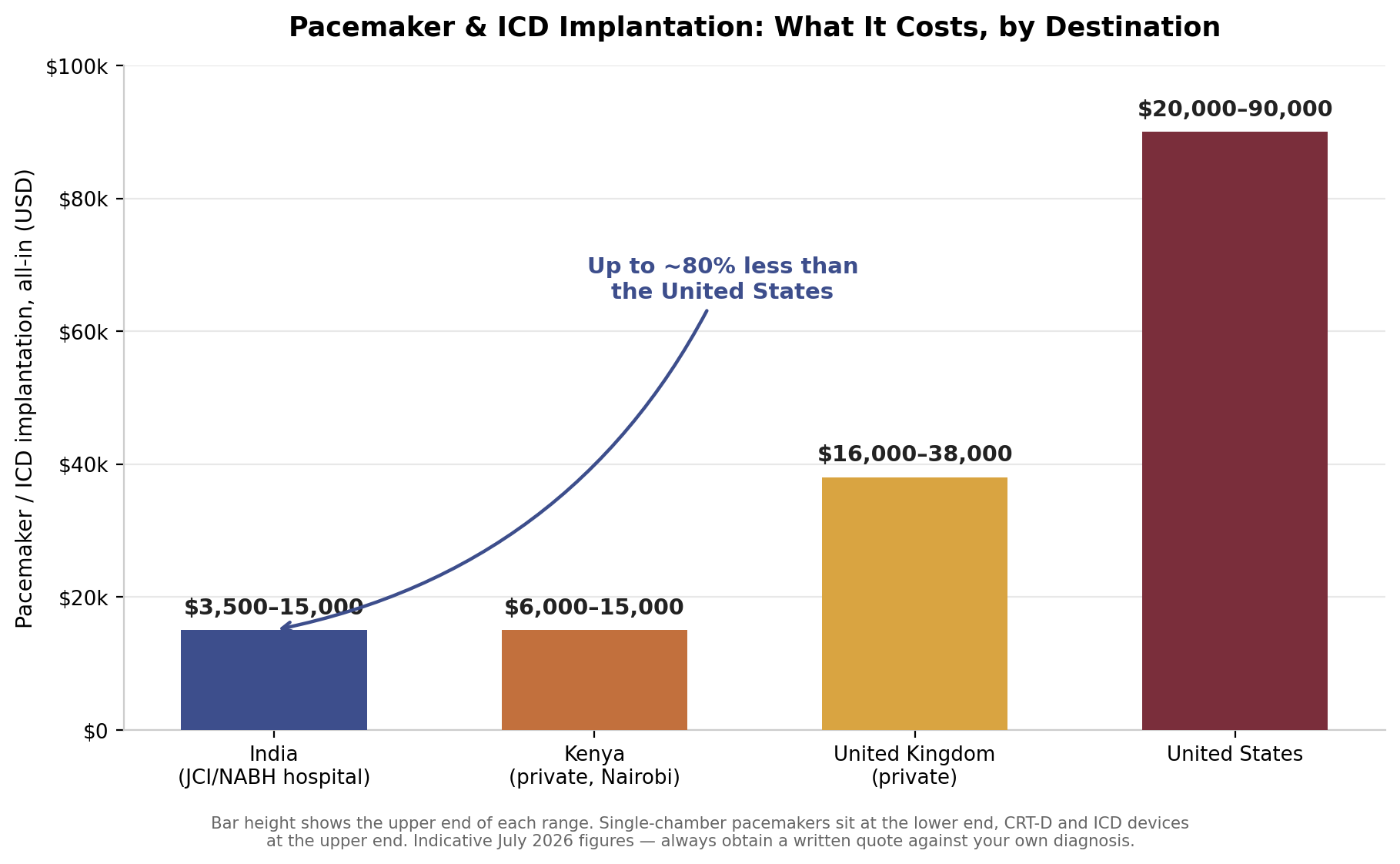
Let me be emphatic about this, because 24 years of handling these cases has taught me nothing more consistently: disputes almost never concern the quoted price. They concern what the quote silently omitted. For device implantation specifically, insist the estimate states the device brand and model, whether remote monitoring equipment is included, and what a future battery replacement is likely to cost.
Budget beyond the surgery. Direct Nairobi–Delhi and Nairobi–Mumbai flights run roughly 550 to 850 dollars return, and a short hospital stay of one to three days keeps accommodation costs modest compared to more complex procedures in this series.
Four signals that should make you pause
Certain patterns reliably precede a difficult outcome. A surgeon who cannot state his personal volume in device implantation specifically. No clear answer on remote monitoring compatibility with Kenya. A quote that doesn't specify the device brand and model. And a hospital unable to describe what happens if you have a problem after you fly home.
None alone proves a bad hospital. Together they warrant a second opinion before you commit to device implantation.
The Kenya-specific practicalities
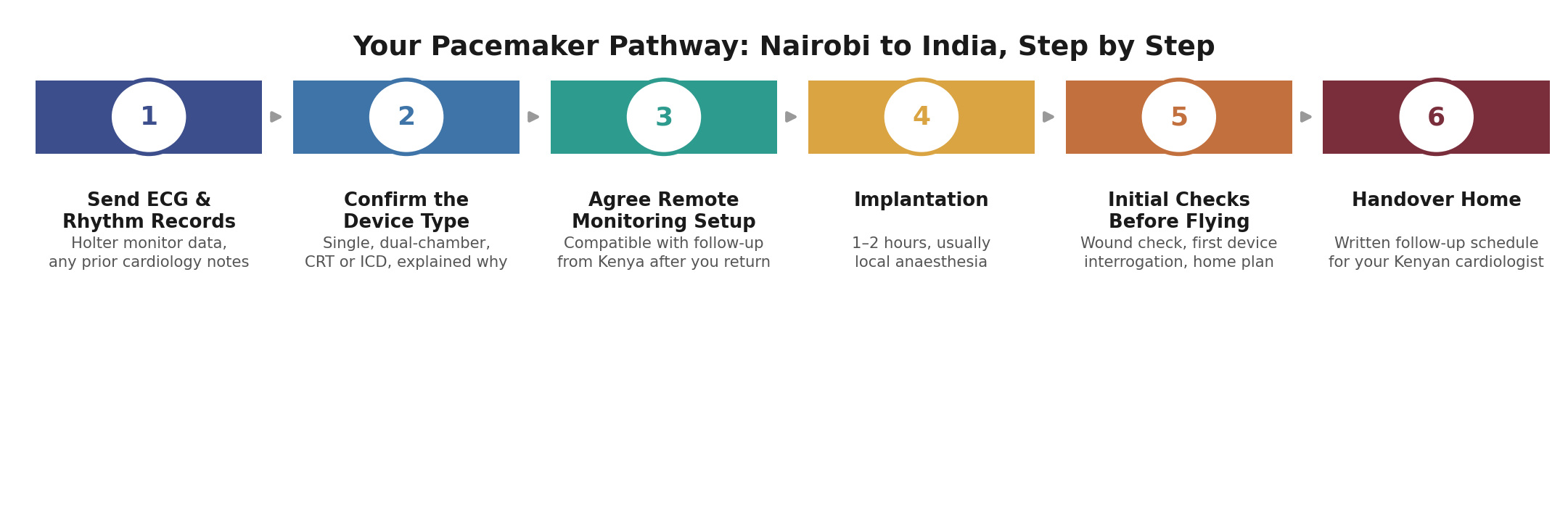
Send your ECG, any Holter monitor recordings, and prior cardiology notes, not just a summary letter, so the electrophysiology team can confirm the right device before you arrive.
Direct Nairobi–Delhi and Nairobi–Mumbai flights make this roughly a six-hour journey. The Indian medical e-visa is issued within three to five working days against a hospital letter, and up to two attendants can travel on a medical attendant visa.
Before you leave India, confirm in writing exactly how remote monitoring data will reach a cardiologist in Kenya, and identify that cardiologist by name before you travel, not after a problem arises.
The questions I would ask before paying a deposit
Of the surgeon:
- How many pacemakers or ICDs do you personally implant each year?
- Why this specific device for my rhythm disorder, and what would change that?
- Are you a specialist electrophysiologist?
- How long is my device expected to last, and what does replacement involve?
Of the hospital:
- Is remote monitoring compatible with follow-up from a cardiologist in Kenya?
- What is the written schedule for long-term device checks?
- What happens if I have a problem after I return home?
- What exactly is excluded from the quoted price?
- May I speak to a previous East African patient with a similar device?
A team that answers all nine without irritation is very likely the right team. One that turns vague at the first or fifth has told you what you needed to know at no cost at all.
Straight Answers for Kenyan Patients about Cardiac Pacemaker Surgeons and Hospitals in India
How do I choose the best surgeon in India for pacemaker implantation as a Kenyan patient?
Ask his annual volume in device implantation specifically, whether he is a specialist electrophysiologist, and why he recommends a specific device type for your rhythm disorder rather than a default choice.
How much does pacemaker implantation cost in India for a Kenyan patient?
Typically 3,500 to 15,000 US dollars all in, depending on device type. The same procedure runs roughly 6,000 to 15,000 dollars in Kenya, 16,000 to 38,000 in the UK, and 20,000 to 90,000 in the US.
Why does follow-up matter so much for a pacemaker specifically?
Because a pacemaker keeps working, or fails, over years, not just on the day it's implanted. Kenya has roughly one cardiologist per 750,000 people, and most practise in cities, so a realistic remote-monitoring and follow-up plan matters as much as the surgery itself.
Will SHA fund my pacemaker implantation in India?
Not for standard cases. SHA's overseas benefit covers only 36 gazetted procedures unavailable in Kenya, capped at 500,000 shillings a year, and routine pacemaker or ICD implantation isn't among them. Budget to self-fund it.
What is the difference between a pacemaker and an ICD?
A pacemaker corrects a heart that beats too slowly. An implantable cardioverter-defibrillator, or ICD, additionally detects and corrects dangerously fast or chaotic rhythms with an electrical shock. Some patients need a combined device. Your electrophysiologist should explain which applies to you and why.
How long does a pacemaker battery last, and what happens when it runs out?
Typically five to fifteen years, depending on device type and how much it is used. When the battery nears end of life, a shorter, simpler procedure replaces the generator, usually reusing the existing leads. Ask early who will perform this for you in Kenya or whether you would need to travel again.
A closing word
A pacemaker done well in India, backed by a genuine plan for the next decade of checks, gives a Kenyan patient real peace of mind, not just a working device. The best surgeon is the one whose implantation volume and honest device recommendation show he is solving your specific rhythm problem, not applying a default. The best hospital pairs him with remote monitoring built for a patient who lives far from routine specialist care, and a written plan that treats the years after surgery as seriously as the day itself. If you would like me to look at your ECG and records and talk through honestly what device and follow-up plan make sense for you, send them across.
Sources
- 🌐 Cardiovascular Disease Care Beyond the Cardiologist
- 🌐 An Inside Look at the Cardiology Workforce: Shortages, Demand, and Strategic Responses (US cardiologist workforce figures)
- 🌐 Comparison Between In-Office Versus Remote Follow-Up Costs in Patients with Pacemakers, PMC. ncbi.nlm.nih.gov/pmc/ar ticles/PMC12733147
- 🌐 National Medical Commission of India — surgeon and specialist registration verification
- 🌐 National Accreditation Board for Hospitals & Healthcare Providers (NABH) — accredited hospital directory
- 🌐 Kenya Social Health Authority (SHA) — benefits packages and overseas treatment guidance
Frequently Asked Questions by Kenyans about Cardiac Pacemaker Surgeons and Hospitals in India
How should Kenyan patients choose the best pacemaker surgeon in India?
Ask about the surgeon's personal annual pacemaker and ICD implantation volume, electrophysiology expertise and why a particular device is appropriate for your rhythm disorder.
Does every Kenyan patient needing a pacemaker need treatment in India?
No. Straightforward cases may be treated in Kenya when reliable cardiology follow-up is available. India may be more useful for complex devices, electrophysiology cases or limited local follow-up access.
Why is follow-up so important after pacemaker implantation?
A pacemaker requires periodic checks of its settings, battery and leads for years. The guide therefore treats long-term monitoring as equally important as the implantation itself.
What is the difference between a pacemaker and an ICD?
A pacemaker primarily treats abnormally slow heart rhythms. An ICD can also detect and treat dangerously fast or chaotic rhythms with an electrical shock.
How long does a pacemaker battery usually last?
The guide gives an approximate lifespan of 5–15 years, depending on the device and its use. Battery replacement generally involves replacing the generator while existing leads may be reused.
Can a pacemaker implanted in India be monitored from Kenya?
Potentially, if the selected device and hospital systems support remote monitoring. Patients should confirm exactly how monitoring data will reach their Kenyan cardiologist before travelling.
How much does pacemaker implantation cost in India for Kenyan patients?
The guide gives an indicative range of US$3,500–15,000, depending on the device type. Patients should confirm exactly what the quotation includes.
What should be included in the pacemaker quotation?
The quotation should clearly identify the device brand and model, whether remote-monitoring equipment is included and the likely future cost of battery replacement.
What records should Kenyan patients send before travelling?
Patients should provide their ECG, Holter monitor recordings and previous cardiology notes so the electrophysiology team can assess the rhythm problem and appropriate device before arrival.
Does Kenya's SHA normally fund pacemaker treatment in India?
The guide states that routine pacemaker or ICD implantation is not included in the cited overseas-treatment list and advises patients to plan for self-funding.
Page Summary
This guide explains how Kenyan patients can select suitable pacemaker surgeons and hospitals in India, focusing on device-specific implantation experience, electrophysiology expertise, appropriate device selection, remote monitoring and long-term follow-up. It compares surgeon and hospital criteria, provides indicative pacemaker and ICD costs across India, Kenya, the UK and US, and outlines the treatment pathway from sharing ECG and rhythm records through implantation, initial checks and continued monitoring by a Kenyan cardiologist.
Citation Block
| Topic | Information |
|---|---|
| Topic | Cardiac Pacemaker and ICD Treatment in India for Kenyan Patients |
| Patients | Kenyan Cardiac Patients |
| Specialist | Electrophysiologist / Cardiac Device Specialist |
| Treatment | Pacemaker or ICD Implantation |
| Device Options | Single-chamber, dual-chamber, CRT or ICD |
| Primary Assessment | Rhythm disorder and appropriate device selection |
| Surgeon Check | Personal annual pacemaker/ICD implantation volume |
| Specialisation | Electrophysiology sub-specialisation |
| Device Recommendation | Should be specifically matched to the rhythm disorder |
| Device Longevity | Approximately 5–15 years |
| Hospital Priority | Remote monitoring compatible with follow-up from Kenya |
| Follow-Up | Written long-term monitoring and battery-life plan |
| Complication Support | Genuine 24/7 cover or clear escalation plan |
| Accreditation | JCI/NABH |
| India Cost | Approximately US$3,500–15,000 |
| Kenya Cost | Approximately US$6,000–15,000 |
| UK Cost | Approximately US$16,000–38,000 |
| US Cost | Approximately US$20,000–90,000 |
| Quote Check | Device brand, model, monitoring equipment and replacement costs |
| Pre-Travel Records | ECG, Holter recordings and cardiology notes |
| Travel Route | Nairobi–Delhi or Nairobi–Mumbai |
| Hospital Stay | Approximately 1–3 days |
| Follow-Up Location | Kenya with a designated cardiologist |
| Remote Monitoring | Should be arranged before leaving India |
| Warning Signs | Unclear implantation volume, no remote-monitoring plan or vague pricing |
| Decision Principle | Plan for long-term device care, not only implantation |
| Patient Pathway | ECG/records → device confirmation → remote monitoring → implantation → initial checks → Kenyan follow-up |
| Kenyan Cardiology Access | Approximately 40 cardiologists cited for around 30 million adults |
| Key Chart Finding | Surgeon and hospital factors each receive 50% overall weighting |
| Funding | Routine pacemaker/ICD implantation is not included in the cited SHA overseas-treatment list |


Our Mission Statement
Our mission is to place patients at the centre of every healthcare decision by providing trustworthy, evidence-based, and unbiased medical information. We believe that informed patients make better decisions. Backed by personalised guidance from our experienced advisory team, we help patients understand their treatment options, compare them objectively, and confidently choose the path that best suits their medical needs and personal circumstances.
Patient Testimonials from Kenya
Ready to Take the First Step?
Share your Medical Reports with our Healthcare Managers Today and Get a FREE CONSULTATION, a Personalized Treatment Plan, and Complete Support from Arrival to Recovery.
Get Your Free ConsultationAreas We Serve
This resource has been thoughtfully prepared for patients from Kenya who are considering medical treatment in India. We also welcome patients from the wider region in the countries mentioned below-
We assist patients from:
- Ethiopia
- Somalia
- Tanzania
- Uganda
- Seychelles
- Guinea
- Guinea-Bissau
- Liberia
- Mali
- Mauritania
- Niger
- Nigeria
- Senegal
- Togo
- South Sudan
- Sierra Leone
Many of the insights, treatment pathways, hospital recommendations, travel guidance, and patient support services described here are equally relevant and may be used as a reference when planning treatment in India.
From Kenya to India: Your Complete Patient Support Guide
- Brain Tumour Surgery in India for Kenyan Patients
- Cancer Treatment and Surgery in India for Kenyan Patients
- Cardiac Treatment and Surgery in India for Kenyan Patients
- Heart Valve Replacement Surgery in India for Kenyan Patients
- Knee Replacement in India for Kenyan Patients
- Prostate Cancer Treatment and Surgery in India for Kenyan Patients
- Spine Treatment and Surgery in India for Kenyan Patients
- Selecting the Best Bariatric Surgeons and Hospitals in India: What Kenyan Patients Should Actually Look For
- Selecting the Best Cancer Surgeons and Hospitals in India: What Kenyan Patients Should Actually Look For
- Selecting the Best Cardiac Surgeons and Hospitals in India: What Kenyan Patients Should Actually Look For
- Selecting the Best Dental Surgeons and Clinics in India: What Kenyan Patients Should Actually Look For
- Selecting the Best Hip Surgeons and Hospitals in India: What Kenyan Patients Should Actually Look For
- Selecting the Best Kidney Transplant Surgeons and Hospitals in India: What Kenyan Patients Should Actually Look For
- Selecting the Best Knee Surgeons and Hospitals in India: What Kenyan Patients Should Actually Look For
- Selecting the Best Liver Transplant Surgeons and Hospitals in India: What Kenyan Patients Should Actually Look For
- Selecting the Best Neurosurgeons and Hospitals in India: What Kenyan Patients Should Actually Look For
- Selecting the Best Prostate Cancer Surgeons and Hospitals in India: What Kenyan Patients Should Actually Look For
- Selecting the Best Spine Surgeons and Hospitals in India: What Kenyan Patients Should Actually Look For