Apollo Hospital
 Fortis Hospital
 Artemis Hospital
 Max Hospital
 Columbia Asia Hospital
 Medanta Hospital


 Jaslok Hospital
 Lilavati Hospital


 Global Hospitals

 :
: Radius and Ulna Fracture - Internal Fixation Surgery in India
Key Takeaways
- The operation uses open reduction and internal fixation with steel plates and screws, performed under general anaesthetic, and patients stay in hospital for one to two nights.
- Post‑operative care includes a sling, arm elevation, a drainage tube removed after 24–48 hours, stitch removal at 10–12 days, and a follow‑up orthopaedic visit with X‑rays about one month after discharge.
- Patients are advised not to drive for approximately six weeks; light‑duty work may resume after three to four weeks, while manual labour may require two to three months, and most sports can be resumed after six weeks.
- Potential complications include a very small risk of heart or lung problems from anaesthesia, wound infection (prevented with antibiotics), temporary nerve bruising causing hand weakness or numbness, and rare non‑union of the fracture that may need another operation.
- The metal plates and screws generally remain in place; removal is only considered for high‑contact sports and, if needed, is performed no earlier than 18 months after the initial surgery.
What is it?
Your forearm is made up of two long bones that sit side by side. The inside bone is called the ulna, and the outside bone is called the radius. You have broken both bones. A fracture means just the same as a break. The bone ends are out of line and may be overlapping. Without an operation, the bones would heal, but not in their correct position. You would not be able to turn your hand from palm up to palm down.
The Operation
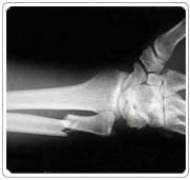 You will have a general anaesthetic, and will be asleep for the whole operation. The surgeon makes two cuts. One will be on the side of your forearm, in line with your little finger, where the ulna is just under the skin. The other will be on the underside of the arm (the palm side). He will move the bone ends into their correct position and then fix them with steel plates and screws. This is called 'open reduction and internal fixation'. There may be a fine plastic drainage tube running from the wound. This is to drain any residual blood form the operation. The skin wound is then closed up with stitches. You will be in hospital one or two nights after the operation.
Any Alternatives
If you leave things as they are, the bones will not heal in the correct position. A plaster cast will not hold the bone ends in the correct position properly. Fixing the steel plates onto the bones is better than using steel pins attached to a frame outside the arm (External Fixation).
To get free no obligation Quote For Radius and Ulna Fracture - Internal Fixation Surgery in India :
Click HerePhone Numbers Reach Us-
India & International : +91-9860755000 / +91-9371136499
UK : +44-2081332571
Canada & USA : +1-4155992537
Before the operation
You will have come to the hospital as an emergency. You need to let the doctors and nurses know about your general health, past illnesses, and drug treatment. You will have all the necessary tests to make sure that you are well prepared and that you can have the operation as safely as possible.
Arrangements will be made for you to have the operation within 24 hours or so of the injury.
After - In Hospital
You will have a dressing on your arm, and your arm will be in a sling. You will not need to be in a plaster cast. Your arm will be raised to reduce any swelling. It will either be on pillows or held up in a foam support. The wound may be painful. You will be given injections and later tablets to control this. Ask for more if the pain getts worse. A general anaesthetic will make you slow, clumsy and forgetful for about 24 hours. The nurses will help you with everything you need until you are able to do things for yourself. Do not make important decisions, drive a car, use machinery, or even boil a kettle during thist time. The wounds will have simple adhesive dressings over them. The nurses will pull out your wound drain after 24 to 48 hours. Your stitches will be taken out 10 to 12 days after the operation. You may remove your sling to wash. Wash around the dressings for the first 10 days. You can wash the wound area as soon as the dressing has been removed. Soap and warm tap water are entirely adequate. Salted water is not necessary. You can shower or take a bath as often as you like. Discomfort in the arm will stop you doing too much. Take things easily for the first month. Keep your finger, wrist, elbow and shoulder joints working. You will be given an appointment to visit the orthopaedic outpatient department for a check-up about one month after you leave hospital. There you will have an examination and more X-rays to check the bones are healing properly. The nurses will advise about sick notes, certificates etc.
After - At Home
You cannot drive while your arm hurts. You cannot drive until you can move your arm freely. Therefore you may not be able to drive for six weeks after your operation. How soon you can return to work depends on your job. If your work is light, you may be able to return to work three or four weeks after the operation. This also depends on you being able to get to work. If your job is manual, you will be unable to work for two or three months. You may swim and play most sports six weeks after your operation, as your break should have healed by this time. When you start playing, you will not be able to play for as long as normal. Your arm will ache at the end of a game. Your arm will continue to improve for at least six months. The plates and screws do not have to be removed. The plate on the underneath bone may be uncomfortable and can be removed. If you indulge in high level contact sports, it may be best to remove the plates. This is to avoid breaks where the plate is fixed to the bone. This is because these second breaks are more difficult to fix. If the metalwork is to be removed, this will not be for at least 18 months after your operation. The risk of serious injury to a nerve is much higher when taking out the metal plates than putting them in. This is because your nerves may be embedded in scar tissue from the first operation. This makes them more difficult to see and avoid.
Possible Complications
As with any operation under general anaesthetic there is a very small risk of complications related to your heart or you lungs. The tests that you will have before the operation will make sure that you can have the operation in the safest possible way and will bring the risk for such complications very close to zero.
Wound infection sometimes happens. You will be given antibiotics to prevent this. There are several important nerves which run in the region of your operation. One or more of these nerves can be bruised during your operation. This would make your hand temporarily weak and numb. It is very rare for a nerve to be permanently damaged. Very rarely, damage to the blood vessels in or aound the area of the operation and bleeding can occur and might require another operation to deal with the problem.
The operations is successful most of the time. On rare occasions a fracture may not heal. If this occurs you will need another operation.
To get free no obligation Quote For Radius and Ulna Fracture - Internal Fixation Surgery in India :
Click HerePhone Numbers Reach Us-
India & International : +91-9860755000 / +91-9371136499
UK : +44-2081332571
Canada & USA : +1-4155992537
Some of the common countries from which patients travel to India for surgery are:
| USA | UK | Canada |
| Australia | New Zealand | Nigeria |
| Kenya | Ethiopia | Uganda |
| Tanzania | Zambia | Congo |
| Sri Lanka | Bangladesh | Pakistan |
| Afghanistan | Nepal | Uzbekistan |
Below are the downloadable links that will help you to plan your medical trip to India in a more organized and better way. Attached word and pdf files gives information that will help you to know India more and make your trip to India easy and memorable one.
| Click icon to Download Document | ||||||
| About India |  |  | Destinations in India | | | |
| Indian Embassy List | | | Medical Tourism FAQ | | | |
| Visa For India | | | ||||
Frequently Asked Questions
Related Articles:
- Knee Arthroscopy Surgery in India
- Knee Replacement Surgery In India
- Hip Replacement Surgery in India
- Shoulder Arthroscopy Surgery in India
Our objective is to empower patients with accurate, evidence-based, and patient-centric information, enabling them to make informed healthcare decisions with confidence. We combine reliable medical knowledge with personalized guidance and compassionate support, helping every patient choose the treatment that best serves their health and long-term well-being.
Quick Facts
Internal fixation surgery stabilizes broken radius and ulna forearm bones using metal plates, screws, or rods.
General anesthesia is required with preoperative tests to minimize heart and lung risks.
Nerve injury may cause temporary hand weakness or numbness; permanent damage is very rare.
Nonunion occurs rarely and may require a second operation if the fracture fails to heal.
Last updated: May 2026